Opel Astra Electric vs. Renault Mégane E-Tech: Complete comparison 2026
Detailed comparison of the Opel Astra Electric and Renault Mégane E-Tech Electric. Find out the real range, compare equipment, and read our final verdict.
Apr 29, 2026
Articles
Review
Nissan Leaf (2026) review: real owner feedback, battery range, boot space, pricing, and our expert verdict on the all-new electric crossover.
October 30, 2026

The third generation of the Nissan Leaf marks a distinct shift in identity, transitioning from its predecessor's conventional hatchback proportions into a five-door crossover. Competing in the European compact electric crossover segment, it is aimed at daily commuters and small families seeking an all-electric vehicle for everyday driving and regional travel.
This review covers the third-generation electric Nissan Leaf, which made its world premiere on 17 June 2025. Series production began on 16 December 2025, with initial European customer deliveries starting in February 2026 and wider European showroom deliveries underway from March 2026. The model line launched with the Extended Range version, while customer orders for the Standard Range variant opened on 1 July 2026.
As an all-new generation introduced for the 2026 model year, it has not received a mid-cycle facelift. It is offered exclusively as a five-door crossover with front-wheel drive, available in two battery configurations.
The third-generation Nissan Leaf entered series production in December 2025, with first European customer deliveries beginning in February 2026. Because the model has been in customer hands across Europe for only about eight months as of October 2026, multi-year reliability, winter heat-pump performance, and high-mileage battery durability are not yet established. Nissan Europe specifies a 30,000 km routine inspection interval, a 3-year / 100,000 km base vehicle warranty, a 5-year / 100,000 km EV-dedicated component warranty, and an 8-year / 160,000 km traction battery capacity warranty (with up to 6 years / 100,000 miles service-activated warranty available in the UK).
Official European safety registers, including EU Safety Gate and national monitoring authorities, record zero verified safety recalls or statutory technical campaigns for this generation as of October 2026.
No repeated, model-specific mechanical, electrical, or software defects have met the threshold of verified patterns among European owners. The transition to a dedicated electric vehicle platform with active liquid battery cooling and standard Combined Charging System (CCS) hardware ensures consistent charging performance on long journeys.
Given that vehicles appearing on the used market are near-new, buyers should focus on diagnostic health and ensuring optional equipment operates as intended. Arranging a detailed pre-purchase inspection through CarAudit provides independent verification of vehicle history, control modules, and charging hardware.
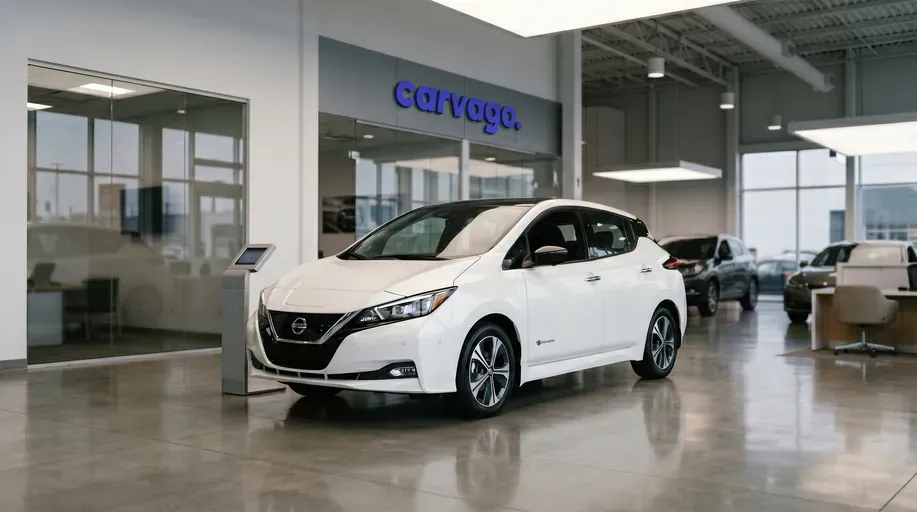
The third-generation Nissan Leaf is built on a dedicated electric vehicle platform featuring liquid battery cooling and an integrated front-wheel-drive unit. The European engine line-up consists of two single-motor configurations paired with a single-speed reduction transmission.
| Engine | Fuel | Power | Gearbox | Model years |
|---|---|---|---|---|
| Leaf (52 kWh) | Electric | 130 kW | Automatic (1-speed) | 2026 – present |
| Leaf (75 kWh) | Electric | 160 kW | Automatic (1-speed) | 2026 – present |
For town driving, suburban commuting, and short daily routines, the base motor with the smaller battery provides more than enough responsiveness and a lighter kerb weight, making it nimble and cost-effective for everyday urban use.
For mixed driving, regular motorway distances, or occasional towing, the stronger motor paired with the extended-range battery is the sensible choice. The additional output provides relaxed overtaking ability at cruising speeds, while the greater energy storage helps minimise required stops on longer cross-country routes.
Equipped with active liquid thermal management, the electric Nissan Leaf maintains consistent battery temperatures during fast charging. On rapid chargers, intake remains prompt at lower states of charge, though the charging rate tapers noticeably past the halfway mark.
| Dimension / Parameter | Crossover |
|---|---|
| Length | 4,350 mm |
| Width | 1,810 mm |
| Height | 1,550 mm |
| Wheelbase | 2,690 mm |
| Boot capacity (seats up) | 437 l |
| Boot capacity (seats folded) | 1,052 l |
In the passenger compartment, the Nissan Leaf provides seating for five with a fixed rear bench and a standard split-folding backrest. Because the traction battery is packaged beneath the floor, the rear footwell floor sits relatively high, which forces taller occupants into a knees-up sitting position with reduced under-thigh support. The tapering roof profile also restricts headroom for taller rear passengers. Practical versatility remains conventional rather than modular, as the rear seats do not slide fore and aft. In the boot, the cargo area offers a deep and usable space for luggage, though loading heavier items requires lifting them over a pronounced sill.
On the road, the third-generation Nissan Leaf prioritises compliant suspension tuning over outright agility. The chassis absorbs typical road imperfections smoothly, and the steering behaves predictably with reassuring front-end direction. Body lean is evident when pressing through tighter turns, however, and professional tests noted that the brake pedal feels somewhat spongy and inconsistent to modulate. While the primary ride remains absorbent, larger optional wheels transmit noticeable thumps across sharp expansion joints, and the chassis can feel slightly underdamped over rolling undulations at higher cruising speeds.
Acoustic insulation keeps the cabin quiet in urban driving thanks to linear power delivery and absent motor whine, though motorway travel introduces audible wind flutter around the door mirrors. Inside, testers commend the dual Google-based displays for their rapid response times and the retention of physical switches on the steering wheel. In contrast, the flush touch-sensitive strip for climate controls proves awkward to adjust without glancing away from the road. The driving position also drew mixed feedback: front seats feel perched rather than commanding, offering modest lower-back and under-thigh support.
Where professional evaluations agree is on the electric Nissan Leaf’s easygoing town manners and intuitive touchscreen interface. They diverge mainly on secondary ride composure: while some tests consider the ride plush and relaxing, others describe low-level testing over broken asphalt and highlight limited front-tyre bite on wet tarmac under firm acceleration.
All the charts in this section are drawn from Carvago listings representing the whole Nissan Leaf model family across multiple generations, rather than the reviewed generation alone. Across the available model years, current listings show a median asking price starting at €14,900 for 2019 models and reaching €42,400 for 2026 models. Because these figures reflect the entire model lineup advertised on the platform, this broader dataset does not establish a verified separate price level specifically for the newest generation.
The chart tracks the volume of advertised Nissan Leaf models per month from April 2026 to September 2026, opening at 1,172 listings before dropping to 959 in May.
Active listings over time
| Month | Nissan Leaf |
|---|---|
| 2026-04 | 1 172 |
| 2026-05 | 959 |
| 2026-06 | 969 |
| 2026-07 | 1 060 |
| 2026-08 | 1 030 |
| 2026-09 | 1 044 |
Source Carvago
Available stock fluctuated over the following months to finish at 1,044 listings in September 2026, providing buyers with a steady pool of around 1,000 cars to choose from across the market.
Among used listings advertised today, the median asking price of cars built in 2019 is €14,900, whereas the median asking price of cars built in 2026 is €42,400. The chart displays how these median asking prices compare across model years.
Median advertised price by year of manufacture
| Model year | Nissan Leaf |
|---|---|
| 2019 | 14 900 |
| 2020 | 15 800 |
| 2021 | 16 300 |
| 2022 | 17 000 |
| 2023 | 20 900 |
| 2024 | 25 000 |
| 2025 | 23 000 |
| 2026 | 42 400 |
Source Carvago
Buyers reviewing cars advertised today will find median asking prices between €14,900 for 2019 models and €17,000 for 2022 models. Asking figures do not increase across every subsequent build year, as listings advertised today reflect a median asking price of €23,000 for 2025 cars compared to €25,000 for 2024 cars, alongside a median asking price of €42,400 for 2026 cars.
This depreciation curve illustrates how the model's residual value falls with age, with the car shedding roughly 32% of its original value in the first year and 48% by age two.
Residual value by vehicle age
| Vehicle age | Nissan Leaf |
|---|---|
| New | 42 600 |
| 1 yr | 28 800 |
| 2 yrs | 22 100 |
| 3 yrs | 20 800 |
| 4 yrs | 18 700 |
| 5 yrs | 16 900 |
| 6 yrs | 15 900 |
| 7 yrs | 14 100 |
Source Carvago
Over the seven-year span shown, the model loses 67% of its initial residual value, with depreciation slowing considerably after the sharp drop of the first two years.
Active listings for the Nissan Leaf were entirely electric from April 2026 to September 2026, opening with 1172 cars and closing the period with 1044. The monthly figures below show how the advertised supply tracked across this span.
Supply composition by fuel type
| Month | Electric |
|---|---|
| 2026-04 | 1 172 |
| 2026-05 | 959 |
| 2026-06 | 969 |
| 2026-07 | 1 060 |
| 2026-08 | 1 030 |
| 2026-09 | 1 044 |
Source Carvago
Because every other fuel type recorded 0 listings across all six months, buyers will find an exclusively electric selection on the market.
From April 2026 to September 2026, the average asking price for the Nissan Leaf developed as shown in the chart below, beginning at €16,600 in the first month.
Average price development over time
| Month | Nissan Leaf |
|---|---|
| 2026-04 | 16 600 |
| 2026-05 | 17 300 |
| 2026-06 | 18 600 |
| 2026-07 | 21 700 |
| 2026-08 | 23 200 |
| 2026-09 | 24 300 |
Source Carvago
Across the six months, the average asking price rose continuously from €16,600 in April 2026 to €24,300 in September 2026, increasing in each consecutive month.
Active liquid battery cooling resolves thermal throttling during repeated fast charges
Fast and intuitive Google-based infotainment system
Supple suspension and low cabin noise provide relaxed town driving
High rear floor and sloping roofline limit passenger comfort in the back
Noticeable body lean in corners paired with an inconsistent brake pedal feel
Flush touch-sensitive climate controls are awkward to adjust while driving
Long-term mechanical and battery durability is not yet established because European customer deliveries only began in early 2026. However, official European safety monitoring authorities record zero recalls, and no systemic defect patterns have emerged so far.
The smaller battery is best for urban driving and short daily commutes thanks to its lighter kerb weight. For regular motorway distances or cross-country trips, choose the extended-range electric Nissan Leaf with the stronger motor to minimise charging stops.
Verify that all electronic control module software updates are current by checking the car's VIN through an authorised dealer. Inspect the charging port latch and ensure that optional equipment such as the dimming panoramic roof operates evenly.
Sources: nissannews.com, nissan.co.uk, autoexpress.co.uk, whatcar.com, autocar.co.uk
This article was prepared using artificial intelligence tools. The section guarantor is Petr Dušek.

Detailed comparison of the Opel Astra Electric and Renault Mégane E-Tech Electric. Find out the real range, compare equipment, and read our final verdict.
Apr 29, 2026

Tesla Model 3 vs. BMW i4: Which premium electric car is better? Our detailed comparison of range, performance, and price will help you choose.
Oct 23, 2026

Cupra Born review: real owner experience, battery range, common faults, running costs and used prices — everything you need before you buy.
Oct 17, 2026