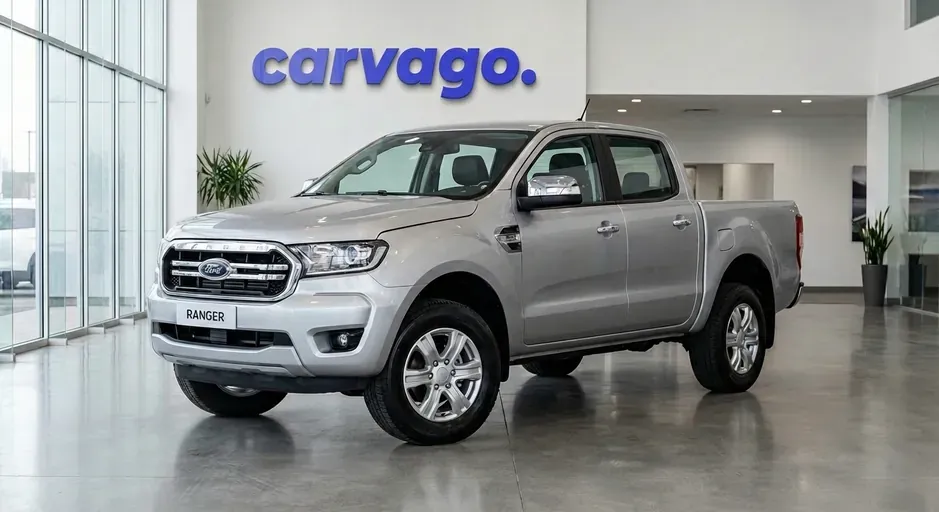
Review Ford Ranger: What do owners and experts really say?
Ford Ranger review: real owner experience, diesel and PHEV engine picks, towing limits, running costs and our verdict before you buy.
November 1, 2026
Introduction
The Ford Ranger pickup occupies a central position in the European one-tonne commercial utility vehicle market. This review covers the fifth-generation model, which had its world premiere in November 2021. European customer deliveries commenced in November 2022, followed by mainstream variants in May 2023, and the vehicle remains in continuous production and distribution as of late 2026.
Rather than receiving a traditional mid-cycle sheet-metal facelift, the Ford Ranger has evolved through rolling technical updates. A plug-in hybrid derivative expanded the lineup with initial European deliveries arriving in June 2025, alongside ongoing equipment revisions that introduced enhanced central display interfaces and upgraded driver-assistance technology.
Offered in Single Cab, Super Cab, and Double Cab body configurations, the Ford Ranger serves tradespeople and commercial fleets requiring heavy-duty payload and towing capacities, alongside private buyers looking for an all-wheel-drive lifestyle vehicle capable of replacing a conventional family SUV.
Owner Experiences: Common Faults and Recalls
European deliveries of the fifth-generation Ford Ranger commenced in late 2022 with high-performance variants, followed by mainstream diesel configurations in May 2023 and the plug-in hybrid derivative in June 2025. Because the model remains in active production, high-mileage long-term reliability is not yet established across the secondary market. Early ownership experiences and safety notices nevertheless highlight specific electronic and mechanical areas that require attention.
On the automatic Ford Ranger equipped with the ten-speed transmission, owners report shift irregularities, including hesitant take-off from a standstill, abrupt downshifts when braking to a halt, and shift flare before reaching operating temperature. In most cases, workshop recalibration of the powertrain and transmission software, accompanied by an adaptive relearn cycle, resolves the rough shifting. However, some vehicles required physical valve body replacements due to machining defects that caused complete loss of reverse gear engagement.
Owners report intermittent software stability glitches with the central portrait touchscreen. Typical symptoms include screen freezing, navigation restarts, and delays in bringing up the reversing camera feed when selecting reverse. Most routine crashes have been resolved through over-the-air software updates. On the diesel Ford Ranger fitted with the 2.0-litre four-cylinder engine, owners report premature emissions warnings and AdBlue countdown alerts triggered by drifting exhaust sensors. Additionally, vehicles driven primarily on short urban routes suffer from rapid particulate filter soot accumulation and unburnt fuel dilution in the engine oil. When considering a used vehicle, verifying documented service histories and mechanical health through CarAudit provides clarity on whether routine maintenance and software updates were carried out.
Verified Safety Recalls
Safety Defect
Affected Production Window
Market Reach
Workshop Action
Curtain airbag deployment and B-pillar trimSide trim may impede curtain airbag deployment; B-pillar trim may detach and strike occupants when side airbag deploys.
2023-01-13 to 2026-06-24
Worldwide (33,449 vehicles, including EU and UK)
Replace interior B-pillar and side trim pieces with redesigned parts.
Electric brake booster softwarePossible loss of brake power assistance, leading to increased pedal travel and extended braking distances.
2024-06-27 to 2025-06-24
Worldwide (340,756 vehicles, including EU and UK)
Update software for the electric brake booster and anti-lock braking modules.
3.0-litre V6 diesel camshaft sprocketLeft-side camshaft sprocket may fracture due to a material hardening defect, leading to engine stall and loss of drive.
2023-01-26 to 2025-03-11
Worldwide (3,910 vehicles, including EU and UK)
Inspect camshaft sprocket batch codes and replace parts from defective production batches.
2.3-litre petrol/PHEV engine valve followerDislodged roller finger follower during camshaft assembly can cause mechanical failure and loss of drive power.
2025-03-04 to 2026-02-12
European Union and UK
Inspect valvetrain and replace the engine long block assembly.
Driver seatbelt lower anchorageSeatbelt webbing routed only through the rubber sleeve rather than the metal anchor loop, reducing occupant restraint.
2022-05-20 to 2024-04-02
Worldwide (4,944 vehicles, including Europe)
Inspect lower anchor routing and replace seatbelt assembly if misrouted.
🔍 What to check before buying
Check recall completion via VIN: Confirm with an authorised dealer that all manufacturer campaigns have been completed for the specific chassis, particularly the electric brake booster software update, the driver seatbelt anchor inspection, and the 3.0-litre V6 camshaft sprocket replacement.
Cold transmission behavior: During a cold test drive, test engagement between Drive and Reverse multiple times to confirm the transmission engages promptly without hesitation, clunking, or warning lamps on the instrument cluster.
Touchscreen responsiveness: Start the vehicle and verify the portrait infotainment display loads quickly, cycles between menu screens without freezing, and displays the reversing camera immediately upon selecting reverse.
Oil life monitor reading: On diesel variants, review the digital instrument cluster's oil life monitor. Premature low-percentage alerts can indicate oil dilution from repeated uncompleted diesel particulate filter regenerations on urban short trips.
Underbody and chassis condition: Inspect the chassis rails, leaf-spring mounting bushings, transfer case, and protective underbody plates for bending, severe scrapes, or deep gouges that reveal heavy commercial overloading or severe off-road use.
Engines: Which One to Choose
The current European Ford Ranger line-up spans four-cylinder and six-cylinder diesels, a petrol plug-in hybrid, and a dedicated performance petrol engine. Every powertrain delivers power to an electronically controlled four-wheel-drive system.
Engine
Fuel
Power
Gearbox
Model years
2.0 EcoBlue
Diesel
125 kW (170 hp)
6-speed manual / 6-speed automatic
2023–present
2.0 EcoBlue Bi-Turbo
Diesel
151 kW (205 hp)
10-speed automatic
2023–present
2.0 EcoBlue Bi-Turbo Raptor
Diesel
151–154 kW (205–210 hp)
10-speed automatic
2023–present
3.0 EcoBlue V6
Diesel
177 kW (240 hp)
10-speed automatic
2023–present
2.3 EcoBoost PHEV
Petrol plug-in hybrid
205–207 kW (279–281 hp)
10-speed automatic
2025–present
3.0 EcoBoost V6 Raptor
Petrol
215 kW (292 hp)
10-speed automatic
2022–present
Which engine fits your driving profile?
For short trips in town and suburban commuting, the hybrid Ford Ranger is the only sensible choice. Repeated urban short hops present operational hurdles for the diesels due to particulate filter regeneration cycles, whereas the plug-in hybrid can complete daily urban runs entirely on electricity when charged regularly, while retaining full utility off-road.
For mixed everyday use combining country roads, occasional highway stretches, and light work, the bi-turbo diesel Ford Ranger represents the most balanced option. It provides solid mid-range pulling power with lower overall running costs than the six-cylinder alternatives, making it an effective all-rounder for general utility. The entry-level single-turbo diesel is better suited to fleet duties and utilitarian work, feeling audible under heavy throttle and pedestrian when carrying maximum cargo.
For regular long motorway journeys, the 3.0 EcoBlue V6 diesel is the most suitable choice. Its surplus of low-end torque allows the automatic gearbox to hold taller ratios quietly at sustained cruising speeds, delivering a refined cabin environment comparable to large passenger off-roaders.
For heavy towing and commercial hauling, both the 3.0 EcoBlue V6 diesel and the 2.3 EcoBoost PHEV deliver maximum pulling capability, maintaining full certified trailer ratings without hesitation on steep gradients. In contrast, the performance-oriented petrol Ford Ranger Raptor is tuned for high-speed off-road driving with bespoke suspension, which comes at the expense of reduced towing and payload ratings alongside substantial fuel use.
For detailed service vulnerabilities, known recall campaigns, and long-term mechanical reliability across these powertrains, refer to the dedicated owner experiences section.
Space & Practicality
In standard configurations, the Ford Ranger pickup provides a utility-focused cargo bed shaped to accommodate a standard Euro pallet between the rear wheel arches. Bed utility includes perimeter tie-down anchor points and integrated access steps behind each rear wheel to simplify side loading.
Dimension
Double Cab
Super Cab
Single Cab
Length (mm)
5 370
5 370
5 370
Width (mm)
2 015
1 918
1 918
Height (mm)
1 886
1 874
1 868
Wheelbase (mm)
3 270
3 270
3 270
Cargo bed volume (l)
1 233
–
–
Cargo volume represents the standard load box filled to the rail line; figures do not apply to the petrol performance derivative or the plug-in hybrid, which vary in exterior height, track width, and cargo floor depth.
Inside the passenger cabin of the Ford Ranger, the Double Cab provides adequate accommodation for four adults, though seating three across the rear bench is restricted by tight shoulder room in the centre position. Professional road tests note that the rear seatback angle is relatively upright, which reduces postural relaxation on long journeys. Fitting child safety seats can require care due to the narrow rear door openings. Practical cabin touches include two under-seat storage bins exposed when the rear lower cushions flip upward, as well as a single-piece folding rear backrest that creates an enclosed, level luggage platform sheltered from the weather.
What the Tests Say
On tarmac, the Ford Ranger demonstrates composed manners for a ladder-frame truck. Professional road tests highlight its progressive steering and settled long-distance damping, aided by a wider track that suppresses cornering push. When driven unladen, the leaf-sprung rear axle still transmits low-speed jitter across broken surfaces, whereas the coil-sprung off-road specialist variant absorbs severe ruts with passenger-car compliance. That dedicated off-road setup, however, suffers from sluggish emergency evasion and extended braking on its knobbly all-terrain tyres. Cabin isolation is generally effective, though wind noise rustles around the large side mirrors at motorway speeds. Under load, the smaller four-cylinder diesel sounds noticeably gruff, while the larger V6 diesel delivers quiet, smooth progress.
The cabin earns praise on higher trims for soft-touch dashboard toppers, though scratch-prone hard plastics line the lower doors and centre console. The portrait infotainment display offers clear graphics and responsive connectivity, yet testers consistently criticise burying secondary ventilation controls into on-screen sub-menus. A tall bonnet impairs forward visibility during close-quarter parking manoeuvres. Overall, professional verdicts agree that the diesel Ford Ranger delivers predictable highway stability and accurate steering, but they divide over whether its unladen secondary ride over urban tarmac is pliant enough for everyday family use.
Prices and Market Offer
All the charts in this section reflect listings of the complete Ford Ranger model family across multiple generations, rather than the reviewed generation alone, and the data does not establish separate pricing levels specifically for the newest series. Across the advertised model years, the median asking price sits at €30,000 for 2019 and €36,300 for 2022, before reaching €45,900 for 2023. At the newer end of the market, listings show a median asking price of €51,900 for 2024 and €57,600 for 2026 models.
Between April 2026 and September 2026, the count of active Ford Ranger listings moved from 6,390 to a high of 6,950 in June. The chart below illustrates how listing numbers developed across this six-month period.
Ford Ranger - availability over time
Active listings over time
Month
Ford Ranger
2026-04
6 390
2026-05
6 827
2026-06
6 950
2026-07
6 919
2026-08
6 586
2026-09
6 496
Source Carvago
Buyers can expect a broad selection of vehicles on the market, as listings rose through the spring before easing down to 6,496 in September 2026.
Among used listings advertised today, the median asking price of vehicles built in 2019 is €30,000, while for those built in 2026 the median asking price is €57,600. The chart below shows how these figures compare across each build year.
Ford Ranger - median price by model year
Median advertised price by year of manufacture
Model year
Ford Ranger
2019
30 000
2020
32 000
2021
33 900
2022
36 300
2023
45 900
2024
51 900
2025
57 400
2026
57 600
Source Carvago
Buyers focusing on 2019 to 2022 models see median asking prices ranging from €30,000 to €36,300. For 2023 through 2026 models, the median asking prices span from €45,900 to €57,600.
This depreciation curve tracks how the model's residual value falls with vehicle age, showing a loss of approximately 28% by age three. The steepest annual decline takes place between ages two and four, leading into the trend shown below.
Ford Ranger - value loss by age
Residual value by vehicle age
Vehicle age
Ford Ranger
New
56 200
1 yr
51 200
2 yrs
47 000
3 yrs
40 600
4 yrs
35 200
5 yrs
31 500
6 yrs
29 400
7 yrs
26 500
Source Carvago
Across the seven-year span shown, the model sheds roughly 53% of its original value while retaining nearly half of it. Past age four, the sharpest phase of depreciation has passed and annual value loss slows considerably.
Between April and September 2026, diesel vehicles made up the bulk of advertised inventory, beginning with 5,301 listings in April 2026 alongside 821 hybrid listings. The breakdown below details how the available choices split across fuel types over these six months.
Ford Ranger - supply by fuel over time
Supply composition by fuel type
Petrol
Diesel
Hybrid
Month
Petrol
Diesel
Hybrid
2026-04
264
5 301
821
2026-05
255
5 690
878
2026-06
234
5 783
929
2026-07
198
5 622
1 096
2026-08
208
5 081
1 294
2026-09
153
4 896
1 445
Source Carvago
In September 2026, diesel continued to dominate availability with 4,896 listings, followed by 1,445 hybrid listings and 153 petrol models. Anyone shopping the used market will find the widest selection among diesel options, with hybrids providing an established secondary choice and petrol models remaining scarce.
The chart tracks the average asking price for the Ford Ranger from April 2026, when it stood at €47,100, through September 2026.
Ford Ranger - price trend over time
Average price development over time
Month
Ford Ranger
2026-04
47 100
2026-05
46 500
2026-06
46 100
2026-07
46 400
2026-08
47 200
2026-09
47 000
Source Carvago
Over this six-month window, the average dipped to €46,100 in June 2026 before finishing at €47,000, reflecting minimal overall movement across the period.
Composed on-road handling with settled long-distance stability
Practical cargo bed fits a standard Euro pallet between the wheel arches
Plug-in hybrid option allows electric urban driving with full towing capability
Cons
Jittery unladen low-speed ride over uneven tarmac
Upright rear seatback angle and narrow rear door openings
Secondary ventilation controls buried in touchscreen sub-menus
Frequently asked questions
Is the Ford Ranger reliable as a used purchase?
Long-term reliability is not yet fully established because this generation entered European production relatively recently. Buyers should confirm with an authorised dealer that all manufacturer recalls have been completed by VIN.
Which engine is best to choose?
The bi-turbo diesel Ford Ranger is the most balanced choice for general utility, offering strong mid-range pulling power with manageable running costs. However, regular urban drivers should choose the hybrid Ford Ranger to avoid diesel emissions filter complications.
Can a Double Cab work as an everyday family vehicle?
It accommodates four adults comfortably on open roads, but its unladen leaf-sprung suspension produces a jittery ride over broken city surfaces. An upright rear seatback and bulky dimensions also make it less practical in urban environments than a conventional SUV.
What should be checked before buying?
Verify that all recall campaigns have been completed by VIN, particularly the electric brake booster update. On a cold test drive, check for smooth transmission engagement between Drive and Reverse, and inspect the underbody for off-road damage.