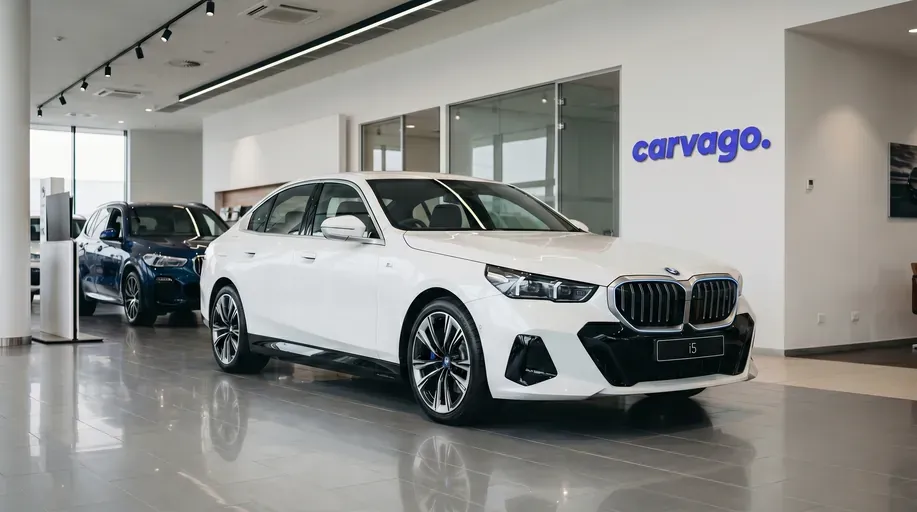
Review BMW i5: What do owners and experts really say?
BMW i5 review: real owner experience, electric range, practicality, running costs, and expert verdict — everything you need before you buy.
October 22, 2026
Verdict at a Glance
Who it suits: Long-distance commuters and business drivers wanting traditional executive road manners and practicality without moving to an SUV.
Recommended engine: The single-motor eDrive40 for daily commuting, or the all-wheel-drive xDrive40 for snowy regions and towing.
What to avoid: Any car without documented completion of safety recalls—verify the service history by VIN.
Introduction
The BMW i5 represents the transition of BMW’s traditional executive line-up into fully electric propulsion. Marking the first generation to carry the dedicated electric badge under the eighth-generation 5 Series family, it competes directly in the premium upper-medium class. First European deliveries of the electric BMW i5 Sedan began on 21 October 2023, followed by the electric BMW i5 Touring in May 2024, with continuous production confirmed into 2026.
Available in both four-door saloon and five-door estate body styles, the vehicle has received no mid-cycle Life Cycle Impulse update through October 2026. Instead, technical running revisions took effect in March 2024, November 2024, and March 2025, gradually adding drivetrain options and refining efficiency.
The model appeals primarily to business fleets, long-distance commuters, and private buyers who require traditional executive road manners and practical luggage carrying capacity without stepping into a taller crossover or SUV.
Owner Experiences: Common Faults and Recalls
Long-term reliability data for the BMW i5 is still accumulating, as customer deliveries only began in late 2023 for the saloon and spring 2024 for the estate. Early ownership reports show that the core electric drivetrain and high-voltage battery have proven mechanically sound. However, the ownership record has been shaped by several significant safety recalls alongside a handful of recurring minor defects and initial software teething issues.
The most prominent campaigns involve the integrated braking system. In September 2024, a worldwide recall covering approximately 1.5 million vehicles manufactured between June 2022 and August 2024 addressed a signal disruption in the motor position sensor. This defect can cause a loss of hydraulic brake assistance, disabling antilock braking and dynamic stability control and extending stopping distances. Workshops install diagnostic software to monitor sensor integrity and replace the brake module if a fault is detected. A separate safety alert in early 2025 recalled European and global vehicles produced between June 2022 and November 2024 due to an improperly welded servomotor shaft in the brake system, which could break under high pressure and similarly reduce pedal assistance. In December 2024, an EU-wide recall of 21,955 vehicles built between June 2024 and September 2024 addressed steering column double universal joints whose rotation bushings could fracture under extreme steering lock, requiring assembly replacement.
Fire prevention campaigns have also triggered workshop actions. In March 2026, an EU-notified recall covering 337,374 vehicles worldwide produced between June 2022 and December 2025 warned that the cockpit wiring harness could be damaged during cabin air microfilter replacement, potentially causing a short circuit, smoke, or fire. Authorised workshops inspect and secure the harness routing. Earlier, in March 2024, a targeted European recall for vehicles produced between September 2023 and February 2024 resolved an issue where incorrectly manufactured battery cell modules could lose electrical contact and overheat under heavy loads. Additionally, an April 2024 campaign corrected defective welds on rear-seat child seat anchor clips on cars built in January 2024.
Beyond official safety actions, owners report several recurring everyday niggles. A frequent complaint involves a rhythmic ticking or knocking sound from behind the dashboard or lower footwell when running the climate control in mild weather. This stems from pressure pulses in the heat pump and air-conditioning lines, which workshops resolve by fitting revised, insulated refrigerant pipes. Some owners also describe sticking motorised charging flap latches that fail to open on command or trigger false dashboard warnings indicating the flap is open when fully closed. Early production models suffered from minor electronic quirks, including the ambient lighting bar defaulting to white after sleep mode and occasional central screen lockups, though remote software updates have cured most interface bugs. Professional tests describe rapid inner-shoulder tyre wear caused by the car's substantial weight and instant torque. Before committing to a purchase, buyers can have any prospective vehicle inspected through CarAudit.
🔍 What to check before buying
Request an official dealer service printout by VIN to verify that all mandatory recalls—specifically the brake module, steering spindle, and cockpit wiring harness campaigns—have been completed.
Inspect the tyres on full steering lock and beneath the rear axle to check for uneven tread wear or severe inner-shoulder scrubbing.
Operate the motorised charging port door multiple times to confirm the latch releases smoothly and does not trigger erroneous instrument cluster warnings.
Test the central curved touchscreen through a system restart to verify that driver profiles save correctly, smartphone integration connects seamlessly, and all parking cameras initialise without delay.
Engines: Which One to Choose
The all-electric BMW i5 relies on fifth-generation electrically excited synchronous motors across both saloon and Touring estate body styles. The line-up offers single-motor rear-wheel-drive configurations and twin-motor all-wheel-drive setups, all paired with a single-speed automatic transmission.
Engine
Fuel
Power
Gearbox
Drivetrain
Model years
i5 eDrive40 (Saloon)
Electric
250 kW (340 hp)
1-speed automatic
Rear-wheel drive
2023 – present
i5 Touring eDrive40
Electric
250 kW (340 hp)
1-speed automatic
Rear-wheel drive
2024 – present
i5 xDrive40 (Saloon)
Electric
290 kW (394 hp)
1-speed automatic
All-wheel drive
2024 – present
i5 Touring xDrive40
Electric
290 kW (394 hp)
1-speed automatic
All-wheel drive
2024 – present
i5 M60 xDrive (Saloon)
Electric
442 kW (601 hp)
1-speed automatic
All-wheel drive
2023 – present
i5 Touring M60 xDrive
Electric
442 kW (601 hp)
1-speed automatic
All-wheel drive
2024 – present
For daily commuting, town driving, and regular mixed routes, the single-motor eDrive40 represents the most balanced choice in the line-up. Its rear-wheel-drive architecture delivers composed handling, more than adequate acceleration for overtaking, and the lowest energy consumption of any version.
Drivers who frequently travel in snowy or mountainous regions, or who require higher braked trailer limits for towing, should step up to the dual-motor electric all-wheel-drive BMW i5 xDrive40. Available across both the electric BMW i5 Saloon and the estate BMW i5 Touring, it provides secure all-weather traction and greater pulling capacity without the firmer chassis calibration of the performance flagship.
The range-topping twin-motor M60 xDrive caters primarily to drivers seeking rapid straight-line acceleration and sharper handling responses, though it incurs a trade-off in overall driving range.
For detailed reliability records, software behaviour, and verified safety recall notices on these electric powertrains, see the owner experiences section.
Real-world range and charging
Real-world efficiency varies with ambient temperatures and road types. During winter operations, owners and professional testing services record a clear reduction in travel distance per charge, driven primarily by cabin climate demands and high-voltage battery thermal management. Motorway cruising speeds also draw substantially more energy than urban driving cycles.
DC fast-charging performance benefits from integrated navigation battery preconditioning, sustaining strong charge intake before tapering as the battery fills.
Space & Practicality
Both the BMW i5 Sedan and the BMW i5 Touring offer sufficient legroom and shoulder room for adult rear passengers, accommodating two tall occupants comfortably on long journeys, while the narrower centre seat remains best suited to shorter trips. A standard 40:20:40 split-folding rear bench across both body styles allows longer cargo to slide through without sacrificing the outer seating positions.
Everyday loading practicality is highest in the estate, which provides a level cargo floor, boot-wall remote releases to fold the backrests flat, and dedicated underfloor compartments that store charging cables and luggage partition cassettes out of the way. The rear window is fixed in the tailgate and does not open separately, requiring the complete electric hatch to be raised for loading.
Dimension / Metric
Sedan (G60)
Touring (G61)
Length (mm)
5,060
5,060
Width (mm)
1,900
1,900
Height (mm)
1,515
1,515
Wheelbase (mm)
2,995
2,995
Boot volume, seats upright (l)
490
570
Boot volume, seats folded (l)
—
1,700
Note: High-output M60 xDrive variants feature a lower unladen height of 1,505 mm due to their dedicated adaptive suspension setup; folded luggage capacity is not officially specified for the saloon.
What the Tests Say
Professional road tests find that the BMW i5 delivers a firmly tied-down driving experience. At lower speeds around town, cars fitted with firmer optional sports suspensions and larger alloy wheels can feel restless over sharp potholes and sunken drains. Once on open roads and motorways, the chassis settles into a composed cruise with tight body control. Handling remains accurate and stable, with optional rear-wheel steering aiding manoeuvrability in tighter corners. Testers observe that although turn-in is prompt and body lean is well checked, the steering offers muted road feedback, and the car's substantial mass is detectable during rapid direction transitions. Cabin isolation from tyre, wind, and motor noise earns consistent praise across evaluations.
Inside, the driving position and seat support are widely commended for long-distance travel. The digital interface, however, splits opinion. Testers note that routing the climate controls into display submenus increases distraction, diluting the convenience of the central rotary controller. Lower cabin plastics on the console and door cards also drew criticism for lacking the tactile density expected in an executive vehicle.
Evaluations universally agree on the quiet cruising refinement and stable high-speed tracking of both the estate and the BMW i5 Sedan, while disagreeing on low-speed ride compliance across different wheel and suspension combinations.
Prices and Market Offer
All the charts in this section are drawn from Carvago's listings of the whole model family, including other generations represented in the data, not only the reviewed generation. Consequently, this chart does not establish a separate price level for the reviewed BMW i5 generation alone. Across current listings, the median asking price stands at 70500 EUR for 2023 models, 68000 EUR for 2024, 67000 EUR for 2025, and 74600 EUR for 2026 examples. Variations between these model years reflect differences in factory options, body styles, and powertrain configurations in advertised inventory.
Between April and September 2026, the number of advertised BMW i5 vehicles moved within a narrow band, starting at 2,011 listings and closing at 1,864. The chart below details how monthly listing counts evolved over this six-month span.
BMW i5 - availability over time
Active listings over time
Month
BMW i5
2026-04
2 011
2026-05
1 919
2026-06
1 883
2026-07
1 967
2026-08
1 934
2026-09
1 864
Source Carvago
Buyers can expect a substantial selection on the market, with overall availability shifting only slightly from month to month and remaining close to the 1,900-car mark.
The chart outlines asking figures across build years, where the median asking price of BMW i5 cars advertised today built in 2023 is €70,500, while the median asking price of cars advertised today built in 2026 is €74,600.
BMW i5 - median price by model year
Median advertised price by year of manufacture
Model year
BMW i5
2023
70 500
2024
68 000
2025
67 000
2026
74 600
Source Carvago
Buyers comparing build years will find the lowest median asking price on 2025 models at €67,000, alongside 2024 models at €68,000. Those looking at 2023 models see a median asking price of €70,500, whereas 2026 models require a median asking price of €74,600.
This depreciation curve illustrates how the model's residual value declines with vehicle age, shedding roughly 17% of its initial value after the first year and about 32% by age three.
BMW i5 - value loss by age
Residual value by vehicle age
Vehicle age
BMW i5
New
75 700
1 yr
62 900
2 yrs
56 300
3 yrs
51 200
4 yrs
45 100
5 yrs
42 200
6 yrs
40 200
7 yrs
34 900
Source Carvago
Across the full seven-year span shown, the model loses approximately 54% of its initial residual value, with the steepest drop occurring during the first year.
Between April 2026 and September 2026, listings were exclusively electric, shifting from 2,011 advertised vehicles in April to 1,864 in September. The monthly numbers illustrate how the model family's advertised inventory was distributed by fuel type.
BMW i5 - supply by fuel over time
Supply composition by fuel type
Month
Electric
2026-04
2 011
2026-05
1 919
2026-06
1 883
2026-07
1 967
2026-08
1 934
2026-09
1 864
Source Carvago
With electric models accounting for all 1,864 active listings in September 2026 and zero recorded for any other fuel type, prospective buyers will find a market made up entirely of electric options.
The chart shows the monthly average asking price for the BMW i5 between April 2026 and September 2026, beginning at €65,400.
BMW i5 - price trend over time
Average price development over time
Month
BMW i5
2026-04
65 400
2026-05
65 700
2026-06
65 600
2026-07
65 800
2026-08
66 100
2026-09
66 500
Source Carvago
Across the six months, the average shifted by under two percent overall, rising from €65,400 to €66,500 aside from a minor dip to €65,600 in June 2026.
Quiet cabin refinement with effective insulation from road and wind noise
Composed high-speed cruising stability and well-controlled body motions
Practical estate layout with a flat cargo floor and dedicated underfloor storage
Cons
Subject to several significant safety recalls that require dealer verification by VIN
Climate controls moved into touchscreen submenus increase distraction while driving
Estate omits the traditional independently opening rear tailgate window
Frequently asked questions
Is the BMW i5 reliable as a used purchase?
The core electric drivetrain and battery have proven mechanically dependable, though early cars were subject to significant safety recalls. Verifying that all manufacturer campaigns have been completed for the vehicle's specific VIN is essential.
Which powertrain is best suited for everyday driving?
The rear-wheel-drive BMW i5 eDrive40 provides the lowest energy consumption and balanced road manners for routine commuting and long-distance travel. Drivers requiring all-weather traction for snowy conditions or higher trailer towing limits should opt for the dual-motor xDrive40 instead.
Is the estate practical enough for family duties?
The BMW i5 Touring provides versatile cargo space and a flat loading floor for family use. However, the rear tailgate window is fixed and cannot be opened independently.
What should you check before buying a used example?
Inspect the inner shoulders of the tyres on full steering lock for accelerated wear driven by vehicle weight and electric torque. Buyers should also verify that all recall campaigns are signed off in the official service record.