Porsche Taycan vs. Tesla Model S: Complete comparison 2026
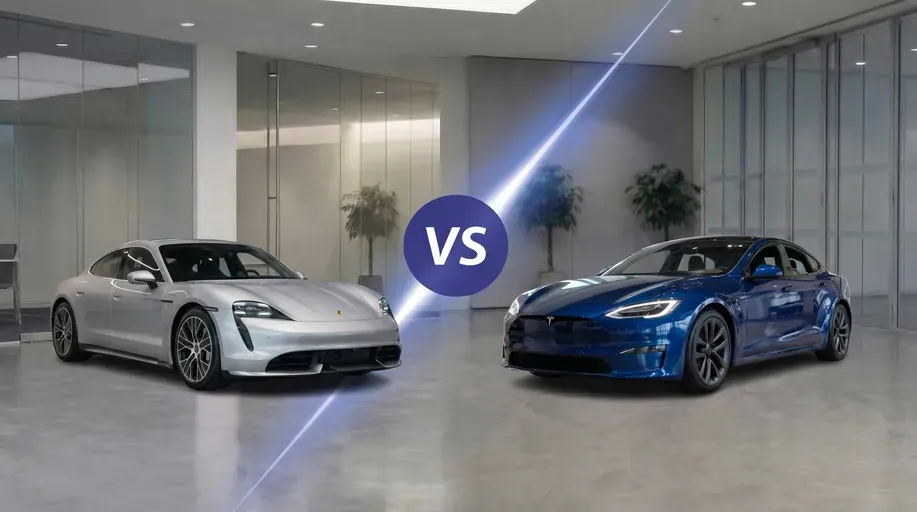
Porsche Taycan vs. Tesla Model S: Which electric car is better? We compared real-world range, performance, and equipment. Read our verdict and make your choice easier.
Apr 14, 2026
Articles
Car battle
Audi e-tron GT vs. Porsche Taycan Comparison: Which luxury electric car should you choose? Find out everything about performance, real-world range, and read our final verdict.
April 14, 2026


Audi e-tron GT is a stunning electric gran turismo that hides cutting-edge technology beneath its elegant curves and is designed for fast yet supremely comfortable long-distance travel. In contrast, the Porsche Taycan, initially developed and known under the concept name Mission E, represents a fierce electric sports sedan focused primarily on uncompromising dynamics and a purist driving experience. Although both these cars share the identical J1 group platform and, as approximately four-year-old used cars, represent a highly attractive entry point into the world of luxury electromobility on the market, our detailed comparison will show you that their distinct characters target a completely different type of driver.
When comparing the exterior dimensions of the Audi e-tron GT and Porsche Taycan models, it is key to keep in mind that both cars share the identical J1 group platform. This is directly reflected in their basic footprint, where both competitors feature a practically identical wheelbase of 2900 mm (in the Taycan Cross Turismo version, it has slightly stretched to 2904 mm due to specific chassis tuning). While this generous distance between the axles ensures extraordinary directional stability on highways and maximizes interior space for the traction batteries, in combination with a width exceeding 1.96 meters, it means poorer maneuverability in narrow city streets and underground garages. In terms of everyday parking, neither car offers a significant advantage, as both require increased attention from the driver.
The biggest differences are therefore found primarily in the overall body shaping and its height. The Audi e-tron GT, which appears on the four-year-old used car market exclusively as an elegant four-door model (in terms of the Sedan body style), is approximately 26 mm longer than the standard Taycan with a length of 4989 mm. More significant, however, is the height profile – despite its very dynamic stance, the e-tron GT is slightly taller at 1414 mm than the base Taycan, whose sharpest road versions drop to an extreme 1378 mm. The Audi's occupants benefit primarily from this millimeter difference, as they can rely on slightly more comfortable entry and more generous headroom, making the e-tron GT a more ideal choice for relaxed long-distance travel.
On the other hand, the Porsche Taycan has the upper hand in terms of practicality thanks to a wider range of body variants. While the base version of the Taycan (mostly classified in the Coupé or sports sedan category) bets on the lowest possible aerodynamic drag and a sporty silhouette, you will commonly come across the more spacious Sport Turismo and the light-off-road-tuned Cross Turismo (Estate/Station Wagon category) on the used car market. These variants extend the rear overhang up to 4974 mm and raise the roofline to a solid 1412 mm. For a buyer looking for uncompromising sporty driving characteristics with a family overlap, the Turismo versions represent a significant advantage and better usability of the luggage compartment, while pure formal elegance and balanced classic proportions remain the domain of Audi.
| Parameter | Audi e-tron GT Sedan | Porsche Taycan Coupé | Porsche Taycan Estate |
|---|---|---|---|
| Width (mm) | 1964 | 1966 | 1966-1967 |
| Length (mm) | 4989 | 4962-4963 | 4963-4974 |
| Height (mm) | 1414 | 1378-1395 | 1379-1412 |
| Wheelbase (mm) | 2900 | 2900 | 2900-2904 |
When choosing a premium electric gran turismo on the used car market, typically for models around four years old, practicality still plays a key role for many buyers. Although Audi e-tron GT and Porsche Taycan share the same J1 technological platform and primarily focus on stunning driving dynamics and captivating aerodynamic design, their everyday family usability can differ vastly. The luggage compartment volume and, more importantly, access to it fundamentally influence whether the car serves only as a stylish commuting tool or as a full-fledged leisure vehicle.
The base body versions of both cars, i.e., low-slung four-door sedans, offer very similar values. The Audi e-tron GT has a standard rear trunk volume of 405 liters, while the base Porsche Taycan offers a slightly larger 407 liters. In the top performance versions (for example, Taycan Turbo or RS e-tron GT), the rear volume decreases slightly due to added technology – for Porsche, it drops to 366 liters. Fortunately, both cars cleverly exploit the absence of an internal combustion engine and add a front trunk (so-called frunk) with a volume of about 80 liters, where you can easily hide charging cables or a smaller bag. This combined space is perfectly sufficient for a weekend shopping trip or a longer holiday for two, but the narrow loading opening typical of sedans logically limits the transport of bulkier items.
A completely different situation arises if you are looking for space for a few extra suitcases and plan to use the car fully for the family. Here, Porsche has a clear advantage because, unlike Audi, it offers more practical body variants: Cross Turismo and Sport Turismo. These attractive estate models push the basic luggage volume up to 446 liters and, above all, bring a large tailgate for hassle-free loading. After folding down the rear seats, the usable space increases to a highly functional 1,212 liters, making the Taycan an ideal choice for skiers, golfers, or cyclists. The Audi e-tron GT does not offer its body in an estate form, which makes the Porsche a clear favorite for buyers looking for the ultimate combination of sportiness and utility.
| Parameter | Audi e-tron GT Sedan | Porsche Taycan Sedan | Porsche Taycan Estate |
|---|---|---|---|
| Base volume (liters) | 405 | 407 | 446 |
| Max volume with seats folded down (liters) | N/A | N/A | 1212 |
While the sedans of both brands offer similar space that is perfectly sufficient for normal travel for two, the Porsche Taycan, thanks to its spacious and versatile Estate (Turismo) versions, represents a much more sensible choice for used car buyers who also require everyday family practicality.
When comparing premium electric sports cars such as the Audi e-tron GT and Porsche Taycan (focusing on models from the first years of production around 2020–2022 available on the used car market), you will encounter a common limitation in terms of towing capacity that is typical for this class. Due to the emphasis on aerodynamic efficiency, a low center of gravity, and the effort to maintain the longest possible range, this platform was not designed for towing loads.
Both the standard and maximum permitted weight of a braked and unbraked trailer for the standard versions of both models is exactly 0 kg. None of the available powertrains, not even the top-of-the-line RS or Turbo S versions, have official homologation for attaching a conventional towing device. Instead of a classic "tow ball," the manufacturers of both cars offer only a special preparation in the rear bumper, which serves exclusively for attaching an original bicycle carrier.
The practical impact of this absence is obvious: although you can easily attach several bicycles to the cars for weekend sports activities, you can forget about connecting a trailer for a weekend trip to the hardware store or towing a boat or caravan for a longer holiday. If towing bulkier loads is important to you, sports gran turismos will not be the right choice, and it would be better to opt for electric SUVs. However, this parameter plays no role in deciding between Audi and Porsche, as neither brand supports this feature. Since there is no official data on towing capacity for the Audi e-tron GT and Porsche Taycan models, the comparison table shows zero values.
| Model and motorization | Braked weight of trailer (kg) | Unbraked weight of trailer (kg) |
|---|---|---|
| All available versions | 0 | 0 |
Both EVs share the revolutionary J1 platform and advanced 800V architecture, which in practice means not only exceptional driving dynamics but also the capability for ultra-fast DC charging at up to 270 kW. A crucial technical feature that sets these cars apart from most electric competitors is the two-speed automatic transmission located on the rear axle. This allows for lightning-fast and repeatable starts thanks to a short first gear, while also ensuring efficient driving and energy savings at high highway speeds. While Audi opted for a simplified range of high-performance versions for this model, all featuring all-wheel drive, Porsche offers a much wider range of powertrains. Those looking for a roughly four-year-old used car can choose between "purer" rear-wheel-drive versions, all-wheel-drive variants, and additionally select from two battery capacities (79.2 kWh or 93.4 kWh). For drivers who want an easily configurable and comfortable electric "gran turismo," the Audi is the straightforward choice. However, if you are looking for the best possible track performance or, conversely, a more affordable entry into the world of electric sports cars, Porsche will offer exactly what you need.
The range of powertrains for the Audi e-tron GT from 2021–2024 is very clear and fully matches the character of a comfortable yet exceptionally fast touring car. It includes only two fully electric versions, both of which are standard with quattro all-wheel drive (thanks to two electric motors) and use the larger battery with a usable capacity of 85 kWh (93.4 kWh gross). The standard e-tron GT quattro offers a nominal output of 350 kW, which increases to 390 kW when using the launch control function (a short-term power boost known as overboost). The top-of-the-line RS e-tron GT is tuned directly by the Audi Sport division, and its 440 kW output (up to 475 kW in boost mode) makes it one of the fastest cars in the brand's history, with 0 to 100 km/h acceleration in 3.3 seconds.
| Engine type | Fuel | Power (kW) | Torque (Nm) | Transmission |
|---|---|---|---|---|
| e-tron GT quattro | Electric | 350 (390 boost) | 630 | 2-speed automatic |
| RS e-tron GT | Electric | 440 (475 boost) | 830 | 2-speed automatic |
At Porsche, the situation is much more diverse, as is typical for the brand. The foundation in the four-year-old used car market (pre-2024 facelift) is the entry-level Taycan model with rear-wheel drive only and a smaller battery (Performance Battery), which is lighter and more playful. However, you can pay extra for a larger battery (Performance Battery Plus), which increases not only the range but also the power from 300 to 350 kW in boost mode. The golden middle ground is the extremely popular Taycan 4S with all-wheel drive and an ideal compromise between dynamics and everyday usability. For enthusiastic drivers looking for track potential, the stiffer and more aggressive Taycan GTS is available. At the very top are the Turbo and Turbo S models, with the Turbo S version capable of catapulting the car from 0 to 100 km/h in an absurd 2.8 seconds thanks to 560 kW of power and a massive 1050 Nm of torque. In addition to the classic sedan, most powertrains also offer Cross Turismo and Sport Turismo wagon versions.
| Engine type | Fuel | Power (kW) | Torque (Nm) | Transmission |
|---|---|---|---|---|
| Taycan (Performance Battery) | Electric | 240 (300 boost) | 345 | 2-speed automatic |
| Taycan (Performance Battery Plus) | Electric | 280 (350 boost) | 357 | 2-speed automatic |
| Taycan 4S (Perf. Battery) | Electric | 320 (390 boost) | 640 | 2-speed automatic |
| Taycan 4S (Perf. Battery Plus) | Electric | 360 (420 boost) | 650 | 2-speed automatic |
| Taycan GTS | Electric | 380 (440 boost) | 850 | 2-speed automatic |
| Taycan Turbo | Electric | 460 (500 boost) | 850 | 2-speed automatic |
| Taycan Turbo S | Electric | 460 (560 boost) | 1050 | 2-speed automatic |
The decision between the two models depends purely on your personal priorities. Budget-oriented buyers who don't need all-wheel drive and are looking for pure driving pleasure will do best with the base Porsche Taycan with rear-wheel drive. However, if you desire an exceptionally comfortable and powerful car for fast highway travel and prefer a car with maximum equipment without lengthy study of option price lists, the base Audi e-tron GT quattro is a top-tier gran turismo. For those chasing absolute performance, there is the phenomenal RS e-tron GT on one hand and the ruthlessly fast Taycan Turbo S on the other, which, despite a massive drop in price, requires a significantly higher initial investment on the used market.
While Audi scores with a very clear and richly equipped range of two extremely powerful versions designed for fast highway travel, Porsche allows you to build a car exactly to your driving tastes thanks to its huge palette of powertrains, battery capacities, and drivetrains.
Choosing the right powertrain is crucial for long-term satisfaction with the vehicle. Although the Audi e-tron GT and Porsche Taycan (from production years approximately 2020 to 2024) share the same J1 platform and advanced 800V architecture, their offerings differ slightly. Interestingly, both cars utilize a completely unique two-speed gearbox on the rear axle for electric vehicles, which improves both rocket-like acceleration from a standstill and highway range thanks to a taller gear. In the market for roughly four-year-old used cars, the most important thing for both models is to find the optimal balance between performance, the optional large battery (93.4 kWh), and, above all, a verifiable service history, as the early model years went through software teething troubles. Our recommendations are therefore based on real-world range, reliability, and the practical experiences of owners.
The base e-tron GT quattro version (with temporary overboost up to 390 kW / 530 hp) represents by far the most rational and best choice in the used car market. Even as standard, it offers absolutely crushing dynamics with acceleration from 0 to 100 km/h in 4.1 seconds and, unlike the Taycan, it always relies on the large battery with a total capacity of 93.4 kWh (83.7 kWh usable). This eliminates the need to check whether the first owner paid extra for the larger battery.
While the absolute base Taycan (available since 2021) only features rear-wheel drive and a smaller battery, the absolute favorite for the used market is the mid-range 4S version with the optional "Performance Battery Plus" package (produced in the Y1A generation for years 2020–2024). This equips the car with the larger 93.4 kWh battery. In overboost mode, the Taycan thus delivers a massive 420 kW (571 hp) and crosses the 100 km/h mark in 4.0 seconds. It outperforms the standard Audi in terms of power and offers unmatched driving characteristics with a precisely tuned air suspension, all without the astronomical price premiums carried by the Turbo or Turbo S versions.
It is widely known that official standardized consumption figures provided by manufacturers often differ significantly from everyday reality. For luxury electric vehicles from 2020–2022, such as the Audi e-tron (GE generation) and Porsche Taycan (Y1A generation), driving style, aerodynamics, and route profile play a major role. To get a more accurate idea of the real-world "appetite" of these premium cars on the 4-year-old used car market, we rely on real user data from the Spritmonitor.de portal, which we compared with the available engine versions from both manufacturers.
| Model and powertrain | Average consumption (kWh/100 km) | Source (news_site) |
|---|---|---|
| Porsche Taycan (RWD) | 21.5 | Spritmonitor.de |
| Porsche Taycan 4S | 23.6 | Spritmonitor.de |
| Porsche Taycan Turbo / Turbo S | 25.5 | Spritmonitor.de |
| Audi e-tron 50 quattro | 26.0 | Spritmonitor.de |
| Audi e-tron 55 quattro | 26.8 | Spritmonitor.de |
| Audi e-tron S | 28.5 | Spritmonitor.de |
When interpreting this user data, several interesting trends emerge:
What does this mean for the typical user?
If you are a driver looking for a car for regular long-distance commuting, the Taycan is clearly the better choice due to its lower highway consumption. A smaller appetite directly extends the highway range, which, combined with its super-fast 800V architecture, shortens the time spent at charging stations. Conversely, with the heavier and taller Audi e-tron, as an owner, you must expect a noticeably faster drop in battery percentage at highway speeds, where air resistance increases. In city and suburban driving, where vehicles move at lower speeds and benefit significantly from strong recuperation, the differences in the tables narrow slightly, but the massive weight of the Audi SUV still takes its toll.
In conclusion, consumption and the associated real-world range should be key decision-making factors for these specific generations. While in the Porsche Taycan you get an exceptionally efficient machine by the standards of its class, with a roughly four-year-old Audi e-tron (GE), you must accept that its premium comfort and extraordinary spaciousness come at the cost of the lower energy efficiency of an older powertrain from the early days of the brand's full electrification.
Looking at the market for roughly four-year-old used cars (model years 2021–2022) reveals one of the biggest benefits of buying these premium electric vehicles second-hand – a massive drop in value compared to the original list prices. Although the Audi e-tron GT and Porsche Taycan share the exact same technical foundation in the form of the J1 platform, their pricing policy and value depreciation differ slightly on the market.
The Audi e-tron GT entered the market as a slightly cheaper alternative, and in the used car market, this gap is widening even further. For those interested in a luxury electric sports car, it is currently one of the most rational choices.
With the Taycan, the market situation is much more diverse, primarily due to a very wide range of body styles (it also offers the more practical Cross Turismo and Sport Turismo) and a huge number of powertrains. Porsche models historically hold their value slightly better than Audi, and it's no different for this prestigious electric car.
| Model (2021–2022) | Estimated starting price of used car | Typical price of more powerful versions on the market |
|---|---|---|
| Audi e-tron GT | from ~ €53,000 | €74,000 – €90,000 (RS version) |
| Porsche Taycan | from ~ €62,000 | €82,000 – €123,000+ (Turbo / Turbo S) |
From a used car buyer's perspective, the Audi e-tron GT offers a fantastic opportunity to get the identical 800V architecture and premium driving characteristics at a significantly more affordable price. Porsche, on the other hand, justifies its higher price tags with slightly sportier suspension tuning, a better brand image, and unrivaled customization options.
If you are looking for the best value entry to the phenomenal J1 platform, a four-year-old Audi e-tron GT represents an extremely tempting offer with an unbeatable price-to-performance ratio, while the Taycan is there for those who are happy to pay extra for a wider range of body styles and the prestigious crest from Stuttgart.
Both of these vehicles are generally associated in the automotive world with achieving a maximum five-star Euro NCAP safety rating; however, it is extremely important to consider the context and the year of the testing itself. The methodology and testing protocols of this independent organization are constantly evolving and becoming more stringent. While basic assistance systems were sufficient for a full star count in older tests, newer years strictly require advanced cyclist detection, intersection collision simulations, or more rigorous frontal impact barrier tests. Therefore, percentage results achieved in different years cannot be directly compared.
Porsche Taycan underwent the official Euro NCAP crash test series in 2019. According to the standards at that time, the car received the maximum five stars. In the individual categories, it earned a score of 85% for adult occupant protection and 83% for child occupant protection. Vulnerable road user protection (pedestrians and cyclists) was rated at 70%, and safety assistance systems received a solid 73%. Given the year of testing, these values reflect an older methodology. This means that although the car is mechanically and structurally extremely strong, its safety assistants would likely achieve a slightly lower percentage rating under the strictest current standards.
Audi e-tron GT represents a specific case from a data perspective. Although the car shares the same J1 group platform and key safety architecture with the Taycan, Euro NCAP has never independently tested the e-tron GT model. For this reason, there are no official data or percentage ratings for the Audi. However, the absence of an independent crash test does not mean lower safety. The structural integrity, crumple zones, and the range of active safety assistants are practically identical for both sibling models. Due to the lack of exact figures for the e-tron GT, we have intentionally omitted the values in the table.
In conclusion, both electric sports cars offer a highly superior level of safety and robust occupant protection, contributed to by a rigid body and a heavy battery located low in the floor. While the Porsche Taycan relies on an official five-star result, this is from 2019 and does not reflect the latest market requirements for predictive assistance functions. In terms of the overall safety package, however, both cars rank among very safe and reliable choices on the used car market without significant differences.
| Parameter | Audi e-tron GT | Porsche Taycan |
|---|---|---|
| Year of testing | - | 2019 |
| Adult occupant protection | - | 85 % |
| Child occupant protection | - | 83 % |
| Vulnerable road user protection | - | 70 % |
| Safety assistance systems | - | 73 % |
Although only the Taycan has undergone an official five-star crash test, both sibling models offer top-tier structural protection and modern assistants, making them some of the safest electric sports cars on the used car market.
In addition to standard equipment, each of the models offers several unique features that can be decisive for the customer, and both approach added value in their own way.
With its electric pioneer, Audi focused on combining futuristic design with a traditional concept of comfortable long-distance travel.
The Porsche Taycan is more uncompromising, and its optional equipment and technological solutions focus on achieving maximum and, above all, repeatable dynamic performance.
Significantly more comfortable chassis tuning for long journeys (true Gran Turismo character)
Retention of practical physical buttons for climate control and basic functions
Richer standard equipment without the need to pay extra for basic comfort features
800V J1 platform architecture enabling extremely fast charging (up to 270 kW)
Aggressive exterior design with significantly widened fenders that commands respect on the road
Less sharp and less playful driving characteristics during sporty driving on backroads
Some plastic elements and controls in the interior shared with cheaper Audi models reduce exclusivity
Noticeably limited rear and rear-quarter visibility due to massive C-pillars
Limited headroom in the rear seats and overall more difficult entry
Audi e-tron GT is the perfect electric cruiser for those looking for stunning design and lightning-fast charging, but who prefer comfort on long routes over ultimate sports performance. Thanks to more user-friendly ergonomics with physical controls and a softer chassis, it is an ideal executive car for eating up highway kilometers.
Phenomenal driving dynamics and precise steering that fantastically masks the car's actual weight
Absolutely top-tier interior materials and a sense of exceptional cabin build quality
Low driving position that perfectly matches the tradition of sports cars from Zuffenhausen
800V system ensuring top charging speeds and excellent battery thermal management
Better value retention and higher prestige in the used electric vehicle market
Significantly higher purchase price on the used market and extremely expensive optional equipment
Stiffer and less compliant chassis, which can be tiring on broken city roads
Fully touch-based control across several displays (including directing the air vents) is distracting
Poorer real-world range for base versions if not equipped with the larger Performance Battery Plus
Porsche Taycan targets enthusiastic drivers for whom uncompromising driving experience, precise handling, and sports DNA are absolute priorities. Although it requires compromises in the form of more complex touch controls and higher costs, it rewards on a twisty road with driver engagement that is unparalleled in the heavy electric vehicle category.
Based on long-term owner experience, service reports, recalls, and our own data from independent technical inspections, we have compiled a detailed overview of the most common problems you should watch out for with these roughly four-year-old electric sports cars.
Since the Audi e-tron GT shares the J1 technological platform with Porsche models, early model years struggle with very similar "teething troubles," mainly concerning software and the high-voltage system.
Most key mechanical components of the Audi e-tron GT are robust, but owners must put up with occasional software glitches and the risk of issues with the 12V onboard network or heating. For used cars, a verified service history and confirmation of completed recalls are critically important.
The first model years of the Taycan (especially cars manufactured in 2020 and 2021) were accompanied by a number of rookie issues, but the automaker has successfully ironed out most software and hardware shortcomings in today's four-year-old vehicles as production progressed.
A used Porsche Taycan from the early production years can test your nerves and wallet if the J1 platform recalls haven't been faithfully addressed. However, models after software updates with a replaced heating module represent a technically brilliant choice with unrivaled road behavior.
When buying a used car, a thorough inspection is crucial. Although the Audi e-tron GT and Porsche Taycan share the same J1 electric platform and advanced 800V architecture, both models have their specifics and weak points that need to be watched out for when choosing a roughly four-year-old used car.
Both vehicles are built on the same group J1 platform and share key technologies, including the 800V architecture and powertrains. Nevertheless, they differ fundamentally in their character and chassis tuning. While Porsche focuses more on sharp sporty driving, Audi functions more as an exceptionally comfortable gran turismo for long distances.
The real-world range of both cars is very similar, and for roughly four-year-old used cars, it ranges between 380 and 450 kilometers depending on driving style. Audi has a larger battery as standard, which guarantees consistent values across all trim levels. The Porsche with the basic smaller battery covers less distance, but with the optional Performance Battery Plus version, it achieves comparable, if not slightly better, results.
The interior space in the cabin is almost identical for both sedans, and both cars add a practical front storage space (the so-called frunk) to the rear trunk. The basic volume of the rear luggage compartment is 405 liters for the Audi and 407 liters for the Porsche. However, the Stuttgart brand scores with the availability of more practical body versions, Cross Turismo and Sport Turismo, which accommodate significantly more luggage and offer better access to the trunk.
For regular daily driving and covering longer distances, the e-tron GT is slightly more suitable. Its air suspension is softer even in the basic setting and filters out bumps on broken city roads significantly better. The Taycan is substantially stiffer and more communicative, which will thrill drivers on backroads, but in the city, it can feel almost too uncompromising.
Thanks to the advanced 800V electrical network, both models are among the fastest-charging electric cars on the market, with a maximum power of up to 270 kW. At an adequately powerful charger, they can replenish energy from 5% to 80% capacity in just 22.5 minutes. The battery thermal management and charging curves are practically identical for both siblings from the years 2021 to 2022.
Although the Audi e-tron GT and Porsche Taycan share the same technological platform with 800V architecture and lightning-fast charging, as approximately four-year-old used cars, they appeal to a completely different spectrum of buyers. The Audi e-tron GT represents an exceptionally comfortable, elegant, and more rational choice for relaxed long-distance highway travel, offering an excellent ratio of depreciated price to performance. In contrast, the Porsche Taycan is an uncompromising sports car that, despite higher acquisition costs, thrills with its purist driving characteristics and, thanks to a wider range of Turismo body styles, can also offer much better family practicality. If you are looking for a representative luxury cruiser with more traditional ergonomics and a softer suspension, go for the Audi, while for absolute driver engagement, precise handling, and genuine sporting DNA, Porsche remains the clear king of the used electric car market.
Sources: ADAC, auto.cz, lidovky.cz, auto-mania.cz, fdrive.cz, autospektrum.cz
This article was prepared using artificial intelligence tools. The section guarantor is Petr Dušek.

Porsche Taycan vs. Tesla Model S: Which electric car is better? We compared real-world range, performance, and equipment. Read our verdict and make your choice easier.
Apr 14, 2026

Mercedes-Benz EQE vs Tesla Model S: A detailed comparison of range, technology, and comfort. Our final verdict will help you choose the best electric car.
Apr 13, 2026

Detailed comparison of Mercedes-Benz EQE vs Porsche Taycan. A detailed look at real-world range, performance, and equipment. Read our verdict and choose your winner!
Apr 14, 2026