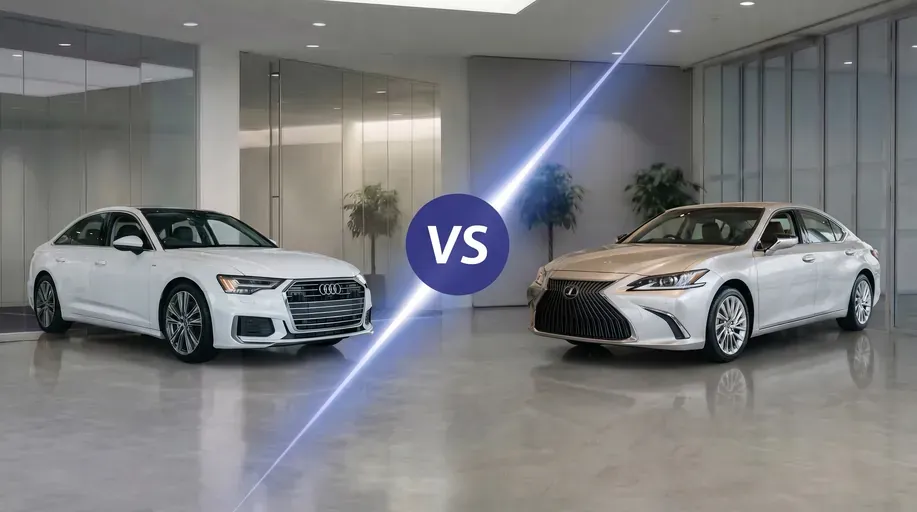
Car battle
Audi A6 vs. Lexus ES: Complete comparison 2026
Audi A6 vs. Lexus ES: A detailed comparison of premium sedans. Discover the differences in comfort, equipment, and reliability, and read our final verdict.
May 16, 2026
Articles
Review
BMW 7 Series (G70) review: real owner experience, i7 electric range, common issues, running costs, and our definitive buying verdict.
October 22, 2026
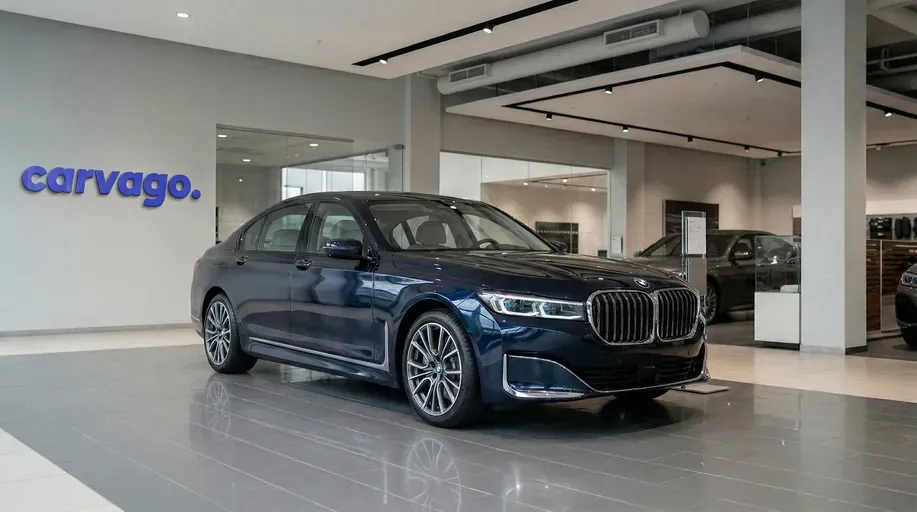
The BMW 7 Series sits at the peak of the Bavarian brand's passenger car lineup as a full-size luxury saloon. This review focuses on the seventh-generation model (G70), which entered series production on 1 July 2022, with initial European customer deliveries beginning in November 2022.
The lineup includes all-electric variants alongside mild-hybrid diesel and plug-in hybrid options, which arrived on European roads in March 2023. A mid-cycle update had its world premiere on 22 April 2026 and entered production on 1 July 2026. European deliveries of the updated all-electric versions began in September 2026, followed by the refreshed plug-in hybrid and diesel variants in autumn 2026.
Designed for executive chauffeur fleets, corporate fleets, and private owners prioritising rear-seat travel, the BMW 7 Series saloon competes directly in the upper luxury class against established European flagships.
The seventh-generation BMW 7 Series, introduced for European buyers in November 2022, represents a complex technological shift toward comprehensive electrification and digital integration. Because the lineup received a mid-cycle update in 2026 with deliveries only beginning in autumn 2026, long-term mechanical durability and extended-mileage reliability for the newest facelifted models are not yet established. Early production years, however, have accumulated sufficient feedback from European driver forums, long-term road tests, and official safety registers to identify recurring software glitches and several critical factory safety recalls.
The most significant safety campaign affecting this generation concerns the integrated electro-hydraulic braking system. Officially registered in April 2024 and updated in January 2025, the campaign covers 1,493,890 vehicles worldwide built between 6 July 2022 and 13 November 2024, spanning combustion models, plug-in hybrids, and the all-electric BMW 7 Series. Official notices state that the hollow shaft of the brake servomotor was not welded correctly, meaning the weld may break under high braking pressure. If failure occurs, ABS and stability control assist are disabled, requiring noticeably higher physical pedal effort and lengthening stopping distances, although mechanical front-axle braking remains intact. Workshops install diagnostic monitoring software that checks sensor integrity, replacing the complete integrated brake module free of charge if anomalies are identified.
Three additional safety recalls demand verification on the second-hand market:
On early production cars built between late 2022 and July 2023, owners frequently report system freezes and unexpected reboots of the curved central display and digital instrument cluster. In several cases, the rear-view parking camera experiences sluggish activation upon selecting reverse. When the interface freezes, occupants are temporarily prevented from adjusting cabin temperature until the unit reboots. Routine over-the-air and workshop-applied operating system updates have largely resolved these glitches.
In the plug-in hybrid BMW 7 Series, official technical service bulletins address spurious charging electronics errors that cause the malfunction indicator lamp to illuminate and interrupt alternating-current charging prematurely. Dealership reprogramming of the combined charging unit resolves the issue in most instances without requiring hardware replacement.
Professional tests and owner reports indicate that models optioned with fully automated power doors can suffer from oversensitive ultrasonic side sensors. The sensors can misinterpret curbs, adjacent vehicles, or painted road markings as hazards, abruptly stalling motorized opening or requiring excessive manual pushing force. Dealership recalibration of the side-sill sensors and latch adjustments typically resolves the issue in reported cases.
The seventh-generation BMW 7 Series arrived in Europe with a multi-powertrain architecture, offering mild-hybrid diesel, petrol plug-in hybrid, and fully electric variants on a single platform. The 2026 facelift refined power outputs across the range and introduced a six-cylinder mild-hybrid petrol model to European showrooms.
| Engine | Fuel | Power | Gearbox | Drivetrain | Model years |
|---|---|---|---|---|---|
| 740d xDrive | Mild-hybrid diesel | 220 kW (300 hp) | 8-speed automatic | All-wheel drive | 2022–2026 |
| 740d xDrive | Mild-hybrid diesel | 230 kW (313 hp) | 8-speed automatic | All-wheel drive | 2026–present |
| 740 xDrive | Mild-hybrid petrol | 294 kW (400 hp) | 8-speed automatic | All-wheel drive | 2026–present |
| 750e xDrive | Plug-in hybrid petrol | 360 kW (490 hp) | 8-speed automatic | All-wheel drive | 2023–2026 |
| 750e xDrive | Plug-in hybrid petrol | 360 kW (489 hp) | 8-speed automatic | All-wheel drive | 2026–present |
| M760e xDrive | Plug-in hybrid petrol | 420 kW (571 hp) | 8-speed automatic | All-wheel drive | 2023–2026 |
| M760e xDrive | Plug-in hybrid petrol | 450 kW (612 hp) | 8-speed automatic | All-wheel drive | 2026–present |
| i7 eDrive50 | Electric | 335 kW (455 hp) | Automatic | Rear-wheel drive | 2023–2026 |
| i7 50 xDrive | Electric | 335 kW (455 hp) | Automatic | All-wheel drive | 2026–present |
| i7 xDrive60 | Electric | 400 kW (544 hp) | Automatic | All-wheel drive | 2022–2026 |
| i7 60 xDrive | Electric | 400 kW (544 hp) | Automatic | All-wheel drive | 2026–present |
| i7 M70 xDrive | Electric | 485 kW (660 hp) | Automatic | All-wheel drive | 2023–2026 |
| i7 M70 xDrive | Electric | 500 kW (680 hp) | Automatic | All-wheel drive | 2026–present |
Long-distance motorway travel
For frequent cross-country journeys and high annual mileages, the diesel BMW 7 Series in 740d xDrive specification remains the most practical choice. Its smooth inline-six diesel engine pairs with an integrated starter-generator to deliver relaxed cruising and extended non-stop highway range, avoiding the charging stops required by fully electric alternatives.
Town driving and mixed commuting
Drivers who primarily cover urban routes alongside regular regional trips are best served by the hybrid BMW 7 Series models, particularly the 750e xDrive. With access to regular home or workplace charging, it operates quietly in electric mode around town while preserving petrol power for long journeys. Urban and suburban drivers committed to pure electric power will find the rear-wheel-drive i7 eDrive50 on the used market or the newer i7 50 xDrive well suited to daily commuting.
Towing and high performance
For drivers who need to tow trailers or horseboxes, the 740d xDrive offers the highest braked towing capacity in the lineup, making it the preferred choice for heavy hauling. If high-speed overtaking is the priority, the plug-in hybrid M760e xDrive combines six-cylinder petrol response with an electric motor for rapid mid-range acceleration, while the electric BMW 7 Series flagship i7 M70 xDrive provides immediate electric launch and standard all-wheel traction.
For recurring mechanical faults, electrical charging issues, and manufacturer recall campaigns affecting these powertrains, refer to the dedicated owner experiences section.
The seventh-generation BMW 7 Series saloon is offered exclusively in a single long-wheelbase body style, prioritising executive passenger comfort over general cargo utility. Rear legroom and headroom are expansive, allowing tall occupants to stretch out comfortably in plush armchair-style seating. When equipped with the optional reclining lounge configuration, the front passenger seat tilts and glides forward, transforming the rear passenger side into a near-flat resting environment. Practicality for bulk cargo, however, remains limited. The rear seatbacks are entirely fixed and do not fold down to expand the luggage area, so carrying longer items depends solely on the standard through-loading ski hatch behind the centre armrest. The boot compartment is wide and well-shaped, though electrified variants sacrifice some luggage space to underfloor battery and motor packaging.
| Dimension / Capacity | Mild-Hybrid (Petrol / Diesel) | Plug-In Hybrid | All-Electric (i7) |
|---|---|---|---|
| Length | 5,391 mm (2022–2026) / 5,395 mm (from 2026) | 5,391 mm (2022–2026) / 5,395 mm (from 2026) | 5,391 mm (2022–2026) / 5,395 mm (from 2026) |
| Width (excluding door mirrors) | 1,950 mm | 1,950 mm | 1,950 mm |
| Height | 1,544 mm (2022–2026) / 1,550 mm (from 2026) | 1,544 mm (2022–2026) / 1,550 mm (from 2026) | 1,544 mm (2022–2026) / 1,550 mm (from 2026) |
| Wheelbase | 3,215 mm | 3,215 mm | 3,215 mm |
| Boot capacity (seats upright / folded) | 540 l / non-folding | 525 l / non-folding | 500 l / non-folding |
The BMW 7 Series prioritises travel comfort over sporting sharpness. Standard adaptive air suspension absorbs broken tarmac and undulating motorways smoothly, isolating occupants from coarse road textures. Steering is accurate and high-speed stability is secure, aided by standard rear-axle steering. However, testers note that the saloon's sheer size and substantial weight remain noticeable during rapid direction changes or in narrow city streets. Cabin acoustic insulation is thorough across all powertrains, keeping wind and road noise subdued at sustained motorway speeds.
Inside, the BMW 7 Series saloon earns praise for solid craftsmanship, plush materials, and armchair-style seat comfort, though the front seats offer modest lateral bolstering in tighter corners. Criticism centres on control ergonomics: physical ventilation switches were replaced by nested touchscreen menus, the illuminated interaction bar can produce reflections in the side mirrors at night, and thick rear pillars compromise over-the-shoulder visibility.
Road testers agree that the chassis comfort and acoustic isolation provide traditional limousine relaxation. Opinions diverge slightly on low-speed manoeuvrability: some find the rear-wheel steering effective in tight spaces, while others point out that its modest turning angle creates a wider turning circle than dedicated electric rivals with more aggressive steering setups. The mid-cycle update retains this supple ride and quiet cruising character, leaving vehicle mass as the main limitation in brisk driving.
All the market charts in this section are drawn from Carvago’s listings of the entire BMW 7 Series model family, including earlier generations represented in the data, rather than the reviewed generation alone. Because listings are grouped strictly by production year, the dataset does not establish a separate price level specifically for the newest generation. Across the available offerings, the median asking price stands at €52,900 for 2019 models, €97,900 for 2023 cars, and €125,200 for 2026 examples. These figures describe the current asking price distribution across varied specifications, rather than tracking value changes over time.
Active listings for the BMW 7 Series ranged from a high of 585 cars in April 2026 to a low of 484 in August 2026. The chart below tracks these monthly advertised totals through to September 2026.
Active listings over time
| Month | BMW 7 Series |
|---|---|
| 2026-04 | 585 |
| 2026-05 | 560 |
| 2026-06 | 572 |
| 2026-07 | 550 |
| 2026-08 | 484 |
| 2026-09 | 546 |
Source Carvago
Buyers typically have around 500 to 600 advertised cars to choose from across the market, with overall availability rebounding to 546 listings in September 2026 after dipping late in the summer.
Among listings advertised today, the median asking price of cars built in 2019 is €52,900, while the median asking price of cars advertised today and built in 2026 is €125,200. The chart below illustrates how these median figures compare across each build year.
Median advertised price by year of manufacture
| Model year | BMW 7 Series |
|---|---|
| 2019 | 52 900 |
| 2020 | 58 900 |
| 2021 | 61 200 |
| 2022 | 68 400 |
| 2023 | 97 900 |
| 2024 | 100 000 |
| 2025 | 100 000 |
| 2026 | 125 200 |
Source Carvago
Buyers exploring older builds will find a median asking price of €52,900 for 2019 and €68,400 for 2022. Those considering newer options face a median asking price of €97,900 for 2023, with both 2024 and 2025 listings standing at €100,000.
This depreciation curve shows how the model's residual value declines with vehicle age, losing roughly 21% in the first year and 32% by age three. The chart below illustrates how this drop progresses across the first seven years.
Residual value by vehicle age
| Vehicle age | BMW 7 Series |
|---|---|
| New | 126 800 |
| 1 yr | 100 700 |
| 2 yrs | 90 500 |
| 3 yrs | 86 500 |
| 4 yrs | 55 400 |
| 5 yrs | 49 200 |
| 6 yrs | 46 300 |
| 7 yrs | 40 400 |
Source Carvago
Over seven years, the model sheds roughly 68% of its initial residual value. The steepest drop occurs between age three and age four, after which annual losses moderate considerably.
From April to September 2026, petrol consistently represented the highest number of active listings, starting at 319 cars in April and finishing at 253 in September. The chart below shows how the monthly advertised counts shifted across each powertrain.
Supply composition by fuel type
Petrol
Diesel
Hybrid
| Month | Petrol | Diesel | Hybrid |
|---|---|---|---|
| 2026-04 | 319 | 76 | 190 |
| 2026-05 | 270 | 74 | 216 |
| 2026-06 | 293 | 68 | 211 |
| 2026-07 | 287 | 65 | 198 |
| 2026-08 | 240 | 60 | 184 |
| 2026-09 | 253 | 60 | 233 |
Source Carvago
In September 2026, petrol models led the market with 253 listings, closely followed by hybrid versions at 233, while diesel accounted for 60. Buyers will find the greatest availability among petrol and hybrid cars, with diesel offering a distinctly narrower selection.
Between April 2026 and September 2026, the average asking price for BMW 7 Series listings fluctuated between €51,100 and €55,900, starting the period at €51,500.
Average price development over time
| Month | BMW 7 Series |
|---|---|
| 2026-04 | 51 500 |
| 2026-05 | 55 900 |
| 2026-06 | 53 600 |
| 2026-07 | 51 100 |
| 2026-08 | 52 700 |
| 2026-09 | 55 500 |
Source Carvago
Across the six months, the average moved from €51,500 to €55,500, showing a net rise of roughly 8% despite noticeable dips in June and July.
Supple air-sprung ride comfort and subdued cabin noise at motorway speeds
Expansive rear-seat legroom and head space provided by the standard long wheelbase
Broad powertrain selection spanning mild-hybrid diesel, plug-in hybrid, and pure electric models
Fixed rear seatbacks do not fold down, limiting cargo expansion to the ski hatch
Enormous footprint and heavy vehicle mass demand caution in tight spaces
Major safety recalls on braking modules and starter motors require VIN verification
The 740d xDrive in the diesel BMW 7 Series lineup is the most practical choice due to its cruising refinement and extended highway range without electric charging stops. Buyers must ensure, however, that factory recall work on the starter motor and integrated brake system has been verified by VIN.
Early builds experienced curved display freezes and slow camera activation, which operating system updates have largely addressed. Long-term mechanical durability for the newest facelifted models remains unproven, making a verified service history and recall check essential.
Verify through dealer records that official recalls for the integrated brake module, starter motor assembly, and steering spindle have been carried out for the vehicle's VIN. Testing the optional automated doors for sensor obstruction and inspecting the rear tyres for uneven inner-shoulder wear is also recommended.
Cargo flexibility is limited because the rear seatbacks are completely fixed and do not fold down, leaving only the central ski hatch for longer items. Electrified variants also sacrifice a portion of boot volume to underfloor components.
Sources: press.bmwgroup.com, adac.de, ec.europa.eu, kba.de, autocar.co.uk
This article was prepared using artificial intelligence tools. The section guarantor is Petr Dušek.
Audi A6 vs. Lexus ES: A detailed comparison of premium sedans. Discover the differences in comfort, equipment, and reliability, and read our final verdict.
May 16, 2026
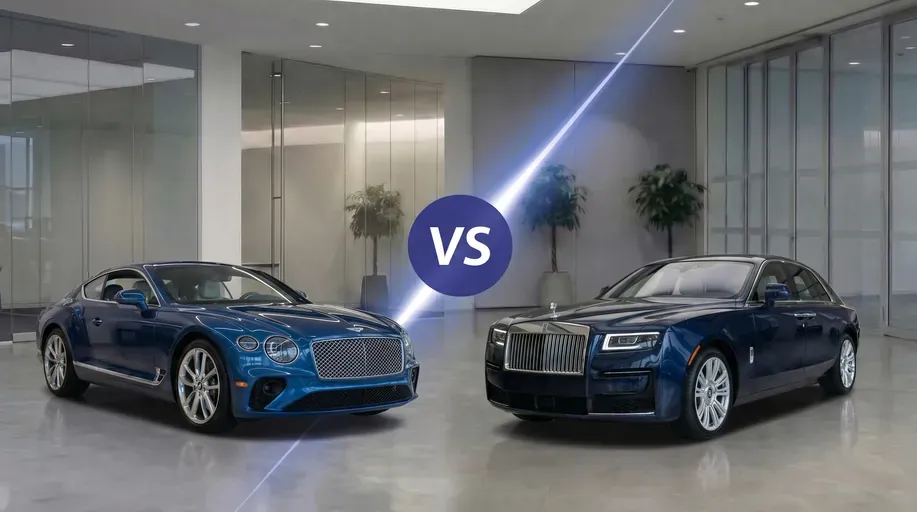
Bentley Continental GT vs Rolls-Royce Ghost. A detailed comparison of British luxury. Discover the differences in comfort, equipment, driving characteristics, and our verdict.
Oct 16, 2026
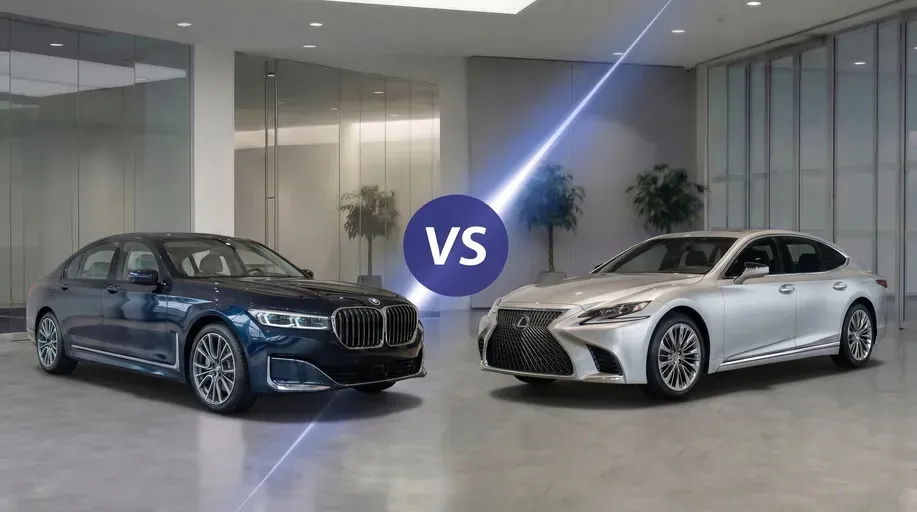
Comparison of used BMW 7 Series vs Lexus LS luxury sedans. Discover key differences in comfort, equipment, and reliability. Read our clear verdict before you buy!
Oct 22, 2026