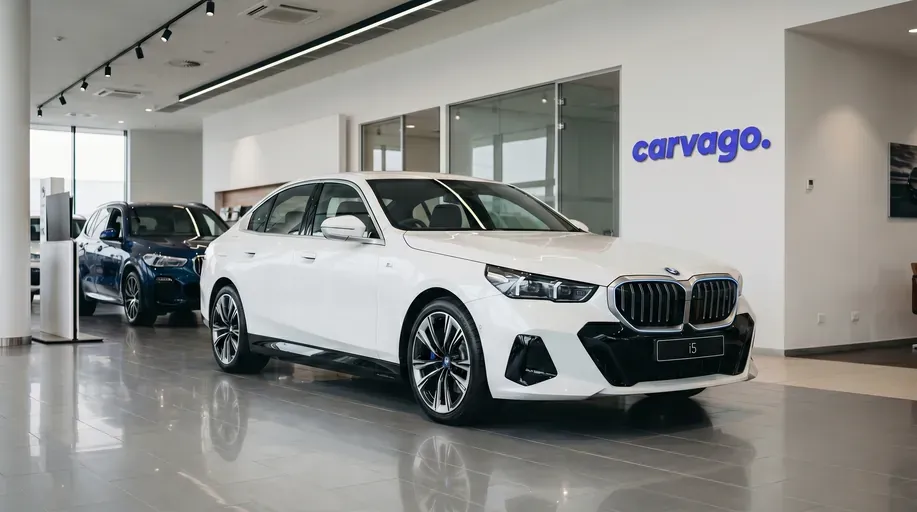
Review
Review BMW i5: What do owners and experts really say?
BMW i5 review: real owner experience, electric range, practicality, running costs, and expert verdict — everything you need before you buy.
Oct 22, 2026
Audi e-tron GT review: real owner experiences, real-world range, common faults, and running costs. Everything you need to know before buying.
November 8, 2026

The Audi e-tron GT is the brand's flagship four-door grand tourer, competing in the upper-executive electric segment. This review covers the first-generation model, which entered production in December 2020 at Audi Böllinger Höfe, followed by first customer deliveries in Europe in May 2021. Built exclusively as a low-slung, four-door saloon, it combines long-distance grand-touring usability with sports-car proportions.
A comprehensive mid-cycle update was premiered with European order books opening on 18 June 2024, followed by production start and first showroom arrivals in July 2024. This facelift reworked the model portfolio into the S e-tron GT, the revised RS e-tron GT, and the new RS e-tron GT performance, introducing refreshed exterior styling, revised suspension options, and revised battery and powertrain hardware. On 13 May 2025, Audi reopened orders for an accessible base quattro variant to complete the updated range.
On the European pre-owned market, the electric Audi e-tron GT primarily attracts company car drivers, executive commuters, and private enthusiasts looking for high cross-country cruising capability and distinctive design without sacrificing standard four-door practicality.
Real-world ownership of the Audi e-tron GT centres largely around its complex high-voltage electrical hardware and chassis engineering. While long-term reliability on high-mileage examples is still developing, early production years required several official workshop visits to resolve high-profile recalls, alongside recurring electronic gremlins documented by owners and fleet tests across Europe.
The most critical issues on the electric Audi e-tron GT involve official safety campaigns concerning the braking system and high-voltage traction pack. In July 2024, a worldwide recall covering 35,370 vehicles built between 2020 and 12 June 2024 was initiated because front-axle brake hoses can develop tears and fatigue cracks over time from tight bending radii. This leakage can disable the front hydraulic brake circuit while leaving rear braking intact; workshops fit redesigned hoses featuring an increased bending radius. High-voltage battery modules also faced multiple recall tranches across 2024 and early 2025 for cars produced between 9 January 2020 and 16 February 2024, addressing cell manufacturing anomalies that pose an increased fire risk. Remedial action involves automated diagnostic screening and replacing anomalous modules, alongside diagnostic software updates. An earlier campaign launched in autumn 2023 addressed potential moisture ingress into the battery housing on cars produced from September 2022 to June 2023, requiring airtightness checks and battery replacements where necessary.
Air suspension hardware has also been the subject of targeted factory interventions. In September 2025, an EU Safety Gate recall was issued for vehicles produced between 25 June 2024 and 31 March 2025 due to a manufacturing defect within the air suspension system that may lead to a single-sided drop in vehicle level, potentially limiting strut function and compromising driving dynamics. Authorised dealers inspect and replace defective strut assemblies. Earlier, a batch of vehicles produced between 31 August 2021 and 7 September 2021 was recalled to check and replace front left air spring struts due to a manufacturing discrepancy. Additionally, a March 2022 recall for vehicles built between February and August 2021 remedied incorrectly routed centre rear seat belt sensor wiring that risked contacting the right rear ISOFIX mounting.
| Campaign Subject | Affected Production Window | Geographic Reach | Workshop Remedy |
|---|---|---|---|
| Front Brake Hoses | 2020 – 12 June 2024 | Worldwide (35,370 cars) | Replace front hoses and brackets with revised wider-radius parts |
| Battery Cell Defects | 9 January 2020 – 16 February 2024 | Worldwide (7,697 cars) | Diagnostic evaluation, module replacement if anomalous, software flash |
| Battery Sealing / Moisture | September 2022 – June 2023 | Europe | Airtightness check; battery replacement if moisture is present |
| Air Suspension Level Drop | 25 June 2024 – 31 March 2025 | European Union | Inspect strut assemblies and replace defective air suspension components |
| Centre Belt Sensor Wiring | February 2021 – August 2021 | Europe | Inspect wiring harness for damage; reroute and secure away from ISOFIX |
Beyond official recalls, owners report several recurring component failures. A frequent complaint during winter involves the high-voltage PTC inline coolant heater. Tests and owner forums describe instances of lost cabin heating and windscreen demisting capabilities, which require replacement of the heater matrix. Another reported issue involves the 12-volt auxiliary lithium-iron-phosphate battery discharging when power management systems fail to enter deep sleep during prolonged parking, prompting electrical system malfunction warnings or preventing the car from starting. Dealers address this via control module software updates to ensure float charging from the main battery, or by replacing depleted 12-volt units. Finally, drivers frequently report occasional central touchscreen freezes or reboot loops, which can temporarily be cleared via a hard reset before requiring dealer software updates.
The electric Audi e-tron GT is powered exclusively by a dual-motor, all-wheel-drive setup pairing a single-speed transmission on the front axle with a two-speed automatic gearbox on the rear axle. The lineup covers standard, S, and high-performance RS models across both pre-facelift and facelift production runs.
| Engine | Fuel | Power | Gearbox | Model years |
|---|---|---|---|---|
| e-tron GT quattro | Electric | 350 kW / 476 hp (Boost: 390 kW / 530 hp) | 2-speed automatic | 2021–2024 |
| RS e-tron GT | Electric | 440 kW / 598 hp (Boost: 475 kW / 646 hp) | 2-speed automatic | 2021–2024 |
| e-tron GT quattro | Electric | 370 kW / 503 hp (Boost: 430 kW / 585 hp) | 2-speed automatic | 2025–present |
| S e-tron GT | Electric | 435 kW / 592 hp (Boost: 500 kW / 679 hp) | 2-speed automatic | 2024–present |
| RS e-tron GT | Electric | 500 kW (Boost: 630 kW / 856 hp) | 2-speed automatic | 2024–present |
| RS e-tron GT performance | Electric | 620 kW / 843 hp (Boost: 680 kW / 925 hp) | 2-speed automatic | 2024–present |
On the used market, the pre-facelift e-tron GT quattro represents the most balanced choice for mixed daily driving and long-distance travel, offering more than enough performance for brisk overtaking without the hefty used price tag of the pre-facelift RS e-tron GT. For buyers considering newer iterations, the facelifted S e-tron GT acts as the sweet spot in the range, delivering composed grand-touring performance. The RS e-tron GT and the RS e-tron GT performance remain dedicated choices for enthusiasts prioritizing sheer straight-line acceleration and launch response.
In urban traffic, every version behaves smoothly because the two-speed rear gearbox defaults to second ratio at lower speeds to avoid abrupt steps, although the vehicle’s substantial width requires care in narrow streets. Towing is not possible with any Audi e-tron GT, as the vehicle lacks manufacturer type approval for trailers and has no towbar option.
For detailed reliability observations and known high-voltage powertrain issues, consult the owner experiences section of this review.
Real-world range varies significantly between seasons. In winter driving, owners report noticeable efficiency loss caused by battery thermal management and cabin heating demands. High-speed motorway travel also accelerates consumption due to aerodynamic drag at sustained pace.
Long-distance travel is supported by an 800-volt electrical architecture that allows rapid direct-current charging when using ultra-fast charging hubs. Achieving maximum charging speeds relies on route-based battery preconditioning via the navigation system; arriving at a high-power charger with a cold battery in winter leads to slower initial charge acceptance until the pack warms up.
| Dimension | Pre-facelift (2021–2024) | Facelift (2024–present) |
|---|---|---|
| Length (mm) | 4,989 | 4,997–5,004 |
| Width without mirrors (mm) | 1,964 | 1,964 |
| Height (mm) | 1,396–1,413 | 1,379–1,396 |
| Wheelbase (mm) | 2,898–2,900 | 2,900 |
| Boot capacity, seats up / folded (l) | 405 (350 with premium audio) / — | 405 (350 with premium audio) / — |
| Front luggage compartment (l) | 81 | 77–81 |
Note: Figures reflect factory specifications; rear cargo capacity is reduced on models fitted with the optional premium sound system (standard on RS models) due to sub-floor audio equipment. The manufacturer does not state an official maximum volume for folded rear seats.
The Audi e-tron GT sedan prioritises a low-slung grand touring silhouette over sheer interior versatility. Its cabin uses a four-plus-one seating arrangement, though the narrow middle position is practical only for brief journeys. Getting in and out of the rear row requires some care due to the low roofline and tapering door openings. Once inside, legroom is sufficient thanks to recesses carved into the underfloor battery housing, but the sweeping roof profile noticeably restricts headroom for taller passengers. Everyday utility benefits from the dedicated front compartment, which neatly stores charging cables to keep the main luggage area clear. The rear backrest folds in a three-way split with an integrated load-through hatch for carrying longer items, though the saloon boot opening remains relatively shallow.
On the road, the electric Audi e-tron GT prioritises long-distance cruising comfort over outright track aggression. Professional testers consistently praise its primary ride, which filters broken pavement and motorway expansion joints with far greater suppleness than firmer rivals. The steering feels stable and predictable at pace, offering high grip levels, though it lacks the sharp feedback and agility of its platform-shared Porsche sibling. Some testers note slight float over deep compressions on air suspension. Cabin noise isolation is thorough, keeping wind and road rumble subdued, although electric drive motors emit an audible mechanical whine under maximum acceleration.
Inside, the Audi e-tron GT wins approval for its driver-focused cockpit and physical climate control buttons, avoiding the distracting digital menus found elsewhere. Upper interior trim feels solid, and the supportive front bucket seats hold occupants firmly. However, testers criticise the unpadded hard plastics on the lower dashboard and console, as well as integrated front headrests that lack individual adjustment.
Where testers agree is on its refined touring character; they disagree on whether the helm feels engaging or simply detached. The facelift refined chassis behaviour further with an optional active suspension setup, virtually eliminating body roll in bends while preserving ride compliance.
All charts in this section are drawn from Carvago listings across the wider model family, including every generation represented in the data, rather than exclusively reflecting the reviewed generation. Across the advertised model years, the median asking price for an electric Audi e-tron GT spans from €54,200 for 2022 cars to €103,200 for 2026 builds. Early manufacturing runs from 2021 sit at a median of €58,800, whereas 2023 examples settle around €57,900, reflecting strong supply from initial corporate leasing cycles. From 2024 onwards, median prices climb significantly to €91,900 and reach €102,900 for 2025, capturing late pre-facelift models and the arrival of extensively updated variants.
Between May 2026 and October 2026, active Audi e-tron GT listings declined from 630 to 484 cars on the market. The following chart illustrates the month-by-month count of advertised vehicles over this span.
Active listings over time
| Month | Audi e-tron GT |
|---|---|
| 2026-05 | 630 |
| 2026-06 | 569 |
| 2026-07 | 541 |
| 2026-08 | 527 |
| 2026-09 | 528 |
| 2026-10 | 484 |
Source Carvago
While the volume of advertised cars moved downward from 630 to 484 over these months, buyers can still expect a broad selection of vehicles to choose from across the market.
The median asking price of cars advertised today, built in 2021, is €58,800, while the median asking price of cars advertised today, built in 2026, is €103,200. The comparison across build years does not follow a continuous upward pattern, as 2022 models are advertised at lower figures than 2021 models before a sharp step up in 2024.
Median advertised price by year of manufacture
| Model year | Audi e-tron GT |
|---|---|
| 2021 | 58 800 |
| 2022 | 54 200 |
| 2023 | 57 900 |
| 2024 | 91 900 |
| 2025 | 102 900 |
| 2026 | 103 200 |
Source Carvago
Buyers exploring 2021 through 2023 models see median asking prices among current listings spanning between €54,200 and €58,800. For 2024 to 2026 build years, median asking prices among current listings are noticeably higher, running from €91,900 to €103,200.
This depreciation curve illustrates how the model's residual value falls as vehicle age increases. The decline is steepest in the initial years, with the car losing roughly 45% of its original value by age three.
Residual value by vehicle age
| Vehicle age | Audi e-tron GT |
|---|---|
| New | 105 200 |
| 1 yr | 86 400 |
| 2 yrs | 71 100 |
| 3 yrs | 58 200 |
| 4 yrs | 53 100 |
| 5 yrs | 48 500 |
| 6 yrs | 47 700 |
| 7 yrs | 42 300 |
Source Carvago
Across the full seven-year span recorded, the model sheds approximately 60% of its initial residual value, retaining around 40%. The pace of annual value loss slows markedly after the third year, with the smallest drop occurring between ages five and six.
Across the six months shown, electric listings moved from 630 advertised cars in May 2026 to 484 in October 2026, while all other fuel types recorded 0 listings. The figures below show how the available powertrain options split across each recorded month.
Supply composition by fuel type
| Month | Electric |
|---|---|
| 2026-05 | 630 |
| 2026-06 | 569 |
| 2026-07 | 541 |
| 2026-08 | 527 |
| 2026-09 | 528 |
| 2026-10 | 484 |
Source Carvago
Electric vehicles account for the entire advertised selection, meaning prospective buyers will exclusively encounter all-electric models when browsing the market.
Between May 2026 and October 2026, the average asking price for the Audi e-tron GT moved from €65,100 down to €61,900, as shown in the monthly figures below.
Average price development over time
| Month | Audi e-tron GT |
|---|---|
| 2026-05 | 65 100 |
| 2026-06 | 63 100 |
| 2026-07 | 62 600 |
| 2026-08 | 62 500 |
| 2026-09 | 62 100 |
| 2026-10 | 61 900 |
Source Carvago
Across these six months, the average asking price declined by roughly 5% overall, with the largest step occurring between May and June before easing into smaller decreases through October.
Supple ride comfort and thorough cabin noise isolation on long journeys
Driver-focused cockpit retaining physical climate control buttons
Dedicated front luggage compartment keeps charging cables out of the boot
Safety recalls affecting brake hoses and battery cells require verification by VIN
Restricted rear headroom and narrow door apertures for taller passengers
Complete lack of towing capability or factory towbar option
Early production years required safety recalls for front brake hoses and battery modules, though ongoing reliability is still developing. When considering a used Audi e-tron GT, check the VIN to confirm all recall remedies were performed.
The pre-facelift e-tron GT quattro offers the most balanced performance and daily usability without the price premium of the RS models. For newer examples, the facelifted S e-tron GT represents the sweet spot in the updated range.
Test that the high-voltage cabin heater produces warm air from a cold start, and inspect tyres for heavy inner-shoulder wear. You should also ensure the central touchscreen operates without freezing or rebooting.
No, the Audi e-tron GT lacks manufacturer type approval for towing and cannot be fitted with a towbar.
Sources: audi.com, adac.de, ec.europa.eu, check-vehicle-recalls.service.gov.uk, autocar.co.uk
This article was prepared using artificial intelligence tools. The section guarantor is Petr Dušek.
BMW i5 review: real owner experience, electric range, practicality, running costs, and expert verdict — everything you need before you buy.
Oct 22, 2026
Porsche Taycan vs. Tesla Model S: Which electric car is better? We compared real-world range, performance, and equipment. Read our verdict and make your choice easier.
Apr 14, 2026
Detailed comparison of Audi e-tron GT vs. BMW i5. Discover the differences in performance, range, and equipment. Read our verdict and choose the best electric car.
May 20, 2026