Audi Q4 e-tron vs. Mercedes-Benz EQA: Complete comparison 2026
Comparison: Audi Q4 e-tron vs. Mercedes-Benz EQA. Discover the real-world range, differences in equipment, and our clear verdict for choosing the right premium used SUV.
Apr 13, 2026
Articles
Car battle
Undecided between a Volvo XC40 and a VW T-Roc? Our comparison will help you choose. Discover the main differences, real-world impressions, and a clear verdict.
April 14, 2026


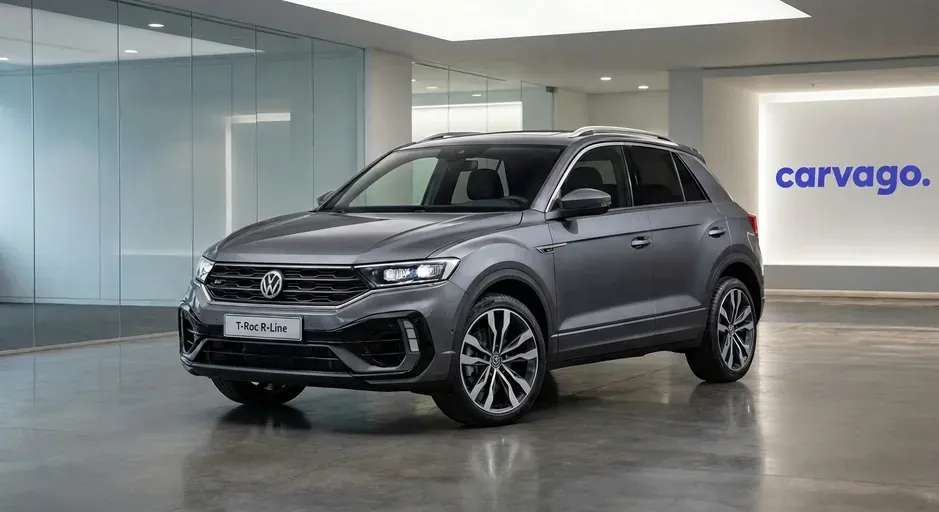
The Volvo XC40 enters the scene as a premium compact SUV that embodies Scandinavian design, luxury, and renowned safety. Against it stands the Volkswagen T-Roc, a stylish and dynamic crossover designed to captivate in the urban jungle with its practicality and playful character. Let's take a detailed look at how these two titans in the compact SUV category stack up against each other.
Looking at the exterior dimensions, it is immediately clear that the Volvo XC40 and the Volkswagen T-Roc are in slightly different leagues, although both are compact SUVs. The Volvo is larger in all key parameters, indicating its premium focus with an emphasis on space and comfort. The T-Roc, on the other hand, is more down-to-earth, and its more compact body promises better agility, especially in an urban environment.
With a length of over 4.4 metres, the XC40 is a noticeable 20 centimetres longer than the T-Roc. This difference is most evident in the wheelbase, where the Volvo offers more than 10 centimetres of extra distance between the wheels. In practice, this means significantly more legroom for rear-seat passengers and a generally airier cabin. The longer wheelbase also contributes to better driving stability on the motorway. For families looking for maximum interior space, the XC40 is the clear favourite.
The differences continue in width and height. The Volvo is more than 4 cm wider and almost 8 cm taller, giving it a more robust stance and a better view for the occupants. You'll appreciate the extra shoulder room, especially when travelling with five people. The more compact T-Roc is therefore more agile in narrow streets and easier to park, making it an ideal city companion that won't get lost on longer journeys.
| Parameter | Volvo XC40 SUV | Volkswagen T-Roc SUV |
|---|---|---|
| Length (mm) | 4425 - 4440 | 4234 - 4241 |
| Width (mm) | 1863 | 1819 |
| Height (mm) | 1647 - 1652 | 1559 - 1584 |
| Wheelbase (mm) | 2702 | 2590 - 2594 |
The practicality and size of the luggage compartment are key in the compact SUV segment. And this is where the Volvo XC40 and the Volkswagen T-Roc differ more than it might seem at first glance. While the T-Roc entices with a larger basic volume on paper for front-wheel-drive versions, the Volvo counters with a more balanced offering across all variants and smarter use of space.
The Volkswagen T-Roc in front-wheel drive offers an above-average 445 litres in its class. That's enough space for a family holiday or for transporting bulkier items. However, the crucial turning point comes with the 4MOTION all-wheel-drive versions, where the boot shrinks to a noticeably smaller 392 litres due to the technology under the floor. This difference needs to be considered if all-wheel drive is a priority for you. With the seats folded down, the T-Roc offers a maximum of 1290 litres (for FWD) and 1237 litres (for 4x4). In the used car market, you can also find a specific convertible version, which logically has the smallest boot with a volume of just 284 litres.
On the other hand, the Volvo XC40 approaches practicality more consistently. Most combustion versions (petrol and diesel) offer a solid 452 litres (around 433 litres in older model years), regardless of whether you have the front-wheel or all-wheel-drive version. Volvo does not penalise those interested in AWD by reducing the boot size. The exceptions are the electrified variants – plug-in hybrids have a reduced boot size of 405 litres. Folding down the rear seats creates a space of up to 1328 litres, which means the Volvo slightly surpasses its German rival and confirms its reputation as a practical car.
| Parameter | Volvo XC40 (FWD/AWD) | Volkswagen T-Roc (FWD) | Volkswagen T-Roc (AWD) |
|---|---|---|---|
| Basic volume (litres) | 452 | 445 | 392 |
| Maximum volume (litres) | 1328 | 1290 | 1237 |
The ability to tow a trailer is a key parameter for an SUV, and in this respect, the Volvo XC40 clearly beats its German competitor. If you plan to regularly hitch up a caravan, a boat trailer or other heavy loads, the Swedish model offers significantly higher limits that give you more flexibility.
The Volvo XC40, in more powerful specifications such as the D4 diesel (140 kW) or the T5 and B5 petrol (182-184 kW), boasts a maximum braked trailer weight of up to 2100 kg. This is a figure that stands out in its class and can easily handle a larger family caravan. The T4 and T5 plug-in hybrid versions also do very well, managing a respectable 1800 kg. The basic petrol engines like the T2 and T3 still offer a solid 1600 kg. The electric variants can then tow 1500 to 1800 kg depending on the version.
The Volkswagen T-Roc is much more modest in this discipline. Its top versions, typically with the 2.0 TDI or 2.0 TSI engine (including the sporty R model), have a limit most often set at 1700 kg, with older specifications managing up to 1800 kg. The popular 1.5 TSI engine can tow a 1500 kg trailer, and the basic one-litre three-cylinder 1.0 TSI has to make do with 1300 kg. The T-Roc is fine for towing a light unbraked trailer for garden waste, but its capacity is limited for heavier trailers.
In short, for those for whom towing power is a priority, the Volvo XC40 is clearly the better choice. It offers higher limits across almost the entire engine range, making it a more versatile and capable partner for demanding tasks.
| Model and Engine | Braked trailer weight (kg) | Unbraked trailer weight (kg) |
|---|---|---|
| Volvo XC40 T3/B3 (approx. 120 kW) | 1600 | 750 |
| Volvo XC40 D4/B4/B5 (approx. 140-184 kW) | 1800 - 2100 | 750 |
| Volvo XC40 Recharge Plug-in Hybrid | 1800 | 750 |
| Volkswagen T-Roc 1.0 TSI (approx. 81 kW) | 1300 | 650 - 710 |
| Volkswagen T-Roc 1.5 TSI (110 kW) | 1500 - 1600 | 660 - 730 |
|---|---|---|
| Volkswagen T-Roc 2.0 TDI (110 kW) | 1600 - 1700 | 750 |
When it comes to engine choices, the paths of the Volvo XC40 and Volkswagen T-Roc diverge significantly. While Volvo bets on a broad and technologically advanced range including mild-hybrids, plug-in hybrids, and purely electric versions, Volkswagen sticks to its proven and efficient lineup of TSI petrol and TDI diesel engines. This differing philosophy fundamentally influences which driver each vehicle is better suited for.
The Volvo XC40 offers one of the most diverse engine ranges in its class. On the used car market, you will encounter older pure petrol (designated as T) and diesel (D) engines. However, these were gradually replaced by more modern mild-hybrid variants (B), which reduce fuel consumption and emissions. For those interested in maximum urban savings, the key options are the plug-in hybrid versions (Recharge T4 and T5), which combine a three-cylinder petrol engine with an electric motor, allowing for dozens of kilometers on pure electricity. The range is crowned by the fully electric variants (Recharge), which make the XC40 a quiet and dynamic companion for the city and longer journeys—an advantage the T-Roc cannot offer.
Selected Volvo XC40 Engines (2018–2024 Generation)
| Engine | Fuel | Power (kW) | Torque (Nm) | Transmission |
|---|---|---|---|---|
| T3 (1.5) | Petrol | 120 | 265 | 6MT/8AT |
| B3 (2.0 MHEV) | Mild-Hybrid | 120 | 265 | 7DSG |
| B4 (2.0 MHEV) | Mild-Hybrid | 145 | 300 | 7DSG/8AT |
| D3 (2.0) | Diesel | 110 | 320 | 6MT/8AT |
| Recharge T5 | Plug-in Hybrid | 193 | 425 | 7DSG |
| Recharge (EV) | Electric | 170 | 330 | 1-speed Automatic |
*Note: On the used car market, you may also encounter other performance variants, such as the T2, T4, T5 petrol engines or the D4 diesel. Over time, the combustion engines were fully replaced by mild-hybrid and electric versions.
The Volkswagen T-Roc opts for a more conservative, yet time-tested strategy. The foundation is the economical three-cylinder 1.0 TSI, ideal for urban and suburban driving. The most popular choice is the four-cylinder 1.5 TSI with 110 kW, which represents an excellent compromise between performance and fuel economy. For drivers who cover long distances, the 2.0 TDI diesel engine is available in several power outputs. At the top of the range is the sporty T-Roc R version with a powerful two-litre TSI, 4MOTION all-wheel drive, and 221 kW (300 hp), making it a "hot-hatch" in an SUV body. The 4MOTION all-wheel drive is also available for the more powerful versions of the 2.0 TSI and 2.0 TDI engines.
Selected VW T-Roc Engines (2017–2024 Generation)
| Engine | Fuel | Power (kW) | Torque (Nm) | Transmission |
|---|---|---|---|---|
| 1.0 TSI | Petrol | 81 | 200 | 6MT |
| 1.5 TSI | Petrol | 110 | 250 | 6MT/7DSG |
| 2.0 TSI 4MOTION | Petrol | 140 | 320 | 7DSG |
| 2.0 TDI | Diesel | 110 | 360 | 7DSG |
| R 2.0 TSI 4MOTION | Petrol | 221 | 400 | 7DSG |
*Note: In the first years of production, a 1.6 TDI diesel engine was also available, which was later replaced by a more economical and powerful version of the 2.0 TDI engine.
Choosing the right engine is absolutely crucial for long-term satisfaction with a car. It's not just about straight-line performance, but about the overall harmony with the vehicle's character. Our recommendations are therefore based on a combination of dynamics, real-world fuel consumption, owner feedback, and mechanical reliability. Volvo and Volkswagen approach powertrains differently: after 2020, Volvo focused completely on electrification and abandoned diesels, while the T-Roc still offers a proven and wide range of corporate engines, including economical diesel variants.
In the XC40's engine lineup from the years most relevant to the used car market, the B4 version represents the ideal compromise. Whether with front-wheel or all-wheel drive (AWD), this two-litre turbocharged four-cylinder with mild-hybrid technology is the best choice for most drivers. It replaced the older but very similar T4 unit, bringing refinement, sufficient power, and reasonable fuel consumption.
While the basic one-litre three-cylinder is more of an emergency solution for the T-Roc, and the two-litre engines are unnecessarily powerful and expensive, the 1.5 TSI engine with 150 hp is the golden mean and the most sensible choice. This engine is the heart of the range and perfectly matches the car's character – it's sufficiently agile, economical, and refined.
Official fuel consumption figures, measured under laboratory conditions using the WLTP cycle, are one thing, but the reality on the road is often different. That's why we looked at data from drivers themselves, primarily from the German portal Spritmonitor.de, which collects real refuelling data from thousands of owners. These values provide a much better reflection of the running costs you can expect with used cars.
In the following table, we present the average real-world consumption for the most common engine versions of both models from years relevant to the used car market, i.e., from around 2019 onwards.
| Model and Engine | Average Real-World Consumption (l/100 km) |
|---|---|
| Volvo XC40 T3 (1.5 petrol) | 7.8 |
| Volvo XC40 B4 (2.0 mild-hybrid petrol) | 8.2 |
| Volvo XC40 D3 (2.0 diesel) | 6.5 |
| Volkswagen T-Roc 1.0 TSI (1.0 petrol) | 6.4 |
| Volkswagen T-Roc 1.5 TSI (1.5 petrol) | 6.7 |
| Volkswagen T-Roc 2.0 TDI (2.0 diesel) | 5.8 |
The data clearly shows that the Volkswagen T-Roc is the more economical car overall. Its modern petrol engines, especially the popular 1.5 TSI with cylinder deactivation technology, can achieve a very favourable consumption of around 6.7 l/100 km, which is more than a litre less than comparably powerful petrol engines in the Volvo. The premium character and higher weight of the XC40 are reflected in its greater appetite.
The biggest difference is noticeable in the diesel engines. While the 2.0 TDI engine in the T-Roc comfortably stays under six litres in real-world driving, the D3 engine in the Volvo averages around 6.5 litres. For drivers who cover tens of thousands of kilometres per year, the T-Roc represents a significantly cheaper option in terms of fuel costs. For a buyer focused primarily on the lowest possible running costs, the Volkswagen is the clear favourite. On the other hand, if fuel consumption is secondary to comfort and safety for you, the Volvo XC40's higher appetite may not be an obstacle.
When comparing the prices of used cars, the Volvo XC40 and Volkswagen T-Roc are in different price brackets, reflecting their market positions – a premium segment versus a mass-market brand. The availability of both models from 2020 to 2022 is quite broad on the used car market, giving potential buyers a decent range of choices.
The Volkswagen T-Roc is the more affordable option. Used models from 2020–2022 can be purchased for prices starting at around €14,000. For this amount, you'll typically get versions with the basic 1.0 TSI engine and a lower trim level with higher mileage.
As a premium vehicle, the Volvo XC40 holds its value significantly better. Prices for used models from 2020–2022 start at a considerably higher level, typically around €25,000. Even older cars from the start of production (around 2018) rarely drop below €21,000.
| Model | Approximate price range (2020-2022) | Key factors influencing the price |
|---|---|---|
| Volkswagen T-Roc | €14,000 – €29,000 | Engine (1.0 TSI vs. 1.5 TSI/2.0 TDI), trim level (Style vs. R-Line), drive (front vs. 4Motion), mileage |
| Volvo XC40 | €25,000 – €37,000+ | Engine (T3 vs. B4/D4), trim level (Momentum, Inscription, R-Design), mileage, presence of AWD, plug-in hybrid version |
As a result, for the price of a better-equipped T-Roc with a more powerful engine and 4x4 drive, you are more likely to get a basic version of the Volvo XC40. The difference in purchase price is thus one of the main deciding factors between these two cars.
When it comes to safety, both the Volvo XC40 and the Volkswagen T-Roc boast the highest five-star rating from the independent organization Euro NCAP. However, it is crucial to place these results in the proper context. Euro NCAP's testing protocols are constantly becoming stricter, and therefore, percentage results from different years cannot be directly compared. A star earned in a more recent test simply carries more weight.
The Volvo XC40 underwent crash tests in 2018 and came away with an excellent score. With a result of 97% for adult occupant protection, it ranked among the absolute top in its segment. It also performed above average in child occupant protection (87%). Its rating reflects the standards in place in 2018, which already included advanced tests of assistance systems, such as emergency braking with cyclist detection. Although several years have passed since the test, the Volvo brand's reputation and the wide range of safety features supplied as standard guarantee an exceptionally high level of safety.
The Volkswagen T-Roc was tested a year earlier, in 2017, and also easily achieved five stars. In adult occupant protection, it scored just one percent less than the XC40 (96%), and in child protection, it achieved an identical score (87%). This excellent result proves that the T-Roc was also designed with maximum emphasis on safety at the time of its launch. For a used car buyer, it is important to know that this generation also offers a solid foundation of passive and active safety, even though the tests for assistance systems were not as comprehensive then as they are today.
Both cars are among the safest in their class and represent an excellent choice for family use. The Volvo XC40 was tested a year later according to slightly stricter criteria and achieved a top rating in adult protection. However, the Volkswagen T-Roc is only minimally behind and fully matches its rival in child protection. The main difference for a used car buyer is that the standards for testing assistance systems and protecting vulnerable road users have advanced since then. Nevertheless, you can't go wrong with either of these models in terms of safety.
| Parameter | Volvo XC40 | Volkswagen T-Roc |
|---|---|---|
| Year of testing | 2018 | 2017 |
| Adult Occupant Protection | 97 % | 96 % |
| Child Occupant Protection | 87 % | 87 % |
| Vulnerable Road User Protection | 71 % | 79 % |
| Safety Assist Systems | 76 % | 71 % |
In addition to the standard equipment, each model offers several unique features that may be decisive for a potential buyer. While Volvo focuses on premium comfort and clever practicality, Volkswagen concentrates on sporty style and technological customisation.
The Volvo XC40 brings a range of innovative solutions, typical for the brand, to the compact SUV segment. The emphasis is on minimalism, intuitive operation, and maximum safety.
The Volkswagen T-Roc is aimed at drivers looking for a more dynamic appearance and a modern digital environment. It offers a wide range of customisation options and several unique features in its class.
Based on our own CarAudit inspections, breakdown statistics, and owner feedback, we have compiled an overview of the most common problems that used car buyers should look out for. Although both models are considered relatively reliable, neither is flawless.
The Volvo XC40 generally has a reputation as a safe and well-built car, but some areas require extra attention when buying a used one.
Summary for the Volvo XC40: The problems are more related to software and electronics, which can often be resolved with an update. The mechanical parts are reliable with proper maintenance. A thorough check of the service history is an absolute must.
The Volkswagen T-Roc shares many components with other models from the group, which means it has proven technology but also some known and recurring problems.
Summary for the Volkswagen T-Roc: Most of the known problems are of a technical nature and relate to proven but sometimes problematic group components (DSG, 1.5 TSI). A thorough inspection and a documented service history are key to a trouble-free purchase.
When buying a used car, a thorough inspection is key, and these two models are no exception. Although both are considered reliable cars, they have their specific areas that are good to focus on to prevent expensive repairs in the future.
The Volvo XC40 offers a slightly larger basic boot capacity – 460 litres compared to 445 litres in the Volkswagen T-Roc. Overall, the XC40 is also a larger car; it is longer and taller, which translates into a slightly more spacious feel in the cabin. For family needs, the Volvo may be the more practical choice.
The Volvo XC40 is primarily focused on comfort, offering a quieter and more stable ride that absorbs bumps well, which you'll appreciate on longer journeys. The Volkswagen T-Roc, on the other hand, has a slightly livelier and more agile driving character, which is better suited for the city and for drivers who prefer more direct feedback from the steering. Its chassis is tuned to be a bit stiffer.
The Volvo XC40 generally has a more premium reputation, which is reflected in the quality of the materials used and the overall minimalist and elegant cabin design. The T-Roc's interior, especially in models before the 2022 facelift, has been criticised for its use of harder plastics and feels functional but less luxurious. In this respect, the Volvo offers a more high-end impression.
Both models are considered relatively reliable, but specific problems can occur with both. Some Volvo XC40 owners complain about occasional issues with the infotainment system. With the Volkswagen T-Roc, there can be problems with the electronics and, in some versions with higher mileage, with the DSG gearbox.
For families with children, the Volvo XC40 is slightly more suitable due to its larger luggage compartment and more spacious interior overall. Volvo also traditionally prides itself on a high level of safety equipment, which is a key factor for many families. The T-Roc is still a practical choice, but its more compact dimensions make it better suited for smaller families or couples.
As a premium brand, Volvo generally has slightly higher service and spare parts costs compared to Volkswagen. Fuel consumption is very similar for comparable petrol engines, though the T-Roc may be a few tenths of a litre per 100 km more economical due to its lower weight. However, slightly lower overall long-term costs are expected for the T-Roc.
The choice between Volvo XC40 and Volkswagen T-Roc represents a decision between premium comfort and dynamic efficiency. Volvo XC40 is a clear choice for those seeking a top-tier experience, uncompromising safety, and maximum comfort, with a premium interior and excellent bump absorption, which justifies its higher price. Conversely, Volkswagen T-Roc excels in value for money, offering more fun and agile driving characteristics with lower running costs. It is ideal for drivers who prefer dynamism, affordability, and a versatile SUV for everyday use. The final choice thus depends on individual priorities, whether you prefer a premium feel and safety, or dynamic economy and playfulness.
Sources: ADAC, novinky.cz, aktualne.cz, dopravniinfo.cz, autotechnik.cz, autosvet.cz
This article was prepared using artificial intelligence tools. The section guarantor is Petr Dušek.

Comparison: Audi Q4 e-tron vs. Mercedes-Benz EQA. Discover the real-world range, differences in equipment, and our clear verdict for choosing the right premium used SUV.
Apr 13, 2026

They share the same platform, but which one is better? A detailed comparison of the Audi Q8 and Volkswagen Touareg. We have evaluated the features and prices, and we provide a clear final verdict.
Apr 2, 2026

BMW iX3 vs Tesla Model Y: A detailed comparison of electric SUVs. Discover real-world range, differences in equipment, and read our verdict for an easier choice.
Apr 14, 2026