Articles

Car battle

Tesla Model Y vs. BMW iX3: A Complete 2025 Comparison

Tesla Model Y vs. BMW iX3: A detailed test of real-world range, features, and a verdict to help you choose the right electric SUV.

April 14, 2026

VS
Tesla Model Y

Tesla Model Y

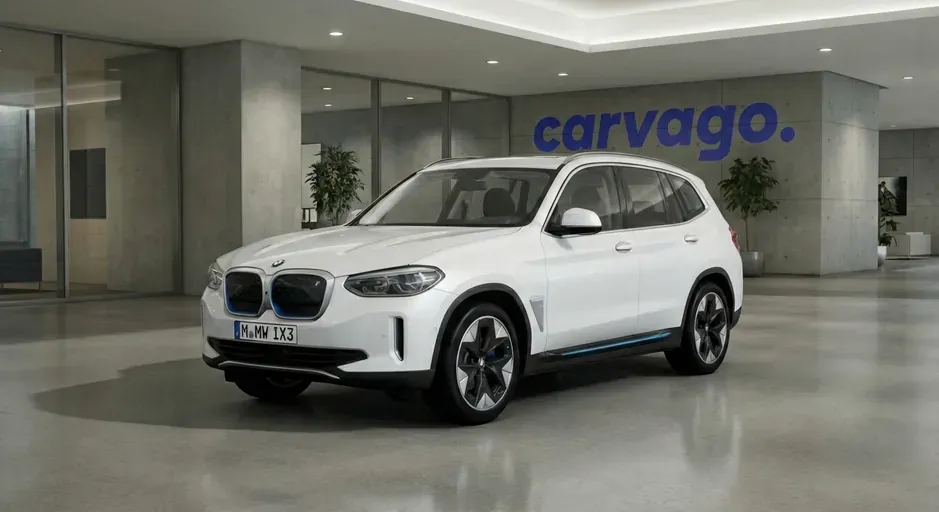
BMW iX3

BMW iX3

Introduction

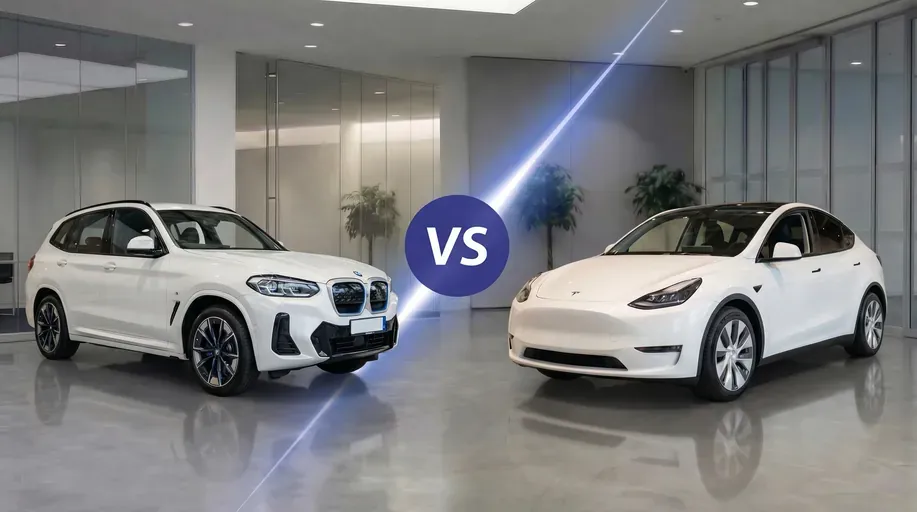
We're stepping into the ring where two titans of the electric SUV world face off: the American innovator and bestseller, the Tesla Model Y, which has rewritten the rules of the game and become a global phenomenon. Against it stands a representative of the traditional German premium school, the BMW iX3, which combines the brand's proven quality and luxury with a modern electric powertrain. This battle will show whether the better bet is on revolutionary simplicity and performance, or on sophisticated and time-tested automotive excellence.

Comparison of External Dimensions

Body Dimensions: American Space vs. European Compactness

Although both vehicles fall into the same category of mid-size electric SUVs, a look at their exterior dimensions reveals different design philosophies. The Tesla Model Y is slightly larger than the BMW iX3 in most respects. It is longer, significantly wider, and has a longer wheelbase, suggesting a focus on maximum interior space and driving stability.

In contrast, the BMW iX3 opts for a more traditional and slightly more compact approach. While it is marginally shorter and narrower, it is also noticeably taller, giving it a more classic SUV silhouette. This difference in height can play a role not only in the driving feel but also in headroom. While the Model Y has a wider, sportier stance on the road, the iX3 maintains the more robust and upright posture typical of cars from Munich.

The 26 mm difference in wheelbase in Tesla's favour may not seem like much, but it often translates to more legroom for rear passengers. The difference in width is more significant – a full 3 centimetres more for the Model Y means more shoulder room. BMW counters with 44 mm more in height, which taller individuals will appreciate and which makes getting in and out easier. The choice thus depends on whether you prefer a roomier interior in terms of width and length (Tesla), or a more traditional SUV with more vertical space (BMW).

ParameterTesla Model Y SUVBMW iX3 SUV
Length (mm)47514734
Width (mm)19211891
Height (mm)16241668
Wheelbase (mm)28902864

Trunk Volume

Boot Space: American Spaciousness vs. German Practicality

When it comes to practicality and luggage space, the Tesla Model Y and the BMW iX3 are at completely different ends of the spectrum, which is a key deciding factor for many buyers, especially families. Tesla's Model Y focuses on maximum volume and versatility, while the BMW iX3 offers a more traditionally designed but still very usable space. However, the difference between them is so striking that it can be the sole reason for choosing one car over the other.

The Tesla Model Y, in the generation produced from 2021 to 2025, outclasses the competition with a staggering basic volume of 854 litres. It should be noted, however, that this figure includes the front boot (the "frunk") with a volume of 117 litres, which is ideal for storing charging cables or smaller bags. Even without it, the rear boot is exceptionally spacious. In contrast, the BMW iX3 (2021-2025 generation) offers a solid but significantly smaller 510 litres. In practice, this means that while the iX3 can comfortably accommodate luggage for a family holiday, the Model Y offers extra space for sports equipment or a pram without having to make compromises.

With the rear seats folded down, the difference becomes even more pronounced. The Tesla Model Y transforms into a small van with a maximum volume of up to 2158 litres, allowing you to transport very bulky items like furniture or bicycles. The BMW iX3 still offers a very respectable 1560 litres with the seats folded, which is sufficient for most everyday needs, but it falls far short of the Tesla's moving capabilities. For users for whom maximum transport capacity is an absolute priority, the Tesla Model Y is the clear winner. The BMW iX3, on the other hand, offers a sufficient and well-designed space for those who do not need to regularly transport oversized loads.

ParameterTesla Model Y SUVBMW iX3 SUV
Basic volume (litres)854510
Max. volume with seats folded (litres)21581560

Trailer Weights

Towing Capacity: A Significant Difference in Practicality

The ability to tow a trailer is becoming an increasingly important criterion even for electric cars, and it is in this discipline that one of the biggest differences between the Tesla Model Y and the BMW iX3 emerges. For many drivers, this parameter can be a deciding factor, whether they need to transport sports equipment, a small caravan, or building materials. While one of the models offers figures comparable to cars with internal combustion engines, the other is significantly limited in this respect.

The Tesla Model Y, across all its versions (Long Range and Performance) from 2021–2025, consistently offers a generous maximum braked towing capacity of up to 1600 kg. This makes it an exceptionally practical companion that can easily tow most unbraked trailers, smaller caravans, or a boat trailer. For families planning active holidays, this is a key advantage.

On the other hand, the BMW iX3 (G08 generation, produced from 2021–2025) falls short in this comparison. Its maximum permitted braked towing capacity is just 750 kg. While this is sufficient for a light unbraked trailer for garden waste or transporting a few bicycles, you can forget about towing a larger load or a caravan. For users for whom a tow hitch is a necessity, the Model Y is clearly the more capable choice.

Model and Engine VersionBraked Towing Capacity (kg)Unbraked Towing Capacity (kg)
Tesla Model Y (all versions)1600750
BMW iX3 (G08)750750

Overview of Most Common Motorizations

Engine Comparison: American Versatility vs. German Simplicity

When choosing between the Tesla Model Y and the BMW iX3, the range of powertrains plays a key role and reveals the completely different strategies of the two manufacturers. While Tesla bets on a wide range of variants with rear-wheel and all-wheel drive and various performance levels, BMW chose the path of simplicity for the G08 generation – a single powerful and efficient electric motor driving the rear wheels. This choice fundamentally affects not only the dynamics and handling of the car under different conditions but also the target customer group. Buyers are thus faced with a decision: whether to prefer the versatility and choice offered by Tesla, or the precisely tuned and straightforward offering from BMW.

Tesla Model Y: Performance and Drive for Everyone

The Tesla Model Y offers several variants on the used car market, differing in performance, range, and drive type. The base is the rear-wheel drive (RWD) version, which is ideal for drivers who prefer a lower purchase price and high efficiency in daily use. For more demanding customers, there are the Long Range and Performance versions, both with all-wheel drive (AWD) thanks to a dual-motor system. The Long Range variant represents an optimal compromise between long range and impressive dynamics, while the Performance model pushes the boundaries of acceleration to supercar levels and is the choice for those seeking maximum adrenaline.

Engine TypeFuelPower (kW)Torque (Nm)Transmission
Model Y (RWD)Electric2204201-speed automatic
Model Y Long Range (AWD)Electric3784931-speed automatic
Model Y Performance (AWD)Electric3936601-speed automatic

BMW iX3: A Safe Bet with Rear-Wheel Drive

Unlike Tesla, BMW opted for a single, yet carefully tuned, engine version for the iX3 G08 generation (produced from 2021 to 2025). All iX3 cars from this period are equipped with a single electric motor that drives the rear axle. This solution is typical for the BMW brand and delivers engaging driving characteristics with an emphasis on agility and balance. The power output of 210 kW (286 hp) and torque of 400 Nm provide the car with confident dynamics for everyday use and longer journeys. The facelift at the end of 2021 brought design changes, but the proven powertrain remained unchanged. For those interested in a used car, the choice is simple and focuses more on the equipment level than on the technology under the bonnet.

Engine TypeFuelPower (kW)Torque (Nm)Transmission
iX3 (G08)Electric2104001-speed automatic

Choosing the right powertrain is crucial for long-term satisfaction with electric vehicles. Our recommendations are based on a combination of performance, real-world range, owner feedback, and overall reliability. Tesla and BMW approach electric propulsion differently: Tesla focuses on stunning performance and its own charging network, while BMW concentrates on maximum efficiency and premium driving comfort, which is reflected in their only available engine versions for the compared generations.

For the Tesla Model Y, we recommend: Maximum Range AWD (Long Range)

The most balanced and popular choice in the Model Y lineup is the Maximum Range all-wheel-drive version, often referred to as Long Range. It offers the best compromise between range, performance, and practicality for everyday use. The two electric motors provide a system output of over 500 hp, guaranteeing acceleration from 0 to 100 km/h in approximately 5 seconds. This is sports-car-level dynamics, available instantly at any time. Thanks to a battery with a usable capacity of around 75 kWh, the real-world range is over 450 km in the summer months; expect a drop to around 350 km in winter. The main advantage is the unparalleled access to the Tesla Supercharger network of fast-charging stations, which makes long-distance travel completely hassle-free. Among the weaker points for older model years (around 2021-2022) were inconsistent interior build quality and panel gap alignment. The suspension is also tuned in a rather stiff, sporty style. This version is ideal for families and drivers who frequently travel long distances and require the assurance of all-wheel drive and fast charging.

For the BMW iX3, we recommend: 210 kW (286 hp) with rear-wheel drive

The BMW iX3 in the G08 generation (2021-2025) was offered with a single, yet perfectly tuned powertrain. The 210 kW (286 hp) electric motor powers the rear wheels exclusively, which is typical for BMW and delivers driving pleasure. Although on paper, its performance lags behind Tesla, in the real world, the dynamics are more than sufficient, and the acceleration from 0 to 100 km/h in 6.8 seconds certainly won't disappoint. However, the main advantage of the iX3 is its exceptional efficiency. Thanks to sophisticated technology and aerodynamics, real-world consumption is around 19 kWh/100 km, which is an excellent value for an SUV of this size. The battery with a usable capacity of 74 kWh thus ensures a reliable real-world range of around 400 km. Unlike Tesla, the iX3 offers top-notch build quality, a traditionally luxurious interior, and excellent ride comfort. A weakness for some may be the absence of all-wheel drive, which could be a limitation in harsh winter conditions. The BMW iX3 is thus a perfect choice for drivers transitioning from premium combustion engine cars who are looking for comfort, quality, and traditional driving characteristics in an electric package and don't need extreme acceleration or 4x4 drive.

Real Fuel Consumption

Real-world Consumption: Who Drives More Efficiently?

Official consumption figures, measured in the WLTP laboratory cycle, are one thing, but real-world driving often shows different numbers. That's why we looked at data from drivers themselves, primarily from the German portal Spritmonitor.de, which collects real-world consumption data from thousands of owners. And the results are very interesting for those interested in a used electric car.

In a direct comparison of relevant versions, i.e., models up to about four years old, the Tesla Model Y emerges as a noticeably more economical car. Its sophisticated aerodynamics and efficient powertrain result in lower energy demands across all versions.

Model and PowertrainAverage Real-world Consumption (kWh/100 km)
Tesla Model Y
Standard Range / RWD17.5
Long Range AWD19.1
Performance AWD20.5
BMW iX3
G08 (210 kW)21.2

Note: The values are an average from multiple sources and may vary depending on driving style, weather conditions, and vehicle equipment.

It is clear from the table that even the most powerful Tesla Model Y Performance has real-world consumption comparable to, or even slightly lower than, the single version of the BMW iX3. The base version of the Model Y with rear-wheel drive is then clearly the most economical choice, which will be especially appreciated by drivers with high annual mileage for whom the price per kilowatt-hour is key.

A difference of about 2-3 kWh/100 km in favor of the Tesla may not seem dramatic, but with an annual mileage of 20,000 km, it already represents a saving of 400-600 kWh. For drivers who often travel longer distances and use motorways, where the advantage of Tesla's better aerodynamics is most apparent, this difference will be even more noticeable. In city traffic, on the other hand, the consumption of both cars is closer. For the buyer looking for maximum efficiency and the lowest operating costs, the Tesla Model Y is the clear favorite from a consumption perspective.

Price Range and Used Car Offerings

Price Comparison: Tesla Model Y vs. BMW iX3 on the Used Car Market

When deciding between a Tesla Model Y and a BMW iX3 on the used car market, price plays a key role. Both models, as premium electric SUVs, hold their value well, but their price ranges differ depending on the version, mileage, and equipment. We looked at models that are approximately four years old, around the 2022 model year.

Tesla Model Y: Wider Availability and Lower Starting Price

The Tesla Model Y, as one of the best-selling electric cars, has a significantly wider presence on the used car market. This has a positive effect on both availability and price variability.

A used 2022 Tesla Model Y on the Czech market most often ranges in price from €30,000 to €37,000. According to available data, the average price is around €33,000.

  • Most affordable variants: Base models and Long Range versions with higher mileage can be found at the lower end of this range.
  • More expensive versions: On the other hand, you will pay more for Performance or Long Range models with low mileage and extra equipment (e.g., Enhanced Autopilot), and the price may approach the upper limit.

BMW iX3: Exclusivity with a Higher Price Tag

The BMW iX3 is rarer on the used car market, reflecting its originally higher purchase price and lower sales volume compared to the Model Y. This is also reflected in its price as a used car.

The price of a used 2022 BMW iX3 typically ranges from €35,000 to approximately €45,000.

  • Factors influencing the price: For the iX3, in addition to mileage, the specific equipment line (e.g., M Sport package) and other optional extras that were more expensive on the new car play a major role.
  • Resale value: BMWs generally hold their value well, and although the supply on the Czech market is limited, prices are stable and reflect the brand's premium status.

Verdict: Which is More Affordable?

From a purely price-based perspective, the more affordable choice is the Tesla Model Y. Thanks to its wider availability on the market, it is easier to find a unit that fits the desired budget, and its starting price is noticeably lower.

In contrast, the BMW iX3 represents an investment in a more premium segment with less choice, but with the promise of traditional BMW quality and craftsmanship. Its higher price as a used car corresponds to its position in the new car market. The choice thus depends on the buyer's preferences – whether they prefer the availability and wider selection of the Tesla, or the exclusivity and traditional concept of luxury of the BMW.
Safety and Euro NCAP Rating

Safety: A Battle of Generations in Euro NCAP Tests

When evaluating safety, it might seem at first glance that there is no difference between the Tesla Model Y and the BMW iX3 – both cars boast a five-star rating from Euro NCAP. However, this figure needs to be seen in context, as testing methodology has become significantly stricter over time. Therefore, a direct comparison of percentage results from different years is not entirely conclusive. More recent tests place much greater emphasis on active safety assistants and the protection of vulnerable road users.

Tesla Model Y (tested 2022)

The Tesla Model Y underwent Euro NCAP crash tests in 2022 according to one of the latest and most stringent methodologies. The results were absolutely dominant. The car achieved one of the highest overall scores in the organization's history. An excellent rating of 97% for adult occupant protection and a near-perfect 98% in the safety assist systems category demonstrate how modern and sophisticated its safety equipment is. Systems like autonomous emergency braking, which reacts to pedestrians, cyclists, and potential collisions at intersections, and advanced lane-keeping assist function with exceptional precision.

BMW iX3 (tested 2017)

The safety rating of the BMW iX3 is derived from the related BMW X3 model, which was tested back in 2017. Although five stars is still an excellent result, the testing protocols at that time were significantly more lenient. This is particularly evident in the lower score for safety assistants (58%), where the standards of the time were nowhere near as demanding as they are today. Nevertheless, the iX3 offers a solid level of passive safety with 93% protection for adults and 84% for children. In 2021, Euro NCAP did separately evaluate the iX3's assistance systems in its "Highway Assist" tests, where it performed very well, but this assessment did not cover crash tests or the overall safety of the vehicle.

Verdict: The Newer Tests Speak for Themselves

Although both cars are safe and have five stars, the Tesla Model Y demonstrates its technological superiority thanks to tests conducted under more modern and demanding standards. Its results in active safety and occupant protection are a benchmark in its class. The BMW iX3's rating, while still valid, is based on an older methodology that does not fully reflect the current capabilities and requirements for safety technology. For a buyer who places maximum emphasis on the latest safety standards, the Tesla Model Y is clearly the more modern and more comprehensively tested choice.

ParameterTesla Model YBMW iX3
Year of Testing20222017
Adult Occupant Protection97 %93 %
Child Occupant Protection87 %84 %
Vulnerable Road User Protection82 %70 %
Safety Assist Systems98 %58 %

Comparison of Interesting Equipment Features

In addition to standard equipment, each model offers several unique features that can be decisive for a potential buyer, and each approaches innovation and comfort in its own way.

Tesla Model Y: Digital Future and Minimalism

Tesla bets on centralized control and software gadgets that define the driving and ownership experience.

  • Minimalist interior with a central display: Almost all car functions, from mirror adjustments and the speedometer to wiper controls, are concentrated on a single 15-inch touchscreen. This creates an extremely clean design but takes some getting used to.
  • Advanced Autopilot: The standard version of Autopilot is one of the most advanced assistance systems on the market, keeping the car in its lane and adjusting its speed to the surrounding traffic. An upgraded version (Enhanced Autopilot) or Full Self-Driving capability is available for an extra charge, adding features like automatic lane changes or Navigate on Autopilot.
  • Software gadgets and entertainment: Tesla is famous for its "toys." These include modes like "Dog Mode" (maintains a safe temperature for dogs in the car), "Camp Mode" (allows you to sleep in the car with the climate control and power on), or "Sentry Mode," which uses cameras to monitor the surroundings of the parked car and record suspicious activity.
  • Mobile app as a key: The Tesla app on your phone completely replaces the car key. It allows for remote control of the climate system, tracking the car's location and charge status, and even "summoning" the car from a parking spot using the Summon feature.
  • Huge storage space: Thanks to the absence of a traditional engine, the Model Y offers a front trunk ("frunk"), which, together with the rear trunk and the space under its floor, provides one of the largest total luggage volumes in its class.

BMW iX3: Premium Comfort and Traditional Luxury

The BMW iX3 combines an electric powertrain with a proven approach to design, ergonomics, and premium features that the brand's customers are accustomed to.

  • iDrive System: Unlike Tesla, BMW retains the classic iDrive infotainment system with a rotary controller on the center console. This allows for easy and intuitive operation while driving, without the driver having to rely solely on the touchscreen.
  • Adaptive suspension: The standard adaptive suspension allows the driver to choose between comfortable and sporty damper settings. This enables the iX3 to adapt perfectly to both the road quality and the preferred driving style.
  • Premium equipment as standard: Many features that are optional extras on competitor models are offered as standard in the iX3's "Inspiring" trim. These include, for example, a panoramic sunroof, electrically adjustable sports seats, or three-zone automatic climate control.
  • Iconic "BMW IconicSounds Electric" sound: In collaboration with the famous composer Hans Zimmer, BMW developed specific sounds that accompany acceleration. This synthetic soundscape enhances the emotional driving experience and gives the driver acoustic feedback.
  • Advanced driver-assistance systems: The Driving Assistant Professional package offers top-of-the-line features such as adaptive cruise control with Stop&Go function, active lane keeping with steering assist, and automatic obstacle avoidance, enhancing safety and comfort on long journeys.

Key Advantages and Disadvantages

Tesla Model Y

Advantages:

  • Exceptional interior space: It offers a huge luggage compartment of 854 litres at the rear and another 117 litres at the front ("frunk"). Folding down the seats creates over 2,000 litres of space, making it one of the most practical cars in its class.
  • Excellent dynamics and performance: Even the base version offers impressive acceleration. The Long Range and Performance variants provide dynamics that surpass many sports cars, ensuring safe overtaking even at higher speeds.
  • Access to the Supercharger network: The exclusive and dense network of Tesla Supercharger fast-charging stations significantly simplifies long-distance travel and represents a key competitive advantage.
  • High efficiency and range: The Model Y is known for its low energy consumption, which, combined with a large battery, ensures a solid real-world range. The rear-wheel-drive Long Range version promises up to 600 km on a single charge (WLTP).
  • Advanced technology and simplicity: The minimalist interior with a dominant central display, a sophisticated mobile app, and features like "Autopilot" deliver a futuristic user experience and continuous software updates.
  • Strong used market value: Thanks to its popularity and technological edge, the Model Y holds its value well, which is advantageous for resale.

Disadvantages:

  • Build quality and materials: Compared to premium competitors like BMW, the fit and finish of the body panels and the materials used in the interior can feel cheaper, and various creaks and rattles occasionally appear.
  • Ride comfort: The suspension is tuned to be rather firm, which leads to less comfort and the transmission of bumps into the cabin on poor-quality roads.
  • Display-dependent controls: Almost all of the car's functions, including the wipers and mirror adjustments, are controlled via the central touchscreen, which can be impractical and distracting while driving.
  • Minimalist design may not suit everyone: The extremely simple exterior and interior design may seem bland to some and lack the emotion of traditional car brands.

BMW iX3

Advantages:

  • Premium interior quality: The interior boasts high-quality materials and precise craftsmanship, which are typical for the BMW brand and create a sense of luxury.
  • Excellent ride comfort and handling: The iX3's suspension is perfectly tuned, offering excellent damping of bumps while providing confidence and fun in corners, which is characteristic of BMW.
  • Traditional and ergonomic controls: Unlike Tesla, BMW retains a number of physical buttons and the proven iDrive controller, making it easier to operate key functions without having to click through menus on the display.
  • Conservative design: For customers who prefer the classic look of an SUV and don't want to stand out, the iX3 is an ideal choice as it is based on the popular X3 model.
  • Quiet and refined: The car is exceptionally well soundproofed, even compared to other electric vehicles. Almost no noise from the motor or chassis penetrates the cabin.

Disadvantages:

  • Rear-wheel drive only: Unlike the Model Y, the iX3 (in the G08 generation) does not offer an all-wheel-drive option, which can be a disadvantage in winter conditions.
  • Smaller luggage space and lack of a "frunk": The 510-litre boot is significantly smaller than the Tesla's. Additionally, the iX3 lacks a front storage compartment, which limits its practicality.
  • Higher purchase price and more expensive options: As a premium car, the iX3 has a higher base price, and the list of optional extras can significantly increase the final cost.
  • Slower charging and a smaller public network: Although it supports fast charging (up to 150 kW), in practice, the charging power and speed can be lower than Tesla's. The reliability and availability of public charging stations outside the Ionity network are not as consistent as with Superchargers.

Common Problems and Owner Complaints

Based on data from technical inspections, reliability statistics like the German TÜV Report, and owner feedback, we have compiled an overview of the most common problems that used car buyers should watch out for.

Tesla Model Y

The Tesla Model Y faces problems that can be divided into two main categories: build quality and the mechanical durability of some components. Cars from the first years of production (approximately 2020–2022) in particular show shortcomings that have been partially mitigated in newer units from the Shanghai and Berlin factories.

  • Build quality and bodywork: The most frequently criticised point is inconsistent build quality. Owners complain about uneven body panel alignment ("panel gaps"), paint imperfections (peeling paint, especially on the sills), and occasional creaks and rattles in the interior. When buying a used car, a thorough physical inspection of the used car focusing on these details is essential.
  • Suspension and brakes: According to TÜV Report statistics, the suspension and brakes are among the Model Y's biggest weaknesses. The car's high weight, combined with intensive recuperation, means the mechanical disc brakes are not used often, leading to corrosion and reduced efficiency. The suspension experiences premature wear of the control arms and suspension pins, which manifests as creaking or knocking when driving over bumps. Several recalls have also been issued to check and tighten the suspension arm bolts.
  • Electronics and software: Although software is a strong point for Tesla, minor issues can occasionally occur, such as the central display freezing (usually solvable with a restart) or temporary malfunction of the Autopilot system's sensors and cameras, for example, due to dirt or heavy rain. Some recalls have involved software updates for the proper functioning of safety systems.
  • Other issues: Some owners report problems with the door and rear trunk seals, which can lead to water leaks. Another mentioned drawback is the sensitive paint, which is prone to damage from stone chips.

Summary for the Tesla Model Y: The issues primarily concern build quality and higher wear on suspension components and brakes, as confirmed by independent technical inspections. These are generally not faults that would immobilize the vehicle, but they require increased attention and potential investment when buying a used model. A comprehensive vehicle inspection is key here.

BMW iX3

The BMW iX3 is built on the proven platform of the X3 model, which helps it avoid many "growing pains." Its reliability is generally rated as good, but a few specific areas deserve attention.

  • Software and infotainment: Similar to other modern cars, software glitches can occur here as well. Owners report occasional freezing or spontaneous reboots of the iDrive system. Problems can also arise with the stability of the wireless Apple CarPlay or Android Auto connection. Most of these issues are usually resolved by a software update, which can be done remotely or at an authorized service center.
  • Battery and charging: The powertrain system is considered very reliable. However, isolated software errors in the battery management system can occur, which may affect the charging process or the accuracy of the range indicator. A recall was issued for vehicles manufactured up to May 2021 due to a software bug that could cause the 12V system and related functions like eCall to fail in the event of a serious accident.
  • Chassis and driving comfort: Some users complain about creaking noises from the chassis, especially at lower speeds. The cause is usually bushings or other suspension components, which should be checked during a technical inspection of the car. It's not a widespread problem, but it's good to focus on it.
  • Electronics and assistance systems: There have been reports of sporadic issues with assistance systems, such as the temporary deactivation of adaptive cruise control, which could be caused by dirty sensors or a software glitch.

Summary for the BMW iX3: Most of the reported problems with the iX3 are minor software glitches or isolated mechanical noises that do not compromise the overall reliability of the car. Unlike the Tesla, there are no systematic issues with build quality or premature wear of key mechanical parts. These are more like partial inconveniences, many of which can be resolved with a software update.

Tips for Buying a Used Car

What to look out for when buying a used car

A thorough inspection is crucial when buying a used car, especially for electric vehicles with complex technology. Here are a few specific points to focus on with these two models to avoid potential problems.

When choosing a Tesla Model Y:

  • Build quality and panel alignment: Early model years (2020–2021) often had uneven gaps between body panels (doors, hood, trunk) or issues with seals. Carefully inspect the car from all angles and run your hand over the joints. Irregularities can indicate not only carelessness in manufacturing but also a poorly repaired accident.
  • Noises from the chassis: During the test drive, focus on any knocking, creaking, or squeaking from the front and rear axles, especially when driving over bumps. The Model Y can have issues with the upper control arms and other suspension components. Their repair can be costly.
  • Functionality of the central display: Test all the functions on the giant touchscreen. Check the response speed, the smoothness of the map, and the functionality of all settings. Occasional freezing or system reboots can be a warning sign. Make sure all cameras (rear and side) transmit a clear and undistorted image.
  • Battery condition and range: In the car's menu, check the maximum range at 100% charge. Compare it with the original stated value for that version. Natural degradation is normal, but a significant drop could indicate a problem. Also, inquire about the charging history—frequent use of Superchargers can affect battery life.
  • Heat pump and air conditioning: Older models had issues with the heat pump, which is crucial for efficient heating in winter and affects the range. During the test drive, turn on both the heating and air conditioning to full power and listen for any unusual noises from the compressor. Every physical inspection of a used car should include these points.

When choosing a BMW iX3:

  • Software version and battery preheating: For models produced before the facelift (until the end of 2021), verify that they have updated software. Older versions lacked the manual battery preheating function, which significantly slows down fast DC charging in winter months. This can be a key disadvantage for longer journeys.
  • Chassis and steering behavior: Although the iX3 is generally reliable, focus on any strange noises from the adaptive suspension when changing driving modes during the test drive. There have been isolated cases of problems with the power steering or suspension. The ride should be quiet and smooth.
  • Functionality of the iDrive infotainment system: Thoroughly go through all the functions of the iDrive system. Check if wireless Apple CarPlay or Android Auto connects reliably and without dropouts. Occasional system reboots or problems connecting your phone may indicate the need for a software update at a service center.
  • Interior condition and strange noises: Pay attention to any creaking sounds from the dashboard or door panels, which some owners have reported. When driving on an uneven road, turn off the radio and listen for any disturbing noises from the interior.
  • Complete service history: Although an electric car is easier to maintain, regular service inspections and software updates are essential. Ask for the complete service history and verify that all recalls have been carried out. A comprehensive vehicle inspection will give you certainty about its past.

FAQ: Most Frequently Asked Questions

The Tesla Model Y Long Range offers a slightly longer real-world range under ideal conditions, which can exceed 450 km. The BMW iX3 is around 400 km. However, both ranges are highly dependent on driving style and external conditions, especially in winter.

The Tesla Model Y can charge faster, with a power of up to 250 kW. The BMW iX3 supports charging with a power of up to 150 kW. In practice, Tesla's biggest advantage is the denser and more reliable Supercharger network of fast-charging stations.

The Tesla Model Y is the more practical choice in terms of overall storage space. It offers a huge rear boot and also a front boot ('frunk'), which the BMW iX3 lacks. Although the dimensions of both cars are very similar, the Tesla makes better use of the interior space for luggage, which families on longer trips will especially appreciate.

The interior of the BMW iX3 is more traditional, with premium materials, a digital instrument cluster behind the steering wheel, and a combination of a touchscreen display with physical buttons. The Tesla Model Y relies on a minimalist design where almost everything is controlled via a single large central display. Unlike Tesla, the BMW also supports Apple CarPlay and Android Auto.

The Tesla Model Y, especially in the Long Range version, has significantly better acceleration from 0 to 100 km/h (around 5 seconds) compared to the BMW iX3 (6.8 seconds). The BMW, on the other hand, focuses on more balanced and comfortable driving characteristics, which some drivers prefer for daily driving.

Conclusion: Which Model to Choose?

Sources: ADAC, evo.co.uk, carwow.co.uk, caranddriver.com, electrek.co, electricvehicleweb.com

This article was prepared using artificial intelligence tools. The section guarantor is Petr Dušek.

Related articles

Car battle

Audi Q4 e-tron vs. Mercedes-Benz EQA: Complete comparison 2026

Comparison: Audi Q4 e-tron vs. Mercedes-Benz EQA. Discover the real-world range, differences in equipment, and our clear verdict for choosing the right premium used SUV.

Apr 13, 2026

Car battle

Audi Q8 vs. Volkswagen Touareg: Complete comparison 2026

They share the same platform, but which one is better? A detailed comparison of the Audi Q8 and Volkswagen Touareg. We have evaluated the features and prices, and we provide a clear final verdict.

Apr 2, 2026

Car battle

BMW iX3 vs. Tesla Model Y: Complete comparison 2026

BMW iX3 vs Tesla Model Y: A detailed comparison of electric SUVs. Discover real-world range, differences in equipment, and read our verdict for an easier choice.

Apr 14, 2026

We accept online card payments as well as wire transfers.

visa payment provider logovisa-electron payment provider logomastercard payment provider logomaestro payment provider logodiners-club payment provider logodiscover payment provider logo