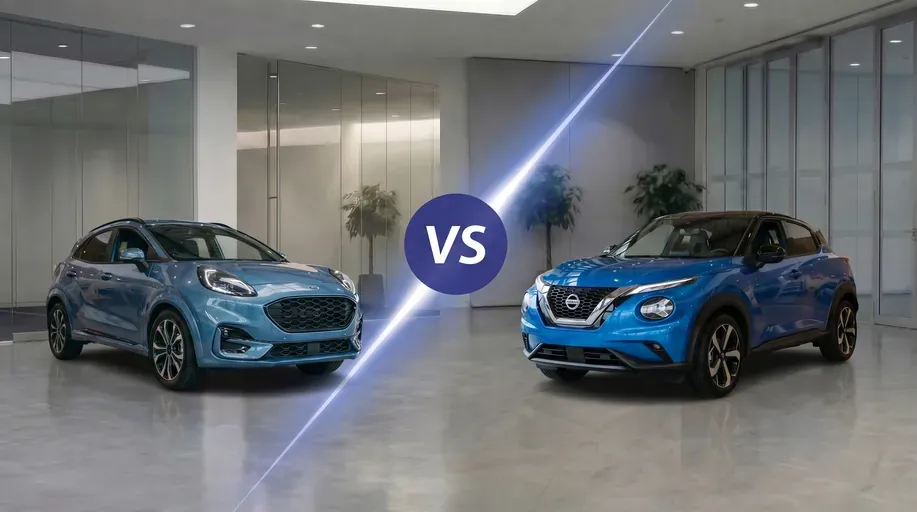
Ford Puma vs. Nissan Juke: Complete comparison 2026
Are you deciding between the Ford Puma and the Nissan Juke? We bring you a detailed comparison of both SUVs, real-world experience with used cars, and a clear verdict for your choice.
Apr 19, 2026
Articles
Car battle
Nissan Juke vs Toyota Yaris Cross comparison. Find out which city SUV offers better equipment, fuel consumption, and driving characteristics. Read our final verdict!
May 21, 2026


Nissan Juke, also known as the Infiniti ESQ in selected markets, is a long-standing pioneer of the small crossover class, winning drivers over primarily with its bold, extravagant design and sportier character. Standing against it is the Toyota Yaris Cross, a modern and practically oriented city SUV that relies on renowned reliability and highly efficient hybrid technology. In the following comparison, we will take a detailed look at the key differences between these two Japanese rivals and find out which one represents a better choice for your daily journeys on the nearly-new used car market.
When choosing a city crossover, external dimensions play a crucial role. If we focus on models around four years old, which are currently the most sought-after on the used car market – namely the second generation Nissan Juke (code name F16) and the Toyota Yaris Cross (XPB1F) – we find that although both belong to the compact SUV category, their footprint differs quite noticeably.
The Nissan Juke is a larger car in most respects. With a length of 4210 mm and a width of 1800 mm, it is exactly 30 mm longer and 35 mm wider than the Toyota Yaris Cross. While you will hardly notice three centimeters in length when parallel parking in the city, the greater width gives the Nissan a more muscular and sporty stance on the road and, above all, promises more shoulder room in the interior. Interestingly, both models share the same height of 1595 mm (although it dropped slightly to 1593 mm for newer Juke model years). As a result, both cars offer the popular elevated driving position, excellent visibility, and comfortable entry.
However, the most significant difference for the occupants is the wheelbase. The Nissan Juke boasts a value of 2636 mm, which is a significant 76 mm more than in the case of the Toyota Yaris Cross (2560 mm). In practical terms, this means that the Juke can offer more generous legroom for rear-seat passengers, and its longer wheelbase usually results in slightly smoother and more stable handling at higher highway speeds. Conversely, the Toyota's slightly more compact dimensions represent an undeniable advantage in heavy city traffic – the car is more agile, and maneuvering in cramped underground garages will be noticeably easier.
| Parameter | Nissan Juke SUV | Toyota Yaris Cross SUV |
|---|---|---|
| Width (mm) | 1800 | 1765 |
| Length (mm) | 4210 | 4180 |
| Height (mm) | 1593 - 1595 | 1595 |
| Wheelbase (mm) | 2636 | 2560 |
The small city crossover (B-SUV) category is often replacing traditional family hatchbacks today, which is why luggage capacity plays a key role in the selection process. For buyers of used cars around four years old, trunk size is a crucial parameter that determines the vehicle's daily practicality. It is primarily about whether the car can handle only routine daily tasks or if it provides enough versatility for packing luggage for a longer trip without having to make major compromises in the interior.
Nissan Juke in its second generation (F16, available on the used car market since 2020) has taken a huge step forward in terms of interior space compared to its predecessor. The standard version with a pure gasoline engine offers a very solid base volume of 422 liters, which in practice means space for several extra suitcases and trouble-free storage of a stroller. With the rear seats folded down, the cargo space increases to an impressive 1305 liters. However, if you come across a hybrid powertrain, you must expect a slight reduction in capacity to 354 liters at the base and 1237 liters with the backrests folded down, due to the high-voltage battery being stored under the floor.
Toyota Yaris Cross, on the other hand, scores with excellent use of space and great variability. In standard front-wheel-drive versions, you have a base trunk volume of 397 liters, which is fully sufficient for weekend shopping as well as longer vacations for couples or small families. In the case of variants equipped with all-wheel drive (AWD), however, the trunk floor is raised and the base volume drops to 320 liters. The maximum transport capacity with the rear seats folded down in the Toyota is 1097 liters in all versions, losing out to its Nissan counterpart.
| Parameter | Nissan Juke SUV (Standard) | Nissan Juke SUV (Hybrid) | Toyota Yaris Cross SUV (Standard) | Toyota Yaris Cross SUV (AWD / Reduced) |
|---|---|---|---|---|
| Base volume (liters) | 422 | 354 | 397 | 320 |
| Max. volume with seats folded (liters) | 1305 | 1237 | 1097 | 1097 |
In terms of absolute numbers and maximum transport capacity, the Nissan Juke is the clear winner, as it significantly better meets the requirements for family travel and transporting bulkier items. The Toyota Yaris Cross, conversely, is ideal for drivers who are satisfied with an average-sized trunk and prefer better driving characteristics in winter thanks to the optional all-wheel drive, which Nissan does not offer at all.
If maximum luggage space and family weekends are your priority, the Nissan Juke offers a significantly larger trunk. The Toyota Yaris Cross has a smaller transport capacity but can compensate for this shortcoming with the option of all-wheel drive.
When choosing a compact city crossover on the used car market, especially for cars around four years old (specifically the Nissan Juke F16 and Toyota Yaris Cross XPB1F generations), towing capacity plays an important role for all drivers who require greater practicality. The ability to tow a trailer with materials or attach a bike rack to the tow bar is a key benefit that can influence the overall utility of the car. There are quite significant differences between these two representatives, which stem primarily from the engine used.
While the Nissan Juke with the standard 1.0 DIG-T turbocharged petrol engine (84 kW) can tow a braked trailer with a maximum weight of 1,250 kg, its unbraked trailer capacity is roughly 631 to 648 kg. This capacity is very impressive for the segment and in practice means room for a few extra suitcases, trouble-free transport of building materials to a cottage, or even hitching up a lighter caravan. In contrast, the Toyota Yaris Cross in the 1.5 Hybrid 116 version (with a combustion engine output of 68 kW), which relies mainly on an exceptionally economical powertrain, offers a significantly lower towing capacity. Here, a braked trailer can weigh a maximum of 750 kg and an unbraked one 550 kg. While this value is easily sufficient for a weekend shopping trip with a small garden trailer or for securely mounting heavier e-bikes, it is no longer enough for more demanding holiday trips with a caravan. Special attention must also be paid to the hybrid variant of the Nissan Juke 1.6 Hybrid (69 kW). The installation of heavier hybrid technology has caused its capacities to drop to the level of the Toyota – the maximum weight of a braked trailer has fallen to 750 kg and an unbraked one to just 500 kg.
From an overall perspective, the conclusion is quite clear. If occasional towing of larger and heavier loads is a priority for you, the petrol Nissan Juke will clearly serve you better and offer a greater degree of versatility. If, on the other hand, you are looking for an economical family car and basic towing capabilities are sufficient for occasional use, both hybrid powertrains in this comparison can easily handle hauling regular waste or holiday gear.
| Model and engine | Braked trailer weight (kg) | Unbraked trailer weight (kg) |
|---|---|---|
| Nissan Juke 1.0 DIG-T (84 kW) | 1250 | 631 - 648 |
| Nissan Juke 1.6 Hybrid (69 kW) | 750 | 500 |
| Toyota Yaris Cross 1.5 Hybrid 116 (68 kW) | 750 | 550 |
When comparing the engine options of the Nissan Juke and Toyota Yaris Cross, we encounter completely different approaches to powering compact crossovers, which is key for used car buyers. While Toyota relies almost exclusively on its renowned and highly efficient full hybrid system for the Yaris Cross, ensuring extremely low fuel consumption, Nissan offers a wider choice for the second-generation Juke. Customers can opt for a traditional turbocharged petrol engine (ideal for drivers preferring a more dynamic feel and manual shifting) or choose a more complex multi-mode hybrid. For those interested in approximately four-year-old used cars, this decision is primarily a choice between driver engagement with the Nissan and unrivaled operational efficiency combined with the option of all-wheel drive with the Toyota.
The second-generation Nissan Juke (F16) entered the market with a turbocharged one-liter three-cylinder engine. In the early years, it was offered in the 1.0 DIG-T 117 version with 86 kW. As availability data shows, production of this specific specification ended during 2020. On the four-year-old used car market, you will most often encounter its more economical and emission-optimized version, the 1.0 DIG-T 114 (84 kW). Both pure petrol variants can be purchased with either a snappy 6-speed manual transmission or a 7-speed dual-clutch automatic (DCT). In 2022, the range was supplemented by the full hybrid 1.6 Hybrid model with a maximum system output of 105 kW. It cleverly combines a naturally aspirated four-cylinder with an electric motor and uses an innovative multi-mode automatic transmission (4AMT), representing the ultimate technological choice for smooth driving with lower consumption.
| Engine type | Fuel | Power (kW) | Torque (Nm) | Transmission |
|---|---|---|---|---|
| 1.0 DIG-T 114 | Petrol | 84 | 200 | 6MT / 7DCT |
| 1.0 DIG-T 117 | Petrol | 86 | 200 | 6MT / 7DCT |
| 1.6 Hybrid | Petrol / Hybrid | 105 | 148 / 205* | 4AMT |
*For the hybrid powertrain, the value indicates torque separately for the internal combustion engine and the electric motor.
From an engine perspective, the Toyota Yaris Cross (XPB1F) offers a much simpler and clearly profiled selection that will particularly please rational and economically minded drivers. The cornerstone of the range is the economical 1.5 Hybrid 116 with a system output of 85 kW. It precisely combines a naturally aspirated three-cylinder with an electric motor via a reliable e-CVT continuously variable transmission. A major advantage over the Nissan Juke is the availability of the AWD-i version, which adds a small independent electric motor to the rear axle and provides intelligent all-wheel drive – a highly sought-after rarity in the small city crossover segment. Although a more powerful 1.5 Hybrid 130 (96 kW) variant enriched the market from 2024, when looking for approximately four-year-old used cars, your primary and perfectly sufficient goal will be the time-tested standard 116 version.
| Engine type | Fuel | Power (kW) | Torque (Nm) | Transmission |
|---|---|---|---|---|
| 1.5 Hybrid 116 | Petrol / Hybrid | 85 | 120 / 141* | e-CVT |
| 1.5 Hybrid 130 | Petrol / Hybrid | 96 | 120 / 185* | e-CVT |
*For hybrid powertrains, the value indicates torque separately for the internal combustion engine and the main electric motor.
The Toyota Yaris Cross is the clear choice for those seeking maximum operational savings in the city and a smart AWD system, while the Nissan Juke scores with drivers requiring a sportier feel thanks to its traditional turbo engine and the option of a manual transmission.
Choosing the right engine is absolutely crucial for long-term satisfaction with the vehicle. Our recommendations are based on real-world experience, owner feedback, mechanical reliability, and actual fuel consumption. When comparing these two models, we encounter an interesting contrast in their approach to propulsion. While the Nissan Juke initially relied on a small-displacement turbocharged three-cylinder from the Renault-Nissan alliance and only later (from 2022) added a unique hybrid system with an advanced multi-mode gearbox that does away with a traditional clutch and synchro rings, the Toyota Yaris Cross has dominated the market from the start with its fourth-generation full hybrid powertrain. Toyota has leveraged over a quarter-century of experience in hybrid development, allowing its system to operate in pure electric mode for a significant portion of the time in typical urban environments without the need for external charging.
This one-liter turbocharged three-cylinder, which has appeared under the hood of the F16 generation since late 2020, is the ideal and most versatile choice for a roughly four-year-old used car.
For the Yaris Cross XPB1F generation (available since 2021), there is essentially no reason to choose anything other than this exceptionally proven full hybrid system paired with an electronically controlled e-CVT transmission when looking at used cars.
Official fuel consumption figures provided by manufacturers are often subject to the optimism of laboratory tests and can differ significantly from everyday reality on the roads. To get an accurate picture when choosing a used car, it is much more reliable to base decisions on aggregated real-world data from drivers themselves. Independent crowdsourced platforms, such as the German portal Spritmonitor.de, are an ideal source in this regard. Based on these databases and user experiences, we analyzed the actual appetite of the most common engines in generations that correspond to approximately four-year-old cars on the used market today (i.e., the Nissan Juke generation F16 and the Toyota Yaris Cross generation XPB1F).
| Model and engine | Average consumption (l/100 km) |
|---|---|
| Petrol engines | |
| Nissan Juke 1.0 DIG-T 117 | 5.0 |
| Nissan Juke 1.0 DIG-T 114 | 5.8 |
| Hybrid engines | |
| Toyota Yaris Cross 1.5 Hybrid 116 | 4.5 |
| Toyota Yaris Cross 1.5 Hybrid 130 | 4.6 |
| Nissan Juke 1.6 Hybrid | 4.9 |
When interpreting this data, very interesting trends emerge. First and foremost, it is evident that both manufacturers have completely abandoned diesel engines for these modern generations. While the 1.5 dCi unit in the older Nissan Juke (F15 generation) was considered a popular highway all-rounder with great fuel consumption between 4.0 and 4.9 l/100 km, in the case of current four-year-old used cars, manufacturers have fully replaced the diesel branch with electrification. The Toyota Yaris Cross absolutely excels in this regard, and thanks to its time-tested full-hybrid drive (e-CVT), it can push average consumption down to a fantastic 4.5 liters per hundred kilometers. Nissan responds with its 1.6 Hybrid version using a structurally different and more complex multi-mode system; while it runs at a respectable 4.9 l/100 km, it falls slightly short of Toyota's efficiency benchmark. Perhaps the most surprising finding, however, is the comparison with the purely petrol versions of the Nissan. Although the small turbocharged three-cylinder 1.0 DIG-T appears on paper to be a highly economical choice, reality is often different. Especially its newer variant tuned to 114 hp often demands up to 5.8 l/100 km in normal traffic. This only confirms the well-known rule that small-displacement turbo engines under greater load in crossovers do not always deliver the fuel savings they promise.
For the typical driver, these differences have very clear and practical implications. If you spend most of your time in city traffic jams or are a driver who commutes daily on suburban routes, the hybrid Toyota Yaris Cross represents the absolute ideal from an economic perspective. It can cover a large part of stop-and-go driving purely on electricity. For budget-oriented buyers looking for a lower purchase price for a used car, the purely petrol Nissan Juke 1.0 DIG-T may make sense, but they must logically accept higher bills at the gas stations. For long-distance travelers, modern petrol hybrids may not provide the same uncompromising highway efficiency as former diesels, but even on the highway, the consumption of these vehicles remains within reasonable limits and won't drain your family savings.
In conclusion, fuel consumption will be a key decision parameter for many interested parties in this specific battle. If your absolute top priority is low running costs and maximum fuel efficiency in all modes – and especially in the city – the Toyota Yaris Cross emerges from this comparison as the clear winner. While the Nissan Juke offers decent operating economy, especially in its own hybrid version, it still falls a little short of the dominant efficiency of its Japanese competitor.
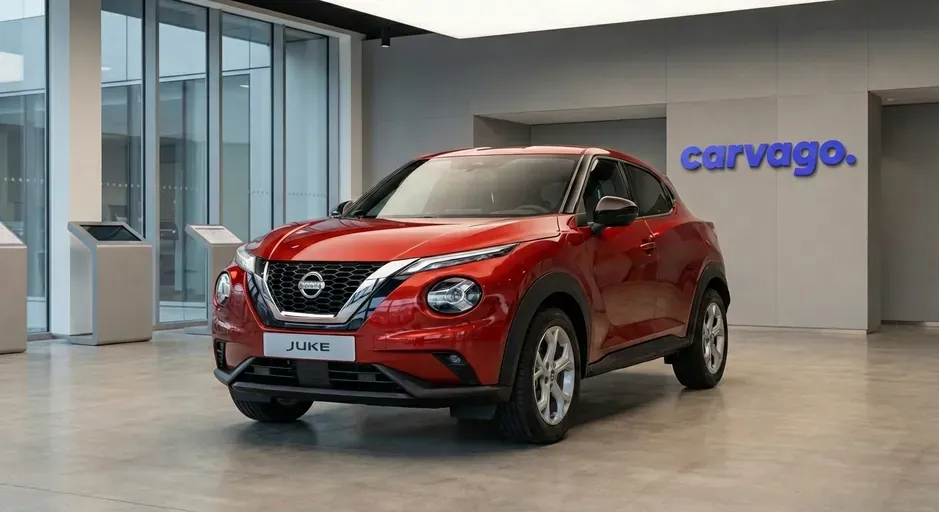
When looking for a roughly four-year-old city crossover, you will come across an interesting price difference. While the Nissan Juke (second generation F16, produced since late 2019) is an established and more affordable player on the used car market, the Toyota Yaris Cross (on the market since 2021) holds its value much higher thanks to its reputation and sophisticated hybrid powertrain.
| Model (approx. 4 years old) | Indicative price from | Price of better-equipped units |
|---|---|---|
| Nissan Juke (F16) | €14,000 | €17,000 – €20,000 |
| Toyota Yaris Cross | €19,000 | €23,000 – €26,000 |
As a used car, the second-generation Nissan Juke represents an excellent opportunity for buyers with a more limited budget. Four-year-old cars are powered almost exclusively by the 1.0 DIG-T three-cylinder engine. The price on the secondary market is most influenced by:
The Toyota Yaris Cross is a phenomenon in the compact SUV field, holding its purchase price extremely well as a used car. Basic variants with the pure petrol 1.5 Dynamic Force engine can be found most cheaply, but most buyers aim for more advanced technology. What drives Yaris Cross prices up?
Thanks to faster depreciation, the Nissan Juke is a great choice for those looking for a stylish city SUV at a more affordable price, while the more expensive Toyota Yaris Cross attracts with its unbeatable residual value and fuel-efficient hybrid.
Both vehicles boast a maximum five-star rating in independent Euro NCAP safety tests. However, when comparing results, it is crucial to take into account the context and the year of testing. Euro NCAP protocols are constantly evolving and becoming stricter every year. Percentage scores from different years cannot always be directly compared, as newer tests include much more demanding crash simulations and stricter requirements for assistance systems.
The second-generation Nissan Juke underwent Euro NCAP testing in 2019, just before the introduction of new rules. It achieved excellent results in these tests, mainly thanks to an exceptionally strong body structure, which ensured a top rating for adult occupant protection. In contrast, the Toyota Yaris Cross was tested in 2021, when significantly stricter and modernized methodology was already in place. This included, among other things, a new mobile barrier for frontal impact simulation, improved cyclist detection scenarios, and a comprehensive assessment of protection in intersection situations. Although the Yaris Cross has a slightly lower percentage gain in passive protection on paper, this score must be viewed through the lens of a more demanding test.
| Parameter | Nissan Juke | Toyota Yaris Cross |
|---|---|---|
| Year of testing | 2019 | 2021 |
| Adult occupant protection | 94 % | 86 % |
| Child occupant protection | 85 % | 84 % |
| Vulnerable road user protection | 81 % | 78 % |
| Safety assistance systems | 73 % | 81 % |
The results clearly show the different strengths of both cars. While the Nissan Juke completely dominated in raw passive occupant protection with an impressive 94% score, the Toyota Yaris Cross demonstrates a significant technological shift in the market in the area of active safety. Its 81% rating in the assistance systems category (compared to 73% for the Nissan) is excellent given the much stricter 2021 standards. This means that the Toyota features a more modern and sensitive package of active assistants that can prevent collisions more effectively. For roughly four-year-old used cars, it is also good to know that certifications for older model years gradually expire from Euro NCAP's perspective, and the Yaris Cross thus benefits from more up-to-date homologation.
In conclusion, both used cars represent a top-tier choice for daily driving in terms of safety. However, if your highest priority is advanced active protection and sophisticated assistance systems calibrated to newer standards, the Toyota Yaris Cross offers a slightly more comprehensive and modern safety package.
Even though both cars received the full five stars, the Toyota Yaris Cross underwent much stricter tests in 2021, which is the source of its more advanced active assistance systems. Nevertheless, the Nissan Juke remains a highly safe choice with an exceptionally strong construction protecting the adult crew.
In addition to standard equipment, each model offers several unique features that can be decisive for the customer and clearly demonstrate where their main added value lies.
Extravagant and attractive exterior design that stands out on the road
Agile driving characteristics and confident cornering behavior
High-quality interior craftsmanship with premium materials and an ergonomic dashboard
Very good level of standard safety equipment and modern assistance systems
Limited headroom in the rear seats due to the sloping roofline
Poorer rear-quarter visibility caused by massive C-pillars and small windows
Stiffer chassis tuning, which can reduce ride comfort on broken roads
Narrower range of engines on the used car market, dominated by basic three-cylinder units
The Nissan Juke is ideal for drivers looking for a stylish city crossover with a distinct personality and a sportier feel. It will be most appreciated by individuals or couples for whom attractive design and driving pleasure are more important than maximum interior space or soft suspension.
Top-tier efficiency and low fuel consumption thanks to a reliable hybrid powertrain
Availability of intelligent all-wheel drive (AWD-i), which is a rarity in this segment
Excellent brand reputation for long-term reliability and durability
Very good safety equipment (Toyota Safety Sense) as standard
Practically designed luggage compartment with a split double floor
Significantly limited legroom and knee room in the rear seats
Increased combustion engine noise during sharp acceleration (typical behavior of the e-CVT transmission)
Use of harder and cheaper-feeling plastics in some parts of the interior
Higher purchase price for used cars due to excellent value retention
The Toyota Yaris Cross represents a highly rational choice for those who prefer low operating costs, top-tier reliability, and worry-free ownership. It is a perfect car for daily city commuting, which, thanks to the optional all-wheel drive, will also be appreciated by residents of hilly or mountainous areas.
Based on long-term owner experience, service reports, and detailed outputs offered by a comprehensive car inspection, we have compiled an overview of the most common problems you should watch out for when buying these used crossovers.
The second generation of the Nissan Juke (produced since 2019) brought a significant improvement in reliability compared to its predecessor, but there are still several specific areas that require attention.
The second-generation Juke is a mechanically solid car; be prepared primarily for occasional infotainment freezes and less smooth reactions of the dual-clutch automatic in city traffic jams.
The Toyota Yaris Cross builds on proven and years-refined hybrid technology. It enjoys a reputation as one of the most reliable cars in its segment, yet even it has not completely avoided some typical ailments.
The Yaris Cross powertrain is a benchmark for durability and resilience; from a practical standpoint, owners must come to terms with higher engine noise on the highway and the need to monitor the 12V battery status during frequent short trips.
When buying a used car, a thorough inspection is key. Here are some specific points to focus on for these two models, especially if you are choosing from the market of approximately four-year-old vehicles.
The Nissan Juke offers a boot capacity of 422 liters in its base petrol version, while the Toyota Yaris Cross has 397 liters. However, if you choose the all-wheel drive version (AWD-i) for the Toyota, the boot volume decreases to 320 liters. The former model is therefore more advantageous for carrying more luggage, although both cars feature a practical double floor.
All-wheel drive is only available in the Toyota range, which features the intelligent AWD-i system available exclusively for hybrid powertrains. The rival Nissan is sold on the market only with front-wheel drive (FWD). For frequent driving in snow or mountain areas, the Japanese rival from Toyota is therefore much more suitable and safer.
The Toyota Yaris Cross, with its proven full hybrid system, dominates in fuel economy and can typically achieve around 4.5 l/100 km in city traffic. The Nissan Juke, with its most common turbocharged one-liter engine, consumes on average 1 to 1.5 liters more petrol. Although the Juke is also available in a newer hybrid version, Toyota's technology remains overall more efficient and smoother.
Toyota uses an e-CVT planetary continuously variable transmission, which is very simple in design, exceptionally reliable, and low-maintenance. Nissan, on the other hand, often relies on a seven-speed dual-clutch transmission (DCT), which shifts more sportily but can jerk slightly in stop-and-go city traffic and represents a higher service risk in the long run. For worry-free and smooth city driving, the e-CVT solution is therefore a much better choice.
Both vehicles belong to the small crossover (B-SUV) category, so the space in the second row is rather a compromise for taller individuals. While the Juke has more knee room thanks to a slightly longer wheelbase, its sharply sloping roof significantly limits headroom. The Yaris Cross, by contrast, offers a slightly airier feel for the head in the back, albeit at the cost of less legroom.
Sources: ADAC, denik.cz, novinky.cz, chytreauto.cz, autozive.cz, autosport.cz
This article was prepared using artificial intelligence tools. The section guarantor is Petr Dušek.

Are you deciding between the Ford Puma and the Nissan Juke? We bring you a detailed comparison of both SUVs, real-world experience with used cars, and a clear verdict for your choice.
Apr 19, 2026

Citroën C3 Aircross vs Opel Mokka: A major comparison of popular SUVs. Discover the differences in spaciousness, engines, and equipment, and find out our final verdict.
Apr 16, 2026

Audi Q3 vs Jaguar E-Pace Comparison: Which premium used SUV to choose? We reveal the differences in equipment, driving characteristics, and reliability. Find out the winner!
May 15, 2026