Car battle
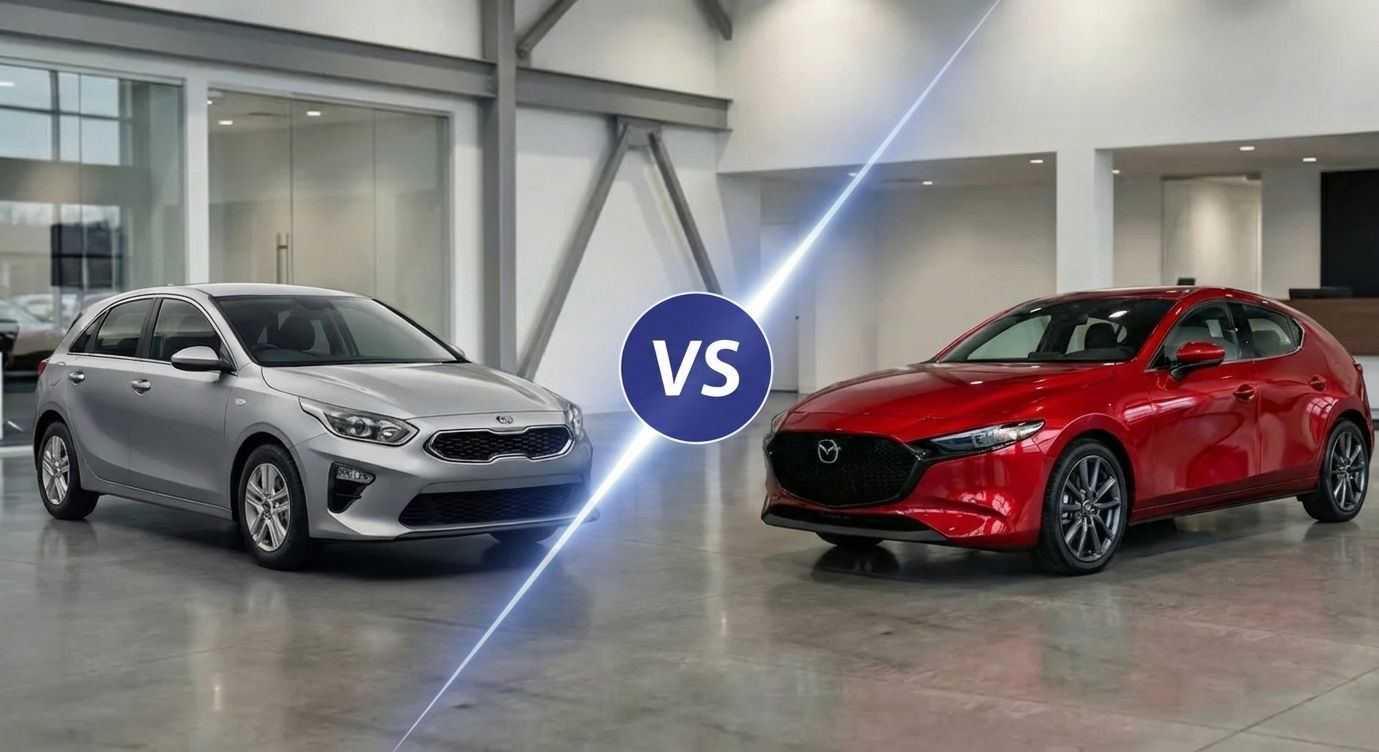
Kia Ceed vs. Mazda 3: Complete comparison 2026
Detailed comparison: Kia Ceed vs. Mazda 3. We compared the engines, equipment, and driving characteristics. Read our verdict and find out which hatchback to choose.
Apr 8, 2026
Articles
Car battle
Mazda 3 vs. Toyota Corolla: Which bestseller is better? Our detailed comparison of engines, features, and handling will help you make your final choice.
April 13, 2026
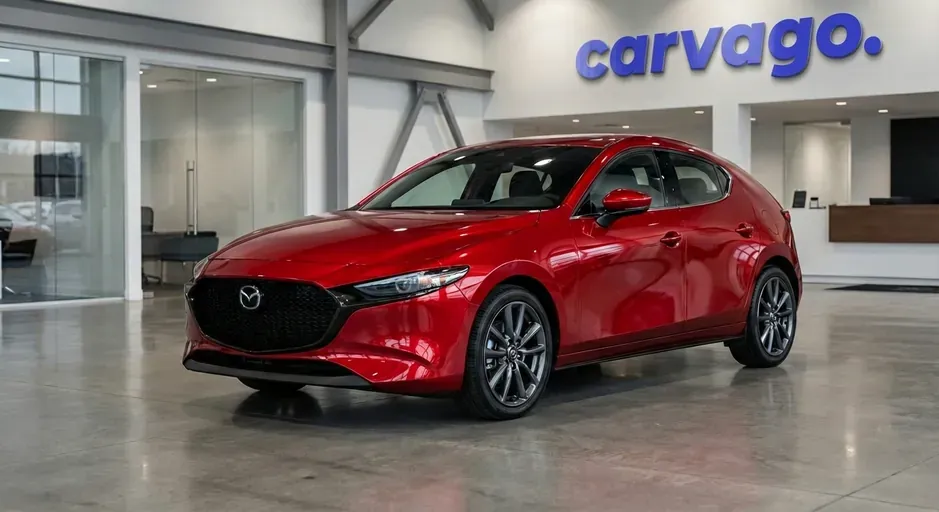
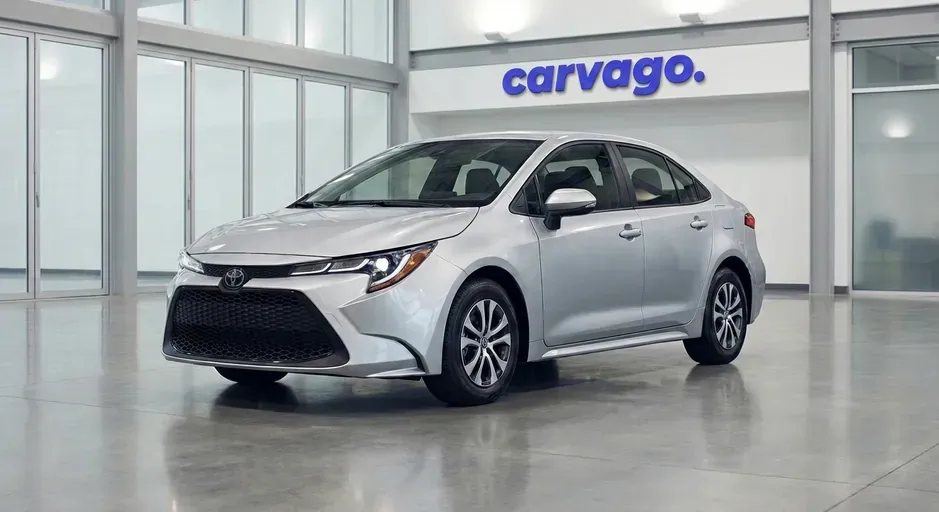
The Mazda 3, also known in Japan as the Axela, has long been prized for its engaging design and sporty driving characteristics, appealing to drivers looking for fun behind the wheel. Against it stands a global automotive icon, the Toyota Corolla, whose name is synonymous with reliability, practicality, and economical operation, with its hatchback version temporarily known in Europe as the Auris. The following comparison will reveal which of these two titans of the compact class will better suit your needs and ideas for an ideal car.
Looking at the exterior dimensions of the Mazda 3 and the Toyota Corolla, it's clear that both models fall into the same class, but each adopts a slightly different strategy. The Mazda 3 in its fourth generation (designated BP, from 2019) relies on a generous wheelbase and overall length, which gives it a more elegant and mature silhouette. In contrast, the twelfth generation Corolla (E21, from 2019) sticks to slightly more compact dimensions, especially in the hatchback version, which can be an advantage in heavy city traffic.
The biggest difference in dimensions is in the wheelbase. The Mazda 3 offers an identical wheelbase of 2725 mm for both body styles (hatchback and sedan), which is one of the highest values in the segment. This has a positive effect on driving stability at higher speeds and, theoretically, on passenger space. The Toyota Corolla is more varied in this respect – while the hatchback has a wheelbase of 2640 mm, the more practical Sedan and Touring Sports estate versions are built on an extended platform with a 2700 mm wheelbase. Even so, the Mazda offers 25 mm more, which can mean a little more knee room for rear passengers.
In terms of overall length, the Mazda 3 is always longer in a direct comparison of body styles. The Mazda 3 hatchback is a noticeable 90 mm longer than the Corolla hatchback, which is mainly reflected in the design with a longer bonnet. For the sedans, the difference is smaller, but still in Mazda's favor by 30 mm. However, Toyota scores points by offering a spacious estate version (Touring Sports), which Mazda does not offer at all in its current generation, thus targeting customers who require maximum practicality and luggage space.
| Parameter | Mazda 3 Hatchback | Toyota Corolla Hatchback | Mazda 3 Sedan | Toyota Corolla Sedan | Toyota Corolla Touring Sports (Estate) |
|---|---|---|---|---|---|
| Length (mm) | 4460 | 4370 | 4660 | 4630 | 4650 - 4653 |
| Width (mm) | 1795 | 1790 | 1795 | 1780 | 1790 |
| Height (mm) | 1435 | 1435 | 1440 | 1435 | 1435 |
| Wheelbase (mm) | 2725 | 2640 | 2725 | 2700 | 2700 |
For many drivers, practicality and luggage space are key factors when choosing a car. In this respect, the Mazda 3 and the Toyota Corolla take slightly different paths that reflect their overall focus. While Toyota offers an estate body style, clearly targeting families and customers who require maximum utility, Mazda focuses more on style, which is also reflected in the boot volume.
In the hatchback body style, the cars are similar at first glance, but with one crucial difference in the Corolla. The Mazda 3 offers a consistent volume of 351 litres, which is an average value in its class. The Toyota Corolla with the 1.8 Hybrid engine slightly surpasses it with 361 litres. However, if you opt for the more powerful 2.0 Hybrid, the volume is reduced to just 313 litres due to the placement of the larger battery, which is a noticeable difference. With the seats folded down, the differences are almost eliminated, with the Mazda offering 1026 litres and the Corolla slightly over 1000 litres, depending on the engine version.
The biggest difference in practicality is seen in the other body styles. Both models offer a sedan version (called Fastback by Mazda), where the Mazda, with a volume of 450 litres, slightly lags behind the Corolla, which provides 471 litres. However, Toyota's real trump card is the estate version, known as the Touring Sports. It offers a generous 596 litres (581 litres for the 2.0 Hybrid) in its basic configuration and up to 1606 litres with the seats folded down. The Mazda 3 does not offer this variant at all in its current generation, which is a decisive factor for families or active individuals who need to transport bulkier cargo. The choice is therefore clear: if the boot is a priority, the Toyota Corolla Touring Sports is the winner. In the case of hatchbacks and sedans, the cars are much closer, but even here, Toyota generally has a slight edge.
| Parameter | Mazda 3 Hatchback | Toyota Corolla Hatchback (1.8 Hybrid) | Toyota Corolla Hatchback (2.0 Hybrid) | Mazda 3 Saloon (Fastback) | Toyota Corolla Saloon | Toyota Corolla Estate (Touring Sports) |
|---|---|---|---|---|---|---|
| Basic boot capacity (litres) | 351 | 361 | 313 | 450 | 471 | 596 |
| Maximum capacity with seats folded (litres) | 1026 | 1052 | 1004 | - | - | 1606 |
If you plan to occasionally tow a trailer with your new car, you should pay close attention in this comparison. It is in the towing capacity that one of the biggest practical differences between the Mazda 3 and the Toyota Corolla emerges, which can be a deciding factor for many potential buyers.
The fourth-generation Mazda 3 (BP, from 2019) offers very consistent and solid values across its engine range. Whether you opt for the Skyactiv-G petrol engine, the economical Skyactiv-X, or the Skyactiv-D diesel, you can count on a maximum braked trailer weight of 1300 kg. This is sufficient for a small caravan, a trailer with a motorbike, or building materials.
On the other hand, the twelfth-generation Toyota Corolla (E21, from 2019) has two completely different faces. The now-discontinued, purely petrol 1.2 Turbo version matches the Mazda and can also tow 1300 kg. However, a significant limitation comes with the popular hybrid variants. Both the less powerful 1.8 Hybrid and the more powerful 2.0 Hybrid have a maximum braked trailer weight of just 750 kg listed in their registration documents. In practice, this is only enough for a light unbraked trailer for garden waste, and you can forget about larger loads.
For drivers who need a versatile car capable of towing heavier loads without any problems, the Mazda 3 is clearly the better choice. In this respect, the Corolla is only satisfactory in its rarer non-hybrid version, while the economical hybrids are only suitable for those who will use a tow bar very sporadically and for light loads.
| Model and engine | Braked trailer weight (kg) | Unbraked trailer weight (kg) |
|---|---|---|
| Mazda 3 (BP, from 2019) 2.0 Skyactiv-G/X | 1300 | 600 |
| Mazda 3 (BP, from 2019) 1.8 Skyactiv-D | 1300 | 600 |
| Toyota Corolla (E21, from 2019) 1.2T | 1300 | 600 |
| Toyota Corolla (E21, from 2019) 1.8 Hybrid | 750 | 450 |
| Toyota Corolla (E21, from 2019) 2.0 Hybrid | 750 | 450 |
When choosing an engine, the decision between the Mazda 3 and the Toyota Corolla is a choice between two completely different philosophies. Mazda relies on larger-capacity, naturally aspirated petrol engines, supplemented by mild-hybrid technology, which will appeal to drivers who prefer a traditional driving experience and smooth power delivery at higher revs. Toyota, on the other hand, is the king of economical and proven full-hybrid systems that excel in urban and suburban traffic with low consumption and quiet operation.
For its fourth generation (designated BP, from 2019), Mazda has primarily focused on refined two-litre petrol four-cylinder engines. All are equipped with a 24V mild-hybrid system (M Hybrid), which helps reduce fuel consumption and emissions by recuperating braking energy. The basic variant is the e-Skyactiv-G with power outputs of 90 kW (122 hp) and later 110 kW (150 hp). For more demanding drivers, there is the unique e-Skyactiv-X unit. This engine combines the advantages of a petrol and a diesel engine thanks to spark-controlled compression ignition. It initially offered 132 kW (180 hp) and, after an update, even 137 kW (186 hp). In the first years of production (2019–2021), an economical 1.8-litre Skyactiv-D diesel with 85 kW (116 hp) was also available, but it is rarer on the used car market. Most engines are paired with a precise six-speed manual transmission, with a six-speed automatic available as an option.
| Engine type | Fuel | Power (kW) | Torque (Nm) | Transmission |
|---|---|---|---|---|
| e-Skyactiv-G 122 | Petrol (Mild-Hybrid) | 90 | 213 | 6MT / 6AT |
| e-Skyactiv-G 150 | Petrol (Mild-Hybrid) | 110 | 213 | 6MT / 6AT |
| e-Skyactiv-X 180/186 | Petrol (Mild-Hybrid) | 132 / 137 | 240 | 6MT / 6AT |
| Skyactiv-D 116 | Diesel | 85 | 270 | 6MT / 6AT |
The twelfth-generation Toyota Corolla (E21, from 2019) is synonymous with hybrid drive. The range is based on two self-charging full-hybrid systems. The base is the 1.8 Hybrid with a system output of 90 kW (122 hp), which was updated in 2023 and boosted to 103 kW (140 hp). For more dynamic driving, there is the more powerful 2.0 Hybrid, which originally offered 135 kW (184 hp) and, after an update, an impressive 144 kW (196 hp). Both variants are exclusively paired with an e-CVT automatic planetary gearbox, which ensures the smoothest and most economical ride possible. For fans of conventional engines, a turbocharged 1.2 Turbo petrol engine with 85 kW (116 hp) was initially available (2019–2021), but it gave way to full electrification.
| Engine type | Fuel | Power (kW) | Torque (Nm) | Transmission |
|---|---|---|---|---|
| 1.2 Turbo | Petrol | 85 | 185 | 6MT / CVT |
| 1.8 Hybrid | Petrol (Full-Hybrid) | 90 (after 2023: 103) | 142 (comb. engine) | e-CVT |
| 2.0 Hybrid | Petrol (Full-Hybrid) | 135 (after 2023: 144) | 190 (comb. engine) | e-CVT |
The choice of engine is therefore crucial. If you are primarily looking for low running costs and maximum driving comfort in the city, the hybrid Corolla is the clear choice. If, on the other hand, you prefer a sportier character, a precise manual gearbox, and a high-revving naturally aspirated engine, the Mazda 3 will be more to your liking.
Choosing the right engine is key to long-term satisfaction with a car. In the following recommendations, we focus on the ideal choice for each model, considering the combination of performance, real-world fuel consumption, owner feedback, and mechanical reliability. While Mazda takes the path of naturally aspirated engines and driving pleasure, Toyota relies on its legendary hybrid technology and maximum efficiency.
The best choice for the Mazda 3 appears to be the naturally aspirated two-litre petrol engine with mild-hybrid technology. Whether in the 90 kW version or the later 110 kW version, this engine represents an ideal compromise between reliability, refinement, and running costs. Mazda deliberately avoids small turbocharged engines, and this unit is proof of that. Its greatest strength lies in its simplicity and predictability.
The engine has a linear power delivery and requires higher revs for dynamic driving, which is more of an advantage for drivers who enjoy the experience. It pairs perfectly with the precise manual gearbox, which is among the best in its class. While the mild-hybrid system doesn't offer the same fuel savings in the city as Toyota's full hybrid, it helps to cover up lag and reduces consumption during calm driving. Real-world fuel consumption is between 6 and 7 litres per 100 km. In terms of reliability, it's a safe bet – the engine doesn't suffer from carbon build-up like direct-injection turbo engines, and its design is well-proven. It is an ideal choice for drivers looking for a reliable and fun-to-drive car for mixed use.
In the case of the Corolla, the choice is clear: the hybrid system with a 1.8-litre petrol engine is what makes a Toyota a Toyota. This powertrain, proven over years in the Prius and other models, is synonymous with bulletproof reliability and extremely low running costs. The 90 kW (122 hp) output isn't staggering, but it's perfectly adequate for everyday driving, and its real magic lies elsewhere.
Its domain is urban and suburban driving, where it can cover a large part of the journey purely on electricity. It is here that real-world consumption drops well below 5 litres per 100 km. The e-CVT planetary gearbox ensures a perfectly smooth ride without any jerking. Under hard acceleration, the engine does run at higher revs, which can sound monotonous, but with the calm and smooth driving style it was designed for, the powertrain is quiet and refined. From a long-term ownership perspective, this system is almost maintenance-free – it has no conventional clutch, starter, or alternator, and the brakes wear out much more slowly thanks to regenerative braking. It's the perfect choice for drivers who prioritise maximum reliability, minimal costs, and a calm, stress-free drive.
Official fuel consumption figures are one thing, but real-world operation and owner experiences are another. Laboratory values are often overly optimistic, so we looked at data from the German portal Spritmonitor.de, which collects real-world data from thousands of drivers. This is where it becomes clearest how both cars perform in daily traffic and which approach to fuel economy is more effective in practice – Mazda's honest naturally aspirated engine, or Toyota's time-tested hybrid? For comparison, we selected engines from the generations available on the used car market, namely the Mazda 3 (BP) and Toyota Corolla (E21), both produced from around 2019.
| Model and Engine | Average Consumption (l/100 km) |
|---|---|
| Mazda 3 2.0 Skyactiv-G (90 kW/122 hp) | 6.3 |
| Mazda 3 2.0 Skyactiv-X (132 kW/180 hp) | 6.6 |
| Toyota Corolla 1.8 Hybrid (90 kW/122 hp) | 4.8 |
| Toyota Corolla 2.0 Hybrid (135 kW/184 hp) | 5.2 |
At first glance, it is clear that Toyota's hybrid technology has a clear advantage in terms of consumption. While Mazda relies on sophisticated naturally aspirated engines with mild-hybrid assistance, offering great response and refinement, in the real world they consume on average 1.5 to 2 litres more fuel than a comparably powerful Corolla.
For drivers who often navigate the city and traffic jams, the Toyota Corolla 1.8 Hybrid is the clear winner. The ability to drive short distances purely on electricity and the efficient energy recovery during braking bring its city consumption well below five litres. The more powerful 2.0 Hybrid offers significantly better dynamics at the cost of only a few decilitres of higher consumption, making it a very attractive option.
Conversely, the Mazda 3 shows the strength of its concept more outside the city and on motorways, where the differences in consumption are slightly reduced. Its Skyactiv-G and innovative Skyactiv-X engines are economical, but they cannot overcome the magic of the hybrid at low speeds. Interestingly, the more complex and expensive Skyactiv-X engine does not deliver as dramatic fuel savings in practice compared to the simpler Skyactiv-G as was originally expected.
For the typical user, fuel consumption is therefore one of the key factors that speaks in favour of the Toyota. The fuel savings, especially with frequent city driving, are so significant that for many drivers it outweighs the Mazda's advantages in terms of more refined driving characteristics. So, if low running costs are your priority, the Corolla is clearly the more economical choice in this duel.
When looking at the used car market, both the Mazda 3 and the Toyota Corolla appear to be valuable choices, but their prices vary depending on the engine, equipment, and mileage. In general, both models hold their value well, but there are interesting differences between them.
Mazda 3: A Premium Feel for More Affordable Money
The fourth generation of the Mazda 3 (from 2019) is entering the used car market with prices that may be tempting for many. The oldest and most used examples from 2019 with over 100,000 km on the clock can be purchased for around €15,000. Typically, the price range for roughly four-year-old models is from approximately €14,000 to €21,000. The price depends mainly on the engine (the weaker Skyactiv-G vs. the more powerful Skyactiv-X) and the trim level. However, even the basic version has a premium feel, making the Mazda 3 an attractive choice for drivers looking for style and quality at a reasonable price.
Toyota Corolla: A Safe Bet on Hybrid
The twelfth-generation Toyota Corolla (from 2018) is widely available on the used car market, especially in hybrid variants, which are in demand for their reliability and low fuel consumption. The prices of the cheapest Corollas start similarly to the Mazda, at around €14,000, but these are often cars with the 1.2 Turbo petrol engine or hybrids with higher mileage.
Well-equipped hybrid models from 2020-2021 with reasonable mileage (around 60,000 km) typically range from €18,000 to €21,000. The average price for a 2020 model year is around €18,000 – €18,000, but higher trim levels can easily exceed this amount. The Corolla holds its value a bit more tenaciously, mainly due to the reputation of its hybrid powertrain.
Summary
Although both cars received the highest five-star rating in Euro NCAP safety tests, it is important to look at the details and, above all, the year in which the tests were conducted. The Euro NCAP methodology is constantly becoming stricter, and therefore results from different years are not directly comparable. Newer tests place greater emphasis on advanced assistance systems and the protection of vulnerable road users.
The Mazda 3 underwent crash tests in 2019 and achieved truly stellar results. In adult occupant protection, it received an exceptionally high score of 98%, one of the highest values ever awarded in this category. It performed excellently in both frontal and side impacts. It also did very well in child occupant protection with a rating of 87%. For the protection of vulnerable road users (pedestrians and cyclists), it received 81%, and for assistance systems, 73%. This result confirms that the Mazda 3 has a very rigid body and sophisticated passive safety.
The Toyota Corolla also went through Euro NCAP tests in 2019 and also took home five stars. In adult occupant protection, it scored an excellent 95%, just a few percentage points less than the Mazda. For child protection, it achieved 84%. However, where the Corolla slightly surpassed its competitor was in the protection of vulnerable road users, with a result of 86%, and also in the assistance systems category, where it scored 77%. This indicates a very well-tuned Toyota Safety Sense system, which was already standard at the time and included advanced features like pedestrian and cyclist detection.
Both cars are at the absolute top of their class in terms of safety, as evidenced by their five-star ratings from the same year, 2019. The Mazda 3 excels in passive safety and adult occupant protection, where its score is among the best in history. The Toyota Corolla, on the other hand, offers a slightly more sophisticated and better-rated package of assistance systems and protection for pedestrians and cyclists. The choice between them from a safety perspective is therefore more a matter of preference – whether you place more emphasis on near-perfect protection in an accident (Mazda), or on systems that try to prevent an accident from happening in the first place (Toyota).
| Parameter | Mazda 3 | Toyota Corolla |
|---|---|---|
| Year of testing | 2019 | 2019 |
| Adult occupant protection | 98 % | 95 % |
| Child occupant protection | 87 % | 84 % |
| Vulnerable road user protection | 81 % | 86 % |
| Safety assist systems | 73 % | 77 % |
In addition to standard equipment, each model offers several unique features that can be decisive for the customer. While the Mazda 3 focuses on a more premium interior concept and innovative engine technologies, the Toyota Corolla counters with renowned reliability, an economical hybrid powertrain, and a rich set of safety equipment even in the base model.
With the fourth generation of the Model 3 (designated BP, from 2019), Mazda has taken a path of premium quality and driver focus, which is reflected in several key areas.
The twelfth generation of the Corolla (E210, from 2018) builds on the brand's traditional values – reliability and low running costs – while adding modern technology and significantly improved driving characteristics.
Advantages:
Disadvantages:
Advantages:
Disadvantages:
Based on our own CarAudit inspections, breakdown statistics, and service data, we have compiled an overview of the most common problems that used car buyers should look out for. Neither model suffers from major, widespread issues, but there are still areas that require increased attention.
The fourth-generation Mazda 3 is generally considered a very reliable car with high-quality workmanship. Most reported problems relate to minor electronic anomalies, which the manufacturer has gradually addressed with software updates.
Summary for the Mazda 3: This is a mechanically very reliable car. Potential issues are almost exclusively software-related and should have been resolved on cars that have been regularly serviced at an authorized dealership. The battery condition and the functionality of the electronics deserve special attention.
Toyota's reputation as a manufacturer of indestructible cars is no accident, and the twelfth-generation Corolla confirms it. Nevertheless, a few weak spots can be found, especially in early models.
Summary for the Toyota Corolla: The Corolla is a benchmark for reliability, but it is not entirely flawless. It is crucial to check the recall history (especially for the CVT) and to look for potential coolant leaks. Most other issues are minor inconveniences rather than serious faults.
When buying a used car, a thorough inspection is key. Even with models as reliable as the Mazda 3 and Toyota Corolla, there are specific points to focus on to prevent potential future complications.
Both models are considered very reliable. The Toyota Corolla benefits from a long-standing reputation, and its hybrid system is proven and durable. In recent generations, the Mazda 3 is often on par with Toyota in reliability ratings, thanks to its robust Skyactiv engines.
The Mazda 3 is driver-focused and offers a sportier and more enjoyable driving experience with more precise steering. The Toyota Corolla focuses more on comfort, a quiet ride, and the lowest possible fuel consumption, especially in its hybrid version. For the enthusiastic driver, the Mazda is the better choice; for a calmer ride, the Corolla is better.
The Toyota Corolla is unequivocally more fuel-efficient, especially with its hybrid powertrain, which achieves a combined consumption of around 4-5 l/100 km. The Skyactiv petrol engines in the Mazda 3 are also good, but their real-world consumption is more in the range of 6-7 l/100 km. If low fuel consumption is your priority, the Corolla Hybrid is the clear choice.
The Toyota Corolla offers more practical space, especially in the saloon version, whose boot has a volume of approximately 470 litres. The Mazda 3 hatchback, on the other hand, has one of the smallest boots in its class, with a volume of only around 295 litres. Even the Corolla hatchback tends to be slightly better in terms of space, making the Toyota more practical for family purposes.
In terms of interior design and quality, the Mazda 3 clearly excels. The materials used, the craftsmanship, and the overall impression feel almost premium and a class above. The Toyota Corolla's interior is functional and durable, but in terms of design and the plastics used, it feels simpler and less premium.
Sources: ADAC, pistonheads.com, autoexpress.co.uk, motortrend.com, roadandtrack.com, chargedevs.com
This article was prepared using artificial intelligence tools. The section is guaranteed by Petr Dušek.
Detailed comparison: Kia Ceed vs. Mazda 3. We compared the engines, equipment, and driving characteristics. Read our verdict and find out which hatchback to choose.
Apr 8, 2026
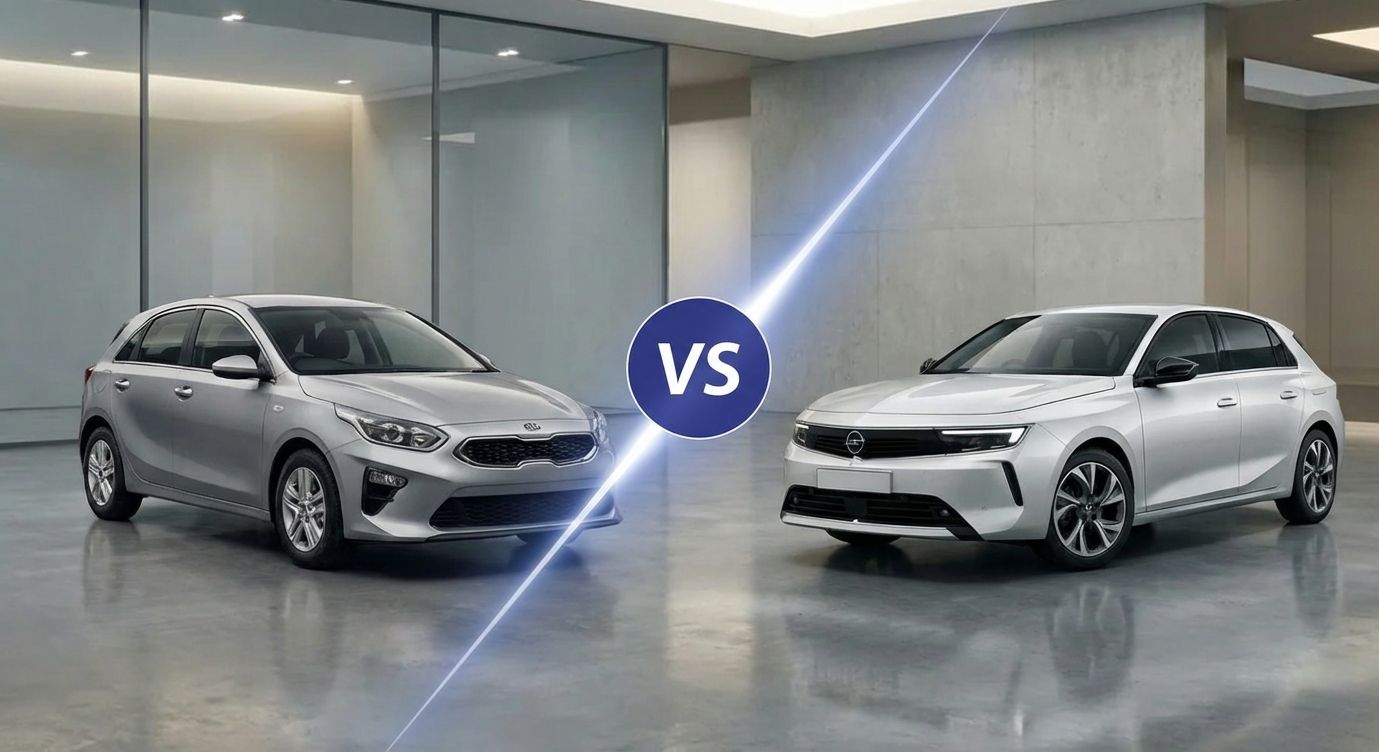
Detailed comparison of the Kia Ceed and Opel Astra. We compared real-world fuel consumption, reliability, and equipment. Find out which popular hatchback is worth buying.
Apr 14, 2026
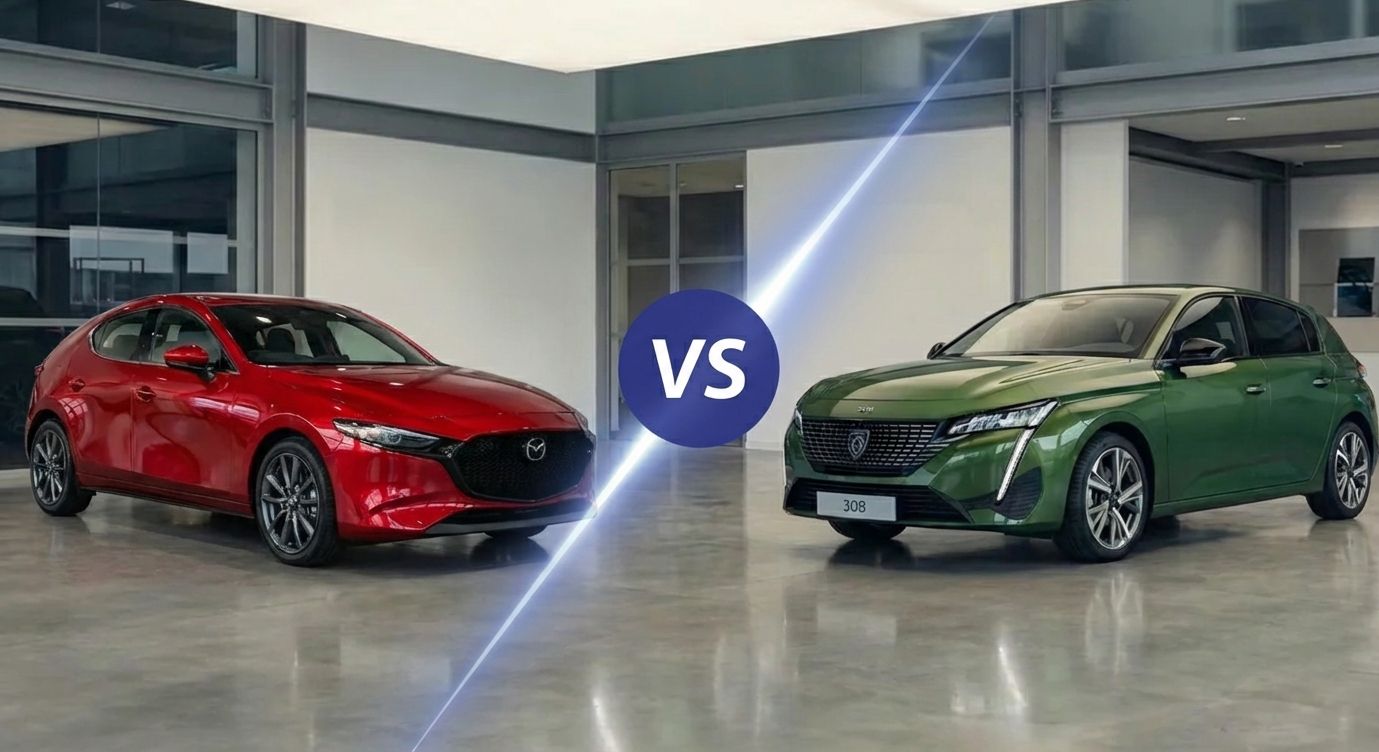
Mazda 3 vs. Peugeot 308: A detailed comparison of engines, interior, and reliability. Find out which stylish hatchback is the best choice for you.
Apr 13, 2026