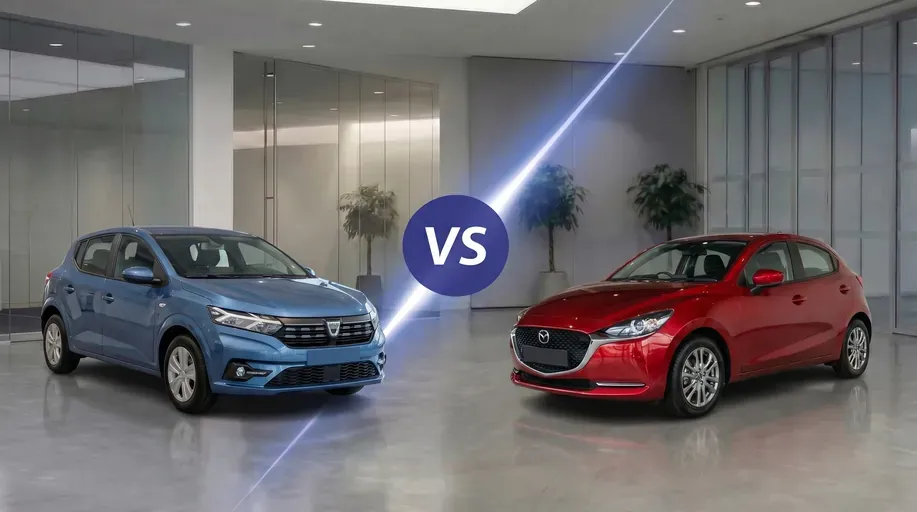
Car battle
Dacia Sandero vs. Mazda 2: Complete comparison 2026
Comparison: Dacia Sandero (Stepway) vs Mazda 2 (Mazda2). Which used hatchback offers better reliability? Read real-world insights and our clear verdict!
May 7, 2026
Articles
Car battle
Detailed comparison: Mazda 2 vs. Škoda Fabia. Find out which used hatchback to choose. We offer a comparison of equipment, real-world driving experiences, and a clear verdict.
May 14, 2026
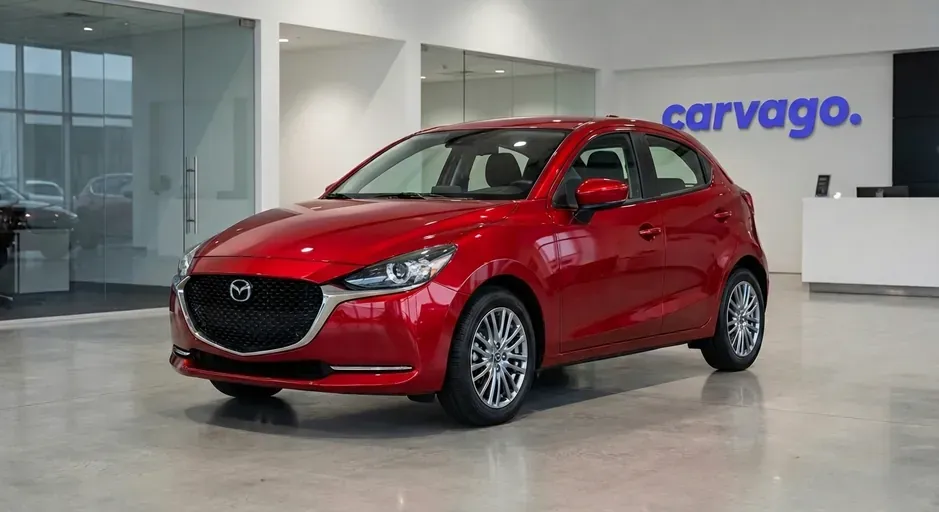
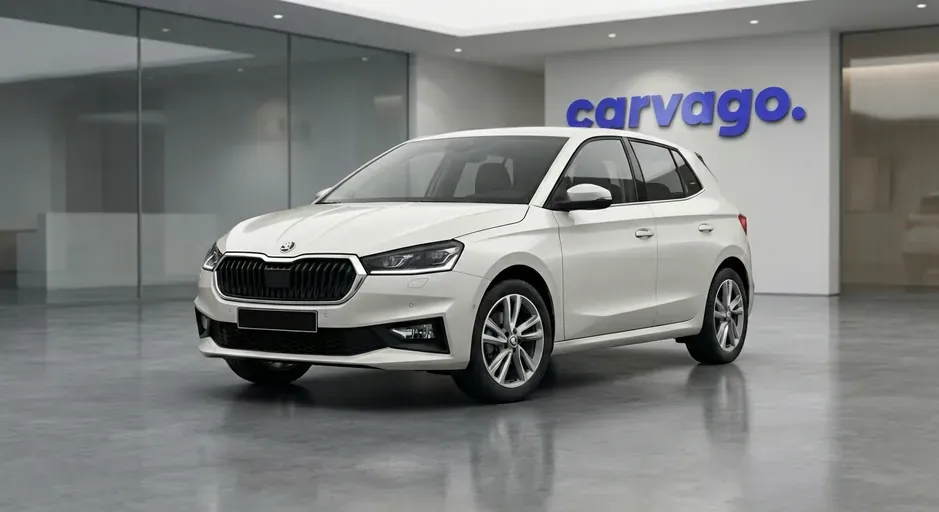
The Mazda 2, which is also known in its history as the Mazda Demio or in its latest full-hybrid version as a rebadged Toyota Yaris, represents a stylish and agile Japanese hatchback betting on captivating driving characteristics and dynamic design. Standing against it is the Škoda Fabia, a long-standing benchmark of the European small car class, which wins the hearts of drivers primarily with its unrivaled practicality, generous interior space, and renowned clever solutions. Let's take a detailed look at how these two popular B-segment representatives fare in our direct comparison and which of them will become the better choice for your daily journeys.
Looking at the exterior dimensions of roughly four-year-old used cars – the current fourth-generation Škoda Fabia and the concurrently offered Mazda 2 models (the traditional DJ generation and the ZV hybrid derivative) – the different approaches of both automakers to city cars are clearly evident. While Mazda 2 maintains more classic, very compact dimensions with a length of up to 4080 mm and a narrower body (1695 mm), the fourth-generation Škoda Fabia has grown significantly compared to its predecessor. With a width of 1780 mm, the Fabia is a massive 85 mm wider than the conventional Mazda 2, making it one of the most robust cars in its class. The wider body of the Fabia provides passengers with significantly more generous shoulder room and gives the car a much more confident and stable stance at highway speeds. Mazda, in contrast, thanks to its narrower and overall smaller build, excels when parking in narrow city streets and older underground garages.
A completely different philosophy can be observed when comparing overall height and wheelbase. Although the Fabia is longer overall on the outside, its wheelbase (2564 mm) is surprisingly 6 mm shorter than that of the purely internal combustion versions of the Mazda 2 (2570 mm). Japanese engineers have pushed the wheels to the absolute corners of the body. The result is, on one hand, agile, even playful handling for the Mazda in corners, but on the other hand, the Škoda benefits from its larger overhangs in the form of an unbeatable luggage compartment volume. The lower and more elongated silhouette of the Mladá Boleslav hatchback (around 1460 mm high) compared to the slightly taller Mazda also improves aerodynamics, which has a positive effect on fuel consumption during longer trips.
A major competitive advantage for Škoda in the nearly-new used car market remains the availability of the Combi (estate) body style. While for four-year-old used cars this still falls into the previous, third generation, with a length of 4262 mm, it represents a total unique in the B-segment. For families with children or drivers requiring regular transport of bulkier items, the extended version is a clear trump card. Mazda 2, on the other hand, relies exclusively on the traditional five-door hatchback and targets primarily individuals, couples, and lovers of clean-designed compact shapes. From a practical standpoint, the final choice depends primarily on whether you prefer maximum utility and interior space in a car, or if you appreciate agility and minimalist dimensions in heavy city traffic.
| Parameter | Mazda 2 Hatchback | Škoda Fabia Hatchback | Škoda Fabia Combi |
|---|---|---|---|
| Width (mm) | 1695 - 1745 | 1780 | 1732 |
| Length (mm) | 3940 - 4080 | 4108 - 4125 | 4262 |
| Height (mm) | 1495 - 1515 | 1459 - 1461 | 1482 |
| Wheelbase (mm) | 2560 - 2570 | 2564 | 2470 |
When choosing a small car from the used car market, boot capacity is often a deciding factor, especially if the car is to perform a wider range of daily tasks. The difference in practicality between the Mazda 2 and Škoda Fabia is quite vast and clearly shows that each manufacturer targeted a slightly different customer. While the Japanese model prioritizes elegant design and driving dynamics at the expense of interior space, the Czech bestseller remains true to its reputation as the absolute class leader when it comes to overall utility and transport capacity.
Looking at the hatchback variants, which are most common on the market for roughly four-year-old used cars, the Škoda Fabia is in a completely different league. Its fourth generation (available since 2021) offers a respectable 380 liters in its basic configuration. This space is easily sufficient for a large weekend shop, a stroller, or luggage for a longer holiday. In contrast, the standard Mazda 2 (DJ1 generation) has only 280 liters, or 286 liters in the newer full-hybrid version (ZV generation). This hundred-liter difference means in practice that the Fabia offers space for several extra suitcases, which significantly eases packing.
The situation is even more favorable for the Czech car if we include more practical body versions and folded seats in the comparison. Škoda long offered the very popular Fabia Estate version (the 3rd generation was sold alongside the new hatchback until 2022), which boasts a massive base volume of 530 liters and a huge loading area with the seats folded. Mazda does not offer a modern estate body alternative at all in this regard. Even with the rear backrests folded in the standard hatchbacks, the Fabia clearly leads – offering a maximum of 1,190 liters compared to 950 liters (or 935 liters for the hybrid version with reduced capacity) for its Japanese competitor.
| Parameter | Mazda 2 Hatchback | Škoda Fabia Hatchback | Škoda Fabia Estate |
|---|---|---|---|
| Base capacity (liters) | 280 - 286 | 380 | 530 |
| Max. capacity with seats folded (liters) | 935 - 950 | 1190 | 1395 |
Note: Values reflect models typical for the four-year-old used car market (Škoda Fabia 4th generation, outgoing Fabia Estate 3rd generation, and Mazda 2 in DJ1/ZV versions). The Mazda 2 has not been produced in an estate version in recent history, which is why it does not appear in the table.
For individuals or couples looking for an agile car primarily for city commuting, the Japanese car's boot will be perfectly adequate. However, if you need to fulfill the role of a smaller family car, transport bulky sports equipment, or simply demand maximum utility for your money, the massive spatial advantage of the Škoda Fabia makes it an incomparably more rational choice.
While the Mazda 2 offers a boot more suited for modest city use, the Škoda Fabia literally crushes it with its liters and easily serves as a full-fledged smaller family car.
Towing capacity for small city hatchbacks might seem like a marginal parameter, but for many buyers, it plays a key role. Whether a car can tow a small trailer for garden waste or handle a light caravan determines its overall practicality. When comparing used cars approximately four years old on the market, we encounter quite fundamental differences between the Mazda 2 and the Škoda Fabia.
The Škoda Fabia (spanning the 3rd and 4th generations) offers more impressive figures and a wider range of choices. The standard braked trailer weight for the basic naturally aspirated 1.0 MPI engines is 800 kg. With the turbocharged 1.0 TSI engines, however, this value increases to 1,000–1,100 kg. The maximum capacity is then demonstrated by the top-of-the-line 1.5 TSI engine in the fourth generation, which can handle a respectable 1,200 kg.
The Mazda 2 (especially in the popular DJ1 generation) has a much more consistent situation across its versions, but is overall more limited. Most common petrol and mild-hybrid engines (SKYACTIV-G and e-SKYACTIV-G) have a braked trailer capacity of 900 kg. However, special attention must be paid to the full hybrid Mazda 2 Hybrid model (ZV generation from 2022). Here, the permitted braked trailer load drops to just 450 kg due to the specifics of the powertrain and the weight of the batteries.
In practice, these differences mean that while the hybrid Mazda will serve at most for a bike rack on the tow bar, the standard versions of both cars can easily handle lighter loads, which is perfectly sufficient for weekend shopping or longer holidays. However, if you plan to tow a small caravan or heavier construction materials, the more powerful Škoda Fabia engines will not only offer significantly greater confidence but also save you valuable space for a few extra suitcases that you would otherwise have to squeeze into the cabin. As a result, the Fabia represents a far more versatile family workhorse, while the Mazda 2 remains a more stylish city choice.
| Model and motorization | Braked weight of trailer (kg) | Unbraked weight of trailer (kg) |
|---|---|---|
| Mazda 2 e-SKYACTIV-G / SKYACTIV-G (DJ1) | 900 | Not specified |
| Mazda 2 Hybrid (ZV) | 450 | Not specified |
| Škoda Fabia 1.0 MPI (3rd and 4th gen) | 800 | Not specified |
| Škoda Fabia 1.0 TSI (3rd and 4th gen) | 1000 - 1100 | Not specified |
| Škoda Fabia 1.5 TSI (4th gen) | 1200 | Not specified |
When it comes to choosing engines for approximately four-year-old used cars, the Mazda 2 and Škoda Fabia represent two completely different engineering philosophies. This has a fundamental impact on the driving experience itself, maintenance requirements, and long-term reliability. While Škoda relies on the proven Volkswagen Group recipe of smaller turbocharged engines for its current fourth generation, Mazda has long preferred larger-displacement naturally aspirated four-cylinder engines for its generation codenamed DJ1, which are often supplemented by mild-hybrid systems. For the buyer, this means that the turbo engines in the Fabia offer a stronger pull from low revs and subjectively better flexibility on the highway, while the naturally aspirated 1.5 SKYACTIV-G units in the Mazda 2 require more active gear shifting but reward you with perfectly linear power delivery and excellent reliability. An important fact from the history of both these models is that among roughly four-year-old used cars (around the 2022 model year), you will no longer find any of the previously popular diesel engines. Economical diesels like the Mazda 1.5 SKYACTIV-D or the Škoda 1.4 TDI left the market around 2018 as part of previous versions.
Under the hood of the Mazda 2 from 2021 to 2023, you will mostly find the very reliable naturally aspirated 1.5 SKYACTIV-G four-cylinder. The automaker tuned it into several different power levels, from 55 kW (75 hp) to a more spirited 85 kW (115 hp). The more powerful versions often use advanced mild-hybrid technology (labeled as e-SKYACTIV-G M Hybrid in materials), which serves to ensure smoother operation of the start-stop system and a slight reduction in average fuel consumption. Alongside this traditional line, a specific "Mazda 2 Hybrid" (ZV generation) also appeared in the range. In reality, this is a full-hybrid model created through technology sharing, built on the Toyota Yaris platform. The perfectly tuned cooperation between the internal combustion engine and the electric motor via a continuously variable e-CVT transmission makes this variant an unrivaled choice in terms of operating costs in heavy city traffic.
| Engine type | Fuel | Power (kW) | Torque (Nm) | Transmission |
|---|---|---|---|---|
| 1.5 SKYACTIV-G 75 | Petrol | 55 | 135 | 6MT |
| 1.5 SKYACTIV-G 90 | Petrol | 66 | 148 | 6MT / 6AT |
| 1.5 e-SKYACTIV-G 90 M Hybrid | Petrol (Mild-Hybrid) | 66 | 148 | 6MT / 6AT |
| 1.5 e-SKYACTIV-G 115 M Hybrid | Petrol (Mild-Hybrid) | 85 | 151 | 6MT |
| 1.5 Hybrid (ZV) | Petrol (Full-Hybrid) | 85 | 120 | e-CVT |
The fourth generation of the popular Škoda Fabia model, available on the used car market from roughly the 2021/2022 model year, took the path of exclusively pure petrol engines without any widespread electrification. The base engine, intended for very calm drivers with minimal mileage outside the city, remained the proven naturally aspirated 1.0 MPI three-cylinder. However, the vast majority of buyers and reviewers head for the turbocharged 1.0 TSI engines, which, thanks to a decent reserve of torque (up to 200 Nm), promise an optimal balance between respectable driving dynamics and low real-world fuel consumption. At the absolute top of the civilian versions sits the refined 1.5 TSI four-cylinder with a very generous output of 110 kW (150 hp). This engine, capable of challenging even larger vehicles on the highway, features advanced Active Cylinder Technology (ACT) to save fuel during steady driving and is supplied exclusively with a seven-speed dual-clutch DSG automatic.
| Engine type | Fuel | Power (kW) | Torque (Nm) | Transmission |
|---|---|---|---|---|
| 1.0 MPI | Petrol | 48 / 59 | 93 | 5MT |
| 1.0 TSI | Petrol | 70 / 81 | 175 / 200 | 5MT / 6MT / 7DSG |
| 1.5 TSI | Petrol | 110 | 250 | 7DSG |
While the turbo engines in the Škoda Fabia provide more agile pull from low revs and highway confidence, the traditional naturally aspirated four-cylinders and the modern full-hybrid in the Mazda 2 will captivate drivers who prefer technical durability and maximally refined, economical city driving.
Choosing the right engine is absolutely crucial for long-term satisfaction with the car, and our recommendations are based on real-world performance experience, actual fuel consumption, owner feedback, and mechanical reliability. The comparison of the powertrains of these two cars represents a fascinating clash of different engineering philosophies. While Mazda holds the banner for traditional Japanese naturally aspirated four-cylinder engines in roughly four-year-old used cars, scoring points with immediate response and bulletproof mechanical durability, Škoda relies on highly advanced turbocharged three-cylinder engines from the VW Group for the 4th generation Fabia, which offer pulling torque from low revs thanks to the turbocharger. Interestingly, despite its old-school approach, Mazda manages to fully match modern "downsizing" in terms of fuel consumption through a clever increase in compression ratio and mild-hybrid technology.
| Model | Recommended engine | Displacement and power | Availability (AVAILABLE_YEARS) |
|---|---|---|---|
| Mazda 2 | 1.5 e-SKYACTIV-G 90 M Hybrid | 1.5 l, 66 kW (90 hp) | 2021 - 2023 (DJ1 Generation) |
| Škoda Fabia | 1.0 TSI | 1.0 l, 81 kW (110 hp) | 2021 - 2023 (4th Generation) |
The table and available database records ("AVAILABLE_YEARS") reveal an important fact: for roughly four-year-old used Mazda 2s, the previously popular pure internal combustion variants are no longer commonly available on the market. Their place has been completely taken by the more advanced mild-hybrid powertrains (M Hybrid), or e-SKYACTIV-G versions, where driving pleasure is complemented by even lower operating fuel consumption.
This petrol four-cylinder is a complete revelation on today's used car market and the best thing you can have under the hood of the Japanese hatchback. It offers an ideal balance between playful dynamics, exemplary efficiency, and low operating costs. Thanks to the absence of a turbocharger and complex peripherals, it easily avoids the expensive risks of modern engines. Its main technical advantage is incredibly linear power delivery and perfectly precise operation without any delays. The assistance of the mild-hybrid system (M Hybrid) also noticeably smooths out starts and helps keep real-world consumption steadily around 5 liters per 100 km, even in heavy city traffic.
Although it is considered a benchmark for reliability, like any direct-injection unit, it carries one major specific:
This engine is tailor-made for drivers who like the classic revving character of a pure internal combustion engine, demand precision on backroads, and at the same time aim for long-term durability and reliability with a minimum of unexpected service items.
For the fourth generation of the Fabia, the advanced turbocharged 1.0 TSI three-cylinder from the improved EA211 Evo generation is a clear bullseye. In its more powerful 81 kW (110 hp) version, it fits the car by far the best, as unlike the basic 70 kW specifications, it comes with a six-speed manual transmission (or a very brisk DSG automatic). The strongest technical asset of this small engine is the surge of solid torque practically just above idle. Thanks to this, the Fabia can move nimbly even when fully loaded and swallows highway hills without downshifting. All this with a real combined consumption of around 5.5 l / 100 km.
This engine has already proven through years of sales that it is highly durable; however, the presence of a turbocharger and direct fuel injection makes it more sensitive to the quality of maintenance:
The Škoda Fabia equipped with the 1.0 TSI will perfectly suit a wide range of motorists. It will delight both pragmatic families and drivers regularly commuting from the suburbs to the center, for whom cabin refinement at highway speeds and confident flexibility supported by exemplary operating economy are important.
Official fuel consumption figures provided by car manufacturers based on laboratory measurements often differ from what drivers experience in real-world traffic. A car's actual appetite always depends on a number of real-world variables – from your personal driving style and the car's load to the proportion of driving in congested cities. For the most accurate comparison possible, we have therefore relied on long-term data from owners themselves from the popular community portal Spritmonitor.de. To maintain the highest possible relevance for the used car market, we focused primarily on models and engines roughly four years old (for Škoda, this is the transition between the third and fourth generation; for Mazda, it's the DJ1 series models and the latest purely hybrid ZV platform).
| Model and engine | Average consumption (l/100 km) |
|---|---|
| Mazda 2 Hybrid (85 kW) | 4.0 |
| Mazda 2 1.5 SKYACTIV-G 75 (55 kW) | 5.1 |
| Mazda 2 1.5 e-SKYACTIV-G 90 M Hybrid (66 kW) | 5.3 |
| Škoda Fabia 1.0 MPI (59 kW) | 5.2 |
| Škoda Fabia 1.0 TSI (81 kW) | 5.3 |
| Škoda Fabia 1.5 TSI (110 kW) | 5.5 |
When interpreting the table data, several interesting trends emerge. First, small cars have come a long way in recent years. Although fuel-efficient diesel engines (such as the popular older 1.4 TDI) are practically non-existent in four-year-old used cars, modern petrol units can completely replace them in terms of efficiency, making diesel unnecessary for this application. A particularly surprising finding is that for the Škoda Fabia, the bet on the basic naturally aspirated 1.0 MPI three-cylinder engine does not pay off much in terms of consumption. In practice, the turbocharged, much more dynamic 1.0 TSI engine works less during normal driving and consumes only a negligible tenth of a litre more fuel. Similarly, the robust and refined 1.5 TSI four-cylinder in the Fabia does not show any drastic increase in consumption. For Mazda, the full hybrid system (borrowed from its sister Toyota Yaris) clearly wins in terms of running costs, as it can easily push consumption down towards the four-litre per hundred kilometres mark. While the mild-hybrid systems on Mazda's larger naturally aspirated 1.5-litre four-cylinder do not see such a radical drop in thirst, they still maintain an excellent and stable average of just over five litres.
For the typical user, these findings mean that they should choose an engine primarily based on how they use the car. For drivers living in cities who stand in traffic jams every morning and take short trips, the Mazda 2 Hybrid makes the most sense, as it can handle a large part of the stop-and-go driving purely on electricity. Long-distance travellers and families, on the other hand, will appreciate the confidence of the more powerful Fabia 1.0 TSI or 1.5 TSI, which maintain exceptionally low consumption even at highway speeds. From the perspective of a very budget-conscious motorist, Mazda's weaker base engine without mild-hybrid complexity will also do an excellent job.
In the end, it turns out that for neither of the mentioned models from the current market of nearly-new used cars is consumption a real bogeyman, and it should not act as the main deterrent. The fuel differences between the standard petrol engines of Škoda and Mazda are, when calculated, in the range of pennies per kilometre. Decisions should therefore be based more on personal preference, luggage space requirements, or a fondness for smooth hybrid driving in the city.
When looking for a roughly four-year-old car (with a production year around 2022), you will find that the used car market presents a completely different picture for these two models. The Škoda Fabia is the traditional king of Czech used car dealerships, offering a huge selection, while the Mazda 2 is more of an exclusive commodity with very stable value.
Thanks to its massive popularity on the Czech market, the supply of used Fabias is enormous. For roughly four-year-old cars (which at this age represents the transition between the late third and early fourth generation), prices most often move within very affordable levels.
The Mazda 2 appears on the used car market in significantly smaller numbers, which is directly reflected in its purchase price and its ability to withstand the ravages of time in terms of depreciation.
| Parameter | Mazda 2 (approx. 4 years old) | Škoda Fabia (approx. 4 years old) |
|---|---|---|
| Approximate starting price | From €9,900 | From €7,000 |
| Price of better-equipped models | €12,300 – €16,400 | €10,300 – €13,600 |
| Depreciation | Very slow | Moderately fast |
| Market supply | Low | Extremely high |
| Spare parts availability | Good, but parts are more expensive | Unbeatable and cheap |
While the homegrown Škoda Fabia attracts buyers with its easy availability, cheaper authorized and independent service, and a vast selection of dozens of cars in one place, the Mazda 2 scores primarily with its exclusivity and uncompromising reliability. Although the initial investment in a used Japanese alternative is slightly higher, thanks to the excellent reputation of its robust engines, the car will lose value only very slowly in the coming years.
The Škoda Fabia wins with its huge selection and more favorable initial price; however, the Mazda 2 holds its value significantly better thanks to its Japanese reliability, and you will sell it with less loss in the future.
When looking at safety records, it can be stated that both cars have five-star Euro NCAP ratings to their credit. However, it is absolutely crucial to understand the context and the year in which the specific testing took place. Euro NCAP's methodology and test protocols are constantly evolving and becoming significantly stricter, which means that percentage results from different years cannot be directly compared. What was enough for a top rating a few years ago would likely not hold up today due to new frontal barriers or stricter requirements for active assistants.
Mazda 2
The situation on the used car market for the Mazda 2 is slightly specific. Its five-star result is often associated with the Mazda 2 Hybrid, which is sold in parallel (a technological twin of the Toyota Yaris, whose five-star test dates from 2020). In contrast, the most widespread standard combustion version of the third generation, which you will most often encounter in the category of roughly four-year-old used cars, was last tested in 2015 and received a four-star rating. Although it recorded a very solid 86% for adult protection and 84% for the protection of vulnerable road users, its assistance systems received only 64%. The reason was mainly the absence of now-required autonomous emergency braking at higher speeds or advanced cyclist detection. From today's perspective, the validity of its original certification has already expired.
Škoda Fabia
The fourth generation of the Škoda Fabia was tested in 2021 and received a full five stars according to very strict, modern protocols. Its testing already included new frontal collision simulations with a mobile barrier, crash tests focused on cyclist detection, and a thorough evaluation of the car's behavior in complex intersection scenarios. In adult protection, the Fabia scored 85%, and for children, 81%. In the area of vulnerable road users, it reached 70%, and its assistance systems received a rating of 71%. The Fabia benefits massively from the shared MQB-A0 platform, which inherently supports the advanced Front Assist system and sophisticated lane-keeping assistance.
Conclusion
The comparison clearly shows that the Škoda Fabia offers a much more modern and comprehensive safety package. Its rigid body and advanced assistance systems fully correspond to current standards. The conventional Mazda 2, on the other hand, relies on a structural and software foundation that has its best years behind it in terms of overall safety.
| Parameter | Mazda 2 (2015)* | Škoda Fabia (2021) |
|---|---|---|
| Year of testing | 2015 | 2021 |
| Adult protection | 86% | 85% |
| Child protection | 78% | 81% |
| Vulnerable road user protection | 84% | 70% |
| Safety assistance systems | 64% | 71% |
\Note: The table shows values for the most widespread combustion version. The hybrid Mazda 2 has a 5-star rating from 2020.*
While the combustion Mazda 2 on the used car market offers a safety certification that has already expired, the Škoda Fabia provides comprehensive protection according to modern and significantly stricter standards.
In addition to standard equipment, each model offers several unique features that can be decisive for the customer in the final selection. While the Japanese representative bets on driver connection and driving feel, the Czech model scores with unrivaled everyday practicality and clever interior equipment.
Mazda has long built on the feeling of connection between driver and car, making the B-segment model a car that retains a premium feel and specific technological solutions usually found in larger classes.
The fourth generation of the Fabia (available as a roughly four-year-old used car) has made a huge leap in spaciousness and brought advanced aerodynamics and features to the small car class that fundamentally simplify everyday life with the car.
Excellent driving characteristics and precise, communicative steering
Very reliable naturally aspirated Skyactiv-G four-cylinder engines with a long lifespan
High-quality interior craftsmanship with premium materials and a touch of luxury
Excellent ergonomics thanks to the retention of physical buttons and infotainment control via a rotary dial
Low real-world fuel consumption even without the need for a complex hybrid system
Below-average luggage capacity (only 280 liters)
Very cramped legroom and headroom for adult passengers in the rear seats
Poorer cabin and chassis sound insulation at higher highway speeds
Older platform (the car's foundation dates back to 2014, although it has undergone significant facelifts)
The Mazda 2 is an ideal choice for drivers who demand agility, reliable naturally aspirated Japanese technology, and pure driving pleasure from a small car. Given the smaller interior space and modest trunk, it serves best for individuals or couples as a stylish and trouble-free car for the city and winding country roads.
Unrivaled luggage capacity in its class (380 liters)
Generous interior space that comfortably accommodates adult passengers even in the rear seats
A wide range of useful "Simply Clever" details and cleverly designed storage compartments
A very comfortably tuned chassis that smooths out bumps exceptionally well
Top-tier level of passive and active safety, evidenced by five stars in Euro NCAP tests
In lower trim levels, larger areas of hard plastics appear in the interior
Higher purchase price on the nearly-new used car market compared to most direct competitors
Poorer ergonomics caused by moving the climate control intensity to the touchscreen
The base naturally aspirated 1.0 MPI engine is very weak and is suitable exclusively for city traffic
The fourth-generation Škoda Fabia behaves like a mature and exceptionally practical car, which, thanks to its dimensions, can even fulfill the role of a small family vehicle. It is a perfect choice for rational buyers looking for maximum utility, driving comfort, and the latest technology in a modest package.
Based on long-term user feedback, service bulletins, and data from our inspections, we have compiled an overview of the most common problems that buyers of four-year-old used cars should watch out for. For this reason, an independent technical inspection of the car before purchase is an essential step to uncovering any hidden defects.
Mazda 2 (third generation, designated DJ) is considered one of the most reliable cars in its class, yet certain typical ailments can appear over the years.
Mazda 2 excels with the fantastic reliability of its naturally aspirated engines and a minimum of serious mechanical problems. Its main weakness is the thinner paint prone to chips and occasional electronic quirks, such as failing mirror motors or freezing infotainment.
Škoda Fabia (the interface of the third and fourth generations for four-year-old used cars) is a robust and well-thought-out car, where buyers, however, encounter specific problems often related to modern equipment and emission savings.
Fabia offers a great and durable foundation in the form of proven TSI engines; however, its overall impression in more modern versions is marred by more frequent infotainment software errors and the risk of expensive DSG transmission repairs after city use.
When buying a used car, a thorough inspection is key. Here are some specific points to focus on for these two models, although the greatest certainty is always provided by a comprehensive independent technical inspection of the car.
The fourth-generation Škoda Fabia has a significant advantage, offering an above-standard trunk capacity of 380 liters. In contrast, the Mazda 2 has only 280 liters (or 286 liters in the full hybrid version). For family use and frequent transport of larger loads, the Czech representative is the clear choice.
Both cars are considered reliable on the used car market, however, the Japanese hatchback stands out slightly thanks to its naturally aspirated gasoline engines. These units do not use complex turbochargers and, with regular servicing, promise exceptional longevity with minimal breakdowns. The turbocharged TSI engines in the Mladá Boleslav car are more dynamic at lower revs, but from a long-term perspective, they represent somewhat more complex technology.
The Japanese model is renowned for its excellent driving characteristics, precise steering, and low weight, making it a very fun and agile car. Its Czech competitor relies more on a mature, stable, and exceptionally comfortable driving experience that filters out bumps well. For driving enthusiasts, the Asian representative is the more attractive choice, while the European one wins for calm highway cruising.
Cabin spaciousness is clearly a strength of the Mladá Boleslav car, which can comfortably carry two adult passengers in the back without any issues. The Japanese competitor has relatively cramped space in the rear seats, both in terms of knee room and headroom. For frequent travel with more people or installing bulkier child car seats, the Czech hatchback is therefore much more suitable.
Both cars are among the most fuel-efficient in their class, and they can typically be driven with a consumption of around 5 liters per 100 kilometers. With the Japanese car, consumption can be reduced even further by choosing the full hybrid version, which excels particularly in heavy city traffic. The turbocharged one-liter three-cylinder engines in the Czech model, on the other hand, prove their high efficiency mainly during smooth driving outside the city.
Sources: ADAC, novinky.cz, forbes.cz, motorvize.cz, smartmania.cz, e-auto.cz
This article was prepared using artificial intelligence tools. The section guarantor is Petr Dušek.
Comparison: Dacia Sandero (Stepway) vs Mazda 2 (Mazda2). Which used hatchback offers better reliability? Read real-world insights and our clear verdict!
May 7, 2026
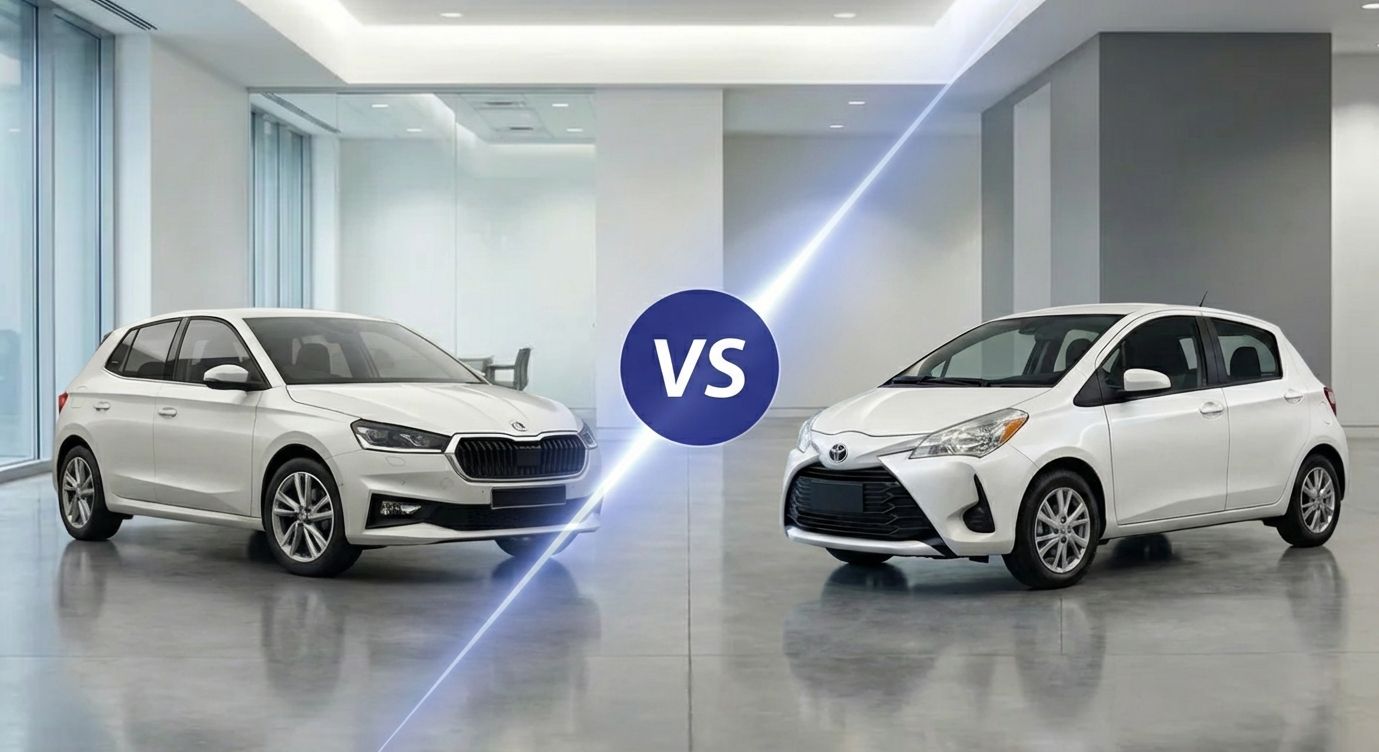
Škoda Fabia vs. Toyota Yaris. A detailed comparison of engines, features, and prices. Find out which of these popular small cars is the right one for you.
Oct 23, 2026
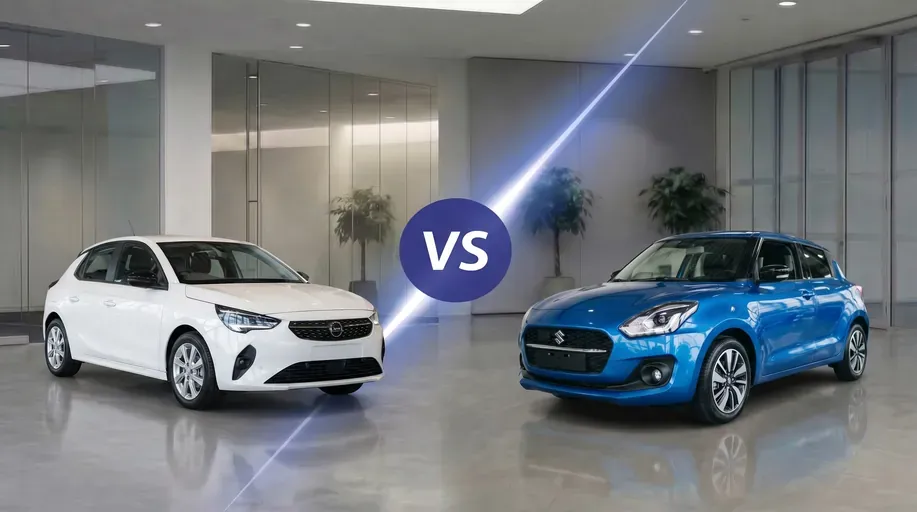
Detailed comparison of the Opel Corsa vs. Suzuki Swift. Discover real-world experiences, comparisons of equipment and driving characteristics, as well as our final verdict. Which model should you choose?
Apr 27, 2026