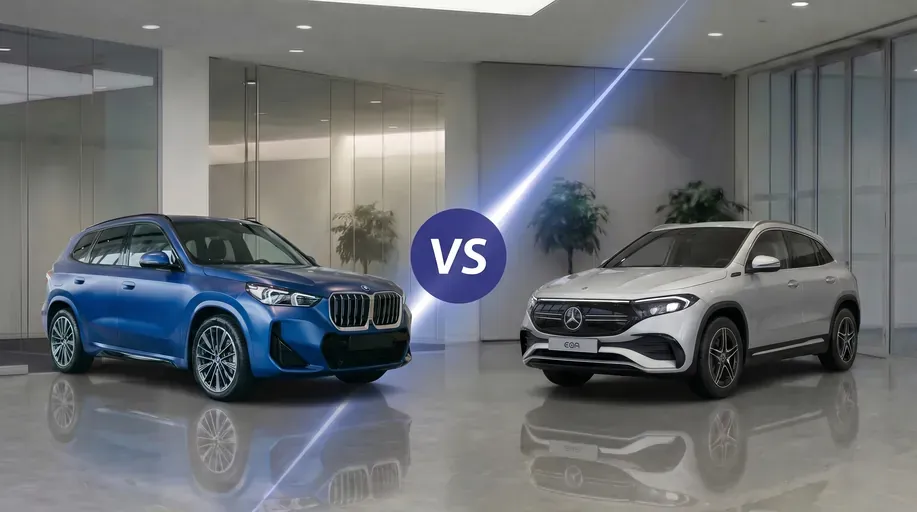
Car battle
BMW iX1 vs. Mercedes-Benz EQA: Complete comparison 2026
Detailed comparison of BMW iX1 vs Mercedes-Benz EQA. Find out which premium electric SUV offers better range, equipment, and real-world performance. Read our verdict!
Apr 16, 2026
Articles
Car battle
Detailed comparison of Jaguar I-Pace vs. Mercedes-Benz EQC. Find out which electric SUV offers better range, performance, and overall value on the used car market.
April 22, 2026
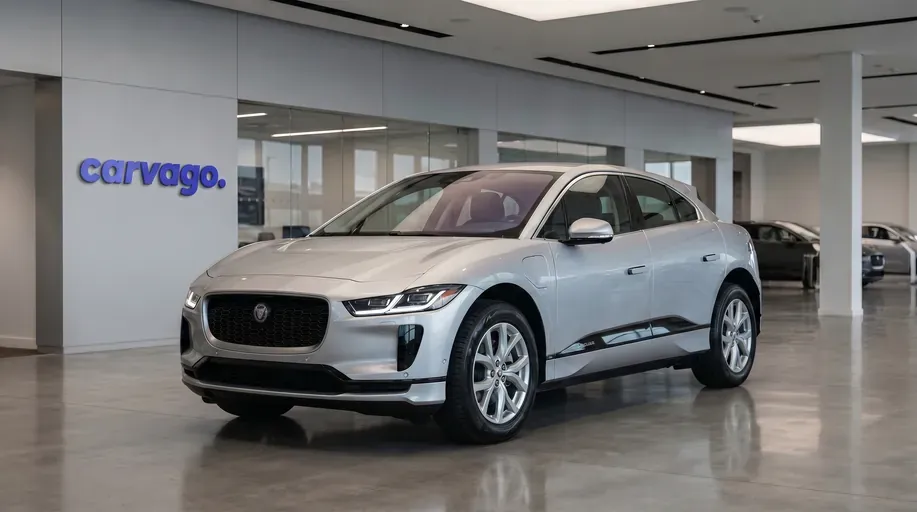
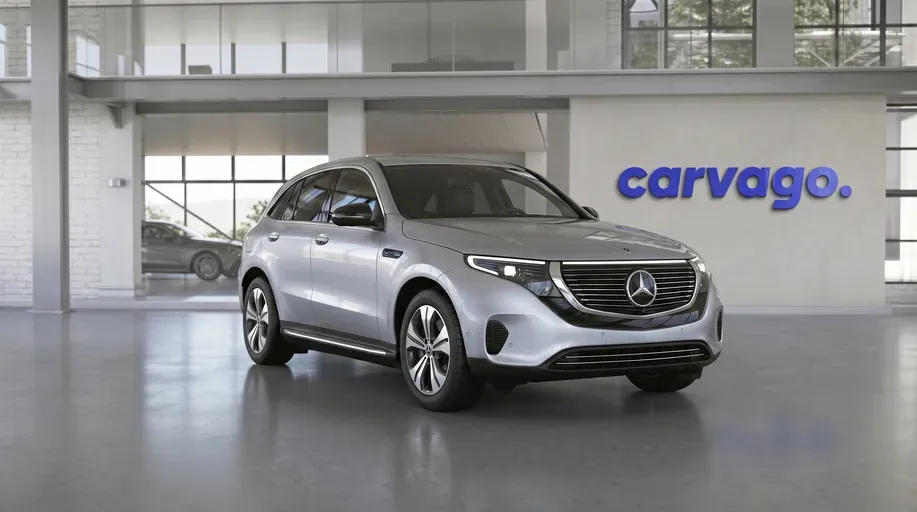
Jaguar I-Pace represents a pioneering British luxury SUV that successfully combines a dynamic sporting character with a fully electric powertrain and bold aerodynamic design. Standing against it is the Mercedes-Benz EQC, which, as the first representative of the purely electric EQ family, brings traditional German elegance, maximum driving comfort, and cutting-edge technology to the market. Let's take a detailed look at how these two premium electric vehicles fare in a direct comparison and which of them is the better choice for you on the used car market.
When comparing the exterior dimensions of both premium electric vehicles, it is clear at first glance that each manufacturer has chosen a completely different philosophy for its SUV. The Mercedes-Benz EQC bets on a more traditional silhouette, as evidenced by its total length of 4762 mm. As a result, it is 80 mm longer than its British competitor. The German representative is also 58 mm taller (1624 mm compared to 1566 mm for the Jaguar), giving it a more classic and robust appearance that customers are accustomed to with traditional SUVs.
In contrast, the Jaguar I-Pace is closer in its proportions to a raised sports car. The most striking difference is its enormous width, which reaches 2011 mm, a significant 127 mm more than the EQC model (1884 mm). This above-standard width, combined with the lower body structure, gives the Jaguar excellent stability in corners and an overall more aggressive stance on the road. However, the practical side must also be considered – with a width of over two meters, parking in narrow garages or maneuvering in historic city centers can be quite a challenge. In this regard, the narrower Mercedes-Benz is significantly more user-friendly and agile for daily city driving.
A fundamental difference for the interior layout is the wheelbase. Although the Jaguar is shorter overall, its wheelbase reaches an impressive 2990 mm. That is a full 117 mm more than the Mercedes (2873 mm). Jaguar's engineers took full advantage of the pure electric platform and pushed the wheels to the very corners of the body. The result is not only a more dynamic appearance with minimal overhangs but, above all, more generous longitudinal space for the occupants, which significantly benefits rear-seat passengers. For those looking for maximum utilization of the enclosed space, the British car is thus the better choice.
| Parameter | Jaguar I-Pace SUV | Mercedes-Benz EQC SUV |
|---|---|---|
| Width (mm) | 2011 | 1884 |
| Length (mm) | 4682 | 4762 |
| Height (mm) | 1566 | 1624 |
| Wheelbase (mm) | 2990 | 2873 |
When choosing a luxury electric SUV, practicality and trunk size often play a key role, especially if you plan to use the car for daily family needs or trips to the countryside. Although both compared SUVs offer generous interior space from the perspective of roughly four-year-old used cars, their different design philosophies are reflected in their approach to storage capacities. While the Mercedes-Benz EQC (generation 293) relies on a traditional trunk concept based on a shared platform for internal combustion models, the Jaguar I-Pace (generation X590) fully takes advantage of a dedicated electric platform, which brings interesting differences in the overall variability of storage spaces.
In its basic configuration, the Jaguar I-Pace offers a trunk volume of 505 liters according to the stricter VDA methodology (while the manufacturer often also communicates a value of 656 liters measured up to the roof). After fully folding down the rear seats, this space can be expanded to an impressive 1,453 liters. The competing Mercedes-Benz EQC has a very similar standard volume of 500 liters, but after folding down the rear bench, it offers a slightly larger maximum space of 1,460 liters. A fundamental difference between the two models as electric vehicles, however, is the presence of a front trunk (so-called frunk). The Jaguar I-Pace offers an additional 27 liters of space under the front hood, while the Mercedes-Benz EQC completely lacks this feature due to the installation of drive components and the absence of a purely electric platform.
In practice, this means that both cars offer a capacity fully sufficient for weekend shopping and longer vacations without having to make major compromises. However, the Jaguar scores points with smarter organization, as the front trunk provides an ideal isolated space for storing dirty charging cables, leaving you with clean space in the rear for a few extra suitcases. Mercedes, on the other hand, pleases with a slightly more regular shape of the loading area when the seats are fully folded, which you will undoubtedly appreciate when transporting bulkier items. Overall, both electric SUVs are very evenly matched, but if having a clean and separate place for accessories is important to you, the British car is the smarter choice.
| Parameter | Base volume (liters) | Max volume with seats folded down (liters) |
|---|---|---|
| Jaguar I-Pace SUV | 505 | 1,453 |
| Mercedes-Benz EQC SUV | 500 | 1,460 |
While both cars offer a comparably spacious rear trunk of around 500 liters, the Jaguar I-Pace gains valuable points for practicality thanks to the presence of a front storage space for charging cables. The Mercedes-Benz EQC, on the other hand, slightly leads in maximum capacity after folding the seats, making it a more reliable choice for transporting bulkier and harder-to-store items.
Trailer weight, or towing capacity, is an absolutely decisive parameter for many buyers – especially if you plan weekend trips with a family caravan, transporting a boat, or just occasional handling of heavier loads. In electric vehicles such as the Jaguar I-Pace and Mercedes-Benz EQC, towing is also significantly facilitated by massive and instantly available torque, although a more noticeable drop in total range must be expected. When comparing approximately four-year-old used cars from this category (both available mainly from the 2020 model year), however, you will soon encounter diametrical differences.
While the Jaguar I-Pace in the more powerful EV400 version (X590 generation) offers an identical and, by SUV standards, relatively strict limit of just 750 kg for both braked and unbraked trailers, its German competitor fares significantly better. The Mercedes-Benz EQC 400 (generation 293) can tow a braked trailer with an impressive weight of up to 1,800 kg, while the value for a standard unbraked trailer remains at the classic 750 kg. Also worth mentioning is the temporarily offered weaker variant, the Jaguar I-Pace EV320 (from 2020–2021), for which the manufacturer does not specify towing capacity values at all, and therefore the use of a tow bar with this version cannot be counted on.
This abysmal difference of more than one ton brings completely different possibilities for practical use. The British Jaguar, with its 750 kg limit, represents more of a lifestyle choice – it is sufficient for weekend shopping of bulkier garden items, hauling a light trailer with leaves, or mounting a practical rack for several e-bikes. In contrast, the Mercedes-Benz EQC represents a robust utility tool that can easily tow a full-sized family caravan for a longer holiday, offering space for plenty of extra equipment.
The conclusion from these values is perfectly clear. If you know that you will tow at most a light trailer with wood, the British I-Pace will be fully sufficient for you. But if you expect your electric SUV to fulfill the role of a full-fledged workhorse for heavy trailers, the Mercedes-Benz EQC becomes the clear and unrivaled winner in terms of towing capacity.
| Model and motorization | Braked weight of trailer (kg) | Unbraked weight of trailer (kg) |
|---|---|---|
| Jaguar I-Pace EV400 | 750 | 750 |
| Mercedes-Benz EQC 400 | 1800 | 750 |
When choosing a fully electric premium SUV from the used car market approximately four years old, the Jaguar I-Pace and Mercedes-Benz EQC stand against each other with completely different approaches to the powertrain, which plays a key role in terms of dynamics, efficiency, and overall driving feel. Both models rely on pure electric drive (BEV) using two electric motors, providing permanent all-wheel drive and instant power delivery. While the Mercedes-Benz EQC relied exclusively on a single, but extremely powerful 300 kW engine throughout its production, the British Jaguar chose the path of two performance variants. The Jaguar standard is a more powerful version offering 294 kW, but for those looking for a more efficient and affordable choice, a weaker version with 235 kW was briefly available. For drivers who demand a more sporty character and agility from their SUV, Jaguar's engines represent a more attractive choice. Conversely, those looking for uncompromising silence, massive torque, and an emphasis on maximum driving comfort will find their favorite in the Mercedes.
The Jaguar I-Pace engines will especially please drivers who prefer sportier driving characteristics. On the used car market, the powerful EV400 version is the absolute standard and dominant force, offering truly thrilling acceleration thanks to its 294 kW (400 hp) output and massive 696 Nm of torque. Two permanent magnet synchronous electric motors perfectly mask the car's higher weight in corners. However, it is worth mentioning that between 2020 and 2021 (the relevant period for finding a four-year-old used car), Jaguar also offered a milder EV320 variant. This is rarer on the used market, but technically shares the same 90kWh battery and construction of both motors as the more powerful model, only its power is software-restricted to 235 kW (320 hp) and torque has dropped to 500 Nm. Although this specification is no longer offered today, for those interested in a 2021 used car, it can represent a great way to get a premium electric SUV at a more favorable price while maintaining premium range.
| Engine type | Fuel | Power (kW) | Torque (Nm) | Transmission |
|---|---|---|---|---|
| EV320 | Electricity | 235 | 500 | 1AT |
| EV400 | Electricity | 294 | 696 | 1AT |
Mercedes-Benz approached the EQC model with traditional conservatism and offered only one, albeit top-tier, power unit designated EQC 400 4MATIC throughout the production of the corresponding generation (2019–2023). This system relies on a pair of asynchronous electric motors, where the front is optimized for maximum efficiency during steady driving and the rear takes care of immediate dynamics when the pedal is pressed. System power reaches an impressive 300 kW (408 hp), paired with a brutal 760 Nm of torque. This guarantees a perfectly smooth but crushing pull at any speed, which perfectly matches the 80kWh battery. All-wheel drive combined with a single-speed automatic transmission makes this car an ideal long-distance cruiser with fantastic acoustic comfort, which does not lack power reserves even when fully loaded.
| Engine type | Fuel | Power (kW) | Torque (Nm) | Transmission |
|---|---|---|---|---|
| EQC 400 4MATIC | Electricity | 300 | 760 | 1AT |
While the rarer base and common top-tier Jaguar I-Pace engines clearly target emotions and sport-oriented drivers, Mercedes-Benz, with its single and extremely powerful EQC 400 variant, bets everything on absolute smoothness, comfort, and the effortless power of a highway cruiser.
When choosing between these two premium electric SUVs targeting the market for roughly four-year-old used cars, you will encounter two different design approaches. While the Jaguar I-Pace (X590 generation) benefits from the proportions of a purpose-built electric vehicle with a huge cabin and wheels pushed to the very corners of the body, the Mercedes-Benz EQC (293 generation) is based on a modified platform of the internal combustion GLC model, which brings certain compromises in interior space. Choosing the right model year is absolutely crucial for both cars, not only in terms of mechanical reliability but also because of the speed of home alternating current (AC) charging, which underwent a critically important evolution in both models during production.
From the Jaguar range, we clearly recommend the EV400 version with all-wheel drive. Although a weaker and cheaper EV320 variant was briefly available between 2020 and 2021, it practically doesn't appear on the used car market, so the EV400 makes the most sense. The pair of electric motors offers an output of 294 kW (400 hp) and a torque of 696 Nm, which is easily enough for highly dynamic driving and acceleration from zero to one hundred in under five seconds. With a usable battery capacity of just under 85 kWh, the real-world range reliably hovers around 350 km.
When choosing a used car, strictly focus on units manufactured from summer 2020 (specifically model year 2021). It was at this time that Jaguar replaced the original slow infotainment with a completely new, smooth Pivi Pro system and, most importantly, introduced an 11kW three-phase on-board charger as standard (older model years from 2018–2019 only had 7.4kW single-phase charging, which took disproportionately long to charge at home). When buying, pay attention to the air suspension – the car should change height evenly and without error messages. Also, verify the functionality of the DC charging port lock, which occasionally suffers from jamming on older units. The Jaguar I-Pace will be most appreciated by drivers who prefer perfect weight masking in corners, agile handling, and a spacious interior.
For this model, the choice is straightforward – the EQC 400 4MATIC represents the only and fully comprehensive powertrain variant in the range. Two electric motors generate an output of 300 kW (408 hp) and an impressive torque of 760 Nm. This power can very smoothly, yet vigorously, accelerate even a 2.5-ton SUV (0–100 km/h in 5.1 s). With an 80kWh usable battery, you can expect a similar practical range to the Jaguar, roughly 350 to 360 km.
Just like with the Jaguar, it pays to hunt for models from 2021 (or late 2020) for the Mercedes as well. Only then did the manufacturer upgrade the on-board AC charger to a full 11 kW, which significantly speeds up home charging. During a test drive with a used EQC, pay extra attention to the front axle. If you hear an unnatural humming or high-pitched whistling from the front electric motor during acceleration, it could be a costly defect associated with coolant leaking into the stator, which is the most well-known weakness of this model. It is also worth checking the air bellows compressor on the rear axle (standard for maintaining ride height when loaded). The EQC 400 4MATIC is primarily a perfect highway cruiser for those who prioritize top-notch soundproofing, luxury materials, and an extremely smooth ride over sporty driving. Fast charging peaks at an average 110 kW, which is not enough for today's leaders, but for occasional longer trips, this performance is still fully acceptable.
Official consumption figures provided by manufacturers often differ significantly from reality on the road, and for heavy premium electric vehicles, this is doubly true. To get a more accurate picture of how much energy the Jaguar I-Pace and Mercedes-Benz EQC actually consume, it is ideal to compare tabular data with real-world user experiences from platforms such as Spritmonitor.de or EV Database. While official technical specifications (reflecting the WLTP homologation cycle) for roughly four-year-old used examples of these models promise very optimistic values, practice shows that with the influence of weather, heating, and highway speeds, the energy appetite grows noticeably.
| Model and powertrain | Average consumption (kWh/100 km) |
|---|---|
| Jaguar I-Pace EV320 | 22.0 |
| Jaguar I-Pace EV400 | 22.6 |
| Mercedes-Benz EQC 400 | 22.1 |
A closer look at both official and real-world data reveals that both vehicles from the generations relevant to the four-year-old used car market (X590 and 293) offer very similar efficiency on paper. In the real world, however, users on the Spritmonitor portal commonly report an average consumption of around 24.5 kWh/100 km for the Jaguar I-Pace EV400. The Mercedes-Benz EQC 400, which pays the price for its overall aerodynamics and heavier platform shared with the internal combustion GLC model, often exceeds the 26 kWh/100 km mark in practice, especially in cold months and on the highway. A surprising finding is that although the tabular averages of both cars are almost neck-and-neck, in real-world conditions these values diverge quite clearly in favor of the Jaguar, as it was developed as a pure electric vehicle from the very beginning.
For the typical user, this means an important difference in real-world range and operating costs. If you frequently undertake long highway journeys or regularly commute longer distances, the Jaguar I-Pace can manage energy significantly better. With a similar usable battery capacity, this translates directly into longer ranges without the need to stop at a charger. Conversely, with the Mercedes EQC, the traditionally top-tier level of luxury and soundproofing is traded for a higher appetite. This model therefore makes the most sense for drivers who move predominantly in suburban environments, where the higher consumption is not as apparent and its comfortable tuning can be fully utilized.
Electricity consumption and the resulting range are thus among the key decision-making factors between these two cars. Although both cars are excellently equipped and offer strong performance, from the perspective of everyday energy efficiency, the Mercedes-Benz EQC comes up slightly short. For buyers looking for maximum real-world efficiency and a more reliable highway range in their used electric vehicle, the Jaguar I-Pace will be the more rational choice.
When choosing a premium electric SUV on the used car market, specifically for models approximately four years old (2021–2022 model years), the Jaguar I-Pace and Mercedes-Benz EQC offer very different depreciation dynamics. While the purchase prices of new cars were often comparable in both cases and exceeded the €82,000 mark, the used car market values these models differently today.
The British Jaguar I-Pace has faced a fairly brutal drop in value in recent years. For a used car buyer, however, this is excellent news. Well-maintained four-year-old examples with all-wheel drive (EV400 version) can be purchased today for very attractive amounts.
Mercedes-Benz traditionally does not suffer from such a sharp drop in value, although depreciation for electric vehicles is always slightly higher than for classic internal combustion engines. Four-year-old EQC 400 4MATIC models still maintain more confident price tags compared to the Jaguar.
| Model | Drivetrain / Version | Estimated price from | Estimated price to |
|---|---|---|---|
| Jaguar I-Pace | EV320 / EV400 AWD | €25,000 | €39,000 |
| Mercedes-Benz EQC | 400 4MATIC | €31,000 | €45,000 |
Note: Prices may vary slightly depending on current market supply, documented vehicle history, and the state of health of the traction battery.
Both cars were standardly offered with a generous 8-year or 160,000-kilometer warranty on the high-voltage battery at the time of sale. This means that approximately four-year-old models from 2021 to 2022 are still under a long factory warranty for the car's most expensive component, giving second-hand buyers necessary peace of mind. However, for both candidates, always request a certificate of the current battery capacity status (SOH - State of Health) and verify whether the cars have undergone all recalls and software updates.
The Jaguar I-Pace offers excellent value for money thanks to its huge drop in value, while the Mercedes-Benz EQC maintains a higher residual value and benefits from the market's traditional trust in German premium brands.
Both of these premium electric vehicles earned the maximum five-star rating in independent Euro NCAP tests, confirming their exceptionally robust construction. However, when evaluating the safety of used cars, it is always necessary to consider the important context and the year of testing. The Euro NCAP methodology is constantly evolving and becoming stricter. Tests conducted in more recent years include much more complex frontal crash simulations, stricter evaluations of cyclist detection, and brand-new intersection collision scenarios. Therefore, percentage results from different years are not directly comparable, even though the tests for these two specific vehicles are only one year apart.
The British Jaguar I-Pace underwent crash tests in 2018. At the time of its market launch, it dazzled experts with its exceptionally strong aluminum structure integrated directly with the battery frame, which was reflected in a score of 91% for adult occupant protection. Child protection and safety assistance systems both achieved a very good 81%. It is important to mention that according to standard Euro NCAP rules (where certification is valid for six to seven years), the validity of this 2018 rating officially expired in January 2025. For those interested in a used car, this obviously does not mean the car stopped being safe overnight, but rather indicates that its level of assistance systems no longer meets the latest and very strict standards for brand-new cars.
The German Mercedes-Benz EQC headed toward the crash barriers a year later, in 2019. The automaker fully capitalized on its long-standing experience in developing passive safety, and the electric SUV took home a top rating – 96% for adult protection and 90% for child protection. This model thus represents an exceptionally safe space for transporting a family. Somewhat paradoxically, however, the EQC received a lower score in the assistance systems category at the time (75%), although its autonomous emergency braking features worked perfectly reliably in most test scenarios and were able to prevent potential collisions in time.
If, when choosing a roughly four-year-old used electric car, you place the main emphasis on the highest possible passive safety and direct protection of the occupants during the impact itself, the Mercedes-Benz EQC leads slightly according to the test results, especially in the protection of child passengers in the rear seats. In contrast, the Jaguar I-Pace offers very robust protection complemented by a slightly more balanced score for the electronic assistants of that time. You won't go wrong with either – as family cars, both models guarantee a highly above-average sense of security on the road.
| Parameter | Jaguar I-Pace | Mercedes-Benz EQC |
|---|---|---|
| Year of testing | 2018 | 2019 |
| Adult occupant protection | 91 % | 96 % |
| Child protection | 81 % | 90 % |
| Vulnerable road user protection | 73 % | 75 % |
| Safety assistance systems | 81 % | 75 % |
Although both cars offer a five-star level of safety, the Mercedes-Benz EQC provides slightly more convincing passive protection for occupants and children, while the Jaguar I-Pace wins slightly in the overall rating of its electronic assistants from the time of its launch.
In addition to the standard equipment, each of the models offers several unique features that can be decisive for the customer during the final selection and represent a completely different approach to a premium electric vehicle.
Excellent driving characteristics and sporty handling thanks to a low center of gravity
Exceptionally spacious interior benefiting from a dedicated electric platform (so-called cab-forward design)
Attractive and distinctive look that ages slowly
Powerful all-wheel drive (400 hp) with smooth power delivery as standard
Presence of a smaller front trunk (frunk) for storing charging cables
Older models (up to 2020) only have a single-phase on-board charger for slower AC charging
The original Touch Pro Duo infotainment is slower and less intuitive than the later Pivi Pro system
Stiffer suspension tuning, which reduces ride comfort on large wheels
Higher electricity consumption at highway speeds
The Jaguar I-Pace is an ideal choice for enthusiastic drivers who expect a sporty character, perfect driving characteristics, and original design from an electric car. It offers great use of interior space, but on the used car market, it's worth looking for models from 2021 onwards, which brought an improved on-board system and faster three-phase charging.
Exceptionally quiet and perfectly soundproofed interior that isolates the occupants from the outside world
Top-notch cabin craftsmanship using luxurious and pleasant-to-the-touch materials
Very comfortable suspension oriented towards a smooth and comfortable ride
Advanced MBUX infotainment system with excellent voice control and intelligent navigation
Standard all-wheel drive with quiet and refined pull (408 hp output)
Poorer use of interior packaging and the presence of a center tunnel in the rear due to the shared platform with the GLC model
Completely lacks a front trunk (frunk)
Higher curb weight (nearly 2.5 tons) limits agility in corners and driving dynamics
Weaker aerodynamics and higher consumption mean an average real-world range in practice
The Mercedes-Benz EQC will primarily appeal to more conservative customers looking for maximum comfort, acoustic well-being, and traditional luxury associated with this German brand. Although it makes compromises in range or interior space due to its internal combustion engine origins, it excels as a top-notch and soothing highway cruiser.
Based on long-term owner experience, service bulletins, and findings from our comprehensive car audit, we have compiled an overview of the most common problems that potential buyers of these used electric vehicles should watch out for.
The Jaguar I-Pace is among the pioneers of premium electric vehicles on the market, but its early model years quite often struggle with specific software and electronic faults.
For used examples, it is essential to check the condition and age of the 12V battery, test the functionality of the cabin heating, and ensure that the car has undergone all key software updates from the manufacturer.
The Mercedes-Benz EQC shares its basic architecture with internal combustion engine models (GLC), which gives it solid build quality, but at the same time, it faces several serious problems with the powertrain itself.
The biggest risk with a used EQC is the condition of the front drive unit. A thorough service history and verification of the absence of fluid leaks are absolutely key when purchasing this car.
When buying a used car, a thorough inspection is key, but for advanced premium electric vehicles full of modern technology, this is doubly true. Therefore, an independent comprehensive car audit is absolutely essential. Here are several specific points to focus on for these two models.
Jaguar I-Pace has a larger 90kWh battery, which provides an official range of up to 470 kilometers according to the WLTP standard. Mercedes-Benz EQC relies on an 80kWh battery with a stated range of around 417 kilometers. In practice, you will cover a significantly longer distance on a single full charge with the British car.
The Jaguar is significantly more practical in this regard, offering a generous trunk volume of 656 liters and adding a small 27-liter storage space under the front hood. The Mercedes-Benz EQC has a standard rear trunk with a volume of 500 liters. Unfortunately, the German representative completely lacks a practical front storage space for charging cables (frunk).
The Jaguar is tuned more sportily, offering sharper steering, a lower center of gravity, and an overall very dynamic driving experience in corners. In contrast, the Mercedes-Benz focuses on maximum comfort, a smooth ride, and top-tier cabin soundproofing. Your choice should therefore depend on whether you prefer a driver-focused performance or quiet and relaxing travel.
Both vehicles have rather average charging performance for four-year-old used cars, so the differences in overall charging speed are minimal. The Mercedes-Benz EQC can handle a maximum charging power of 110 kW, while the Jaguar I-Pace reaches 100 kW. Both electric cars will charge from 10 to 80% battery capacity at a fast charger in about 40 minutes.
The Mercedes-Benz EQC uses the very popular MBUX system with excellent voice control and a clear display structure. Fortunately, the Jaguar I-Pace from 2021 and newer already features the updated Pivi Pro system, which resolved previous issues with slow response. Both systems in approximately four-year-old used cars thus function briskly and reliably support smartphone mirroring.
The choice between these two premium electric vehicles from the used car market depends primarily on your driving priorities and daily practicality requirements. Jaguar I-Pace represents the ideal choice for enthusiastic drivers looking for sportier driving characteristics, a more spacious interior with a cleverer layout, and, thanks to a steeper depreciation, an unbeatable price-to-performance ratio. In contrast, the Mercedes-Benz EQC will clearly appeal to more conservative customers who prioritize absolute acoustic comfort, luxurious craftsmanship, and the practical ability to tow heavy trailers weighing up to 1,800 kg over aggressive dynamics. Whether you ultimately decide on British agility or German smoothness, both roughly four-year-old used cars will provide you with a top-tier and very safe entry into the world of quiet electromobility, provided their technical condition is carefully checked.
Sources: ADAC, aktualne.cz, lidovky.cz, hybrid.cz, fdrive.cz, motoristickydenik.cz
This article was prepared using artificial intelligence tools. The section guarantor is Petr Dušek.
Detailed comparison of BMW iX1 vs Mercedes-Benz EQA. Find out which premium electric SUV offers better range, equipment, and real-world performance. Read our verdict!
Apr 16, 2026
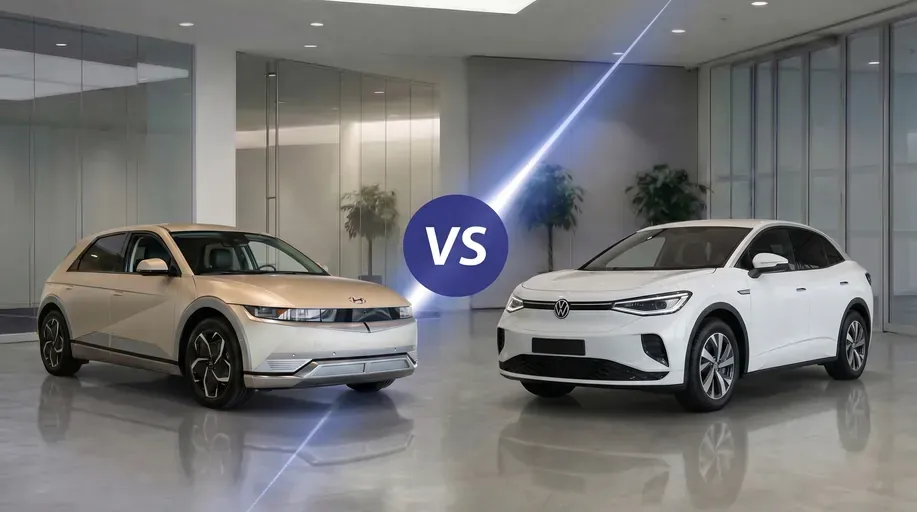
Detailed comparison of Hyundai Ioniq 5 vs. Volkswagen ID.5. Discover the real differences in range, practicality, and equipment. Read our verdict and make the right choice!
Apr 19, 2026
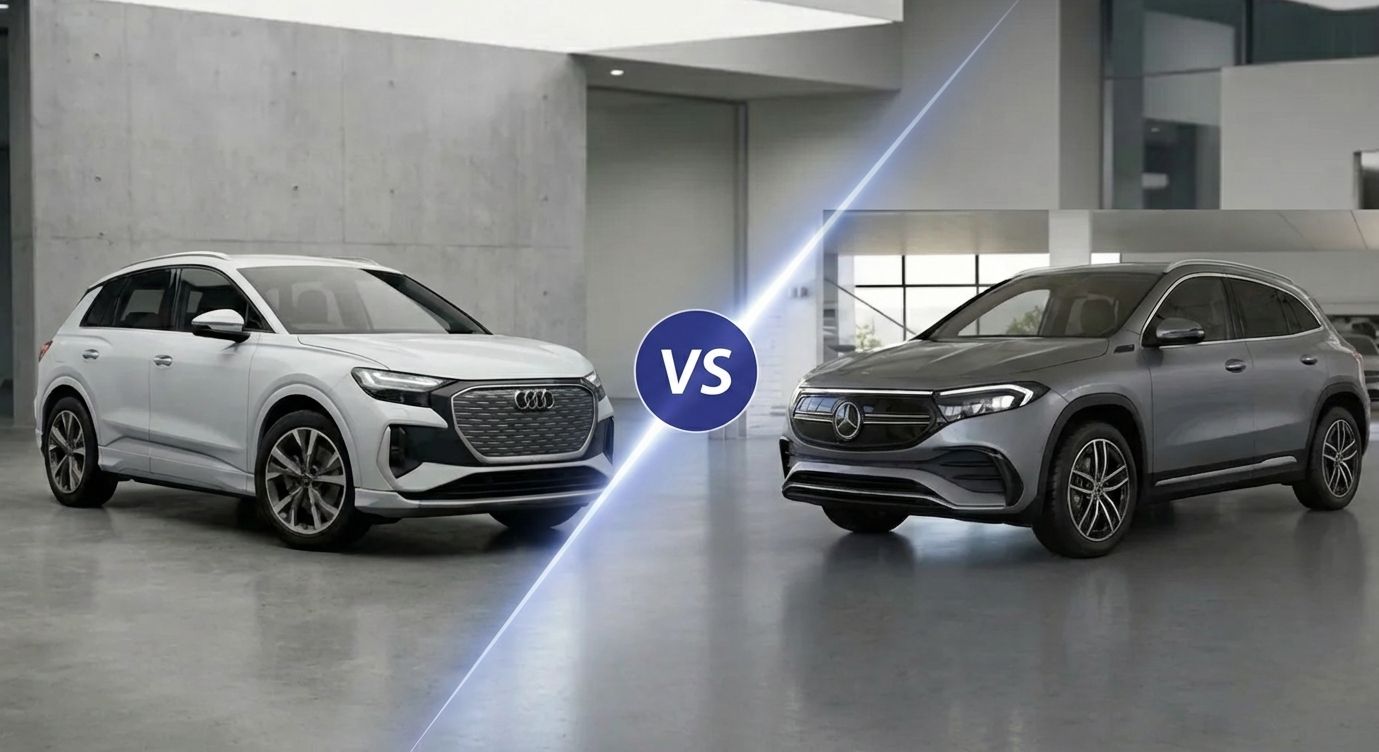
Comparison: Audi Q4 e-tron vs. Mercedes-Benz EQA. Discover the real-world range, differences in equipment, and our clear verdict for choosing the right premium used SUV.
Apr 13, 2026