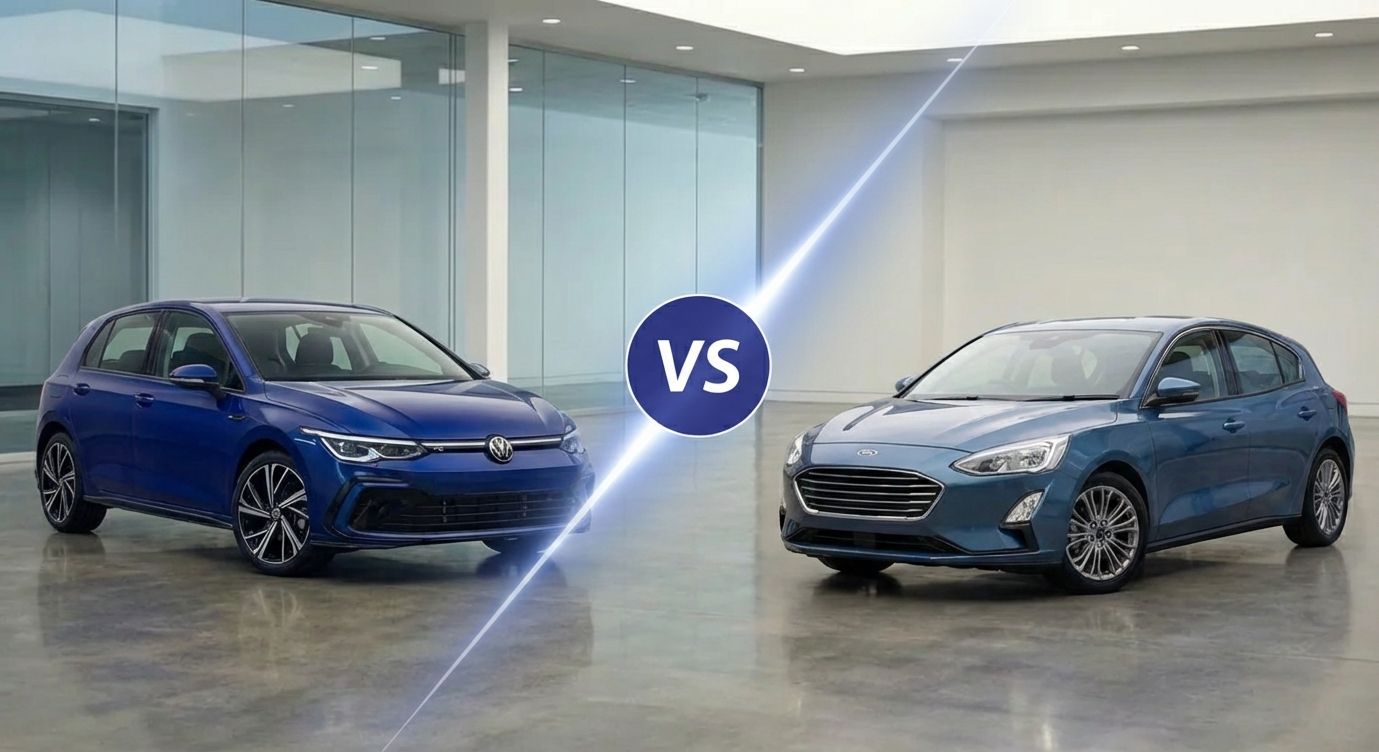
Car battle
Volkswagen Golf vs. Ford Focus: Complete comparison 2026
Volkswagen Golf vs. Ford Focus: a detailed comparison of the engine, equipment, and reliability. Find out which of these hatchbacks is the best choice for you.
Apr 13, 2026
Articles
Car battle
Detailed comparison of Jaguar F-Type vs. Mercedes-AMG C 63 Coupé (C63 AMG). Real-world experience, performance test, and final verdict. Which sports car to choose?
April 14, 2026
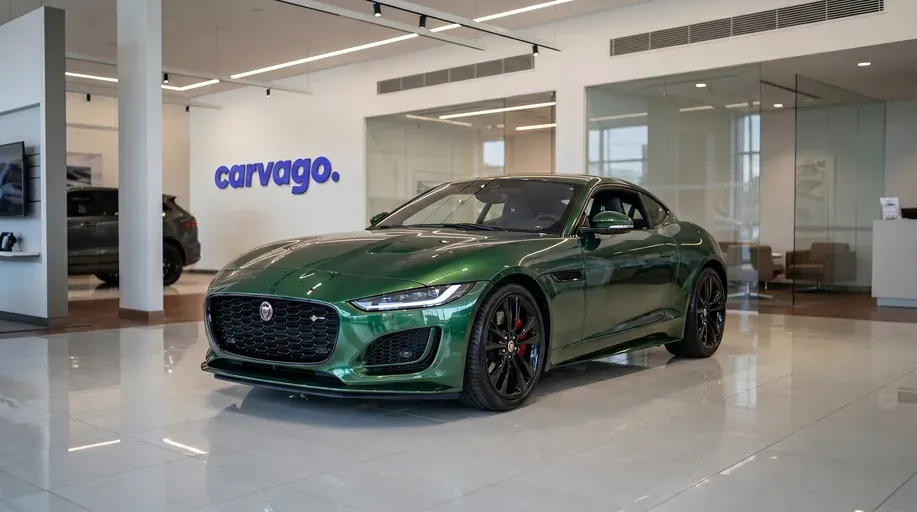
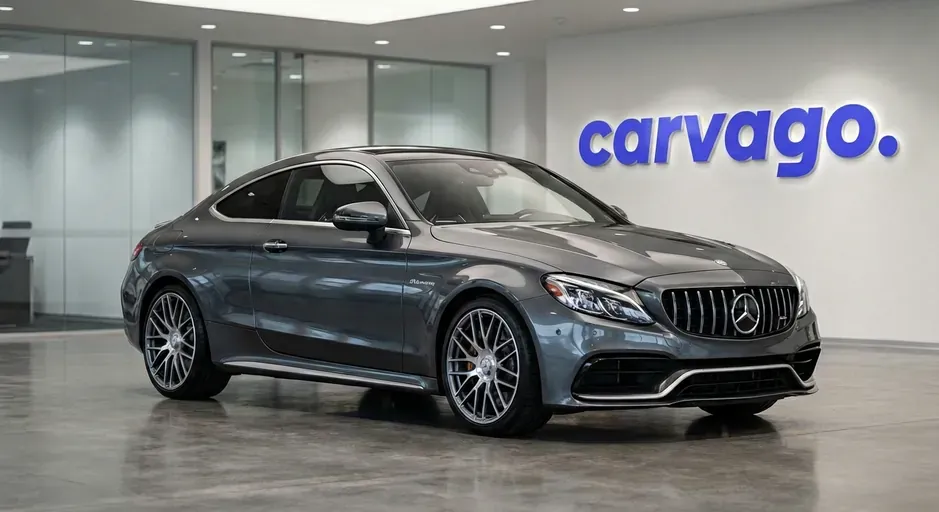
The British Jaguar F-Type, also known in the car enthusiast community by its development designation X152, is the embodiment of a purist two-seater sports car that builds on the historical legacy of the legendary E-Type and offers an enchanting combination of timeless design and a dramatic sound profile. Standing against it is the German muscle car Mercedes-AMG C 63 Coupé (internally designated as the C205 generation and succeeding the earlier models named Mercedes-Benz C 63 AMG), which uncompromisingly combines everyday touring luxury with the brutal power of a hand-assembled V8 from Affalterbach. Let's take a detailed look at how this fascinating duel between British island elegance and German engineering brutality unfolds, and find out which of these exceptional coupés represents a more compelling choice for passionate drivers in today's market.
When comparing the external dimensions of these two high-performance vehicles, we encounter completely different development philosophies. While the Jaguar F-Type was designed from the outset as a purist two-seater sports model, the Mercedes-AMG C 63 is based on a classic mid-size car platform. This structural difference is fundamentally reflected in their physical proportions, which is particularly evident when looking at the most sought-after used cars from roughly 2020 to 2022 (the facelifted X152 generation for Jaguar and the 205 generation for Mercedes). For potential buyers, this means choosing between a purebred sports car design and the robustness of a powerful car for everyday use.
Length and wheelbase speak clearly in favor of the German representative. The Mercedes-AMG C 63 in its coupé version, with a total length of 4751 mm, is a staggering 281 mm longer than the British beast (4470 mm). The wheelbase of the Mercedes is 2840 mm, which is 218 mm more than the Jaguar's 2622 mm. For the occupants, this represents a diametrical difference in interior spaciousness. The Mercedes provides a more voluminous cabin with a second row of seats and overall higher directional stability for fast highway cruising. In contrast, the shorter Jaguar features minimal overhangs and more compact dimensions, giving it excellent agility on winding backroads and making parking in tight urban spaces significantly easier.
However, an interesting turn occurs when looking at the width and height of the bodywork. At 1923 mm wide, the Jaguar F-Type is 46 mm wider than the C 63 Coupé (1877 mm). At the same time, it is a significant 90 mm lower (1311 mm compared to 1401 mm for the AMG coupé). These proportions give the British car a much more aggressive, low-slung stance, which naturally lowers the center of gravity and benefits aerodynamic efficiency. The driver sits noticeably closer to the road in the Jaguar, providing a more authentic connection with the car. The higher silhouette of the Mercedes, on the other hand, offers easier entry and better visibility, but it cannot visually mask its sedan origins as well as a dedicated sports car.
When deciding on the four-year-old used car market, these external dimensions will play a key role depending on your intended use. If you are looking for an uncompromising weekend sports tool whose unusually wide and low stance commands immense respect on the road, the Jaguar F-Type will absolutely thrill you. However, if you are looking for a more versatile vehicle that you can easily park at the supermarket, offers space for more people, and handles daily road imperfections better with its slightly higher build, the significantly longer and more practical Mercedes-AMG C 63 will be the safer and more logical choice.
| Parameter | Jaguar F-Type Coupé | Mercedes-AMG C 63 Coupé | Jaguar F-Type Cabriolet | Mercedes-AMG C 63 Cabriolet | Jaguar F-Type Sedan | Mercedes-AMG C 63 Sedan | Jaguar F-Type Estate | Mercedes-AMG C 63 Estate |
|---|---|---|---|---|---|---|---|---|
| Width (mm) | 1923 | 1877 | 1923 | 1877 | - | 1839 | - | 1839 |
| Length (mm) | 4470 | 4751 | 4470 | 4751 | - | 4757 | - | 4772 |
| Height (mm) | 1311 | 1401 | 1307 | 1404 | - | 1426 | - | 1441 |
| Wheelbase (mm) | 2622 | 2840 | 2622 | 2840 | - | 2840 | - | 2840 |
When choosing a sporty car, trunk capacity plays a surprisingly important role, especially if you plan to use the car not only for pleasure drives but also for daily commutes. In this regard, the Jaguar F-Type and the Mercedes-AMG C 63 represent two completely different worlds. While the British beast is strictly a two-seater sports car, the German powerhouse benefits from a classic car platform, offering a significantly higher level of family practicality. To keep the comparison relevant for the used car market, we are focusing on approximately four-year-old vehicles: the facelifted Jaguar F-Type (X152 generation) and the iconic V8 generation of the Mercedes-AMG C 63 (W205).
The Jaguar F-Type Coupé offers a base trunk capacity of 299 liters. As it is a two-seater, you naturally won't find any rear seats. However, after removing the parcel shelf and loading up to the roof, the maximum capacity climbs to a solid 509 liters, which is quite sufficient for a weekend grocery run or a longer holiday for two. For the Jaguar F-Type Convertible variant, the situation is more modest; the folding roof mechanism limits the fixed capacity to 207 liters, enough for roughly two small travel bags.
The Mercedes-AMG C 63, on the other hand, excels in family usability and the variety of body styles. The most spacious variant, the Mercedes-AMG C 63 Estate (T-Modell), offers an excellent 490 liters as standard, which can be expanded to a massive 1,510 liters by folding down the rear seatbacks. The classic Mercedes-AMG C 63 Sedan impresses with a base value of 435 liters (with a maximum of 1,335 liters), easily swallowing gear for the whole family. If you prefer a sporty look, the Mercedes-AMG C 63 Coupé version has 355 liters of space, and the Mercedes-AMG C 63 Convertible version offers 260 liters with the top down (up to 355 liters with the top up). Compared to its British rival, the Mercedes provides secure space for several extra suitcases across the range. It is also worth noting that if you were to opt for the latest generation (W206), the installation of the plug-in hybrid battery significantly reduces the trunk space. Thus, the four-year-old internal combustion W205 generation remains a much more rational choice in terms of hauling capabilities.
| Parameter | Jaguar F-Type Coupé | Jaguar F-Type Convertible | Mercedes-AMG C 63 Coupé | Mercedes-AMG C 63 Convertible | Mercedes-AMG C 63 Sedan | Mercedes-AMG C 63 Estate |
|---|---|---|---|---|---|---|
| Base capacity (liters) | 299 l | 207 l | 355 l | 260 l | 435 l | 490 l |
| Max. capacity with seats folded (liters) | 509 l | 207 l | 1235 l | 355 l | 1335 l | 1510 l |
(Note: The Jaguar F-Type is strictly a two-seater with no option to fold rear seats; the maximum volume value represents the total usable space loaded to the roofline.)
In conclusion, if you only expect your car to stylishly transport weekend luggage, the Jaguar F-Type's limited trunk will not be an obstacle. But if you are looking for supercar performance wrapped in a maximally usable form, the Mercedes-AMG C 63 in Sedan and Estate variants offers practicality that can easily handle moving half your family's belongings.
While the Mercedes-AMG C 63 scores points for its immense practicality and the option of a spacious estate for family travel, the Jaguar F-Type remains an intimate weekend car where you pack only the absolute essentials.
When comparing these two high-performance cars, it turns out that trailer weight and overall towing capacity can be a surprisingly decisive factor for buyers considering a combination of driving dynamics and everyday practicality. The Jaguar F-Type (X152 generation), which is a typical representative on the market for approximately four-year-old used cars, does not account for trailer attachment at all. Since it is a strictly purist sports model, its official towing capacity is 0 kg, and the car has no factory homologation for towing.
Conversely, the Mercedes-AMG C 63 model range has undergone a very interesting development in this regard. While you would also look in vain for a tow bar on the older 205 generation (typical for roughly four-year-old Coupés on the used car market), the newer plug-in hybrid version, the C 63 AMG S E PERFORMANCE (206 generation), brings a radical change. This powerful hybrid, with its specified capacity, boasts a standard and maximum braked trailer weight of an impressive 1800 kg. In practice, such a difference means that with the Mercedes, after attaching a trailer, you get not only a luxurious and fast ride but also trouble-free space for several extra suitcases. Its transport capacity is thus perfectly sufficient for weekend shopping of bulkier items or a longer holiday with a caravan in tow.
In conclusion, if towing capability and transport versatility are key for you, the hybrid variant of the Mercedes clearly wins, giving the car a completely new, utilitarian dimension. With the Jaguar F-Type, on the other hand, you have to accept that it is an uncompromising sports machine built exclusively for driving pleasure. Due to the complete absence of factory homologation for a tow bar on the Jaguar F-Type model, we list only the available data for the Mercedes-Benz vehicle in the table below.
| Model and motorization | Braked weight of trailer (kg) | Unbraked weight of trailer (kg) |
|---|---|---|
| Mercedes-Benz C 63 AMG S E PERFORMANCE (gen. 206) | 1800 | 750 |
When choosing between these two attractive sports cars, you will encounter completely different philosophies of the British and German carmakers, which fundamentally influences the overall driving experience, fuel consumption, and everyday usability. In its modernized form, the Jaguar F-Type offers a wider range of powertrains, which on the market for approximately four-year-old used cars ranges from a lighter turbocharged 2.0-liter four-cylinder to a characterful 5.0-liter supercharged V8. Furthermore, customers can choose between rear-wheel drive or all-wheel drive (AWD). Conversely, the Mercedes-AMG C 63 Coupé (C205 generation) remains faithful to the uncompromising concept of a muscular "muscle car" with a massive 4.0-liter V8 Biturbo engine and exclusively rear-wheel drive. While the Jaguar can appeal to drivers looking for a more balanced and lighter sports car with more reasonable fuel consumption (in the P300 version), the AMG clearly targets lovers of brutal pull, aggressive sound, and the desire to constantly tame an excess of power.
The engine range of the Jaguar F-Type stabilized after the facelift (around 2020) into three main specifications covering various driver requirements, while the popular supercharged six-cylinders from earlier years were phased out of the permanent lineup. The base variant on the market for slightly used cars today is represented by the 2.0-liter P300 petrol four-cylinder, which stands out for its light front end, agility, and reasonable running costs. For fans of the classic British school, the purist P450 versions and the absolute top-of-the-line R (or the special R75 edition) are intended, both powered by a full-fat 5.0-liter V8 engine with a supercharger. This unit gives the car a completely unmistakable mechanical sound profile, which is among the best on the market. Standard power transmission is provided by an eight-speed Quickshift automatic gearbox. While the four-cylinders and weaker eight-cylinders are primarily rear-wheel drive, the top R version is available exclusively with efficient all-wheel drive (AWD), which significantly increases traction and stability in any weather.
| Engine type | Fuel | Power (kW) | Torque (Nm) | Transmission |
|---|---|---|---|---|
| 2.0 I4 Turbo (P300) | Petrol | 221 | 400 | 8-speed Quickshift (Aut.) |
| 5.0 V8 Supercharger (P450) | Petrol | 331 | 580 | 8-speed Quickshift (Aut.) |
| 5.0 V8 Supercharger (R / P575) | Petrol | 423 | 700 | 8-speed Quickshift (Aut.) |
In the case of the Mercedes-AMG C 63 Coupé (205 generation, produced until roughly 2023), the engine choice is fascinating yet very simple – a hand-built 4.0-liter V8 Biturbo always roars under the hood. Since the 2018 update, the engine has also been paired with the excellent and fast nine-speed AMG SPEEDSHIFT MCT 9G automatic transmission. You essentially only decide between the standard C 63 version and the sharper C 63 S variant. While even the base version provides immense power and 650 Nm of torque, the "S" variant adds another 25 kW of power, 700 Nm of torque, active engine mounts, and a sophisticated electronically controlled limited-slip differential on the rear axle. Despite this massive power, in this generation of the Coupé, power is sent uncompromisingly only to the rear wheels, which demands respect but also makes the C 63 S one of the most playful and emotionally appealing cars in its class.
| Engine type | Fuel | Power (kW) | Torque (Nm) | Transmission |
|---|---|---|---|---|
| 4.0 V8 Biturbo (C 63) | Petrol | 350 | 650 | 9-speed AMG SPEEDSHIFT MCT |
| 4.0 V8 Biturbo (C 63 S) | Petrol | 375 | 700 | 9-speed AMG SPEEDSHIFT MCT |
While the Jaguar F-Type P300 is a sensible and agile entry ticket to the world of sports coupés, the Mercedes-AMG C 63 S or the V8 F-Type R are unstoppable "tire hammers" for true enthusiasts of extreme performance.
Choosing the right engine is absolutely crucial for long-term satisfaction with a vehicle, and our recommendations are based on real-world operating experience, performance parameters, actual fuel consumption, owner feedback, and overall mechanical reliability. In the segment of premium sports coupes and convertibles, you will encounter an absolutely fascinating battle of differing technologies among approximately four-year-old used cars (around the 2022 model year). Both cars offer the best from the era of pure internal combustion engines, but their approach to forced induction differs radically.
As evidenced by data from the production length database (see table below), if you are looking for traditional, high-displacement engines, you are already severely limited in late-model used cars. Jaguar's characterful supercharged V6 engines ended completely in 2019. For the Mercedes-AMG C 63 brand, a complete revolution occurred around 2023 – the iconic V8 was replaced by a complex four-cylinder plug-in hybrid. This makes the older, honest V8 engines, which we will focus on in our recommendation, hold their driving and market value all the more.
| Brand and model | Engine version | Engine configuration | Production period (per database) |
|---|---|---|---|
| Jaguar F-Type | P340 / P380 | 3.0 V6 Supercharged | 2017 – 2019 (discontinued) |
| Jaguar F-Type | P450 | 5.0 V8 Supercharged | 2020 – 2024 |
| Mercedes-AMG C 63 | S AMG (generation 205) | 4.0 V8 BiTurbo | 2015 – 2023 (discontinued) |
| Mercedes-AMG C 63 | S E PERFORMANCE (gen 206) | 2.0 R4 Plug-in Hybrid | 2023 – present |
Why it's the best choice in the range:
Given that characterful V6 variants are no longer found among late-model used cars from 2020 and newer, the choice remains between the P300 four-cylinder or the massive five-liter V8s. The P450 engine represents the absolute ideal. The four-cylinder cannot offer the desired sonic or mechanical drama for a car of this stature, while the top-tier R version with its 575 horsepower can be senselessly aggressive on public roads, too stiff, and unnecessarily expensive to purchase and maintain. The P450 version offers exactly the right British charisma and balance.
Technical advantages:
The power unit, code-named AJ133, relies on a classic mechanical supercharger (Roots system), which brings a fundamental advantage: the absolute absence of "turbo lag." Throttle response is lightning-fast, and the pull with a smooth curve builds relentlessly upward. Combined with the excellently tuned eight-speed Quickshift automatic, the car handles unexpectedly refined highway journeys with acceptable real-world fuel consumption. Above all, however, reigns the extraordinarily dramatic baritone roar of the exhaust system, which you will never tire of.
Known risks and how to prevent them:
Who it's for:
The P450 will primarily appeal to lovers of Gran Turismo class cars. It is built for people who crave emotional engine sound, crushing torque from any RPM, comfort on long weekend drives, and who do not insist on constantly pushing the car to its absolute limit on a race track.
Why it's the best choice in the range:
If you are looking for an approximately four-year-old coupe with a hooligan nature, the generation designated as W205/C205 currently makes the most sense. It represents the swan song of the V8 for C-Class models, and in the context of current four-cylinders, connoisseurs view it with almost religious reverence. We clearly recommend looking for the optional "S" version. In addition to a significant power boost to 510 hp, you primarily get a sophisticated electronically controlled limited-slip differential and dynamic engine mounts. Both of these features drastically improve the car's ability to dampen understeer and maintain rear-wheel traction.
Technical advantages:
The M177 power unit comes from hand-built production ("One Man, One Engine") and is a technical masterpiece. Its main advantage is the structural architecture known as "hot-V." Engineers placed two turbochargers directly inside the V-opening of the cylinders. This means exhaust gases do not have to travel through long pipes and spin up the chargers very promptly. Along with the specially tuned 9-speed AMG SPEEDSHIFT MCT automatic (which replaced the classic torque converter with a more precise wet start-off clutch), the powertrain response is incredibly immediate.
Known risks and how to prevent them:
Who it's for:
This AMG is the perfect toy for experienced, more aggressively focused drivers with fast hands on the steering wheel. If joy behind the wheel means delicate balancing on a throttle-steered rear axle, precise communication from the wheels, and you love the dark thunder of a German V8 from the exhaust tips, the C 63 S is a definitive hit.
In high-performance sports cars, there is traditionally a vast gap between the officially stated fuel consumption and what drivers achieve in real-world conditions. While standardized manufacturer tests keep the figures surprisingly low, real-world data from users on community platforms such as Spritmonitor.de show a much rawer picture of how many liters of fuel these engines actually require. For comparison, we focused on the most sought-after engine versions of roughly four-year-old generations (around 2020–2023), which are currently popular choices on the used car market.
| Model and Engine | Average Consumption (l/100 km) |
|---|---|
| Jaguar F-Type P300 (2.0 R4) | 9.6 |
| Mercedes-Benz C 63 AMG (4.0 V8) | 10.7 |
| Mercedes-Benz C 63 S AMG (4.0 V8) | 10.8 |
| Jaguar F-Type R (5.0 V8) | 10.7 |
| Jaguar F-Type P450 (5.0 V8) | 10.8 |
Looking closely at the trends, we find several surprising facts. The entry-level two-liter four-cylinder P300 in the Jaguar might theoretically seem like a very economical choice, but in practice, during more spirited driving, it doesn't save fuel nearly as effectively as one might expect. The relatively heavy car has to rely on high turbocharger boost pressure. Conversely, the massive V8 engines – whether the five-liter from the British beast or the twin-turbocharged four-liter from AMG – paradoxically stay at almost identical values just below the 11-liter mark in official combined figures. However, the reality on the road is more unforgiving, and community websites clearly show averages commonly climbing to 13 or 14 liters, depending on the driver's level of courage. If you're interested in a comparison with diesel, you'll logically hit a wall in this exclusive category – diesel engines are not offered here at all, and both cars require exclusively high-quality high-octane gasoline.
For the typical user, this means a clear recommendation: neither of these cars can rationally be cast in the role of an economical vehicle for daily commuting or crawling through congested cities. In such conditions, consumption will easily exceed 15 liters per hundred kilometers. On the other hand, during smooth long highway trips or weekend fun, the differences between the four-cylinder and eight-cylinder concepts begin to blur unexpectedly. Especially for more budget-conscious buyers, it's good to know that thanks to better-optimized aerodynamics, the AMG can consume a comparable amount of fuel to the larger-displacement Jaguar on longer trips.
In the end, it can be said with certainty that fuel consumption will likely not be the main deciding factor for you between the F-Type and the C 63 Coupé. You buy both cars for a highly emotional experience, where design, chassis, and the thrilling orchestra emanating from the exhausts take center stage. The bill at the gas station for both rivals should thus be seen only as a necessary, and actually quite understandable, tax for first-class driving pleasure.
Looking at the market for approximately four-year-old used cars (primarily model years around 2022), we find highly sought-after generations for both models. In the case of the Jaguar F-Type, these are cars after a significant facelift that brought a sharper design and more modern technology. For the Mercedes-AMG C 63 Coupé (C205 generation), we are talking about the final years of production for the prized four-liter V8, before the German automaker switched to powerful but characteristically different hybrid four-cylinders in the C-Class.
The British beast offered a wide range of engines in its final years of production, which is reflected in the wide price range on the used market:
The situation on the used market is diametrically different for the German representative. The end of the V8 Biturbo engine (M177) in this model line has caused the last rear-wheel-drive C 63 Coupé to hold its value phenomenally:
| Model / Engine | Estimated Price From | Estimated Price To | Depreciation Characteristics |
|---|---|---|---|
| Jaguar F-Type (I4 2.0L) | €53,000 | €66,000 | Faster depreciation in the first years |
| Jaguar F-Type (V8 5.0L) | €70,000 | €103,000 | Steeper loss of value, great second-hand buy |
| Mercedes-AMG C 63 Coupé | €62,000 | €74,000 | Very stable prices on the used market |
| Mercedes-AMG C 63 S Coupé | €74,000 | €94,000 | Low depreciation, future collector potential |
While you can get a Jaguar F-Type on the used market at very attractive prices even in the version with the famous V8 engine, the Mercedes-AMG C 63 Coupé requires a higher investment but, in return, holds its value with the certainty of a future classic.
When evaluating the safety of used cars on the secondary market, it is essential to take into account the Euro NCAP methodology, which constantly tightens its standards over time. Percentage results from different years cannot be directly compared, as today's testing protocols require far more advanced crash simulations, intersection protection, or more sensitive detection of cyclists and pedestrians. Older five-star ratings thus do not automatically mean the same level of protection as recent ones, which is crucial to consider when comparing these two high-performance sports models.
The British Jaguar F-Type has never been officially tested by Euro NCAP throughout its production. This phenomenon is quite common for exclusive sports cars with lower production volumes. For this reason, the car has no official star rating, and we intentionally do not provide any percentage data for it in the attached comparison table. However, the car relies on a very rigid all-aluminum construction and generous safety equipment. More recent model years feature an active hood for pedestrian protection, autonomous emergency braking (AEB) systems, and advanced lane-keeping assist, protecting the occupants at a high level even without certification.
Its German competitor, the Mercedes-AMG C 63 Coupé, is based on the standard C-Class sedan (W205 generation) in terms of crash tests, which underwent Euro NCAP testing in 2014 with a then-prestigious five-star result. The scores of 92% for adult protection and 84% for child protection represented the absolute top ten years ago. However, it must be emphasized that the validity of this certificate has officially expired due to its age and the change in testing protocols in 2021. Furthermore, from the then-result of 70% in the safety assist category, it is clear that the standards for autonomous safety functions have tightened significantly since this car's inception.
Although neither model has a fully up-to-date star certificate in the context of today's strictest standards, they represent a very safe environment for the occupants. Mercedes-AMG offers excellent and historically documented structural body rigidity, while the Jaguar F-Type compensates for the lack of formal tests with a high-quality aluminum chassis and an army of modern assistance systems. If you are considering a roughly four-year-old used car, both vehicles will offer you more than adequate protection within the sports coupé segment.
| Parameter | Jaguar F-Type | Mercedes-AMG C 63 Coupé |
|---|---|---|
| Year of testing | Not tested | 2014 |
| Adult occupant protection | - | 92 % |
| Child protection | - | 84 % |
| Vulnerable road users protection | - | 77 % |
| Safety assist | - | 70 % |
While the safety of the Mercedes is confirmed by older but excellent crash test results, the untested Jaguar relies on modern safety systems and a highly rigid aluminum construction, so you don't have to worry about your safety in either car.
In addition to the standard equipment, each of the models offers several unique features that provide specific added value and can be decisive for the customer when making a choice.
Stunning and timeless exterior design that is guaranteed to turn heads
Fantastic sound, especially in the top versions with the supercharged V8 engine
Low driving position providing the feel of a purebred sports car
Greater exclusivity on the road compared to more common German competitors
Decent suspension comfort in versions without the sports chassis for longer journeys
Cramped interior and very small, shallow luggage compartment
Outdated multimedia system with slower response compared to modern standards
Despite the aluminum construction, the car is quite heavy, which slightly limits agility
Faster depreciation on the used car market
The Jaguar F-Type is the embodiment of British charm and undiluted emotion, designed for drivers looking for a charismatic sound and distinctive style. It is an ideal weekend car for those who don't mind significant compromises in interior space and practicality.
Brutal power and massive torque from the twin-turbo 4.0 V8
Luxuriously crafted interior with premium materials and great infotainment
Significantly better everyday usability thanks to emergency rear seats and a more spacious trunk
Top-tier stability at high speeds and excellently functioning electronic systems
Excellent value retention on the used car market, especially as one of the last models with a V8 engine
Very hard and uncompromising chassis, which reduces comfort on rough roads
Extremely high running costs for service, fuel, and consumables (tires, brakes)
Higher curb weight is felt more in sharp corners than in purebred sports cars
Mercedes-AMG C 63 Coupé is a muscular grand tourer in a luxurious German package, combining crushing dynamics with everyday usability. It perfectly suits demanding drivers who crave brutal V8 performance but don't want to give up premium equipment and the practicality of a coupé.
Based on long-term user feedback, service bulletins, and findings regularly provided by independent car technical inspections, we have compiled an overview of the most common problems for both cars that you should watch out for when choosing a roughly four-year-old used vehicle.
The British beast from the last years of production (especially the popular facelifted models) benefits from the gradual refinement of earlier teething problems, yet the following specific faults may still occur.
The power units and mechanical components of newer F-Type model years are very robust. However, buyers should keep an eye on the condition and tightness of the cooling system and be prepared for occasional minor whims of British electronics.
This heavy German caliber of the C205 generation, combined with the famous M177 twin-turbo V8, is considered an extraordinarily durable machine. However, the brutal power and overall weight take an uncompromising toll on the lifespan of components during sportier driving.
Mechanically, the C 63 ranks among the most successful and reliable AMG models of the modern era; however, its long-term vitality depends on shortened oil intervals and a budget prepared for accelerated wear of chassis components.
When buying a used car, a thorough inspection is key. Here are several specific points to focus on for these two models, and why a comprehensive car audit is essential for high-performance sports cars.
The Mercedes-AMG C 63 Coupé is significantly more practical, as it offers four full-sized seats and a larger luggage compartment with a volume of 355 liters. The Jaguar F-Type, on the other hand, is a strictly two-seater sports car whose trunk has a smaller and less accessible volume. For everyday use with a family or for transporting bulkier items, the Mercedes is a much more suitable choice.
Both cars are famous among four-year-old used cars for their fantastic V8 engines. Jaguar relies on a 5.0-liter supercharged V8 with a very loud and raw mechanical roar, while Mercedes uses a 4.0-liter V8 biturbo with a characteristic deep rumble. The choice depends on personal preference, however, the AMG engine often offers more precise response and more brutal pull at lower revs.
For year-round driving and poor grip conditions, the Jaguar F-Type has the advantage, as it offers all-wheel drive (AWD) either optionally or as standard on its more powerful engines. The Mercedes-AMG C 63 Coupé from this period transfers its massive power exclusively to the rear axle. Driving this Mercedes on snow or wet roads therefore requires much more caution and driving experience.
Both premium models require relatively high maintenance costs, premium fuel, and careful regular servicing. Mercedes-AMG generally has a slightly better reputation regarding electronics and overall build quality, but specific spare parts and large brakes are very expensive. On the other hand, the Jaguar may more frequently experience minor infotainment software glitches and minor issues with the quality of some interior plastics.
Despite its extreme performance, the Mercedes-AMG C 63 Coupé is a much better touring car on the border of the Gran Turismo category. It has a more sophisticated adaptive suspension and a more luxurious and spacious interior that better filters out highway bumps. The Jaguar F-Type has a stiffer setup and is noisier in the cabin, which enhances sporting emotions on backroads but can be more tiring on long journeys.
Sources: ADAC, garaz.cz, svetmotoru.cz, autoweb.cz, smartmania.cz, cistadoprava.cz
This article was prepared using artificial intelligence tools. The section guarantor is Petr Dušek.
Volkswagen Golf vs. Ford Focus: a detailed comparison of the engine, equipment, and reliability. Find out which of these hatchbacks is the best choice for you.
Apr 13, 2026
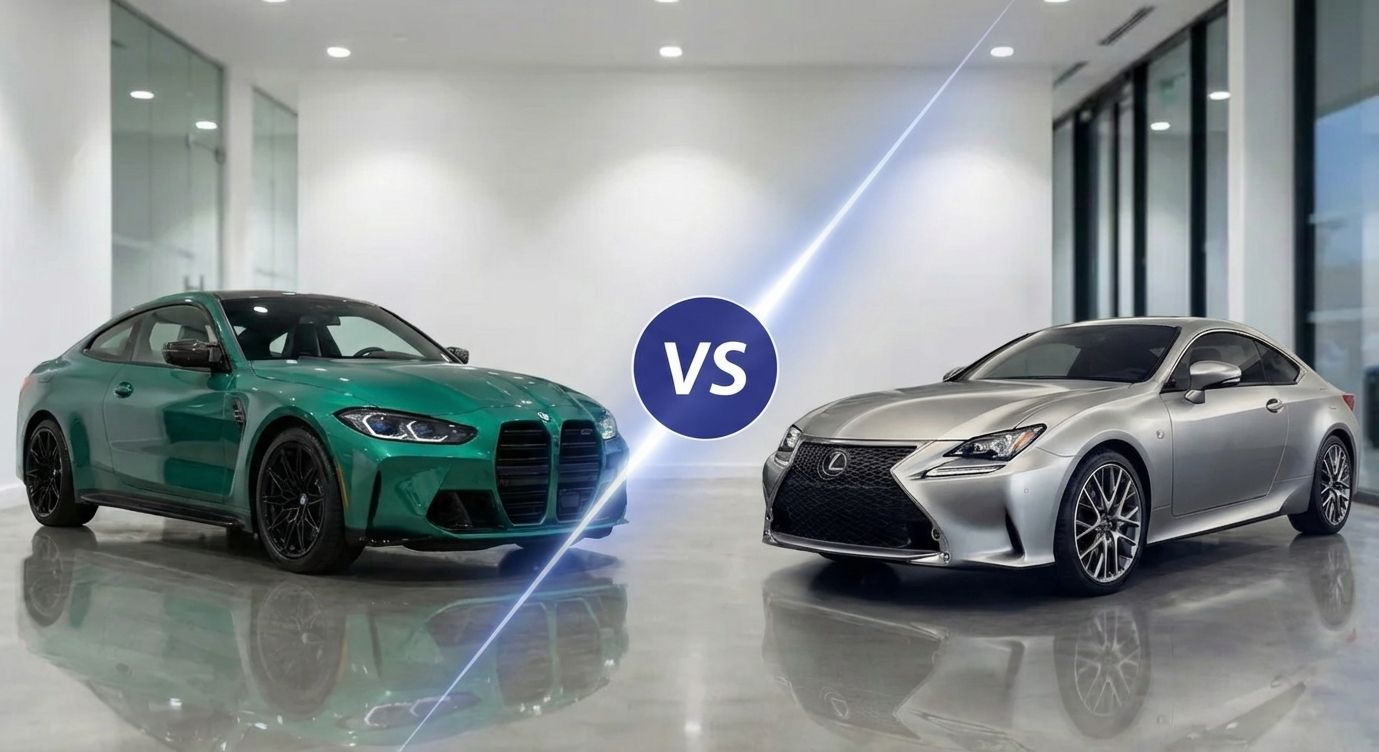
Detailed comparison of the BMW M4 and Lexus RC F. Discover the key differences in engines, driving characteristics, and reliability. Read our verdict before you buy.
Apr 14, 2026
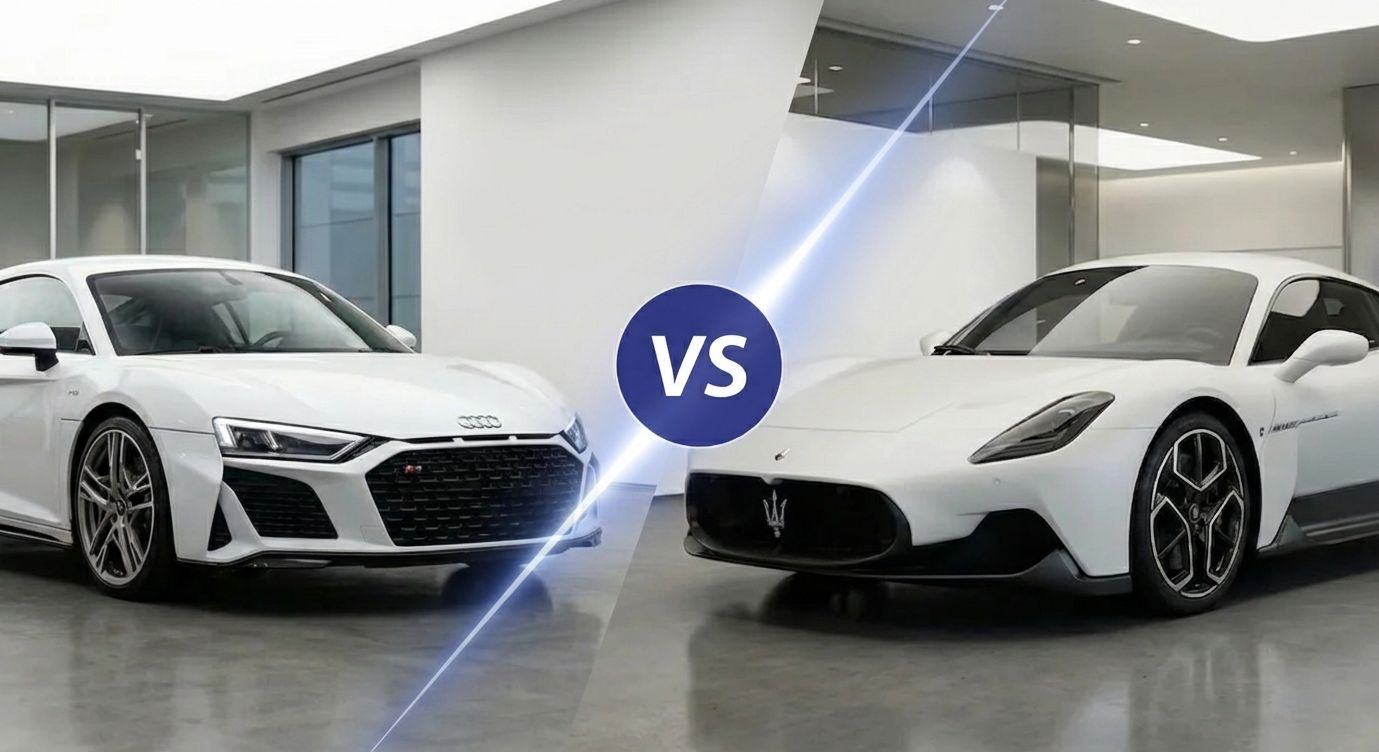
Audi R8 or Maserati MC20? Comparing performance, design, and handling. Our detailed test helps you choose the perfect supercar.
Apr 13, 2026