Audi R8 vs. Lamborghini Huracán: Complete comparison 2026
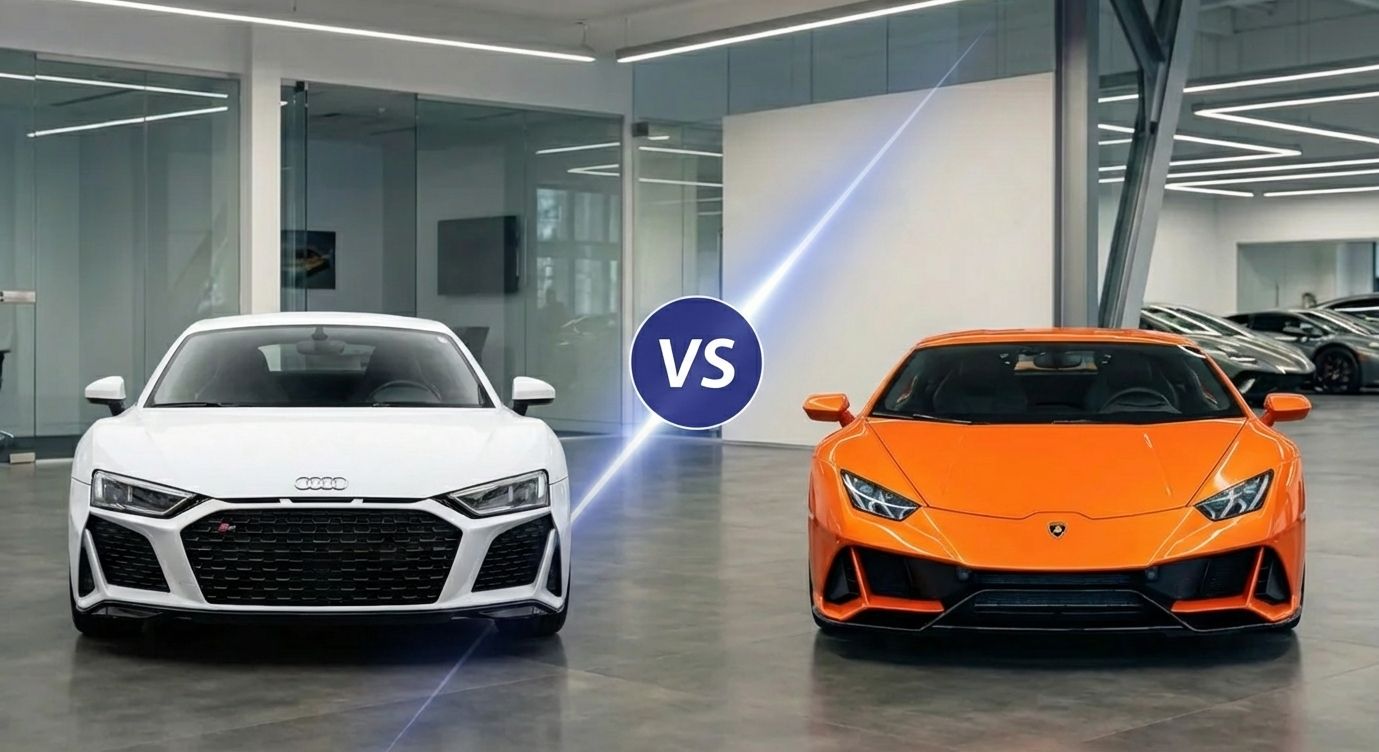
Detailed comparison of Audi R8 vs Lamborghini Huracán. We reveal the real differences, performance, and driving characteristics of these V10 supercars. Which one to choose?
Apr 14, 2026
Articles
Car battle
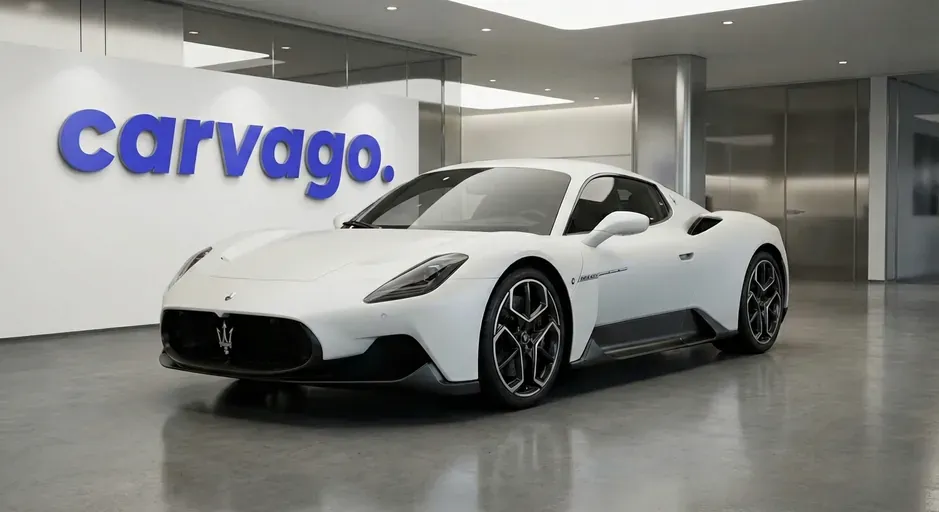
Audi R8 or Maserati MC20? Comparing performance, design, and handling. Our detailed test helps you choose the perfect supercar.
April 13, 2026


Enter the arena of high-performance sports cars, where two titans of European engineering clash. On one side stands the Audi R8, renowned for its high-revving naturally aspirated V10 engine and precise quattro all-wheel drive, making it an exotic supercar for everyday use. Against it is the Maserati MC20, a dramatic Italian sports car with an innovative Nettuno V6 engine featuring Formula 1 technology and a lightweight carbon construction focused on the ultimate driving experience. Let's take a detailed look at how these two exceptional machines fare in a head-to-head comparison.
Looking at the dimensions table, it is immediately clear that the Maserati MC20 is the larger car in most respects. The most significant difference is in length, where the Italian supercar surpasses the Audi R8 by a full 240 mm. This difference gives the MC20 a more dramatic and elongated silhouette, typical of exotic cars. Conversely, the more compact dimensions of the Audi R8 can be an advantage when maneuvering in narrow city streets or when parking.
Maserati also dominates in width, although the difference here is a smaller 25 mm. The wider track and body give the MC20 a more imposing stance on the road and contribute to its aggressive appearance. The only parameter where the Audi R8 is larger is height. While the MC20 stays as close to the ground as possible with a height of just 1224 mm for both versions, the R8 is 12 mm (Coupé) and 18 mm (Spyder) taller, respectively. The lower profile of the Maserati underscores its racing genes but may mean slightly more challenging entry and exit.
The 50 mm difference in wheelbase in favor of the Maserati indicates a focus on high-speed stability, which is typical for cars with a longer wheelbase. The shorter wheelbase of the Audi R8, on the other hand, theoretically promises slightly more agile and playful behavior in tight corners. The choice between these two cars in terms of dimensions thus depends on the preference between a more compact, agile concept and a larger, dramatically impressive design.
| Parameter | Audi R8 Coupé | Maserati MC20 Coupé | Audi R8 Spyder | Maserati MC20 Cielo |
|---|---|---|---|---|
| Length (mm) | 4429 | 4669 | 4429 | 4669 |
| Width (mm) | 1940 | 1965 | 1940 | 1965 |
| Height (mm) | 1236 | 1224 | 1242 | 1224 |
| Wheelbase (mm) | 2650 | 2700 | 2650 | 2700 |
Although practicality is not a top priority for supercars, differences in the approach to storage space can be crucial for owners, especially when planning weekend trips. The Audi R8 and Maserati MC20 differ fundamentally in this regard, each offering a unique solution to combine adrenaline-pumping performance with at least minimal utility.
The Maserati MC20 uses a concept of two separate luggage compartments. A smaller one is located at the front (the "frunk") and offers a volume of 50 liters, while the second, larger one is located at the rear behind the engine and provides 100 liters. The total capacity of 150 liters is the same for both the Coupé and the Cielo convertible. This division allows for carrying smaller items separately, but it should be noted that the rear trunk is affected by heat from the engine and exhaust system.
In contrast, the second-generation Audi R8 (Type 4S) relies on a single main storage space, exclusively at the front. This "frunk" has a volume of 112 liters in both the Coupé and Spyder variants. However, the key advantage is found in the Coupé version, which offers an additional storage space of up to 226 liters behind the seats. This space is large enough for a golf bag or several soft bags, making the R8 Coupé a surprisingly practical companion for longer journeys. The Spyder version loses this advantage due to the folding roof mechanism and has to make do with only the 112 liters at the front.
If you are looking for a supercar with the largest possible transport capacity, the clear winner is the Audi R8 Coupé with a total volume of up to 338 liters. It offers more than enough space for a weekend for two. In the battle of the open-top versions, however, the Maserati MC20 Cielo has a slight edge, with its 150 liters surpassing the 112 liters in the Audi R8 Spyder.
| Parameter | Audi R8 Coupé | Maserati MC20 Coupé | Audi R8 Spyder | Maserati MC20 Cielo |
|---|---|---|---|---|
| Total luggage compartment volume (liters) | 338 | 150 | 112 | 150 |
When comparing cars like the Audi R8 and Maserati MC20, the trailer weight category is more of a formality that clearly underscores their character. For those interested in these models, the information about towing capacity is very simple and straightforward – neither of these supercars is designed or approved for towing any kind of trailer.
The construction of both cars is fully subordinated to performance, aerodynamics, and the lowest possible weight. The body and chassis are not adapted for the installation of a tow hook, and the technical documentation does not specify any values for braked or unbraked trailers. Attempting a retrofit would not only be technically extremely difficult but would also disrupt the car's balance and handling characteristics.
In practice, this means that if you are looking for a car that can handle a small trailer or caravan in addition to providing a sporty experience, you need to look in a completely different category of automobiles. Both the Audi R8 and Maserati MC20 are purebred machines for the joy of driving, where practicality in the form of towing capacity takes a complete back seat.
| Audi R8 (all versions) | Not allowed | Not allowed |
|---|---|---|
| Maserati MC20 (all versions) | Not allowed | Not allowed |
The choice between the Audi R8 and the Maserati MC20 is, at its core, a choice between two completely different supercar engine philosophies. The Audi R8 sticks to the classic school of thought with a large-displacement, naturally aspirated V10 engine that offers linear power delivery and a breathtaking soundtrack at high revs. In contrast, the Maserati MC20 arrives with a technologically advanced, smaller, twin-turbocharged V6 "Nettuno" engine, which bets on explosive power and massive torque in the mid-range. This difference is reflected not only in performance but also in the overall character and driving experience.
The heart of the Audi R8 in its second generation (Type 4S), which is relevant to the used car market, is exclusively a 5.2-liter V10 FSI engine. This engine, shared with the Lamborghini Huracán, is one of the last great naturally aspirated engines in the supercar world. Audi offered it in several performance variants, and a key decision for buyers was the choice between the iconic quattro all-wheel drive and the more purist rear-wheel drive (RWD) version. While quattro provides maximum traction and confidence in all conditions, the RWD version offers a more traditional and playful driving character. All models are paired with a lightning-fast seven-speed S tronic dual-clutch transmission.
| Engine | Fuel | Power (kW) | Torque (Nm) | Transmission | Drive |
|---|---|---|---|---|---|
| 5.2 FSI V10 RWD | Petrol | 397 | 540 | 7-DSG | Rear |
| 5.2 FSI V10 quattro | Petrol | 419 | 560 | 7-DSG | All-wheel |
| 5.2 FSI V10 performance RWD | Petrol | 419 | 550 | 7-DSG | Rear |
| 5.2 FSI V10 performance quattro | Petrol | 456 | 580 | 7-DSG | All-wheel |
| 5.2 FSI V10 GT RWD | Petrol | 456 | 565 | 7-DSG | Rear |
Maserati took the path of innovation with the MC20. Its "Nettuno" engine is a technical marvel. It is a 3.0-liter V6 with a 90-degree angle, boosted by two turbochargers. What makes it unique is the patented pre-chamber combustion technology (Maserati Twin Combustion), derived from Formula 1, which maximizes efficiency and performance. The result is a staggering 463 kW (630 hp) and 730 Nm of torque. Unlike the Audi, there is no choice here – the MC20 is available exclusively with this engine, an eight-speed dual-clutch transmission, and rear-wheel drive, underscoring its focus on a pure driving experience.
| Engine | Fuel | Power (kW) | Torque (Nm) | Transmission | Drive |
|---|---|---|---|---|---|
| 3.0 V6 Nettuno Twin-Turbo | Petrol | 463 | 730 | 8-DSG | Rear |
The choice of powertrain clearly defines which driver the car is intended for.
Choosing the right engine is key to long-term satisfaction. For supercars like the Audi R8 and Maserati MC20, this is doubly true, as the engine is the heart of the entire experience. Our recommendations are based on a combination of performance, reliability, owner feedback, and the overall character that the engine lends to the car. Here, two completely different worlds collide: the old-school naturally aspirated V10 in the R8 and the technologically advanced, twin-turbocharged V6 in the MC20.
Within the second generation of the Audi R8 (Type 4S, produced from 2015), the choice is clear: the naturally aspirated 5.2 FSI V10. We recommend going for the top-tier performance quattro version introduced after the 2019 facelift. It not only offers the highest output of 620 hp (456 kW) but also the best-tuned chassis and steering. This engine is one of the last of its kind and is the main reason to buy an R8.
With the Maserati MC20, the choice is simple, as there is only one, yet absolutely exceptional, engine on offer. The three-litre, twin-turbocharged six-cylinder with a 90-degree V-angle is named Nettuno and was developed from the ground up by Maserati itself. This engine is the brand's technological showcase and points to the future of internal combustion engines in supercars.
For cars in the supercar category, fuel consumption is rarely at the top of the priority list. Nevertheless, real-world consumption figures can reveal a lot about the technological maturity of the engine and the manufacturer's overall approach. The official figures provided by manufacturers are often just a theoretical minimum, which is why we looked at data from owners themselves, for example, from the community website Spritmonitor.de, to find out how both cars perform in everyday use. Although it is not a key factor, differences in appetite can indicate different powertrain philosophies.
In our comparison, we focus on the relevant generations for the used car market. For the Audi R8, this is the 4S generation (from 2015) with the naturally aspirated V10, and for the Maserati MC20, its first generation (from 2021) with the innovative turbocharged V6.
| Model and Engine | Average Consumption (l/100 km) |
|---|---|
| Audi R8 Coupé 5.2 FSI V10 performance (4S) | 13.0 - 14.5 |
| Maserati MC20 3.0 V6 Nettuno | 11.5 - 13.0 |
The table clearly shows that Maserati's more modern approach is paying off. Its three-litre, twin-turbocharged Nettuno V6, equipped with pre-chamber combustion technology derived from Formula 1, is more economical despite its staggering 630 horsepower. In contrast, the Audi R8 relies on a classic in the form of a high-revving, 5.2-litre naturally aspirated V10. This engine is a celebration of traditional engineering, whose breathtaking sound and linear power delivery come at the cost of higher consumption, which can easily exceed 15 l/100 km during dynamic driving.
For the average user, this means the Maserati MC20 will offer a slightly longer range on a single tank and, in the long run, slightly lower fuel costs. However, in the context of the purchase price and overall maintenance costs of these vehicles, the difference in consumption is rather symbolic. Ultimately, fuel consumption is not the deciding factor. The choice between these two supercars will always depend primarily on personal preference—whether you prefer the technologically advanced and more efficient Maserati engine or the charismatic and sonically captivating naturally aspirated heart of the Audi.
When comparing the prices of used Audi R8 and Maserati MC20 cars, we enter two different worlds of supercars. While the R8 is an established player on the market with wider availability, the MC20 is still a hot new item, which is significantly reflected in their prices.
The second-generation Audi R8 post-facelift (from 2019) is logically more accessible on the used car market. Prices for models that are roughly four years old, i.e., from 2020 to 2022, typically range from €144,000 to €205,000. The price depends on the specific configuration (Coupé vs. Spyder, RWD vs. quattro), mileage, and overall condition. Thanks to a longer production history and a larger number of units produced, buyers have a wider selection and can find a car that precisely meets their expectations at a more competitive price.
The Maserati MC20, whose production only began in 2021 with the first cars hitting the market in 2022, is a considerably more expensive affair. As a newer and rarer model, it holds its value much more tenaciously. Prices for the oldest used units from 2022 rarely drop below €226,000 and more often move towards €246,000 and higher. Limited production and high demand for this Italian supercar with the V6 Nettuno engine mean that even on the used market, the MC20 is an exclusive commodity with a corresponding price tag.
| Model | Approximate Price Range (used car, approx. 2-4 years old) |
|---|---|
| Audi R8 (2020-2022) | €144,000 – €205,000 |
| Maserati MC20 (2022) | €226,000 – €267,000 |
Summary
While the Audi R8 offers a proven supercar experience with a naturally aspirated V10 engine at a relatively more attainable price, the Maserati MC20 represents a more modern, exclusive, and significantly more expensive alternative. The price difference for similarly aged cars can be more than €62,000 in favor of the Audi. The choice, therefore, depends not only on the driver's preferences but also on the depth of their wallet.
When evaluating the safety of supercars like the Audi R8 and Maserati MC20, we encounter a fundamental difference from regular cars – neither of these models has undergone Euro NCAP crash tests. This is common practice for low-volume and highly specialized automobiles. However, the absence of a star rating does not mean that manufacturers neglect safety. Both cars rely on extremely rigid and lightweight body structures and a specific set of safety features, but their approaches differ, especially in the area of modern assistance systems.
The second-generation Audi R8 (Type 4S, produced since 2015) builds its safety philosophy primarily on passive features. The foundation is the highly rigid Audi Space Frame, which combines aluminum profiles with parts made of carbon fiber reinforced polymer (CFRP). This structure is designed to protect the occupants as much as possible by absorbing energy in the event of an impact. Standard equipment includes a set of airbags (front, side, and head), electronic stability control (ESC), and a tire pressure monitoring system. What is surprising for this category of vehicle, however, is that the R8 lacks most of the modern active assistance systems that are common even in much cheaper cars today. You would search in vain for systems like autonomous emergency braking or lane-keeping assist. Audi focused on a pure driving experience and passive protection.
The Maserati MC20, launched later, brings a slightly more modern concept of safety that better reflects recent trends. The basis is also an ultra-light and extremely strong carbon fiber monocoque, which ensures top-tier passive safety. Unlike the R8, however, Maserati also offers some advanced assistance systems. For example, a forward collision mitigation system, blind-spot monitoring, Rear Cross Traffic Alert, and parking sensors supplemented by a 360-degree camera are available. Although this is not a full autonomous driving package, these features represent a noticeable step forward and can prevent minor accidents in daily traffic.
Given the absence of crash test data, it is impossible to objectively determine which car would better protect its occupants in a serious accident. Both models rely on top-quality materials and structural body designs that should ensure a high level of passive safety. However, the Maserati MC20 has the upper hand due to the presence of more modern active safety assistants. While the Audi R8 sticks to a more traditional concept, relying on structural rigidity and basic electronic systems, the MC20 adds another layer of protection in the form of systems that can actively prevent an accident. For drivers who appreciate modern technology and assistance features, the Maserati represents a slightly more comprehensive safety package.
| Parameter | Audi R8 | Maserati MC20 |
|---|---|---|
| Year of Euro NCAP testing | Not tested | Not tested |
| Adult Occupant Protection | N/A | N/A |
| Child Occupant Protection | N/A | N/A |
| Pedestrian Protection | N/A | N/A |
| Safety Assists | N/A | N/A |
In addition to the standard equipment, each model offers several unique features that may be decisive for the customer. While Audi relies on proven technology and digital perfection, Maserati counters with innovations from the world of motorsport and a dramatic design.
The second-generation Audi R8 (Type 4S) is a celebration of classic supercar engineering, but wrapped in a modern and user-friendly package. Its most interesting features reflect this philosophy.
The Maserati MC20 is a completely new car that has returned the brand to the top of the supercar segment. Instead of evolution, it bets on revolutionary technology and a breathtaking design.
Advantages:
Disadvantages:
Advantages:
Disadvantages:
Based on our own CarAudit inspections, breakdown statistics, and service reports, we have compiled an overview of the most common problems that buyers of used cars should watch out for. Although these are top-tier supercars, even they are not immune to occasional technical issues.
The second-generation Audi R8 is generally considered a very reliable supercar, largely thanks to shared technology with the Lamborghini Huracán and a robust naturally aspirated V10 engine. Nevertheless, there are areas that require attention.
Summary for Audi R8: Problems are rather isolated and often related to the demands of maintenance. The key is a comprehensive vehicle inspection with a documented service history. Most issues are minor inconveniences rather than fatal flaws.
The Maserati MC20 is a relatively new model, so long-term experience is still accumulating. However, the first few years of production have revealed several areas that deserve attention.
Summary for Maserati MC20: As this is a newer and technologically more complex car, the first years of production revealed several "teething problems," which the manufacturer addressed through recalls. Buying a used MC20 requires a careful check of the car's history and confirmation that all service campaigns have been completed. Potential problems are more of a workshop nature than fundamental design flaws.
When buying a used supercar, a thorough inspection is absolutely crucial. Even on newer cars with low mileage, expensive faults can appear, so it's good to know what to focus on for both models.
The Audi R8 second generation (Type 4S) is considered a robust and reliable supercar, but even with it, it pays to focus on a few key areas where repairs can be extremely expensive.
The Maserati MC20 is a relative newcomer to the used car market, which means that experience with long-term reliability is limited. This makes it all the more important to focus on build quality and the functionality of its modern systems.
The Audi R8 sticks to the classic with a naturally aspirated 5.2-liter V10 engine, known for its characteristic sound and linear power delivery. In contrast, the Maserati MC20 uses a modern 3.0-liter twin-turbocharged V6 engine with technology from Formula 1. This engine offers a more explosive pull thanks to the turbochargers.
The Maserati MC20 has a power advantage with its 621 horsepower compared to the Audi R8's 562 to 620 horsepower (depending on the version). This also results in slightly better acceleration from 0 to 100 km/h, which the MC20 manages in 2.9 seconds, while the R8 needs 3.1 seconds. In the real world, however, both cars are very similar in performance.
Generally, a used Audi R8 tends to be more affordable than a Maserati MC20. While the prices of R8 models that are several years old fall within a wider and lower price range, the newer and more exclusive MC20 holds a higher price. Maserati also retains its value better for resale.
Although neither car is ideal for daily driving, the Audi R8 is perceived as slightly more usable in this regard. It offers slightly more storage space and a generally more comfortable setup for regular journeys. Both cars have very limited luggage space, which makes longer trips with more baggage difficult.
The Audi R8 benefits from proven technology shared within the VW Group, which generally means better service availability. Known issues with older models include problems with the adaptive dampers or the air conditioning compressor. Maserati has a historically variable reputation for reliability, but owners of the new MC20 have not yet reported any systematic problems.
The choice between Audi R8 and Maserati MC20 represents a clash of two distinct supercar philosophies. Audi R8 appeals to purists seeking an old-school emotional experience with a naturally aspirated V10, the confidence of quattro all-wheel drive, and surprising everyday usability, offering great value for money and emotions in the used car market. Conversely, the Maserati MC20 is for those who crave technological avant-garde, low weight, and maximum agility thanks to its carbon monocoque and Nettuno engine, providing an exclusive and intense driving experience. The decision thus depends on whether you prefer the majestic end of one era or the exciting beginning of a new one.
Sources: ADAC, forbes.cz, e15.cz, techfocus.cz, autojournal.cz, transport.cz
This article was prepared using artificial intelligence tools. The section guarantor is Petr Dušek.

Detailed comparison of Audi R8 vs Lamborghini Huracán. We reveal the real differences, performance, and driving characteristics of these V10 supercars. Which one to choose?
Apr 14, 2026

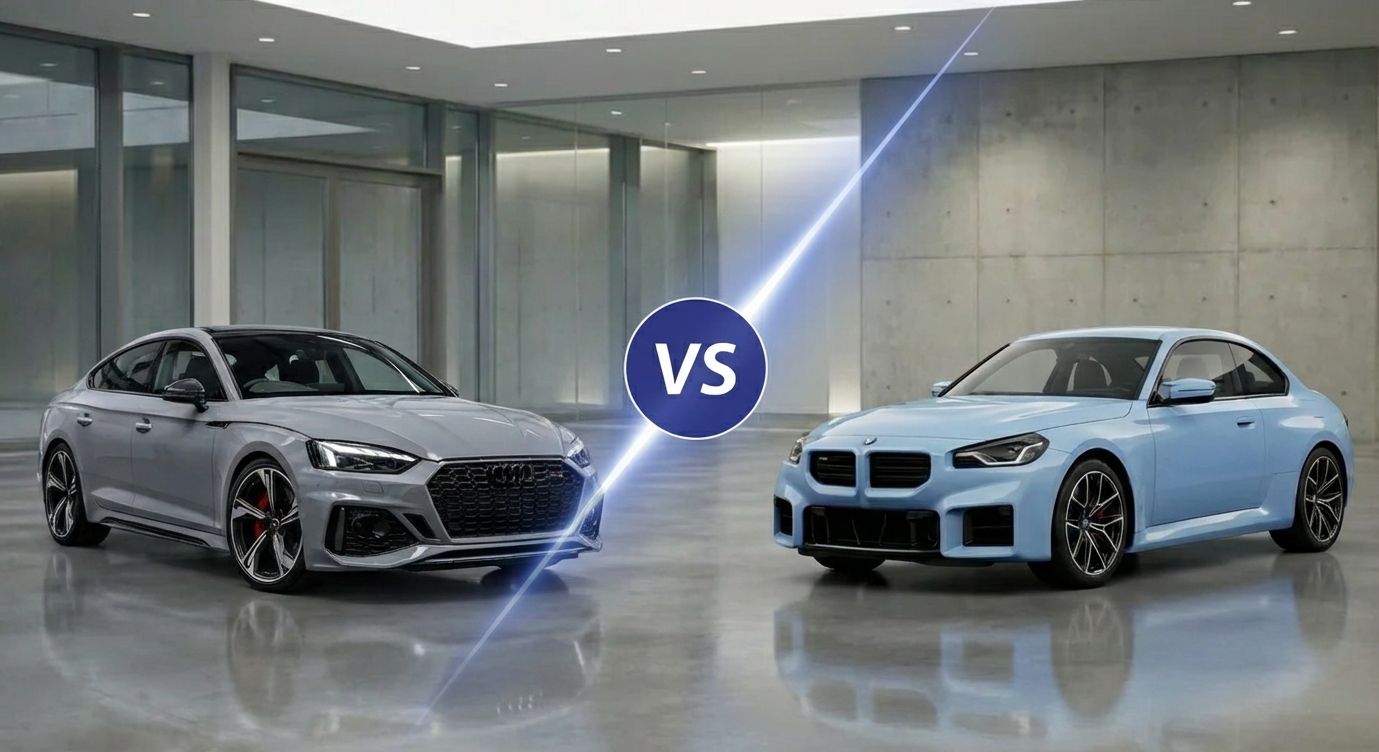
Audi RS 5 vs. BMW M2. A detailed comparison of performance, driving dynamics, and practicality. Find out which sports coupe is the right choice for you.
Apr 14, 2026

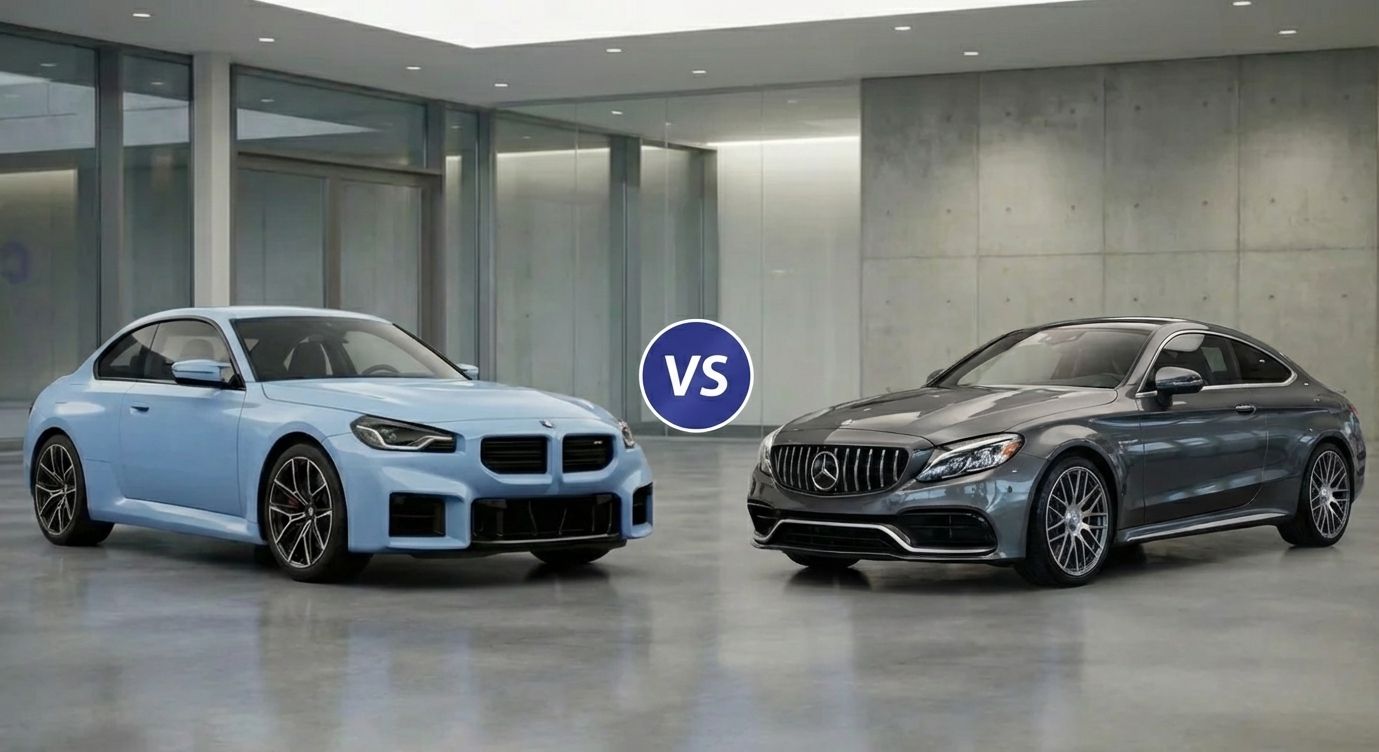
BMW M2 vs Mercedes-AMG C 63: A detailed comparison of performance, driving, and price. Find out which sports coupé is the right choice for you in our test.
Apr 14, 2026