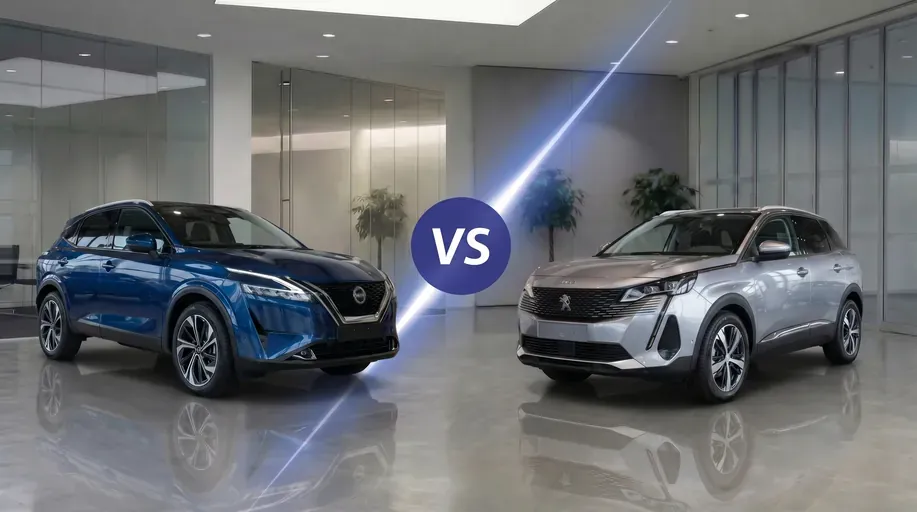
Nissan Qashqai vs. Peugeot 3008: Complete comparison 2026
Nissan Qashqai vs Peugeot 3008: A major comparison of used SUVs. Find out real-world fuel consumption, reliability, and differences in equipment to help you choose the right car.
Apr 23, 2026
Articles
Car battle
Detailed comparison of Jaguar E-Pace vs Mercedes-Benz GLB. Discover the differences in equipment, driving characteristics, and read our verdict for choosing the best SUV.
April 29, 2026


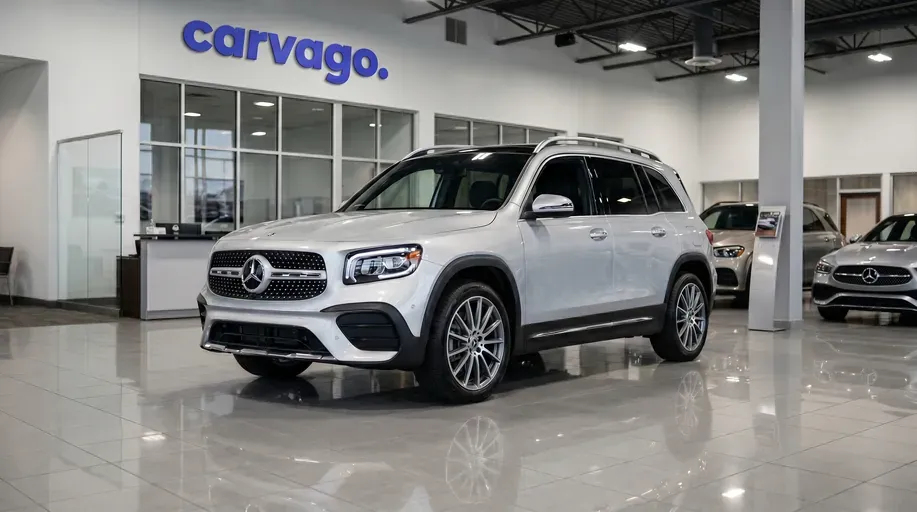
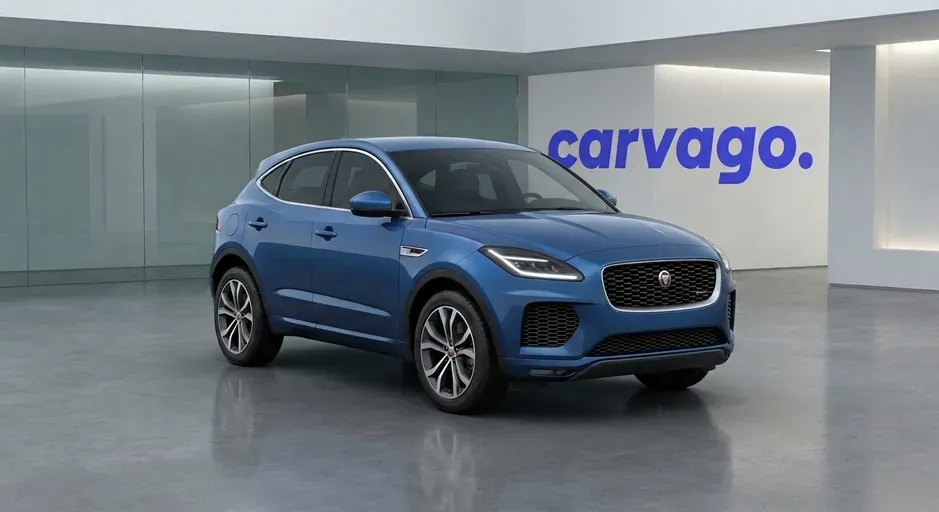
The British Jaguar E-Pace is a premium compact SUV that brings a fierce sporty look inspired by the F-Type model and very agile driving characteristics. On the opposite side of the ring stands the Mercedes-Benz GLB, also known commercially as the GLB Class, which instead bets on maximum interior space, a boxier family design, and a unique optional seven-seat configuration in its category. The following comparison will show you in detail which of these roughly four-year-old luxury crossovers represents a smarter choice on the used car market for your daily driving and practical needs.
When looking at the exterior dimensions of both premium SUVs, which are represented on the used car market primarily by their main generations (X540 for the Jaguar and 247 for the Mercedes), we encounter two completely different design and practical philosophies. The Mercedes-Benz GLB, with a total length of 4634 mm, surpasses its British rival by a significant 239 mm. Conversely, the Jaguar E-Pace, thanks to its width of 1984 mm, is a full 150 mm wider than its German competitor. While Mercedes bets on a longer and narrower body, which makes maneuvering and parking in narrow underground garages or European shopping centers significantly easier, Jaguar, thanks to its extremely wide and low-slung stance, offers a sportier visual impression and greater confidence in corners. However, when looking for a transverse parking space for the Jaguar, you will often struggle with insufficient space to open the doors.
The second key difference shaping the overall utility of both vehicles is the wheelbase. The Mercedes-Benz GLB has a wheelbase of 2829 mm, which is a significant 148 mm more than in the case of the Jaguar E-Pace (2681 mm). The boxier build and slightly higher roof of the GLB (up to 1692 mm compared to 1649 for the Jaguar) mean that the Mercedes excels in interior spaciousness and is even one of the few in its category to offer the option of a third row of seats. Therefore, if you are primarily looking for a family car with maximum interior space, the GLB is the clear winner thanks to its longer wheelbase and purposeful shape. The Jaguar E-Pace, on the other hand, represents an ideal choice for couples or smaller families who are happy to sacrifice trunk liters or rear legroom for muscular, athletic proportions evoking a sports hatchback on stilts.
| Parameter | Jaguar E-Pace SUV | Mercedes-Benz GLB SUV |
|---|---|---|
| Width (mm) | 1984 | 1834 |
| Length (mm) | 4395 | 4634 |
| Height (mm) | 1648 - 1649 | 1658 - 1692 |
| Wheelbase (mm) | 2681 | 2829 |
Luggage capacity is often a key factor for families and active individuals, and it is in this area that the differing philosophies of the two cars are clearly demonstrated. While the Jaguar E-Pace bets on a dynamic, sporty design with a sloping roofline, the Mercedes-Benz GLB was designed from the outset with an emphasis on maximum practicality and efficient use of space. For a used car buyer looking for a family car approximately four years old (representing the X540 and X247 generations from 2021 to 2022), this means a fundamental difference in how much gear they can actually carry for a family holiday or a weekend trip.
Looking at the exact figures, the elegant British Jaguar E-Pace presents a standard boot capacity of 425 litres (measured using the VDA method under the luggage cover), or offers up to 577 litres when loaded to the roof. With the rear seats fully folded, this space increases to 1,234 litres. The five-seater version of the Mercedes-Benz GLB significantly outperforms its competitor, offering a generous 570 litres even in its basic configuration. Furthermore, if you fold down the rear bench in the GLB, you get a massive 1,805 litres, making it a literal removal van in its class. It is worth mentioning that the popular seven-seater variant of the Mercedes still offers a very solid 500 litres with the third row of seats folded. However, one must keep in mind the plug-in hybrid versions, where a slight reduction in capacity is to be expected – for example, in the Jaguar E-Pace P300e, the usable boot volume drops to approximately 494 litres due to the battery placement.
In practice, these differences mean that the Mercedes-Benz GLB will swallow a full-size pram without the slightest problem and still leave room for several extra suitcases, making it perfectly adequate for weekend shopping or longer holidays. Thanks to the regular, boxy shape of the body, loading bulky items is also significantly easier. The Jaguar E-Pace, on the other hand, handles daily commutes without trouble and can carry a few bags for a long weekend, but it will soon require compromises for more demanding family packing. While the Jaguar primarily brings style and sporty flair to the road, the Mercedes becomes the clear rational choice for those seeking pure spaciousness and utility.
| Parameter | Jaguar E-Pace SUV | Mercedes-Benz GLB SUV |
|---|---|---|
| Base volume (litres) | 425 | 570 |
| Max volume with seats folded down (litres) | 1234 | 1805 |
If boot size is your priority in a used SUV, the Mercedes-Benz GLB easily outperforms the Jaguar E-Pace with its specifications and boxy shape, making it the ideal family choice.
The ability to tow a trailer is an important parameter for many prospective buyers of premium compact SUVs, whether it's for towing a spacious caravan, a boat for weekend adventures, or simply moving heavier materials. When comparing roughly four-year-old used cars on the market, we find that both models can easily handle an unbraked trailer with the standard legal weight of 750 kg. However, significant differences arise with braked trailers. The Mercedes-Benz GLB in the 250 version offers an excellent and consistent towing capacity of exactly 2,000 kg across model years. For the Jaguar E-Pace, the situation is noticeably more varied, and the maximum permitted trailer weight depends heavily on the specific engine.
While the top-of-the-line diesel Jaguar E-Pace D200 fully matches the Mercedes and also tows 2,000 kg, for most common petrol versions (P200, P250, and P300), this value drops to 1,800 kg. The P300e plug-in hybrid variant requires special attention, as its capacity is reduced to just 1,600 kg due to the extra weight of the batteries and electric motor. A similar 1,600 kg limit can be found for the base D165 diesel engine in certain model years, and for the base P160 petrol version, towing data is completely missing.
In practice, these differences mean that with the Mercedes or the most powerful diesel from Jaguar, you can easily hitch up a large twin-axle caravan or a heavy boat. On the other hand, values around 1,600 to 1,800 kg are still sufficient for weekend shopping of bulkier materials, a smaller family caravan, or an e-bike rack – in short, they provide ideal space for a few extra suitcases and longer holidays.
In conclusion, if maximum towing power and versatility when pulling heavy loads is a priority for you, the Mercedes-Benz GLB 250 is a safe bet with the maximum possible capacity right from the start. With the Jaguar E-Pace, on the other hand, you have to study the technical certificate much more carefully and choose the right engine so that the vehicle fully meets your transport requirements.
| Model and engine | Braked trailer weight (kg) | Unbraked trailer weight (kg) |
|---|---|---|
| Jaguar E-Pace D165 | 1600 - 1800 | 750 |
| Jaguar E-Pace D200 | 2000 | 750 |
| Jaguar E-Pace P200, P250, P300 | 1800 | 750 |
| Jaguar E-Pace P300e (PHEV) | 1600 | 750 |
| Mercedes-Benz GLB 250 | 2000 | 750 |
Diversity under the hood plays a crucial role for premium compact SUVs, as it influences not only the driving dynamics and comfort but also the overall operating costs. The Jaguar E-Pace and Mercedes-Benz GLB approach this discipline slightly differently. While Jaguar relies on the characteristic power of the British Ingenium engine family and a massive push toward hybrid technologies, Mercedes-Benz bets on the first-class efficiency of a wide range of diesel and petrol four-cylinders paired exclusively with dual-clutch transmissions. Standard petrol and diesel engines in the Jaguar utilize modern mild-hybrid assistance (MHEV) with a smooth-shifting 9-speed automatic transmission. In contrast, Mercedes engines benefit from the vehicle's low weight and generous interior space, although the entry-level displacements can run out of breath more quickly when the seven-seat interior is fully occupied. In terms of overall impressions, a direct comparison of the top models pits the innovative British plug-in hybrid against raw performance from the AMG workshop.
The evolution of the engine range for the Jaguar E-Pace (X540 generation) is a typical example of the transition toward maximum efficiency. As the data on AVAILABLE_YEARS clearly shows, the older generation of pure internal combustion diesel engines—D150 (110 kW), D180 (132 kW), and the twin-turbocharged D240 (177 kW)—ended production during 2020 and are no longer featured in new offers. Therefore, if you are looking for an optimal roughly four-year-old used car, you will mostly be choosing from the updated Ingenium units.
Since spring 2021, Jaguar has narrowed the diesel spectrum to the D165 (120 kW) and the more powerful D200 (150 kW) versions, which boast excellent torque of up to 430 Nm, ideal for confident highway cruising. The petrol side opens with the turbocharged P160 (118 kW) three-cylinder, supplied with an 8-speed automatic and front-wheel drive (FWD). Much more sought-after, however, are the more powerful 2.0-liter petrol units: P200 (147 kW), P250 (184 kW), and the high-performance P300 (221 kW), which are always paired with a 9-speed automatic and all-wheel drive (AWD). The crowning jewel for flexible drivers is the P300e plug-in hybrid with a combined output of 227 kW and a massive torque of 540 Nm. Occasionally, a newer P270e derivative (available from 2024) appears in production data, but you won't encounter it yet on the market for classic four-year-old used cars. A disadvantage of the basic combustion versions is the slightly higher kerb weight of the vehicle, which forces the weaker engines to work at higher RPMs, potentially resulting in slightly higher fuel consumption.
| Engine Type | Fuel | Power (kW) | Torque (Nm) | Transmission |
|---|---|---|---|---|
| D150 (until 2020) | Diesel | 110 | 380 | 6MT / 9AT |
| D180 (until 2020) | Diesel | 132 | 430 | 6MT / 9AT |
| D240 (until 2020) | Diesel | 177 | 500 | 9AT |
| D165 (from 2021) | Diesel (MHEV) | 120 | 380 | 6MT / 9AT |
| D200 (from 2021) | Diesel (MHEV) | 150 | 430 | 9AT |
| P160 (from 2021) | Petrol (MHEV) | 118 | 260 | 8AT |
| P200 | Petrol (MHEV) | 147 | 320 | 9AT |
| P250 | Petrol (MHEV) | 184 | 365 | 9AT |
| P300 | Petrol (MHEV) | 221 | 400 | 9AT |
| P300e (from 2021) | PHEV (Petrol/Elec.) | 227 | 540 | 8AT |
The Mercedes-Benz GLB (X247 generation from the relevant years 2020–2023) scores on the market with a very sophisticated range of engines. All power units rely exclusively on lightning-fast dual-clutch transmissions (7G-DCT for basic petrols, the more durable 8G-DCT elsewhere), which ensures snappier throttle response compared to the torque-converter automatics in the Jaguar.
For highway flyers and drivers with high annual mileage, the exceptionally economical family of 2.0-liter diesel engines is available, labeled 180 d (85 kW), 200 d (110 kW), and 220 d (140 kW). Despite their relatively modest paper performance, they impress with an enormous real-world range and strong torque of 400 Nm in the most powerful variant. The entry-level petrol models, GLB 180 (100 kW) and GLB 200 (120 kW), rely on a smaller 1.3-liter engine. While perfectly adequate for the city, they can feel slightly strained when loaded on the highway. By far the most versatile and manufacturer-promoted model is the GLB 250 petrol 2.0-liter. Production data confirms its massive availability across the years in both front-wheel drive and smart 4MATIC versions, with a convincing output of 165 kW and 350 Nm of torque. The range traditionally concludes with the sporty AMG GLB 35 (225 kW). For this vehicle, databases also indicate future sales of the innovative GLB 250+ EQ series with a full mild-hybrid setup (generation code 244/248), but since its deliveries are scheduled from 2026, it cannot be found on the current market for nearly new used cars.
| Engine Type | Fuel | Power (kW) | Torque (Nm) | Transmission |
|---|---|---|---|---|
| GLB 180 | Petrol | 100 | 200 | 7G-DCT |
| GLB 200 | Petrol | 120 | 250 | 7G-DCT |
| GLB 250 | Petrol | 165 | 350 | 8G-DCT |
| AMG GLB 35 | Petrol | 225 | 400 | 8G-DCT |
| GLB 180 d | Diesel | 85 | 280 | 8G-DCT |
| GLB 200 d | Diesel | 110 | 320 | 8G-DCT |
| GLB 220 d | Diesel | 140 | 400 | 8G-DCT |
In a nutshell: For pragmatically minded drivers focused on family use and longer trips, the diesel Mercedes-Benz GLB 200 d or the powerful all-rounder GLB 250 makes the most sense. In contrast, customers looking for maximum technological premium feel, emission-free daily city commuting, or a charismatic sporty chassis will find their ideal in the hybrid Jaguar E-Pace P300e, or in the traditional combustion versions with the nine-speed automatic.
While the Mercedes-Benz GLB wins with perfectly efficient diesel four-cylinders offering unrivaled range and fast dual-clutch transmissions, the Jaguar E-Pace counters with top-tier plug-in hybrids and smooth nine-speed automatics for a first-class isolated ride.
Choosing the right engine is crucial for long-term satisfaction with a car, as it directly affects driving dynamics, real-world fuel consumption, and maintenance costs. While the Jaguar E-Pace relies on British Ingenium engines, which offer massive torque for its heavier body and added efficient mild-hybrid technology after the facelift, the Mercedes-Benz GLB benefits from highly refined power units with excellent pairing with dual-clutch transmissions. Interestingly, although both cars primarily use transversely mounted two-liter engines, the Jaguar has much higher demands for raw power at low revs due to its higher curb weight, while the boxier, seven-seater (optional) GLB focuses more on linear power delivery. Our recommended engines primarily target roughly four-year-old used cars, which combine ideal residual value with solid mechanical reliability.
For a heavier and more robust SUV like the E-Pace, the Ingenium D200 four-cylinder diesel with 150 kW (204 hp) represents an absolutely ideal compromise between smooth dynamics and reasonable fuel consumption. Paired with all-wheel drive (AWD) and a nine-speed automatic transmission, it offers a generous 430 Nm of torque, which is essential for safe overtaking and driving with a loaded vehicle. According to data from our database, this engine appeared in early 2021 and directly replaced the earlier D180 version (production of which ended definitively in 2020). The newer D200 unit is thus very common on the market among roughly four-year-old used cars and benefits from mild-hybrid (MHEV) technology, which significantly smoothens the operation of the start-stop system. In terms of reliability, Ingenium engines manufactured after 2020 have already shed the worst problems with rapid timing chain wear, but it should be remembered that this is a full-fledged diesel suitable more for long-distance drivers. It is not suitable for short city trips.
Although diesel engines often take the lead in mid-sized family SUVs in Europe, from the perspective of long-term mechanical durability and absolute versatility, the GLB 250 4MATIC four-cylinder petrol engine with 165 kW (224 hp) is a great tip. Although the basic equipment variants of the GLB 250 4MATIC engine ended in May 2023 according to our database, the unit continues to appear on the market even in newer cars through specific lines such as AMG Line or Progressive, up to the present day. This two-liter petrol engine provides the car with excellent dynamics, with acceleration from zero to one hundred in less than 7 seconds, and works excellently with the eight-speed 8G-DCT dual-clutch transmission. Unlike diesel alternatives, it does not suffer from expensive emission problems with AdBlue or DPF clogging during short trips to the city school and on short routes. Real-world consumption is around 8 to 9 liters, which is a very solid result considering the body's poorer aerodynamics, compensated for by absolute quietness and smoothness of operation.
When it comes to choosing a used premium SUV, the official fuel consumption figures provided by manufacturers often differ significantly from everyday reality. Especially for heavier and taller vehicles like the Jaguar E-Pace and Mercedes-Benz GLB, aerodynamics, weight, and driving style play a major role. To get a more accurate picture of what buyers of approximately four-year-old used cars can realistically expect, we looked at data from drivers themselves. We based our findings on long-term user averages from the popular crowdsourcing portal Spritmonitor.de, supplemented by available databases, focusing primarily on the vehicle generations available around 2022 (Jaguar X540 and Mercedes-Benz 247 series).
| Model and engine | Average consumption (l/100 km) |
|---|---|
| Mercedes-Benz GLB 200 d (110 kW) | 5.8 |
| Mercedes-Benz GLB 220 d 4MATIC (140 kW) | 6.0 |
| Jaguar E-Pace D165 (120 kW) | 6.6 |
| Jaguar E-Pace D200 AWD (147 kW) | 6.9 |
| Mercedes-Benz GLB 200 (120 kW) | 7.6 |
| Mercedes-Benz GLB 250 4MATIC (165 kW) | 8.1 |
| Jaguar E-Pace P200 AWD (147 kW) | 8.6 |
| Jaguar E-Pace P250 AWD (184 kW) | 9.2 |
| Jaguar E-Pace P300e PHEV (227 kW) | 2.5 |
The figures show a fairly clear trend. Thanks to its slightly better aerodynamics and exceptionally efficient powertrain tuning, the Mercedes-Benz GLB is a noticeably more economical choice across both diesel and petrol engines.
What does this mean for typical used car buyers? If you are a driver who spends a lot of time on motorways or regularly commutes longer distances, the diesel Mercedes-Benz GLB 200 d or 220 d is the clear choice for you. These versions represent an ideal compromise between decent dynamics and exceptionally low running costs. For urban and suburban drivers looking for a petrol car, the GLB 200 version makes a lot of sense in the Mercedes lineup. Conversely, the petrol variants of the Jaguar E-Pace target enthusiasts and drivers who prioritize specific British style and a sportier driving feel over how much they save at the petrol station each month. However, for homeowners with the possibility of home charging, the hybrid E-Pace P300e could be a hidden trump card, making great sense for daily emission-free commuting.
In conclusion, it can be said with certainty that fuel consumption will play a fairly fundamental role in the decision between these two cars. While the Mercedes-Benz GLB pleases with its everyday efficiency and significantly friendlier running costs, the Jaguar E-Pace demands a slight toll for its premium look and bulkier proportions. For pragmatically minded and budget-conscious buyers, the representative with the three-pointed star clearly emerges as the winner from this comparison.
When looking at the used car market for vehicles around four years old (model years 2021 and 2022), you will encounter interesting differences in how the Jaguar E-Pace and Mercedes-Benz GLB hold their value. Both compact SUVs target a premium clientele, but their different focus and brand perception are significantly reflected in second-hand purchase prices.
| Model | Starting price (higher mileage) | Average price (good condition/equipment) | Top versions (PHEV / AMG) |
|---|---|---|---|
| Jaguar E-Pace | from €18,000 | €23,000 – €29,000 | €33,000 and more |
| Mercedes-Benz GLB | from €23,000 | €29,000 – €35,000 | €39,000 and more |
Prices are indicative and depend on the engine, specific equipment level, and service history.
While visual equipment such as large alloy wheels and exterior accessories from the R-Dynamic packages plays a major role for the Jaguar E-Pace, for the Mercedes, interior utility and electronics take center stage. Family buyers of the GLB often pay extra for models equipped with a third row of seats, a panoramic roof, and the advanced MBUX system, which pushes up the price of well-maintained units.
While the Jaguar E-Pace attracts with a faster depreciation and thus a lower and more affordable second-hand purchase price, the Mercedes-Benz GLB is more expensive but holds its value significantly better thanks to its unrivaled family practicality.
Both compared models, the Jaguar E-Pace and the Mercedes-Benz GLB, achieved the maximum five-star rating in independent Euro NCAP crash tests. However, the year the testing actually took place is crucial for the correct interpretation of these results. Euro NCAP's methodology and test protocols are constantly evolving and becoming radically stricter over time. New frontal crash simulations, advanced cyclist detection, or the behavior of active assistants at complex intersections are gradually being taken into account. Percentage results from different years cannot be directly compared, as achieving a high score in 2017 simply does not mean the same level of safety as under the stricter standards of 2019 and later.
Jaguar E-Pace underwent independent crash tests in November 2017. Although the car offers a very rigid body and reliable passive protection for the crew with a result of 86% for adults and 87% for children, the age of this test protocol must be taken into account. The safety assist systems rating of 72% clearly reflects the time of the vehicle's creation, when requirements for active safety features and radars were not nearly as complex as they are today. Used car buyers should also know that the Euro NCAP certificate for the Jaguar E-Pace officially expired in January 2024, which is a standard administrative procedure for older test cycles.
Mercedes-Benz GLB was tested by the Euro NCAP organization two years later, in the autumn of 2019. The evaluation was conducted according to slightly stricter rules, which examined in more detail, among other things, the functionality of automatic emergency braking (AEB) for pedestrians and cyclists in both city and highway traffic. The GLB model demonstrated excellent rigidity with a premium rating of 92% for adult protection and added very strong results in child passenger protection (88%). Its safety assist systems (74%) benefit from more advanced camera and radar sensors, which offer quicker reactions in critical situations.
| Parameter | Jaguar E-Pace | Mercedes-Benz GLB |
|---|---|---|
| Year of testing | 2017 | 2019 |
| Adult occupant protection | 86 % | 92 % |
| Child occupant protection | 87 % | 88 % |
| Vulnerable road users protection | 77 % | 78 % |
| Safety assist systems | 72 % | 74 % |
Looking at the safety equipment and test results from a used car market perspective, both cars offer a high standard of everyday family safety. However, thanks to its newer certification date, more sophisticated autonomous assistant package, and significantly better percentage results in adult occupant protection, the Mercedes-Benz GLB is a more modern and safer choice. For the Jaguar E-Pace, the validity of the original five-star certificate has already expired. While this does not mean the British SUV has suddenly stopped being mechanically safe, it clearly points to a generational shift in the safety standards of both vehicles.
Although both family SUVs reliably protect their occupants, the Mercedes-Benz GLB benefits from a newer Euro NCAP testing year and offers an overall more robust architecture and more advanced assistance systems.
In addition to the standard equipment, each of these models offers several unique features that can be a deciding factor for a customer. Both cars have their own distinct approach to added value, whether they focus on British flair and sporting roots or on family versatility and top-tier digitalisation.
Attractive and sporty design heavily inspired by the F-Type model
Confident handling, agile cornering, and precise steering
Premium interior finish with the fast and modern Pivi Pro multimedia system (on post-2020 facelift models)
Attractive range of plug-in hybrid (PHEV) powertrains that make sense for daily city driving
Disproportionately high curb weight for its class, which dulls dynamics and increases fuel consumption
Limited rear legroom and overall smaller luggage capacity
Stiffer suspension tuning that transmits more bumps into the cabin on larger wheels
Average reputation for long-term reliability and potentially higher bills for authorized service
The Jaguar E-Pace is built for drivers looking for style, premium materials, and a sportier feel behind the wheel in a compact SUV. It is better suited for couples or small families who don't mind sacrificing a bit of practicality and interior space in exchange for a bold and unmistakable British design.
Excellent use of interior space with generous headroom and a unique option for up to a seven-seat layout
Top-tier MBUX multimedia system with dual displays and highly advanced voice control
Very comfortable suspension tuning that perfectly absorbs bumps and is ideal for long family trips
Sliding second row of seats ensuring above-standard variability and interior flexibility
The third row of seats (if equipped) is very cramped and realistically usable only for small children
The boxy body shape leads to higher fuel consumption and more noticeable wind noise at highway speeds
Some harder plastics in the lower part of the dashboard and doors fall short of the expected Mercedes-Benz standard
Generally higher purchase price on the used car market and expensive optional equipment packages
The Mercedes-Benz GLB represents a highly practical and cleverly designed choice for families who need ample interior space but want to avoid parking huge SUVs. It offers modern technology, uncompromising travel comfort, and unrivaled cabin variability in its class.
Based on long-term user experience, service reports, reliability statistics, and data from our own comprehensive car inspections, we have compiled an overview of the most common problems that used car buyers should watch out for.
The Jaguar E-Pace is a stylish premium SUV, which, however, requires consistent and diligent maintenance, as it often suffers from minor and more serious teething problems from the first years of production.
Buyers should pay maximum attention to the service history of the E-Pace model, require proof of shortened oil change intervals, and always ensure a detailed physical inspection of the used car before purchase to avoid expensive repairs to the Ingenium power units.
Mercedes-Benz GLB benefits from a proven modern architecture shared with the A-Class, B-Class, and GLA models, but even it has typical weak points that are worth focusing on when checking a used car.
The GLB model represents a robust used car without major structural failures, so most criticism is directed at creaking plastics and occasional software glitches. Especially as a prevention against hidden problems with the dual-clutch transmission and sophisticated emission systems, it is recommended to undergo an independent technical inspection of the vehicle.
When buying a used car, a thorough inspection is key. Here are some specific points to focus on for these two models, which is why a comprehensive car audit performed by an experienced mechanic is always the ideal choice.
The Mercedes-Benz GLB has a significantly larger and more practical trunk thanks to its boxy shape and longer body. While the Jaguar E-Pace offers a basic volume of 470 liters, the GLB provides a generous 570 liters in a five-seat configuration. The Mercedes is thus a much better choice for family vacations or transporting bulkier luggage.
Of this pair, only the Mercedes-Benz GLB offers a seven-seat layout as part of its optional equipment. Although the third row of seats in the GLB is more suitable for children or smaller individuals, it significantly increases the vehicle's flexibility. The Jaguar E-Pace is produced exclusively as a classic five-seat SUV.
The Mercedes-Benz GLB scores with its MBUX system, which is among the best on the market thanks to excellent voice control and connected dual displays. The Jaguar E-Pace relies on the Pivi Pro system (in newer model years), which is fast and graphically successful after the update, but lags slightly behind in complexity. Overall, the Mercedes interior feels somewhat more modern and digital.
The Mercedes-Benz GLB is clearly more suitable for families thanks to its excellent use of interior space, higher roof, and sliding rear seats. The occupants have more head and legroom, which significantly facilitates, for example, the installation of child car seats. The Jaguar E-Pace emphasizes style and an overall more cramped, sporty feel in the cabin.
The Jaguar E-Pace will be appreciated by drivers looking for a sportier-tuned chassis, stiffer steering, and an overall more dynamic feel behind the wheel. In contrast, the Mercedes-Benz GLB is designed primarily for driving comfort, perfect absorption of bumps, and relaxed long-distance travel. Despite its higher weight, the Jaguar can be more agile in corners, while the Mercedes dominates in smoothness and refinement of the ride.
The final comparison of both premium SUVs clearly shows two completely different paths taken by the automakers. Mercedes-Benz GLB represents a rational choice for families and pragmatically-minded drivers, as it reigns supreme in its class in terms of interior space, extraordinary practicality with the option of seven seats, and high efficiency of diesel engines. In contrast, the Jaguar E-Pace targets emotions more, appealing to couples and smaller families who are happy to trade trunk liters for sportier driving characteristics, a certain agility, and unmistakable British flair. While the German model thus excels as an unrivaled and comfortable family all-rounder for every day, the British crossover remains the ideal choice for those who demand distinctive style and driving pleasure above all else.
Sources: ADAC, auto.cz, novinky.cz, dopravniinfo.cz, autoweb.cz, nabijecka.cz
This article was prepared using artificial intelligence tools. The section guarantor is Petr Dušek.

Nissan Qashqai vs Peugeot 3008: A major comparison of used SUVs. Find out real-world fuel consumption, reliability, and differences in equipment to help you choose the right car.
Apr 23, 2026

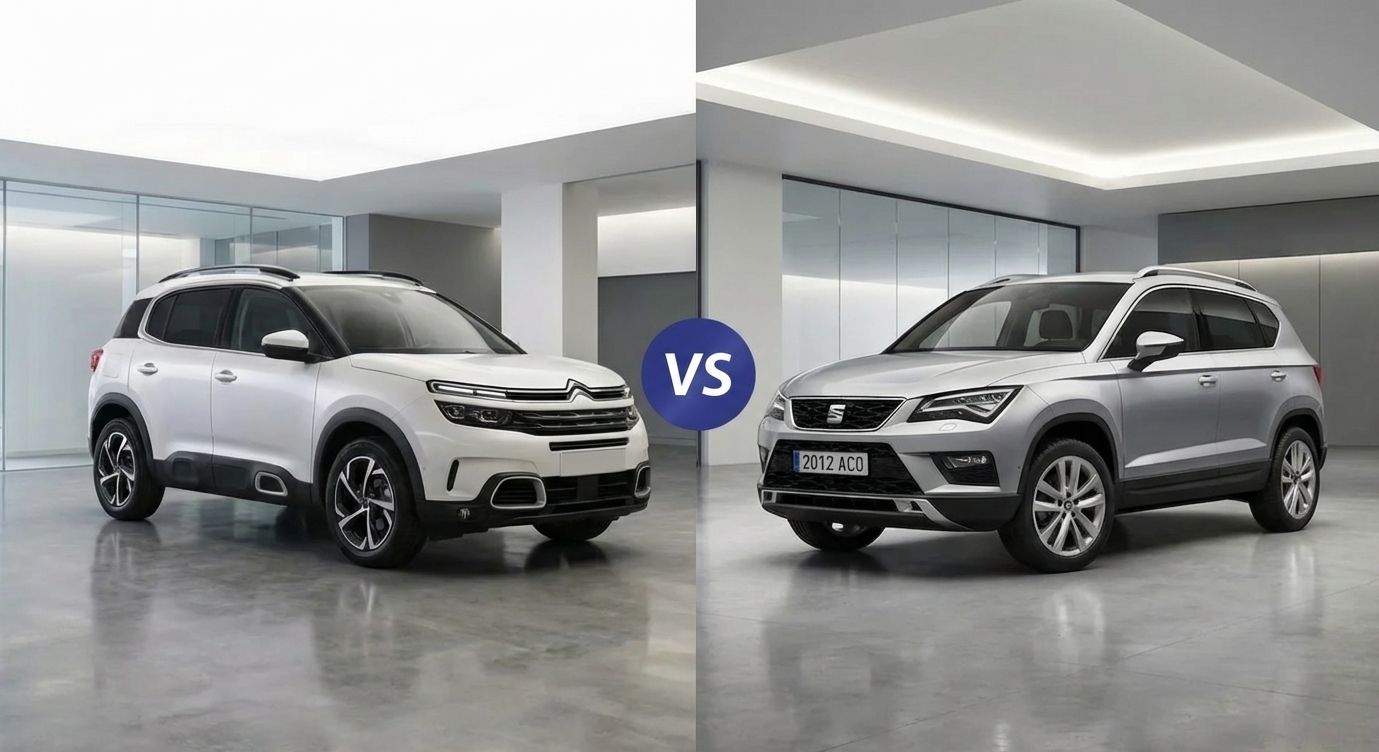
Detailed comparison: Citroën C5 Aircross vs. Seat Ateca. Find out which used SUV offers better comfort and equipment. Read the facts and our final verdict.
Apr 8, 2026

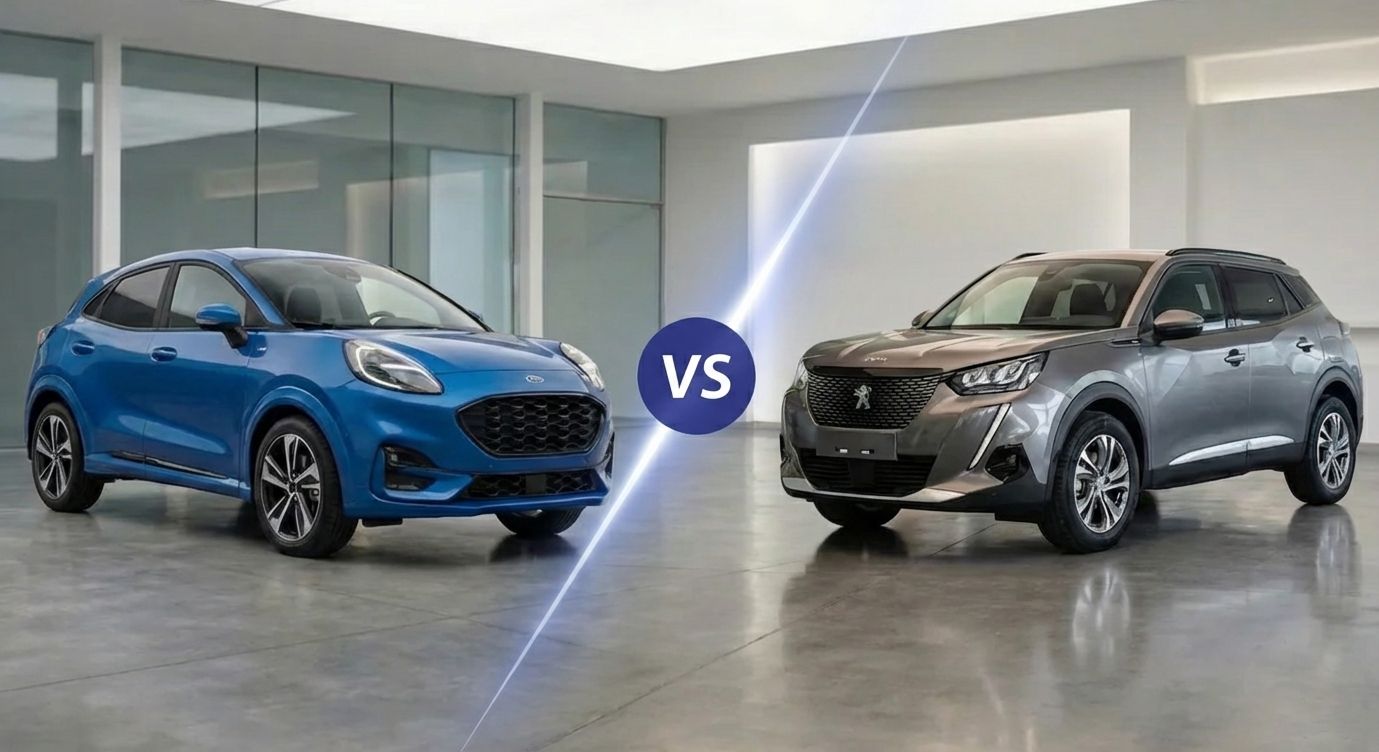
Ford Puma vs Peugeot 2008: Which crossover should you choose? Our detailed comparison, real-world insights, and verdict will help you decide.
Apr 13, 2026