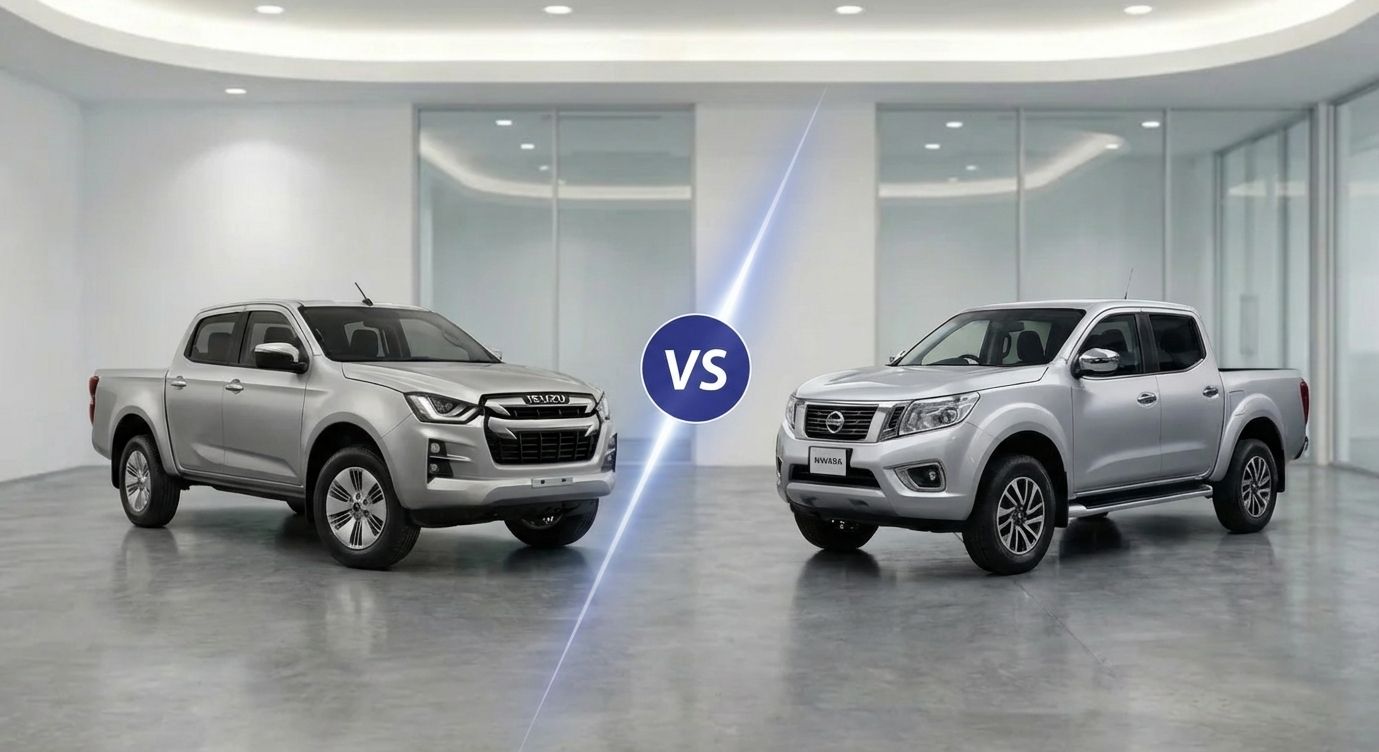
Car battle
Isuzu D-Max vs. Nissan Navara: Complete comparison 2026
Isuzu D-Max vs. Nissan Navara: Which pick-up is better? Our detailed comparison, tests, and verdict will help you choose the right vehicle.
Apr 14, 2026
Articles
Car battle
Looking for the perfect pickup truck? A detailed comparison of the Ford Ranger vs. Isuzu D-Max. We reveal the differences in off-road performance, reliability, and equipment to help you choose the best one.
October 16, 2026
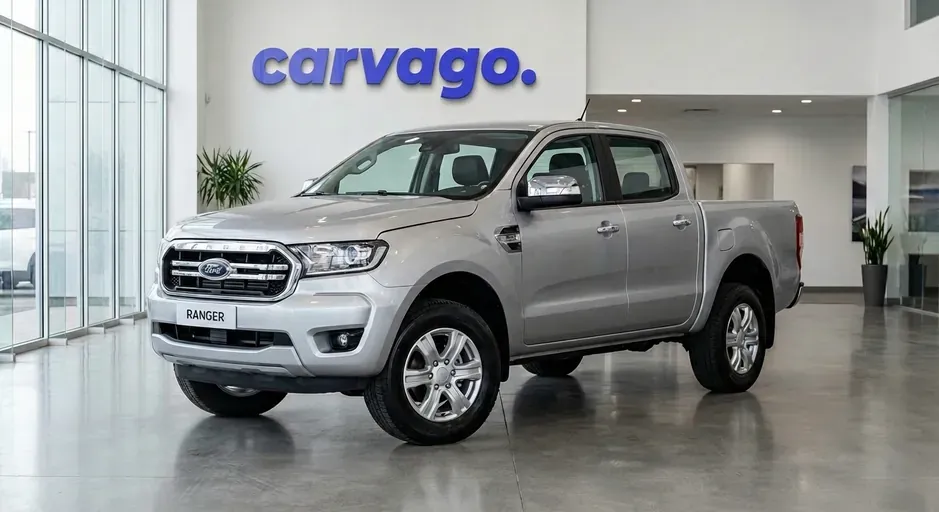
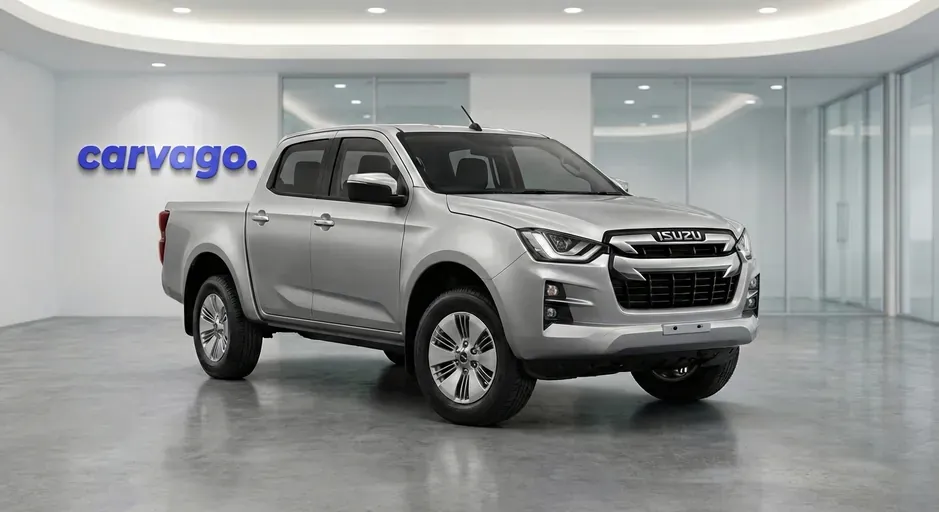
The Ford Ranger is a globally recognized mid-size pick-up that has built a reputation as a robust yet comfortable vehicle for both heavy work and everyday family use. Its challenger is the Isuzu D-Max, a vehicle known historically or currently in some markets also under the names Isuzu KB, Chevrolet D-Max, or Holden Colorado, which traditionally relies primarily on uncompromising mechanical durability and excellent utility features. The following comparison will show in detail how these two tough rivals stand in a direct duel and which of them represents a better choice for a potential buyer.
When you put roughly four-year-old models of these popular workhorses side by side (we are focusing on the 3rd generation Ford Ranger from 2019–2023 and the 3rd generation Isuzu D-Max from 2020–2024), you'll notice at first glance that the Ranger gives a more massive overall impression. While the Isuzu D-Max sticks to slightly more compact figures with a maximum length of 5310 mm, the popular Ford Ranger in the Double Cab version can stretch up to 5363 mm. The American representative is thus up to 53 mm longer. The greater overall length gives the Ranger the advantage of a slightly longer load bed or more generous cabin space; on the other hand, it means you'll struggle significantly more when parallel parking in narrow city streets.
However, the most fundamental physical difference is hidden under the bodywork, specifically in the wheelbase value. The Ford Ranger offers a generous wheelbase of 3220 mm, while the Isuzu D-Max has a value of only 3125 mm. The Ford's wheels are thus a significant 95 mm further apart. In practice, for the Ranger, this means a calmer and more directionally stable ride at highway speeds and slightly more longitudinal knee room for rear-seat passengers. However, with its shorter wheelbase, the Isuzu gains extremely valuable points in heavy off-road conditions – thanks to a significantly better breakover angle, there is a much lower risk of getting stuck "on its belly" when crossing sharp terrain breaks.
In terms of overall width and height, the standard variants of these pickups are quite similar, both oscillating around a width of 1870 mm, which is a standard value in this class for comfortably seating two well-built passengers. But the specific Ford Ranger Raptor version enters the fray, which, thanks to extremely widened fenders and a redesigned chassis, reaches a respectable width of 2028 mm. While such an increase guarantees unrivaled and confident behavior during fast off-road driving, it will quickly become your nightmare on narrow forest paths or in modern underground garages. The choice in this category is therefore a matter of your priorities: the Isuzu is more compact and agile in technical terrain and in the city, while the Ford bets on highway stability and overall robustness.
| Parameter | Ford Ranger Pick-up | Isuzu D-Max Pick-up |
|---|---|---|
| Width (mm) | 1867 - 2028 | 1810 - 1870 |
| Length (mm) | 5282 - 5363 | 5270 - 5310 |
| Height (mm) | 1800 - 1873 | 1770 - 1790 |
| Wheelbase (mm) | 3220 | 3125 |
When comparing practicality and storage space in approximately four-year-old used cars (focusing primarily on the 3rd and the transitional 4th generation of the Ford Ranger and the 3rd generation of the Isuzu D-Max), traditional trunk volume is naturally replaced by the dimensions of the open cargo bed. Utility space is absolutely key for these vehicles, both for craftsmen transporting oversized building materials and for active families for whom the vehicle must suffice for weekend shopping as well as longer holidays with bulky camping equipment. A fundamental difference compared to conventional body styles like estates or SUVs is the fact that in pick-ups with a separate bed, the main loading area cannot be increased simply by folding down the rear seats. The space in the cabin behind the front row serves primarily only as a safer and enclosed storage space for more sensitive personal items.
The Ford Ranger from 2021 and 2022 is at the absolute top of its segment in terms of bed capacity. In the most sought-after full five-seater Double Cab (SuperCrew) variant, it offers a base volume of an impressive 1233 liters. If family trips are not a priority and you sacrifice rear space for the extended SuperCab, you get an extended loading area with a volume of up to 1466 liters. An interesting feature of the Ford Ranger is the newly arriving plug-in hybrid version (PHEV within the 4th generation), where engineers cleverly integrated the batteries directly into the vehicle's reinforced frame under the floor. Thanks to this technical solution, there is no reduction in the usable volume of the bed, as is often the case with conventional passenger hybrids that tend to have batteries in the trunk.
On the other hand, the Isuzu D-Max (3rd generation) bets on slightly more pragmatic, compact dimensions with a huge emphasis on absolute durability in demanding terrain. In the comparable Double Cab version, the Isuzu's bed volume is approximately 1120 liters, which in the real world means that the Ford Ranger provides the owner with valuable space for a few extra suitcases. However, the Japanese automaker offers a very diverse portfolio for hard-working users – the Space Cab version with an extended cabin has a volume of approximately 1350 liters, and the purely utility two-seater Single Cab variant (often with a flatbed) swallows a massive 1720 liters. The D-Max thus balances the minor compromise in the family version with phenomenal flexibility for commercial fleets. Overall, from the perspective of a versatile and family lifestyle user, the Ford Ranger with its larger standard bed makes a bit more sense, while the Isuzu D-Max will please professionals requiring maximum loading area length in utility versions at the expense of cabin space.
| Parameter | Ford Ranger Pick-up Double Cab | Isuzu D-Max Pick-up Double Cab | Ford Ranger Pick-up SuperCab | Isuzu D-Max Pick-up Space Cab | Isuzu D-Max Pick-up Single Cab |
|---|---|---|---|---|---|
| Base volume (liters) | 1233 | 1120 | 1466 | 1350 | 1720 |
| Max volume with seats folded down (liters) | N/A | N/A | N/A | N/A | N/A |
While the popular Ford Ranger excels with a more generous bed in the sought-after Double Cab family version, the Isuzu D-Max is a great and indestructible workhorse for those looking for the absolute maximum workspace in the purely utility Single Cab version.
The ability to tow heavy trailers is one of the most critical parameters for work pickups like the Ford Ranger and Isuzu D-Max. For many buyers, maximum towing capacity is the deciding factor that determines whether the vehicle will function as a full-fledged work tool for construction companies, farmers, or active travelers. Both cars, in generations current for the market of approximately four-year-old used vehicles (3rd generation for Isuzu and the transition between 3rd and 4th generation for Ford), reach the absolute top of their class in terms of towing capacity, yet important differences can be found across specifications.
Both basic and better-equipped versions of the Isuzu D-Max with Double Cab and Space Cab body styles, powered by the 1.9 Diesel engine (120 kW), offer a respectable maximum braked trailer weight of 3,500 kg. A certain compromise occurs only with the purely work-oriented Single Cab version, where the limit can range between 2,500 and 3,500 kg depending on the specific configuration.
The competing Ford Ranger performs identically in standard specifications. Most variants, such as the popular 2.0 TDCi or 2.0 EcoBlue engines with the Double Cab body, easily handle a maximum load of 3,500 kg. An important exception that every prospective buyer should know about, however, is the top-tier sports version, the Raptor. While it dominates in terms of performance and off-road capabilities, its towing capacity is across-the-board reduced to just 2,500 kg due to a softer suspension with special Fox shocks. The same reduced limit is also found in the weakest commercial versions with a base output of 96 kW.
From a practical standpoint, a value of 3,500 kg means total freedom. Such a vehicle can easily handle transporting a dual-axle trailer with heavy construction machinery, two horses, or towing a large sea yacht for a summer vacation. While the reduced capacity of 2,500 kg for the Ranger Raptor version is still more than enough for weekend construction material shopping, a standard family caravan, or a lighter motorboat, it represents a limiting factor for demanding professional use.
Conclusion: If you require maximum towing capabilities from your pickup without compromise, the standard versions of both vehicles will serve you perfectly. The Isuzu D-Max is considered an exceptionally reliable workhorse with consistent performance. When choosing a Ford Ranger, however, you must carefully consider your priorities – if you opt for the attractive Raptor version, you will have to sacrifice a full ton of towing capacity in favor of sporty off-road experiences.
| Model and engine | Braked trailer weight (kg) | Unbraked trailer weight (kg) |
|---|---|---|
| Isuzu D-Max Double Cab / Space Cab 1.9 Diesel (120 kW) | 3500 | 750 |
| Isuzu D-Max Single Cab 1.9 Diesel (120 kW) | 2500-3500 | 750 |
| Ford Ranger Double Cab 2.0 TDCi / EcoBlue (125–156 kW) | 3500 | 750 |
| Ford Ranger Raptor 2.0 TDCi / 3.0 EcoBoost (154–215 kW) | 2500 | 750 |
| Ford Ranger Single Cab 2.0 TDCi (96 kW) | 2500 | 750 |
The difference in engine options between the Ford Ranger and Isuzu D-Max is vast and showcases two completely different approaches, which is crucial for buyers in terms of performance, fuel consumption, and reliability. While Ford bets on a wide range of modern and high-performance units, including powerful six-cylinders, Isuzu takes the path of maximum simplicity and efficiency with one main engine. The Ranger (represented on the used car market by the transition between the 3rd and 4th generation around 2022) offers a diverse selection from economical 2.0 EcoBlue four-cylinders to the mighty 3.0 EcoBlue six-cylinder or the recently added 2.3 EcoBoost PHEV plug-in hybrid. In contrast, the 3rd generation Isuzu D-Max (from 2020) is powered in Europe almost exclusively by a more modest but famously durable 1.9 Diesel engine. For drivers looking for raw power, modern technology, and dynamics, the Ford is the clear choice. Isuzu, on the other hand, targets budget-conscious users who appreciate reliability, low operating costs, and don't need to break speed records with a loaded cargo bed.
Under the hood of the Ford Ranger, you will find a diverse range of turbocharged diesel and petrol engines that will satisfy both workhorses and demanding adventurers. For roughly four-year-old used cars, the base is the reliable 2.0 EcoBlue four-cylinder diesel (referred to as 2.0 TDCi in older model years) with an output of 125 kW (170 hp) and a single turbocharger. Much more interesting, however, is its more powerful Bi-Turbo variant, boasting 151 to 155 kW (up to 213 hp) and a massive 500 Nm of torque. This engine is paired with an advanced 10-speed automatic transmission that perfectly optimizes both pull and fuel consumption. With the arrival of the 4th generation (from 2022/2023), a refined 3.0 EcoBlue V6 diesel with 176 to 184 kW and a crushing 600 Nm also joined the lineup. A specialty for enthusiasts is the top-of-the-line 3.0 EcoBoost petrol engine (215 kW) reserved for the sporty Raptor model, and the modern 2.3 EcoBoost PHEV version combining a petrol engine with an electric motor. From available data, it is evident that the previously very popular 3.2 TDCi five-cylinders and weaker 2.2 TDCi four-cylinders ended their life cycle mostly in 2019 and 2020 – you will therefore only rarely encounter them in four-year-old used cars.
| Engine Type | Fuel | Power (kW) | Torque (Nm) | Transmission |
|---|---|---|---|---|
| 2.0 EcoBlue (TDCi) | Diesel | 125 | 405 | 6MT / 6AT |
| 2.0 EcoBlue Bi-Turbo | Diesel | 151 - 155 | 500 | 10AT |
| 3.0 EcoBlue V6 | Diesel | 176 - 184 | 600 | 10AT |
| 3.0 EcoBoost V6 (Raptor) | Petrol | 215 | 491 | 10AT |
| 2.3 EcoBoost PHEV | Plug-in Hybrid | 205 | 690 | 10AT |
| 2.2 TDCi (discontinued 2020) | Diesel | 96 - 118 | 330 - 385 | 6MT / 6AT |
| 3.2 TDCi (discontinued 2020) | Diesel | 147 | 470 | 6MT / 6AT |
While Ford bets on diversity, the Isuzu D-Max pursues a philosophy in Europe of a single, perfectly refined unit. For 3rd generation vehicles (from 2020) and in the late years of the 2nd generation (2017–2020), the entire range consists exclusively of the 1.9 Ddi four-cylinder turbodiesel (often listed as 1.9 Diesel in databases). This economical and robust unit provides 120 kW (163 hp) and a maximum torque of 360 Nm. Although it lags significantly behind Ford's more powerful engines on paper and requires higher revs when towing heavy loads, in practice, drivers benefit from the lower overall weight of the vehicle. A major advantage is that this engine meets strict emission limits without overly complex additional technologies and scores points with favorable fuel consumption, realistically hovering around 7.3 l/100 km. Customers can choose either a sturdy manual transmission or a proven 6-speed automatic from the Japanese brand Aisin. If you were to long for a larger displacement in the form of 2.5 Diesel or 3.0 Diesel engines with Isuzu, you would have to go deep into the past to the 1st or 2nd generation. As the data shows, these large-displacement diesel engines were discontinued for the European market in 2017 (2.5 Diesel) and as early as 2012 (3.0 Diesel), and are therefore no longer relevant for four-year-old used cars.
| Engine Type | Fuel | Power (kW) | Torque (Nm) | Transmission |
|---|---|---|---|---|
| 1.9 Diesel (Ddi) | Diesel | 120 | 360 | 6MT / 6AT |
| 2.5 Diesel (discontinued 2017) | Diesel | 120 | 400 | 6MT / 5AT |
| 3.0 Diesel (discontinued 2012) | Diesel | 120 | 360 | 5MT / 4AT |
If you are looking for confident performance, modern technology, and the ability to tow the heaviest trailers without breaking a sweat, the Ford Ranger with its powerful EcoBlue engines is the clear choice. The Isuzu D-Max, on the other hand, will please those who prioritize low fuel consumption, the legendary reliability of a single honest engine, and do not want to pay extra for horsepower they won't use during normal work.
Choosing the right engine for work pick-ups is absolutely crucial for long-term satisfaction, as these vehicles often face heavy loads, towing heavy trailers, and demanding terrain. While for roughly four-year-old used cars (third generation of both models), Ford took the path of a modern, technologically advanced two-liter replacing the older large-displacement five-cylinders, Isuzu bet on pragmatism and the maximum simplicity of a single available unit. Our recommendations are based on real user experiences, mechanical reliability, and real-world fuel consumption.
Although many fans mourn the legendary 3.2 TDCi five-cylinder, according to available data, it stopped being imported for the third-generation Ranger in early 2020. Most roughly four-year-old used cars will therefore be equipped with the newer 2.0 TDCi four-cylinder (also known commercially as EcoBlue). The most powerful twin-turbocharged version with 157 kW (213 hp) represents the ideal compromise between massive towing power and modern refinement.
With the third-generation Isuzu D-Max, which has been on the market since late 2020, the choice is significantly easier. In Europe, the vehicle is available exclusively with the 1.9 Ddi four-cylinder turbodiesel. While on paper the 120 kW power and 360 Nm torque might look underpowered for a large pick-up, in practice, it is an absolutely reliable and proven "anvil" that won't let you down.
When purchasing a roughly four-year-old used pickup truck, it is important to keep in mind that the official fuel consumption figures stated by the manufacturer (often still measured using older methodologies or under unrealistically ideal conditions) can differ significantly from everyday heavy-duty reality. To get a more accurate picture of the actual requirements of these popular workhorses, we analyzed real-world data from the popular crowdsourcing platform Spritmonitor.de, where thousands of owners share their refueling logs. We focused exclusively on versions corresponding to the four-year-old used car market, i.e., predominantly the 3rd generation Ford Ranger and the 3rd generation Isuzu D-Max.
| Model and engine | Average consumption (l/100 km) |
|---|---|
| Isuzu D-Max 1.9 Diesel (Single / Space Cab) | 8.3 |
| Isuzu D-Max 1.9 Diesel (Double Cab) | 8.8 |
| Ford Ranger 2.0 TDCi / EcoBlue | 8.8 |
| Ford Ranger 3.2 TDCi | 10.5 |
| Ford Ranger Raptor 2.0 TDCi | 10.6 |
Looking at the real-world data, several interesting trends are apparent. The Isuzu D-Max relies exclusively on a single diesel engine, the 1.9 Diesel, which proves to be very economical. Especially in lighter body versions, the average consumption stays close to the eight-liter mark without much trouble. Ford, on the other hand, offered both a downsized two-liter (often as a bi-turbo) and the iconic massive five-cylinder 3.2 TDCi during the period under review. A very surprising finding from practice is the fact that although the smaller turbocharged two-liter promises significant savings on paper, in real life – especially under load or at highway speeds – it doesn't save as much fuel as one might expect, often consuming nearly nine liters. A specific case is the popular off-road Raptor version with the diesel two-liter, which, due to massive off-road tires and poorer aerodynamics, reaches an average of over 10 liters. Both models are, of course, clearly dominated by more economical diesel engines; gasoline alternatives in this used car market don't make much sense.
For regular users, these figures clearly define what they should reach for. If you are looking for an indomitable workhorse for frequent work-related travel and carefully monitor your company's operating budget, the Isuzu D-Max or the standard Ranger with the 2.0 TDCi engine will be the most sensible choice. The Ranger with the charismatic but thirsty 3.2 TDCi engine will appeal more to enthusiasts or those who tow heavy trailers daily, appreciate the massive low-end torque, and accept higher fuel bills as a necessary trade-off.
In conclusion, although the Isuzu D-Max comes out slightly more economical in the overall comparison, the real differences between volume-comparable four-cylinder diesels are not vast. Fuel consumption for both vehicles ranges from eight to ten and a half liters, and therefore, for these heavy utility machines, it rarely represents the main decision factor – payload, off-road capabilities, and driving comfort will carry much more weight.
When choosing a roughly four-year-old pickup truck (models manufactured around 2021–2022), the different market positions of both vehicles become apparent. The Ford Ranger benefits from its position as the long-term best-selling pickup in Europe, which means a huge selection on the secondary market. The third-generation Isuzu D-Max, on the other hand, is more of a scarce commodity, often sought after by highly specialized professionals, and as a result, it holds its residual value very firmly.
Ford Ranger (T6 generation after updates)
The Ranger from 2021–2022 (before the arrival of the entirely new generation) offers great diversity on the used car market, which is reflected in its wide price range.
Isuzu D-Max (3rd generation)
The Isuzu D-Max bets on absolute durability and a proven, robust 1.9 D diesel engine (120 kW). Due to lower new car sales, there is a significantly smaller supply on the used market.
| Category / Trim | Ford Ranger | Isuzu D-Max |
|---|---|---|
| Basic (work version) | €23,000 – €27,000 | €27,000 – €31,000 |
| Mid-range / Lifestyle (e.g., Wildtrak / V-Cross) | €29,000 – €37,000 | €33,000 – €39,000 |
| Top-tier / Off-road (e.g., Raptor) | €39,000 – €49,000 | No direct equivalent |
Note: The amounts listed are approximate average selling prices on the market (including VAT). The final price of a specific used car is fundamentally influenced by mileage, overall technical condition, and documented service history.
While the vast supply of Ford Rangers makes it possible to find a used vehicle for every budget, the Isuzu D-Max benefits from its reputation as an indestructible workhorse and maintains above-average and stable prices on the secondary market.
Both of these popular pick-ups boast a maximum five-star rating in tests by the independent Euro NCAP consortium. However, when evaluating the safety of used vehicles, it is necessary to take into account the context and the specific year of testing. Euro NCAP methodology and protocols are constantly becoming stricter over time, which means that percentage scores from different years cannot always be directly compared. In recent years, tests have placed far greater emphasis on advanced assistance systems, such as more accurate cyclist detection, new intersection scenarios, or protection against injuries in a far-side impact.
The current generation Ford Ranger underwent crash tests in 2022, according to very strict protocols of the time. The Isuzu D-Max originally passed its main set of tests in 2020; however, in 2022, Euro NCAP updated its rating following successful modifications to the knee airbag. Although the vehicles are separated by a slight shift in primary design, both models demonstrated excellent structural strength and offer advanced active and passive safety features. Standard equipment for both cars includes, for example, an innovative center airbag that prevents dangerous collisions between front-seat occupants during a side impact. Similarly, autonomous emergency braking (AEB) systems with vulnerable road user detection are standard.
In terms of detailed results, the Ford Ranger has a slight edge regarding modern assistance standards, which is primarily reflected in excellent child protection (90%) and more advanced protection for pedestrians and cyclists (74%). However, despite its older base architecture, the Isuzu D-Max scores with excellent robustness and even achieves a slightly higher rating for adult occupant protection, which rose to 86% after the 2022 updates. In conclusion, while the Ford Ranger offers a slightly more comprehensive and modern safety package fully in line with the latest trends, the Isuzu D-Max does not lag significantly behind and remains a safe and highly-rated choice for both work and family use.
| Parameter | Ford Ranger | Isuzu D-Max |
|---|---|---|
| Year of testing | 2022 | 2022 |
| Adult occupant protection | 84 % | 86 % |
| Child occupant protection | 90 % | 86 % |
| Vulnerable road user protection | 74 % | 69 % |
| Safety assist systems | 84 % | 83 % |
Both models are exceptionally safe and boast five stars from Euro NCAP tests; however, thanks to newer testing methodology, the Ford Ranger provides more modern protection for vulnerable road users and children. The Isuzu D-Max, however, represents a very reliable alternative with great structural protection for adult passengers.
In addition to standard equipment, each model offers several unique features that can be decisive for the customer, and both pick-ups approach added value in their own distinctive way. While one bets on digitalization and cutting-edge innovation, the other excels in uncompromising safety and thoughtful robustness.
The fourth-generation Ford Ranger (from 2022) brings features to the pick-up segment more commonly found in luxury passenger cars, yet ingeniously combines them with rugged work capabilities.
The Isuzu D-Max (RG generation) follows the path of maximum reliability and durability. At the same time, it brings its users an unprecedented standard of safety and surprisingly comfortable features for everyday life.
Driving comfort approaching regular passenger cars even when unladen
Powerful and dynamic engines, including the popular 2.0 EcoBlue Bi-Turbo
Fast and very intuitive SYNC 3 multimedia system (or SYNC 4 in newer models)
Top-tier towing capacity (up to 3,500 kg) and excellent payload
Wide range of trim levels, from purely work-oriented to the premium Wildtrak
Higher purchase price of used cars compared to Asian competitors
Higher fuel consumption with more powerful engine options
The ten-speed automatic transmission sometimes shifts gears unnecessarily often
Larger dimensions can make maneuvering in narrow city streets difficult
Ford Ranger is an ideal choice for drivers looking for a versatile pickup combining uncompromising work commitment with the comfort of a classic SUV. Thanks to powerful engines, an advanced chassis, and modern technology, it serves perfectly not only for towing heavy trailers but also for active leisure time or longer journeys.
Renowned reliability, longevity, and exceptionally robust construction
Excellent safety level evidenced by a 5-star rating in Euro NCAP tests (2020)
The economical 1.9 diesel engine features very favorable operating and service costs
Top-tier off-road capabilities complemented by a rear differential lock on most versions
Significantly better price-to-value ratio on the used car market
The 1.9 l engine (120 kW) lags slightly behind competitors in dynamics and is noisier at higher RPMs
Stiffer suspension tuning means a bouncier and less comfortable ride with an empty bed
The onboard system and infotainment feel outdated and have a slower response
The interior relies more on hard plastics and an overall more utilitarian feel
Isuzu D-Max is a tough workhorse designed primarily for demanding physical labor, where users will most appreciate its unrivaled durability and low operating costs. It is a perfect fit for farmers, foresters, and craftsmen who are willing to sacrifice a bit of highway comfort and premium materials in exchange for maximum reliability and great off-road capability.
Based on long-term user experience, service reports, recall campaigns, and findings from independent technical inspections, we have compiled an overview of the most common problems you should watch out for when choosing these roughly four-year-old pick-ups.
The Ford Ranger from around 2021 is a robust and technologically advanced pick-up, but its more sophisticated powertrains and transmissions may require increased attention after several years.
The Ranger offers excellent driving comfort and performance; however, the modern EcoBlue diesel engines and multi-speed automatics are sensitive to neglected maintenance. A documented service history and timely fluid changes are absolutely key to the reliability of this model.
The latest generation Isuzu D-Max (produced since 2020) has long been profiled as an indestructible workhorse, yet it has specific weaknesses associated with modern electronics and exhaust filtration.
The basic mechanics and the 1.9 Ddi engine excel in above-average longevity and can handle hard work without issues. You only need to pay increased attention to the particulate filter in vehicles used for short trips and accept the occasional confusion of the safety assistants.
When buying a used car, a thorough inspection is key. Both compared pick-ups are known as robust and durable workhorses, yet they have their specific weak points that need to be focused on during a test drive. We always recommend a thorough independent technical inspection of the car before making a final decision, which will reveal even hidden defects.
Both vehicles can tow a braked trailer weighing up to 3,500 kg as standard, which is the absolute maximum in this class. However, the Isuzu D-Max often offers a slightly higher payload capacity, exceeding 1 tonne even in more premium trim levels. Ford, on the other hand, counters with more advanced camera assistants that significantly simplify the process of hitching and reversing with a trailer.
In the European market, the Isuzu D-Max relies primarily on a very economical but rather work-oriented 1.9 Ddi diesel four-cylinder engine with 120 kW of power. The Ford Ranger, by contrast, offers a wider range of engines, including powerful two-liter bi-turbos or larger six-cylinder engines that provide much better dynamics. As a result, the Ranger has the upper hand in towing power and acceleration, while the Isuzu can operate with slightly lower running costs.
The Ford Ranger is generally considered the more comfortable choice, with a chassis and interior that feel closer to conventional SUVs. While the latest generation of the Isuzu has a significantly improved and modern cabin, its rear axle remains tuned rather stiffly for carrying heavy loads. If you plan frequent family trips or longer highway journeys, the Ranger offers better sound insulation and a richer technological equipment.
The Isuzu D-Max has long maintained an excellent reputation as a mechanically robust workhorse, with an emphasis on simplicity and durability. The Ford Ranger is also sturdy, but its more complex and powerful engines with more electronics may pose a slightly higher risk of service costs in used models. For daily heavy work on a construction site, farm, or in the forest, the Japanese model is therefore often rated as the bulletproof choice.
Both pickups feature selectable four-wheel drive, a low-range gearbox, and a rear differential lock, so they perform excellently in mud and snow. The Isuzu excels with slightly better approach and departure angles and underbody protection, which you will appreciate when overcoming large obstacles. However, the Ford brings more sophisticated electronic driving modes for off-roading, which effectively manage traction and help even less experienced drivers.
Sources: ADAC, auto.cz, aktualne.cz, hybrid.cz, fdrive.cz, portalridice.cz
This article was prepared using artificial intelligence tools. The section guarantor is Petr Dušek.
Isuzu D-Max vs. Nissan Navara: Which pick-up is better? Our detailed comparison, tests, and verdict will help you choose the right vehicle.
Apr 14, 2026
Detailed comparison: Mitsubishi L200 (Triton) vs Toyota Hilux. Find out which used pick-up offers better equipment, performance, and price. Our verdict here!
Apr 14, 2026
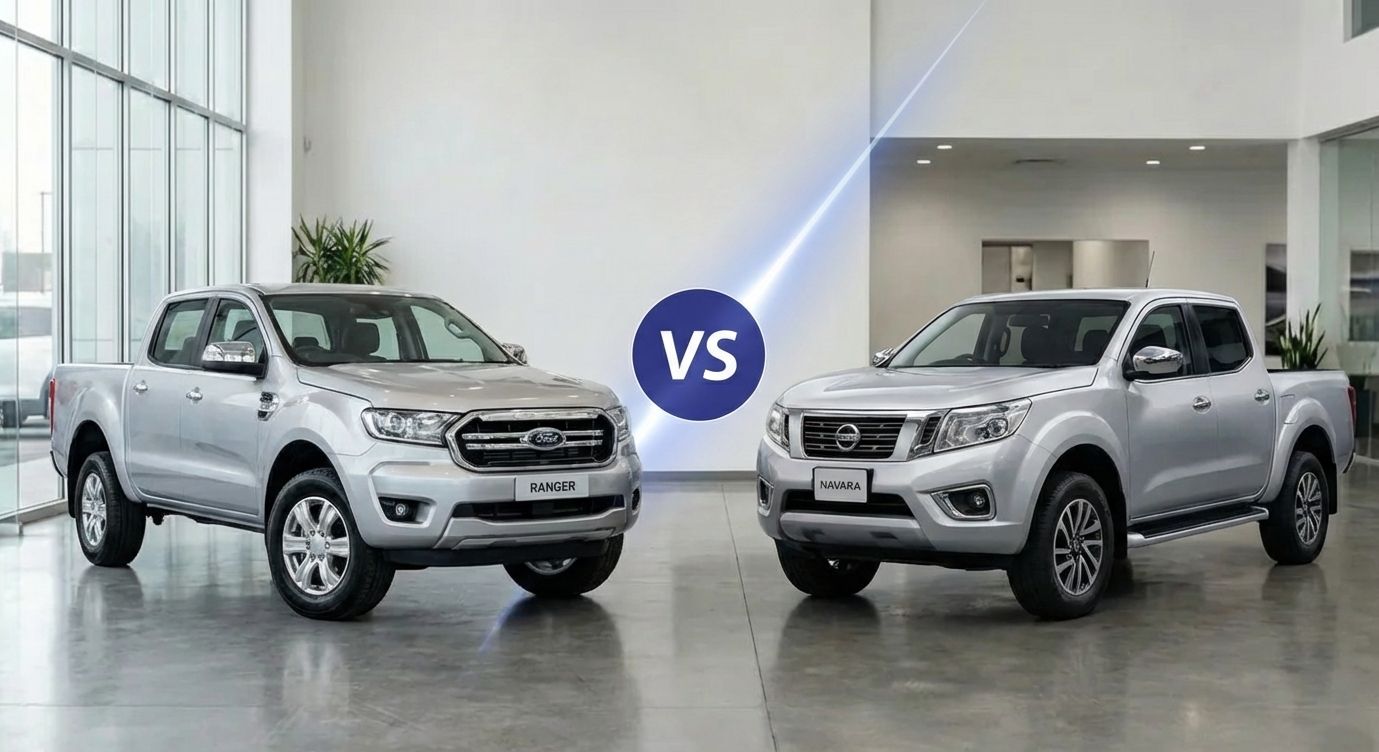
Ford Ranger vs Nissan Navara (NP300) comparison. We bring real-world experience, a comparison of equipment and driving characteristics. Which used pick-up is the better choice?
Apr 14, 2026