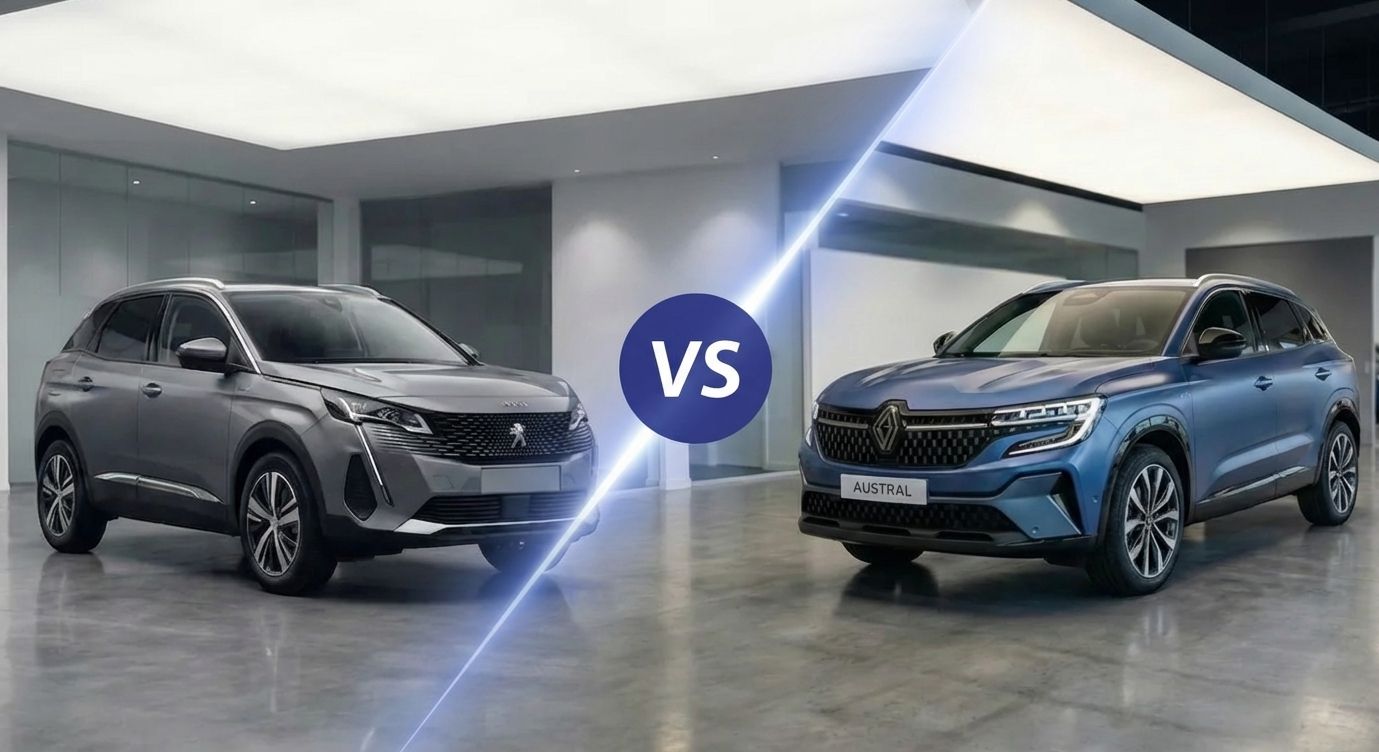
Car battle
Peugeot 3008 vs Renault Austral: Complete Comparison 2026
Peugeot 3008 vs Renault Austral. Which SUV is better? Detailed comparison, real-world data, and the final verdict will help you choose.
Oct 23, 2026
Articles
Car battle
Detailed comparison: Ford Kuga vs. Kia Sportage. Discover the differences in engines, equipment, and reliability, and find out which used SUV is the best choice for you.
April 22, 2026
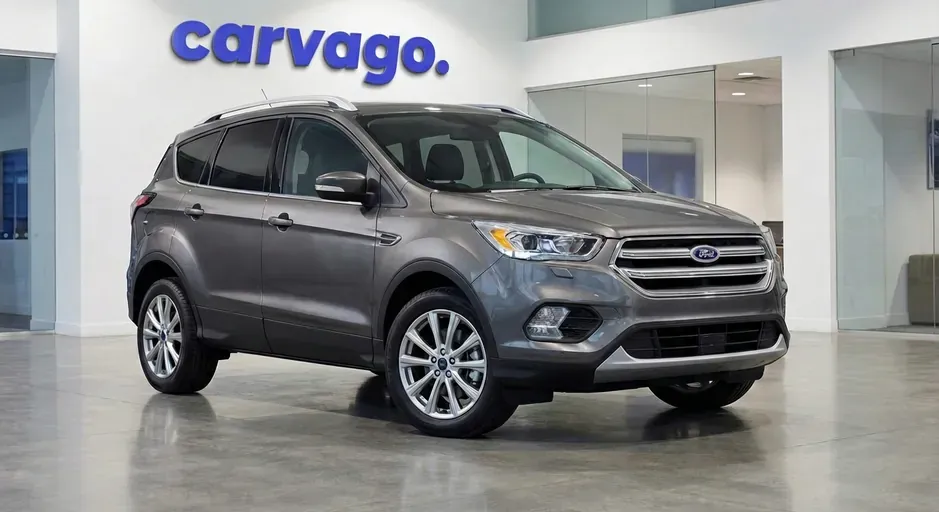
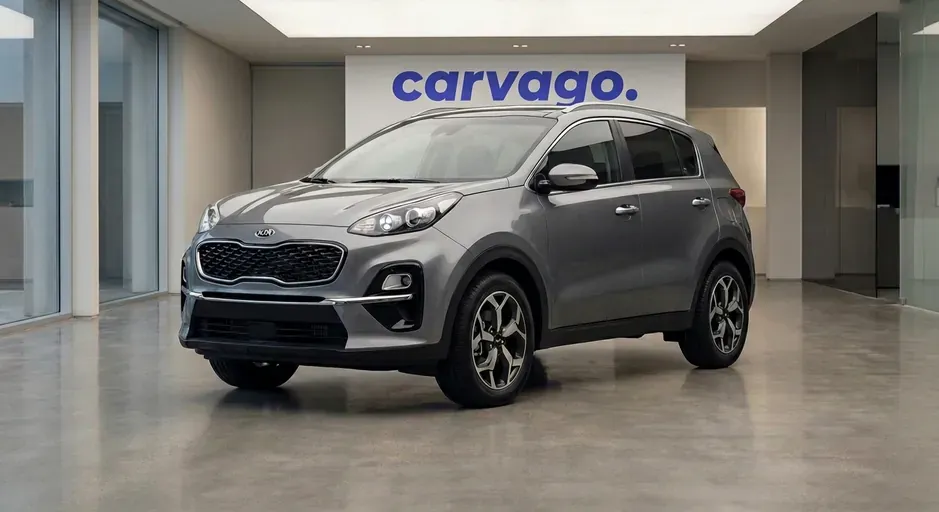
Ford Kuga, also sold under the name Ford Escape in many global markets, is a very popular family SUV that traditionally wins drivers over with its above-average driving characteristics and a diverse range of efficient engines. Standing against it is the popular Kia Sportage (also known in China as the Kia KX5 or Sportage Ace), which instead appeals to the emotions with its bold modern design, high-quality craftsmanship of its spacious interior, and advanced on-board technologies. Let's now take a detailed look at which of these two attractive SUVs, with an average age of around four years, represents a more rational and advantageous choice on the used car market for your daily travels.
When choosing a roughly four-year-old used family SUV, external dimensions play a key role not only for interior space but also for everyday usability. In the used car market at this age, you will primarily encounter the third-generation Ford Kuga and the modern fifth-generation Kia Sportage (designated as NQ5, arriving at the turn of 2021 and 2022). In a direct comparison of these generations, it is clear at first glance that the Ford Kuga plays the role of a slightly larger and more robust vehicle.
The Ford Kuga measures 4,614 to 4,629 mm in length, outgrowing the Kia Sportage and its 4,515 mm by a full 100 to 114 millimeters. This significant difference is also complemented by a more generous wheelbase. Ford offers 2,710 mm, while Kia has a wheelbase of 2,680 mm. In practice, this 30-millimeter lead for the Kuga means a slightly smoother and more stable ride at highway speeds and a slight benefit in longitudinal space for rear-seat passengers.
On the other hand, the Kia Sportage's more compact footprint brings an undeniable advantage in the urban jungle. With a total length just over 4.5 meters and a slightly narrower body (1,865 mm compared to 1,883 mm for the Ford), the Korean representative is slightly more confident to maneuver in tight underground garages and during parallel street parking. As for height, both vehicles hover around 1,650 mm, which ensures the popular higher seating position and an excellent view of the road for both.
While the Ford Kuga's proportions target drivers looking for the most mature SUV possible, approaching a vehicle from a class above, the Kia Sportage represents the golden mean for those who prefer a balanced ratio between solid interior space and maintaining excellent urban agility.
| Parameter | Ford Kuga SUV | Kia Sportage SUV |
|---|---|---|
| Length (mm) | 4614 - 4629 | 4515 |
| Width (mm) | 1883 | 1865 |
| Height (mm) | 1650 - 1663 | 1650 |
| Wheelbase (mm) | 2710 | 2680 |
Trunk capacity is one of the most important parameters when choosing a family SUV on the used car market. Both the Ford Kuga (in its third generation available since 2020) and the Kia Sportage (in its fifth generation NQ5 sold since 2022) approach the issue of interior practicality differently. These differences have a direct impact on everyday usability, whether it's carrying a stroller, large weekend shopping trips, or comfort when packing for a long holiday. While one model bets on maximizing absolute volume, the other offers exceptionally clever variability in the rear of the interior.
In its basic configuration, the Ford Kuga has a trunk with a capacity of 475 liters. Its main advantage, however, is the cleverly designed sliding rear bench, which allows the car to adapt to the situation. If you slide the rear seats all the way forward, you suddenly get a generous luggage space of 645 liters, albeit at the cost of a noticeable reduction in legroom for rear passengers. With the backrests fully folded, the total capacity climbs to a solid 1,534 liters. It should be noted that the very popular plug-in hybrid (PHEV) and full hybrid versions of the Kuga have their maximum volume reduced to 1,481 liters due to the placement of the traction battery.
The fifth-generation Kia Sportage, on the other hand, is designed with an emphasis on the largest possible basic trunk without the need to restrict living space for the occupants. Standard non-electrified versions offer an excellent 591 liters, which is 116 liters more than the Kuga in its default seat setting. In practice, this volume difference means space for several extra suitcases, which is safely sufficient even for the most demanding family holiday. With the backrests folded, the Sportage offers a massive 1,780 liters. Similar to the Ford, however, the battery installation partially reduces the trunk capacity – diesel mild-hybrids offer 526 liters and the plug-in hybrid variant has a capacity of 540 liters.
| Parameter | Ford Kuga SUV | Kia Sportage SUV |
|---|---|---|
| Basic volume (l) | 475 - 645 | 526 - 591 |
| Max. volume with seats folded (l) | 1481 - 1534 | 1715 - 1780 |
While the Kia Sportage clearly wins in total trunk size and accommodates more luggage without restricting the occupants, the Ford Kuga manages to score cleverly with its sliding rear seats, allowing you to flexibly adjust the space.
The weight of the trailer you can tow behind a car is a crucial parameter for all drivers looking for maximum practicality. Towing capacity directly determines how large and heavy items you can transport. If we focus on roughly four-year-old used cars on the market – namely the third-generation Ford Kuga and the fifth-generation Kia Sportage (designated as NQ5) – we encounter interesting differences. Both SUVs offer a very solid foundation, but when it comes to maximum limits, they take slightly different approaches.
In standard petrol engine versions, Ford has a slight edge. While the popular Ford Kuga 1.5 EcoBoost version can tow a braked trailer weighing a solid 1,800 kg, common versions of the Kia Sportage with the 1.6 T-GDI engine stay slightly lower at 1,650 kg. An even more significant difference can be found in the maximum towing capacity values. If you need maximum performance, the diesel Ford Kuga 2.0 EcoBlue, with a limit of up to 2,100 kg, is the absolute favorite in this comparison and can easily handle even a caravan. In contrast, the most powerful diesel Kia Sportage 1.6 CRDI has a ceiling of 1,950 kg.
A very specific situation arises with the popular hybrid and plug-in hybrid (PHEV) versions. For both brands, towing capacity is significantly limited due to heavy traction batteries. The frequently sought-after Ford Kuga 2.5 Plug-in Hybrid can handle 1,500 kg on the hitch, while the competing Kia Sportage 1.6 T-GDI Plug-In Hybrid is limited to just 1,350 kg in selected older model years. However, even this slightly lower value means, in practice, ideal space for a few extra suitcases in a smaller trailer, easy attachment of an e-bike rack, and is fully sufficient for weekend shopping or a longer holiday.
Final evaluation: If your primary goal is regular towing of heavy loads or large caravans, the Ford Kuga (especially in combination with a powerful diesel engine) will provide you with a significantly larger performance reserve. However, the Kia Sportage will serve perfectly reliably for all common family needs and occasional towing of lighter trailers.
| Model and engine | Braked trailer weight (kg) | Unbraked trailer weight (kg) |
|---|---|---|
| Ford Kuga III 1.5 EcoBoost (110 kW) | 1800 | 750 |
| Ford Kuga III 2.0 EcoBlue (140 kW) | 2100 | 750 |
| Ford Kuga III 2.5 Plug-in Hybrid (112 kW) | 1500 | 750 |
| Kia Sportage NQ5 1.6 T-GDI (110-132 kW) | 1650 | 750 |
| Kia Sportage NQ5 1.6 CRDI (100 kW) | 1650 - 1950 | 750 |
| Kia Sportage NQ5 1.6 T-GDI Plug-In Hybrid (132 kW) | 1350 | 750 |
Looking at the engine range of roughly four-year-old used cars (third-generation Ford Kuga from 2020 and Kia Sportage generation NQ5 available since early 2022), we find that both manufacturers approach electrification and traditional engines quite differently. While Ford uses a reliable naturally aspirated 2.5-liter four-cylinder engine operating on the efficient Atkinson cycle for its popular hybrids, Kia has taken the downsizing route, building its electrified models on the turbocharged 1.6 T-GDI engine. The Korean approach offers slightly better flexibility and a higher overall power peak (up to 195 kW for the PHEV version), whereas Ford scores with unrivaled durability and excellent fuel economy without unnecessary added complexity. There is also a significant difference in diesel variants – drivers with high annual mileage or those looking for a car to tow trailers (the Kuga can handle a heavy 2,100 kg on the tow bar) will clearly appreciate the robust 2.0 EcoBlue diesel. For motorway travelers, Kia has the smaller 1.6 CRDi diesel in reserve, targeting calmer drivers with an emphasis on the lowest possible fuel consumption.
The third generation of the Ford Kuga can satisfy a very wide range of buyers. The affordable entry point is the turbocharged 1.5 EcoBoost three-cylinder, but the real hit on the used car market is the 2.5 PHEV (Plug-in hybrid) version, which has long been one of the best-selling plug-in cars in Europe and impresses with its robust construction. A comfortable FHEV variant is also available, which does not require external charging. Motorway mile-munchers most often search for the 2.0 EcoBlue diesel engine. Its top variant with 140 kW of power features a strong 400 Nm of torque and includes intelligent all-wheel drive paired with a traditional eight-speed automatic. However, if you are interested in the smaller, economical diesel, pay attention to the production year. As used car production data shows, the entry-level 1.5 EcoBlue (88 kW) diesel unit was only offered in the first years of production and quietly disappeared from the range at the turn of 2021 and 2022, so you will no longer find it in newer models.
| Engine Type | Fuel Type | Power (kW) | Torque (Nm) | Transmission |
|---|---|---|---|---|
| 1.5 EcoBoost | Petrol | 88 / 110 | 240 | 6MT |
| 2.5 FHEV | Hybrid (Petrol) | 140 | 200* | CVT |
| 2.5 PHEV | Plug-in Hybrid | 165 | 200* | CVT |
| 1.5 EcoBlue | Diesel | 88 | 300 | 6MT / 8AT |
| 2.0 EcoBlue | Diesel | 110 / 140 | 370 / 400 | 6MT / 8AT |
*Note to the table: The value of 200 Nm for the hybrid versions indicates the torque of the internal combustion engine alone. The vehicle's total power is significantly higher during acceleration thanks to the generous assistance of the powerful electric motor.
On the other hand, the Kia Sportage in its current NQ5 generation has bet on cylinder displacement unification – all engine options are covered by a 1.6-liter capacity. The common base is the modern 1.6 T-GDI petrol four-cylinder, which largely benefits from the presence of a mild-hybrid system (EcoDynamics+), which imperceptibly shuts off the engine and saves fuel at intersections or while coasting. For corporate fleets and long family trips, the 1.6 CRDi diesel engine remains an interesting alternative, often paired with a responsive seven-speed dual-clutch automatic (7DCT). However, the technological peak lies in the two electrified variants. The Sportage in HEV and PHEV versions pairs the combustion engine with powerful electric motors and a smooth six-speed automatic transmission. The standard hybrid provides an above-standard 169 kW, and the plug-in hybrid variant reaches a top 195 kW, which, together with the presence of 4x4 drive, makes it the fastest family SUV of this compared pair.
| Engine Type | Fuel Type | Power (kW) | Torque (Nm) | Transmission |
|---|---|---|---|---|
| 1.6 T-GDI (MHEV) | Petrol | 110 / 132 | 250 / 265 | 6MT / 7DCT |
| 1.6 T-GDI HEV | Hybrid (Petrol) | 169 | 350 | 6AT |
| 1.6 T-GDI PHEV | Plug-in Hybrid | 195 | 350 | 6AT |
| 1.6 CRDi (MHEV) | Diesel | 85 / 100 | 280 / 320 | 6MT / 7DCT |
While the Ford Kuga appeals to demanding drivers with its powerful two-liter diesel, excellent for towing trailers, and its highly reliable naturally aspirated plug-in hybrid, the Kia Sportage targets proponents of modern technology with more dynamic turbocharged hybrids and a sophisticated interior.
Choosing the right engine is absolutely crucial for long-term satisfaction with a used car. Both manufacturers in the mid-size SUV segment offer a different approach, which is very interesting for comparison in roughly four-year-old vehicles on the used car market. While Ford heavily bet on sophisticated electrification for the third-generation Kuga (produced since 2020), with its main star being a robust plug-in hybrid powertrain, the Kia Sportage scored points at the turn of the QL and newer NQ5 generations (around 2021 and 2022) primarily with proven petrol four-cylinders, which it cleverly supplemented with EcoDynamics+ mild-hybrid support technology in the newer version. Our recommendations are based on real-world performance, actual fuel consumption in daily traffic, user feedback, and mechanical reliability identified by mechanics after several years of real ownership.
This plug-in hybrid powertrain, widely available in the third generation (III) produced between 2020 and 2024, is the best unit the Kuga offers from a long-term perspective. Its absolute greatest technical advantage is the 2.5-liter naturally aspirated petrol four-cylinder engine operating on the Atkinson cycle. The intentional absence of a turbocharger and complex components makes it a mechanically exceptionally durable engine that does not suffer from common faults of turbocharged units. In combination with the planetary e-CVT transmission, the power curve is beautifully linear and the ride is velvety smooth. Real-world consumption stays around 2 to 3 liters per 100 km with regular home charging, but even with a discharged battery, the system works efficiently as a classic full-hybrid with consumption under 6 l/100 km. In terms of prevention and potential risks for four-year-old used cars, however, watch out for engine oil dilution with petrol. This problem occurs if the previous owner used the car only for extremely short trips with a discharged battery and the internal combustion engine did not have time to warm up to operating temperature. If you smell petrol from the oil dipstick, it is a warning signal. As a preventive measure, we strongly recommend changing the engine oil every 10,000 km to 15,000 km, rather than following long "long-life" intervals, and having the state of health (SOH) of the high-voltage battery checked at a service center. This version of the car (available until 2024) currently stands out on the used car market as an absolutely ideal choice for suburban drivers with the possibility of home charging, who appreciate the silence of an electric vehicle on shorter trips but want to head out on a long family vacation on the weekend without any stress or planning.
When choosing a four-year-old used car, where you will encounter either a very well-tuned end of the QL generation (until the end of 2021) or the beginning of the highly modern NQ5 generation (from 2022 and available to the present), the 1.6 T-GDI turbocharged petrol four-cylinder is the most sensible recommendation. Its greatest asset is the excellent balance between purchase costs, solid dynamics, and proven reliability. The engine offers a strong torque curve starting at low revs, making the masking of the SUV's higher weight in city and highway traffic completely effortless. Consumption under normal use ranges between an acceptable 7 to 8 l/100 km (the more modern version with EcoDynamics+ mild-hybrid can save a liter). A known weak point for all direct-injection engines is the gradual accumulation of carbon on the intake valves. In a used car, experienced mechanics can detect this by a slightly rougher idle or occasional minor hesitation during sharp acceleration. To eliminate this problem, just follow a simple rule: fill up with high-quality additive-treated petrol, change the oil strictly every 15,000 km, and regularly warm up and "stretch" the car at higher revs, for example, when driving on the highway. If you opt for a vehicle equipped with a dual-clutch automatic (DCT), also check whether the car jerks when starting from a standstill, which would indicate a worn clutch set from constant crawling in traffic jams. This turbocharged engine is absolutely ideal for versatile drivers and active families who alternate between the city and weekend trips and do not have an annual mileage that justifies buying a diesel engine with all its future risks, such as DPF filter clogging during frequent short trips.
Official fuel consumption figures provided by car manufacturers are often overly optimistic and hardly achievable in everyday traffic. For an objective comparison of real-world appetite, we have focused on user data from the well-known community portal Spritmonitor.de, where hundreds of thousands of drivers record their actual fuelings. We focused on generations and vehicles typical for the current market of roughly four-year-old used cars – the third-generation Ford Kuga (from 2020) and the current Kia Sportage (NQ5 generation, from 2022).
Source: news_site
| Model and engine | Average consumption (l/100 km) |
|---|---|
| Ford Kuga 1.5 EcoBoost | 6.6 |
| Ford Kuga 2.0 EcoBlue | 5.9 |
| Ford Kuga 2.5 Hybrid (FHEV) | 5.6 |
| Ford Kuga 2.5 Plug-in Hybrid | 1.2 * |
| Kia Sportage 1.6 T-GDI | 6.7 |
| Kia Sportage 1.6 CRDi EcoDynamics+ | 5.5 |
| Kia Sportage 1.6 T-GDI Hybrid | 6.2 |
| Kia Sportage 1.6 T-GDI Plug-In Hybrid | 1.1 * |
(Note: The extremely low values for both plug-in hybrid versions apply only assuming regular charging. With a discharged battery, average consumption easily exceeds that of conventional petrol engines due to the higher kerb weight of both vehicles.)
Looking at the real-world figures, it is clear to see how different technological approaches behave in practice. When it comes to conventional fuels, diesel engines remain unbeatable on longer routes. Both the diesel Kuga 2.0 EcoBlue and the Sportage 1.6 CRDi comfortably settled below the 6 l/100 km mark in real-world conditions.
Basic petrol engines logically require slightly more fuel. Ford's compact three-cylinder 1.5 EcoBoost maintains a solid average of 6.6 l/100 km, which is slightly more efficient than Kia's four-cylinder 1.6 T-GDI, which approaches the 6.7-liter mark.
Significant and very interesting differences appear in hybrid powertrains:
Selection on the used car market should be strictly guided by the future owner's daily routine:
In the end, differences in fuel consumption will likely not be the primary factor deciding the purchase of one of these used SUVs. The Ford Kuga offers a slightly more economical full-hybrid powertrain with an excellent large-displacement engine in the real world, while the Kia Sportage scores in the overall comparison with a slightly more economical turbodiesel and a modern turbocharged base. Most importantly, however, both brands have prepared an extremely rich and advanced spectrum of engines for these specific generations, among which everyone will simply find their ideal powertrain.
When looking for a used family SUV roughly four years old (2021–2022 models), you will encounter a different market situation for both models. While the Ford Kuga was already steadily offering its third generation at that time, the Kia Sportage was undergoing a significant generational change during this period.
Prices for roughly four-year-old Ford Kuga models range quite widely, depending heavily on the chosen engine and trim level.
For four-year-old Kia Sportage models, the generation is absolutely crucial for the final price. The turn of 2021 and 2022 marked the arrival of the fifth generation (NQ5) with a revolutionary design.
| Model and engine | Approximate used price (€) | Generation / Specification |
|---|---|---|
| Ford Kuga 1.5 EcoBoost/EcoBlue | 16,500 – 19,300 | 3rd generation (Base / Titanium) |
| Ford Kuga 2.0 EcoBlue / 2.5 PHEV | 18,500 – 22,600 | 3rd generation (ST-Line, 4x4) |
| Kia Sportage 1.6 GDI/CRDi | 15,600 – 18,500 | 4th generation (outgoing model) |
| Kia Sportage 1.6 T-GDI (MHEV) | 21,400 – 26,700+ | 5th generation (new design) |
While a roughly four-year-old Ford Kuga offers balanced prices across the third generation and makes sense if you are looking for a good value hybrid, a 2022 Kia Sportage will cost you more due to the arrival of the modern fifth generation, but it rewards you with a futuristic look and a lucrative remainder of the factory warranty.
Both the Ford Kuga and Kia Sportage boast a maximum five-star rating in crash tests by the independent organization Euro NCAP. However, when comparing these results, it is crucial to take into account the year of testing itself. Euro NCAP methodology becomes stricter every year and undergoes fundamental development. For this reason, the percentage results of cars from different years cannot be directly compared. Modern tests place much greater emphasis not only on passive safety and body rigidity, but especially on active safety assistants, cyclist protection, and complex scenarios when passing through an intersection.
The third-generation Ford Kuga underwent Euro NCAP evaluation in 2019. At the time, it achieved excellent results and demonstrated a solid body structure complemented by rich safety equipment. The car received a great 92% for adult occupant protection, with commissioners highlighting the full points gained in side impact and pole impact tests. Child occupant protection was rated at a solid 86%. According to the testing protocols of the time, the Kuga also performed very well in terms of consideration for vulnerable road users (82%) and received 73% in the safety assistance systems category.
The fifth-generation Kia Sportage underwent safety tests in 2022. This means it had to face significantly stricter protocols requiring more reliable autonomous emergency braking (AEB) systems and improved pedestrian and cyclist detection. Even under these more difficult conditions, the Sportage easily earned five stars. For adult protection, it took home a score of 87%, where Euro NCAP praised primarily the excellent stability of the passenger compartment. Child protection was rated identically to the Ford at 86%. Although the scores for vulnerable road users (66%) and assistance systems (72%) may seem slightly lower compared to its American rival, they actually reflect the much more demanding requirements that today's modern cars must face.
If you are looking for a safe used SUV, both cars represent an excellent and above-average choice that will safely protect the whole family. Although the Ford Kuga has overall higher percentage gains from the older methodology, the Kia Sportage offers a slightly more advanced approach to safety assistance thanks to its newer certification date. Its camera sensors and active safety systems are of a newer date and were factory-calibrated to handle complex modern road traffic situations according to the most up-to-date requirements.
| Parameter | Ford Kuga | Kia Sportage |
|---|---|---|
| Year of testing | 2019 | 2022 |
| Adult occupant protection | 92 % | 87 % |
| Child occupant protection | 86 % | 86 % |
| Vulnerable road user protection | 82 % | 66 % |
| Safety assistance systems | 73 % | 72 % |
Both models boast five stars, but the Kia Sportage successfully passed significantly stricter tests in 2022, which means slightly more sophisticated active safety systems, while the Ford Kuga impresses with first-class results in occupant protection and excellent structural rigidity.
In addition to standard equipment, each model offers several unique features that can be decisive for the customer, demonstrating a completely different approach to value added and everyday usability.
Excellent driving characteristics, precise steering, and an agile chassis for an SUV
Very efficient and popular plug-in hybrid version (PHEV) with a realistic electric range
Sliding rear bench, which allows for flexible adjustment of legroom or luggage space
User-friendly and fast SYNC infotainment with physical buttons for climate control
Affordability of used cars and a dense service network
Use of harder and cheaper-feeling plastics in some parts of the interior
Limited luggage space in the PHEV version due to battery placement
Rather conservative appearance compared to modern Asian competitors
Higher level of aerodynamic noise at highway speeds
The Ford Kuga is an ideal choice for drivers who demand not only practicality from a family SUV but also above-average driving experiences and steering feedback. It will particularly appeal to those who have the opportunity to charge and thus fully utilize the potential of the exceptionally well-executed plug-in hybrid variant, which scores with low operating costs.
Generous seven-year factory warranty, which is transferable and covers even four-year-old used cars
Top-notch interior craftsmanship with high-quality materials and modern curved displays
Excellent cabin soundproofing and very comfortable chassis tuning
Rich standard equipment including a wide range of advanced safety assistants
Spacious and symmetrically shaped luggage compartment even in hybrid versions
Detached steering and less agile driving performance strictly focused on a calm ride
Extravagant front grille design with prominent LED headlights may not suit everyone
Higher real-world fuel consumption for pure gasoline and full-hybrid powertrains
Limited rear-quarter visibility caused by massive rear pillars
The Kia Sportage will appeal to customers looking for maximum travel comfort, a luxurious-feeling cabin, and a sense of security backed by a long factory warranty. It is a perfect car for families who prioritize calm travel, the latest digital technologies, and bold style over sporty driving characteristics.
Based on data from our own CarAudit inspections, long-term user experience, service reports, and breakdown statistics, we have compiled an overview of the most common problems that buyers of these used SUVs should watch out for.
The third generation of the Ford Kuga is generally a reliable car, yet specific faults occur, especially in electronics and early plug-in hybrid versions.
The third-generation Kuga is mechanically durable but requires caution regarding software bugs and documentation of completed recalls for the plug-in hybrid. An independent comprehensive car inspection can reliably and timely detect most of these risks.
The Kia Sportage has long been considered a very solid and durable car; however, even in roughly four-year-old used cars, typical ailments associated with direct-injection engines, dual-clutch transmissions, and emission systems can appear.
The Sportage is overall a very reliable SUV, where the greatest risk is the clogging of particulate filters during frequent short trips and the wear of the dual-clutch transmission in city traffic. A thorough technical inspection of the car before purchase should therefore be an absolute matter of course.
When buying a used car, a thorough inspection is key. Here are some specific points to focus on for these two models to avoid expensive repairs. Given the complexity of modern systems, it is always worth considering whether a comprehensive car audit by a professional, which reveals even hidden defects, is worth it for you.
The fifth-generation Kia Sportage (from 2021 onwards) offers a larger luggage compartment as standard, with up to 591 litres depending on the chosen engine. Thanks to its sliding rear seats, the Ford Kuga has a variable boot with a volume ranging from 412 to 526 litres. The Sportage is therefore slightly more practical for carrying larger amounts of luggage without having to restrict rear passengers.
Both vehicles are considered reliable, however, the Kia Sportage has a huge advantage on the used car market in the form of a seven-year factory warranty, which still applies to four-year-old cars. With the Ford Kuga, pay particular attention to the maintenance history of early plug-in hybrid versions, which underwent recalls regarding the traction battery. Overall, however, neither model suffers from serious and recurring fatal defects.
The Ford Kuga has long been considered one of the best-driving SUVs in its class, offering precise steering and a very confident, sophisticated chassis. The Kia Sportage, on the other hand, focuses more on maximum comfort and a smooth ride, which you will appreciate especially on quieter long-distance family trips. If you enjoy a more dynamic drive behind the wheel, the Ford will clearly be the better choice for you.
The Ford Kuga has long dominated plug-in hybrid sales in Europe thanks to its exceptionally efficient 2.5-litre powertrain, which easily covers over 50 kilometres on pure electricity. The Kia Sportage PHEV, on the other hand, counters with higher system power (265 hp) and, most importantly, the availability of all-wheel drive, which is missing from the plug-in hybrid Kuga. The choice therefore depends on whether you prefer absolute fuel economy or rather higher performance combined with 4x4 traction.
Since 2021, the Kia Sportage has clearly dominated with its futuristic interior featuring a large curved panel combining two displays, which feels very premium. The Ford Kuga relies more on traditional and conservative ergonomics with more physical buttons and a free-standing infotainment display. While the Kia will dazzle lovers of modern technology and displays, the Ford will be appreciated by drivers who prefer simple and classic controls even while driving.
Sources: ADAC, aktualne.cz, novinky.cz, autorevue.cz, autotechnik.cz, businessinfo.cz
This article was prepared using artificial intelligence tools. The section guarantor is Petr Dušek.
Peugeot 3008 vs Renault Austral. Which SUV is better? Detailed comparison, real-world data, and the final verdict will help you choose.
Oct 23, 2026
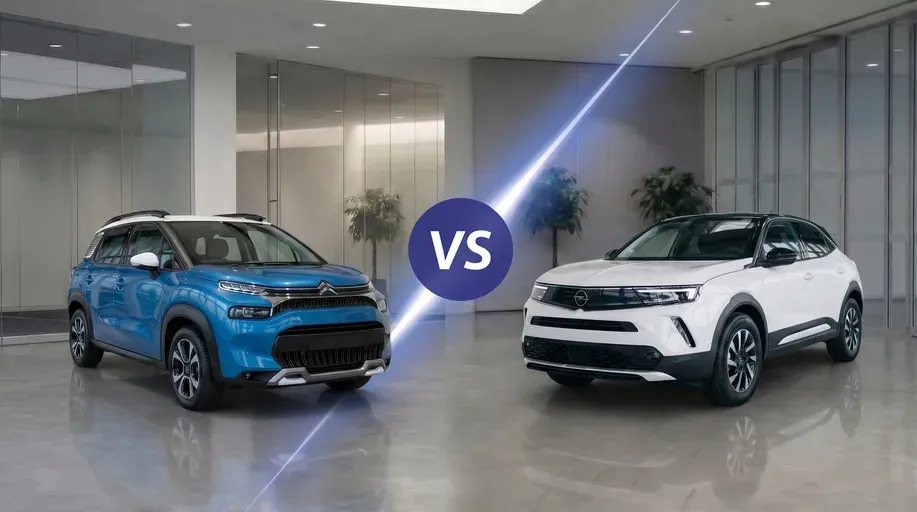
Citroën C3 Aircross vs Opel Mokka: A major comparison of popular SUVs. Discover the differences in spaciousness, engines, and equipment, and find out our final verdict.
Apr 16, 2026
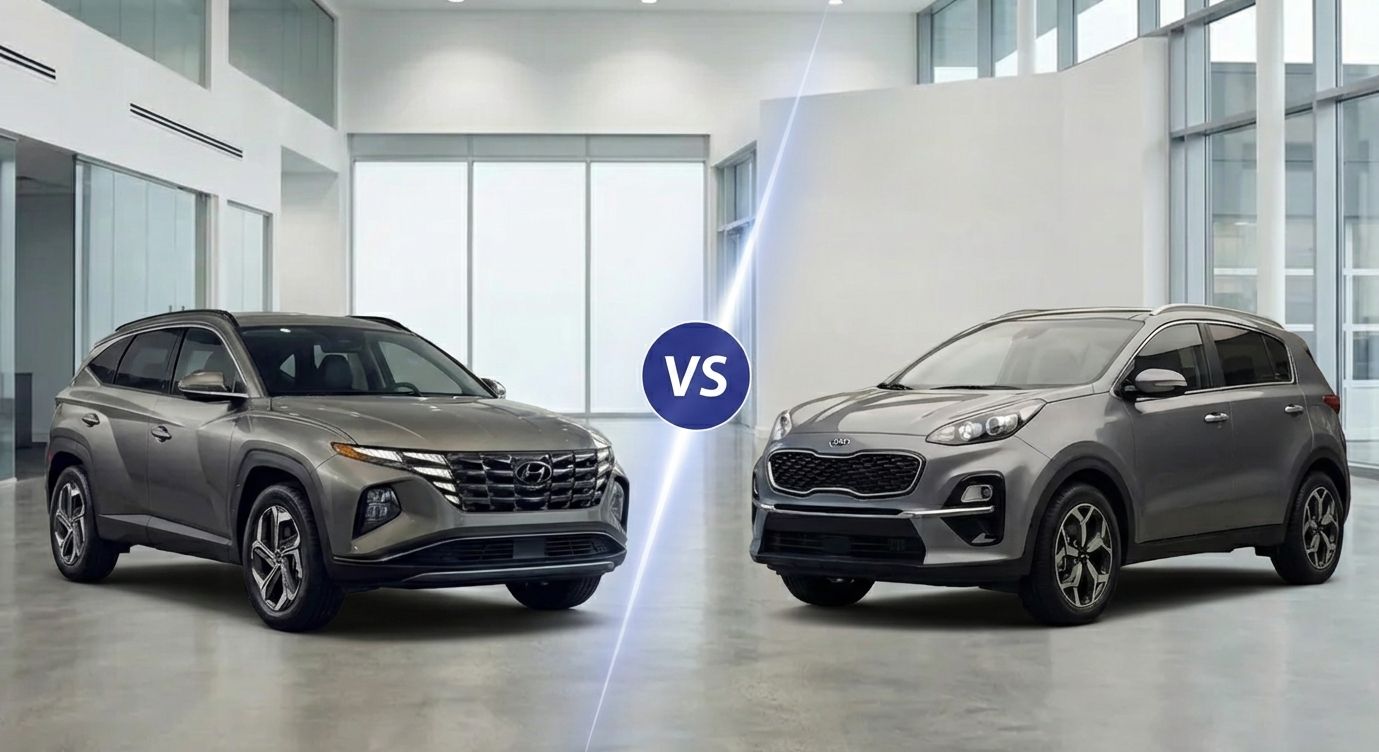
Hyundai Tucson vs. Kia Sportage: A detailed comparison of design, engines, and practicality to help you choose. Read our final verdict.
Oct 23, 2026