Car battle
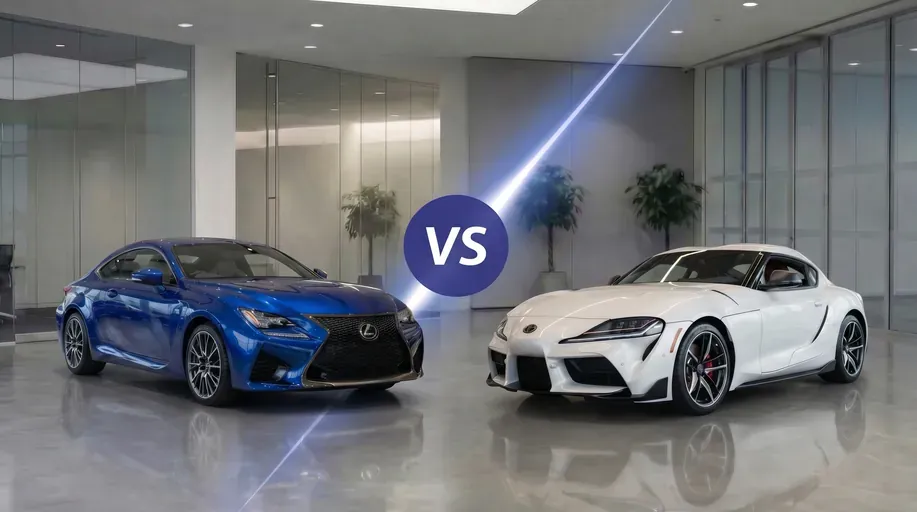
Lexus RC F vs. Toyota Supra: Complete comparison 2026
The Great Coupe Comparison: Lexus RC F vs Toyota GR Supra. A detailed look at performance, equipment, and real-world driving characteristics. Read our final verdict!
Oct 16, 2026
Articles
Car battle
Detailed comparison of Ferrari F8 Tributo vs Maserati MC20. Performance, driving impressions, and a clear verdict that will help you choose the best Italian supercar.
April 24, 2026
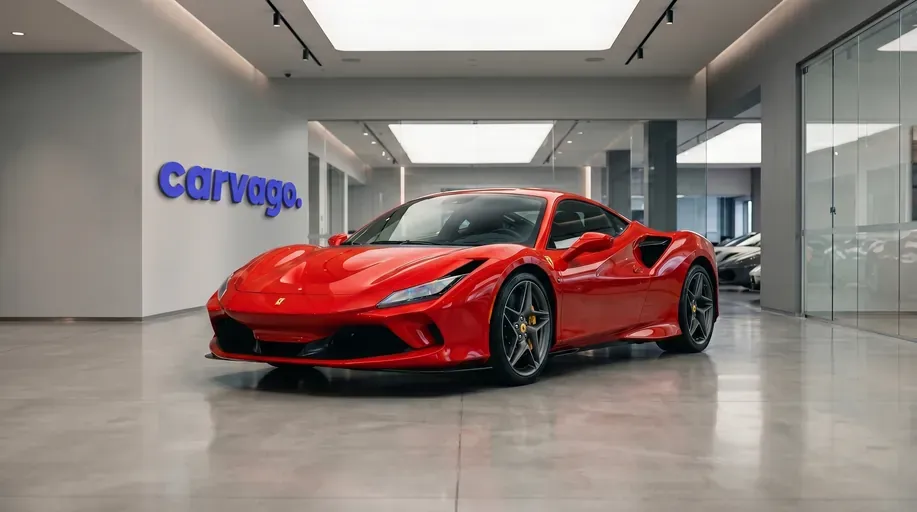
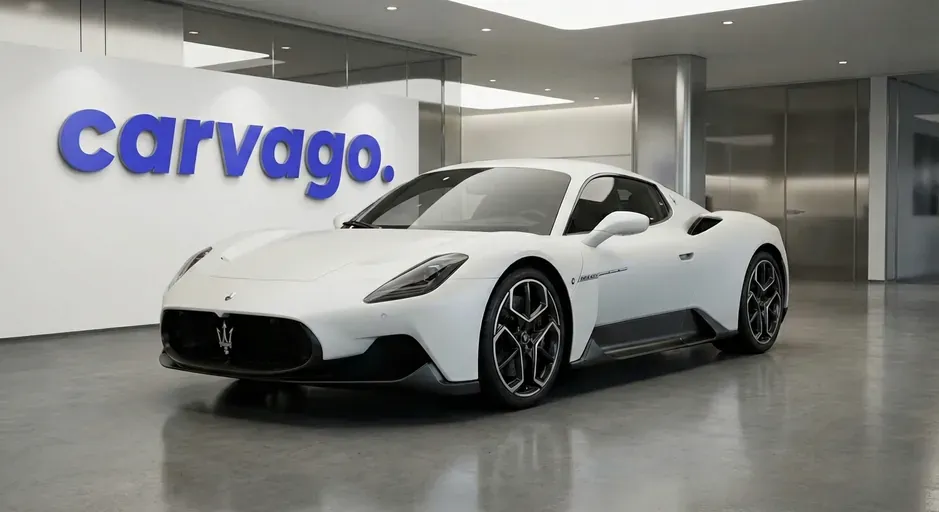
Ferrari F8 Tributo is a stunning Italian supercar that pays tribute with its name to the legendary V8 engines from Maranello and represents the absolute pinnacle of the evolution started by the 488 GTB model. Standing against it is the no less fascinating Maserati MC20 (also known by the internal designation M240 or, following a recent update, as MCPura), which marked a triumphant return to the field of uncompromising mid-engine cars for the brand with the trident emblem. Let's take a detailed look at how these two exceptional representatives of purebred Italian passion fare in a head-to-head battle and which one represents a more attractive choice on the used car market.
Although the Ferrari F8 Tributo and Maserati MC20 represent the absolute pinnacle of Italian engineering, their exterior dimensions and proportions reveal a different approach to design and driving dynamics. A detailed look at the longitudinal parameters reveals that the Maserati MC20 is 58 mm longer than the Ferrari F8 Tributo (4669 mm compared to 4611 mm) and also features a 50 mm longer wheelbase (2700 mm vs. 2650 mm). In practice, the longer wheelbase of the Maserati favors slightly calmer and more stable behavior at high highway speeds. Conversely, the shorter and more compact build of the Ferrari brings maximum agility and a lightning-fast willingness to change direction on twisty backroads. Furthermore, the shorter dimensions of the Ferrari represent a slight advantage when parking or maneuvering in tight spaces, where every centimeter counts.
Regarding width, the Ferrari F8 Tributo slightly dominates with a value of 1979 mm, which is 14 mm more than the Maserati MC20 (1965 mm). The greater width gives the Ferrari an even more aggressive, low-slung stance, and the wider track traditionally contributes to better mechanical grip and stability in tight corners. On the other hand, this characteristic can mean more stress when driving through narrow city streets or parking in standardized garage spaces. For drivers who also use their supercar for occasional city driving, the slightly narrower profile of the Maserati MC20 may be a more practical benefit.
In terms of body height, the Maserati, at 1224 mm, is 18 mm taller than the Ferrari (1206 mm). These values apply equally to both the closed Coupé variants and the open versions (Ferrari F8 Spider and Maserati MC20 Cielo). Although 18 millimeters may seem like a negligible difference, in the supercar category, even such a deviation affects the overall center of gravity. The lower build of the Ferrari promises a subjectively tighter connection with the road and sharper reactions, while the slightly taller silhouette of the Maserati makes getting in over the wide sills easier and can offer slightly more headroom, which you will appreciate especially on longer trips.
| Parameter | Ferrari F8 Tributo Coupé | Maserati MC20 Coupé | Ferrari F8 Spider Cabriolet | Maserati MC20 Cielo Cabriolet |
|---|---|---|---|---|
| Length (mm) | 4611 | 4669 | 4611 | 4669 |
| Width (mm) | 1979 | 1965 | 1979 | 1965 |
| Height (mm) | 1206 | 1224 | 1206 | 1224 |
| Wheelbase (mm) | 2650 | 2700 | 2650 | 2700 |
Even though mid-engine supercars aren't expected to offer everyday family utility, the size of the luggage compartment plays a key role during weekend getaways or longer trips in the spirit of grand touring cars. Differences in practicality on the market for used cars around four years old can often determine whether you pack only the essentials for your dream trip or enjoy the luxury of greater flexibility. The ability to easily transport personal belongings for several days adds an important layer of everyday usability to these high-performance Italian exotics, which is missing in many purist competitors.
When comparing specific figures, the Ferrari F8 Tributo offers a relatively generous 200 liters of cargo space for its class, all concentrated in the front of the car (the so-called frunk). In contrast, the Maserati MC20 divides its volume into two separate compartments with a total capacity of 150 liters – 100 liters can be found in the rear trunk right behind the engine, and the remaining 50 liters under the front hood. This 50-liter deficit in the Maserati means that while the Ferrari's single deep luggage compartment easily accommodates bulkier bags, provides space for several extra suitcases, and is fully sufficient for weekend shopping or a longer holiday for two, the divided space in the Maserati requires much more creativity when packing.
Interestingly, if you are looking for open-top versions, you won't be penalized in terms of space with either brand within the first generation. The Ferrari F8 Spider and Maserati MC20 Cielo models maintain exactly the same volume as their coupe counterparts, despite the presence of the retractable roof mechanism. Since both vehicles have a strictly two-seater layout, it is logically impossible to count on folding down rear backrests to increase transport capacity. The standard luggage volume is therefore the maximum in both cases. Overall, Ferrari emerges as the winner for more practical travel from this comparison, while Maserati will appeal more to drivers with strictly minimalist needs.
| Parameter | Ferrari F8 Tributo Coupé | Maserati MC20 Coupé | Ferrari F8 Spider Cabriolet | Maserati MC20 Cielo Cabriolet |
|---|---|---|---|---|
| Standard volume (liters) | 200 | 150 | 200 | 150 |
| Max. volume with seats folded (liters) | 200 | 150 | 200 | 150 |
If you appreciate the ability to go on longer trips in a roughly four-year-old supercar, the Ferrari F8 with its deeper and unified 200-liter trunk offers significantly better usability than the space-compromised, divided luggage compartment in the Maserati MC20.
When choosing a dream supercar like the Ferrari F8 Tributo or Maserati MC20, towing capacity is usually not a deciding factor. Nevertheless, for assessing overall practicality, it's good to know where you stand. Although these are cars with immense power, neither of these Italian thoroughbreds from the generations available on the nearly-new used car market (2019–2023 models for Ferrari and 2021–2024 for Maserati) is, of course, designed for towing heavy loads.
For both the Ferrari F8 Tributo (including the open-top Ferrari F8 Spider) and the Maserati MC20, the standard and maximum weight for both braked and unbraked trailers is exactly 0 kg. The manufacturers do not offer tow bar homologation for these models at all, and you won't find any exceptions with different capacities, as is sometimes the case with specific hybrid variants of regular passenger cars. So, if you were secretly hoping that by attaching a designer trailer you would gain extra space for a few more suitcases, sufficient for a weekend shop or a longer holiday, you have to forget that idea for both models. You will have to make do exclusively with their very limited luggage compartments.
In conclusion, the absence of towing capability is entirely expected in this class of vehicle, and in terms of utility, there is no difference between them in this regard. The choice of car will therefore not be defined by the ability to carry oversized loads, but rather by personal preference between the 530 kW twin-turbocharged V8 in the Ferrari and the innovative 463 kW Nettuno V6 in the Maserati. Since no data on permitted trailer weight is available for these models (towing is neither legally nor technically possible), no values have been added to the table below, and it is left empty exactly according to the specifications of both manufacturers.
| Model and engine | Braked trailer (kg) | Unbraked trailer (kg) |
|---|
When comparing the engines of these two Italian thoroughbreds, we encounter a fascinating battle of concepts. On one side stands the Ferrari F8 Tributo with its proven 3.9-liter twin-turbocharged V8, which is considered by many experts to be one of the best modern engines from Maranello, while the Maserati MC20 enters the ring with an innovative 3.0-liter V6 dubbed Nettuno. Although Maserati's petrol engine has two fewer cylinders, it compensates with advanced pre-chamber combustion technology derived directly from Formula 1. For buyers in the market for roughly four-year-old used cars, this means a choice between the pure, explosive power of the Ferrari with a breathtaking 530 kW (720 hp) and the technological exclusivity of the Maserati, which with its 463 kW (630 hp) offers a different but no less intoxicating experience. While Ferrari targets drivers seeking absolute performance, maximum emotion, and exceptionally sharp throttle response, Maserati scores with drivers who appreciate a combination of purebred racing genes and a slightly more compliant character, making it a car surprisingly suitable even for longer weekend trips.
Under the hood, mounted mid-ship behind the seats of the Ferrari F8 Tributo (just like in its open-top version, the F8 Spider), we find the only available engine that powered the production of this model during the available years of 2019 to 2023. Since production of the F8 series officially ended in 2023, this phenomenal engine is now an exclusive affair of the used car market. It is a technical masterpiece – a 3.9-liter twin-turbo V8 (internally designated F154), which the car technically borrowed from the track-focused 488 Pista. The petrol-burning engine generates a staggering 530 kW (720 hp) at 7,000 rpm and 770 Nm of torque available from as low as 3,250 rpm. All power is sent exclusively to the rear wheels via a seven-speed dual-clutch automatic transmission with lightning-fast F1 shifting. You won't find any mild-hybrid or plug-in hybrid systems here; the F8 Tributo is the pure embodiment of a classic high-revving internal combustion V8 in its purest form.
| Engine type | Fuel | Power (kW) | Torque (Nm) | Transmission |
|---|---|---|---|---|
| 3.9 V8 Twin-Turbo | Petrol | 530 | 770 | 7-speed dual-clutch automatic |
The Maserati MC20, whose most relevant production series for the four-year-old used car market dates from 2021 to 2024, boasts a brand-new engine called Nettuno. This 3.0-liter twin-turbocharged V6 was developed directly in Modena, and its greatest strength is a unique twin-spark ignition system with a passive pre-chamber. This technology ensures exceptionally efficient combustion and rapid power delivery. The unit produces an impressive 463 kW (630 hp) and 730 Nm of torque, which is unerringly delivered to the rear axle by an eight-speed Tremec dual-clutch transmission. Like Ferrari, Maserati in the first generation of this model relies exclusively on this top-tier engine, which is the standard and only available internal combustion choice across both body styles – both for the purist Coupé and the retractable hardtop version, the MC20 Cielo.
| Engine type | Fuel | Power (kW) | Torque (Nm) | Transmission |
|---|---|---|---|---|
| 3.0 V6 Twin-Turbo (Nettuno) | Petrol | 463 | 730 | 8-speed dual-clutch automatic |
While the Ferrari F8 Tributo charms with the brutal power and heritage of its purebred V8 from Maranello, the Maserati MC20 counters with innovative F1 technology in its advanced V6, combining uncompromising dynamics with smooth everyday usability.
Choosing the right engine is key to long-term satisfaction, and our recommendations are based on real-world experience with performance, mechanical reliability, and overall user-friendliness. In the case of these two thoroughbred supercars, it is a very specific and all the more interesting comparison, as both models offer only a single flagship power unit, but each represents a completely different technological approach. An interesting fact is that while Ferrari brought its legendary 3.9-litre V8 (a multi-time "Engine of the Year" award winner) to absolute perfection in the F8 Tributo, Maserati developed a completely new, in-house 3.0-litre V6 for the MC20 called "Nettuno", which utilizes unique pre-chamber combustion technology derived directly from Formula 1. Given that production of the Ferrari F8 Tributo was completely phased out between 2019 and 2023 and it can no longer be ordered as a new car, it is becoming an extremely exclusive collector's item on the four-year-old used car market, while the Maserati MC20 from 2021 to 2024 offers a look at the current technological pinnacle of the Trident brand.
Since this twin-turbocharged V8 (codenamed F154 CG) is the only choice for this model, it naturally represents the best solution, perfectly balancing track-focused uncompromising nature with surprising everyday usability. Its greatest technical advantage is the complete elimination of turbo lag and a cleverly electronically controlled torque curve (up to 770 Nm), which delivers maximum power gradually depending on the currently engaged gear, faithfully simulating the linear pull of classic naturally aspirated engines. The basic engine design is time-tested and excels in robustness, but for cars from the discontinued 2019–2023 production run, it requires an absolutely meticulous approach to service. The greatest risk for examples used primarily in city traffic is the gradual clogging of the gasoline particulate filter (GPF), which these cars must have due to emission standards. During inspection, request a complete diagnostic report of the exhaust system; a clogged GPF (which restricts the engine's breathing) can manifest during a test drive as a noticeable loss of peak power at high RPMs or directly via warning lights on the display. This engine will be appreciated primarily by experienced drivers looking for a dramatic sound, immediate throttle response, and a willingness to regularly and thoroughly warm up the car during dynamic drives.
In the MC20, especially if we focus on cars from the early production years between 2021 and 2024 suitable for the current used market, the technologically fascinating Nettuno V6 is found exclusively under the hood, which in itself justifies the purchase of this car. Its main advantages include an incredible power ratio of 210 hp per liter of displacement and immense efficiency, backed by the patented MTC (Maserati Twin Combustion) system with spark plugs located in a small pre-chamber. In practice, this means a very aggressive, explosive onset of power. However, due to the high complexity of this revolutionary unit, there is a higher risk with neglected maintenance – the engine is extremely sensitive to precise adherence to premium oil change intervals and cannot tolerate low-quality fuel with a lower octane rating. During a test drive of a used unit, focus on the smoothness of the pull when transitioning from low to mid-range RPMs; any jerking, idling fluctuations, or reluctance to accelerate often indicates the need for immediate replacement of specific spark plugs or neglected software updates for the control unit from the first years of production. The Nettuno unit is an ideal companion for technology enthusiasts and fans of surgical precision who are looking for a lightweight, extremely agile sports car with a mechanically raw sound rather than the classic rumble of a large-displacement V8.
When purchasing approximately four-year-old exclusive supercars such as the Ferrari F8 Tributo and Maserati MC20, fuel consumption is rarely the primary deciding factor. Nevertheless, it is interesting to observe the discrepancy between laboratory results and real-world practice. Official figures from manufacturers for machines of this performance level often appear quite optimistic, while actual consumption during dynamic driving or in city traffic logically skyrockets. The values listed below are based on official data for the individual engine versions found on the used car market and also reflect estimates from well-known community platforms like Spritmonitor.de, where owners share their long-term real-world experiences.
| Model and Engine | Average Consumption (l/100 km) |
|---|---|
| Maserati MC20 3.0 V6 Nettuno | 11.5 |
| Maserati MC20 Cielo 3.0 V6 Nettuno | 11.7 |
| Ferrari F8 Tributo 3.9 V8 Twin-Turbo | 12.8 |
| Ferrari F8 Spider 3.9 V8 Twin-Turbo | 12.8 |
A detailed look at the engines clearly reveals the differing generational approaches of the two Italian brands. While the Ferrari F8 Tributo and its open-top Spider version rely on a more traditional and larger-displacement 3.9-liter V8 with an average consumption of around 12.8 l/100 km, the Maserati MC20 utilizes a highly innovative 3.0-liter V6 Nettuno engine with pre-chamber combustion. On paper, this smaller unit appears to be the more economical choice, showing a combined consumption of 11.5 l/100 km (or 11.7 l/100 km for the slightly heavier Cielo variant). However, practice and user data point to an interesting trend: similar "downsizing" in sports engines does not actually deliver the fuel savings that the spec sheets might promise. If you push both cars to a more spirited pace, the advantage of the smaller turbocharged engine quickly evaporates, and the real-world consumption of both supercars commonly reaches the 15 to 18-liter mark.
For a typical buyer of these vehicles on the nearly-new used car market, clear conclusions can be drawn from this data. For calmer highway journeys, the Maserati can offer a slightly longer range thanks to its modern V6, which will please drivers looking for a usable compromise for weekend trips. Conversely, with the eight-cylinder Ferrari, one must expect slightly more frequent stops at filling stations, especially when the car spends more time in stop-and-go city traffic. Overall, however, it can be said with certainty that fuel consumption for used cars with a similar purchase price is definitely not a point that would sway a buying decision – potential buyers will primarily be interested in the breathtaking dynamics, unmistakable sound, and the overall experience behind the wheel.
When focusing on roughly four-year-old models (production years 2021 to 2022), the situation on the used car market clearly shows completely different price developments and a different approach by both brands to maintaining value.
Ferrari F8 Tributo
As one of the last Ferrari models with a purely internal combustion mid-mounted V8 (without a modern hybrid powertrain), its value decreases very reluctantly. The market perceives this model almost as a modern collector's piece. For roughly four-year-old used cars, prices on the European market range in quite high amounts, which heavily depend on optional equipment (especially exterior and interior carbon fiber packages) and mileage.
Maserati MC20
The Maserati MC20 represented a grand return to the world of supercars for the Italian automaker, bringing a fantastic carbon fiber monocoque and the innovative Nettuno engine. However, like most luxury and sports cars from this brand, the MC20 is subject to a more noticeable drop in value in its first years of operation. This, however, makes it an exceptionally attractive purchase on the used car market for savvy buyers.
| Model (Years 2021–2022) | Approx. Price From | Approx. Price To | Value Retention |
|---|---|---|---|
| Ferrari F8 Tributo | €267,000 | €361,000 | ⭐⭐⭐⭐⭐ |
| Maserati MC20 | €177,000 | €238,000 | ⭐⭐⭐ |
Note: Prices may vary slightly in real-time depending on the specific vehicle history, custom specification (e.g., paint from a special division), and current exchange rates.
While the Ferrari F8 Tributo acts as an excellent store of value with minimal price depreciation, the Maserati MC20 represents a fantastic financial buy on the four-year-old used car market, where the steepest price drop has already been absorbed by the first owner.
When evaluating the safety of modern cars in this category, we usually start by stating that the tested representatives take home top five-star ratings. However, with Euro NCAP results, it is always necessary to emphasize the context and the specific year of the test. The methodology is constantly evolving, becoming stricter and placing more emphasis on active safety, simulations of complex frontal impacts, or detection of cyclists at blind intersections, so percentage gains from different years cannot be directly compared. But if you were looking for exact test data for the Ferrari F8 Tributo or Maserati MC20, you're in for a surprise. Due to very low production volumes and huge purchase prices, neither of these Italian supercars has undergone official Euro NCAP certification. All comparisons are thus based on the structural solutions used and the actual availability of active safety features.
Ferrari F8 Tributo is built on an exceptionally tuned aluminum space frame, which is a direct and very sophisticated evolution of the architecture from the earlier 458 and 488 models. Although laboratory data is missing, it is clear from the long history of this platform and findings from real-world accidents that the structure itself provides the crew with an excellent level of mechanical protection. From the perspective of current testing methodologies, however, Ferrari would struggle in the category of advanced assistance systems. Features such as Autonomous Emergency Braking (AEB), adaptive cruise control with front radar, or a 360-degree camera system do appear in the specifications, but for the first owner, they were only available for astronomical surcharges. The fact that these systems were not standard would, according to current rules, lead to a significant point deduction.
Maserati MC20 approaches occupant protection with a newer and even more sophisticated technological arsenal. The fundamental difference is the use of a custom carbon fiber monocoque, developed for the brand with the trident emblem by the renowned engineering firm Dallara. This shell brings a purely racing level of structural rigidity while maintaining minimum weight. Although the MC20 also lacks Euro NCAP stars, its range of Advanced Driver Assistance Systems (ADAS) is noticeably wider and more modern. The car's optional equipment was continuously enriched and includes autonomous braking with precise pedestrian and cyclist detection, blind spot monitoring, traffic sign recognition, or useful Rear Cross-Traffic Alert.
In conclusion, although both of these cars rely more on perfect brakes and top-tier chassis responses to primarily prevent a potential accident, the Maserati MC20 offers a more modern and comprehensive safety shield. Its carbon monocoque is, from a structural point of view, a generation newer solution than Ferrari's aluminum base, and the wider implementation of modern assistance systems shows noticeably better compliance with today's strict safety standards.
| Parameter | Ferrari F8 Tributo | Maserati MC20 |
|---|---|---|
| Year of testing | Not tested | Not tested |
| Adult occupant protection | - | - |
| Child occupant protection | - | - |
| Vulnerable road user protection | - | - |
| Safety assistance systems | - | - |
Although exact Euro NCAP test data does not exist for either of the supercars, the Maserati MC20 offers a slightly more advanced safety concept for everyday driving thanks to its top-tier carbon monocoque from Dallara and a more modern range of assistance systems.
Beyond the standard equipment, each of these models offers much more, with both approaching added value, technological innovation, and the overall driving experience in their own, entirely distinct way.
Legendary 3.9 V8 twin-turbo engine with 720 hp and near-instant response
Incredibly precise steering and aerodynamic downforce ensuring top-tier driving dynamics
Surprising comfort even on poorer roads thanks to the adaptive suspension and "Bumpy Road" mode
Lightning-fast seven-speed dual-clutch transmission
Extremely high residual value and lasting collector appeal
The exhaust sound is less emotive than its naturally-aspirated predecessors due to particulate filters (OPF) and turbochargers
Outdated and less intuitive infotainment system
Astronomical purchase costs and post-warranty service prices
The Ferrari F8 Tributo is the perfect choice for enthusiastic drivers and lovers of the traditional Italian school who demand absolute driving perfection and uncompromising performance at the limit. It is particularly suitable for those buyers who also see the car as a stable investment and fully appreciate the unrivaled aura of the prancing horse.
Lightweight carbon fiber monocoque ensuring extreme structural rigidity and agility
Innovative 3.0 V6 Nettuno engine (630 hp) utilizing Formula 1 pre-chamber combustion technology
Fascinating exotic design with spectacular butterfly doors
Brilliant suspension comfort, making the car suitable even for more frequent use
Fresh look and a high degree of exclusivity compared to established competitors
The V6's sound profile feels somewhat flat and lacks the drama of large-displacement engines
Sharing some interior elements and controls with common Stellantis group models detracts from the premium feel
Very cramped total luggage space (only 150 liters in total), complicating longer trips
Risk of a steeper decline in value on the used market compared to Ferrari models
The Maserati MC20 will primarily appeal to individualists looking for a fresh supercar with stunning clean design and innovative technologies. It is the ideal car for drivers desiring a combination of surprising touring comfort with the genuine experience of a lightweight carbon-fiber machine that is guaranteed to stand out from the crowd.
Based on long-term owner experience, service reports, recorded recalls, and data typically revealed by an independent technical inspection of the car, we have compiled an overview of the most common problems that buyers of used examples of both models should watch out for.
Although the Ferrari F8 Tributo (focused especially on cars produced between 2019–2023) is considered one of the more reliable supercars from Maranello, it is still an uncompromising exotic car prone to specific ailments that require an expensive approach.
Although the F8 Tributo does not suffer from fatal engine design flaws, the risk of losing braking effect due to an incorrect cap and high sensitivity to the battery's condition require a prospective used car buyer to thoroughly check the documentation for completed recalls.
The Maserati MC20 (model years 2020 and newer), as the bearer of a brand-new engineering approach with the Nettuno engine, faces the usual "teething troubles" of completely new vehicles and platforms on the market.
The brand-new carbon supercar pays for the ailments of early production years – from rapid wear of interior elements to uncertain differential behavior at low speeds, which only underlines the necessity of a careful inspection of each unit before purchase.
When buying a used car, especially in the category of exotic supercars with immense power, a thorough inspection is absolutely crucial, as even the smallest overlooked defect can result in astronomical repair costs. An ideal solution in this regard is a thorough independent technical inspection of the car. Here are some specific points to focus on for these two particular models.
Both cars accelerate from 0 to 100 km/h in an identical 2.9 seconds, so the initial dynamics are perfectly balanced from the driver's perspective. However, thanks to its higher power output, the Ferrari has a slight advantage at higher speeds and reaches a top speed of 340 km/h, while the Maserati tops out at 325 km/h. In normal road and highway traffic, however, these real-world dynamic differences are practically imperceptible.
The Ferrari F8 Tributo relies on the legendary twin-turbocharged 3.9-liter V8 with 720 hp, which is the absolute pinnacle of development and offers an exceptionally emotive sound. The Maserati MC20, on the other hand, uses a unique 3.0-liter Nettuno V6 with 630 hp, featuring pre-chamber combustion technology derived directly from Formula 1. The V8 from Maranello has a more explosive character and sharper response, while the Maserati engine bets on fascinating smoothness and cutting-edge technological innovation.
The Maserati MC20 is surprisingly refined and, thanks to its specific damper tuning, can filter out even significant road imperfections very effectively. The Ferrari always feels like a sharp supercar with more noise from the wheels and engine, although its adaptive suspension in Bumpy Road mode also provides decent comfort. For longer travel and daily commutes without unnecessary fatigue, the Maserati is overall more suitable and quieter.
The Maserati MC20 is built on a modern carbon fiber monocoque developed in collaboration with Dallara, which ensures extreme rigidity and allows for the use of butterfly doors. The Ferrari F8 Tributo, on the other hand, uses a more traditional aluminum space frame, which has, however, been refined through years of development to absolute driving and engineering perfection. The carbon tub gives the Maserati a touch of racing exclusivity, yet the final curb weight of both cars is at a very similar level below 1,500 kg.
In terms of practicality and luggage space, the Ferrari is the clear winner, hiding a deep and well-usable 200-liter space under the front hood. The Maserati offers only 47 liters under the front hood and another 101 liters in a shallow compartment behind the engine, which is more suitable for soft bags. Furthermore, the rear luggage compartment in the Maserati can get quite hot, so for weekend trips for two, the Ferrari is a much more usable choice.
Sources: ADAC, auto.cz, mdcr.cz, motorvize.cz, emobility.cz, autobox.cz
This article was prepared using artificial intelligence tools. The section guarantor is Petr Dušek.
The Great Coupe Comparison: Lexus RC F vs Toyota GR Supra. A detailed look at performance, equipment, and real-world driving characteristics. Read our final verdict!
Oct 16, 2026
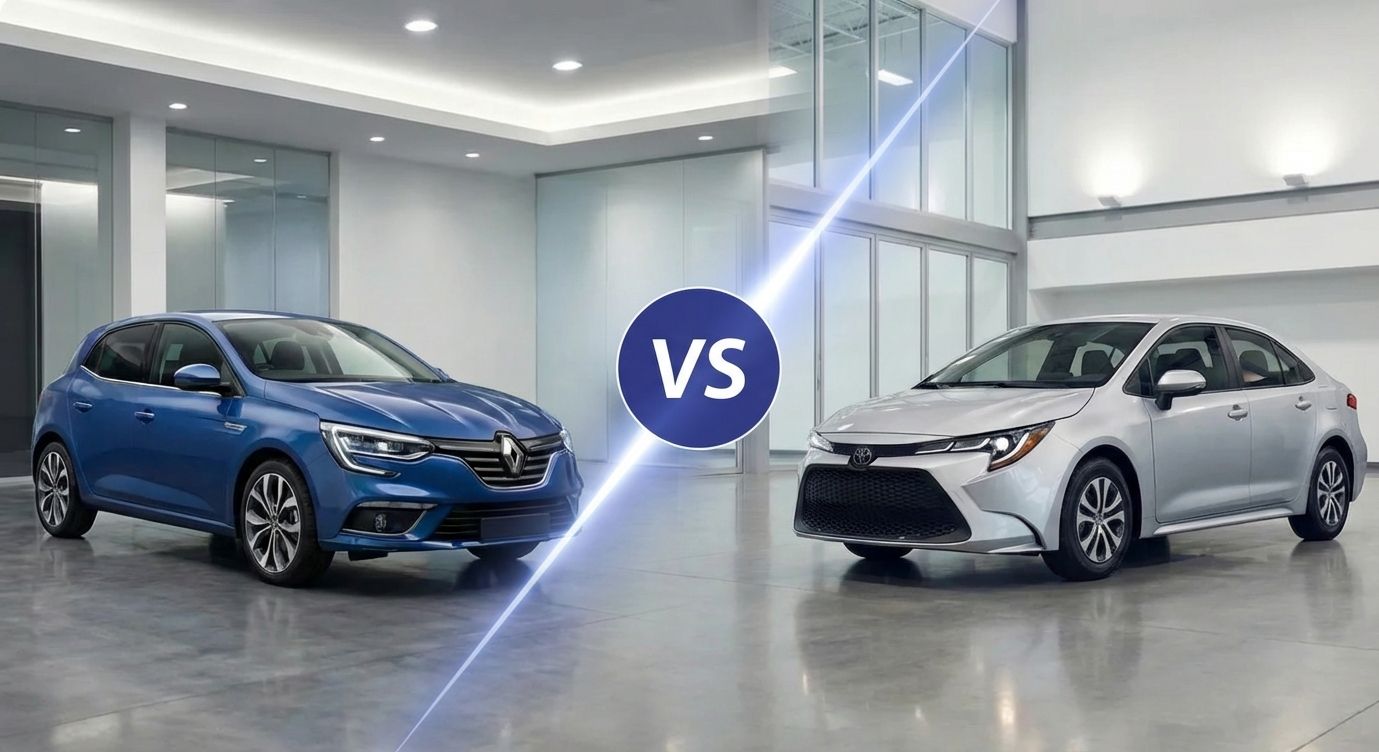
Detailed comparison: Renault Mégane vs Toyota Corolla. Discover the differences in engines, equipment, and reliability, and find out which used car is the best for you.
Oct 16, 2026
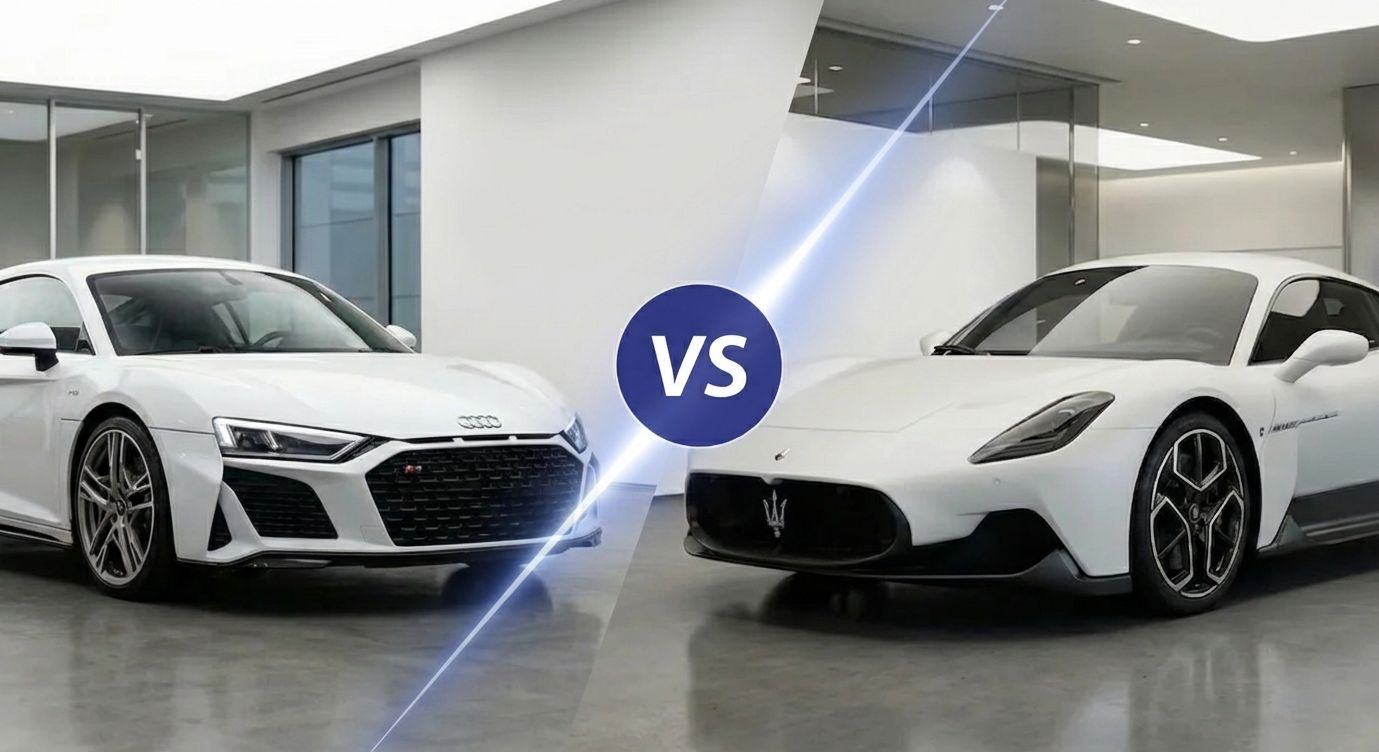
Audi R8 or Maserati MC20? Comparing performance, design, and handling. Our detailed test helps you choose the perfect supercar.
Oct 23, 2026