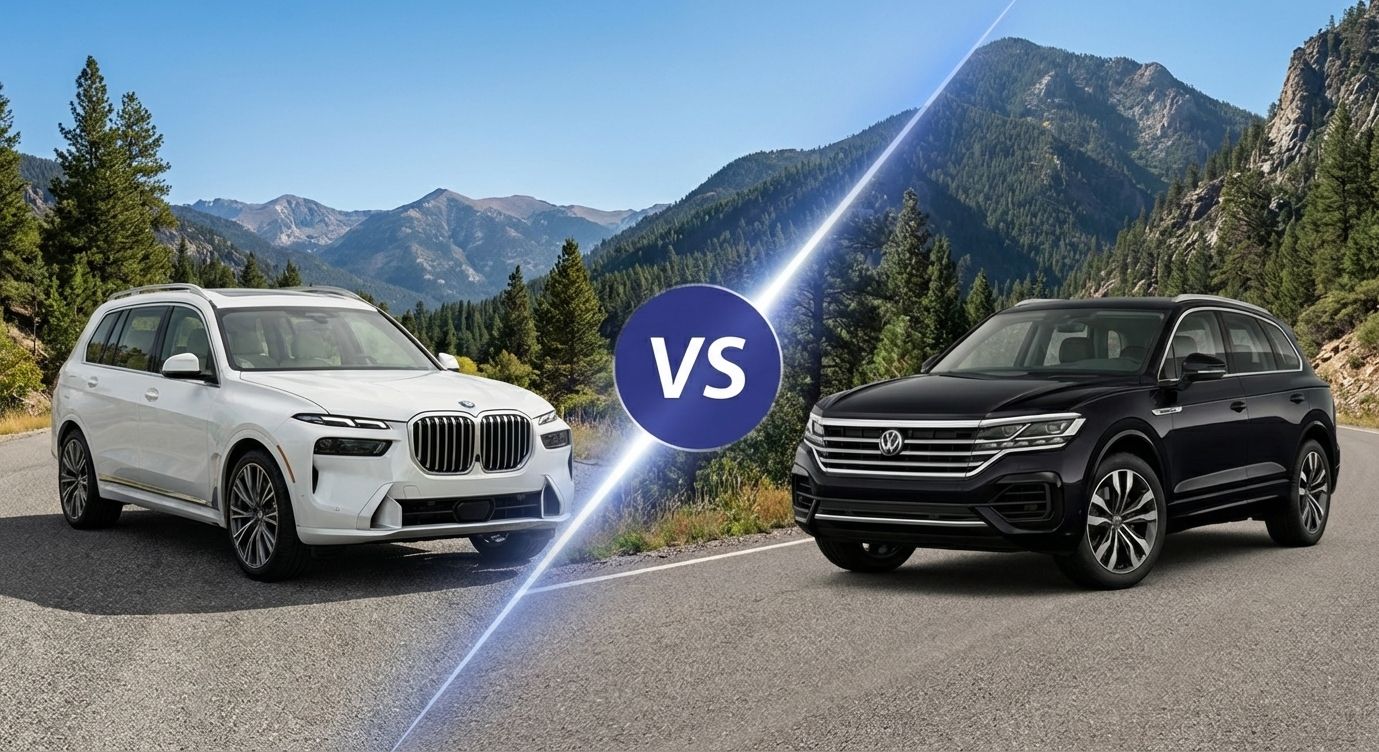
Car battle
BMW X7 vs. Volkswagen Touareg: Complete comparison 2026
BMW X7 vs. Volkswagen Touareg. Our detailed comparison of design, performance, and practicality will help you choose the right luxury SUV.
Apr 14, 2026
Articles
Car battle
Detailed comparison of the BMW X5 vs. BMW X7. Discover the main differences in space, equipment, and real-world driving characteristics. Read our verdict and make the right choice!
April 14, 2026
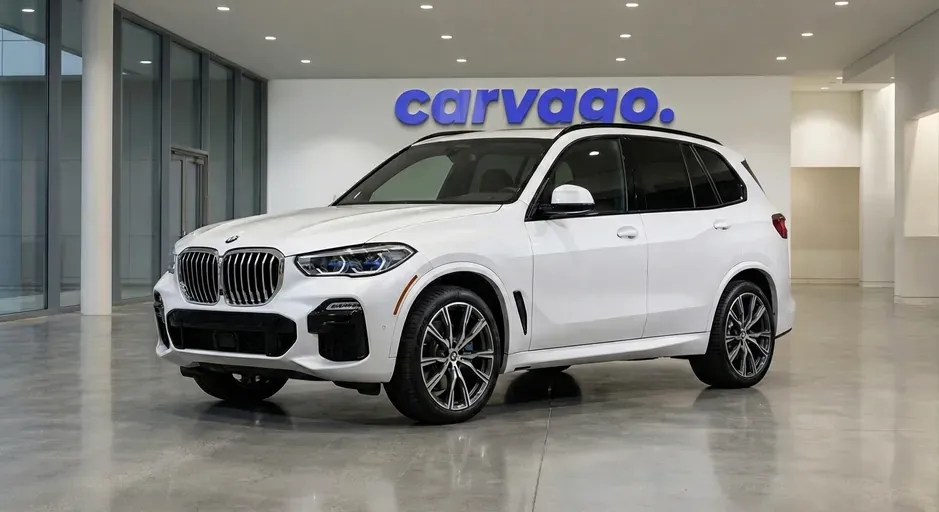
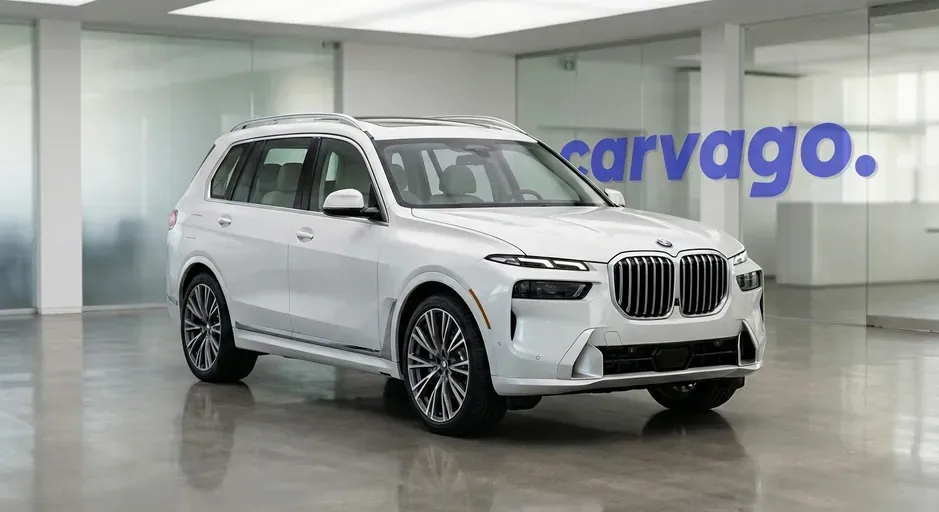
The BMW X5 is a legendary premium SUV that masterfully combines dynamic driving characteristics with everyday practicality and proven luxury. Standing against it is the majestic BMW X7, which represents the absolute pinnacle of the Bavarian brand's lineup, enticing with its vast interior space, standard three rows of seats, and uncompromising opulence. In this detailed comparison, let's look at which of these family giants better suits your lifestyle and becomes the ideal choice for your garage.
Looking at the exterior dimensions, it is immediately clear who holds the role of the majestic flagship and who fulfills the role of the sportier premium SUV. While the BMW X5 (in the highly sought-after G05 generation on the used car market) represents the perfect middle ground in the large luxury SUV class, the BMW X7 (G07 generation) plays in the league of full-size family cruisers. The fundamental difference lies in the overall length – at over 5.1 meters, the X7 is a significant 229 to 259 millimeters longer than its smaller sibling.
However, a look at the width of both cars is interesting. Although the BMW X7 appears monumental and indomitable from the outside, the BMW X5 is actually a negligible 4 millimeters wider at 2004 mm. This fact, combined with a noticeably lower body structure (the X5 is 60 to 90 mm lower), gives the shorter model a much more planted and dynamic stance. Conversely, the major advantage of the larger BMW X7 is its 130-millimeter longer wheelbase. It is this generous space between the wheels that allows for the comfortable installation of a third row of seats, where, unlike the rather occasional-use solution in the X5, even adult passengers will find enough room.
In real life, these extra millimeters mean a completely different user experience. With a length safely under five meters, the BMW X5 still fits relatively easily into most parking spaces at shopping centers and does not suffer in narrow streets. The BMW X7, on the other hand, occasionally hits the physical limits of common European infrastructure and typical underground garages due to its mammoth dimensions. The choice thus clearly defines your daily territory: if you spend a lot of time in the city, you will appreciate the relative agility of the X5. But if you regularly devour highway miles with a large crew and need maximum space, the massive dimensions of the X7 easily translate into unrivaled travel comfort.
| Parameter | BMW X5 SUV | BMW X7 SUV |
|---|---|---|
| Width (mm) | 2004 | 2000 |
| Length (mm) | 4922 | 5151 - 5181 |
| Height (mm) | 1745 | 1805 - 1835 |
| Wheelbase (mm) | 2975 | 3105 |
The luggage compartment area is one of the main factors that can decide the choice between the BMW X5 and BMW X7 models. Both of these premium SUVs offer top-tier luxury and comfort, but their approach to interior space differs. While the BMW X5 represents an ideal family car with a balanced ratio between exterior dimensions and interior spaciousness, the more massive BMW X7 functions as a full-fledged family cruiser. For those interested in approximately four-year-old used cars (G05 generation for the X5 and G07 for the X7, both from around 2018–2023), this means they must carefully consider how often they plan to use the full seating capacity and how much luggage they typically need to carry.
In terms of specific numbers, the difference between the two models is quite noticeable. The BMW X5 offers an excellent 650 liters of volume in its standard configuration, which can be increased to 1870 liters by folding the rear seats. However, it is necessary to mention that in the popular plug-in hybrid version (such as the xDrive45e), the base capacity is reduced to 500 liters due to battery placement, with the maximum volume dropping to 1720 liters. In contrast, the BMW X7 is primarily a seven-seater. When all three rows of seats are occupied, a rather modest 326 liters remain for luggage. But if you electrically fold the third row into the floor and use the vehicle as a five-seater, you get 750 liters – that's a full 100 liters more than in the standard X5. The maximum transport capacity after folding both the second and third rows then reaches a staggering 2120 liters, representing a massive difference of 250 liters in favor of the larger X7 model.
From a practical standpoint, the trunk in the BMW X5 is perfectly sufficient for weekend shopping and longer vacations for a family of four. Furthermore, the two-piece tailgate on both models makes loading heavier items easier, and its lower part can even serve as a practical bench when changing shoes. The BMW X7, however, pushes the limits of spaciousness to another level. In a five-seat configuration, it offers space for several extra suitcases, and with maximum folding, it becomes a luxury van that easily swallows even very bulky cargo. If you are looking for a more agile car for every day with a generous trunk, the X5 will be the right choice. If, however, you regularly need to combine carrying up to seven passengers with at least basic space for bags, or simply require uncompromising capacity, the BMW X7 is the clear winner.
| Parameter | BMW X5 SUV | BMW X7 SUV |
|---|---|---|
| Base volume (l) | 650 | 750 |
| Max. volume with seats folded (l) | 1870 | 2120 |
The ability to tow a heavy trailer is often a key factor for buyers of premium SUVs of this size. Whether you plan to tow a large family caravan, a horse trailer, or a heavy boat, both the BMW X5 and BMW X7 offer top-tier parameters in this regard. Given their massive construction and powerful engines, both vehicles rank among the best towers on the used car market, yet there are important differences between them to watch out for when choosing.
If you opt for the larger BMW X7 (G07 generation), you don't have to make any compromises when choosing an engine. All available engines on the four-year-old used car market, from diesel six-cylinders (xDrive30d, xDrive40d) to the top-of-the-line petrol V8s (M50i), have a standard and maximum permitted braked trailer weight of 3,500 kg. For the BMW X5 (G05 generation), the situation with conventional internal combustion engines is identical, and it can easily handle a trailer of the same maximum weight of 3,500 kg.
However, a difference arises with specific and very popular versions of the X5. If you choose a plug-in hybrid variant, such as the xDrive45e (or the newer xDrive50e), or go for the entry-level four-cylinder diesel xDrive25d, the maximum permitted braked trailer weight drops to 2,700 kg. The X7 model does not offer these compromise engines at all.
From a practical standpoint, the value of 3,500 kg is the legislative maximum for passenger cars in Europe and provides complete freedom for towing the heaviest trailers. While the reduced capacity of 2,700 kg for the hybrid X5 is significantly lower on paper, in practice, it is still a value more than sufficient for safely towing a standard caravan, a medium-sized boat, or for transporting construction materials during weekend projects.
In conclusion, if maximum towing power is your absolute priority regardless of the chosen engine, the BMW X7 represents certainty in every situation. However, the BMW X5 is a fully equal competitor with traditional powertrains and only loses slightly if you prefer the more eco-friendly plug-in hybrid drive.
| Model and engine | Braked trailer weight (kg) | Unbraked trailer weight (kg) |
|---|---|---|
| BMW X5 xDrive30d (G05) | 3500 | 750 |
| BMW X5 xDrive40i (G05) | 3500 | 750 |
| BMW X5 xDrive45e (G05) | 2700 | 750 |
| BMW X5 xDrive25d (G05) | 2700 | 750 |
| BMW X7 xDrive40d (G07) | 3500 | 750 |
| BMW X7 xDrive40i (G07) | 3500 | 750 |
| BMW X7 M50i (G07) | 3500 | 750 |
Both models, the BMW X5 and BMW X7, share the same premium CLAR platform and, in their modern generations (around 4 years old on the used market), use a top-of-the-line eight-speed automatic transmission combined with the intelligent xDrive all-wheel drive. However, the fundamental difference in engines lies in the target group. While the BMW X5 offers a wider range of powertrains, including an economical four-cylinder diesel and highly sought-after plug-in hybrid variants, the majestic BMW X7, as the brand's flagship, completely ignores four-cylinders and plug-in hybrids. Instead, the X7 focuses exclusively on massive and refined six-cylinder and eight-cylinder engines that can easily move the vehicle's higher weight. Furthermore, most engines in both models utilize 48V mild-hybrid technology, which improves throttle response and helps reduce fuel consumption and emissions. The choice between these two models from an engine perspective thus depends on whether you prefer maximum flexibility, efficiency, and the possibility of electric driving with the X5, or uncompromising luxury with large-displacement engines and immense towing power with the X7.
The range of engines for the BMW X5 G05 generation is exceptionally diverse and will satisfy both budget-conscious drivers focused on fuel consumption and lovers of raw power. The base of the range is the two-liter four-cylinder diesel xDrive25d, which is ideal for drivers looking for the lowest possible operating costs. However, the absolute bestsellers on the used market are the reliable diesel six-cylinders xDrive30d and the more powerful xDrive40d. A specialty of the M Performance division was the monstrous quad-turbo diesel engine, the M50d. If you prefer petrol, the excellent six-cylinder xDrive40i is available, along with the absolute pinnacle in the form of the V8 M50i, or the M60i after the 2023 update. Special attention in the used car market is deserved by the popular plug-in hybrids xDrive45e (later improved to xDrive50e). These combine a petrol six-cylinder with an electric motor and a massive battery, making them the ideal choice for drivers with the possibility of home charging and regular suburban commuting.
| Engine type | Fuel | Power (kW) | Torque (Nm) | Transmission |
|---|---|---|---|---|
| xDrive25d | Diesel | 170 | 450 | 8-speed auto |
| xDrive30d | Diesel / Mild-hybrid | 195 / 210 | 620 / 650 | 8-speed auto |
| xDrive40d | Diesel / Mild-hybrid | 250 | 700 | 8-speed auto |
| M50d | Diesel | 294 | 760 | 8-speed auto |
| xDrive40i | Petrol / Mild-hybrid | 250 / 280 | 450 / 540 | 8-speed auto |
| M50i / M60i | Petrol (V8) / Mild-hybrid | 390 | 750 | 8-speed auto |
| xDrive45e | Plug-in hybrid (Petrol + el.) | 290 | 600 | 8-speed auto |
| xDrive50e | Plug-in hybrid (Petrol + el.) | 360 | 700 | 8-speed auto |
From the perspective of model year availability, keep in mind that the top-tier diesel M50d was discontinued at the end of 2020 due to stricter emissions. The plug-in hybrid version xDrive50e and the M60i engine entered the market only with the facelift in 2023.
The powertrains for the luxury BMW X7 fully correspond to the size, premium concept, and significant weight of this family highway cruiser. The base of the range consists exclusively of silky-smooth inline six-cylinders. The diesel starting point was initially the xDrive30d model, which, however, soon handed over the main role on the market to the significantly more powerful xDrive40d version with mild-hybrid assistance. Just like with the smaller X5, for the first two years, it was possible to equip the car with the iconic M50d engine with four turbochargers, whose production ended for good in 2020. For fans of the smell of petrol and absolute silence on board, the six-cylinder xDrive40i is ready. A true performance feast is then provided by the massive turbocharged V8 – this was designated as the M50i until 2022 and subsequently renamed the M60i as part of the facelift, featuring a completely new mild-hybrid system to eliminate turbo lag. No version of the X7 was offered as a plug-in hybrid.
| Engine type | Fuel | Power (kW) | Torque (Nm) | Transmission |
|---|---|---|---|---|
| xDrive30d | Diesel | 195 | 620 | 8-speed automatic |
| xDrive40d | Diesel / Mild-hybrid | 250 / 259 | 700 / 720 | 8-speed automatic |
| M50d | Diesel | 294 | 760 | 8-speed automatic |
| xDrive40i | Petrol / Mild-hybrid | 250 / 280 | 450 / 540 | 8-speed automatic |
| M50i / M60i | Petrol (V8) / Mild-hybrid | 390 | 750 | 8-speed automatic |
Note on availability: As with the X5, the M50d and base xDrive30d variants were only on sale in the early stages of the model (2018–2020) and are giving way to the more confident and updated xDrive40d diesel version among approximately 4-year-old used cars.
Choosing the right power unit is key to long-term satisfaction, reliability, and maintaining reasonable operating costs for premium SUVs. Both Munich SUVs rely on a proven chassis architecture and offer fantastic straight-six engines that absolutely dominate the used car market. While the lighter and more agile X5 (G05 generation) is perfectly fine with the more basic but extremely efficient engine options, the gigantic X7 (G07 generation) requires a bit more torque due to its massive weight and aerodynamic drag to maintain its typical road presence. For four-year-old used cars, we are talking about members of the B57 and B58 engine families, which mechanics consider some of the most reliable units currently offered by the automotive industry.
This three-litre straight-six diesel has long been the most rational and sought-after choice within the G05 generation. It offers an absolutely ideal compromise between dynamics, everyday usability, and operating costs. With the arrival of mild-hybrid technology (from 2020, which exactly matches the 4-year-old used car market), it boasts 210 kW and a massive 650 Nm of torque. The car thus has enough power for safe overtaking, while real-world fuel consumption in combined driving stays at fantastic values around 7.5 to 8.5 litres per 100 km. The mechanical reliability of the B57 block is exemplary; however, as with any modern diesel, one must check the condition of the DPF filter and the functioning of the EGR valve when buying a used car. The risk of rapid soot buildup is primarily present in vehicles that the previous owner used for short city trips. This threat can be easily mitigated by regularly including longer motorway journeys, which allow for thorough filter regeneration. This engine is absolutely perfect for drivers who cover long distances, are looking for a solid family workhorse, but also appreciate the classic Munich emphasis on a more dynamic driving style.
In the case of the monumental X7 model, whose kerb weight easily exceeds 2.4 tonnes and whose aerodynamics resemble a luxury apartment block, a more powerful version of the diesel six-cylinder is practically a necessity. The base 30d model was discontinued from the X7 price list in 2020, and we consider the xDrive40d to be the best engine for this car on the secondary market. Thanks to two-stage turbocharging technology, it generates 250 kW and a massive 700 Nm of torque. This power gives the giant SUV effortless ease and confidence even when fully loaded with family and luggage. In real-world driving, you can expect consumption between 8.5 and 9.5 l/100 km, which is an excellent result for such a huge and luxurious vehicle (petrol V8s typically demand 13 litres or more). However, the system with two turbochargers and an integrated mild-hybrid is more complex in design. The basic rule for the long life of this engine and the prevention of turbocharger bearing damage is to absolutely ignore the factory oil change interval (up to 30,000 km) and shorten it to a proper 15,000 km or 1 year. The xDrive40d is the ideal choice for generous motorway mile-munchers, large families requiring a seven-seat layout, and owners of caravans or heavy trailers.
When choosing a large premium SUV, fuel consumption is a frequently discussed topic, especially because official figures provided by manufacturers can differ significantly from real-world operation. For an objective comparison of both models, we relied on real data from drivers themselves, primarily from the popular community portal Spritmonitor.de, which faithfully reflects everyday use. We focused exclusively on generations and engines typical for approximately four-year-old used cars, i.e., the highly sought-after BMW X5 (G05 generation) and BMW X7 (G07 generation) models from 2020 to 2023.
| Model and engine | Average consumption (l/100 km) |
|---|---|
| BMW X5 xDrive30d (G05) | 6.6 |
| BMW X5 xDrive40d (G05) | 6.9 |
| BMW X7 xDrive40d (G07) | 7.7 |
| BMW X5 xDrive40i (G05) | 8.9 |
| BMW X7 xDrive40i (G07) | 10.1 |
| BMW X5 M50i (G05) | 11.6 |
| BMW X7 M50i (G07) | 12.3 |
| BMW X5 xDrive45e (G05) | 1.2 |
Interesting trends clearly emerge from the collected values. Diesel six-cylinders, which traditionally dominate the European market in the large SUV segment, prove to be extremely efficient. Both the base and more powerful diesels in the BMW X5 can achieve real-world combined consumption well below the 8-litre mark, which is an excellent result for a car weighing over two tonnes. The heavier, taller, and more massive BMW X7 logically requires more energy – the difference compared to the smaller X5 with the same engine (for example, the xDrive40d) is around 0.8 litres of diesel more.
Petrol variants, on the other hand, require a significantly higher fuel supply. Even the base six-cylinder in the X7 easily exceeds the 10-liter mark, and the top-tier V8s designated M50i in both models commonly approach 12 liters. A completely specific category is the plug-in hybrid version, the X5 xDrive45e, with a paper and community-averaged consumption of 1.2 l/100 km. However, this extremely low value can only be achieved in the real world with consistent daily charging and shorter routes; on longer trips with a depleted battery, consumption quickly aligns with classic petrol versions.
For buyers in the used car market, these values represent a clear guide for choosing the appropriate engine:
Overall, it can be said that fuel consumption primarily illustrates the physical differences between the two models – the worse aerodynamics and higher weight of the larger BMW X7 inherently always require roughly 10 to 15% more fuel. In the context of the total costs of acquisition, insurance, and servicing of such luxury used vehicles, consumption should not be the main deciding factor. The key argument for acquiring an X7 instead of an X5 thus remains primarily the need for a full-fledged third row of seats and maximum interior space.
When choosing a premium second-hand SUV, it is crucial to focus on an adequate age and generation that makes the most sense in the used car market. In this comparison, we will focus on models approximately 4 years old, i.e., vehicles with a production year around 2021 to 2022. In this period, for the BMW X5, we are talking about the extremely popular G05 generation (pre-facelift), and for its larger sibling, the BMW X7, the G07 generation (also before modernization). Both cars share the chassis platform and engine range, but their pricing policy and value depreciation differ.
The price difference between the two models in the used car market more or less mirrors the situation that prevailed with new vehicles. As the brand's flagship, the BMW X7 requires a noticeable premium even after several years. On the other hand, the absolute drop in value is more massive for a fully equipped X7, which makes it a very interesting offer from a used car perspective.
| Model (Generation) | Indicative price from (€) | Average price (€) | Price of nearly new and top versions (€) |
|---|---|---|---|
| BMW X5 (G05, 2021-2022) | 45,000 | 61,000 | 81,000+ |
| BMW X7 (G07, 2021-2022) | 57,000 | 77,000 | 102,000+ |
Note: The prices listed are indicative and reflect the current state of the used car market for models approximately 4 years old.
The BMW X5 generation G05 is represented in huge numbers on the used car market. Thanks to this, there is plenty to choose from, and prices are pushed further down.
The supply of BMW X7s on the secondary market is naturally thinner, which helps the vehicle hold its price better. The X7 is bought by customers requiring maximum space and comfort, which is also reflected in the average specification of the used cars offered, which tend to be much more generously equipped than the average X5.
Whether you decide on an X5 or X7, the residual value of a specific unit is fundamentally influenced by these factors:
In terms of value for money, the used G05 generation of the BMW X5 is a very rational choice, offering modern technology and excellent driving characteristics for a reasonable amount. The BMW X7 remains an exclusive item, where the higher purchase price is offset by unsurpassed interior space and an aura of absolute luxury.
In the premium SUV segment, a top-tier five-star safety rating is automatically expected for both vehicles. However, when analyzing the results from independent organizations, it is always necessary to consider the specific context and the year of testing. Euro NCAP's methodology and testing protocols are constantly evolving and becoming significantly stricter over time. Therefore, percentage scores from different years cannot be directly compared. Newer testing methodologies typically include:
BMW X5 underwent Euro NCAP crash tests in 2018 and, according to the standards of the time, comfortably took home the full five stars. The car completely dominated in passive safety with an excellent score of 89% for adult protection and 86% for child protection. Protection of vulnerable road users and assistance systems both achieved a very solid 75%. From the perspective of today's used car market for roughly four-year-old vehicles, it is good to know that the test took place before the introduction of the latest rules. Although the validity of this official certificate formally expired at the beginning of 2025, which is common practice for older vehicle generations, the X5 continues to represent an exceptionally robust vehicle with reliable active assistants.
In the case of the larger BMW X7, you encounter a specific trait of the most expensive and luxurious cars – this model was never officially tested by Euro NCAP. The reason is the high purchase price and significantly lower sales volumes compared to more mass-market models. However, the absence of laboratory data certainly does not mean lower safety. The flagship X7 shares its key chassis architecture, extremely rigid body, and a complete army of advanced safety technologies with the X5 model. You will find identical modern systems here, from autonomous emergency braking with pedestrian detection to a sophisticated lane-keeping assistant, just without an official percentage rating.
| Parameter | BMW X5 | BMW X7 |
|---|---|---|
| Year of testing | 2018 | - |
| Adult occupant protection | 89% | - |
| Child occupant protection | 86% | - |
| Vulnerable road user protection | 75% | - |
| Safety assistance systems | 75% | - |
In conclusion, both Munich SUVs provide a top-tier and highly modern safety package by current standards. While with the BMW X5 you can rely on specific excellent results and detailed data from independent crash tests, the BMW X7 benefits from its more massive construction and identical technological innovations, even though it lacks the official stamp from Euro NCAP. For demanding family use, both models represent the safest possible choice.
In addition to standard equipment, each model offers several unique features that demonstrate their different approaches to luxury and added value, and can thus be decisive for the customer in their final choice.
Pros:
Cons:
Pros:
Cons:
Based on our own CarAudit inspections, failure statistics from service networks, and long-term user experience, we have compiled an overview of the most common problems that used car buyers should watch out for when choosing these premium SUVs.
The current generation of the BMW X5 is considered above-average reliable in the large SUV class, yet due to the complexity of modern technology, it faces several specific ailments.
Summary for the BMW X5: It is a very robust vehicle where most problems are rather software "bugs". More serious risks exist mainly with neglected service of the xDrive system and missing EGR recalls. A comprehensive car inspection before the purchase itself is crucial, as it will reveal any damage to chassis components.
BMW's largest SUV shares most of its technology and platforms with the X5 model. It therefore shares identical problems in the area of engines (EGR valves in diesels, occasional coolant leaks), but adds its own ailments stemming primarily from its significant weight and differently conceived interior.
Summary for the BMW X7: As a flagship, it fulfills its role excellently, and neither the engines nor the transmissions suffer from fatal failures. The biggest threat to the wallet with a used X7 is the extreme weight, which "eats" tires and chassis parts. A thorough physical inspection of a used car on a lift is an absolute necessity for this model, as repairing a faulty air suspension can climb into the hundreds of thousands of crowns.
When buying a used car, a thorough inspection is key. Here are some specific points to focus on for these two models, although for absolute certainty, an independent comprehensive car audit is always the ideal step.
For larger families, the clear winner is the BMW X7, which offers full-sized and comfortable seating for six to seven passengers across three rows. The X5 model is designed primarily as a five-seater, and even though it offers a third row of seats as an option, it is more suitable only for smaller children due to the cramped space. Furthermore, the X7 provides substantially more legroom and headroom throughout the entire interior.
The smaller and lighter BMW X5 feels much more agile behind the wheel and, despite its size, retains the brand's typical sporty character. The larger X7, on the other hand, focuses primarily on maximum smoothness, perfect sound insulation, and uncompromising comfort. If you're looking for at least a hint of driving fun on backroads, choose the X5, while the X7 is ideal for comfortable highway cruising.
In a standard five-passenger configuration, the BMW X7 offers a massive 750-liter luggage compartment, while the X5 has 650 liters. However, if you fold up the third row of seats in the X7, the usable space shrinks to 326 liters, which is still enough for a typical weekend shopping trip. For both models, it's important to note that choosing a plug-in hybrid powertrain will slightly reduce the total trunk volume.
For daily driving in heavy city traffic and parking in narrower garages, the BMW X5 is significantly more practical. With a length just under five meters and a shorter wheelbase, it is much easier to maneuver than the massive X7, which measures 5.15 meters in length. The majestic dimensions of the X7 can be very restrictive in standard European parking spaces.
Thanks to its significantly lower weight and smaller frontal area, the BMW X5 has noticeably better fuel consumption with comparable engines. With the popular six-cylinder diesel (e.g., 30d), the X5 is roughly 1 to 1.5 liters per 100 km more efficient in real-world driving. Furthermore, the larger X7 brings overall higher maintenance costs, more expensive insurance, and more costly wear-and-tear parts.
Sources: ADAC, lidovky.cz, e15.cz, autoservis.cz, dopravniinfo.cz, autorskola.cz
This article was prepared using artificial intelligence tools. The section guarantor is Petr Dušek.
BMW X7 vs. Volkswagen Touareg. Our detailed comparison of design, performance, and practicality will help you choose the right luxury SUV.
Apr 14, 2026
Audi Q7 vs. Audi Q8: Which luxury SUV is better for you? A detailed comparison of design, practicality, and driving performance to help you decide.
Apr 13, 2026
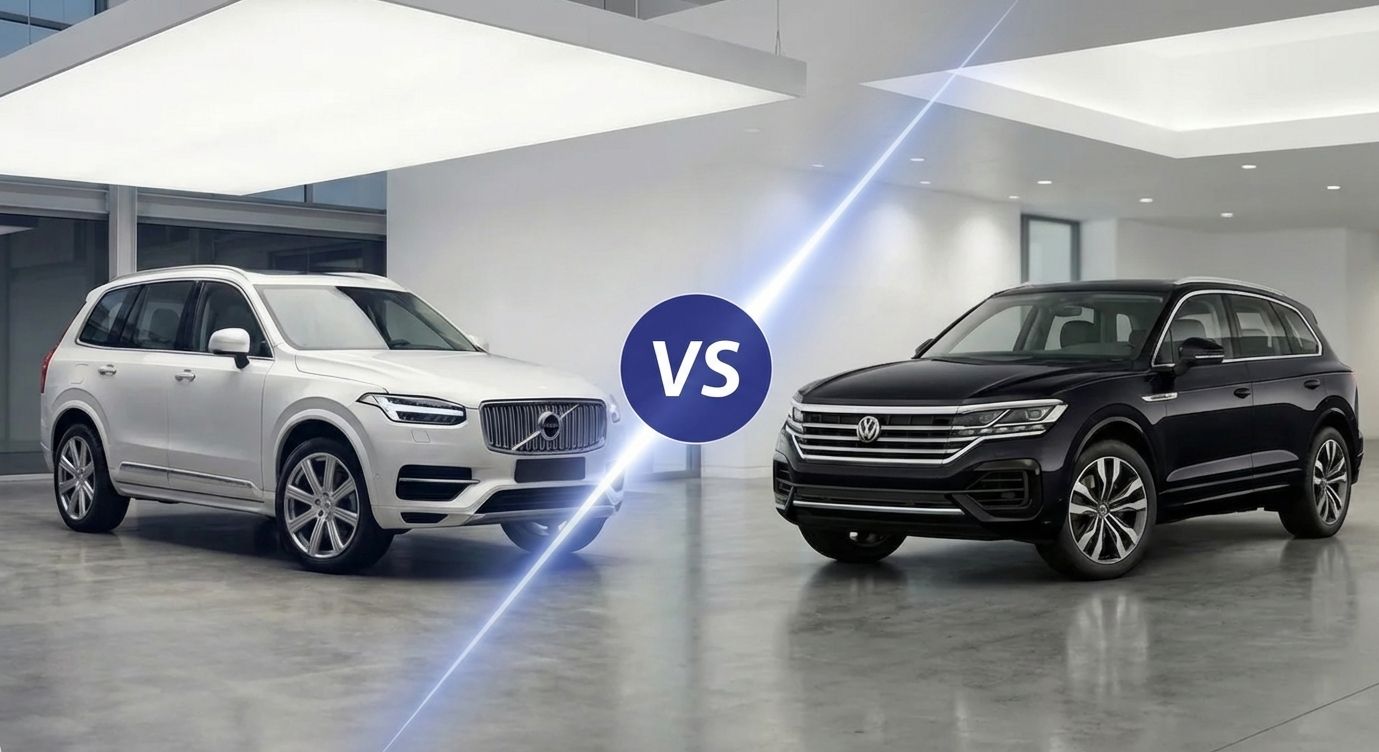
Volvo XC90 vs. Volkswagen Touareg: Which premium SUV is better? A detailed comparison, tests, and a clear verdict will help you choose.
Apr 14, 2026