Jaguar F-Type vs. Mercedes-AMG C 63 Coupé: Complete comparison 2026
Detailed comparison of Jaguar F-Type vs. Mercedes-AMG C 63 Coupé (C63 AMG). Real-world experience, performance test, and final verdict. Which sports car to choose?
Apr 14, 2026
Articles
Car battle
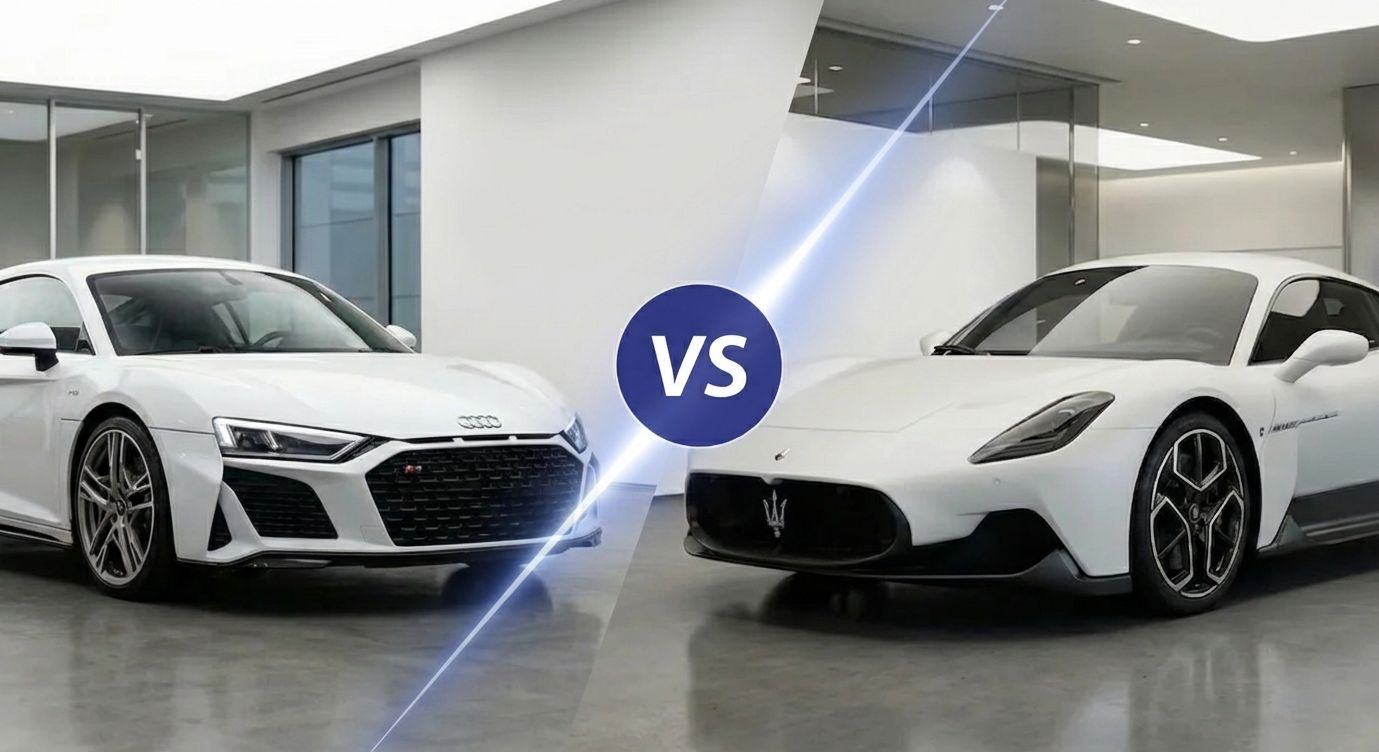
Audi R8 vs McLaren Artura: A detailed comparison of supercars. Discover the real differences in performance, equipment, and reliability, and read our verdict before you buy.
April 17, 2026


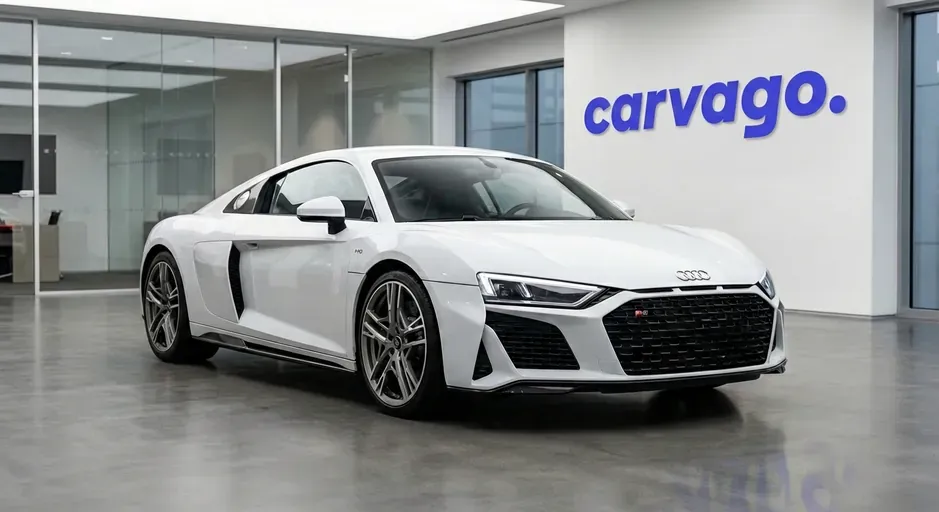
Audi R8 represents an iconic mid-engine supercar that, thanks to its legendary naturally aspirated V10 and precise quattro all-wheel drive, has earned an exceptionally firm place in the history of high-performance cars. Standing against it is the McLaren Artura, a revolutionary British plug-in hybrid model that opens a completely new era for its brand with an uncompromising combination of a twin-turbocharged V6, an advanced electric motor, and ultra-lightweight carbon architecture. In the following detailed comparison, we will explore both distinct philosophies in detail and find out whether traditional purist mechanics or the emerging hybrid technology of tomorrow will prevail among demanding drivers.
When comparing the external dimensions of these two British-German rivals, which are typical representatives of supercars on the market for roughly four-year-old used cars (for Audi, this is the peak phase of the 4S generation, while the McLaren Artura began production as a new model in 2022), distinct design approaches clearly emerge. While the total length of the Audi R8 typically hovers around 4429 mm, the British McLaren Artura is a significant 110 mm longer at 4539 mm. This more elongated body gives the McLaren optimized aerodynamics at very high speeds and visually makes the car look more aggressive. On the other hand, this advantage in length comes at a slight cost in daily usability – a longer car is naturally more demanding for precise maneuvering and parking in narrow underground garages, where the more compact Audi, by contrast, provides the driver with significantly more confidence.
In terms of width and height, the scales tip in favor of different priorities. With a width of 1940 mm, the Audi R8 is slightly wider than the Artura (1913 mm), which guarantees the German car an uncompromisingly wide stance, but requires more of the driver's attention on narrow country roads. The fundamental difference, however, is the overall body height. The McLaren Artura is a genuine "low-slung" machine, measuring just 1193 mm in height, sitting at least 43 mm lower than the already very low Audi (1236 mm). The Artura's extremely low silhouette brings obvious benefits in the form of a radically lowered center of gravity and ideal airflow on the racetrack. In the real world, however, this means a clear compromise – it forces the occupants into a noticeably more complex and physically demanding entry.
The wheelbase, on the other hand, is very similar for both supercars. The Audi R8 offers a wheelbase of 2650 mm, while the McLaren has a value of 2640 mm. This minimal difference of just one centimeter means that the cabin space and weight distribution between the axles work with very similar physical foundations. As a result, both models benefit from top-tier straight-line stability regardless of the current pace. Ultimately, the numbers clearly suggest that the slightly wider and taller Audi R8 serves as a more user-friendly compromise for frequent trips, while the longer and extremely low-slung McLaren Artura uncompromisingly signals its purist track pedigree, where practicality takes a back seat.
| Parameter | Audi R8 Coupé | McLaren Artura Coupé | Audi R8 Cabriolet | McLaren Artura Cabriolet |
|---|---|---|---|---|
| Width (mm) | 1940 - 1964 | 1913 | 1940 | 1913 |
| Length (mm) | 4426 - 4496 | 4539 | 4426 - 4429 | 4539 |
| Height (mm) | 1236 - 1240 | 1193 | 1242 - 1244 | 1193 |
| Wheelbase (mm) | 2650 | 2640 | 2650 | 2640 |
When choosing a supercar like the Audi R8 and McLaren Artura, practicality is not usually the primary decision factor, yet daily usability and luggage space size are extremely important for buyers. Both models use a mid-engine layout, meaning their main luggage compartment ("frunk") is located under the front hood. However, both manufacturers approach storage space differently and offer varying levels of practicality, which can play a significant role in deciding whether you use the car only for weekend drives or also for regular travel.
In the case of the Audi R8, the front trunk offers a rather modest basic volume of 112 liters. However, the Coupé version cleverly compensates for this shortcoming with extensive additional space behind the front seats with a volume of 226 liters, bringing the total theoretical capacity of the car to a respectable 338 liters. The McLaren Artura, which relies on an advanced plug-in hybrid powertrain taking up space in the rear, has only a 160-liter front trunk in the Coupé version; space behind the seats is completely absent in this layout. However, the situation reverses for the open-top variants of both models. While the open McLaren Artura Cabriolet (Spider) offers a slightly reduced but still above-average capacity of 124 liters at the front, the Audi R8 Cabriolet (Spyder) retains its front-mounted 112 liters but completely loses any storage space behind the seats due to the massive folding roof mechanism.
In practice, these volume differences mean that the McLaren Artura offers a better-shaped and deeper front trunk, where you can reliably store a classic medium travel suitcase. The Audi R8 Coupé is on the other hand much more flexible, and the space behind the seats is perfectly sufficient for weekend shopping or a longer holiday for two, as you can easily fit space for several extra suitcases, soft travel bags, or even a compact golf bag. Although the trunk volume in this class of supercars will never reach the values of family estates, the fixed-roof version of the Audi R8 realistically offers much wider usability for a "Grand Touring" lifestyle, while the British McLaren clearly wins among the roofless models.
| Parameter | Audi R8 Coupé | McLaren Artura Coupé | Audi R8 Cabriolet | McLaren Artura Cabriolet |
|---|---|---|---|---|
| Basic volume (liters) | 112 | 160 | 112 | 124 |
| Max. volume with folded seats / behind seats (liters) | 338 | 160 | 112 | 124 |
While the McLaren Artura pleases with a more spacious front trunk in both body styles, the Audi R8 in Coupé form overall wins thanks to the generous internal storage space behind the seats, which allows you to comfortably handle even longer trips for two.
When comparing the towing capacity of premium supercars, such as the approximately four-year-old Audi R8 (4S generation) and the modern McLaren Artura, we encounter a very specific but expected situation. While trailer weight plays an important role in the decision-making process for buyers of conventional cars, in this exclusive segment, the difference between the two models is zero.
Neither vehicle is factory-homologated for towing, which means that the value for both standard and maximum weight of braked and unbraked trailers is exactly 0 kg. This fact remains unchanged across all available engine variants. While we often see in conventional cars that hybrid variants have reduced towing capacity due to the higher weight of the batteries, the plug-in hybrid McLaren Artura shares the exact same zero value in this regard as the purely petrol-powered Audi R8 with its naturally aspirated V10 engine.
In terms of practical consequences, compromises are necessary. Neither of these cars allows for extra luggage space by attaching a small trailer. These are not cars designed for transporting oversized loads for weekend shopping or towing a caravan on a long holiday – all luggage must fit exclusively into the very limited and specifically shaped storage spaces of the vehicles themselves (for example, under the front hood).
The conclusion in this regard is absolutely clear: if the ability to tow a trailer is in any way important to you, you will succeed with neither the Audi R8 nor the McLaren Artura. Both cars are purist machines focused exclusively on driving dynamics, and you must forget about practicality in the form of a tow bar.
Since neither of the assessed supercar models has homologation for towing a trailer, the table contains no data.
| Model and engine | Braked trailer (kg) | Unbraked trailer (kg) |
|---|
A comparison of the powertrains of these two supercars shows a fascinating clash of two completely different engineering worlds. While the Audi R8 relies on a traditional, high-revving naturally aspirated ten-cylinder with a massive displacement, the McLaren Artura brings a revolution in the form of a compact twin-turbocharged V6 with advanced plug-in hybrid technology. For those interested in a roughly four-year-old car on the used market, this means a choice between the absolute purity of raw sound with the option of all-wheel drive (quattro) and the brutal, instant pull of a hybrid system driving exclusively the rear axle. While the top internal combustion version of the Audi offers an impressive 456 kW, the Artura, thanks to its electric motor, raises the bar to 500 kW of total power, additionally with significantly higher torque and better efficiency for city driving.
The Audi R8 from 2020 to 2023 is an unforgettable celebration of one of the best engines in automotive history – the iconic naturally aspirated 5.2 FSI V10 unit. This powertrain is no longer available on the new car market, as its production for the R8 model was completely terminated in 2023, making these engines an exclusive collector's target. The standard rear-wheel-drive (RWD) version starts at a very solid 397 kW, though from 2021 it was replaced by the improved performance RWD variant with 419 kW. The standard version with the quattro all-wheel-drive system delivered the same power. For those seeking the absolute pinnacle, the brand offered the V10 performance quattro variant with a thrilling 456 kW and 580 Nm of torque. The model's swan song at the end of production (2023) was the special V10 GT edition, which offered a maximum of 456 kW exclusively with rear-wheel drive. All powertrains work exclusively with a lightning-fast 7-speed S tronic dual-clutch transmission.
| Engine type | Fuel | Power (kW) | Torque (Nm) | Transmission |
|---|---|---|---|---|
| 5.2 FSI V10 RWD | Petrol | 397 | 540 | 7-speed S tronic |
| 5.2 FSI V10 quattro | Petrol | 419 | 550 | 7-speed S tronic |
| 5.2 FSI V10 performance RWD | Petrol | 419 | 550 | 7-speed S tronic |
| 5.2 FSI V10 performance quattro | Petrol | 456 | 580 | 7-speed S tronic |
| 5.2 FSI V10 GT RWD | Petrol | 456 | 565 | 7-speed S tronic |
While the R8 adheres to internal combustion tradition, the Artura embodies the modern future of the McLaren brand. The standard and currently the only powertrain on the used market (from model year 2021) is the innovative system called High-Performance Hybrid. The heart of the car is an extremely light and flat twin-turbocharged 3.0-liter V6 (with a 120-degree V-angle), which alone produces 430 kW. This is complemented by a lightweight axial flux electric motor integrated directly into the bell housing of the brand-new 8-speed SSG transmission. The combined system power thus increased to an extraordinary 500 kW (680 hp) with a massive 720 Nm of torque. An interesting feature is the lack of a reverse gear – reversing is handled exclusively by the electric motor running in reverse. Furthermore, the 7.4 kWh battery allows for pure electric and emission-free driving in city traffic with a range of just over 30 km, which is a huge practical advantage in the supercar segment.
| Engine type | Fuel | Power (kW) | Torque (Nm) | Transmission |
|---|---|---|---|---|
| 3.0 V6 Twin-Turbo Hybrid | Petrol PHEV | 500 | 720 | 8-speed SSG |
Final evaluation of the powertrains
The final recommendation when choosing divides potential customers into two clearly defined groups. Customers looking for raw driving pleasure, revving the engine into the high ranges, the perfect naturally aspirated ten-cylinder orchestra, and a high degree of sure-footedness thanks to all-wheel drive will find their dream in the now-discontinued Audi R8. However, if you desire modern technology, an extreme delivery of power from zero RPM, sharp rear-wheel drive, and the possibility of quietly cruising through the city center, the McLaren Artura represents a technological gem that surpasses the old school.
While the Audi R8 enchants with the raw roar of its departing naturally aspirated V10, the McLaren Artura shows the clear future of supercars thanks to the crushing power of its innovative plug-in hybrid V6.
Choosing the right engine is crucial for these supercars, not only for achieving maximum performance and driver satisfaction but primarily for long-term reliability and sustainable service costs. Both cars offer a diametrically different approach to performance – while the Audi R8 represents the pinnacle of classic purist engineering with one of the last large-displacement naturally aspirated V10s on the market, the McLaren Artura points clearly towards the future with a highly sophisticated plug-in hybrid (PHEV) powertrain and a unique 120-degree V6. If you are looking for an ideal specimen on the market for approximately four-year-old used cars, you will encounter completely different technical specifics and different mechanical or software risks for each model.
Official fuel consumption figures presented by manufacturers themselves often represent only a theoretical minimum achievable only under laboratory conditions. Especially in the supercar category, real-world consumption can differ significantly from the "paper" figures. For the most objective comparison possible, we rely on long-term independent tests and user data aggregated on portals such as Spritmonitor.de. We focused on models that are sought after in the market for roughly four-year-old used cars (i.e., model years around 2022). Specifically, we are comparing the facelifted generation of the Audi R8 (4S) and the innovative McLaren Artura.
| Model and motorization | Average consumption (l/100 km) |
|---|---|
| McLaren Artura 3.0 V6 PHEV 500 kW | 8.5 |
| Audi R8 Coupé 5.2 FSI V10 performance 456 kW | 12.9 |
| Audi R8 Coupé 5.2 FSI V10 419 kW | 13.1 |
| Audi R8 Spyder 5.2 FSI V10 performance 456 kW | 13.8 |
The trend in both compared cars shows a completely different engineering philosophy and its direct impact on everyday operation. While for common family cars in this section we often discuss the advantages of economical diesels over petrol, in the realm of supercars, a classic naturally aspirated engine stands against electrified downsizing.
For typical drivers considering these approximately four-year-old used gems, this means a fundamentally different style of use. If you often move around the city, the McLaren Artura is unbeatable. It allows for fully electric driving with a real-world range of around 30 kilometers, which represents a huge financial saving for the owner and clean, quiet operation for the surroundings. Conversely, the Audi R8 is a purebred grand tourer without hybrid assistance, perfectly suited for longer weekend trips. However, its higher appetite will not please drivers traveling long distances, as the shorter range constantly necessitates frequent stops at filling stations.
In conclusion, although in the category of cars with a price tag in the millions, the price of petrol itself is usually not the most important argument, the technological gap makes fuel consumption one of the key decision-making factors for these models. A more budget-conscious buyer who wants to use the car during the week will clearly appreciate the British plug-in hybrid efficiency of the McLaren, while for an Audi R8 owner, high consumption is merely an acceptable price for the phenomenal sound of one of the last of the Mohicans among naturally aspirated V10s.
The market for used supercars approximately four years old offers very different dynamics for both vehicles. While the Audi R8 represents the end of an era with its naturally aspirated V10, the McLaren Artura represents the arrival of a new generation of plug-in hybrid technologies. For the buyer of a four-year-old premium car, this means a significant difference not only in the purchase price but also in the expected depreciation.
Looking at the European used car market, the prices for these supercars from 2021 to 2023 range as follows:
| Model | Generation (Year of Manufacture) | Estimated Price in EUR | Estimated Price in EUR |
|---|---|---|---|
| Audi R8 | 4S Facelift (2021–2022) | €123,000 – €185,000 | 120,000 – 180,000 € |
| McLaren Artura | 1st Generation (2022–2023) | €189,000 – €238,000 | 185,000 – 235,000 € |
Audi R8 (Type 4S Facelift)
McLaren Artura
If you are looking for certainty in terms of residual value retention in a four-year-old used car and prefer a rawer, "analogue" driving experience, the Audi R8 is a safe choice. It is a car of collector interest, whose large-displacement engine has now definitively disappeared from the market. On the other hand, the McLaren Artura makes sense for buyers who demand the absolute technological cutting edge, brutal acceleration supported by a hybrid system, and the advantages of carbon fibre construction. However, with the British supercar, it is necessary to account for more specific and expensive maintenance of the high-voltage battery system and a smaller network of authorized service centres.
While the used Audi R8 holds its value surprisingly well thanks to its legendary naturally aspirated V10 engine, the younger McLaren Artura attracts with futuristic hybrid technologies at the cost of a steeper initial price drop.
Although it is customary to expect a five-star Euro NCAP rating for most common premium vehicles (while highlighting the crucial importance of context and the year of testing, as testing protocols constantly evolve, introducing stricter frontal simulations or new intersection scenarios, meaning percentage scores from different years cannot be directly compared), the situation is completely different in the exclusive supercar segment. Due to extremely high acquisition costs and very low production volumes, models like the Audi R8 or McLaren Artura are not tested by Euro NCAP at all. Their safety thus depends on different factors – especially the passive structural strength of high-end materials and precise driver response.
Audi R8
The Audi R8 (in the facelifted generation, typical for the nearly new used car market at around 4 years old) has not undergone any official Euro NCAP crash test. The cornerstone of its safety is the highly rigid Audi Space Frame (ASF), which ingeniously combines aluminum profiles with carbon fiber reinforcements. Adult occupant protection relies on a complete set of front, side, and head airbags. However, in terms of modern assistance systems, this purist car lags significantly behind. It relies primarily on immense mechanical grip, quattro all-wheel drive, and gigantic braking power. Advanced active features such as adaptive cruise control, lane keeping, or advanced autonomous braking for cyclist detection are simply missing here, reflecting its older platform.
McLaren Artura
Even the British McLaren Artura, a representative of a significantly newer hybrid generation of supercars, does not have independent certification from Euro NCAP. Occupant protection in this case is provided by the revolutionary MCLA (McLaren Carbon Lightweight Architecture). This extremely strong carbon tub absorbs kinetic energy with efficiency similar to Formula 1 cockpits. Unlike the older Audi, the British automaker already reflects the pressure for modern active safety. As part of the optional Technology Pack, first owners could pay extra for features that make living with the car on public roads easier – from adaptive LED headlights to traffic sign recognition and lane departure warning, through to adaptive cruise control.
Safety comparison conclusion
If we evaluate both cars through the stricter lens of today's safety standards, the McLaren Artura offers a more modern and comprehensive protection package. While the Audi R8 sticks to the old school and builds protection purely on its rigid construction and driver alertness, the innovative Artura takes safety to a higher level thanks to the use of a state-of-the-art carbon tub and the actual availability of active assistance features. In normal highway traffic, the McLaren is thus significantly better prepared to prevent critical situations.
| Parameter | Audi R8 | McLaren Artura |
|---|---|---|
| Year of testing | Not tested | Not tested |
| Adult occupant protection | - | - |
| Child occupant protection | - | - |
| Vulnerable road user protection | - | - |
| Safety assist systems | - | - |
Although neither of these exclusive supercars has undergone standardized Euro NCAP tests, the McLaren Artura offers a safer package for everyday driving thanks to its more modern carbon architecture and the availability of active assistants.
In addition to standard equipment, each model offers several unique features that can be decisive for the customer, with both cars approaching the concept of a supercar in completely different ways.
Fantastic sound and instant response of the naturally aspirated V10 engine
High level of overall comfort and great daily usability
First-class interior build quality with emphasis on detail and luxury
Confidence and traction thanks to the proven quattro all-wheel drive
Proven technology and generally higher reliability for a supercar
Older platform and lack of a central infotainment display
Significantly higher curb weight compared to carbon-fiber competitors
High fuel consumption and absence of any modern electrification
Less sharp and communicative steering compared to British rivals
The Audi R8 is the perfect choice for those looking for a classic supercar with a stunning naturally aspirated V10 and who don't want to compromise on daily comfort. It will primarily appeal to drivers desiring a reliable and luxurious car, where they appreciate the confidence of all-wheel drive even at the cost of slightly higher weight.
Revolutionary carbon monocoque ensuring extreme rigidity and low weight
Explosive dynamics thanks to the plug-in hybrid combination of a V6 and an electric motor
Pure electric range capability for quiet and emission-free city driving
Phenomenal hydraulic steering with unrivaled feedback from the road
Modern assistance systems and a significantly improved onboard infotainment
More frequent software bugs and teething problems in early production years
The sound of the hybrid V6 does not reach the drama of the V10 engine
Steeper depreciation on the used market and potentially very expensive servicing
Poorer overall ergonomics and more difficult entry over wide sills
The McLaren Artura targets technology enthusiasts and purists for whom state-of-the-art construction, low weight, and surgically precise handling at the limit are absolute priorities. Although it requires slightly more compromises in daily traffic, it rewards the owner with a genuine and sharp experience of a true lightweight track tool.
Based on our own CarAudit inspections, breakdown statistics, service bulletins, and long-term owner experiences, we have compiled an overview of the most common problems that used car buyers should watch out for.
The Audi R8 from recent years (since the 2019 facelift) benefits from an exceptionally long development cycle and the sharing of proven components with the Lamborghini Huracán, making it one of the most reliable supercars on the market.
The Audi R8 is a mechanically exceptionally durable car, whose greatest weakness is the prone and expensive Magnetic Ride dampers. With regular service, however, it offers completely trouble-free daily operation by the standards of its class.
The McLaren Artura, as a technologically revolutionary car that brought a completely new carbon tub, a new plug-in hybrid system, and a new V6 engine, suffered from a number of so-called "teething troubles" and recalls in the early stages of production (around 2021 and 2022).
The Artura suffered from unrefined software and mechanical risks in the fuel lines in the early stages of production, which had to be resolved by recalls. It is therefore necessary to choose exclusively cars with demonstrably resolved teething troubles and the latest software updates.
When buying a used car, a thorough inspection is key, and for such sophisticated and powerful supercars, this is doubly true. Here are several specific points to focus on for these two models. Before the final decision, a thorough physical inspection of the used car should always take place.
The Audi R8 has long been considered one of the most practical supercars for daily use thanks to its comfortable chassis, excellent visibility, and great interior ergonomics. While McLaren offers adaptive dampers and modern technology, its carbon monocoque and extremely low ground clearance make routine city maneuvering difficult. For routine use, the German representative remains the more user-friendly choice.
Audi relies on a traditional naturally aspirated 5.2-liter V10 engine, which excels with its linear power delivery and unmistakable sound. In contrast, the British model uses an innovative plug-in hybrid powertrain combining a twin-turbocharged 3.0-liter V6 with an electric motor. Thanks to this modern concept, the British car offers higher torque at lower RPMs and instant throttle response.
Yes, the McLaren Artura is designed from the ground up as a plug-in hybrid and features a traction battery with a capacity of 7.4 kWh. Thanks to this, it can travel approximately 30 kilometers on pure electric power without local emissions, which is ideal for driving in city centers. The competing R8 does not offer this option, as it relies exclusively on a classic conventional powertrain.
The Artura is significantly more agile on the track thanks to its extremely low weight, rigid carbon architecture, and precise electro-hydraulic steering. Although the R8 has great grip exiting corners thanks to its all-wheel drive, its higher weight means slightly less sharpness during direction changes. The British car thus provides a purer, more precise, and overall faster driving experience on the track.
Most versions of the R8 use the famous Quattro all-wheel-drive system, which ensures maximum traction and confidence in any weather conditions. In contrast, the Artura transfers all the power of its hybrid system exclusively to the rear wheels via a fast dual-clutch transmission and an electronically controlled differential. This makes it more playful, but much more challenging to tame on slippery surfaces.
Choosing between a used Audi R8 and a McLaren Artura represents a fascinating choice between two completely different eras of supercar development. While the iconic Audi R8 appeals to lovers of traditional mechanics thanks to its reliable naturally aspirated V10 engine, high comfort for daily driving, and excellent value retention, the British model clearly targets technology enthusiasts. The McLaren Artura counters with a revolutionary carbon construction, crushing electrified dynamics, and uncompromising track performance, but requires tolerance for more specific maintenance and a steeper initial depreciation. In the end, the Audi R8 is the ideal and more user-friendly grand tourer for drivers longing for an unmistakable sound and the security of all-wheel drive, while the McLaren serves as the ultimate, futuristically tuned tool for maximum and purist driving experiences at the limit.
Sources: ADAC, mdcr.cz, aktualne.cz, elektromobil.cz, autoexpress.cz, autickaruvblog.cz
This article was prepared using artificial intelligence tools. The section guarantor is Petr Dušek.

Detailed comparison of Jaguar F-Type vs. Mercedes-AMG C 63 Coupé (C63 AMG). Real-world experience, performance test, and final verdict. Which sports car to choose?
Apr 14, 2026

Detailed comparison of the BMW M4 and Lexus RC F. Discover the key differences in engines, driving characteristics, and reliability. Read our verdict before you buy.
Apr 14, 2026

Audi R8 or Maserati MC20? Comparing performance, design, and handling. Our detailed test helps you choose the perfect supercar.
Apr 13, 2026