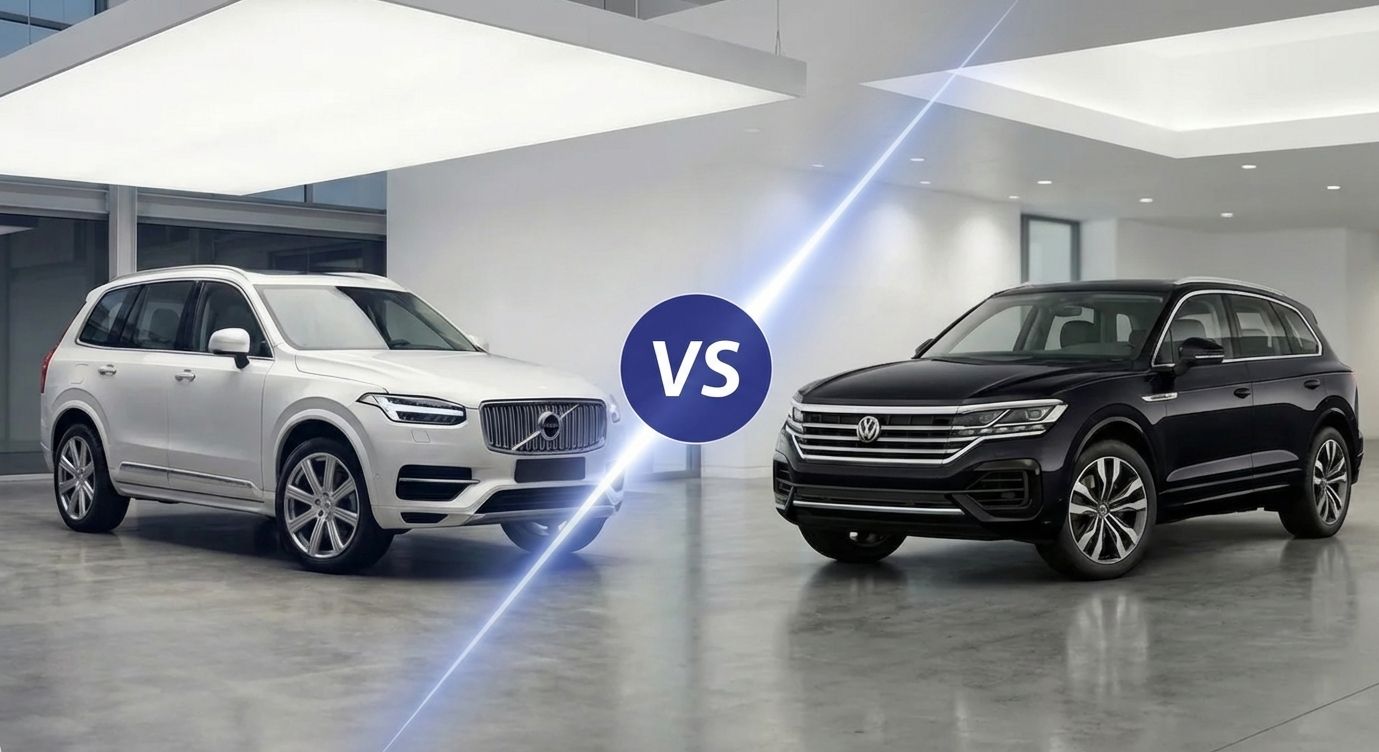
Car battle
Volvo XC90 vs. Volkswagen Touareg: Complete comparison 2026
Volvo XC90 vs. Volkswagen Touareg: Which premium SUV is better? A detailed comparison, tests, and a clear verdict will help you choose.
Apr 14, 2026
Articles
Car battle
Audi Q8 vs Volvo XC90: Detailed comparison of premium SUVs. Discover details about equipment, driving characteristics and read our verdict. Which one to choose?
October 16, 2026
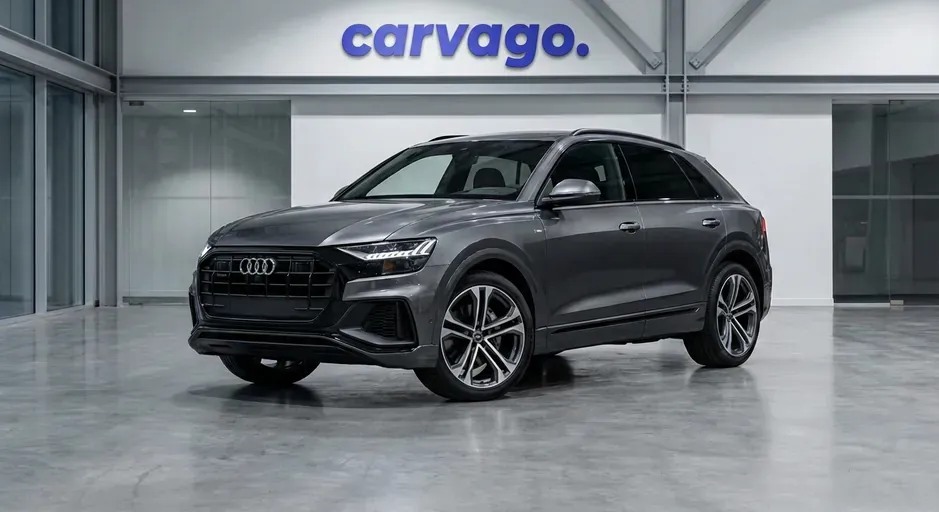
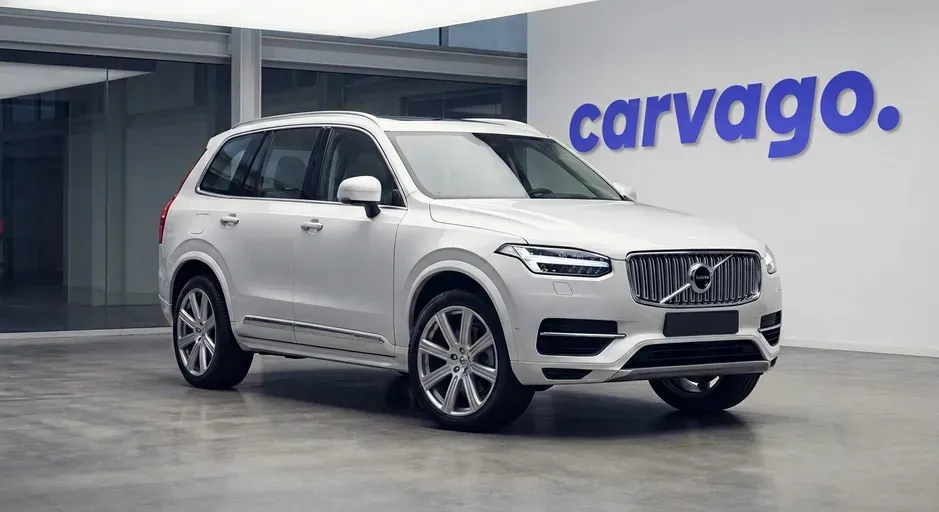
The Audi Q8, which you can also find on the market in its sporty derivatives under the SQ8 or RSQ8 designations, represents the pinnacle of the luxury SUV range with a dynamic coupe silhouette and a strong focus on cutting-edge technology and driving characteristics. In contrast, the Volvo XC90, whose sought-after plug-in hybrid variant bears the name Recharge, embodies traditional Scandinavian elegance with an absolute emphasis on safety, generous interior space, and maximum comfort for up to seven passengers. Let's take a detailed look at how these two different approaches to a premium SUV fare in a head-to-head battle and which model represents a more attractive choice for your daily needs.
When looking at the external dimensions of both premium SUVs, focusing on models available on the market as roughly four-year-old used cars, the different philosophies of the two brands are clearly evident. While the Audi Q8 (4M generation) bets on a sporty and wide-stanced posture evoking dynamism, the Volvo XC90 (second generation) sticks to a more traditional, majestic silhouette of a classic family cruiser.
Audi Q8 measures 4986 to 4992 mm in length, slightly exceeding the Volvo XC90 and its 4950 to 4953 mm by about 36 mm. An even more significant difference can be found in the overall width, where the German representative, with its impressive 1995 mm, appears exceptionally dominant on the road. Standard versions of the Swedish Volvo are noticeably narrower at 1923 to 1931 mm (specific T8 versions may have a slightly higher value due to wider arches and mirrors), which in practice represents a huge advantage when maneuvering. You will definitely appreciate the roughly six to seven centimeters less width of the Volvo when parking in tight underground garages or crowded city streets.
Where the Swedish SUV dominates, on the other hand, is the overall height. At 1771 to 1776 mm, it towers over the sportily tuned Audi (1697 to 1705 mm) by an impressive seven centimeters. This height difference has a positive impact not only on a more commanding view from the car but, above all, on more generous headroom for all passengers. The wheelbase is very generous in both cars – the Audi Q8 offers a range of 2995 to 2998 mm, which is slightly more than the 2984 mm of the Volvo XC90. The Audi's longer wheelbase contributes to exemplary directional stability at high highway speeds.
Overall, the physical proportions clearly suggest who the cars are intended for. The Volvo XC90 is the embodiment of a practical family car, which, thanks to its taller and slightly narrower build, better masks its giant dimensions in the city and offers more vertical interior space. The Audi Q8, by contrast, is an uncompromising style icon – its wider, lower, and more aggressive silhouette pleases the eye and enhances its sporty presence on the road, albeit at the cost of slightly more challenging parking and maneuvering in tight spaces.
| Parameter | Audi Q8 SUV | Volvo XC90 SUV |
|---|---|---|
| Width (mm) | 1995 | 1923 - 2008 |
| Length (mm) | 4986 - 4992 | 4950 - 4953 |
| Height (mm) | 1697 - 1705 | 1771 - 1776 |
| Wheelbase (mm) | 2995 - 2998 | 2984 |
When choosing a family or luxury car, the size of the luggage compartment often plays a key role. This is especially true if you plan on frequent travel with children, transporting sports equipment, or simply need enough space for large family shopping trips. In this regard, the approach of the two carmakers differs quite significantly. While the second-generation Volvo XC90 was designed from the very beginning as a maximally practical and spacious family SUV, the Audi Q8 (4M generation) bets on a sportier silhouette evoking a coupe. This approach naturally takes a certain toll on the overall transport capacity. Both generations, currently very well represented on the market for roughly four-year-old used cars, thus target a slightly different group of drivers.
In terms of specific numbers, the standard internal combustion version of the Volvo XC90 offers a basic luggage volume of 680 liters, which can be increased to an impressive 1,874 liters after fully folding the rear seats. In contrast, the Audi Q8 has 605 liters as standard and offers a maximum of 1,755 liters after folding the backrests. For both models, however, it is necessary to remember that if you opt for the popular plug-in hybrid powertrains, the available space will decrease due to the installation of traction batteries under the floor. In the Audi Q8 TFSI e, the basic volume drops to 505 liters (maximum 1,625 liters), while the electrified Volvo XC90 T8 Recharge has to settle for a basic volume of 640 liters and a total of 1,816 liters.
In practice, these design differences mean that although the Audi Q8's luggage compartment is more than sufficient for a regular weekend shopping trip or a longer holiday for four, the sharply sloping roofline may limit you when transporting bulkier boxes or tall items. Volvo, on the other hand, thanks to its boxier and more upright body, easily offers space for several extra suitcases, an unfolded stroller, and other family essentials, without the need for complex organization of the loaded cargo.
| Parameter | Audi Q8 SUV | Volvo XC90 SUV |
|---|---|---|
| Basic volume (liters) | 605 | 680 |
| Maximum volume with seats folded (liters) | 1,755 | 1,874 |
In conclusion, if everyday family practicality and the ability to transport larger cargo are your top priorities, the Swedish representative will be a much more versatile companion. For those who, on the contrary, prefer a dynamic style and can do without the absolute maximum of usable liters, the Audi Q8's trunk represents a sufficiently sized and stylish compromise.
Volvo XC90 clearly wins with its unrivaled family practicality and huge trunk, while the Audi Q8 sacrifices some space in exchange for a more dynamic and elegant rear design.
The ability to tow heavy trailers is often a decisive factor when choosing a large premium SUV. Whether you plan to transport a boat, a horse trailer, or a bulky family caravan, both vehicles offer extraordinary utility value on the used car market. However, in absolute numbers and maximum trailer weight values, we find interesting differences.
For used cars approximately four years old (around production years 2021–2022), the Audi Q8 dominates in pure towing power:
The competing Volvo XC90 (2nd generation) relies on slightly more modest, but still highly above-average values for most buyers:
In practice, these values mean that even with the Volvo, you are guaranteed sufficient towing power for a large twin-axle family caravan, representing an ideal solution for a comfortable and long holiday across Europe. However, the advantage of the Audi Q8, stemming from the ability to hitch a trailer weighing up to 3.5 tonnes, provides owners with invaluable extra margin – whether for professional use, absolute stability of the combination, or safe handling of a huge motor yacht.
Final verdict: While the Volvo XC90 represents a trouble-free and versatile companion that will satisfy the vast majority of family and recreational needs, the Audi Q8, thanks to its more robust construction and towing power, is the clear choice for the most demanding transport tasks.
| Model and motorization | Braked weight of trailer (kg) | Unbraked weight of trailer (kg) |
|---|---|---|
| Audi Q8 50 TDI / 55 TFSI (4M) | 2800 | 750 |
| Audi Q8 60 TFSI e (4M) | 2800 - 3500 | 750 |
| Audi Q8 e-tron (GE) | 1800 | 750 |
| Volvo XC90 B5 Diesel / B6 (2. Gen) | 2700 | 750 |
| Volvo XC90 B5 / T8 (2. Gen) | 2350 - 2400 | 750 |
When comparing the engine lineups of these two luxury SUVs, we encounter completely different engineering philosophies that have a fundamental impact on daily operation and the preferences of buyers in the used car market. For roughly four-year-old models, the Audi Q8 relies exclusively on robust three-liter six-cylinder engines, which guarantee silky smooth operation, massive towing power, and excellent dynamics even under full load. The Volvo XC90, on the other hand, bets on modular two-liter four-cylinder engines, cleverly compensating for the smaller displacement with advanced electrification in the form of mild-hybrid and very powerful plug-in hybrid systems. While basic diesel versions like the Audi Q8 45 TDI (170 kW) and Volvo XC90 B5 Diesel (173 kW) aim for maximum range and efficiency on long journeys, the top-tier versions – the Audi 60 TFSI e (340 kW) and Volvo T8 Recharge (up to 335 kW) – offer stunning combined output for drivers who demand quick acceleration and the possibility of locally emission-free driving. From an operational perspective, Audi's unwavering TDI six-cylinder units will appeal more to highway travelers and owners of heavy trailers, while Volvo's four-cylinder hybrids excel with extraordinary efficiency in combined and suburban driving.
The engine range for the Audi Q8 from around 2022 (4M generation) is built exclusively on proven three-liter V6 engines. These are always precisely matched with intelligent quattro all-wheel drive and a reliable eight-speed Tiptronic transmission. The base for highway drivers is the 45 TDI diesel version (170 kW); however, the more powerful 50 TDI variant (210 kW) is by far the most sought-after and common among used cars. Its massive 600 Nm of torque represents an ideal choice for a sportily-styled SUV weighing over two tons. Petrol proponents can opt for the very refined 55 TFSI unit (250 kW). For drivers looking for a combination of high performance and quiet city driving, Audi also added the 55 TFSI e and the top-of-the-line 60 TFSI e plug-in hybrid models to the range from 2020, with a combined output of up to 340 kW. All standard internal combustion versions of the Q8, without exception, feature a 48V mild-hybrid (MHEV) system that smooths out the operation of the start-stop system and helps save fuel while coasting.
| Engine type | Fuel | Power (kW) | Torque (Nm) | Transmission |
|---|---|---|---|---|
| 45 TDI | Diesel (MHEV) | 170 | 500 | 8-speed Tiptronic |
| 50 TDI | Diesel (MHEV) | 210 | 600 | 8-speed Tiptronic |
| 55 TFSI | Petrol (MHEV) | 250 | 500 | 8-speed Tiptronic |
| 55 TFSI e | Plug-in Hybrid | 280 | 600 | 8-speed Tiptronic |
| 60 TFSI e | Plug-in Hybrid | 340 | 700 | 8-speed Tiptronic |
Under the hood of the Volvo XC90 from around 2022, you will find exclusively two-liter inline four-cylinder engines, where the Nordic automaker replaced large displacement with sophisticated forced induction and widespread electrification. If you are looking for a roughly four-year-old used car on the market, you will encounter exclusively "B" series mild-hybrid engines (available since 2019/2020). Older classic diesels (D4, D5) and pure internal combustion petrol engines (T5, T6) from the early years of the second generation's production have logically completely disappeared from the listings at this age. The B5 (184 kW) and rarer B6 (220 kW) petrol variants are complemented by the highly sought-after B5 Diesel mild-hybrid with 173 kW and a decent pull of 480 Nm. The brand's technological jewel is the T8 Recharge plug-in hybrid variant (formerly known as Twin Engine). This combines a turbocharged and supercharged internal combustion engine with a powerful electric motor on the rear axle. At the end of 2021, the T8 system underwent an extensive modernization, which increased the combined output to a stunning 335 kW, and an enlarged battery significantly extended the pure electric range. All-wheel drive (AWD) and an eight-speed Geartronic automatic transmission are standard across this entire newer model range.
| Engine type | Fuel | Power (kW) | Torque (Nm) | Transmission |
|---|---|---|---|---|
| B5 | Petrol (MHEV) | 184 | 350 | 8-speed Geartronic |
| B6 | Petrol (MHEV) | 220 | 420 | 8-speed Geartronic |
| B5 Diesel | Diesel (MHEV) | 173 | 480 | 8-speed Geartronic |
| T8 Recharge | Plug-in Hybrid | 288 - 335 | 640 - 709 | 8-speed Geartronic |
While the Audi Q8 impresses with its effortless and durable three-liter six-cylinder engines, which are the clear choice for long highway journeys and towing trailers, the Volvo XC90 scores points with its highly sophisticated four-cylinder hybrids that excel in efficiency, especially in suburban and family use.
Choosing the right power unit is absolutely critical for long-term satisfaction with heavy premium SUVs. While the Audi Q8 in its current 4M generation relies on traditional, silky-smooth V6 engines with a huge power reserve, Volvo took a very radical step with the second generation of the XC90. Under the Swedish hood, you will find exclusively two-liter four-cylinder engines across all versions, which compensate for their lack of displacement with sophisticated forced induction and massive electrification. The following recommendations for roughly four-year-old used cars are therefore based primarily on real-world fuel consumption, mechanical durability, and everyday user-friendliness confirmed by owners themselves.
In the market for late-model used cars (focusing on model years 2020–2022), the 50 TDI V6 diesel represents the absolute best and most balanced choice from the range at that time. Given that the massive Q8 weighs over 2.2 tons, the robust 600 Nm of torque available from low revs is exactly what the car needs for effortless and confident dynamics.
For a luxury seven-seater family cruiser like the Volvo XC90, despite all the plug-in hybrid trends, the B5 Diesel mild-hybrid (commonly available between 2020–2024) makes the most sense as a trouble-free used car. It is a very mature evolution of the previous D5 engine. Although it is "only" a diesel four-cylinder, thanks to the presence of a 48V electrical system, the engine's operation is smoothed out, and the start-stop system's performance is incomparably smoother and faster than in older versions.
In general, the official fuel consumption figures provided by manufacturers often differ significantly from real-world values in everyday traffic. This is doubly true for heavy and large premium SUVs like the Audi Q8 and Volvo XC90. While these vehicles achieve very optimistic numbers in laboratories, physics and a weight exceeding two tons simply cannot be cheated on the road.
To get the most accurate picture of actual operating costs in the used car market (focusing on models roughly four years old, i.e., around 2021 and 2022), we rely on long-term user data from the independent portal Spritmonitor.de. This source aggregates real-world refueling data from everyday drivers and provides a much more realistic view of how much fuel the cars consume in daily life.
| Model and Engine | Average Consumption (l/100 km) |
|---|---|
| Volvo XC90 B5 Diesel | 8.3 |
| Audi Q8 50 TDI (Diesel) | 9.0 |
| Volvo XC90 B5 (Petrol) | 9.5 |
| Audi Q8 55 TFSI (Petrol) | 11.5 |
| Volvo XC90 T8 Recharge (PHEV) | 6.8 |
| Audi Q8 55 TFSI e (PHEV) | 7.5 |
Looking at the real-world data, the interpretation of trends is quite clear. When it comes to long-distance driving, diesel engines remain the unsurpassed choice in this category. An interesting finding is that although the Volvo XC90 exclusively uses smaller two-liter four-cylinder engines, the fuel savings compared to the large three-liter six-cylinder in the Audi are not at all vast on the highway. The heavy Volvo puts more strain on the smaller engine, which is why the advantage of the B5 Diesel variant (8.3 l/100 km) over the more powerful 50 TDI (9.0 l/100 km) is rather marginal. Petrol engines in both models traditionally lag behind; with the powerful Audi Q8 55 TFSI, you must expect consumption regularly exceeding the 11-liter mark. A surprise for many might be the real-world consumption of plug-in hybrids (PHEV) for both models, which on paper promise driving almost "for free". If you don't recharge the battery regularly, the vehicles behave like standard heavy hybrids, and the average usually settles around 7 liters.
What does this mean for the typical user? If you are a driver who spends a lot of time on highways or commutes hundreds of kilometers a week, traditional diesel variants are still the most practical and economical choice for you without the need for any compromises. For families and suburban drivers who have the opportunity to reliably charge the car at home overnight and at work, the plug-in hybrid makes the most sense. With it, you can reduce real fuel costs for shorter daily routes to an absolute minimum. Pure petrol versions are intended more for buyers with lower annual mileage who prioritize absolute refinement of operation.
In conclusion, although the Volvo XC90 achieves slightly better average values than the larger-displacement Audi Q8 thanks to its smaller engines, the differences in costs will not be fatal for buyers in this premium used car price category. Fuel consumption itself is therefore unlikely to be the main deciding factor between these two cars. It is much more important to choose the right type of powertrain based on your personal route profile.
The used car market clearly shows the different approaches of both manufacturers and their different target groups. While the Swedish SUV bets on family practicality, the German representative scores with customers through its aggressive style, which is significantly reflected in both purchase prices and residual value.
When comparing residual value, it is clear that the Volvo XC90 experiences a slightly steeper price drop in its early years than its competitor from Ingolstadt. For a used car buyer, however, this is a clear advantage – they get a luxurious, extremely safe, and immensely spacious SUV for just a fraction of the original purchase price. Audi, on the other hand, skillfully benefits from the more premium image of its muscular SUV-coupe body, and its overall price decline on the used market is more gradual.
| Model (approx. 4 years old) | Starting price of a typical used car | Higher trims and more powerful engines |
|---|---|---|
| Audi Q8 | €54,000 | €74,000 and more |
| Volvo XC90 | €35,000 | €49,000 and more |
While the Audi Q8 maintains a high price and premium image on the used market, a four-year-old Volvo XC90 represents a more rational and significantly cheaper choice for those interested in a large, safe SUV after a steeper depreciation.
Safety is one of the main criteria for those interested in large premium SUVs, and the reassuring news is that both used cars excel in this regard. Both the Audi Q8 and the Volvo XC90 received the maximum five-star rating in independent Euro NCAP tests. However, it is crucial to put these results into the correct temporal context. The Euro NCAP methodology is constantly evolving and significantly tightens its requirements every few years. Percentage scores from different years cannot be directly compared because newer protocols include more demanding frontal crash simulations, more advanced cyclist detection, or emergency braking at intersections.
The Audi Q8 underwent crash tests in 2019, thus facing more modern and stricter safety standards. The car easily took home five stars with an excellent score of 93% for adult protection and 87% for child protection. Active safety systems received a solid 73%. Although this percentage may seem lower at first glance compared to older cars, it reflects the application of much tougher scenarios for autonomous emergency braking (AEB) and lane-keeping systems. Even after several years, the Q8 as a used car offers a highly up-to-date protection package that meets the demands of modern traffic.
The second generation of the Volvo XC90 underwent Euro NCAP tests at its launch in 2015. At that time, the car completely shocked the testing committee by earning an absolute 100% for safety assistance systems and a staggering 97% for adult passenger protection. The XC90 rightfully cemented its reputation as one of the safest cars on the planet. However, it is important to know that tests a decade ago did not examine such complex assistance situations (such as complex pedestrian detection at night) as the 2019 protocols, and the validity of the original certificate has already expired according to Euro NCAP standards. In terms of structural strength, however, the XC90 body remains an absolute benchmark.
Both SUVs represent a fantastically safe choice on the used car market for families. The Audi Q8 benefits from newer software assistants tested under stricter conditions, while the Volvo XC90 offers a massive and time-tested construction that completely defined new limits of passive safety in its time.
| Parameter | Audi Q8 | Volvo XC90 |
|---|---|---|
| Year of testing | 2019 | 2015 |
| Adult protection | 93 % | 97 % |
| Child protection | 87 % | 87 % |
| Vulnerable road users protection | 71 % | 72 % |
| Safety assist systems | 73 % | 100 % |
Although the Volvo XC90 has a higher percentage score on paper, the Audi Q8 underwent newer and significantly stricter tests, making it a slight favorite for today's complex traffic from the perspective of active assistant maturity.
In addition to standard equipment, each model offers more than just basic functions, with both cars taking a completely different approach to added value and the daily driving experience.
Top-notch build quality and luxury materials in the interior
Excellent driving characteristics and agility thanks to optional all-wheel steering
Powerful and refined six-cylinder and eight-cylinder engines
Attractive SUV-coupe design with a sporty touch
Advanced infotainment with dual touchscreens and fast response
Available exclusively as a five-seater version
Less practical trunk shape due to the sloping roofline
Higher operating and service costs associated with premium technology
Climate control via the touchscreen can distract from driving
The Audi Q8 is an ideal choice for drivers looking for a prestigious and dynamic SUV with an emphasis on top-tier technology, premium materials, and driving experience. It perfectly suits used car buyers for whom aggressive styling and the confident performance of six-cylinder engines are more important than maximum carrying capacity.
Practical and exceptionally spacious seven-seat interior
Unrivaled level of active and passive safety
Huge luggage space even when two rows of seats are fully utilized
Elegant and calming Scandinavian cabin design
Efficient plug-in hybrid powertrains with very low consumption when charged
Only four-cylinder engines available, which lack the refinement of six-cylinders at highway speeds
The vertical infotainment system in older models feels slightly dated and responds more slowly
Driving behavior is strictly focused on comfort; the car completely lacks sporty agility
The Volvo XC90 represents the benchmark of family luxury, excelling in the used car market particularly in safety, space, and interior layout variability. It is the perfect vehicle for larger families who prefer a quiet, highly comfortable ride and a timeless Scandinavian approach to design.
Based on breakdown statistics, authorized service reports, and real-world data regularly provided by our independent car technical condition inspection, we have compiled an overview of the most common problems you should watch out for in roughly four-year-old used examples of these premium SUVs.
The Audi Q8 is a technologically extremely advanced SUV, which in practice brings certain specific risks, particularly in the area of sophisticated electronics and complicated powertrains.
Overall, the Audi Q8 is a mechanically robust vehicle, but by far the greatest financial and operational risk is the failing starter-generator in the six-cylinder engines and occasionally temperamental software. A careful check of the warranty repair history is an absolute necessity for this model.
The Volvo XC90 in its updated form (model years around 2021/2022) offers substantially better reliability than early versions, yet some recurring faults still occur – especially depending on the chosen engine.
Although the XC90 is an exceptionally safe and comfortable car, buyers should pay close attention to the condition of the air suspension components and, in the very popular T8 plug-in hybrid version, carefully verify the silent operation of the rear electric motor.
When buying a used car, a thorough physical inspection of the used vehicle is absolutely crucial, ideally using a professional service such as CarAudit. Here are some specific points to focus on for these two models to avoid expensive surprises.
The Volvo XC90 is significantly more practical, as it offers an optional seven-seat layout and a huge luggage compartment with a volume of over 700 liters in the basic configuration. The Audi Q8, on the other hand, is designed purely as a five-seater SUV coupe with a trunk capacity of 605 liters. The Volvo is thus a much better choice for larger families, while the Audi emphasizes style and luxurious space for four adults.
The Audi Q8 provides significantly sportier driving characteristics thanks to a more agile chassis setup and a range of refined and powerful six-cylinder engines. The Volvo XC90, conversely, profiles itself as an exceptionally comfortable and safe family SUV designed for a calm cruise through the countryside, relying exclusively on four-cylinder power units. If you are looking for driving excitement and stability in corners, the Audi Q8 is the clear favorite.
The result depends on the specific type of powertrain and your driving habits. The Volvo XC90 in the plug-in hybrid (Recharge) version can drive purely on electricity in the city with minimal costs if charged regularly at home. The Audi Q8, with its very popular mild-hybrid TDI diesel engines (e.g., the 50 TDI version), excels more on long highway routes, where it offers a consistently low consumption of around 8 liters per 100 km.
The Audi Q8 impresses with a high-tech interior concept featuring two large touchscreens and a top-tier digital instrument cluster, the Virtual Cockpit. The Volvo XC90 offers a cozy, minimalist Scandinavian design with a single vertical display, which in newer models from recent years uses a snappy operating system based on Android Automotive with integrated Google Maps. While the Audi feels futuristic, the Volvo scores with its airiness and first-class cabin materials.
Both of these premium SUVs are at the absolute top in terms of passive and active safety, and both hold the maximum five-star rating in Euro NCAP tests. However, the Volvo XC90 maintains its reputation as the safest family car of all, thanks to its robust construction and exceptionally sensitive preventive assistants. The Audi Q8 confidently matches this standard and offers optional high-tech features, such as advanced night vision with a thermal camera.
Sources: ADAC, svetmotoru.cz, auto.cz, autotechnik.cz, autojournal.cz, autickaruvblog.cz
This article was prepared using artificial intelligence tools. The section guarantor is Petr Dušek.
Volvo XC90 vs. Volkswagen Touareg: Which premium SUV is better? A detailed comparison, tests, and a clear verdict will help you choose.
Apr 14, 2026
Detailed comparison of the BMW X5 vs. BMW X7. Discover the main differences in space, equipment, and real-world driving characteristics. Read our verdict and make the right choice!
Oct 16, 2026
Detailed comparison of the BMW X7 vs. Mercedes-Benz GLS. Discover the real differences in equipment, driving characteristics, and spaciousness, and choose the right luxury SUV for you.
Oct 16, 2026