Car battle
Audi Q7 vs. BMW X5: Complete comparison 2026
Detailed comparison of Audi Q7 vs BMW X5. We compare engines, spaciousness, and used car prices. Read our verdict and find out which luxury SUV is the better choice.
Oct 16, 2026
Articles
Car battle
Detailed comparison of Audi Q7 vs. Volkswagen Touareg. Find out from real-world experience, equipment details, and our verdict which used premium SUV to choose.
May 1, 2026
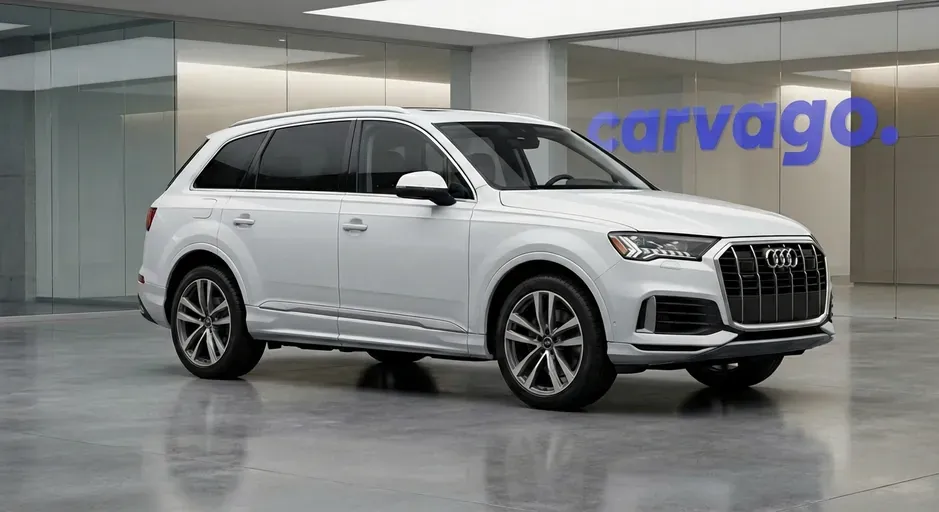
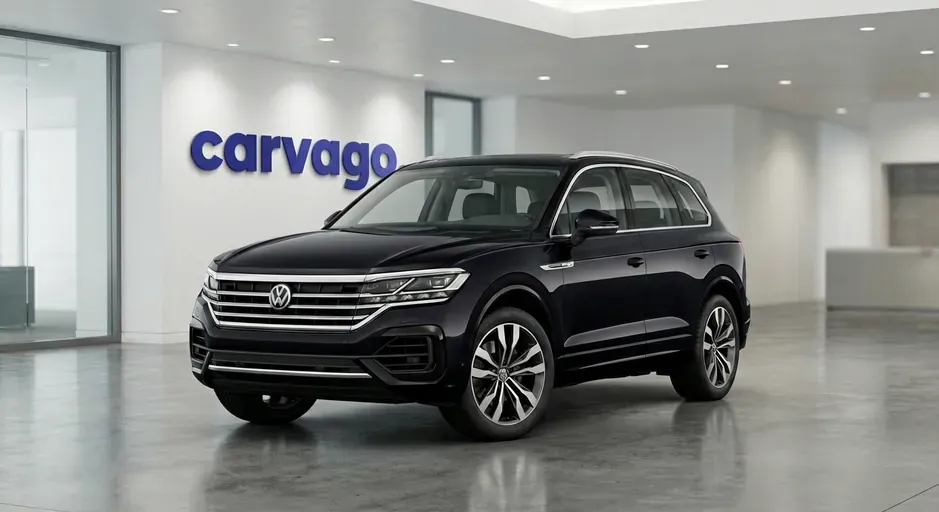
The Audi Q7 is a luxurious and spacious SUV from Ingolstadt that excels with top-tier technologies and often features the highly sought-after seven-seat configuration for demanding users. Its direct technical relative, the Volkswagen Touareg, represents the flagship of the Wolfsburg-based automaker, focusing on precise build quality, an advanced digital cockpit, and a majestic yet slightly less ostentatious design. In the following comparison, we will take a detailed look at how these two platform siblings fare in a head-to-head battle and which of them makes more sense as a slightly used car after approximately four years of operation.
When it comes to exterior dimensions, both models share the advanced MLB Evo chassis platform from the Volkswagen Group workshops, but their physical size and overall concept of space differ significantly. Audi Q7 profiles itself as one of the largest family cruisers on the European market. With a total length reaching up to 5063 mm (in popular versions from recent years), it is a significant 185 mm longer than the Volkswagen Touareg. This generous increase in length, supported by a wheelbase that is 91 mm longer, translates primarily into interior variability. Unlike the Touareg, the Audi Q7 can offer an optional third row of seats, making it a highly practical choice for larger families.
The Volkswagen Touareg, on the other hand, maintains a slightly more modest footprint, which better suits the real-world conditions of European urban infrastructure. With a length of 4878 mm, it is significantly more manageable when looking for a parallel parking space and easier to maneuver in cramped underground garages. An interesting paradox remains, however, that despite the shorter body, the Touareg, at 1984 mm, is 14 mm wider than its sister Audi. This visually gives it a very confident and stable stance on the road, while guaranteeing generous shoulder room for passengers inside. As for height, the Q7 is 24 mm taller, which enhances its monumental silhouette, resembling a raised giant station wagon, while the Touareg bets on more traditional and dynamic SUV proportions.
The decision between these two premium vehicles is thus closely related to your daily needs. If your absolute priority is maximizing interior space, occasionally transporting up to seven people, and you are willing to accept the more demanding maneuvering of a car over five meters long, the Audi Q7 represents a completely logical choice. But if you are looking for a representative and exceptionally comfortable five-seater SUV with more agile dimensions for daily city traffic, which nevertheless feels slightly wider on the road, the Volkswagen Touareg will be a noticeably more pleasant companion.
| Parameter | Audi Q7 SUV | Volkswagen Touareg SUV |
|---|---|---|
| Width (mm) | 1968 - 1970 | 1984 |
| Length (mm) | 5052 - 5072 | 4878 - 4902 |
| Height (mm) | 1734 - 1741 | 1693 - 1717 |
| Wheelbase (mm) | 2994 - 2995 | 2899 - 2904 |
When choosing a large premium family car, luggage compartment volume often plays a decisive role, as it directly affects daily usability and comfort during holiday trips. Both the Audi Q7 and the Volkswagen Touareg are among the above-average spacious vehicles in their class and can easily handle the needs of a large family. In terms of overall concept and body design, both models fall exclusively into the large SUV category, with the Audi Q7 being slightly longer overall, giving it a noticeable advantage in the luggage transport discipline. You will feel the difference between the two cars especially when you need to pack bulkier cargo or a folded stroller for a family trip.
If we look at the basic five-seat versions of these SUVs (specifically models from the generations popular on the market as roughly 4-year-old used cars, namely the Audi Q7 generation 4M and the third-generation Volkswagen Touareg), the Audi Q7 offers a massive basic volume of 865 liters, while the Volkswagen Touareg lags behind with a respectable but still slightly smaller 810 liters. The difference in favor of the Audi might not look like the most important criterion on paper, but in practice, it represents exactly that much-needed space for a few extra suitcases or much easier storage of sports equipment. However, the Q7 builds a huge lead after folding the rear seats. The Touareg can offer a maximum volume of 1800 liters, which is still perfectly sufficient for weekend shopping and longer holidays. But the Audi Q7, in its five-seat variant, can conjure up an impressive 1993 liters of space with an almost flat loading area, making it an exceptionally practical transporter.
It is also important to keep in mind that the trunk volume changes significantly depending on the chosen equipment or engine. The Audi Q7 is often found as a seven-seat SUV among used cars, where the basic volume is reduced to approximately 780 liters after folding the third row of seats into the floor. However, modern plug-in hybrid powertrains bring an even more significant reduction in capacity. While you can pack without compromise in standard internal combustion versions, plug-in hybrid versions (Audi Q7 TFSI e and Volkswagen Touareg eHybrid or the sporty Touareg R) have significantly shallower luggage compartments due to the batteries stored under the floor. The hybrid Q7 thus has to make do with a reduced volume of only 563 liters, and the Touareg offers 665 liters in its electrified version. Therefore, if trunk size is key for you, classic diesel or gasoline engines offer incomparably better usability.
While the Volkswagen Touareg scores as a representative and comfortable car for a classic five-member crew without unnecessarily large overhangs, the Audi Q7 profiles itself as the ultimate family hauler, which can carry up to seven people in a pinch and offers unrivaled cargo variability.
| Parameter | Audi Q7 SUV | Volkswagen Touareg SUV |
|---|---|---|
| Basic volume (liters) | 865 l | 810 l |
| Max. volume with seats folded (liters) | 1993 l | 1800 l |
If maximum variability is your priority and you need to transport truly bulky loads or even occasionally use seven seats, the Audi Q7 emerges from this comparison as the clearly more practical and spatially generous choice for a large family.
When choosing a large premium SUV, the towing capacity is often one of the deciding factors. Whether you plan to tow a heavy caravan for a summer holiday, a two-horse trailer, or a large boat, both of these vehicles are among the best that the market for approximately four-year-old used cars has to offer. Yet, there is one very fundamental difference in their approach to towing power.
The third-generation Volkswagen Touareg (III) is considered an absolute and uncompromising workhorse in terms of towing. Almost regardless of the chosen engine, it offers a standard and maximum braked trailer weight of 3,500 kg. What is fascinating is that even the heavier plug-in hybrid versions, such as the Touareg 3.0 V6 eHybrid or the sporty Touareg R, retain this massive capacity.
In contrast, while the current generation Audi Q7 (4M) can also offer the same impressive 3,500 kg, you will encounter significant differences on the used car market. The standard braked trailer weight for many versions – including the common 45 TDI and 50 TDI diesel engines or the 55 TFSI e and 60 TFSI e plug-in hybrids – often starts at a reduced value of 2,700 kg to 2,800 kg. Achieving the full 3.5-tonne capacity in an Audi is conditional on a specific factory configuration (e.g., choosing adaptive air suspension or a specific seating arrangement). Due to bulky batteries and higher kerb weight, hybrid variants tend to have this lower value as standard.
As for unbraked trailers, both models confidently handle the standard legal limit of 750 kg. In this case, they offer an ideal and safe space for transporting anything – the limits are perfectly sufficient for a typical weekend trip to the DIY store, hauling garden waste, or moving construction materials.
What do these values mean in practice? The 2,700 kg limit for base versions of the Audi Q7 provides plenty of room for several extra suitcases and trouble-free towing of a standard medium-sized caravan, sufficient for a long family holiday. However, the full 3,500 kg pushes the vehicle's capabilities into the category of the most demanding professional and leisure needs, such as heavy yachts or large construction loaders.
In conclusion: If your goal is a versatile family car that occasionally tows something, both SUVs will serve you excellently. However, if you are buying a used car primarily for the purpose of frequently towing the heaviest possible loads, the Volkswagen Touareg represents a much safer bet. You don't have to laboriously decipher equipment codes in the listings to find out the actual towing capacity – almost every unit on the market can handle 3.5 tonnes.
| Model and Engine | Braked Trailer Weight (kg) | Unbraked Trailer Weight (kg) |
|---|---|---|
| Audi Q7 45 TDI / 50 TDI (4M) | 2700 - 3500 | 750 |
| Audi Q7 55 TFSI e / 60 TFSI e (4M) | 2700 - 3500 | 750 |
| VW Touareg 3.0 V6 TDI SCR (III) | 3500 | 750 |
| VW Touareg 3.0 V6 eHybrid / Touareg R (III) | 3500 | 750 |
Since both the Audi Q7 and Volkswagen Touareg are built on a shared platform, they offer a very similar and superbly tuned range of powertrains. The foundation of the used car market for models approximately four years old consists of proven three-liter six-cylinders, both diesel and petrol, which are always paired with an eight-speed automatic transmission and all-wheel drive. An interesting fact from the history of both models is that around 2020, they still offered monstrous diesel V8s with extreme torque of up to 900 Nm, which manufacturers eventually discontinued due to stricter emission standards. Today, six-cylinder diesels are coming to the forefront, excelling in highway range and towing capacity (they can tow up to 3.5 tons). For drivers who cover shorter distances and want to utilize partial electric drive, both manufacturers have very powerful plug-in hybrid alternatives ready.
The engine range for the Audi Q7 (4M generation after facelift, corresponding to an age of roughly 4 years) relies on mild-hybrid technology in its conventional versions, which helps reduce overall consumption. The most popular and sought-after choice in used car dealerships is the more powerful 50 TDI diesel six-cylinder with 210 kW (286 hp) and 600 Nm of torque. For those interested in a quiet and refined petrol engine, the 55 TFSI version with 250 kW is available. Special attention should be paid to the 55 TFSI e and 60 TFSI e plug-in hybrid models. However, it is important to remember that, for example, the top-of-the-line 60 TFSI e version disappeared from the range around 2021, so you will only find older model years of this engine in the used car section.
| Engine type | Fuel | Power (kW) | Torque (Nm) | Transmission |
|---|---|---|---|---|
| 45 TDI (3.0 V6) | Diesel | 170 | 500 | 8-speed tiptronic |
| 50 TDI (3.0 V6) | Diesel | 210 | 600 | 8-speed tiptronic |
| 55 TFSI (3.0 V6) | Petrol | 250 | 500 | 8-speed tiptronic |
| 55 TFSI e (3.0 V6) | PHEV (Petrol/Electric) | 280 | 600 | 8-speed tiptronic |
| 60 TFSI e (3.0 V6) | PHEV (Petrol/Electric) | 335 | 700 | 8-speed tiptronic |
The third-generation Volkswagen Touareg relies on an almost identical concept, albeit with minor nuances. The main role is again played by the three-liter diesel engine labeled 3.0 V6 TDI SCR, typically offered in 170 kW and 210 kW versions. Petrol engines are represented by the refined 3.0 V6 TFSI OPF. A major attraction for enthusiasts until recently was the top-tier 4.0 V8 TDI SCR diesel with 310 kW, but this engine definitely ended production in the autumn of 2020 and is very difficult to find today. The role of the flagship model has thus passed to the powerful Touareg R plug-in hybrid, which combines a petrol six-cylinder with an electric motor for a staggering total output of 340 kW.
| Engine type | Fuel | Power (kW) | Torque (Nm) | Transmission |
|---|---|---|---|---|
| 3.0 V6 TDI SCR | Diesel | 170 / 210 | 500 / 600 | 8-speed tiptronic |
| 3.0 V6 TFSI OPF | Petrol | 250 | 450 | 8-speed tiptronic |
| 3.0 V6 eHybrid | PHEV (Petrol/Electric) | 280 | 600 | 8-speed tiptronic |
| R (3.0 V6 eHybrid) | PHEV (Petrol/Electric) | 340 | 700 | 8-speed tiptronic |
| 4.0 V8 TDI SCR | Diesel | 310 | 900 | 8-speed tiptronic |
For heavy family highway cruisers of this size, the more powerful 210 kW diesel six-cylinder (50 TDI / V6 TDI) remains the logical and most recommended choice, guaranteeing immense towing power and reasonable operating costs.
Choosing the right powertrain for large and heavy premium SUVs is crucial not only for daily driving dynamics but, above all, for long-term reliability and reasonable operating costs. Both the Audi Q7 and Volkswagen Touareg share the identical MLB Evo premium chassis platform, and among four-year-old used cars from the 4M (Audi) and III (Volkswagen) generations, you will mostly encounter proven diesel six-cylinders. An interesting historical fact of this shared generation is that both cars initially offered a monstrous 4.0 V8 TDI, which, however, definitively disappeared from the range in 2020 due to strict emission standards and is now a collector's rarity on the market. The dominant three-liter TDI engines have thus logically become the backbone of sales – in more modern models, they rely on 48V mild-hybrid technology, which excellently masks the two-ton weight of both cars and optimizes real-world fuel consumption.
The version designated as 50 TDI is demonstrably the best choice for the facelifted Audi Q7 (4M) generation, as it perfectly balances premium performance and daily efficiency.
For the third generation of the Volkswagen Touareg, we recommend opting for the technically related 3.0 V6 TDI SCR engine in the more powerful 210 kW (286 hp) specification, which safely dominates the modern used car market.
Official fuel consumption figures provided by manufacturers often differ significantly from what drivers experience in real-world conditions, and this is doubly true for such large and heavy premium SUVs. To get an accurate picture, it is essential to look at real data from owners themselves, collected by independent community portals, led by the popular site Spritmonitor.de. In this comparison, we focus on roughly four-year-old used cars, comparing the most common engines of the current generations (Audi Q7 generation 4M and Volkswagen Touareg 3rd generation), which make the most sense on today's secondary market.
Data source: and user data from Spritmonitor.de
| Model and engine | Average consumption (l/100 km) |
|---|---|
| Audi Q7 55 TFSI e (PHEV) | 2.6 |
| Audi Q7 60 TFSI e (PHEV) | 2.6 |
| VW Touareg R (PHEV) | 2.2 |
| VW Touareg 3.0 V6 eHybrid (PHEV) | 2.4 |
| Audi Q7 45 TDI (Diesel) | 7.9 |
| Audi Q7 50 TDI (Diesel) | 7.9 |
| VW Touareg 3.0 V6 TDI SCR (Diesel) | 8.1 |
| Audi Q7 55 TFSI (Petrol) | 10.2 |
| VW Touareg 3.0 V6 TFSI OPF (Petrol) | 10.8 |
The table clearly shows that although electrified powertrains reign supreme on paper, the traditional diesel V6 remains the most rational choice in practice for these massive SUVs. Diesels (represented by TDI engines) maintain excellent long-term real-world values of around 8 liters per 100 km, which is an outstanding result considering the weight and aerodynamic drag of both vehicles. In contrast, turbocharged petrol V6s (TFSI) show great sensitivity to driving style, and under load, their consumption easily exceeds the 10-liter mark. Plug-in hybrids are a chapter unto themselves. Extremely low averages below 3 liters can only be achieved with meticulous daily charging. Once the battery is depleted, the internal combustion engine must pull the additional weight of the electric motor and battery, causing consumption to skyrocket, often even exceeding the limits of standard petrol versions.
What does this mean for a typical buyer interested in a used model? If you drive long distances, travel frequently on the highway, or use the car for towing trailers, the 3.0 V6 TDI diesel variants in the Touareg or the 45/50 TDI in the Audi Q7 are clearly the most economical and sensible path. Pure petrol models will appeal more to enthusiasts with lower annual mileage who are happy to pay extra for quieter and more refined operation. We recommend purchasing a plug-in hybrid only to those who use the car for daily city commuting and have easy access to a charger both at home and at work.
In conclusion, both vehicles share the same technical foundation and use the same group platform. With comparable engines, their fuel consumption is practically identical, and fuel efficiency itself should not be the main point when choosing between the two cars. Your final decision should primarily depend on which type of fuel and powertrain better suits your real-world driving profile, rather than the badge on the hood.
When looking at the used car market for vehicles approximately four years old (generations produced around 2021 and 2022), there is a clearly visible price difference that reflects the more premium positioning of the Audi brand. While the Volkswagen Touareg (CR generation) represents a more affordable entry into the world of luxury large SUVs, the Audi Q7 (4M generation facelift) maintains a higher residual value.
Both models share the same chassis platform and a large portion of their technology, making them direct and very interesting competitors even on the secondary market.
The offerings for both models are dominated primarily by the popular 3.0 TDI diesel V6 engines. The table below illustrates the typical market price range for cars approximately four years old:
| Model (2021–2022 models) | Estimated starting price | Average market price | Fully equipped versions (S-Line / R-Line) |
|---|---|---|---|
| Volkswagen Touareg | €35,000 | ~ €41,000 | €53,000 and more |
| Audi Q7 | €39,000 | ~ €49,000 | €62,000 and more |
Prices are indicative and depend on mileage, service history, and specific optional equipment.
A used Volkswagen Touareg represents a more rational choice with an excellent price-to-comfort ratio, as it offers top-tier technology for a significantly lower amount. The Audi Q7 requires a noticeable premium, which it easily justifies with a more prestigious image and the ability to carry up to seven passengers.
Both of these premium models earned the maximum five-star rating in independent Euro NCAP crash tests, which is the expected standard in the large family SUV category. When choosing a used car roughly four years old, however, it is crucial to understand the context and the specific year the vehicles underwent testing. Euro NCAP's methodology is constantly evolving and regularly becomes more stringent. Tests from 2018 and 2019 do not yet include the most modern testing protocols, such as cyclist and pedestrian detection when turning at intersections or the new frontal impact simulation with a moving barrier, which only began to be applied after 2020. Thus, the percentage scores cannot be 100% compared with brand-new cars on today's market, but in the context of four-year-old used cars, they remain an exceptionally reliable indicator of excellent structural strength and safety.
The current generation Audi Q7 was last tested in 2019, directly following its significant facelift at the time. The car took home a total of five stars and showed a very strong result in passive safety for adult occupants, for which it earned an impressive 92%. For child passengers, protection reached a safety-guaranteeing 86%. Protection of vulnerable road users (pedestrians and cyclists) ended at 71%, and the safety assist systems category was rated at 72%. This more modest result for assists reflects the state of requirements at the time, when more complex predictive systems did not yet have to be part of the standard equipment of all versions sold.
The third-generation Volkswagen Touareg was tested right at its market debut in 2018. Logically, the overall rating also brought five stars. Although both cars use the same MLB Evo platform, the Touareg's results differed slightly due to a different composition of standard equipment. Adult protection reached an excellent 89%, and child passenger protection recorded the same 86% as the Audi. It is noteworthy, however, that the Touareg received a significantly higher rating for standard safety assist systems (81%) at the time. Although Euro NCAP normally formally terminates the validity of its certificates after six to seven years due to aging technology (which for a model tested in 2018 means an already expired certification), this naturally has no negative impact on the fantastic robustness of the bodywork and the overall protection of the actual occupants in a used car.
In conclusion, this comparison shows that in terms of passive safety, both giant SUVs are built like impregnable fortresses. On paper, the Audi Q7 shows a slight lead in overall adult protection in an impact, while the tested Touareg had a more comprehensive rating for safety assists in its base configuration. From the perspective of today's buyer of a four-year-old used car, however, the models are completely equal, and you won't go wrong with either. Ultimately, the actual level of safety will depend more on how advanced the optional safety systems (e.g., night vision or advanced lane and intersection assist) were prudently chosen by the original owner of the car.
| Parameter | Audi Q7 | Volkswagen Touareg |
|---|---|---|
| Year of testing | 2019 | 2018 |
| Adult occupant protection | 92% | 89% |
| Child protection | 86% | 86% |
| Vulnerable road user protection | 71% | 72% |
| Safety assist systems | 72% | 81% |
Both the Audi Q7 and Volkswagen Touareg represent the absolute top tier in the used car market in terms of protection. Both share an exceptionally rigid platform and will reliably protect your family even in critical situations.
In addition to standard equipment, each of the models offers several unique features that can be decisive for the customer. Although both large SUVs share a common group platform and premium technologies, each adds its own distinctive approach, focus, and added value for everyday use.
The Audi Q7 places great emphasis on futuristic interior design, cutting-edge technologies for a smooth ride, and maximum family practicality.
The Volkswagen Touareg represents the pinnacle of its brand's lineup and focuses on massive digitalization, towing capabilities, and surprising off-road skills without compromising on comfort.
Option of a practical seven-seat interior layout for larger families
Top-tier cabin craftsmanship using premium and highly durable materials
Excellent sound insulation and ride comfort, especially in combination with adaptive air suspension
Advanced quattro all-wheel-drive system ensuring traction in all conditions
High social prestige and slower depreciation of residual value on the used car market
Significantly higher purchase price and more expensive authorized service operations
The third row of seats offers very limited space, suitable more for children
Huge exterior dimensions and a large turning circle make daily city parking difficult
Controlling the air conditioning and other functions via the lower touchscreen distracts from driving
The Audi Q7 represents the pinnacle of luxury for demanding families who require first-class materials, uncompromising comfort on long journeys, and the ability to transport up to seven passengers. It masks its weight brilliantly and offers a prestigious appearance, though one must account for premium maintenance costs and poorer maneuverability in tight spaces.
Uses the same premium platform (MLB Evo) as the Q7 or Porsche Cayenne, but at a more affordable price
Top-tier towing capacity of up to 3.5 tonnes, complemented by the excellent Trailer Assist
Impressive Innovision Cockpit dashboard with a giant 15-inch infotainment display
Less conspicuous, more conservative design that doesn't attract unnecessary attention
Generous and easily accessible luggage compartment with a volume of 810 liters (in the standard five-seat configuration)
Available exclusively as a five-seat SUV; there is no option to pay extra for a third row of seats
In lower trim levels, more ordinary plastics appear in the interior, which don't quite match the high price tag
Faster depreciation in the first years of operation compared to its sister Audi
Although it is a Volkswagen, the prices of spare parts and service are comparable to the premium segment
The Volkswagen Touareg is ideal for drivers who want top-tier technology, air suspension, and the driving characteristics of a luxury SUV, but prefer a more understated look. It represents a more rational and, on the used car market, more cost-effective choice with fantastic towing capabilities, although from a maintenance perspective, it is not a "people's car."
Based on our own inspections through the CarAudit service, long-term owner experience, service reports, and breakdown statistics, we have compiled an overview of the most common problems that buyers of these four-year-old used cars should watch out for.
The second-generation Audi Q7 after its facelift (from 2019 onwards) is a very luxurious and generally mechanically reliable SUV, yet it has its specific weak points, which are usually associated with its extremely complex onboard electronics.
When choosing an Audi Q7, pay maximum attention to the smoothness of gear changes and the condition of the 48V onboard network. A comprehensive check of the complex electronics and potentially the air suspension is an absolute necessity here for your peace of mind and future wallet.
The third generation of the Volkswagen Touareg shares the same premium MLB Evo platform and a significant portion of its technology with the Q7, so typical faults in used cars are often very similar.
The Volkswagen Touareg is a mechanically very durable and mature SUV, where most problems consist only of software teething troubles with the displays and emission-restricted engine-transmission tuning. However, a thorough check of the service history and the functionality of all onboard equipment is absolutely crucial when buying.
When buying a used car, a thorough inspection is key. Both of these premium SUVs share complex technology and the MLB Evo platform, so it is essential to focus on the functionality of expensive electronic and chassis systems. Before you sign the purchase agreement, a comprehensive car inspection is an absolutely ideal step that will help reveal any hidden defects. Here are some specific points to focus on for these two models.
The Audi Q7 is overall longer and offers a more spacious interior, including a larger base trunk volume (up to 865 liters in the five-seater version). The Volkswagen Touareg has a slightly smaller trunk with a total volume of 810 liters. Audi thus serves slightly better for transporting an above-standard amount of luggage.
A third row of seats is offered as optional equipment exclusively for the Audi Q7, making it an ideal choice for larger families. The Volkswagen Touareg is designed purely as a luxury five-seater vehicle. Therefore, you will not find the option to transport seven people in the Touareg at all.
Although both cars share the same MLB Evo chassis platform and most engines, service costs differ slightly. Maintenance, hourly rates at authorized service centers, and specific spare parts tend to be more expensive for the Audi Q7 due to the brand's more premium positioning. The Volkswagen Touareg therefore represents a more economically sensible choice in terms of long-term operation.
Both SUVs provide top-tier comfort, especially if you come across used units equipped with the optional air suspension. However, the Audi Q7 offers slightly better acoustic comfort and an overall smoother ride thanks to its specific chassis tuning. The Volkswagen Touareg, on the other hand, feels slightly stiffer and more agile behind the wheel.
In terms of towing capacity, both models are exactly the same and represent the absolute top of their category. Both the Audi Q7 and the Volkswagen Touareg can tow a heavy braked trailer weighing up to 3,500 kg. This value makes both cars perfect candidates for towing large caravans, boats, or horse trailers.
Sources: ADAC, e15.cz, auto.cz, autorevue.cz, emobility.cz, automotorsport.cz
This article was prepared using artificial intelligence tools. The section guarantor is Petr Dušek.
Detailed comparison of Audi Q7 vs BMW X5. We compare engines, spaciousness, and used car prices. Read our verdict and find out which luxury SUV is the better choice.
Oct 16, 2026
Detailed comparison of the BMW X7 vs. Mercedes-Benz GLS. Discover the real differences in equipment, driving characteristics, and spaciousness, and choose the right luxury SUV for you.
Oct 16, 2026
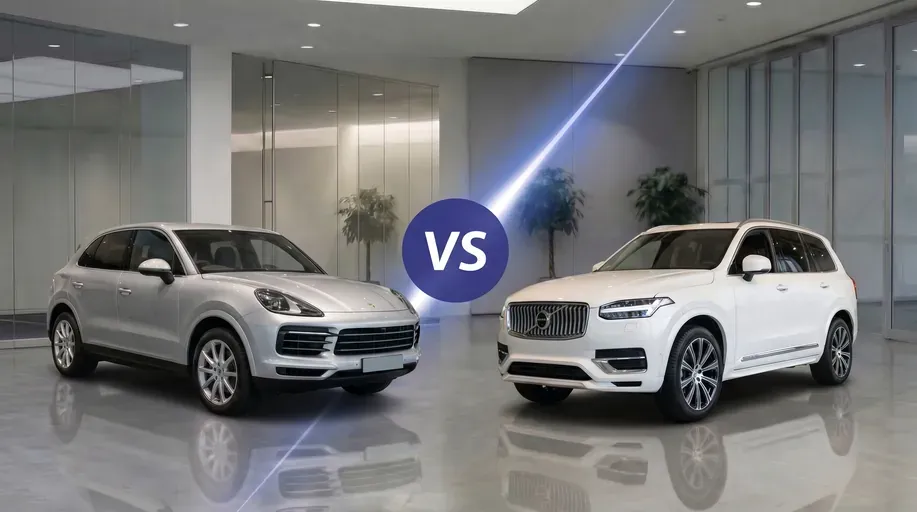
Detailed comparison of Porsche Cayenne vs Volvo XC90. Find out which of these premium SUVs offers better performance, comfort, and operating costs as a used car.
Apr 22, 2026