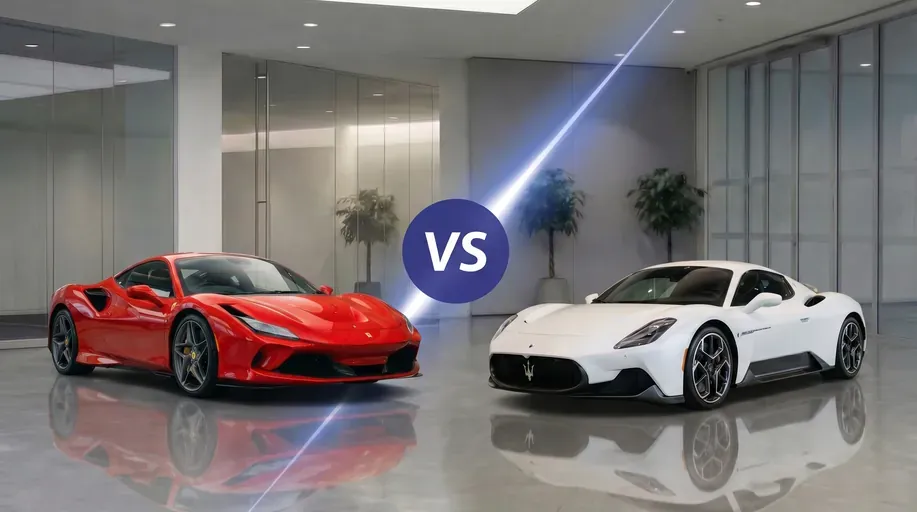
Ferrari F8 Tributo vs. Maserati MC20: Complete comparison 2026
Detailed comparison of Ferrari F8 Tributo vs Maserati MC20. Performance, driving impressions, and a clear verdict that will help you choose the best Italian supercar.
Apr 24, 2026
Articles
Car battle
Alpine A110 vs Mazda MX-5 (Miata) comparison. Discover real-world experiences, a comparison of driving characteristics, and our detailed verdict before buying a used car.
April 27, 2026


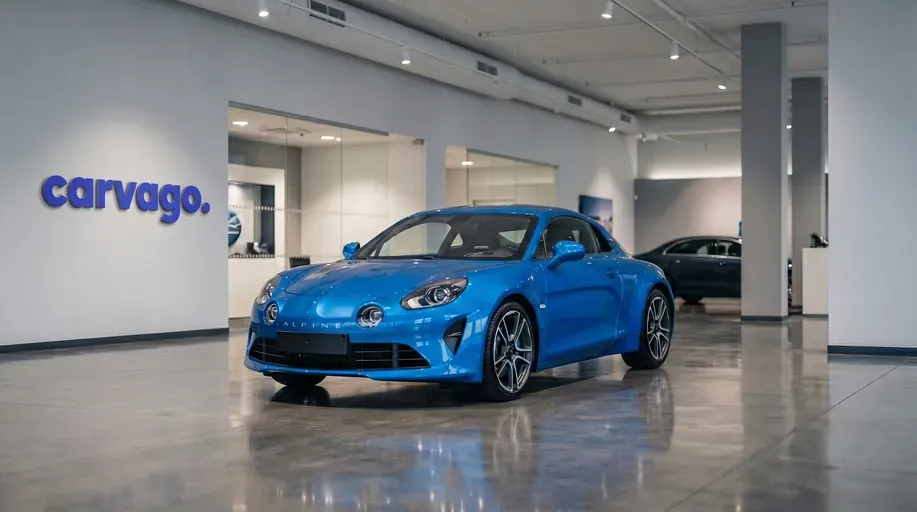
The Alpine A110 represents a spectacular rebirth of the legendary French sports car, dazzling with its ultra-lightweight mid-engine construction and an uncompromising focus on absolute driving purity. Standing against it is the Mazda MX-5, also famous in some markets under the legendary name Miata or Roadster, which for decades has represented the unwavering benchmark for affordable and maximally fun sports convertibles. Dive into our detailed comparison and find out which of these two exceptional machines will best satisfy your driving desires on your favorite winding backroads.
Although both the Alpine A110 and the Mazda MX-5 share a philosophy of lightweight design and maximum driving pleasure, a look at their exterior dimensions reveals that both cars play in slightly different leagues. If we focus on models roughly four years old (the current ND generation for Mazda and the 2nd generation Alpine), the French coupe makes a significantly more muscular and mature impression next to the Japanese roadster. While Mazda stubbornly maintains its status as an ultra-compact purist sports car, Alpine offers slightly more generous proportions. This physical difference fundamentally foreshadows the different approach of both manufacturers to everyday usability and the overall perception of space.
The main yawning gap can be found in the overall length and width of both cars. The Alpine A110 measures 4181 mm in length, which is a significant 266 mm more than the Mazda MX-5, whose length stops at just 3915 mm. Furthermore, at 1798 mm, the French car is 63 mm wider. In practice, this means that thanks to its pocket dimensions, the Mazda is the absolute king when maneuvering in narrow city streets, and parking in tight spaces is a total breeze. Conversely, the greater width and length of the Alpine contribute to better directional stability at higher speeds and give the car a more confident stance. Thus, the Mazda's smaller dimensions are a clear advantage in the city, while the Alpine's wider and longer footprint brings benefits during fast and smooth driving on open roads.
Another key factor is the wheelbase. The Alpine has a wheelbase of 2420 mm, which is exactly 110 mm more than the Mazda (2310 mm). This difference is positively reflected not only in the overall composure of the car in long, sweeping corners but also provides the occupants inside with slightly more living space. In terms of height, both cars are very close – the Alpine measures around 1250 mm, while the Mazda, depending on the version (soft-top Cabriolet or the RF version with a hard folding roof - Coupe), most often ranges between 1225 and 1235 mm. Both cars thus offer an extremely low center of gravity and a seating position close to the asphalt. From the perspective of exterior dimensions, the choice is clear: if you are looking for maximum agility and minimalist dimensions, the Mazda MX-5 has no competition on the used car market. However, if you prefer a more stable car with a more balanced ratio of a more mature body, the Alpine A110 represents the better compromise.
| Parameter | Alpine A110 Coupe | Mazda MX-5 Cabriolet | Mazda MX-5 Coupe |
|---|---|---|---|
| Width (mm) | 1798 | 1735 | 1735 |
| Length (mm) | 4180-4181 | 3915 | 3915 |
| Height (mm) | 1248-1252 | 1225-1230 | 1230-1235 |
| Wheelbase (mm) | 2420 | 2310 | 2310 |
When choosing a purebred sports car like the Alpine A110 or Mazda MX-5, luggage space is usually not the main criterion for a purchase decision. However, it plays a surprisingly important role for those who want to use their car not just for Sunday afternoon drives, but also for weekend trips for two. Although these compact two-seaters cannot be described as having everyday family utility, the ability to safely and comfortably store luggage for a few days can significantly influence how often and with what joy you travel with the car.
The French automaker took a somewhat different approach to space in the Alpine model, considering its mid-engine layout. The Alpine A110 (2nd generation) thus offers a luggage compartment divided into two smaller parts. The front trunk under the hood (the so-called frunk) provides a volume of exactly 100 liters, while the rear storage space behind the engine adds another 96 liters. In total, you have a combined 196 liters at your disposal. In contrast, the Mazda MX-5 (ND generation), with its front-engine layout, relies on a traditional one-piece trunk at the rear. This offers 130 liters in the standard soft-top version and a slightly smaller 127 liters in the RF (Coupé) variant with its more complex retractable hardtop mechanism.
In absolute numbers, the difference is 66 liters in favor of the Alpine. However, practicality is very specific for both cars, and the volume on paper doesn't tell the whole story. The divided space in the French car requires clever packing into soft bags, but it offers room for several extra bags if you arrange your things skillfully. Mazda, on the other hand, has a more modest volume on paper but offers a single, cohesive space that is easily sufficient for weekend shopping or a longer vacation for two, especially if you travel with a standard carry-on suitcase. Due to the rigid structure behind the seats in both of these sports cars, the backrests cannot be folded flat, so the maximum cargo volume equals the basic one.
| Parameter | Alpine A110 Coupé | Mazda MX-5 Convertible | Mazda MX-5 Coupé |
|---|---|---|---|
| Basic volume (liters) | 196 | 130 | 127 |
| Maximum volume with seats folded (liters) | 196 | 130 | 127 |
In terms of total numbers and transport capabilities, the Alpine A110 wins over the Japanese icon, but the need to divide luggage into two relatively narrow and specifically shaped compartments can be limiting when packing. The Mazda MX-5 may offer several dozen liters less, but it provides one continuous space that makes it easier for many drivers to quickly throw in a weekend bag. The decision in this category, therefore, is not about how much you can pack in total, but rather whether you prefer a traditional trunk or would rather get used to a split storage system that ensures perfect weight distribution.
Although the Alpine A110 offers a much larger total volume on paper, divided between the front and rear hoods, the Mazda MX-5's traditional one-piece trunk may prove surprisingly more practical for storing standard weekend luggage.
When comparing the trailer weight of purely sports models such as the Alpine A110 (2nd generation) and the Mazda MX-5 (the popular ND generation on the market for roughly four-year-old used cars), it is necessary to recognize their specific focus. For these light and agile vehicles, driving dynamics and weight reduction are the primary goals, meaning that the manufacturers have completely omitted the possibility of towing any additional load for both cars.
The standard and maximum weight of a braked and unbraked trailer is thus exactly 0 kg in both cases. There is a complete lack of any manufacturer homologation for the installation of a tow bar across all offered trim levels. This fact remains the same for the base Mazda MX-5 engines as well as for the more powerful or track-focused Alpine A110 specifications. No hybrid or otherwise modified variant with a different capacity exists.
From a practical standpoint, this means it is absolutely impossible to expand the very modest transport capacity of these vehicles. A solution in the form of a small trailer, which would provide much-needed space for a few extra suitcases, is simply out of the question. These cars will therefore not be sufficient for weekend shopping for bulkier items or longer holidays with a caravan. Users must rely exclusively on the minimalistic built-in trunks (approximately 190 liters divided between two trunks in the Alpine and just 130 liters in the Mazda).
When deciding between the Alpine A110 and the Mazda MX-5, towing capacity is not a decision factor at all. For both models, you must accept the fact that they are built for the pure joy of driving on twisty backroads, not as practical workhorses. Due to the complete absence of homologation for a tow bar, it was not possible to provide any real data for specific engine variants in the table below.
| Model and motorization | Braked weight of trailer (kg) | Unbraked weight of trailer (kg) |
|---|
Both cars approach propulsion from diametrically different angles, which fundamentally defines their driving character and appeals to a completely different type of driver. The French Alpine A110 coupe bets on a mid-mounted 1.8-liter turbocharged four-cylinder engine, which it shares with the famous Renault Mégane R.S. hot hatch. It thus offers dramatically higher power and a generous portion of torque available across a wide rev range, making it a fantastic tool for crushing acceleration and track driving. In contrast, the Mazda MX-5 remains puristically faithful to the classic front-engine, rear-wheel-drive layout. Its SKYACTIV-G units require revving to the redline and reward the driver with a perfectly linear power delivery and lightning-fast throttle response. While enthusiasts can enjoy one of the best manual transmissions on the market in the Mazda, the Alpine is available exclusively with a lightning-fast dual-clutch automatic. From a used car market perspective, you have to choose between raw and extremely reliable mechanical interaction in the case of the Mazda, or a high-tech approach and aggressive dynamics with the Alpine.
Under the hood (or rather, in front of the rear axle) of the Alpine A110 generation available on the four-year-old used car market, you will find exclusively the 1.8 TCe petrol engine, paired with a seven-speed dual-clutch transmission from Getrag. Standard models (such as Pure or Légende) offer 185 kW (252 hp), which, given the aluminum construction and a curb weight of around one ton, is more than enough for a zero-to-hundred acceleration in 4.5 seconds. The older A110S version had 215 kW, however, since the end of 2021, the A110 S and the more comfortably tuned A110 GT versions were boosted to 221 kW (300 hp) and 340 Nm. This top specification was subsequently also given to the most radical track version, the A110 R. All engine variants are famous for their punchy sound and great flexibility, but you can forget about a classic manual in this model range.
| Engine type | Fuel | Power (kW) | Torque (Nm) | Transmission |
|---|---|---|---|---|
| 1.8 TCe (Standard/Légende) | Petrol | 185 | 320 | 7DCT |
| 1.8 TCe (A110 S - until 2021) | Petrol | 215 | 320 | 7DCT |
| 1.8 TCe (A110 S/GT/R - from 2021) | Petrol | 221 | 340 | 7DCT |
The engine options for the current ND generation Mazda MX-5 on the used market (especially for cars manufactured after the 2018–2019 facelift) rely on two proven high-revving naturally aspirated SKYACTIV-G units. The base variant is a 1.5-liter four-cylinder with 97 kW (132 hp), which benefits from the roadster's extremely low weight. This engine is often chosen by more relaxed drivers focused on lower fuel consumption and playfulness in tight corners, as it feels very sharp thanks to smaller rotating masses. More demanding drivers and those interested in the RF hardtop version, however, in most cases opt for the full-fat two-liter with 135 kW (184 hp), which revs up to 7,500 rpm. Most examples feature a precise six-speed manual transmission; however, a traditional six-speed torque-converter automatic could also be ordered with the two-liter engine (mainly for the RF version). An interesting fact for those looking for a used model is that the more powerful 2.0 SKYACTIV-G 184 engine was discontinued in many markets from 2024 due to fleet emissions; models roughly four years old thus represent one of the best ways to still acquire this excellent engine in near-new condition.
| Engine type | Fuel | Power (kW) | Torque (Nm) | Transmission |
|---|---|---|---|---|
| 1.5 SKYACTIV-G 132 | Petrol | 97 | 152 | 6MT |
| 2.0 SKYACTIV-G 184 | Petrol | 135 | 205 | 6MT / 6AT |
While the Alpine A110 impresses drivers with crushing turbo acceleration and a lightning-fast automatic suitable even for the track, the Mazda MX-5 remains the benchmark for purists seeking the perfect combination of naturally aspirated power and a perfect manual transmission.
Choosing the right engine is absolutely crucial for long-term satisfaction with these sports cars, as both cars represent completely different engineering approaches. While Mazda relies on the classic concept of a purist roadster with a front-mounted naturally aspirated engine and rear-wheel drive, Alpine offers a modern turbocharged unit positioned in the middle for perfect weight distribution. Interestingly, Alpine shares its aluminum four-cylinder with the Renault Mégane R.S. hot hatch, while Mazda developed a completely unique high-revving engine with an unusually high compression ratio for the MX-5. Our following recommendations for roughly four-year-old used cars are based on real-world dynamics, fuel consumption, and verifiable mechanical reliability from the perspective of experienced mechanics.
Although the market also offers more powerful S and GT variants (with up to 300 hp), for a four-year-old used car, the base engine with 252 hp (found, for example, in the Pure trim or the standard model) is the most well-balanced choice.
For the ND generation after the facelift (the so-called ND2 version, available roughly from late 2018 onwards), the more powerful two-liter is the clear favorite. Given that this engine was completely removed from the European new car lineup during 2024, roughly four-year-old used cars with this heart are becoming highly sought-after and valued commodities.
While official fuel consumption figures based on laboratory tests and standards often promise miracles of efficiency, the daily reality of driving is usually a bit different. Especially with sports cars, where their very character tempts you to step on the gas, the liters add up quickly. However, if we look at real-world data from users on independent platforms like the European portal Spritmonitor.de, we find that lightweight construction can work wonders, and the differences compared to official figures are not that vast. For comparison, we have intentionally selected engine versions of both generations around four years old, which are currently on the radar of most buyers looking for a well-maintained used car.
| Model and engine | Average consumption (l/100 km) |
|---|---|
| Mazda MX-5 1.5 Skyactiv-G (97 kW) | 6.3 |
| Mazda MX-5 2.0 Skyactiv-G (135 kW) | 7.2 |
| Alpine A110 1.8 TCe (185 kW) | 7.6 |
| Alpine A110 S/GT 1.8 TCe (215–221 kW) | 8.1 |
The measured data clearly highlights the huge advantage of both lightweight concepts. Although neither manufacturer logically offers heavy diesel engines for these agile sports cars, the petrol four-cylinders prove with their figures that diesel would make no economic sense here. Mazda's naturally aspirated engines deliver on their promised efficiency completely – the smaller 1.5-liter even represents the absolute benchmark for economical sports driving with a real average of 6.3 l/100 km. The larger Japanese 2.0-liter may ask for nearly a liter more, but its dynamic potential and meatier torque are definitely worth it.
Perhaps an even bigger, and it must be added, very pleasant surprise, is the result of the turbocharged 1.8 TCe unit hidden in the middle of the Alpine A110. Although the engine is turbocharged and sends a massive 252 hp to the rear wheels (even up to 300 hp in the S and GT versions), the long-term average consumption in normal traffic stays around a pleasant seven and a half liters. In practice, this confirms that strict weight reduction (which in the Alpine is slightly over 1100 kg) works much better at curbing appetite than relying on a small turbo to automatically save fuel even in a two-ton car.
What does this mean for the average driver or used car buyer?
In conclusion, a clear summary can be drawn: fuel consumption should not play the main role in your final decision in this specific comparison. From a purely mathematical standpoint, the Mazda MX-5 naturally emerges as the more economical winner, but the characters of these cars are so different that the purchase price and preference for specific technology (naturally aspirated with a manual vs. turbo with a lightning-fast dual-clutch automatic) will play the primary role. In any case, both carmakers provide enthusiasts with great proof that you don't need to consume fuel by the hectoliter to have a huge amount of driving fun.
Purchasing a roughly four-year-old sports car (i.e., model years around 2021–2022) represents an ideal compromise between the significant depreciation of a new car and a still excellent, often nearly new technical condition. In the case of the Alpine A110 and Mazda MX-5 (ND generation), however, we are moving in completely different financial and market spheres in used car dealerships and advertisements. While the Mazda is the benchmark for affordable sports driving for the masses, the Alpine targets a narrow group of purists with a much more generous budget and exclusive taste.
The modern reincarnation of the legendary French mid-engine coupe holds its value phenomenally well on the used car market. Due to its exclusivity, lower production numbers, and exceptional all-aluminum construction, its price drops only very slowly.
The world's best-selling roadster is the exact opposite from a market perspective – thanks to mass global production, there is a huge selection among used cars and prices are incomparably more friendly. Even so, the Mazda holds its value better than most common family hatchbacks.
| Model and version | Approximate used car price (in EUR) | Market characteristics |
|---|---|---|
| Mazda MX-5 (1.5 Skyactiv-G) | €21,000 – €25,000 | Most affordable entry into the world of sports cars, huge selection. |
| Mazda MX-5 (2.0 Skyactiv-G / RF) | €27,000 – €35,000 | Highly sought-after variant among enthusiasts with minimal further depreciation. |
| Alpine A110 (Pure/Légende) | €53,000 – €62,000 | Rare commodity on the market, exclusive status, excellent retention of original price. |
| Alpine A110 (S / GT) | €66,000 – €86,000+ | Exceptional dynamics, strong collector potential for the future. |
If you are looking for an affordable and trouble-free ticket to the world of open-top driving joy, a four-year-old Mazda MX-5 has absolutely no competition. In contrast, the Alpine A110 requires at least double the budget, but it rewards you with supercar-level technology, absolute exclusivity on the roads, and minimal further depreciation.
Although in an ideal case we would start a used car comparison by stating that both cars received five-star Euro NCAP ratings, in the category of purist sports cars, it is much more important to perceive the broader context and the year of the testing itself. The testing protocols of the independent Euro NCAP organization are constantly evolving and becoming significantly stricter over time. In practice, this means that percentage scores from different years cannot be directly compared. Today's strict methodology requires sophisticated features, such as advanced cyclist detection or solutions for dangerous scenarios at intersections, which were not assessed at all in older models.
The current generation Mazda MX-5 (ND) underwent crash tests in 2015. According to the standards of the time, it earned a very solid four stars, missing the fifth solely due to the absence of an autonomous emergency braking (AEB) system, which was not common in this class back then. Conversely, the situation with the Alpine A110 is specific. Given that it is an exclusive lightweight sports car with very low sales volume, Euro NCAP has never independently tested this model. For this reason, any official percentage data is missing for comparison and is not listed in the table.
| Parameter | Alpine A110 | Mazda MX-5 |
|---|---|---|
| Year of testing | Not tested | 2015 |
| Adult occupant protection | - | 84 % |
| Child occupant protection | - | 80 % |
| Vulnerable road user protection | - | 93 % |
| Safety assist systems | - | 64 % |
Clear conclusions can be drawn from these results and the overall approach of the manufacturers. The Mazda MX-5 demonstrated an excellent level of structural passive safety for its time. It recorded an extraordinary result in the protection of vulnerable road users (93%), thanks to the standard active pop-up hood that protects pedestrians' heads. Although the validity of this 2015 certificate recently expired according to strict Euro NCAP rules, the mechanical essence of the protection remains intact when purchasing a roughly four-year-old used car.
The French Alpine A110 may not have undergone destruction in laboratories, but it relies on advanced engineering, a modern and exceptionally rigid aluminum construction, and above all, extreme agility. In the spirit of the lightweight sports car philosophy, top-tier brakes and immediate chassis reactions represent your best tool for preventing a crisis situation altogether. Neither car possesses the full suite of modern assistants known from family hatchbacks.
In conclusion, if you are looking for a safer feeling backed by data, the Mazda MX-5 offers a demonstrably more comprehensive and modern safety foundation based on official test results and the integration of features like the active hood. With the Alpine, you must trust the manufacturer's reputation and your own driving skills.
The Mazda MX-5 provides a verifiable safety foundation supported by a very strong four-star rating and a clever hood for pedestrian protection, while the untested Alpine A110 relies primarily on its rigid aluminum construction and top-tier handling, which allows you to avoid a potential accident in time.
In addition to standard equipment, each of these exceptional models offers something extra and approaches the driving experience in its own way, resulting in unique features that can be absolutely crucial for the customer during the final decision-making process.
Unique power-to-weight ratio thanks to all-aluminum construction (kerb weight around 1,100 kg)
Fantastic balance and agility resulting from the mid-engine layout
Surprisingly supple and comfortable suspension even on poor-quality roads
Powerful 1.8 TCe turbocharged engine with instant response and great sound
High exclusivity on the road and excellent residual value retention
Significantly higher purchase price on the used car market compared to the Mazda
Outdated and slower multimedia system with poorer graphics
Strict absence of a manual transmission (only dual-clutch automatic available)
Extremely limited practicality with two tiny and hot luggage compartments (front and rear)
The Alpine A110 is an uncompromising choice for true automotive enthusiasts looking for precise handling, low weight, and the exclusivity of a mid-engine layout. Despite the higher price and compromises in daily practicality, it offers one of the purest driving experiences on the market, brilliantly combining sporting sharpness with unexpected touring comfort.
Unbeatable ratio of purchase price to pure driving joy
One of the best manual transmissions in the world with perfect precision and short throws
Naturally aspirated engines (especially the 2.0 Skyactiv-G) with linear power delivery and great reliability
Low operating costs, accessible service, and cheap spare parts
Option of open-top driving (choice of classic soft top or RF version with a retractable hardtop)
Cramped cabin where drivers over 185 cm will struggle with space
Higher interior noise levels, especially at highway speeds
More pronounced body roll with the standard suspension (often addressed with aftermarket modifications)
Modest and less accessible luggage space with a volume of just 130 liters
The Mazda MX-5 represents the ideal entry ticket into the world of classic rear-wheel-drive sports cars and serves as the benchmark for the purist roadster. It is perfect for drivers who want to enjoy the maximum analogue connection with the machine and the wind in their hair, while appreciating low maintenance costs and trouble-free daily ownership.
Based on long-term user experience, service reports, reliability statistics, and the results of a comprehensive car audit, we have compiled an overview of the most common problems that used car buyers should watch out for.
The Alpine A110 is a purist sports car with a lightweight construction that is mechanically quite robust, but faces minor compromises associated with low-volume production.
The basic mechanics of the A110 are above-average reliable, but the specific aluminum body means extremely expensive repairs even after minor accidents. Daily use is most hampered by the moody infotainment and occasional creaking in the interior.
The Mazda MX-5 ND generation is globally one of the most reliable sports cars on the market, yet it also has its known weak points to focus on when choosing.
The Mazda MX-5 is a mechanically exceptionally reliable car, where the high-revving naturally aspirated engines fail only very rarely. Pay attention especially to the soft and delicate paint, the condition of the soft top, and a documented service history.
When buying a used sports car, a thorough inspection is key because these cars are expected to be used at the limit of their capabilities, and both mentioned cars have their specifics to watch out for. A careful independent technical inspection of the car can save you many future worries and unexpected expenses.
Mazda MX-5 offers better practicality thanks to a denser service network, a classic layout with better cabin access, and lower running costs. However, the Alpine A110 is surprisingly comfortable on longer journeys due to its compliant suspension tuning, despite having very limited and specifically designed storage space. If you are looking for a carefree and reliable car for every day, the Japanese roadster makes a bit more sense.
The Alpine A110 is significantly faster thanks to its turbocharged 1.8 TCe engine with at least 252 hp and a low weight of around 1,100 kg. The French coupe accelerates from 0 to 100 km/h in approximately 4.5 seconds, while the top-of-the-line Mazda MX-5 with a two-liter naturally aspirated engine (184 hp) needs 6.5 seconds to reach the same speed. In terms of pure straight-line dynamics, the Alpine is in a completely different league.
Yes, these differences completely define the driving character of both cars. The Mazda MX-5 follows the traditional recipe with a front-longitudinal engine, rear-wheel drive, and a fantastic short-throw manual gearbox. In contrast, the Alpine A110 has a turbocharged engine mounted mid-ship behind the seats for optimal weight distribution and relies exclusively on a seven-speed dual-clutch automatic transmission.
Both cars are among the absolute top of lightweight sports cars, but they provide a completely different driving experience. The Mazda excels with its playfulness at lower speeds, smooth responses from the naturally aspirated engine, and a pure mechanical connection to the car thanks to the manual. The Alpine fascinates with the incredible lightness of its front axle, immediate willingness to change direction, and grip that evokes much more expensive supercars.
The Alpine A110 is a relatively rare and highly regarded sports car, which means its depreciation curve drops very slowly. The Mazda MX-5 is produced in larger numbers, but especially the version with the more powerful two-liter engine holds its price excellently on the used car market. However, in the long run, the French model has a better chance of becoming a sought-after collector's item with the potential for future value growth.
Choosing between the Alpine A110 and the Mazda MX-5 represents a classic dilemma between affordable purist fun and exclusive engineering approaching full-fledged supercars. With its fantastic manual transmission, high-revving naturally aspirated engine, and more favorable running costs, the Japanese roadster is the ideal choice for drivers looking for a reliable and daily-usable car for pure joy with the wind in their hair. In contrast, the lightweight French coupe with a mid-mounted turbocharged engine targets more demanding enthusiasts who don't mind the significantly higher purchase price, as in exchange they get a lightning-fast, phenomenally agile, and highly collectible machine. While the Mazda thus remains an unsurpassed benchmark for affordable driving experiences even on the used car market, the Alpine brings a breathtaking level of genuine racing precision to winding backroads.
Sources: ADAC, lidovky.cz, mdcr.cz, autojournal.cz, dopravniinfo.cz, carfans.cz
This article was prepared using artificial intelligence tools. The section guarantor is Petr Dušek.

Detailed comparison of Ferrari F8 Tributo vs Maserati MC20. Performance, driving impressions, and a clear verdict that will help you choose the best Italian supercar.
Apr 24, 2026

Audi R8 or Maserati MC20? Comparing performance, design, and handling. Our detailed test helps you choose the perfect supercar.
Apr 13, 2026

Detailed comparison: Renault Mégane vs Toyota Corolla. Discover the differences in engines, equipment, and reliability, and find out which used car is the best for you.
Apr 13, 2026