Ford Edge vs. Nissan X-Trail: Complete comparison 2026
Detailed comparison of Ford Edge vs. Nissan X-Trail (Rogue). Discover the differences in spaciousness, equipment, and reliability. Read our verdict and make the right choice!
Apr 15, 2026
Articles
Car battle
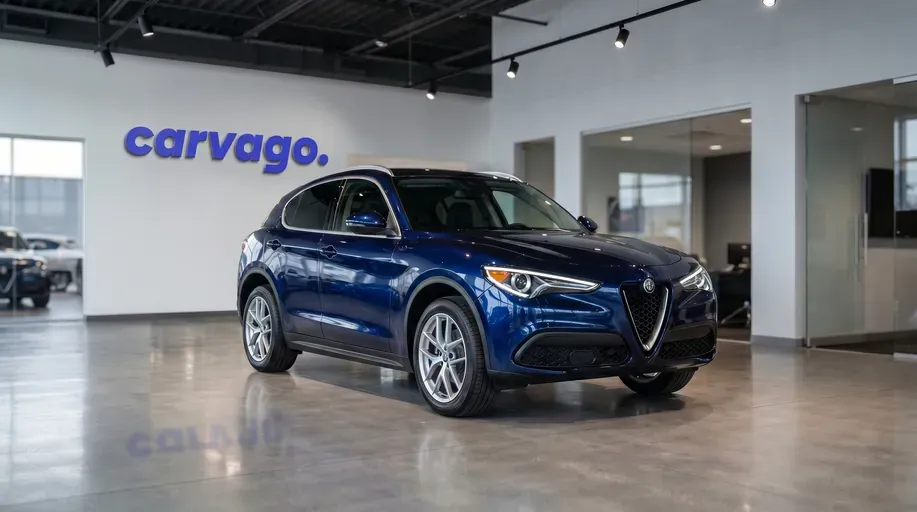
Choosing a used SUV? Detailed comparison of the Alfa Romeo Stelvio vs. Volvo XC60. A detailed verdict, performance and equipment ratings will help you make your choice. Find out more!
April 21, 2026


Alfa Romeo Stelvio brings unmistakable Italian passion and driving dynamics to the premium mid-size SUV segment, rivaling that of sports cars. In contrast, the Volvo XC60 is built on entirely different values, attracting customers with minimalist Scandinavian elegance, top-tier safety, and maximum travel comfort. In this comparison, we take a detailed look at both of these diametrically opposed approaches to a luxury family car to help you decide which one better suits your daily needs and deserves a place in your garage.
When you place the Alfa Romeo Stelvio and Volvo XC60 side by side, you find that their exterior proportions are surprisingly similar. Both premium SUVs share almost identical basic length and width to the millimeter. While the Italian model measures 4,687 mm in length and 1,903 mm in width as standard, its Swedish competitor is practically identical with a length of 4,688 mm and a width of 1,902 mm. In terms of maneuvering in parking lots, underground garages, or narrow city streets, there is no choosing between them – both cars have a nearly identical footprint and require the same amount of space from the driver. Additionally, with the Alfa Romeo, you might come across the top-of-the-line Quadrifoglio version, which is slightly longer and wider due to its sporty accessories.
More interesting differences appear when looking at the wheelbase. The Volvo XC60 offers a wheelbase of 2,865 mm, which is 47 mm more than the Alfa Romeo (2,818 mm). This difference in favor of the Nordic SUV translates positively into longitudinal cabin space, primarily benefiting rear-seat passengers. Furthermore, the longer wheelbase contributes to a smoother and more stable ride on highways, which perfectly aligns with Volvo's typically comfort-oriented focus. Conversely, the Stelvio intentionally relies on a shorter wheelbase, which, combined with sharper steering, gives it more agile and sporty driving characteristics in winding corners.
Regarding overall height, the Alfa Romeo surprisingly slightly exceeds its Swedish competitor. While the Volvo XC60 stays at 1,658 mm for roughly four-year-old used cars, the Stelvio reaches a height of up to 1,693 mm. Although one might expect a more crouched silhouette from a car with such strong sporting DNA, the Alfa's taller build can offer a slightly more upright driving position and make daily entry feel easier. Ultimately, the Volvo will appeal to those looking for a used family car with more generous space for rear passengers, while the Alfa Romeo will attract drivers who prefer more nimble vehicle responses without having to make significant compromises in daily practicality.
| Parameter | Alfa Romeo Stelvio SUV | Volvo XC60 SUV |
|---|---|---|
| Width (mm) | 1903 - 1955 | 1902 |
| Length (mm) | 4687 - 4701 | 4688 |
| Height (mm) | 1671 - 1693 | 1658 |
| Wheelbase (mm) | 2818 | 2865 |
Trunk capacity is one of the key parameters when choosing a mid-size family SUV. Practicality and the ability to accommodate all luggage play just as important a role for many buyers as the driving characteristics or comfort on board. In the market for roughly four-year-old used cars, where the Italian Alfa Romeo Stelvio and the second generation of the Swedish Volvo XC60 often face off, you will encounter surprisingly different approaches to the use of interior space, which can fundamentally influence your final decision.
The Alfa Romeo Stelvio will please drivers looking not only for a dynamic ride but also for unexpectedly generous luggage space. In its basic configuration, it offers a generous trunk with a volume of 525 liters. However, if you fold down the rear seats, you get a space of an impressive 1600 liters, which is perfectly sufficient for a weekend shopping trip or a longer vacation with the whole family. The competing Volvo XC60 in its classic and mild-hybrid engine versions provides a slightly more modest 483 liters as standard, with its transport capacity increasing to 1410 liters after folding down the backrests. In a direct comparison, the Italian representative scores significantly by offering space for several extra suitcases, which is a very pleasant surprise for a premium SUV with a sporty character.
When buying a used Volvo XC60, it is also necessary to monitor the chosen engine, as you will encounter versions with different capacities on the market. Increasingly popular plug-in hybrid variants labeled Recharge (T6 and T8) have a slightly reduced volume due to the placement of the heavy traction battery, specifically 468 liters in the base and 1395 liters with the rear seats folded. Although Volvo lags behind its Italian rival in absolute numbers, it bravely makes up for this minor handicap in the field of practicality. The Swedish SUV scores with the regular shapes of its side walls, well-thought-out fixing systems, and especially a perfectly flat loading area without a loading sill, which makes handling heavy cargo as easy as possible.
| Parameter | Alfa Romeo Stelvio SUV | Volvo XC60 SUV |
|---|---|---|
| Base volume (liters) | 525 | 483 |
| Max volume with seats folded down (liters) | 1600 | 1410 |
While the Alfa Romeo Stelvio triumphs in total volume and can easily carry more luggage, the Volvo XC60 may lose in absolute numbers but compensates with a top-tier approach to the trunk and practical improvements. For families craving maximum space, however, the Italian SUV is the surprising winner.
If you plan to hitch a caravan, boat, or heavy trailer behind your car, both of these premium SUVs (focusing on models approximately four years old) offer very solid figures, but there are important differences between them. The trailer weight fundamentally affects the overall practicality of the vehicle for active families looking for a car that offers not only interior space for a few extra suitcases but also enough towing power for a weekend purchase of bulky materials or a longer holiday with a heavy caravan.
Both the standard and maximum braked trailer weights for both models are above average, while the unbraked trailer has the same legislative limit of 750 kg for both cars. For the Alfa Romeo Stelvio, the capacity depends significantly on the specific engine. Weaker petrol versions 2.0 Turbo (147 kW) have a standard towing capacity of 1600 kg, while more powerful petrol (206 kW) and popular 2.2 Diesel variants can pull a respectable 2300 kg.
The Swedish Volvo XC60 performs even slightly better in terms of maximum values. Most of its mild-hybrid engines (B4, B5, B6) and popular diesel versions (D4) can tow 2300 to 2400 kg. However, a more significant difference in the Volvo is represented by the plug-in hybrid versions (T6 and T8), where, due to the additional weight of the traction batteries, a slightly reduced capacity of 2100 to 2250 kg must be expected. Even this reduced limit is, however, perfectly usable for transporting most common loads without any problems.
Final summary: The Volvo XC60 is the slightly stronger contender in this comparison, as the vast majority of its engines offer a capacity reaching up to 2400 kg. The Alfa Romeo Stelvio lags only slightly behind with its powerful engines (2300 kg); however, with the base petrol version, you are significantly limited by a 1600 kg limit. For the hybrid versions of the Volvo, a slight compromise must be expected, although values safely exceeding two tonnes will not pose any obstacle for the vast majority of users in real life.
| Model and engine | Braked trailer weight (kg) | Unbraked trailer weight (kg) |
|---|---|---|
| Alfa Romeo Stelvio 2.0 Turbo 16V (147 kW) | 1600 | 750 |
| Alfa Romeo Stelvio 2.0 Turbo 16V (206 kW) | 2300 | 750 |
| Alfa Romeo Stelvio 2.2 Diesel | 1600 - 2300 | 750 |
| Volvo XC60 B4 / B5 / B6 | 2300 - 2400 | 750 |
| Volvo XC60 D3 / D4 / D5 | 2300 - 2400 | 750 |
| Volvo XC60 T6 / T8 (Plug-in Hybrid) | 2100 - 2250 | 750 |
When comparing the engine options of these two premium SUVs, the completely different philosophies of the two brands are clearly revealed, which is a key factor for those interested in a car roughly four years old. The Alfa Romeo Stelvio bets on passion, driving dynamics, and classic internal combustion engines that give the car an unmistakable sporting character. Standard diesel and petrol versions of the Italian representative benefit from excellent pairing with a lightning-fast eight-speed gearbox and focus primarily on performance and immediate response. Conversely, the Volvo XC60 takes a determined path of modern technology, maximum refinement, and widespread electrification. While you won't find any hybrids in this generation of the Alfa, the Swedes have completely electrified their range and deployed efficient mild-hybrids or extremely powerful plug-in hybrids. The Stelvio will thus delight enthusiastic drivers and lovers of the old ways looking for emotion behind the wheel, while the XC60 will perfectly serve drivers focused on the family budget, ecology, and a quiet, unhurried ride.
The engine range for the Alfa Romeo Stelvio is pleasantly straightforward and completely avoids complex electrified systems. For used car buyers, this can be very attractive due to theoretically lower future service costs. There is no ordinary "weak" base here – the entry point to the world of petrol is the turbocharged 2.0 Turbo 16V four-cylinder with 147 kW (200 hp), complemented by an even sharper variant with 206 kW (280 hp). Lovers of long motorway journeys and fans of lower fuel consumption will most often reach for the reliable all-aluminum 2.2 Diesel engine. This was gradually available in versions with 118 kW (160 hp), 140 kW (190 hp), and the top 154 kW (210 hp). A major asset of the entire model range is the standard-fit excellent ZF eight-speed automatic transmission. Although weaker diesel engines could also be purchased with pure rear-wheel drive, most used cars on the market boast the Q4 all-wheel-drive system with a strong rear-axle preference, underlining the fantastic driving experience. The proverbial gem for connoisseurs and collectors is the uncompromising Quadrifoglio version with a 2.9 V6 Bi-Turbo, born in collaboration with Ferrari. This provides the driver with a crushing 375 kW, or 382 kW in the most recent model years.
| Engine type | Fuel | Power (kW) | Torque (Nm) | Transmission |
|---|---|---|---|---|
| 2.0 Turbo 16V | Petrol | 147 / 206 | 330 / 400 | 8-speed auto |
| 2.2 Diesel | Diesel | 118 / 140 / 154 | 450 / 470 | 8-speed auto |
| 2.9 V6 Bi-Turbo Quadrifoglio | Petrol | 375 / 382 | 600 | 8-speed auto |
The second generation of the Volvo XC60 offers a significantly more diverse, but inherently also technically more complex, range of powertrains on the used car market. Modern technology and an emphasis on low fuel consumption prevail in the offering. An important fact for used car buyers is that pure internal combustion engines such as the petrol T4 and T5, or the very popular D3, D4, and D5 diesels, were phased out between 2020 and 2021. You will essentially no longer find them in younger used cars, as the Swedish brand has fully replaced them with updated mild-hybrid variants (labeled B). In these, a small onboard electric motor helps with smoother starts and the unobtrusive operation of the start-stop system. Diesel versions, whether the older D4 (140 kW) or the more modern B4 Diesel (145 kW) and B5 Diesel (173 kW), play the role of excellent and economical motorway cruisers. With the exception of the long-discontinued manual in the D3 version, power is handled by the comfortable Geartronic eight-speed automatic. A separate elite chapter is the exceptionally successful T6 Recharge and T8 Recharge plug-in hybrid units. These combine a two-liter petrol engine with massive assistance from an independent electric motor. They can travel approximately 45 kilometers purely on electricity, and the top T8 version boasts a staggering combined output exceeding 300 kW, making even a family SUV an inconspicuous rocket.
| Engine type | Fuel | Power (kW) | Torque (Nm) | Transmission |
|---|---|---|---|---|
| T4 / B4 | Petrol (incl. Mild-hybrid) | 140 / 145 | 300 | 8-speed auto |
| T5 / B5 | Petrol (incl. Mild-hybrid) | 184 | 350 | 8-speed auto |
| T6 / B6 | Petrol (incl. Mild-hybrid) | 220 - 228 | 400 - 420 | 8-speed auto |
| D3 | Diesel | 110 | 320 | 6-speed man. / 8-speed aut. |
| D4 / B4 Diesel | Diesel (incl. Mild-hybrid) | 140 / 145 | 400 / 420 | 8-speed auto |
| D5 / B5 Diesel | Diesel (incl. Mild-hybrid) | 173 | 480 | 8-speed auto |
| T6 Recharge | Plug-in Hybrid | 250 - 257 | 590 - 659 | 8-speed auto |
| T8 Recharge | Plug-in Hybrid | 288 - 335 | 640 - 709 | 8-speed auto |
While the Alfa Romeo Stelvio charms with pure internal combustion engines and untamed sporting DNA, the Volvo XC60 dominates with perfect refinement, advanced plug-in hybrids, and uncompromising ecological efficiency.
Choosing the right engine is absolutely crucial for long-term satisfaction with these premium SUVs. Our recommendation is based on real-world experience, mechanical reliability, and everyday practicality. Each manufacturer approaches the powertrain from a different angle – while the Italian Stelvio boasts an ultra-lightweight construction with a carbon fiber driveshaft even in the base trim, which dramatically improves driving response, Sweden's Volvo, on the other hand, promotes maximum safety (including a blanket top speed limit of 180 km/h) and a strong lean towards mild-hybrid electrification. In the market for roughly four-year-old used cars, we are thus choosing between a mechanical Italian classic and Swedish hi-tech efficiency.
This engine represents an absolutely ideal choice on the used car market for those looking for the perfect compromise between driving experience and reasonable operating costs. The all-aluminum four-cylinder diesel is paired with an excellent eight-speed ZF automatic transmission and the rear-biased (on-demand all-wheel drive) Q4 system.
For roughly four-year-old XC60s (second generation), it's worth reaching for the updated mild-hybrid unit labeled B4 Diesel, which seamlessly replaced the previous popular D4 engines in the lineup. It consists of a two-liter diesel and a 48V starter-generator.
Official fuel consumption figures provided by manufacturers are often far from reality nowadays, which is why it is crucial to follow the daily experiences of owners themselves when choosing an approximately four-year-old used car. Data obtained from user portals, such as the German Spritmonitor, give us a much clearer picture of the appetite with which these premium models actually drive. The comparison below focuses on the real average consumption of the most common engine variants of the Alfa Romeo Stelvio and Volvo XC60, where we focused mainly on generations and drivetrains relevant to the used car market from 2020 to 2022.
| Model and engine | Average consumption (l/100 km) |
|---|---|
| Alfa Romeo Stelvio 2.2 Diesel | 6.8 – 7.5 |
| Alfa Romeo Stelvio 2.0 Turbo 16V | 9.0 – 10.5 |
| Alfa Romeo Stelvio Quadrifoglio | 11.5 – 13.0 |
| Volvo XC60 B4/B5 Diesel (Mild-Hybrid) | 6.5 – 7.2 |
| Volvo XC60 B4/B5 Petrol (Mild-Hybrid) | 8.5 – 10.0 |
| Volvo XC60 T6/T8 Recharge (PHEV) | 3.0 – 7.5 (depending on charging) |
Looking at real data, it is evident that diesel engines firmly defend their place in such large mid-size SUVs. Volvo XC60 diesel engines (more recently labeled B4 and B5) benefit slightly from added mild-hybrid technology, which can save valuable tenths of a liter in city traffic. However, the classic Italian 2.2 Diesel four-cylinder under the Stelvio's hood proves that it can operate highly efficiently even without battery assistance, and both cars easily fit within the seven-liter limit under normal use.
More noticeable differences come in the world of petrol. Alfa Romeo's two-liter turbo (2.0 Turbo 16V) is built for a pure driving experience and fierce dynamics, where the small engine displacement ensures lightning-fast reactions rather than economy – real consumption here therefore quite easily approaches and occasionally exceeds the ten-liter mark. Swedish petrol mild-hybrids B4 and B5 are slightly more economical, but they are still not exactly thrifty cars. A specific case is the extremely popular T6 and T8 Recharge plug-in hybrids from Volvo. Unlike official tests promising figures around one liter, reality shows a huge range. If the owner charges regularly, the car operates at a fraction of normal costs, but with a discharged battery on the highway, the heavy Volvo has consumption identical to regular internal combustion versions, partly due to its higher weight.
For the typical user and driver covering long highway distances, both cars in diesel versions remain an absolutely ideal choice. Consumption can ultimately be a decisive factor, especially for budget-conscious buyers or people commuting from the suburbs to the center – while Volvo offers technically advanced plug-in hybrids suitable for daily emission-free commuting (provided you have a home wallbox), the petrol Alfa Romeo's thirstiness makes it clear that its main priority is always and under all circumstances exclusively driving emotions.
Looking at used cars approximately four years old (mostly 2021 and 2022 models) reveals an interesting difference in how both models hold their value. Both the Alfa Romeo Stelvio and Volvo XC60 started as new cars with a premium price tag, but the used car market has a different dynamic that perfectly reflects the preferences of European buyers.
Alfa Romeo generally faces a slightly steeper depreciation curve in the first years of operation, making it an extremely attractive choice on the secondary market.
Volvo traditionally holds its value very well on the used car market. The reason is its strong reputation as an exceptionally safe, practical, and timeless family car.
| Model | Base price (higher mileage) | Average price (good condition) | Top versions (PHEV / Sport) |
|---|---|---|---|
| Alfa Romeo Stelvio | from €25,000 | €33,000 – €41,000 | €66,000+ (Quadrifoglio) |
| Volvo XC60 | from €27,000 | €35,000 – €45,000 | €41,000 – €54,000 (Recharge) |
While the Alfa Romeo Stelvio represents a more affordable entry into the world of premium sports SUVs due to faster depreciation, the Volvo XC60 holds its value significantly better and represents a stable long-term investment for more conservative and family-oriented drivers.
Both models earned the maximum five-star rating in their independent Euro NCAP crash tests. However, when choosing a used car, it is essential to view this result in the correct context. Euro NCAP testing protocols are constantly evolving and becoming more stringent, meaning that percentage results from different years are not directly comparable. Newer tests already include, for example, advanced frontal impact simulations with a moving barrier, more precise cyclist detection, or the reactions of assistance systems at intersections. From the perspective of the market for roughly four-year-old used cars, the situation for comparison is ideal – both cars underwent testing in the same year (2017), when their tested generations were launched. We can thus compare them head-to-head, although it should be kept in mind that their five-star certification has formally expired according to today's much stricter safety standards.
Alfa Romeo Stelvio performed excellently in the tests, particularly in the area of passive safety. Thanks to the outstanding structural rigidity of its lightweight Giorgio platform, it achieved a superb 97% in adult occupant protection, which at the time of its launch ranked it among the safest vehicles for the occupants during the impact itself. It also showed solid results in child protection (84%). However, a significant weakness of this sportily-styled SUV at the time was the absence of a wider range of active assistants in the standard equipment. For safety assistance systems, Alfa Romeo therefore took home a rating of only 60%, as it lacked more advanced functions for predicting and preventing accidents at higher speeds.
Volvo XC60, on the other hand, absolutely excelled in the tests, confirming the Swedish brand's reputation as a global leader in automotive safety. It earned an almost unbeatable 98% in adult protection and managed 87% for child protection. However, the truly vast difference compared to its Italian competitor was revealed in the safety assistance systems category, where Volvo triumphed with a massive 95% score. This is thanks to the exceptionally rich standard equipment, which already included advanced autonomous braking responding to pedestrians, cyclists, large animals, and approaching vehicles at intersections in the base model.
| Parameter | Alfa Romeo Stelvio | Volvo XC60 |
|---|---|---|
| Year of testing | 2017 | 2017 |
| Adult occupant protection | 97% | 98% |
| Child occupant protection | 84% | 87% |
| Vulnerable road user protection | 71% | 76% |
| Safety assistance systems | 60% | 95% |
When comparing these two models, the conclusion is quite clear. Although passive occupant protection is at a top-tier and comparable level for both premium SUVs, Volvo offers a much more comprehensive approach to avoiding the accident itself. From the perspective of current safety requirements, a roughly four-year-old Volvo XC60 offers a significantly richer package of active assistants, making it a demonstrably more advanced and safer choice, especially for family use.
Both SUVs provide first-class protection for the occupants during an impact, but the Volvo XC60 overwhelmingly beats the competition in terms of assistance systems that can effectively prevent accidents.
In addition to standard equipment, each of the models offers several unique features that can be decisive for the customer. While the Italian SUV appeals to emotions and driving enthusiasm, the Swedish representative bets on calmness, innovative technology, and maximum comfort on board.
Top-tier driving dynamics and sharp, exceptionally precise steering
Attractive and emotive Italian design that easily stands out in traffic
Powerful engines paired with a perfectly tuned ZF automatic transmission
Excellent 50:50 weight distribution and rear-biased drive (even for Q4 all-wheel drive models)
Decent reliability of mechanical parts in post-facelift models (from 2020 onwards)
Outdated and less responsive infotainment with poor parking camera quality
Firmer suspension tuning, which can be less comfortable on rough roads
Limited interior storage space and overall lower family practicality
Faster depreciation of residual value on the used car market compared to premium rivals
The Alfa Romeo Stelvio is the clear choice for driving enthusiasts who expect sporty performance from an SUV and don't want to blend in with the crowd. It is ideal for those who are willing to sacrifice a bit of practicality and comfort in exchange for a huge dose of emotion and genuine driving pleasure.
First-class levels of active and passive safety with excellent assistance systems
Extremely comfortable orthopedic seats and overall top-tier suspension comfort
Elegant, minimalist, and luxuriously crafted interior with high-quality materials
A wide range of efficient and very powerful plug-in hybrid powertrains (Recharge)
Advanced multimedia system with integrated Google services (in newer model years)
Detached steering and overall heavier, less engaging driving dynamics in corners
Control of most basic functions (including climate control) exclusively via the touchscreen
In plug-in hybrid versions, the luggage compartment volume is reduced due to the battery
Higher prices for spare parts and overall more expensive servicing
The Volvo XC60 is the perfect premium SUV for families looking for maximum safety, peace on board, and understated Scandinavian luxury. It perfectly suits drivers who require comfortable and quiet long-distance highway cruising without any ambitions for sporty driving.
Based on long-term user experience, service bulletins, and data provided by our comprehensive car audit, we have compiled an overview of the most common problems you should watch out for with these approximately four-year-old SUVs.
The first-generation Alfa Romeo Stelvio suffers mainly from minor quirks in the onboard electronics, while its mechanical foundation and engines are surprisingly robust and reliable when properly maintained.
The Stelvio pleases with a solid mechanical foundation and reliable engines, but it requires strict adherence to service intervals and will occasionally test your patience with minor software glitches or sensitivity to a weak battery.
The second-generation Volvo XC60 is an exceptionally safe and luxurious SUV, but its highly complex modern technology and emphasis on ecology can take their toll as age and mileage increase.
While safety, materials, and driving comfort are at the absolute top, potential used car buyers should pay maximum attention to the condition of the complex air suspension, leaks in diesel units, and expensive hybrid system components.
When buying a used car, a thorough inspection is key. Although both of these premium SUVs are very attractive, each has its own specifics and weak points that are worth focusing on when choosing a used car. To avoid costly repairs, the best step is always a comprehensive car inspection, which reveals hidden defects on the chassis, engine wear, and electronic errors.
Alfa Romeo Stelvio is much sportier and more agile on country roads thanks to its top-tier platform and very precise steering. Volvo XC60 on the other hand focuses primarily on maximum comfort, cabin quietness, and overall on-board well-being during long journeys. The Stelvio is therefore the clear choice for enthusiastic drivers, while the Swedish competitor serves perfectly for calm family travel.
In terms of official volume, the Alfa Romeo Stelvio leads slightly with 525 liters compared to 483 liters for standard versions of the Volvo XC60. However, the Swedish SUV offers a slightly more practical and regular trunk shape, making it easier to load larger and bulky items. Be careful with the popular plug-in hybrid versions of the Volvo, where the trunk volume is reduced to 468 liters due to the stored batteries.
The Volvo XC60 is generally considered a more robust car with very durable interior materials, but its more complex plug-in hybrid systems may represent a more expensive service item in the future. After the facelift in 2020, Alfa Romeo significantly improved build quality and electronics reliability, but it still requires more careful adherence to service intervals. When choosing a used car, it depends primarily on the documented service history and the care of the previous owner for both vehicles.
The Volvo XC60 is historically and technologically at the absolute top in passive and active safety and offers some of the most advanced driving assistants on the market. Although the Alfa Romeo Stelvio easily achieved five stars in Euro NCAP tests, its assistance systems do not reach such complexity and refinement of interventions. The Volvo thus represents a safer and more modern choice for families concerned with maximum protection.
The Volvo XC60 is known for its powerful plug-in hybrid versions (Recharge), which allow a real range of around 40 to 50 kilometers purely on electricity. The Alfa Romeo Stelvio does not offer electrified powertrains at all in this generation and relies exclusively on traditional internal combustion engines. Therefore, if you have the option to charge at home and want to drive around town with zero emissions, the Volvo is the only possible choice in this comparison.
The decision between these two premium SUVs ultimately depends on whether your desire for driving emotions wins out, or the requirement for maximum safety and travel comfort. Alfa Romeo Stelvio represents the ideal choice for enthusiastic drivers who will appreciate its top-tier driving characteristics, exceptionally sharp steering, and the pure character of classic internal combustion engines. In contrast, the Volvo XC60 will primarily appeal to family-oriented customers looking for quiet Scandinavian luxury, an unrivaled package of safety assistants, and advanced hybrid technologies that reduce fuel consumption in the city. So, if you want to properly enjoy every corner behind the wheel, reach for the Italian temperament, while for quiet, comfortable, and reliable swallowing of highway kilometers with the whole family, the Swedish workhorse will be a better companion.
Sources: ADAC, novinky.cz, aktualne.cz, autoservis.cz, autotechnik.cz, autorskola.cz
This article was prepared using artificial intelligence tools. The section guarantor is Petr Dušek.

Detailed comparison of Ford Edge vs. Nissan X-Trail (Rogue). Discover the differences in spaciousness, equipment, and reliability. Read our verdict and make the right choice!
Apr 15, 2026

Audi Q5 vs. BMW X3: Which premium SUV is better? Our detailed comparison and verdict will help you choose the right car for your needs.
Apr 14, 2026

Detailed comparison of the Nissan X-Trail and Toyota Highlander. Find out which family SUV offers better space, equipment, and fuel consumption. Read our final verdict!
Apr 18, 2026