Review
Review Volvo S90: What do owners and experts really say?
Volvo S90 review: real owner experience, reliability, engine picks and used prices. Discover running costs and faults before you buy.
Oct 20, 2026
Volvo V90 review: real owner experience, common faults, engine picks, running costs, and used prices for the estate and Cross Country.
November 7, 2026
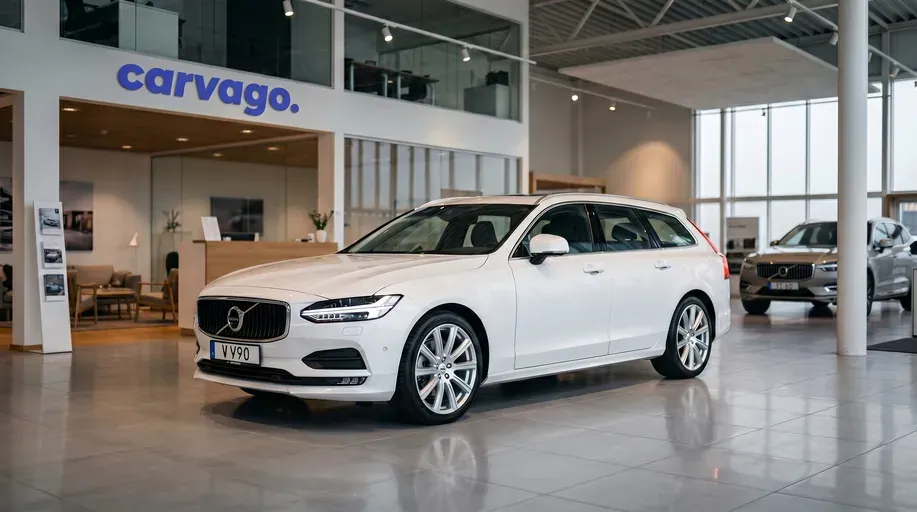
The Volvo V90 represents the Swedish manufacturer in the executive estate segment, positioned as an alternative to long-standing German competitors. This review covers the second modern generation built on the Scalable Product Architecture (SPA) platform. Series production commenced at the Torslanda facility on 22 June 2016, with initial European customer deliveries arriving in October 2016. Alongside the standard Volvo V90 estate, Volvo introduced the raised, all-wheel-drive Volvo V90 4x4 Cross Country variant, which reached customers in early 2017.
A mid-cycle facelift was unveiled on 21 February 2020, with series production beginning in May 2020 for the 2021 model year. The update introduced subtle exterior styling revisions, updated lighting signatures, and 48-volt mild-hybrid systems across the conventional petrol and diesel ranges, followed by revised plug-in hybrid battery hardware in late 2021. Factory order books closed on 30 September 2025, and series production ended permanently in October 2025.
Offered exclusively as an estate, the V90 primarily attracts long-distance business drivers and family buyers seeking estate utility, towing capability, and a lower driving position than an equivalent SUV provides.
The second-generation Volvo V90 and lifted Cross Country have accumulated a substantial service history across European markets. Professional workshop data and owner reports indicate that while the mechanical core of the vehicle is robust, electrified variants and complex auxiliary components require careful pre-purchase scrutiny.
On early plug-in hybrid variants—the T6 and T8 Twin Engine and early Recharge models produced between 2017 and 2022—owners frequently report mechanical degradation of the Electric Rear Axle Drive unit. Symptoms develop as high-pitched whining, rumbling, or harsh shuddering under electric power, occasionally triggering a dashboard warning and disengaging all-wheel drive. The underlying cause lies in internal bearing wear, failing dog-clutch disconnects, or coolant seal leaks. Flushing the lubricant does not cure mechanical noise once present; owners report that resolving the defect typically requires an overhauled or updated rear drive unit.
On early diesel Volvo V90 models equipped with the D5 engine (2016–2020), the PowerPulse system is a recurring trouble spot. The system uses a pressurised tank to inject air into the exhaust manifold to reduce low-rpm turbo lag. The braided rubber delivery hose is prone to splitting or blowing off its fittings, accompanied by an audible pop, hissing under throttle, and increased lag off idle. Volvo introduced a revised, reinforced hose kit with modified clamps that in most cases resolves the failure.
Vehicles fitted with optional rear self-levelling air suspension present another known issue. Over time, road grime and suspension articulation cause micro-cracks in the rubber air spring bellows, leading to gradual overnight pressure loss. Because the leak is slow, the pneumatic compressor runs continuously to compensate, ultimately overheating and burning out. Professional workshops emphasize that fitting a new compressor without renewing both leaking rear air springs leads to repeat compressor failure within months. Additionally, both early portrait-oriented infotainment systems (2016–2021) and the later Google-based operating system (2022–2025) have drawn owner complaints regarding slow boot times from cold, frozen displays, or intermittent telematics communication drops, though software reloads resolve stability issues in most cases.
Several official safety recall campaigns have been registered across Europe for this generation of the Volvo V90:
Every powertrain in the modern Volvo V90 estate is built around a modular 2.0-litre four-cylinder architecture mounted transversely, spanning pure combustion units, 48V mild hybrids, and plug-in hybrids. Depending on the model year, power delivery ranges from front-wheel drive to all-wheel drive, with automatic transmissions dominating the lineup.
| Engine | Fuel | Power | Gearbox | Drivetrain | Model years |
|---|---|---|---|---|---|
| 2.0 D3 | Diesel | 110 kW (150 hp) | 6-speed manual | FWD | 2016–2020 |
| 2.0 D3 | Diesel | 110 kW (150 hp) | 6-speed automatic | FWD | 2016–2020 |
| 2.0 D3 AWD | Diesel | 110 kW (150 hp) | 8-speed automatic | AWD | 2016–2020 |
| 2.0 D4 | Diesel | 140 kW (190 hp) | 6-speed manual | FWD | 2016–2020 |
| 2.0 D4 | Diesel | 140 kW (190 hp) | 8-speed automatic | FWD | 2016–2020 |
| 2.0 D4 AWD | Diesel | 140 kW (190 hp) | 8-speed automatic | AWD | 2016–2020 |
| 2.0 D5 AWD | Diesel | 173 kW (235 hp) | 8-speed automatic | AWD | 2016–2020 |
| 2.0 B4 Diesel | Diesel MHEV | 145 kW (197 hp) | 8-speed automatic | FWD | 2020–2024 |
| 2.0 B4 Diesel AWD | Diesel MHEV | 145 kW (197 hp) | 8-speed automatic | AWD | 2020–2024 |
| 2.0 B5 Diesel AWD | Diesel MHEV | 173 kW (235 hp) | 8-speed automatic | AWD | 2020–2023 |
| 2.0 T4 | Petrol | 140 kW (190 hp) | 8-speed automatic | FWD | 2017–2020 |
| 2.0 T5 | Petrol | 187 kW (254 hp) | 8-speed automatic | FWD | 2016–2018 |
| 2.0 T5 | Petrol | 184 kW (250 hp) | 8-speed automatic | FWD | 2018–2020 |
| 2.0 T6 AWD | Petrol | 235 kW (320 hp) | 8-speed automatic | AWD | 2016–2018 |
| 2.0 T6 AWD | Petrol | 228 kW (310 hp) | 8-speed automatic | AWD | 2018–2020 |
| 2.0 B4 | Petrol MHEV | 145 kW (197 hp) | 8-speed automatic | FWD | 2020–2025 |
| 2.0 B5 | Petrol MHEV | 184 kW (250 hp) | 8-speed automatic | FWD | 2020–2025 |
| 2.0 B6 AWD | Petrol MHEV | 220 kW (300 hp) | 8-speed automatic | AWD | 2020–2022 |
| 2.0 T6 AWD Recharge | Petrol PHEV | 251 kW (340 hp) | 8-speed automatic | AWD | 2020–2021 |
| 2.0 T6 AWD Recharge | Petrol PHEV | 257 kW (350 hp) | 8-speed automatic | AWD | 2021–2025 |
| 2.0 T8 AWD Twin Engine | Petrol PHEV | 300 kW (407 hp) | 8-speed automatic | AWD | 2017–2018 |
| 2.0 T8 AWD Twin Engine | Petrol PHEV | 288 kW (390 hp) | 8-speed automatic | AWD | 2018–2021 |
| 2.0 T8 AWD Recharge | Petrol PHEV | 335 kW (455 hp) | 8-speed automatic | AWD | 2021–2025 |
For regular long-distance motorway driving and touring, a diesel Volvo V90 remains the most sensible choice. The front-wheel-drive D4 and the mild-hybrid B4 diesel balance steady pace with relaxed high-speed cruising, while the twin-turbo D5 AWD adds immediate low-end throttle response and stronger pulling power for heavy estates. Drivers who frequently haul heavy trailers or traverse unpaved terrain should target all-wheel-drive diesels, which provide the required towing reserves without straining the drivetrain.
Urban drivers and short-distance commuters should bypass the diesels entirely to avoid exhaust soot accumulation. The entry-level petrol T4 or mild-hybrid B4 petrol provide smooth suburban manners, assisted in stop-and-go traffic by the starter-generator. For mixed commuting with access to home charging, the plug-in hybrid Volvo V90 models—such as the later Extended Range T6 and T8 Recharge—allow daily city trips to run exclusively on electric power while retaining strong petrol reserves for weekend getaways.
| Model | Length (mm) | Width (mm) | Height (mm) | Wheelbase (mm) | Boot volume (l) |
|---|---|---|---|---|---|
| Standard V90 (Pre-facelift, 2016–2020) | 4,936 | 1,879 | 1,475 | 2,941 | 560 / 1,526 |
| Standard V90 (Facelift, 2020–2025) | 4,945 | 1,879 | 1,478 | 2,941 | 551 / 1,517 |
| V90 Cross Country (Pre-facelift, 2016–2020) | 4,936 | 1,929 | 1,543 | 2,941 | 560 / 1,526 |
| V90 Cross Country (Facelift, 2020–2025) | 4,959 | 1,929 | 1,543 | 2,941 | 551 / 1,517 |
Note: Width excludes door mirrors. Plug-in hybrid variants feature a slightly lower roofline due to chassis packaging but retain the same cargo capacity as mild hybrids because the battery is housed in the central floor tunnel.
Inside the Volvo V90 estate, rear passengers benefit from substantial legroom thanks to the long wheelbase, making long-distance journeys comfortable for two tall adults. Headroom is accommodating despite the sloping roofline, although the wide floor tunnel limits foot space for anyone seated in the middle position. Daily practicality is reinforced by a flat luggage floor with no awkward loading lip and a wide opening. The rear backrests split and fold flat in a standard 60/40 arrangement, accompanied by an integrated ski hatch in the centre armrest that allows long items to slide through without sacrificing both outer seats. The sharply raked rear window cuts into vertical capacity when stacking bulky cargo right to the ceiling, but the broad and uniform floor area easily handles pushchairs, large suitcases, and weekly family duties.
On smooth motorways, the Volvo V90 estate settles into a relaxed, long-legged cruise with well-isolated wind noise. The suspension prioritises calm progression over sporting agility, leaning perceptibly through quick corners. While the primary ride absorbs long undulations smoothly, testers note that sharp ridges and manhole covers send noticeable thuds through the rear axle, an effect amplified on cars fitted with optional larger wheels. The steering is light and accurate, though it delivers minimal feedback from the road surface. Four-cylinder diesel variants exhibit audible clatter under hard acceleration, whereas petrol and hybrid options provide quieter progress.
Inside, the cabin draws consistent praise for solid material finishes and front seats that provide supportive, fatigue-free posture over long journeys. Ergonomics face more criticism: testers regularly point out that managing climate settings and secondary functions exclusively through the portrait touchscreen demands too much visual attention while driving. Professional reviews broadly agree that the Volvo V90 prioritises understated comfort rather than driver engagement. Where opinions diverge is low-speed bump absorption on standard suspension, with some testers finding it sufficiently supple and others noting secondary stiffness. The facelift introduced smoother powertrain transitions on hybrid models alongside subtle styling adjustments, while retaining the estate's composed cruising character.
All market charts in this section draw from Carvago’s advertised listings across the whole Volvo V90 model family, including other generations represented in the data, rather than isolating the reviewed generation alone. As a result, this overview does not establish a separate price level for specific production runs. Among available listings, the median asking price starts at €25,000 for 2019 builds, climbing through €32,200 for 2021 models and reaching €47,900 for 2024 and 2025 registrations, before settling at €44,400 for 2026 listings where volume narrows.
Between May 2026 and October 2026, the number of advertised Volvo V90 listings grew from 1,733 to 1,904, as illustrated in the monthly count below.
Active listings over time
| Month | Volvo V90 |
|---|---|
| 2026-05 | 1 733 |
| 2026-06 | 1 744 |
| 2026-07 | 1 808 |
| 2026-08 | 1 787 |
| 2026-09 | 1 891 |
| 2026-10 | 1 904 |
Source Carvago
Buyers can expect a plentiful selection on the market, with overall choice expanding across the six months despite a brief decrease to 1,787 listings in August.
The median asking price of cars advertised today, built in 2019, is €25,000, while the median asking price of cars advertised today, built in 2024, is €47,900. The chart below shows how these median asking prices compare across build years from 2019 to 2026.
Median advertised price by year of manufacture
| Model year | Volvo V90 |
|---|---|
| 2019 | 25 000 |
| 2020 | 28 900 |
| 2021 | 32 200 |
| 2022 | 36 700 |
| 2023 | 44 000 |
| 2024 | 47 900 |
| 2025 | 47 900 |
| 2026 | 44 400 |
Source Carvago
Buyers exploring 2020 models encounter a median asking price of €28,900, while those considering 2022 models face a median asking price of €36,700. The figures are not strictly higher with each newer build year, as listings built in 2025 match the 2024 median of €47,900, and 2026 models record a lower median asking price of €44,400.
This depreciation curve tracks how the Volvo V90 loses residual value with vehicle age, shedding about 17% in its first year and 27% by age three. The chart below illustrates how this decline unfolds across seven years.
Residual value by vehicle age
| Vehicle age | Volvo V90 |
|---|---|
| New | 48 000 |
| 1 yr | 39 900 |
| 2 yrs | 39 000 |
| 3 yrs | 35 000 |
| 4 yrs | 31 100 |
| 5 yrs | 27 800 |
| 6 yrs | 25 600 |
| 7 yrs | 22 800 |
Source Carvago
Across the full seven-year span shown, the model sheds roughly 53% of its initial residual value, retaining just under half. The steepest single drop occurs in the first year, after which the rate of depreciation moderates noticeably between age one and two.
Hybrid models accounted for the largest advertised volume, recording 1,109 listings in October 2026 compared to 503 for diesel. The figures below trace how monthly listing counts split across each fuel type from May to October 2026.
Supply composition by fuel type
Petrol
Diesel
Hybrid
| Month | Petrol | Diesel | Hybrid |
|---|---|---|---|
| 2026-05 | 275 | 526 | 927 |
| 2026-06 | 268 | 509 | 964 |
| 2026-07 | 277 | 510 | 1 019 |
| 2026-08 | 273 | 495 | 1 017 |
| 2026-09 | 289 | 511 | 1 089 |
| 2026-10 | 290 | 503 | 1 109 |
Source Carvago
Hybrids represent the clear majority of available vehicles, followed by a sizable selection of diesels and a smaller pool of petrol cars. Shoppers will encounter the widest choice among hybrid versions, whereas those seeking pure petrol models will have noticeably fewer cars to consider.
The chart below tracks the average asking price for the Volvo V90 from May 2026 to October 2026, starting at €34,200 and finishing at €33,300.
Average price development over time
| Month | Volvo V90 |
|---|---|
| 2026-05 | 34 200 |
| 2026-06 | 34 000 |
| 2026-07 | 33 700 |
| 2026-08 | 33 800 |
| 2026-09 | 33 500 |
| 2026-10 | 33 300 |
Source Carvago
Across the six months, the average shifted downward by less than 3% from €34,200 to €33,300, with a brief rise to €33,800 in August 2026. That total change is minor relative to the overall price level and reflects modest month-to-month variation rather than a sustained market shift.
Composed motorway cruising with low wind noise and supportive front seats
Flat cargo area with no loading lip and unaffected boot capacity on hybrid variants
Accommodating rear legroom suitable for tall passengers on long journeys
Operating climate and secondary controls exclusively via the touchscreen distracts while driving
Sharp road ridges and manhole covers cause noticeable thuds, particularly on larger wheels
Plug-in hybrid models risk electric rear axle degradation and safety recalls requiring VIN verification
The mechanical core of the Volvo V90 is robust, but electrified powertrains and optional chassis gear demand caution. In particular, early plug-in hybrids and cars with rear air suspension require verified maintenance history to prevent costly repairs.
For motorway touring and heavy hauling, a diesel Volvo V90 like the D4 or mild-hybrid B4 diesel balances relaxed cruising with strong pulling power. Short-distance urban drivers should avoid diesels to prevent exhaust soot accumulation and opt instead for petrol or plug-in hybrid models.
Check the service records and VIN against official safety recalls, especially on plug-in hybrid models. On a test drive, listen for abnormal whining from the rear electric drive unit and confirm the rear air suspension does not lose pressure overnight.
Across the advertised Volvo V90 market, median asking prices start around €25,000 for older model years. Hybrid variants represent the clear majority of available vehicles, offering buyers the widest selection.
Sources: volvocars.com, adac.de, autocar.co.uk, autoexpress.co.uk, autobild.de
This article was prepared using artificial intelligence tools. The section guarantor is Petr Dušek.
Volvo S90 review: real owner experience, reliability, engine picks and used prices. Discover running costs and faults before you buy.
Oct 20, 2026
Mercedes-Maybach S-Class review: real owner experience, common faults, engine picks and luxury tech — everything you need before you buy.
Nov 3, 2026
Lexus ES review: expert verdicts, hybrid and electric performance, cabin luxury, real-world specs and pricing for the all-new executive saloon.
Oct 31, 2026