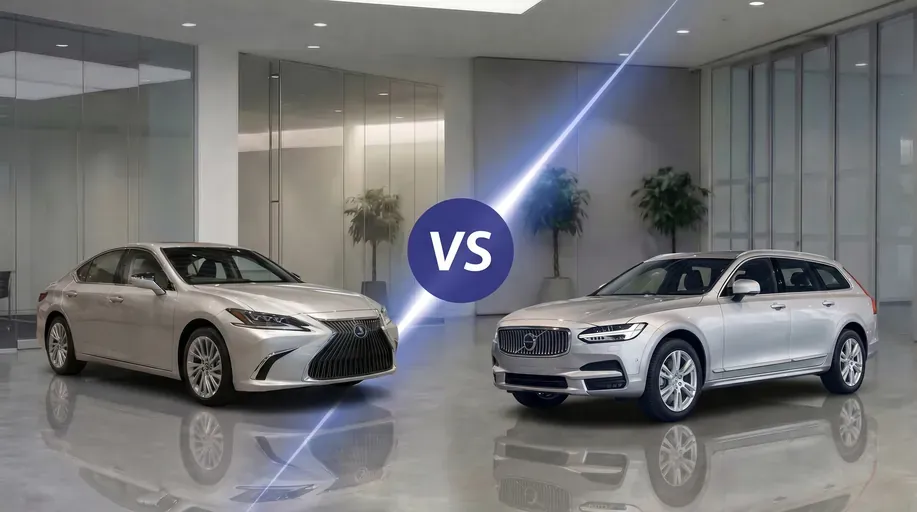
Car battle
Lexus ES vs. Volvo V90: Complete comparison 2026
Lexus ES or Volvo V90? Read a detailed comparison of these premium cars. We evaluate reliability, comfort, and real-world operating costs. Find out the winner!
May 12, 2026
Lexus ES review: expert verdicts, hybrid and electric performance, cabin luxury, real-world specs and pricing for the all-new executive saloon.
October 31, 2026
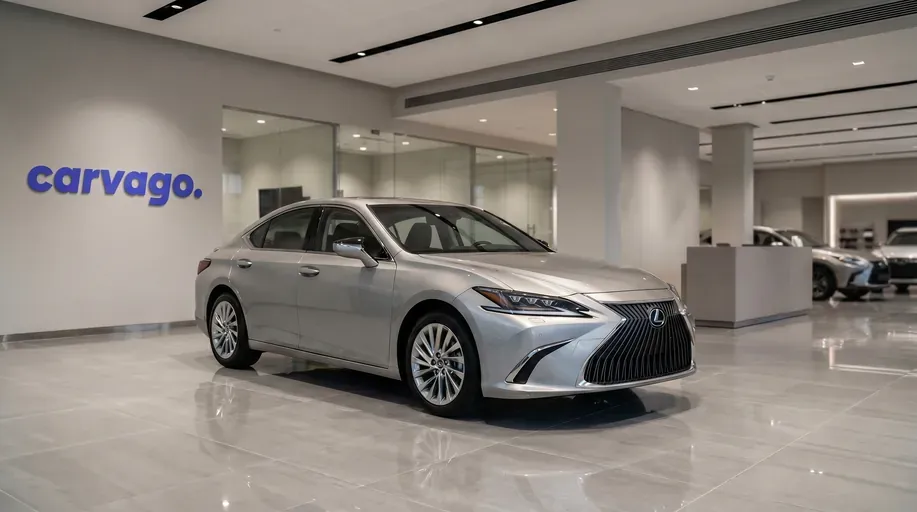
The Lexus ES serves as the brand's entrant in the upper-midsize executive segment, providing an alternative to traditional European executive models. This review focuses on the eighth-generation model, which had its world premiere on 23 April 2025 and entered production in December 2025. Replacing the seventh generation that ran from 2018 to 2026, European customer deliveries of the eighth generation commenced in July 2026.
Sold exclusively as a four-door Lexus ES saloon, this generation introduces both fully electric and self-charging hybrid powertrains to European buyers. Given its recent introduction, no facelift or mid-cycle update has taken place to date.
The ES is aimed primarily at business users, fleet operators, and long-distance drivers seeking an electrified executive cruiser focused on relaxed travel and cabin quietness rather than rear-wheel-drive sporting characteristics.
European customer deliveries of the eighth-generation Lexus ES commenced in July 2026. Because this generation has been in customer hands for only a few months, long-term owner experiences and recurring component wear patterns have not yet been established. Early feedback from initial road tests and franchised dealer networks has noted no chronic electrical breakdowns or systemic mechanical defects, but this absence of recorded faults reflects the model's recent market introduction rather than proven permanent immunity.
Prospective buyers researching safety notifications will find that zero safety recalls have been issued targeting this eighth-generation saloon. However, an extensive multi-model campaign published in November 2025 named the model line across European and global markets. This campaign covered 1,066,857 Lexus vehicles worldwide, including 9,277 in Germany, and affected both left-hand and right-hand drive models.
According to the official safety notice, due to a software issue, the Parking Assist control unit that works with the Panoramic View Monitor to show the rearview camera image may briefly freeze when backing up if reverse gear is selected shortly after starting the vehicle. In addition, the rearview camera may not appear the next time the vehicle is started if the vehicle is turned on and off again within a short time window, which may increase the risk of a crash with a person or another vehicle during a backing event. The official build window for this campaign covers vehicles manufactured between 31 March 2021 and 09 September 2025. Because production of this eighth-generation car began in December 2025, physical exposure to that defect strictly predates this generation.
On early used examples entering the market—consisting primarily of dealer demonstrators and management vehicles—powertrain hardware on both the hybrid Lexus ES and fully electric Lexus ES variants has operated without recurring field defects.
The eighth-generation Lexus ES divides its European powertrain line-up between self-charging hybrid and fully electric options. Depending on the country, buyers can choose front-wheel-drive or electric all-wheel-drive configurations across both propulsion systems.
| Engine | Fuel | Power | Drivetrain | Gearbox | Model years |
|---|---|---|---|---|---|
| ES 300h | Petrol hybrid | 148 kW (201 hp) | Front-wheel drive | Automatic | 2026–present |
| ES 300h | Petrol hybrid | 148 kW (201 hp) | All-wheel drive | Automatic | 2026–present |
| ES 350h | Petrol hybrid | 182 kW (247 hp) | Front-wheel drive | Automatic | 2026–present |
| ES 350h | Petrol hybrid | 182 kW (247 hp) | All-wheel drive | Automatic | 2026–present |
| ES 350e | Electric | 165 kW (224 hp) | Front-wheel drive | Automatic | 2026–present |
| ES 500e | Electric | 252 kW (343 hp) | All-wheel drive | Automatic | 2026–present |
For urban commuting and frequent short hops, the front-wheel-drive electric Lexus ES provides zero local emissions and quiet operation. Urban drivers who lack dedicated home-charging facilities will find the front-wheel-drive hybrid Lexus ES more convenient for stop-and-go conditions, as its system recuperates deceleration energy without requiring plug-in stops.
For mixed daily driving, the standard hybrid variants offer an effective compromise by operating on electric drive at low speeds and blending in combustion power when needed. Buyers who regularly encounter winter weather or wet gradients should consider the all-wheel-drive Lexus ES hybrid, which uses an additional rear electric motor to stabilise traction during pull-away.
For consistent long-distance motorway driving, the hybrid variants remain the practical pick because their driving range does not depend on public charging availability. The dual-motor electric variant delivers prompt passing response, but continuous high cruising speeds deplete battery energy faster and require planned fast-charging stops along highway corridors.
| Dimension / Capacity | Saloon (Hybrid) | Saloon (Electric) |
|---|---|---|
| Length (mm) | 5,140 | 5,140 |
| Width (mm) | 1,920 | 1,920 |
| Height (mm) | 1,555 | 1,560 |
| Wheelbase (mm) | 2,950 | 2,950 |
| Boot volume, seats up (l) | 493 | 517 |
| Boot volume, seats folded (l) | Unverified | Unverified |
Note: Width excludes exterior mirrors; mirror-inclusive width and maximum boot capacity with rear seatbacks folded remain unverified by the manufacturer.
Thanks to a long wheelbase, the Lexus ES saloon provides ample rear legroom, allowing adult passengers to sit without their knees contacting the front seatbacks. Headroom in both rows, however, is restricted by the low, sloping fastback roofline and a raised seating position that accommodates the underfloor battery hardware. Everyday cargo usability varies across the range: the battery-electric Lexus ES provides a slightly larger luggage bay than the self-charging hybrid, though neither powertrain includes a front storage compartment under the bonnet. Neither hybrid nor electric versions are homologated for towing. Carrying longer items is facilitated by a centre through-load ski hatch, but broader cargo versatility is compromised because versions fitted with optional power-reclining rear seats forfeit the split-folding seatback mechanism entirely.
Professional road tests describe the Lexus ES as a comfort-focused cruiser. Over urban ruts and rough asphalt, the chassis glides with cushioned compliance, while acoustic glass and thorough insulation isolate wind rush and tyre slap from the cabin. However, this soft springing compromises composure over undulations at higher speeds, where testers note floaty vertical body movements. Steering is light and precise enough for easy placement, but cornering responses remain inert and roll-prone, making the long saloon feel heavy and unengaging on twisting roads.
Inside, testers praise the tactile material choices, tight panel gaps, and optional backlit bamboo trim, which create an upscale cabin atmosphere. The digital ergonomics prove less convincing. Replacing conventional switchgear with flush, illuminated touchpads on the dashboard requires deliberate eyes-off-road attention, and operating regular functions within the large central multimedia display can feel distracting while driving.
Testers agree unanimously on the car's quietness, low-speed bump absorption, and relaxing motorway stability, as well as its complete lack of sporting pretensions. The minor divergence in opinion centres on its high-speed damping control: while some reviewers praise its compliance over highway surfaces, others note that it allows too much body float over undulating tarmac.
All the charts in this section are drawn from Carvago listings of the whole Lexus ES model family, including other generations represented in the data, not only the reviewed generation. Because available inventory spans multiple production eras, this data does not establish a separate price level for the newest generation alone. Across the advertised build years, the median asking price stands at €23,300 for 2019 models and €34,300 for 2022 examples. The newest offerings in the dataset record a median asking price of €45,000 for 2025 and €48,500 for 2026 vehicles.
From April to September 2026, the count of active Lexus ES listings started at 890, dropped to 752 in July, and finished at 853. The chart below tracks this month-by-month inventory.
Active listings over time
| Month | Lexus ES |
|---|---|
| 2026-04 | 890 |
| 2026-05 | 861 |
| 2026-06 | 807 |
| 2026-07 | 752 |
| 2026-08 | 813 |
| 2026-09 | 853 |
Source Carvago
Buyers can expect a substantial selection across the market, though listing counts fluctuated between 752 and 890 cars across this six-month window.
The median asking price of cars advertised today, built in 2019, is €23,300, while the median asking price of cars advertised today, built in 2026, is €48,500. The chart below shows how these median asking prices differ across model years.
Median advertised price by year of manufacture
| Model year | Lexus ES |
|---|---|
| 2019 | 23 300 |
| 2020 | 28 900 |
| 2021 | 30 800 |
| 2022 | 34 300 |
| 2023 | 37 800 |
| 2024 | 42 500 |
| 2025 | 45 000 |
| 2026 | 48 500 |
Source Carvago
Buyers looking at 2020 models encounter a median asking price of €28,900 for cars advertised today, compared with €37,800 for 2023 builds. For the newest 2026 models, the median asking price of cars advertised today is €48,500.
Across the six months shown, advertised Lexus ES models were almost entirely hybrids alongside a much smaller petrol presence, opening with 842 hybrid listings in April 2026 and finishing with 801 in September 2026. The chart below tracks how the available inventory split between fuel types over this period.
Supply composition by fuel type
Petrol
Hybrid
| Month | Petrol | Hybrid |
|---|---|---|
| 2026-04 | 48 | 842 |
| 2026-05 | 41 | 820 |
| 2026-06 | 36 | 771 |
| 2026-07 | 38 | 714 |
| 2026-08 | 53 | 760 |
| 2026-09 | 52 | 801 |
Source Carvago
In September 2026, hybrids made up 801 of the 853 advertised cars, while petrol variants accounted for the remaining 52 listings, with diesel and electric options recording zero. Buyers browsing the market will find their realistic choice overwhelmingly concentrated in hybrid models, with pure petrol choices appearing in very limited numbers.
From April 2026 to September 2026, the average asking price for the Lexus ES began at €31,400 before moving to €30,600 the following month, as shown in the data below.
Average price development over time
| Month | Lexus ES |
|---|---|
| 2026-04 | 31 400 |
| 2026-05 | 30 600 |
| 2026-06 | 30 900 |
| 2026-07 | 30 600 |
| 2026-08 | 30 900 |
| 2026-09 | 30 600 |
Source Carvago
Across the six-month period, the overall movement was slight, shifting from €31,400 in April to €30,600 in September while alternating between €30,600 and €30,900 from May onward.
Cushioned low-speed suspension compliance over rough road surfaces
Effective cabin acoustic insulation from wind and tyre noise
Ample rear passenger legroom for adult occupants
Zero towing capacity across both hybrid and electric powertrains
Restricted rear headroom caused by the sloping roofline
Flush dashboard touch controls require eyes-off-road attention while driving
Because European deliveries began only in July 2026, long-term reliability and component wear patterns have not yet been established. Early demonstrator vehicles and road tests show no systemic defects, but this absence of recorded faults reflects its recent arrival rather than proven long-term durability.
The hybrid Lexus ES is the practical pick for long-distance driving because its cruising range does not rely on public charging infrastructure. Fully electric variants deliver prompt passing response, but sustained highway speeds deplete battery reserves faster and require planned fast-charging stops.
No. The eighth-generation Lexus ES is not homologated for towing, leaving both the self-charging hybrid and fully electric versions with an official towing capacity of zero.
Have a franchised dealer verify the car's vehicle identification number to confirm its build date and logged software updates, while ensuring initial powertrain health checks are recorded. Additionally, inspect the rear seat layout, as cars equipped with optional power-reclining seats lose the split-folding mechanism entirely.
Sources: newsroom.lexus.eu, media.lexus.co.uk, ec.europa.eu, adac.de, autocar.co.uk
This article was prepared using artificial intelligence tools. The section guarantor is Petr Dušek.
Lexus ES or Volvo V90? Read a detailed comparison of these premium cars. We evaluate reliability, comfort, and real-world operating costs. Find out the winner!
May 12, 2026
BMW 7 Series (G70) review: real owner experience, i7 electric range, common issues, running costs, and our definitive buying verdict.
Oct 22, 2026
Audi A8 (D5) review: real owner experience, common faults, running costs and used values. Everything you need to know before you buy.
Oct 28, 2026