Review
Review BMW 7 Series: What do owners and experts really say?
BMW 7 Series (G70) review: real owner experience, i7 electric range, common issues, running costs, and our definitive buying verdict.
Oct 22, 2026
Articles
Review
Audi A8 (D5) review: real owner experience, common faults, running costs and used values. Everything you need to know before you buy.
October 28, 2026
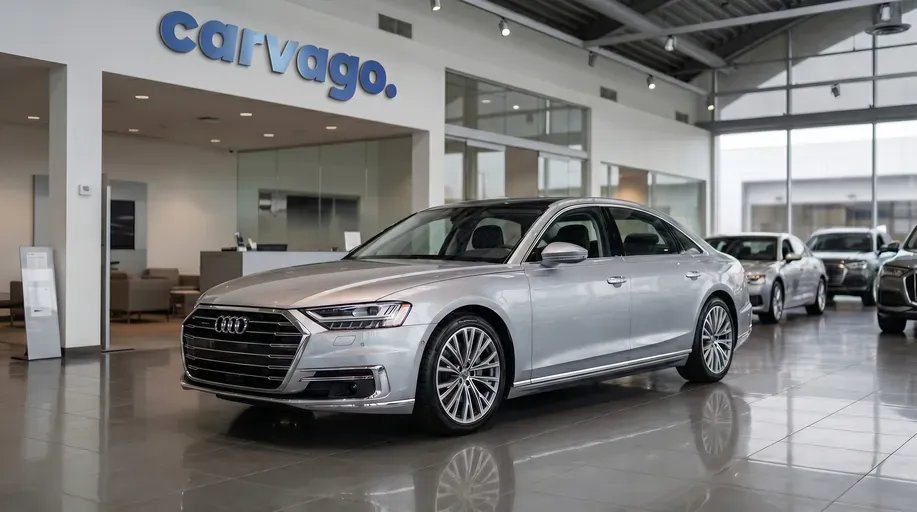
The Audi A8 sits at the top of the brand's lineup as a full-size luxury saloon, competing directly against established German executive flagships. This review covers the fourth generation, produced between July 2017 and October 2026. European order books opened in October 2017, with first customer deliveries commencing in November 2017. A plug-in hybrid variant opened for ordering in October 2019, before European factory orders concluded in February 2026 and production ended in October 2026.
Offered as a standard-wheelbase Audi A8 saloon, an extended-wheelbase A8 L, and the performance-oriented S8, the car primarily serves executive fleets, chauffeur operations, and long-distance business drivers seeking understated presence and rear-passenger accommodation.
Audi premiered a facelift on 2 November 2021, with order intake starting in December 2021 and European customer deliveries underway by March 2022.
On mild-hybrid petrol and diesel Audi A8 variants, particularly from the 2017 to 2021 model years, owners report recurring failures of the 48-volt belt alternator-starter. Owners and technicians report that the issue stems from internal circuit board fractures or inverter semiconductor defects within the generator unit. When failure occurs, an electrical system warning illuminates on the instrument cluster, and the vehicle quickly drains its standard 12-volt battery because the voltage converter stops operating, leading in some cases to auxiliary shutdowns and stalling within a short driving window. Dealerships and specialist workshops resolve this defect by installing a revised alternator-starter assembly alongside updated control software.
Owners of pre-facelift and early facelift examples also report occasional software glitches with the dual-touchscreen infotainment architecture. Reported symptoms include delayed haptic click feedback, unprompted reboots, or central displays failing to illuminate after a cold start. Professional workshop tests show that updated multimedia operating software rectifies most display anomalies, with only isolated cases requiring display control hardware replacement. In terms of chassis wear, vehicle inspection reports note that the saloon's heavy unladen mass accelerates wear on the front suspension's upper and lower control arm hydraulic bushings. This degradation typically reveals itself through dull knocking or creaking noises when driving over speed bumps and slight road tramlining.
Official European safety recalls have addressed several specific manufacturing and assembly defects on the fourth-generation Audi A8:
Every version of the fourth-generation Audi A8 features permanent all-wheel drive and an eight-speed torque-converter automatic transmission as standard, combined with mild-hybrid electrical assistance on conventional engines or a plug-in hybrid arrangement.
| Engine | Fuel | Power | Gearbox | Model years |
|---|---|---|---|---|
| 50 TDI | Diesel | 210 kW (286 hp) | 8-speed automatic | 2017–2026 |
| 60 TDI | Diesel | 320 kW (435 hp) | 8-speed automatic | 2020 |
| 55 TFSI | Petrol | 250 kW (340 hp) | 8-speed automatic | 2017–2026 |
| 60 TFSI | Petrol | 338 kW (460 hp) | 8-speed automatic | 2020–2025 |
| 60 TFSI e | Petrol PHEV | 330 kW (449 hp) | 8-speed automatic | 2019–2021 |
| 60 TFSI e | Petrol PHEV | 340 kW (462 hp) | 8-speed automatic | 2021–2026 |
| S8 TFSI | Petrol | 420 kW (571 hp) | 8-speed automatic | 2019–2026 |
For high-mileage motorway cruising and frequent long-distance travel, the diesel Audi A8 in 50 TDI specification is the most logical choice. Its strong mid-range torque ensures relaxed progress at high speeds and makes it well suited to towing duties, all while offering substantial touring range. As a used car, the eight-cylinder 60 TDI provides massive overtaking thrust, but its brief production window makes finding one on the secondary market difficult.
For mixed driving conditions combining suburban commuting with occasional road trips, the six-cylinder petrol Audi A8 55 TFSI is a balanced alternative. It runs quietly in urban traffic, delivers smooth power delivery when overtaking, and avoids the particulate filter and emission-control concerns associated with running a diesel on short journeys. Drivers who want substantial eight-cylinder reserves without the aggressive persona of the performance model should look toward the V8 60 TFSI.
Urban drivers with regular access to home or workplace charging will get the most benefit from the plug-in hybrid Audi A8 60 TFSI e. It handles short city commutes entirely under quiet electric propulsion while retaining the petrol engine for unrestricted cross-country range, though the traction battery packaging does reduce available luggage volume.
At the sharp end of the range, the S8 is aimed at keen drivers who want sports-car acceleration and sophisticated active suspension technology integrated into an executive saloon package.
For documented service actions, common electrical faults, and component recalls affecting these powertrains, refer to the owner experiences section.
The Audi A8 is engineered around passenger accommodation and structural rigidity, available in both standard and extended wheelbases. Both body styles share the same cabin width, with the stretched model assigning all additional length directly to second-row legroom.
| Dimension / Capacity | Standard Wheelbase | Long Wheelbase (A8 L) |
|---|---|---|
| Length (pre-facelift / facelift) (mm) | 5,172 / 5,190 | 5,302 / 5,320 |
| Width (excluding mirrors) (mm) | 1,945 | 1,945 |
| Height (mm) | 1,473 | 1,488 |
| Wheelbase (mm) | 2,998 | 3,128 |
| Boot volume, standard (seats up / folded) (l) | 505 / — | 505 / — |
| Boot volume, plug-in hybrid (seats up / folded) (l) | 390 / — | 390 / — |
Note: The performance S8 variant features slightly longer bodywork due to restyled bumpers. Luggage capacity on plug-in hybrid models is reduced by traction battery packaging.
In standard five-seat guise, the Audi A8 provides ample legroom and headroom for tall rear occupants, while the long-wheelbase version offers dedicated lounge-grade space. Extended models can also be found with an optional four-seat configuration, which replaces the rear bench with two individual, electrically adjustable relaxation seats separated by a full-length centre console.
Everyday cargo practicality, however, is constrained by the saloon’s underlying engineering. To ensure high torsional stiffness, Audi installed a solid structural bulkhead directly behind the passenger cell. Consequently, the rear seatbacks are permanently fixed and cannot fold down to extend the boot floor. Carrying longer items depends entirely on whether the car was specified with the optional central ski hatch aperture in the rear armrest.
Standard adaptive air suspension allows the Audi A8 to isolate long-wave undulations effectively at motorway speeds. Testers consistently note, however, that low-speed secondary ride comfort suffers over sharp transverse ridges, expansion joints, and broken surfaces, where audible thumps register inside the cabin on larger wheels and on the heavier plug-in hybrid. Handling remains stable and safe, with light, synthetic steering. Road tests praise all-wheel steering (optional on standard models, standard on the S8) for significantly cutting urban turning effort, while mechanical and wind noise remain subdued, particularly when the hybrid variant runs on electric power.
Cabin assembly, material selection, and seat ergonomics draw broad praise from professional testers, who record solid construction free of creaks or rattles. The primary ergonomic complaints center on the twin-screen interface: operating the lower touch panel for climate settings requires deliberate glances away from the road, while the glossy surfaces rapidly show fingerprints and dust. Testers also report inconsistent assistance behaviour, citing abrupt lane-keeping corrections on narrow roads and sporadic navigation speed-limit errors. The mid-cycle facelift brought minor visual revisions and updated lighting technology, but left the underlying chassis dynamics and digital layout unchanged.
All the charts in this section are drawn from Carvago listings of the whole Audi A8 model family across all represented generations, not solely the reviewed generation, and do not establish a separate price level for the reviewed generation alone. Across the model years on offer, the median asking price stands at €48,900 for 2019 examples and reaches €95,000 for 2026 cars. A distinct value step between 2021 and 2022 models corresponds with the arrival of the facelift and updated onboard equipment.
Active advertised listings for the Audi A8 ranged between 1,707 cars in April 2026 and a peak of 1,802 in July 2026 over the six-month period shown below.
Active listings over time
| Month | Audi A8 |
|---|---|
| 2026-04 | 1 707 |
| 2026-05 | 1 718 |
| 2026-06 | 1 777 |
| 2026-07 | 1 802 |
| 2026-08 | 1 744 |
| 2026-09 | 1 736 |
Source Carvago
Buyers can expect a steady pool of around 1,700 to 1,800 vehicles on the market at any given time, providing ample choice without major swings in overall availability.
For cars advertised today, the median asking price for models built in 2019 is €48,900, while the median asking price for 2026 examples is €95,000. The chart below illustrates how these median asking prices compare across build years.
Median advertised price by year of manufacture
| Model year | Audi A8 |
|---|---|
| 2019 | 48 900 |
| 2020 | 50 000 |
| 2021 | 53 900 |
| 2022 | 64 400 |
| 2023 | 69 500 |
| 2024 | 78 900 |
| 2025 | 87 400 |
| 2026 | 95 000 |
Source Carvago
Buyers considering 2020 models advertised today encounter a median asking price of €50,000, which compares with a median asking price of €64,400 for 2022 cars. For the newest 2026 listings advertised today, securing a vehicle requires a median asking price of €95,000.
This depreciation curve illustrates how the model's residual value declines with vehicle age, showing a 29% drop in the first year and a 44% loss by age three. The chart below tracks this pattern over time.
Residual value by vehicle age
| Vehicle age | Audi A8 |
|---|---|
| New | 112 800 |
| 1 yr | 80 200 |
| 2 yrs | 70 300 |
| 3 yrs | 63 700 |
| 4 yrs | 55 600 |
| 5 yrs | 50 900 |
| 6 yrs | 49 100 |
| 7 yrs | 43 500 |
Source Carvago
The sharpest decrease takes place between age zero and age one, after which annual losses moderate substantially. Over the full seven-year span shown, the model sheds 61% of its initial residual value.
Across the six months from April to September 2026, the volume of advertised cars was led by diesel models, starting at 847 listings in April alongside 436 petrol cars. The breakdown below illustrates how inventory is distributed across powertrains over this timeframe.
Supply composition by fuel type
Petrol
Diesel
Hybrid
| Month | Petrol | Diesel | Hybrid |
|---|---|---|---|
| 2026-04 | 436 | 847 | 420 |
| 2026-05 | 445 | 861 | 409 |
| 2026-06 | 442 | 931 | 401 |
| 2026-07 | 457 | 959 | 384 |
| 2026-08 | 422 | 957 | 363 |
| 2026-09 | 431 | 930 | 373 |
Source Carvago
Diesel remains the dominant choice on the market, accounting for 930 listings in September 2026 compared to 431 petrol and 373 hybrid cars. Buyers will encounter the greatest variety among diesel models, while petrol and hybrid variants provide a smaller selection on offer.
From April 2026 to September 2026, the average asking price for the Audi A8 started at €53,700 before softening slightly in the following months, as shown in the chart below.
Average price development over time
| Month | Audi A8 |
|---|---|
| 2026-04 | 53 700 |
| 2026-05 | 52 800 |
| 2026-06 | 52 200 |
| 2026-07 | 52 300 |
| 2026-08 | 52 400 |
| 2026-09 | 51 700 |
Source Carvago
Over the six-month period, the average moved from €53,700 to €51,700—an overall decrease of under four percent, interrupted by minor upticks in July and August.
Effective motorway bump absorption and subdued cabin noise
Vast rear-seat space, particularly on long-wheelbase variants
Solid interior build quality free of creaks and rattles
Fixed rear seatbacks prevent expanding luggage capacity
Recurring 48-volt alternator-starter failures on pre-2022 mild hybrids
Climate touchscreen requires deliberate glances away from the road
The 50 TDI diesel Audi A8 is the most balanced choice for motorway cruising thanks to its strong mid-range torque and long touring range. Drivers with regular charging access can consider the plug-in hybrid 60 TFSI e, though it offers less boot space.
On mild-hybrid models built before 2022, verify that the 48-volt belt alternator-starter has been replaced with the updated hardware revision. An unreplaced original component can fail suddenly, causing total electrical shutdown and stalling.
No, the rear seatbacks are permanently fixed against a structural bulkhead to preserve torsional rigidity. Extending luggage capacity is not possible unless the specific Audi A8 was ordered with the optional ski hatch aperture.
Ask an authorised dealer to run a VIN check confirming that the rear suspension nut replacement and subsequent axle alignment were carried out. On plug-in hybrid models, verify completion of the high-voltage battery management software update.
Sources: audi.com, press.audi.co.uk, adac.de, autocar.co.uk, autoexpress.co.uk
This article was prepared using artificial intelligence tools. The section guarantor is Petr Dušek.
BMW 7 Series (G70) review: real owner experience, i7 electric range, common issues, running costs, and our definitive buying verdict.
Oct 22, 2026
Fourth-gen Bentley Flying Spur review: expert tests, real owner feedback, V8 hybrid performance, running costs and full buying verdict.
Oct 21, 2026
Rolls-Royce Ghost review: real owner experience, V12 performance, running costs and prices — everything you need to know before buying.
Oct 26, 2026