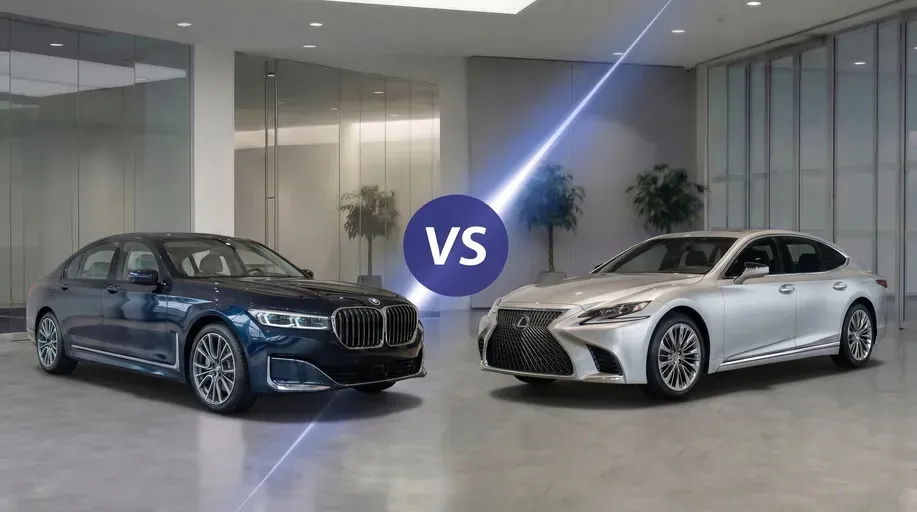
Car battle
BMW 7 Series vs. Lexus LS: Complete comparison 2026
Comparison of used BMW 7 Series vs Lexus LS luxury sedans. Discover key differences in comfort, equipment, and reliability. Read our clear verdict before you buy!
Oct 22, 2026
Articles
Review
Rolls-Royce Ghost review: real owner experience, V12 performance, running costs and prices — everything you need to know before buying.
October 26, 2026
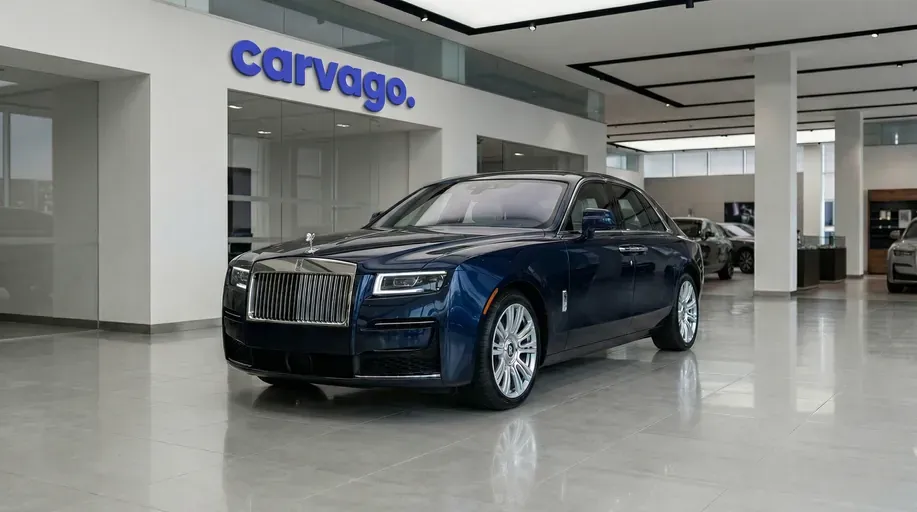
The second-generation Rolls-Royce Ghost serves as the marque's core luxury saloon, positioned alongside the larger Phantom. Built on Rolls-Royce's proprietary all-aluminium Architecture of Luxury spaceframe, this generation had its world premiere on 01 September 2020, with the first European showroom deliveries commencing on 22 October 2020.
Rolls-Royce offers the vehicle in two body lengths: the standard saloon and the Ghost Extended, which opened for orders on 24 September 2020 to provide additional rear passenger space. The performance-focused Black Badge model joined the range on 28 October 2021. The model is aimed at buyers seeking a dual-purpose ultra-luxury car, catering equally to owner-drivers and those who prefer to be chauffeured.
A mid-cycle facelift arrived with the world premiere of the Ghost Series II on 08 October 2024. The revision introduced updated exterior lighting, refreshed front styling, revised interior cabin displays, and upgraded digital interfaces, with European customer deliveries commencing in late 2024 and expanding through the first quarter of 2025. Production of the Rolls-Royce Ghost saloon continues at Goodwood.
Bespoke assembly at Goodwood and low annual mileages mean that major mechanical failures on the second-generation Rolls-Royce Ghost are rarely reported. Furthermore, long-term high-mileage reliability is still becoming established across the fleet, particularly for the updated Series II version delivered from late 2024 onwards. Even so, official European safety registries and manufacturer technical campaigns highlight specific items that prospective buyers must account for.
Across official European safety databases, a tempered glass safety recall has been recorded alongside fuel tank and eCall campaigns for this generation of the Rolls-Royce Ghost saloon. Published in European safety alert notifications in November 2023 and entered into German national registries in August 2024, the campaign covers vehicles manufactured between 03 October 2019 and 08 December 2022.
In the words of the official notice, the instrument unit is made with a single layer of tempered glass, which may break under side impact conditions, increasing the risk of injury in case of an accident. The alert applies worldwide to 4,949 vehicles across both left-hand and right-hand drive configurations, with notifications circulating across EU member states including Germany, France, the Netherlands, Denmark, and Poland. Authorised workshops remedy the issue free of charge by applying a transparent protective safety film over the display glass to contain fragments in the event of an impact. Vehicles manufactured from 09 December 2022 onwards received double-layer laminated glass during factory assembly, eliminating the need for a retrofit.
Outside of statutory recalls, manufacturer technical service communications document two isolated anomalies concerning the cooling circuit of the twin-turbocharged V12 petrol engine:
Professional evaluations highlight that attention should also be directed toward the electronic chassis and body systems on the Rolls-Royce Ghost 4x4. The proactive suspension relies on a windscreen-mounted stereo camera to scan the road surface ahead; road grime, windscreen chips, or camera misalignment can trigger dashboard warnings and disable adaptive damping adjustments. In addition, the air springs must maintain ride height without settling or sagging over several days of standing.
The electromechanical power-assisted coach doors also require scrutiny. Their integrated motors and obstacle sensors must open, close, and hold the heavy doors smoothly on both flat ground and gradients. Given the complexity of these bespoke appointments, buyers arranging an inspection can verify maintenance logs and electrical health through CarAudit.
The second-generation Rolls-Royce Ghost keeps powertrain decisions straightforward, pairing a twin-turbocharged petrol V12 with an automatic gearbox and permanent all-wheel drive across every derivative. Buyers choose essentially between the standard factory calibration and the higher-output Black Badge specification.
| Engine | Fuel | Power | Gearbox | Model years |
|---|---|---|---|---|
| 6.8 V12 | Petrol | 420 kW (571 hp) | 8-speed automatic | 2020–2024 |
| 6.8 V12 Black Badge | Petrol | 441 kW (600 hp) | 8-speed automatic | 2021–2024 |
| 6.8 V12 (Series II) | Petrol | 420 kW (571 hp) | 8-speed automatic | 2024–present |
| 6.8 V12 Black Badge (Series II) | Petrol | 441 kW (600 hp) | 8-speed automatic | 2024–present |
For long-distance touring and regular motorway cruising, the standard twin-turbo V12 is the natural fit. With robust pulling power available just above idle and a satellite-aided transmission that pre-selects ratios using navigation data, sustained high-speed travel requires minimal throttle effort. Continuous open-road running also allows operating temperatures to stabilise, reducing the risk of intake valve coking over extended mileages.
Conversely, confining this large petrol saloon to short urban hops or prolonged periods of stationary idling is ill-advised, as direct-injection engines can develop carbon deposits over time without regular highway use. Heavy city stop-and-go driving also gives the predictive drivetrain few opportunities to deploy its strengths.
Buyers who intend to drive themselves rather than sit in the rear compartment should look at the Black Badge. While remaining subdued during ordinary cruising, engaging its dedicated low mode sharpens throttle pedal mapping, accelerates gearshift execution, and opens active exhaust bypass flaps under acceleration to give the saloon a noticeably more responsive character on flowing roads.
Prospective owners seeking a luxury tow vehicle must look elsewhere, as the second-generation Ghost is not homologated for trailer towing in European markets and offers no factory towing equipment.
| Dimension / Parameter | Ghost | Ghost Extended |
|---|---|---|
| Length (mm) | 5,546 | 5,716 |
| Width (with mirrors, mm) | 2,148 | 2,148 |
| Height (mm) | 1,571 | 1,571 |
| Wheelbase (mm) | 3,295 | 3,465 |
| Boot volume (up / folded, l) | 500 / — | 500 / — |
Dimensions apply to standard, Extended, and Black Badge models.
The second-generation Rolls-Royce Ghost prioritises passenger space and acoustic insulation over utilitarian cargo modularity. Rear accommodation is configured either as a standard three-person bench or as an optional two-seat arrangement with individual reclining armchairs and a fixed centre console. The standard wheelbase provides ample legroom, while the extended version directs all its added body length into rear knee room, allowing occupants to recline comfortably. Inward access is aided by standard power-assisted, rear-hinged coach doors that open wide.
Everyday cargo practicality, however, comes with distinct compromises. To maintain cabin quietness, a structural partition permanently seals the passenger compartment from the luggage bay, meaning the rear seatbacks do not split, fold, or slide forward. The fixed boot area accommodates several suitcases or golf bags, but it cannot expand to carry longer loads. Furthermore, the substantial exterior footprint of the Rolls-Royce Ghost saloon requires caution when navigating older multi-storey car parks or narrow European street spaces.
Road tests consistently highlight the primary ride isolation of the Rolls-Royce Ghost, observing that the planar suspension system flattens undulating asphalt at motorway cruising speeds. However, evaluations note that low-speed urban imperfections, sharp expansion joints, and sunken drain covers disrupt this composure with noticeable thumps, particularly on cars fitted with larger diameter wheels. The steering is tuned to feel light and calm, while standard rear-axle steering aids low-speed maneuverability, though testers emphasize that the saloon's physical length and weight remain evident on winding secondary roads. Cabin sound insulation receives unanimous praise, isolating occupants from wind rush, mechanical vibration, and road noise.
The cabin features tailored leather upholstery, deep-pile wool carpeting, and physical metal organ-stop climate vents that provide distinct tactile feedback. Seating provides firm, long-distance support across both rows from an upright driving position. While the infotainment displays and primary controls are straightforward to navigate, several testers observe that certain digital menu layouts and lower switchgear reveal architectural ties to parent-company components.
Testers agree that the softer suspension setup yields the most composed long-distance travel. The post-facelift Series II models introduce updated glass-fronted instrumentation displays and subtle suspension revisions. Evaluators diverge on sport-oriented configurations such as the Black Badge: while some testers welcome the crisper turn-in and tighter roll control, others caution that pairing firmer damping calibrations with low-profile tyres introduces high-frequency vertical chatter over uneven surfaces.
All market charts in this section reflect listings across the entire Rolls-Royce Ghost model family, including older generations represented in the data, rather than the reviewed second generation alone. Because listings are grouped purely by manufacture date, this dataset does not establish a separate price level specifically for the newest generation. Current advertised listings show a median asking price starting at €152,900 for 2019 examples and reaching €534,900 for the 2025 model year. Individual asking prices reflect bespoke interior commissions, vehicle provenance, and specific factory options.
Active Rolls-Royce Ghost listings on the market moved from 110 cars in April 2026 to 89 cars by September 2026.
Active listings over time
| Month | Rolls-Royce Ghost |
|---|---|
| 2026-04 | 110 |
| 2026-05 | 111 |
| 2026-06 | 94 |
| 2026-07 | 88 |
| 2026-08 | 88 |
| 2026-09 | 89 |
Source Carvago
Buyers typically have between 88 and 111 vehicles to choose from across the period, with market choice contracting in early summer before settling just below 90 listings.
Across listings advertised today, the median asking price of cars built in 2018 is €179,800, whereas the median asking price of cars advertised today built in 2025 is €534,900. The median asking price is not higher for every subsequent build year, as listings from 2019 reflect a lower figure than those from 2018, as detailed in the chart below.
Median advertised price by year of manufacture
| Model year | Rolls-Royce Ghost |
|---|---|
| 2018 | 179 800 |
| 2019 | 152 900 |
| 2020 | 226 100 |
| 2021 | 229 000 |
| 2022 | 282 000 |
| 2023 | 364 000 |
| 2024 | 440 000 |
| 2025 | 534 900 |
Source Carvago
Buyers targeting 2019 models face a market where the median asking price of cars advertised today, built in 2019, is €152,900. For those looking at 2024 models, the median asking price of cars advertised today, built in 2024, is €440,000.
Active listings for the Rolls-Royce Ghost show how advertised volume was distributed across fuel types from April to September 2026, opening with 110 petrol cars in April and recording 89 in September. The chart below tracks these monthly counts across every powertrain option.
Supply composition by fuel type
| Month | Petrol |
|---|---|
| 2026-04 | 110 |
| 2026-05 | 111 |
| 2026-06 | 94 |
| 2026-07 | 88 |
| 2026-08 | 88 |
| 2026-09 | 89 |
Source Carvago
Petrol represents the entire advertised selection throughout the recorded months, with zero listings for diesel, hybrid, or electric alternatives. In practice, anyone shopping for this model will find exclusively petrol options on the market.
The chart traces the average asking price for the Rolls-Royce Ghost from April 2026, when it stood at €201,900, through September 2026.
Average price development over time
| Month | Rolls-Royce Ghost |
|---|---|
| 2026-04 | 201 900 |
| 2026-05 | 218 900 |
| 2026-06 | 202 200 |
| 2026-07 | 206 600 |
| 2026-08 | 198 200 |
| 2026-09 | 214 800 |
Source Carvago
Across the six months shown, values fluctuated between a low of €198,200 and a peak of €218,900 before finishing at €214,800, reflecting modest month-to-month variation rather than a clear directional trend.
Composed high-speed ride isolation and thorough cabin noise insulation
Robust low-rev pulling power paired with satellite-aided gear selection
Substantial rear passenger space with power-assisted coach doors
Sharp urban bumps and sunken drain covers disrupt low-speed ride composure
Fixed rear seatbacks cannot fold and trailer towing is not homologated
Large exterior dimensions complicate navigation in narrow streets and tight car parks
Major mechanical issues are rarely reported, though long-term high-mileage durability is still becoming established. Buyers should ensure the instrument cluster recall was completed on eligible cars and inspect the cooling circuit for weeping hose unions or faulty level sensors.
The Black Badge is best suited to owner-drivers due to its sharper throttle mapping and quicker transmission responses. Those prioritising ride serenity should choose the standard model, which rides more softly over uneven surfaces.
No. A structural acoustic partition permanently separates the passenger cabin from the boot to preserve cabin quietness, meaning the rear seatbacks are completely fixed.
No. The second-generation Rolls-Royce Ghost is not homologated for trailer towing in European markets, and Rolls-Royce offers no factory towing equipment.
Sources: press.rolls-roycemotorcars.com, ec.europa.eu, adac.de, autocar.co.uk, topgear.com
This article was prepared using artificial intelligence tools. The section guarantor is Petr Dušek.
Comparison of used BMW 7 Series vs Lexus LS luxury sedans. Discover key differences in comfort, equipment, and reliability. Read our clear verdict before you buy!
Oct 22, 2026
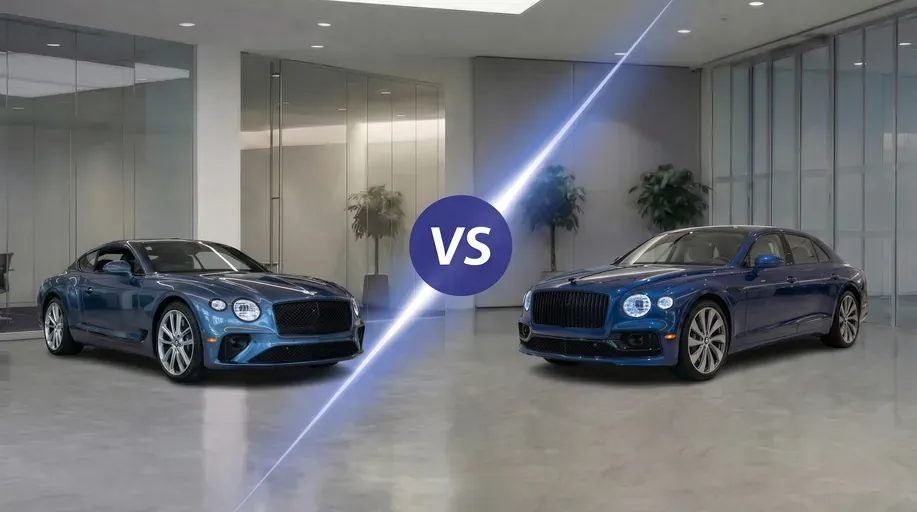
Detailed comparison of Bentley Continental GT vs Bentley Flying Spur. Discover the differences in performance, comfort, and equipment and choose the right luxury car for you.
Apr 13, 2026
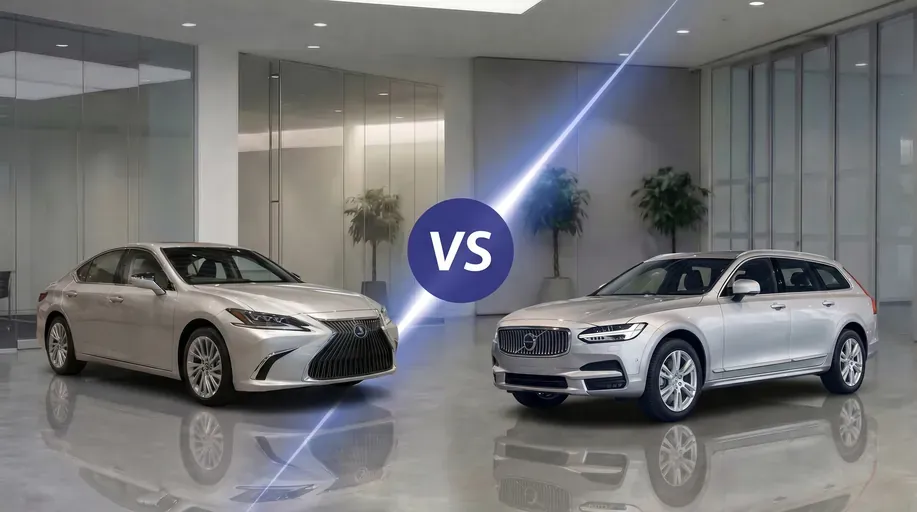
Lexus ES or Volvo V90? Read a detailed comparison of these premium cars. We evaluate reliability, comfort, and real-world operating costs. Find out the winner!
May 12, 2026