Review Volvo S90: What do owners and experts really say?
Volvo S90 review: real owner experience, reliability, engine picks and used prices. Discover running costs and faults before you buy.
October 20, 2026
Verdict at a Glance
Who it suits: Business fleets and long-distance drivers prioritising understated Scandinavian design and relaxed motorway cruising.
Recommended engine: The D4 or mild-hybrid B4 diesel for high-mileage efficiency, or the B5 petrol for balanced everyday driving.
What to avoid: Cars without documented recall repairs checked by VIN, and early plug-in hybrids exhibiting rear electric drive noise.
Introduction
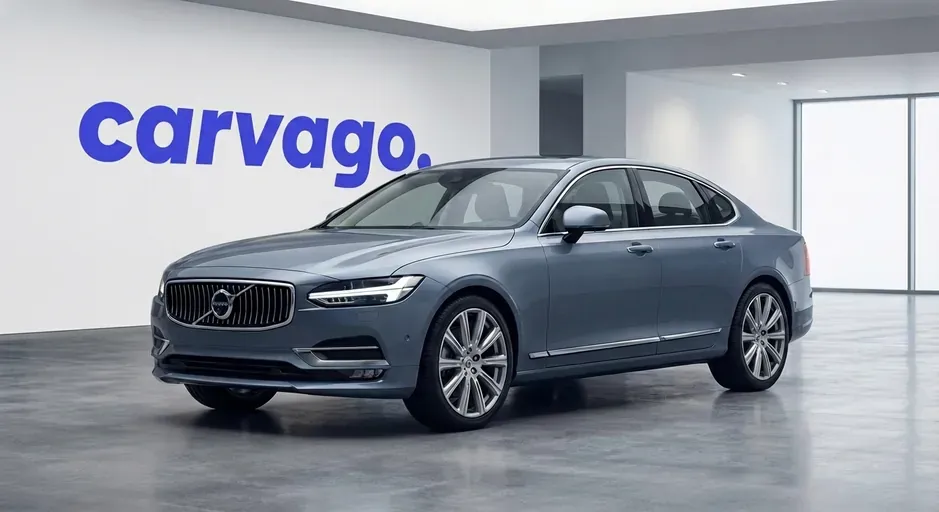
The second-generation Volvo S90 serves as the Swedish manufacturer’s flagship executive saloon, positioned directly against established German rivals in the premium segment. First European customer deliveries commenced in August 2016. Sold exclusively as a four-door saloon—with its estate counterpart badged separately—it appeals primarily to business fleets and long-distance drivers who value understated Scandinavian design and composed long-haul travel.
A mid-cycle update was unveiled on 21 February 2020, with European order books opening on 18 May 2020. This revision brought 48-volt mild-hybrid systems across the core lineup, accompanied by minor cosmetic refinements to the lower front bumper, refreshed rear LED light signatures, and updated audio options.
While saloon order books closed in select European markets in June 2023, the model continued on sale across Continental Europe. A second visual and technological update was revealed on 17 April 2025, though European customer delivery dates for that revision remain unverified. This review evaluates the second-generation car delivered across Europe from 2016 onwards.
Owner Experiences: Common Faults and Recalls
The second-generation Volvo S90 has established a solid mechanical foundation across European markets, though owner reports and workshop data highlight specific recurring faults tied to complex sub-assemblies. On the twin-turbo diesel D5 AWD, owners report frequent failures of the PowerPulse compressed air delivery hose. The system relies on a reservoir of air compressed to 12 bar to spool the turbocharger from idle, but the braided rubber hose linking the tank to the exhaust manifold cyclically fatigues and splits or detaches entirely. Drivers typically experience an audible popping sound under acceleration, a persistent air hiss, and sluggish initial pickup due to low-end turbo lag. Replacing the failed line with Volvo’s reinforced, heat-insulated revised hose resolves the issue permanently in documented cases; ignoring the leak risks burning out the electric air pump.
On the plug-in hybrid hybrid Volvo S90 (T8 Twin Engine and T8 Recharge), owners report bearing wear and coolant seal degradation inside the Electric Rear Axle Drive (ERAD) unit, particularly on assemblies built between 2016 and 2021. When internal coolant seeps past the seal into the electric motor housing, it produces a high-pitched whining or humming sound from the rear axle during electric driving, rough petrol-to-electric power handoffs, or an eventual rear-drive shutdown with a hybrid system failure message. While franchised dealerships replace the entire rear axle assembly, independent hybrid specialists can rebuild the unit using upgraded ceramic bearings and revised seals.
Suspension wear is another recurring theme across all variants, intensified by the saloon's substantial kerb weight. Tests describe early deterioration of the rear hydraulic bushings on the front lower wishbones, which tend to crack and leak damping fluid between 60,000 and 100,000 km. The degradation manifests as low-speed knocking over road humps, vague directional stability on motorways, and uneven wear along the inside edges of the front tyres. Fitting updated control arms or pressing in heavy-duty replacement bushes followed by a full wheel alignment restores chassis composure.
Verified Safety Recalls
Official European recall databases record several critical safety campaigns across the life cycle of the second-generation saloon:
Downhill Braking Deactivation (announced July 2025): Worldwide campaign affecting 76,365 plug-in hybrid and electric vehicles built between 17 May 2019 and 11 June 2025. Braking functionality could be disabled after coasting downhill while using "B" mode. Dealerships rectify this via a total software update to the brake and vehicle control modules.
High-Voltage Battery Overheating (announced April 2025): Covering 59,271 T8 Twin Engine / Recharge units built worldwide between 29 April 2019 and 01 December 2021 with LG Energy Solution battery cells. A cell manufacturing defect can cause overheating and vehicle fires when fully charged while parked. Authorised workshops inspect the cells, replace defective modules free of charge, and apply a battery management software upgrade.
Brake Control Module Software Loss (announced January 2023): Affected 106,691 vehicles globally from model year 2023 production (built January to December 2022). A software error could trigger the sudden shutdown of electronic brake assist, ABS, and stability control, requiring significantly increased physical pedal pressure to stop. Rectified via over-the-air or workshop software installation.
Low-Pressure Fuel Pump Fuse (announced June 2021): Worldwide campaign for 328,308 petrol and plug-in hybrid models built between 23 November 2018 and 23 December 2019. Electrical peaks can blow the 15-amp fuel pump fuse, stalling the engine or preventing restarting. Workshops replace it with an upgraded 20-amp fuse.
Intake Manifold Fire Risk (announced 2019): Applied globally to 507,353 four-cylinder diesel models built between 2015 and 2019, including the diesel 4x4 Volvo S90. Soot accumulation can cause the plastic intake manifold to melt and deform, creating a fire hazard. Technicians clean the intake components, modify the cooling circuit, and install protective software.
Excessive Diesel NOx Emissions (announced December 2024): Mandatory European action on 50,052 Euro 6 diesel vehicles (D4 and D5) built between 13 November 2017 and 23 August 2020 due to increased emissions exceeding limit values. Dealers install recalibrated engine control software to prevent statutory vehicle de-registration.
🔍 What to check before buying
Check the vehicle's service history with an authorised dealer or arrange a CarAudit pre-purchase inspection to verify completion of all safety campaigns, particularly the high-voltage battery cell check on plug-in hybrids, brake module updates, and the diesel intake manifold modification.
On D5 AWD models, inspect the PowerPulse braided rubber hose near the exhaust manifold for splits or detachment, and listen for hissing or delayed turbo response off the line.
Switch plug-in hybrid models into electric-only mode and accelerate smoothly; listen for high-pitched whining, humming, or vibration emanating from the rear electric drive axle.
Inspect front tyre inner edges for uneven feathering and listen for knocking or hollow thuds over uneven tarmac, pointing to leaking front control arm hydro-bushings.
Test the portrait touchscreen thoroughly from a cold start to ensure navigation, reversing camera displays, and climate controls initialise smoothly without software freezing.
Engines: Which One to Choose
The second-generation Volvo S90 relies entirely on modular 2.0-litre four-cylinder engines paired with front-wheel drive or all-wheel drive. Over its production life cycle, the range shifted from traditional petrol and diesel engines to 48-volt mild hybrids and plug-in hybrid powertrains.
Engine
Fuel
Power
Drivetrain
Gearbox
Model years
D3
Diesel
110 kW (150 hp)
Front-wheel drive
6-speed manual / 6-speed automatic
2016–2019
D4
Diesel
140 kW (190 hp)
Front-wheel drive
6-speed manual / 8-speed automatic
2016–2020
D4 AWD
Diesel
140 kW (190 hp)
All-wheel drive
8-speed automatic
2016–2020
D5 PowerPulse
Diesel
173 kW (235 hp)
All-wheel drive
8-speed automatic
2016–2020
B4 Diesel
Diesel MHEV
145 kW (197 hp)
Front-wheel drive
8-speed automatic
2020–2022
B5 Diesel
Diesel MHEV
173 kW (235 hp)
All-wheel drive
8-speed automatic
2020–2024
T4
Petrol
140 kW (190 hp)
Front-wheel drive
8-speed automatic
2017–2020
T5
Petrol
187 kW (254 hp)
Front-wheel drive
8-speed automatic
2016–2018
T5
Petrol
184 kW (250 hp)
Front-wheel drive
8-speed automatic
2018–2020
T6
Petrol
235 kW (320 hp)
All-wheel drive
8-speed automatic
2016–2018
T6
Petrol
228 kW (310 hp)
All-wheel drive
8-speed automatic
2018–2020
B4
Petrol MHEV
145 kW (197 hp)
Front-wheel drive
8-speed automatic
2020–present
B5
Petrol MHEV
184 kW (250 hp)
Front-wheel drive
8-speed automatic
2020–present
B6
Petrol MHEV
220 kW (300 hp)
All-wheel drive
8-speed automatic
2020–2022
Recharge T6
Petrol PHEV
251 kW (340 hp)
All-wheel drive
8-speed automatic
2020–2021
Recharge T6
Petrol PHEV
257 kW (350 hp)
All-wheel drive
8-speed automatic
2021–2024
T8 Twin Engine
Petrol PHEV
300 kW (407 hp)
All-wheel drive
8-speed automatic
2017–2018
T8 Twin Engine / Recharge
Petrol PHEV
288 kW (390 hp)
All-wheel drive
8-speed automatic
2018–2021
Recharge T8
Petrol PHEV
335 kW (455 hp)
All-wheel drive
8-speed automatic
2021–present
Which engine to choose as a used buy
For frequent motorway driving, a diesel Volvo S90 is the sensible option. The front-wheel-drive D4 and the later B4 mild-hybrid diesel deliver long cruising ranges and steady pace. Drivers who regularly contend with poor winter conditions will find better traction in the all-wheel-drive D5 or B5 diesel.
For mixed everyday commuting and moderate yearly mileage, a petrol Volvo S90 provides smoother refinement. The entry-level T4 requires frequent downshifts when carrying passengers and cargo at higher speeds, making the front-wheel-drive T5 or the post-facelift B5 mild-hybrid petrol the most rounded choice for pace and comfort. The twin-charged T6 and mild-hybrid B6 offer rapid acceleration, though their mechanical complexity adds running considerations.
Buyers operating primarily in urban environments or doing short daily journeys should target the plug-in hybrid Volvo S90 variants, provided charging access is available at home or work. The earlier T8 Twin Engine models provide brisk straight-line pace, but later Extended Range versions from the second half of the production run deliver broader electric usability and smoother transitions between electric and petrol drive.
For towing heavy trailers, the all-wheel-drive combustion models are the best candidates, pairing robust low-speed pulling capability with the platform's highest braked towing limits.
For a comprehensive evaluation of mechanical vulnerabilities, factory recalls, and high-mileage wear patterns across these powertrains, refer to the owner experiences section.
Space & Practicality
Dimension
Pre-facelift (2016–2020)
Facelift (2020–2025)
Length (mm)
4,963
4,963
Width (mm)
1,879
1,879
Height (mm)
1,443
1,440–1,443
Wheelbase (mm)
2,941
2,941
Boot volume, seats up (l)
500
461
Boot volume, seats folded (l)
Not stated
Not stated
Official VDA cargo volume with the rear seats folded is not stated by the manufacturer for the European saloon.
The Volvo S90 saloon provides sufficient rear legroom for tall passengers to sit behind tall front occupants without their knees contacting the front seatbacks. Rear headroom is shaped by the sweeping roofline, which leaves less vertical clearance for tall adults than an equivalent estate body style. The outer rear seats are contoured for long-distance support, but carrying three passengers across the fixed rear bench is compromised by the prominent central tunnel, which severely restricts middle-seat foot space.
Everyday cargo practicality relies on a standard 60/40 split-folding rear backrest and an integrated ski hatch behind the fold-down centre armrest for through-loading longer objects. Because the traction battery on plug-in hybrid variants is positioned longitudinally inside the central transmission tunnel, electrified models retain the standard luggage compartment volume without losing space under the boot floor. However, the traditional saloon boot aperture remains relatively shallow and narrow, which limits the loading of bulky items.
What the Tests Say
Professional road tests universally characterise the Volvo S90 as an executive saloon built strictly for calm cruising rather than dynamic driving. On smooth tarmac and undulating motorways, the suspension delivers a soft, relaxed glide. However, testers consistently point out its limits over broken road surfaces. Across sharp transverse ridges and potholed city streets, the rear axle feels brittle and transmits noticeable thumps into the cabin—an issue exacerbated when paired with optional larger alloy wheels. The steering remains light and accurate in a straight line, but it lacks road feedback and turns inert in bends. Driven quickly, the chassis defaults to early understeer, and heavier plug-in hybrid variants exhibit pronounced body lean through directional changes.
Refinement depends heavily on the driving scenario. At steady motorway speeds, cabin noise is well isolated, and plug-in hybrids provide near-silent operation in electric mode. Under brisk acceleration, however, the four-cylinder engines sound strained and vocal, with the diesel in particular noted as gruff from a cold start. Testers also observe that the eight-speed automatic transmission occasionally hesitates when demanding quick kickdown during overtaking manoeuvres.
Where road tests fully align is in praising the cabin environment and front seating, frequently citing the seats among the finest for long-distance fatigue relief. High-grade materials and an understated Scandinavian design feel genuinely upscale. The main ergonomic criticism targets the standard portrait touchscreen: because temperature and basic ventilation settings lack physical dials, adjusting climate controls on the move demands excessive visual attention away from the road.
Prices and Market Offer
All the charts in this section are drawn from Carvago listings covering the entire Volvo S90 model family, including any other generations represented in the data, rather than solely the reviewed generation. Because the supplied data does not establish a separate price level for the reviewed generation alone, these figures reflect the broader market offer. Across the advertised model years, current listings show a median asking price of €26,600 for 2019 vehicles, reaching €45,200 for 2024 examples. Differences between individual model years reflect powertrain variations, optional equipment, and mileage among cars currently on the market.
Advertised Volvo S90 listings fluctuated between April and September 2026, rising from 851 in April to a peak of 881 in July before tapering off. The chart below illustrates the monthly count of active listings across this six-month span.
Volvo S90 - availability over time
Active listings over time
Month
Volvo S90
2026-04
851
2026-05
862
2026-06
852
2026-07
881
2026-08
814
2026-09
783
Source Carvago
Total availability eased to 783 listings by September 2026, yet buyers can still expect a broad selection of several hundred vehicles on offer at any given time.
Across Volvo S90 listings advertised today, the median asking price of cars built in 2019 is €26,600, compared to a peak of €45,200 for those built in 2024. The figures across available build years reflect distinct price tiers rather than an unbroken increase.
Volvo S90 - median price by model year
Median advertised price by year of manufacture
Model year
Volvo S90
2019
26 600
2020
29 300
2021
30 500
2022
32 500
2023
43 500
2024
45 200
2025
38 400
2026
37 300
Source Carvago
Buyers exploring 2019 to 2022 models encounter median asking prices between €26,600 and €32,500, before values step up to €43,500 for 2023 and €45,200 for 2024. The progression does not continue upward for the newest cars in the data, where the median asking price sits at €38,400 for 2025 and €37,300 for 2026.
The count of advertised Volvo S90 models shows petrol engines leading the listings, moving from 466 cars in April 2026 to a peak of 528 in July 2026. The chart below tracks how the available inventory breaks down across fuel types from April to September 2026.
Volvo S90 - supply by fuel over time
Supply composition by fuel type
Petrol
Diesel
Hybrid
Electric
Month
Petrol
Diesel
Hybrid
Electric
2026-04
466
190
194
1
2026-05
483
187
190
2
2026-06
504
175
171
2
2026-07
528
178
173
2
2026-08
473
171
168
2
2026-09
418
187
176
2
Source Carvago
In September 2026, petrol remained the primary choice on the market with 418 advertised vehicles, while diesel and hybrid options offered secondary alternatives at 187 and 176 listings, respectively. Buyers will find ample selection among petrol and electrified hybrids, whereas fully electric cars are virtually absent with just 2 listings.
The chart below traces the average asking price for the Volvo S90 from April 2026 to September 2026, opening at €27,400 and recording €27,000 the following month.
Volvo S90 - price trend over time
Average price development over time
Month
Volvo S90
2026-04
27 400
2026-05
27 000
2026-06
26 200
2026-07
26 000
2026-08
25 900
2026-09
25 900
Source Carvago
Across the six months, the average asking price moved from €27,400 to €25,900. This represents a decline of roughly 5.5%, a relatively modest shift across the period.
Supportive front seating that provides fatigue relief on long journeys
Sufficient rear legroom for tall adults and hybrid battery packaging that preserves boot space
Composed, quiet cabin refinement at steady motorway cruising speeds
Cons
Brittle ride over sharp ridges and potholed streets, exacerbated by larger wheels
Touchscreen-dependent climate adjustments that demand visual attention while driving
Strained four-cylinder engine acoustics under brisk acceleration compared to multi-cylinder alternatives
Frequently asked questions
Which engine is best for the Volvo S90?
Frequent motorway drivers should look at the diesel Volvo S90 such as the D4 or B4 mild hybrid for long-distance cruising range. For mixed everyday driving, a petrol Volvo S90 in T5 or B5 form provides greater refinement without the running complexity of higher-output variants.
What should you check before buying a used Volvo S90?
Verify that all official safety recalls have been carried out by checking the VIN with an authorised dealer. A thorough road test should confirm that the suspension remains quiet over bumps and that electrified models switch smoothly between petrol and electric power.
Is the Volvo S90 practical enough for family duties?
The Volvo S90 saloon provides ample legroom for four adults, though the wide transmission tunnel limits middle-seat foot space. Luggage space accommodates regular travel bags, but the shallow saloon opening restricts loading bulkier cargo.
What does a used Volvo S90 cost?
Across advertised model years on the European market, median asking prices start at €26,600 for 2019 cars, with newer examples commanding a premium. Final values depend heavily on mileage, powertrain selection, and optional equipment.