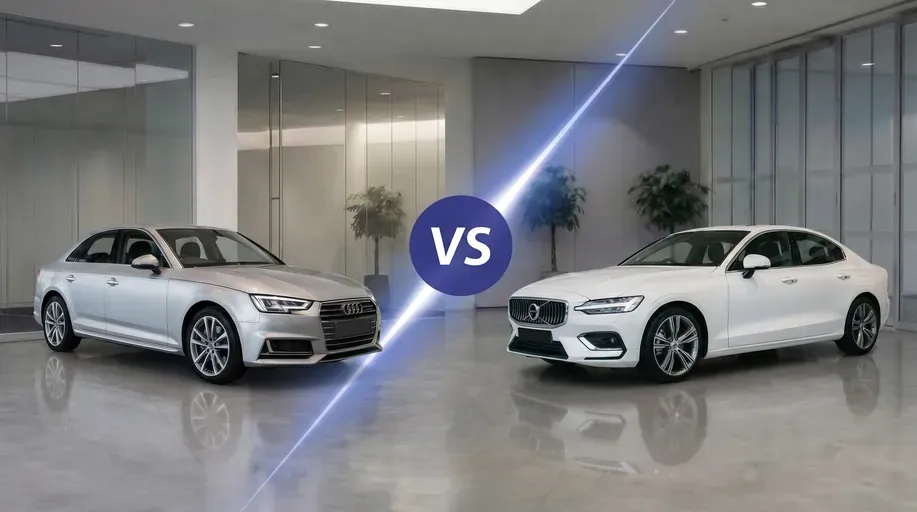
Audi A4 vs. Volvo S60: Complete comparison 2026
Detailed comparison of the Audi A4 and Volvo S60. Discover the differences in driving characteristics, equipment, and reliability of used cars. Read our verdict and make the right choice!
Nov 12, 2026
Volvo S60 review: real owner experience, common faults, hybrid running costs and used prices. Here is the definitive verdict before you buy.
November 6, 2026

The third-generation Volvo S60 represents the Swedish brand’s contender in the premium mid-size saloon segment. Built on the SPA platform, European customer deliveries of this generation commenced in June 2019 following the opening of order books in October 2018.
Offered exclusively as a four-door saloon, the Volvo S60 received a mid-cycle facelift in March 2022 for model year 2023. This update introduced subtle visual revisions, including redesigned bumper aprons and concealed exhaust outlets, alongside a transition to an Android Automotive infotainment operating system with integrated Google services. Factory production at the US plant concluded in June 2024, with European availability continuing through remaining dealer inventory.
On the used market, the Volvo S60 saloon attracts private and corporate buyers seeking an alternative to established German executive saloons, appealing particularly to drivers who prioritise understated design, safety systems, and electrified petrol powertrains over sporting pretensions.
Owner experiences with the third-generation Volvo S60 show a car with sound fundamental mechanics, where the majority of unscheduled workshop visits involve software glitches, braking components, and auxiliary electrical hardware.
On the plug-in hybrid Volvo S60 Recharge built from 2019 to 2021, the high-voltage coolant heater is a frequent point of failure. When this unit fails, the car cannot heat the cabin when driving in pure electric mode during colder weather, which forces the petrol combustion engine to start simply to generate interior heat. Owners report that replacing the heater with a revised component resolves the fault.
Braking friction wear is another recurrent topic. Professional tests describe premature wear of the rear brake pads, which in some cases wear down to their backing plates between 25,000 km and 45,000 km, accompanied by scoring on the rear discs. This accelerated wear is driven by continuous micro-interventions from the stability control and lane-centring assistance systems.
Infotainment stability has affected both the pre-facelift system (2019 to 2022) and the Google-based system introduced for the 2023 model year. Owners report occasional central screen freezing, delayed start-up upon entering the car, spontaneous restarts, and temporary dropouts of the reversing camera display. While regular software updates have resolved most stability concerns, a system restart via the physical home button remains a familiar routine for many drivers.
Several official safety recalls have been issued across the European Union for the third-generation saloon, with software logic and braking systems representing the most significant campaigns:
| Affected Models & Build Window | Scope | Defect (Official Wording) | Remedy |
|---|---|---|---|
| Plug-in Hybrids(17 May 2019 – 11 June 2025) | Worldwide(76,365 vehicles) | "The vehicle's braking functionality can be disabled while using 'B' mode (in plug-in hybrid cars) or One Pedal Drive (in pure electric cars), after coasting downhill. This can lead to a collision and increase the risk of accidents and injuries." | Software update to the brake control module installed via over-the-air update or at an authorised workshop. |
| Plug-in Hybrids(25 June 2019 – 30 November 2021) | EU and North America | "Some problems with the high-voltage battery can cause an overheating of the battery cells when the battery is fully charged. This can lead the vehicle catch fire." | Workshop inspection of battery cell serial numbers, replacement of defective modules, and updated monitoring software. Owners were advised not to charge via mains electricity until inspected. |
| All Powertrains(Production years 2019 – 2020) | Worldwide(16,500 vehicles) | "The rod between the brake pedal and the brake booster may not have been assembled correctly. The rod can become detached, leading the brake pedal to dysfunction, increasing the risk of accidents and injuries." | Authorised workshops inspect and retighten the screw connection between the pushrod and the brake booster unit. |
| All Powertrains(11 April 2022 – 13 January 2023) | Worldwide(106,691 vehicles) | "A software error in the brake control module can lead to a loss of braking power, creating a risk of an accident." | Brake control module software update installed via over-the-air transmission or dealership visit. |
| Four-Cylinder Petrol(November 2018 – December 2019) | Worldwide(~94,000 vehicles) | "The 15A fuse to the low-pressure fuel pump may blow. As a result, the engine could stall and not be able start, increasing the risk of an accident." | Replacement of the 15A low-pressure fuel pump fuse with an uprated 20A fuse. |
| All Powertrains(21 January 2019 – 15 March 2020) | Worldwide(736,000 vehicles) | "The software of the Active Safety Domain Master (ASDM) might be incomplete. Consequently, oncoming obstacles could remain undetected and the Automatic Emergency Brake System (AEB) might not be triggered, increasing the risk of accident." | Dealership software upgrade for the active safety master module. |
| All Powertrains(Build dates 2018–2023) | Worldwide(585 vehicles) | "An insufficient torque might have been applied to the front passenger airbag fixings. Consequently, in the event of an accident the airbag might not properly deploy, increasing the risk of injuries." | Authorised workshops inspect and retighten the front passenger airbag fixings to specification. |
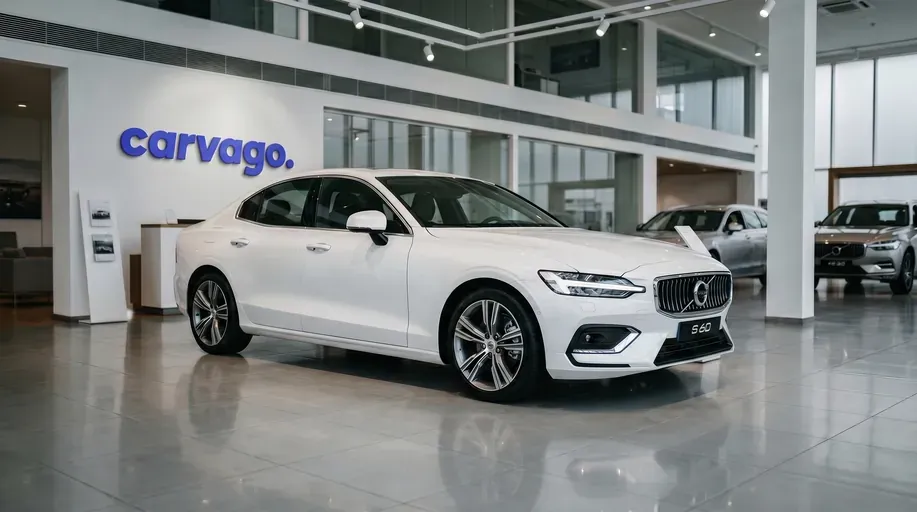
The third-generation Volvo S60 marked a complete departure from diesel power, relying entirely on four-cylinder petrol engines, 48V mild hybrids, and plug-in hybrids. Every variant is paired exclusively with an automatic transmission, directing drive to the front wheels or to all four wheels.
| Engine | Fuel | Power | Gearbox | Drivetrain | Model Years |
|---|---|---|---|---|---|
| T4 | Petrol | 140 kW (190 hp) | 8-speed automatic | Front-wheel drive | 2019–2020 |
| T5 | Petrol | 184 kW (250 hp) | 8-speed automatic | Front-wheel drive | 2019–2020 |
| T6 AWD | Petrol | 228 kW (310 hp) | 8-speed automatic | All-wheel drive | 2019–2020 |
| B3 | Petrol Mild Hybrid | 120 kW (163 hp) | 7-speed automatic | Front-wheel drive | 2021–2024 |
| B4 | Petrol Mild Hybrid | 145 kW (197 hp) | 8-speed automatic | Front-wheel drive | 2020–2022 |
| B4 | Petrol Mild Hybrid | 145 kW (197 hp) | 7-speed automatic | Front-wheel drive | 2022–2024 |
| B5 | Petrol Mild Hybrid | 184 kW (250 hp) | 8-speed automatic | Front-wheel drive | 2020–2024 |
| B5 AWD | Petrol Mild Hybrid | 184 kW (250 hp) | 8-speed automatic | All-wheel drive | 2020–2024 |
| T6 Twin Engine / Recharge | Petrol Plug-in Hybrid | 250 kW (340 hp) | 8-speed automatic | All-wheel drive | 2019–2021 |
| T8 Twin Engine / Recharge | Petrol Plug-in Hybrid | 288 kW (390 hp) | 8-speed automatic | All-wheel drive | 2019–2021 |
| T8 Polestar Engineered | Petrol Plug-in Hybrid | 298 kW (405 hp) | 8-speed automatic | All-wheel drive | 2019–2021 |
| T8 Recharge | Petrol Plug-in Hybrid | 335 kW (455 hp) | 8-speed automatic | All-wheel drive | 2021–2025 |
| T8 Polestar Engineered | Petrol Plug-in Hybrid | 335 kW (455 hp) | 8-speed automatic | All-wheel drive | 2022–2025 |
For urban commuting and frequent short trips, the mild-hybrid B4 is a sensible starting point. Its 48V integrated starter-generator smooths out stop-start cycles in heavy traffic, eliminating the off-idle hesitation found in earlier petrols. Buyers with access to regular home charging should look at the plug-in hybrid Volvo S60, particularly the later T8 Recharge with its revised battery pack, which allows daily city commutes to be completed entirely on electrical power.
For balanced, mixed everyday use, the front-wheel-drive B5 mild-hybrid is the most rounded choice as a used car. It provides a substantial reserve of overtaking power over the entry-level engines while settling into a relaxed cruising rhythm. Early non-hybrid petrol Volvo S60 versions such as the T4 and T5 are widely available on the pre-owned market, though their torque-converter automatics react with noticeably more kick-down lag than the crisper dual-clutch transmission introduced on later mild hybrids.
Frequent long-distance motorway drivers will be best served by the B5 or the early twincharged T6, both delivering quiet high-speed cruising with low cabin intrusion. If towing heavy loads or driving regularly in harsh winter conditions is a priority, choose an all-wheel-drive Volvo S60 such as the B5 AWD or the potent T8 Recharge, which provide dependable traction via mechanical propshafts or electric rear axles. The focused Polestar Engineered versions cater to performance enthusiasts, though their extreme chassis tuning makes them less suited to everyday touring.
The Volvo S60 saloon prioritises outboard comfort, offering sufficient legroom for adult passengers thanks to its long wheelbase, though the sweeping roofline limits rear headroom for taller occupants. Accommodating powertrain and battery components within the chassis creates a prominent floor tunnel, which restricts middle foot space and leaves the rear bench best suited to two adults on longer journeys. Practicality follows standard four-door saloon traits: the boot lid opening is relatively narrow, requiring care when sliding in bulky cargo. Everyday versatility is supported by split-folding rear backrests and a through-load ski hatch behind the centre armrest for carrying longer items.
| Parameter | Petrol & Mild Hybrid | Plug-in Hybrid |
|---|---|---|
| Length (mm) | 4,761 – 4,778 | 4,761 – 4,778 |
| Width without mirrors (mm) | 1,850 | 1,850 |
| Height (mm) | 1,431 – 1,437 | 1,426 – 1,430 |
| Wheelbase (mm) | 2,872 | 2,872 |
| Boot volume (seats up, l) | 427 | 390 |
| Boot volume (seats folded, l) | Unstated | Unstated |
Official roof-height cargo volume with the rear seats folded is not stated in manufacturer specifications for the saloon body style.
Professional road tests depict the Volvo S60 saloon as a composed cruiser rather than a playful sports car. Models fitted with the standard chassis absorb broken road surfaces with supple compliance. Conversely, configurations featuring the lowered sports suspension (standard on sports-themed specifications or optional) and low-profile tyres receive frequent criticism for a brittle ride over urban drain covers and expansion joints. Even the high-output plug-in hybrid with adjustable dampers delivers an unyielding reaction to transverse ridges despite taut high-speed body control. Handling remains reassuringly safe and directional stability in evasive manoeuvres is solid, though light steering devoid of road feedback and significant vehicle weight limit cornering enthusiasm compared to rear-driven rivals. Drivetrain refinement is high at steady cruising speeds, although coarse tarmac transmits audible tyre hum into the cabin.
Inside, the Volvo S60 impresses with tasteful Scandinavian styling, consistent assembly standards, and upscale surface textures. The front seats earn unanimous acclaim for their orthopaedic contouring and long-distance support. Ergonomics prove more contentious: delegating climate adjustments and vehicle settings almost entirely to the portrait touchscreen draws recurring criticism for requiring multiple taps and distracting the driver on the move.
All charts in this section are drawn from Carvago listings of the entire Volvo S60 model family across multiple generations, so the supplied data does not establish a separate price level exclusively for the third generation. Current median asking prices range from 16,400 EUR for 2018 models to 28,000 EUR for 2019 and 36,300 EUR for 2023 listings, reaching 45,200 EUR for 2025 cars. The pronounced step between 2018 and 2019 reflects the broader transition across different production eras and equipment standards in the wider catalogue.
The chart traces the number of advertised Volvo S60 models per month between May 2026 and October 2026, opening at 944 listings and concluding at 884.
Active listings over time
| Month | Volvo S60 |
|---|---|
| 2026-05 | 944 |
| 2026-06 | 933 |
| 2026-07 | 943 |
| 2026-08 | 917 |
| 2026-09 | 929 |
| 2026-10 | 884 |
Source Carvago
Available choices fluctuated within a narrow range from a high of 944 cars to a low of 884, giving buyers a broad and relatively consistent selection to browse throughout the period.
Among used listings advertised today, the median asking price for cars built in 2018 is 16,400 EUR, while the median asking price for those built in 2025 is 45,200 EUR. The chart below compares these median figures across the available model years.
Median advertised price by year of manufacture
| Model year | Volvo S60 |
|---|---|
| 2018 | 16 400 |
| 2019 | 28 000 |
| 2020 | 29 000 |
| 2021 | 30 000 |
| 2022 | 34 400 |
| 2023 | 36 300 |
| 2024 | 39 900 |
| 2025 | 45 200 |
Source Carvago
A buyer targeting a 2019 model sees a median asking price of 28,000 EUR, whereas 2021 models stand at a median asking price of 30,000 EUR. For the newest model years in the dataset, median asking prices are higher, reaching 39,900 EUR for 2024 and 45,200 EUR for 2025.
Between May and October 2026, advertised listings were dominated by petrol models, which opened at 641 cars in May 2026 and closed at 572 in October 2026. The monthly breakdown below shows how each fuel type was represented on the market over this six-month period.
Supply composition by fuel type
Petrol
Diesel
Hybrid
| Month | Petrol | Diesel | Hybrid |
|---|---|---|---|
| 2026-05 | 641 | 120 | 183 |
| 2026-06 | 611 | 136 | 186 |
| 2026-07 | 589 | 152 | 202 |
| 2026-08 | 579 | 133 | 205 |
| 2026-09 | 598 | 116 | 215 |
| 2026-10 | 572 | 112 | 200 |
Source Carvago
In October 2026, petrol remained the primary choice for buyers with 572 advertised cars, followed by hybrids at 200 and diesels at 112 from earlier generations. Anyone shopping for a third-generation car will focus on petrol and hybrid models, as diesel inventory belongs entirely to older generations.
Between May 2026 and October 2026, the average asking price for the Volvo S60 moved from 24,600 EUR to 25,000 EUR, as shown in the monthly figures below.
Average price development over time
| Month | Volvo S60 |
|---|---|
| 2026-05 | 24 600 |
| 2026-06 | 24 000 |
| 2026-07 | 23 700 |
| 2026-08 | 24 300 |
| 2026-09 | 24 900 |
| 2026-10 | 25 000 |
Source Carvago
Prices dipped to 23,700 EUR in July 2026 before climbing back up to 25,000 EUR in October, reflecting only modest overall movement across the six-month span.
Comfortable, orthopaedically contoured front seats suited to long-distance touring
Composed, quiet cruising with supple bump absorption on the standard chassis
Smooth electrified petrol powertrains with pure-electric capability on plug-in hybrids
Climate controls integrated into the central touchscreen distract while driving
Brittle, firm low-speed ride on cars with sports suspension or large wheels
Restricted rear headroom, an intrusive floor tunnel, and a narrow boot opening
Its core mechanical components are durable, though electronics and braking friction parts cause recurring complaints. Most reported issues involve infotainment glitches or auxiliary cabin heaters rather than major engine failures.
The front-wheel-drive B5 mild hybrid is the most balanced choice for mixed driving, offering strong overtaking reserves and relaxed cruising. Buyers who can charge regularly at home should consider the T8 Recharge plug-in hybrid instead.
No. The third-generation Volvo S60 was manufactured entirely without diesel engines, offering only four-cylinder petrol engines, 48-volt mild hybrids, and plug-in hybrids paired exclusively with automatic transmissions.
Verify the car's VIN with an authorised workshop or via CarAudit to confirm that all safety recall campaigns have been completed. On plug-in hybrids, ensure the auxiliary cabin heater functions properly in pure electric mode on a cold start.
Sources: volvocars.com, ec.europa.eu, adac.de, autocar.co.uk, autoexpress.co.uk
This article was prepared using artificial intelligence tools. The section guarantor is Petr Dušek.

Detailed comparison of the Audi A4 and Volvo S60. Discover the differences in driving characteristics, equipment, and reliability of used cars. Read our verdict and make the right choice!
Nov 12, 2026

Detailed comparison of Renault Talisman vs Volkswagen Passat. Discover the differences in equipment and reliability, and read our verdict for choosing the ideal used car.
Oct 16, 2026

Ford Mondeo vs. Volkswagen Passat: Detailed comparison, reviews, engines, and verdict. Find out which of these popular cars is the better choice for you.
Oct 22, 2026