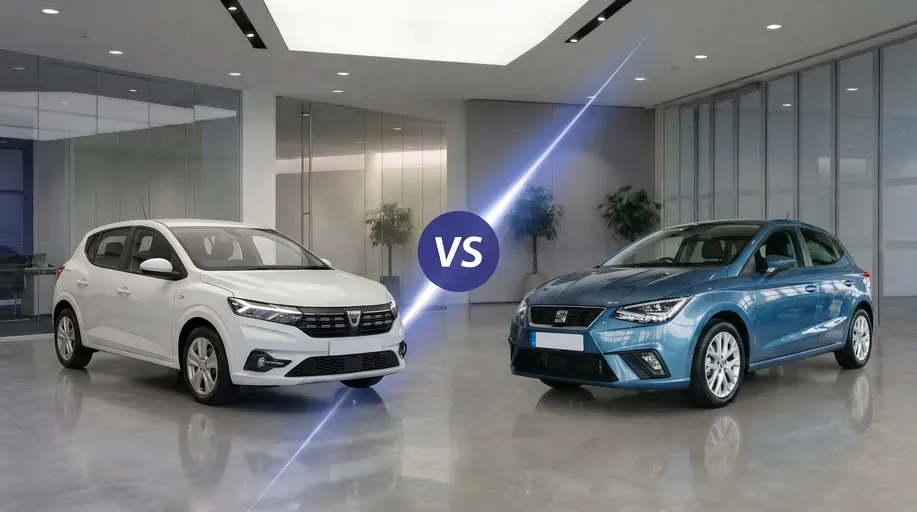
Car battle
Dacia Sandero vs. Seat Ibiza: Complete comparison 2026
Dacia Sandero (including Stepway) vs Seat Ibiza: Which used hatchback to choose? Read our detailed comparison of equipment, running costs, and our final verdict.
Oct 16, 2026
Volkswagen up! review: real owner experience, common faults, running costs, engine picks and used prices — everything you need to know.
October 24, 2026
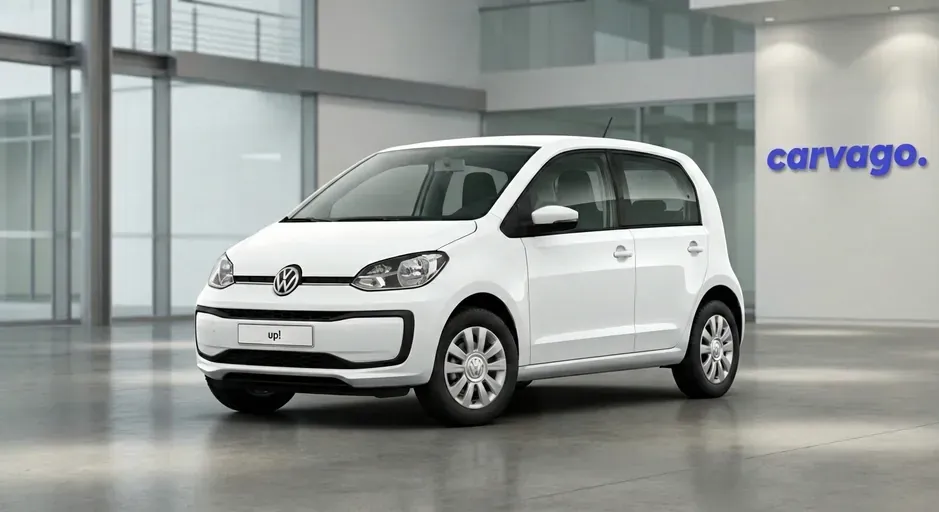
The Volkswagen up! represents the German manufacturer's entry into the European A-segment city car category. Built on the New Small Family architecture, this review covers the model's sole generation, which began customer deliveries in December 2011 and concluded when factory assembly permanently ended in October 2023. It is now available exclusively as a pre-owned vehicle on the European market.
Sold as a three-door or five-door Volkswagen up! hatchback, alongside a raised, ruggedly styled derivative, the model underwent a comprehensive mid-cycle revision. Unveiled at the Geneva International Motor Show in March 2016, the facelift arrived in customer hands in the summer of 2016, introducing refreshed exterior bumpers, updated cabin appointments, and an expanded engine portfolio.
Engineered for congested streets and minimal operating costs, the up! primarily targets urban commuters, first-time drivers, and multi-vehicle households seeking an agile second car for daily local travel.
On the European used market, the Volkswagen up! has built a reputation for solid mechanical durability, though real-world ownership reveals several distinct weak spots. Chief among these is the five-speed automated manual transmission. In professional evaluations, tests describe hesitant and jerky shifting behavior, while owners report severe clutch judder when pulling away, refusal to engage reverse, or the gearbox slipping into neutral. These symptoms stem from actuator motor wear and calibration drift in the transmission control unit after sustained city driving. While basic software readaptation can temporarily restore smooth clutch engagement in early stages, repairs at higher mileages typically require renewing both the clutch pack and the electromechanical actuators. By contrast, the conventional five-speed manual transmission is mechanically sturdy, though tests describe gear baulking or a brief crunch when selecting reverse from a cold start, which occurs because reverse gear lacks synchromesh.
Water ingress is another recurring complaint across all production years. Owners report damp carpets and pooled water in the front footwells, which happens when decaying leaves clog the drainage flaps in the scuttle plenum chamber beneath the windscreen wipers, forcing rainwater past the bulkhead grommets. At the rear, tests describe water seeping into the luggage compartment and spare-wheel well through perished rubber seals around the rear wiper glass spindle and degraded foam gaskets behind the rear light clusters. On pre-facelift examples built between 2011 and 2015, technical inspections note surface corrosion and paint bubbling around the rear wheel arches and fuel filler neck, where factory omission of protective plastic wheel-arch liners left the bare metal vulnerable to stone chips and road salt.
Safety recalls on the model encompass both widespread manufacturer campaigns and targeted powertrain-specific actions. The most extensive safety notice involves deteriorating propellant in Takata front airbag inflators, which can rupture upon deployment and scatter metal fragments toward occupants. The electric Volkswagen up! has been subject to two specific safety actions regarding steering gear corrosion and high-voltage battery insulation.
| Campaign Subject | Affected Build Window | Scope | Remedial Action |
|---|---|---|---|
| Takata driver front airbag inflator rupture | 09.09.2004 to 15.09.2018 (multi-model campaign) | Worldwide | Inspection and replacement of the airbag gas generator or module. |
| Steering gear housing corrosion (e-up!) | 26.09.2013 to 27.02.2023 | Worldwide (16,168 vehicles) | Inspection of the steering rack housing for corrosion cracks; replacement with an updated, wax-sealed steering gear where necessary. |
| High-voltage battery cell insulation short-circuit (e-up!) | 11.05.2020 to 24.06.2020 | Worldwide (122 vehicles) | Inspection and replacement of the high-voltage battery unit or designated cell modules to eliminate short-circuit fire risks. |
| Airbag and seat belt pretensioner igniter mixture | 08.07.2016 to 06.02.2017 | Europe-wide | Inspection and replacement of affected front pyrotechnic airbag and pretensioner assemblies. |
| Toolkit screw-in towing eye weld fracture | 01.10.2015 to 29.10.2017 | Europe-wide | Inspection of the on-board toolkit and replacement of the screw-in towing eye. |
Before committing to a used automatic Volkswagen up! or electric model, verify via official dealer records that all applicable campaign remedies were completed. Prospective buyers who want independent confirmation of a car's structural and mechanical integrity can have its history and condition reviewed through CarAudit.
The Volkswagen up! relied throughout its lifecycle on a compact three-cylinder petrol engine in naturally aspirated and turbocharged forms, supplemented by an eco-conscious natural gas variant and a fully electric powertrain.
| Engine | Fuel | Power | Gearbox | Model years |
|---|---|---|---|---|
| 1.0 MPI | Petrol | 44 kW (60 hp) | 5-speed manual | 2011–2020 |
| 1.0 MPI | Petrol | 44 kW (60 hp) | 5-speed automatic | 2012–2019 |
| 1.0 MPI | Petrol | 48 kW (65 hp) | 5-speed manual | 2020–2023 |
| 1.0 MPI | Petrol | 55 kW (75 hp) | 5-speed manual | 2011–2019 |
| 1.0 MPI | Petrol | 55 kW (75 hp) | 5-speed automatic | 2012–2019 |
| 1.0 EcoFuel | CNG / Petrol | 50 kW (68 hp) | 5-speed manual | 2012–2020 |
| 1.0 TSI | Petrol | 66 kW (90 hp) | 5-speed manual | 2016–2020 |
| up! GTI | Petrol | 85 kW (115 hp) | 6-speed manual | 2018–2023 |
| e-up! | Electric | 60 kW (82 hp) | 1-speed automatic | 2013–2019 |
| e-up! | Electric | 61 kW (83 hp) | 1-speed automatic | 2019–2023 |
For a detailed look at recurring mechanical faults, cooling-system leaks, and transmission wear patterns, consult the owner experiences section of this review.
| Parameter | Pre-facelift Hatchback (2011–2016) | Facelift Hatchback (2016–2023) |
|---|---|---|
| Length (mm) | 3,540 | 3,600 |
| Width excluding mirrors (mm) | 1,641 | 1,641–1,645 |
| Height (mm) | 1,478 | 1,504 |
| Wheelbase (mm) | 2,420 | 2,407 |
| Boot volume, seats upright / folded (l) | 251 / 951 | 251 / 959 |
These dimensions and capacities do not apply to the lowered suspension on performance variants, nor to the reduced underfloor cargo depth on natural gas and electric versions.
The Volkswagen up! hatchback is strictly a four-seater, utilizing an upright cabin profile that provides sufficient headroom for adult occupants in both rows. While front occupants enjoy sufficient legroom, rear knee room is tight behind taller drivers, making the second row best suited to children or shorter urban journeys. Three-door variants require sliding the front passenger seat forward for rear ingress, whereas five-door models simplify passenger access. The rear side windows do not wind down, relying instead on manual pop-out latches.
Everyday cargo practicality remains straightforward. Base models feature a single-piece folding rear backrest, whereas higher trims provide an asymmetrical split-folding bench alongside an adjustable two-tier load floor that eliminates the step when seats are flattened. A minor functional annoyance noted during regular use is that the parcel shelf lacks lifting strings attached to the tailgate, requiring the user to push it down manually after loading to prevent obstructing rearward visibility.
Professional tests describe the standard Volkswagen up! as having a compliant suspension setup that absorbs broken tarmac effectively and maintains composure in crosswinds. The steering is light and accurate for urban manoeuvring, though it isolates the driver from road surface feedback. Cornering behaviour remains safe and predictable with mild understeer, while the non-switchable stability control intervenes early when driven briskly. By contrast, the stiffer suspension on the sports model curtails body lean effectively, though it introduces a noticeably firm ride over expansion joints and crests. Cabin refinement proves mixed: mechanical vibration is well isolated at steady cruising, but the three-cylinder engine buzzes audibly under load and wind rush increases at motorway speeds.
Inside, testers highlight the straightforward dashboard layout and logical switchgear, but consistently remark on evident cost-cutting. The cabin relies on unyielding hard plastics, leaves painted metal exposed on the upper door frames, and limits steering adjustment to rake only. Early production years drew criticism for lacking a passenger-window switch on the driver door.
Testers broadly agree that the Volkswagen up! provides chassis stability typical of larger classes, but they diverge on cabin noise, where some find cruising acoustic insulation adequate while others mark it down for elevated tyre thrum. The facelift brought notable cabin detail updates, adding dual front electric window controls to the driver armrest while leaving the basic unpadded trim surfaces intact.
All market charts in this section are drawn from Carvago's listings across the broader Volkswagen up! model family, including other generations represented in the data, rather than only the reviewed generation. Because the dataset covers the entire model family, these figures do not establish a separate price level specifically for the reviewed generation. Across the advertised model years, the median asking price is 9500 EUR for 2018 cars and 15500 EUR for 2023 examples, with remaining late registrations reaching 23900 EUR for 2025 vehicles.
Between April and September 2026, the number of advertised Volkswagen up! models varied from an initial 3,939 to a high of 3,961 in June. The monthly listing counts across this span are tracked below.
Active listings over time
| Month | Volkswagen up! |
|---|---|
| 2026-04 | 3 939 |
| 2026-05 | 3 802 |
| 2026-06 | 3 961 |
| 2026-07 | 3 893 |
| 2026-08 | 3 719 |
| 2026-09 | 3 630 |
Source Carvago
Buyers have a broad selection of vehicles to choose from, though the volume of active listings moved downward over the final three months to finish at 3,630 in September.
The chart below outlines how median asking prices differ by build year, where the median asking price of cars advertised today is 9,500 EUR for models built in 2018, compared to 23,900 EUR for late registrations in 2025.
Median advertised price by year of manufacture
| Model year | Volkswagen up! |
|---|---|
| 2018 | 9 500 |
| 2019 | 10 000 |
| 2020 | 11 000 |
| 2021 | 12 400 |
| 2022 | 13 000 |
| 2023 | 15 500 |
| 2024 | 22 200 |
| 2025 | 23 900 |
Source Carvago
For cars advertised today from the 2018 to 2021 model years, median asking prices range from 9,500 EUR to 12,400 EUR. Securing a newer model year requires a higher budget, with the largest price difference between consecutive build years occurring between 2023 models at a median asking price of 15,500 EUR and 2024 models at 22,200 EUR.
Between April and September 2026, petrol accounted for the bulk of available vehicles, with 3015 cars advertised in April and 2983 in September. The chart illustrates how listings were divided across each fuel type over this period.
Supply composition by fuel type
Petrol
Diesel
Electric
CNG
LPG
| Month | Petrol | Diesel | Electric | CNG | LPG |
|---|---|---|---|---|---|
| 2026-04 | 3 015 | 4 | 742 | 163 | 7 |
| 2026-05 | 3 074 | 10 | 540 | 169 | 6 |
| 2026-06 | 3 273 | 13 | 502 | 163 | 7 |
| 2026-07 | 3 143 | 9 | 564 | 172 | 5 |
| 2026-08 | 3 023 | 11 | 533 | 144 | 7 |
| 2026-09 | 2 983 | 8 | 499 | 131 | 8 |
Source Carvago
In September 2026, petrol dominated the offer with 2983 listings, followed by 499 electric models and 131 running on CNG, while diesel and LPG stood at 8 listings apiece. Buyers will encounter the widest selection among petrol models, with electric cars serving as the only widely available alternative.
Between April 2026 and September 2026, the average asking price for the Volkswagen up! began at 11,200 EUR before dipping slightly into early summer, as tracked in the monthly figures below.
Average price development over time
| Month | Volkswagen up! |
|---|---|
| 2026-04 | 11 200 |
| 2026-05 | 10 900 |
| 2026-06 | 10 800 |
| 2026-07 | 10 900 |
| 2026-08 | 11 100 |
| 2026-09 | 11 200 |
Source Carvago
Across the six months, the average reached a low of 10,800 EUR in June 2026 before returning to 11,200 EUR by September 2026, ending the period unchanged overall with only minor month-to-month fluctuations.
Compliant suspension absorbs uneven road surfaces effectively while maintaining highway composure
Upright roofline provides accommodating headroom alongside straightforward dashboard controls
Turbocharged petrol engines deliver capable mid-range pulling power for driving outside the city
Automated manual transmission is prone to jerky shifts, clutch shudder, and actuator wear
Evident interior cost-cutting, including hard plastics, exposed painted metal, and pop-out rear windows
Susceptible to water leaks into footwells and the boot from clogged scuttle drains and perished seals
The Volkswagen up! is mechanically dependable, though pre-facelift examples require checks for rear wheel-arch corrosion and water leaks from blocked scuttle drains.
The turbocharged 1.0 TSI petrol Volkswagen up! is the best all-rounder, offering relaxed open-road performance without high fuel consumption. Drivers sticking strictly to urban errands are well served by the simpler naturally aspirated 1.0 MPI.
Yes, buyers should avoid the automatic Volkswagen up! due to hesitant shifting and prone electromechanical actuator wear. The standard manual gearbox is far more durable and smoother in daily use.
Check the cabin carpets and spare-wheel well for water leaks, and verify via the vehicle's VIN that all safety recalls—especially the driver airbag inflator—have been completed.
Sources: volkswagen-newsroom.com, vwpress.co.uk, adac.de, ec.europa.eu, autobild.de
This article was prepared using artificial intelligence tools. The section guarantor is Petr Dušek.
Dacia Sandero (including Stepway) vs Seat Ibiza: Which used hatchback to choose? Read our detailed comparison of equipment, running costs, and our final verdict.
Oct 16, 2026
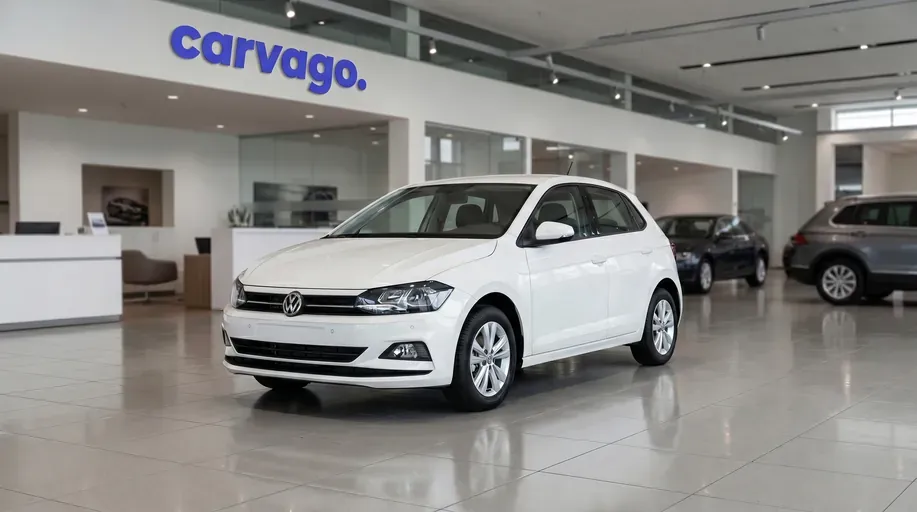
Volkswagen Polo Mk6 review: real owner feedback, common faults, engine picks, and used prices — everything you need to know before you buy.
Oct 18, 2026
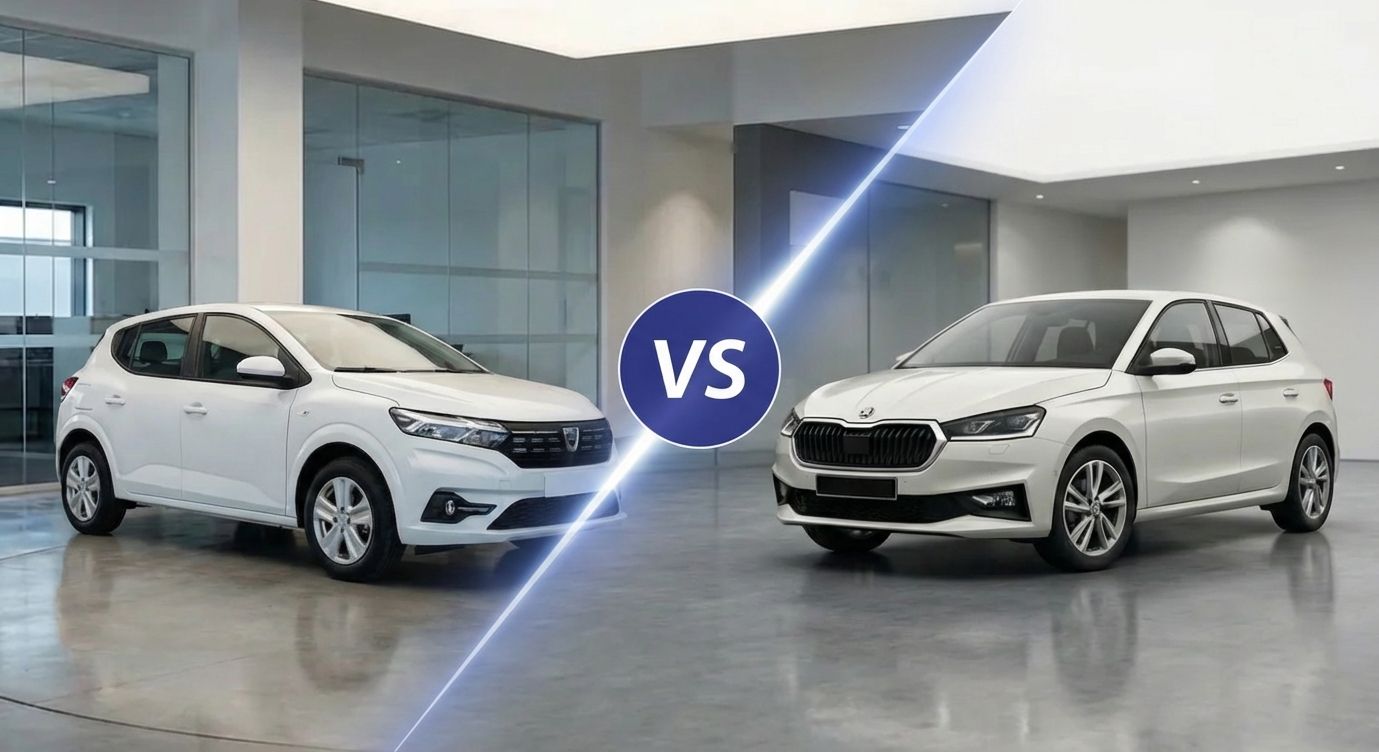
Dacia Sandero vs. Škoda Fabia: Which car is better? We compare engines, equipment, and price. Our detailed verdict will help you choose.
Apr 14, 2026