
Car battle
Toyota RAV4 vs. Volkswagen Tiguan: Complete comparison 2026
Detailed comparison of Toyota RAV4 vs Volkswagen Tiguan. Real data, differences in equipment, fuel consumption, and a clear verdict to help you choose the best SUV.
May 4, 2026
Articles
Review
Volkswagen T-Cross review: real owner experience, cabin practicality, engine picks and common faults — everything you need before you buy.
November 2, 2026
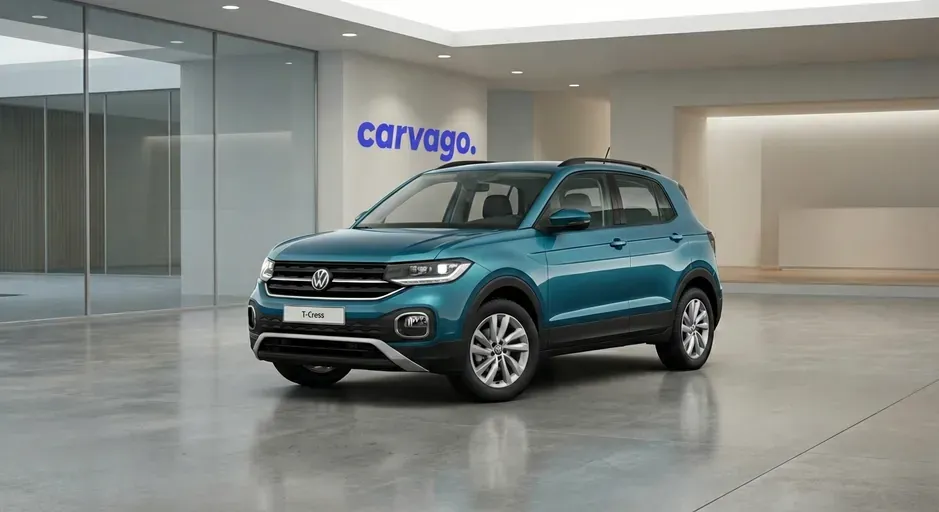
The Volkswagen T-Cross serves as the most compact crossover in Volkswagen’s SUV portfolio. This review focuses on the first-generation model, which arrived for European customer deliveries in April 2019 and remains in production through 2026. Across European markets, it has been offered exclusively as a five-door crossover with front-wheel drive.
Volkswagen unveiled a mid-cycle update on 5 July 2023, opening order books in October 2023 ahead of first customer deliveries in March 2024. The revision brought updated exterior styling and refreshed equipment specifications, while keeping the underlying mechanical platform intact.
As a practical urban vehicle, the Volkswagen T-Cross primarily attracts city drivers, downsizers, and small families looking for an elevated seating position, easy entry, and flexible rear seating inside compact exterior dimensions.
The Volkswagen T-Cross has established a largely dependable mechanical reputation across European markets since customer deliveries began in April 2019. Because the crossover relies on widely used mechanical architecture, catastrophic component failures are rare. Most documented owner concerns and workshop visits instead stem from transmission calibration in urban traffic, minor electronic quirks, and accelerated surface wear on standard chassis friction parts.
Official European registers record four targeted safety and compliance campaigns for this generation, with zero European safety recalls announced in 2025 or 2026. In February 2020, a recall was issued for vehicles built between May 2019 and June 2019 (model year 2019) due to an inappropriately welded gas generator discharge nozzle on the curtain airbag module, covering 766 units worldwide; dealers inspect and replace the defective curtain airbag modules. In July 2020, a campaign covering 4,800 vehicles worldwide across several models was initiated for 1.0 TSI petrol versions built between 2018 and 2020 to replace fuel injectors exhibiting leakage rates outside statutory limits. Two further software campaigns addressed the digital instrument display: in October 2021, a campaign affecting 13,464 vehicles built between September 2020 and July 2021 corrected a software fault where the seat belt reminder failed to consistently alert the driver if rear passengers were unbuckled; in July 2023, another software update covering vehicles produced between 2020 and 2022 resolved a bug causing the seat belt warning status to fail to display entirely.
Tests describe mechanical brake disc corrosion and uneven scoring as the single most frequent roadworthiness inspection failure on this model. The rear discs in particular are prone to surface corrosion under gentle urban driving conditions, where light brake pedal applications fail to clear salt and road grime, necessitating premature disc and pad replacement. On the automatic Volkswagen T-Cross fitted with the seven-speed dry dual-clutch transmission, tests and owners describe low-speed hesitation, stepped power delivery, and clutch shudder when crawling in stop-and-go traffic. While electronic control calibrations can smooth out minor throttle delays, prolonged stop-start driving can accelerate dry clutch wear and require clutch pack replacement.
For vehicles built between 2020 and 2023, owners report occasional infotainment screen freezing, slow start-up response upon starting the engine, and dropped wireless smartphone mirroring connections. These electronic interruptions are typically resolved by updating the central multimedia system with the latest dealer software releases.
The Volkswagen T-Cross relies predominantly on turbocharged three-cylinder and four-cylinder petrol engines, supplemented during its initial production run by a four-cylinder turbodiesel. Every version is front-wheel drive, with power sent through either a manual gearbox or a dual-clutch automatic.
| Engine | Fuel | Power | Gearbox | Model years |
|---|---|---|---|---|
| 1.0 TSI | Petrol | 70 kW (95 hp) | 5-speed manual | 2019–2023 |
| 1.0 TSI | Petrol | 70 kW (95 hp) | 5-speed manual | 2024–present |
| 1.0 TSI | Petrol | 85 kW (115 hp) | 6-speed manual / 7-speed automatic | 2019–2020 |
| 1.0 TSI | Petrol | 81 kW (110 hp) | 6-speed manual / 7-speed automatic | 2020–2023 |
| 1.0 TSI | Petrol | 85 kW (115 hp) | 6-speed manual / 7-speed automatic | 2024–present |
| 1.5 TSI | Petrol | 110 kW (150 hp) | 7-speed automatic | 2019–2023 |
| 1.5 TSI | Petrol | 110 kW (150 hp) | 7-speed automatic | 2024–present |
| 1.6 TDI | Diesel | 70 kW (95 hp) | Manual / 7-speed automatic | 2019–2020 |
For city traffic and local errands, the entry-level 1.0 TSI is the most straightforward option. It reaches operating temperature quickly on short runs and provides sufficient low-end response for urban pace. However, its widely spaced manual transmission ratios require shifting down when climbing motorway gradients or merging at speed. Buyers focusing on town driving will find the manual Volkswagen T-Cross easiest to live with in heavy stop-and-go traffic.
Drivers seeking a balance between suburban commuting and cross-country journeys will be best served by the mid-range 1.0 TSI. Available with either an extra manual gear ratio or the automatic transmission, this version offers substantially more pulling power when overtaking and keeps engine speeds calmer on open roads. Whether sourced from early production or in revised facelift form, it remains the most well-rounded option in the petrol Volkswagen T-Cross lineup.
For regular long-distance travel, fully laden trips, or towing duties, the 1.5 TSI is the most capable choice. Paired exclusively as an automatic Volkswagen T-Cross, it features active cylinder deactivation to curb consumption during steady cruising and delivers authoritative acceleration when joining fast-flowing traffic. Its stronger torque output and higher permissible nose weight also make it the most stable platform for mounting bike racks or pulling a light trailer.
Available only as a used car due to its early retirement, the 1.6 TDI suits high-mileage commuters prioritising long-distance running costs over mechanical refinement. Professional testing noted that while the engine note is noticeably more vocal and sluggish from a standstill than the petrol units, a used diesel Volkswagen T-Cross provides steady pulling power and operates efficiently on sustained motorway commutes where emissions filters regenerate without complication.
For detailed analysis of mechanical reliability, transmission behavior, and specific pre-purchase inspection checkpoints, refer to the owner experiences section.
| Parameter | Volkswagen T-Cross |
|---|---|
| Length | 4,108–4,127 mm |
| Width (excluding mirrors) | 1,760–1,784 mm |
| Height | 1,573–1,584 mm |
| Wheelbase | 2,551 mm |
| Boot capacity (seats upright) | 385–455 l |
| Boot capacity (seats folded) | 1,281 l |
The Volkswagen T-Cross SUV makes effective use of its upright crossover architecture to deliver flexible interior packaging. An elevated seating position and wide door apertures ensure easy entry and exit, while the tall roofline provides ample headroom for occupants in both rows. The cabin’s defining practical feature is its standard sliding rear bench, which glides fore and aft to let owners prioritise either passenger knee room or cargo capacity depending on daily requirements.
When positioned fully rearward, the bench leaves adequate legroom for two adults, though three across the back remains tight across the shoulders. Sliding the bench forward expands the luggage area to take bulkier gear or pushchairs while keeping the rear seats usable. For larger cargo, the rear backrests fold down, and an optional forward-folding front passenger seat available on higher equipment grades creates a continuous load floor running almost the entire length of the cabin to swallow unusually long items.
Road tests consistently praise the Volkswagen T-Cross for secure, predictable road manners and light, accurate steering that eases city driving. Its chassis prioritises stability and composed cornering over playful agility. Ride comfort is broadly balanced, though testers note that sharp tarmac ridges and low-speed urban potholes transmit a dry edge into the passenger compartment, particularly on versions with larger wheels. Tyre roar and wind rush become noticeable at motorway cruising speeds due to modest door insulation, and the petrol three-cylinder sounds thrummy when worked hard, despite settling down during steady running.
Ergonomics are functional throughout, benefiting from an upright seating position and clear outward sightlines. However, interior finish was a primary point of criticism on early production models. Pre-facelift cabins relied heavily on rigid, scratch-prone plastics across the dashboard and door casings, which showed scuffs early in endurance evaluations.
The mid-cycle update significantly improved perceived quality by introducing a soft-touch dashboard with contrast stitching, although the lower centre console and door linings remain unpadded. Testers agree the revised chassis controls vertical body movements more cleanly at higher speeds, ironing out the subtle floatiness found in earlier cars. Opinions diverge on suspension compliance: while some reviewers describe the chassis as comfortably tuned for routine travel, others highlight that certain rivals isolate cabin occupants from broken surfaces more effectively. Additionally, the transition to touch-sensitive digital climate sliders on updated interiors was widely judged as less intuitive and more distracting to operate on the move than the traditional rotary dials it replaced.
All charts in this section are drawn from Carvago listings of the entire Volkswagen T-Cross model family, including other generations represented in the data, rather than strictly the reviewed generation. Consequently, this dataset does not establish a separate price level for the reviewed generation alone. Across current listings, the median asking price sits at €17,500 for 2019 model years and reaches €27,600 for 2026 models. The higher median prices among later build years reflect lower mileage, fresher vehicle condition, and updated technical features.
Active listings for the Volkswagen T-Cross fluctuated over the six-month period, peaking at 20,248 in June 2026 before decreasing to 17,037 by October 2026. The chart below shows the month-by-month count of advertised vehicles on the platform.
Active listings over time
| Month | Volkswagen T-Cross |
|---|---|
| 2026-05 | 19 498 |
| 2026-06 | 20 248 |
| 2026-07 | 20 071 |
| 2026-08 | 18 674 |
| 2026-09 | 19 018 |
| 2026-10 | 17 037 |
Source Carvago
While available listings declined toward the end of the period, supply remained well above 17,000 cars each month, giving used-car buyers a large pool of vehicles to choose from.
Among used listings of this model advertised today, the median asking price for cars built in 2019 is €17,500, compared to a median asking price of €27,600 for those built in 2026. The breakdown below details the median asking price across each available build year.
Median advertised price by year of manufacture
| Model year | Volkswagen T-Cross |
|---|---|
| 2019 | 17 500 |
| 2020 | 18 400 |
| 2021 | 18 900 |
| 2022 | 19 700 |
| 2023 | 22 000 |
| 2024 | 25 500 |
| 2025 | 25 800 |
| 2026 | 27 600 |
Source Carvago
Buyers focusing on earlier build years encounter median asking prices between €17,500 for 2019 models and €19,700 for 2022 models. For newer examples, advertised medians range from €25,500 for the 2024 model year up to €27,600 for 2026.
This depreciation curve tracks how the model's residual value declines with vehicle age, shedding 14% in the first year and 27% by age three. The data illustrates how that loss develops across seven years of ownership.
Residual value by vehicle age
| Vehicle age | Volkswagen T-Cross |
|---|---|
| New | 27 600 |
| 1 yr | 23 700 |
| 2 yrs | 22 100 |
| 3 yrs | 20 200 |
| 4 yrs | 19 600 |
| 5 yrs | 18 300 |
| 6 yrs | 16 900 |
| 7 yrs | 16 400 |
Source Carvago
Across the full seven-year span shown, the model sheds 41% of its residual value, retaining nearly 59% of its baseline figure. The steepest drop occurs in the first year, after which annual value loss moderates significantly.
Across the advertised inventory between May and October 2026, petrol models accounted for almost the entire selection, moving from 19,324 listings in May to 16,866 in October. The chart below details how the monthly count of active listings compares across fuel types.
Supply composition by fuel type
Petrol
Diesel
Hybrid
LPG
| Month | Petrol | Diesel | Hybrid | LPG |
|---|---|---|---|---|
| 2026-05 | 19 324 | 137 | 1 | 4 |
| 2026-06 | 20 053 | 146 | 1 | 7 |
| 2026-07 | 19 868 | 149 | 7 | 8 |
| 2026-08 | 18 476 | 144 | 7 | 15 |
| 2026-09 | 18 811 | 146 | 2 | 15 |
| 2026-10 | 16 866 | 130 | 2 | 11 |
Source Carvago
In October 2026, petrol represented 16,866 cars on offer, while diesel stood at 130, LPG at 11, and hybrid at 2. Buyers will find that the used market is almost exclusively petrol-powered, with alternative fuels available in only very small numbers.
Between May 2026 and October 2026, the average asking price for the Volkswagen T-Cross began at €23,200 before easing slightly.
Average price development over time
| Month | Volkswagen T-Cross |
|---|---|
| 2026-05 | 23 200 |
| 2026-06 | 23 000 |
| 2026-07 | 22 900 |
| 2026-08 | 22 900 |
| 2026-09 | 22 900 |
| 2026-10 | 23 000 |
Source Carvago
Across the six months, the average moved within a narrow range between €22,900 and €23,200, finishing at €23,000 with an overall change of less than one percent.
Sliding rear bench allows flexible balancing of rear legroom and boot volume
Composed, predictable road manners with light steering suited to city driving
Dependable mechanical base with rare catastrophic component failures
Automatic transmission exhibits low-speed hesitation and clutch shudder in stop-and-go traffic
Noticeable tyre roar and wind noise at motorway cruising speeds
Touch-sensitive digital climate sliders on facelifted models are distracting to use while driving
The Volkswagen T-Cross is generally dependable with rare major mechanical failures. However, dual-clutch automatic versions can exhibit low-speed hesitation in heavy traffic, and urban-driven cars require checks for corroded brake discs.
The mid-range 1.0 TSI petrol engine is the most versatile choice, offering the best balance of fuel economy and responsive everyday performance. Buyers undertaking frequent motorway journeys or towing will benefit from stepping up to the 1.5 TSI.
Have a dealer verify by VIN that all recall campaigns have been completed, and inspect the brake discs through the wheels for heavy corrosion. On automatic models, ensure a slow-speed test drive shows no clutch shudder or hesitation.
The refreshed Volkswagen T-Cross introduced upgraded soft-touch dashboard materials and tighter high-speed body control. However, touch-sensitive digital climate controls replaced the more intuitive physical rotary dials.
Sources: volkswagen-newsroom.com, vwpress.co.uk, adac.de, autobild.de, autocar.co.uk
This article was prepared using artificial intelligence tools. The section guarantor is Petr Dušek.
Detailed comparison of Toyota RAV4 vs Volkswagen Tiguan. Real data, differences in equipment, fuel consumption, and a clear verdict to help you choose the best SUV.
May 4, 2026

Kia Stonic vs Suzuki Vitara: A detailed comparison of popular crossovers. Discover real-world experiences, differences in fuel consumption, and a verdict that will make your choice easier.
May 6, 2026

Detailed comparison: Nissan Juke vs. Suzuki Vitara. Discover the real differences in specifications, fuel consumption, and features. Our verdict will help you choose the right SUV.
May 2, 2026