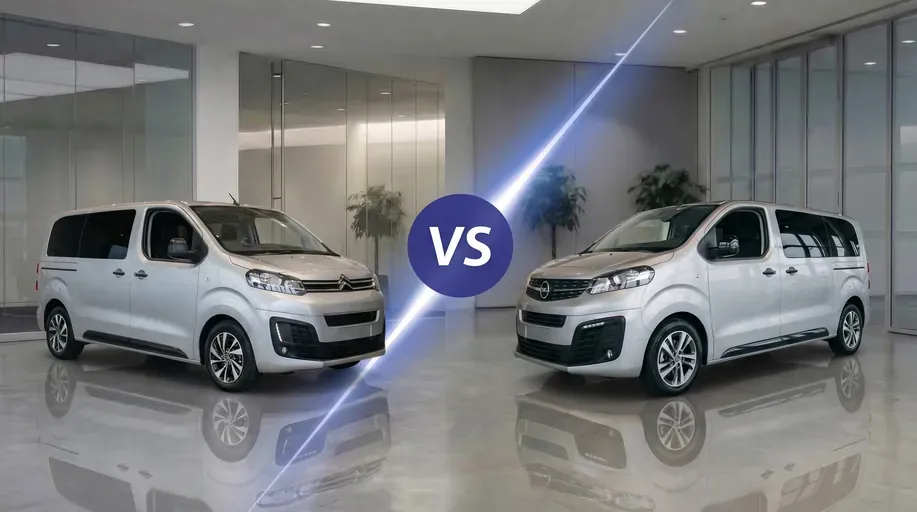
Car battle
Citroën SpaceTourer vs. Opel Zafira Life: Complete comparison 2026
Detailed comparison of Citroën SpaceTourer and Opel Zafira Life. Find out which family MPV offers better engines, equipment, and space. Read our verdict!
Apr 14, 2026
Volkswagen Multivan T7 review: real owner experiences, interior versatility, eHybrid & TDI running costs, reliability, and our final verdict.
October 28, 2026
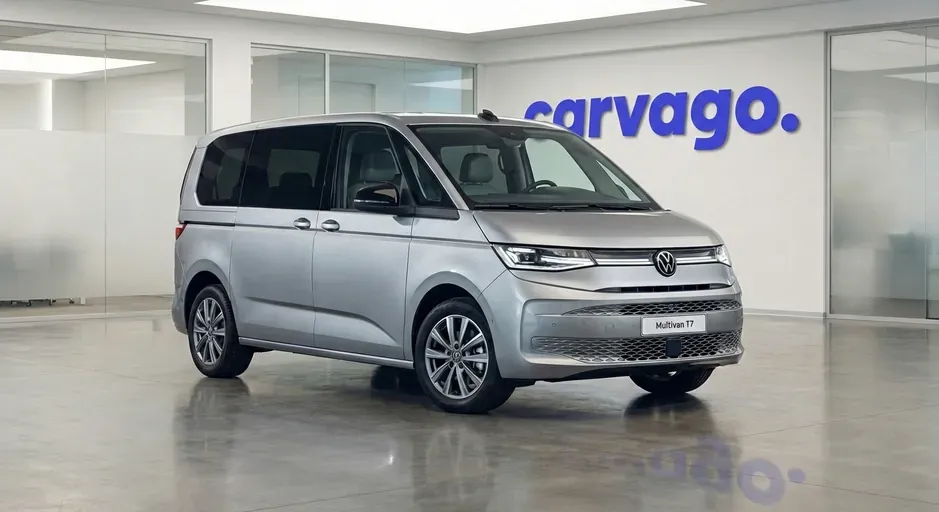
The seventh-generation Volkswagen Multivan (T7) marks a fundamental change in the large multi-purpose vehicle segment. Built on the passenger-car MQB Evo architecture, it sits between traditional commercial-based shuttles and large family people carriers. This review focuses exclusively on the seventh generation, covering vehicles from its European market introduction through to the 2026 model year.
Series production commenced at Hanover in October 2021, and first European customer deliveries followed in November 2021. The vehicle was introduced in two body formats: a standard body and an extended long body with an increased rear overhang, both sharing the same wheelbase and using modular individual seats. A mid-cycle update was previewed in March 2026, bringing a redesigned front fascia, revised lighting signatures, and fresh wheel choices; production of the refreshed version began at the Hanover plant in September 2026.
The Volkswagen Multivan primarily serves large families, outdoor enthusiasts requiring interior flexibility, and executive transport fleets seeking a versatile passenger vehicle without commercial-van underpinnings.
Owner experiences with the Volkswagen Multivan reflect its shift to a car-derived modular architecture, bringing notable refinement alongside early electronic and assembly teething issues. Long-term reliability data for the newest generation remains limited due to its recency, but user reports and professional tests across Europe highlight a clear cluster of recurring operational faults and several official safety campaigns.
On vehicles built between late 2021 and early 2024, owners report sporadic black screens, continuous rebooting, and complete freezing of the central infotainment touchscreen upon startup. Because cabin heating, ventilation, and air conditioning operate almost exclusively through this interface, a frozen display leaves climate settings inaccessible and can trigger recurring warning chimes. In most instances, dealership software updates resolved the software crashes, though owners report that hardware display replacements were necessary when communication failures persisted.
Owners report frequent issues with the optional powered sliding side doors, particularly in cold weather. The anti-pinch safety mechanism can trigger falsely, causing the door to stop after travelling a few millimetres or immediately reverse. In other cases, body flex over road undulations causes momentary loss of contact at the B-pillar pins, triggering a false "door open" warning in the instrument cluster while in motion. Rectification typically involves cleaning the floor guide rails, re-lubricating carriage rollers, adjusting latch tolerances, or replacing the contact switch blocks.
Another recurring complaint across both the diesel Volkswagen Multivan and hybrid Volkswagen Multivan involves auxiliary 12-volt battery discharge. Owners describe finding vehicles immobilized or displaying low-battery cluster warnings after standing unused for two to three days. On plug-in hybrid variants, this occurs despite a fully charged high-voltage traction battery, as control modules remain active instead of entering sleep mode. Software updates for onboard network control modules have resolved the parasitic draw in most vehicles, though severely discharged batteries required replacement.
The manufacturer has issued several European safety recalls for this generation. When evaluating a used vehicle, buyers should verify via official dealer records or an independent CarAudit inspection that all recall actions have been completed for that specific chassis number.
| Recall Focus | Announcement | Affected Build Window | Scope | Defect & Remedy |
|---|---|---|---|---|
| Tailgate Gas Struts | October 2026 | 16 July 2026 – 14 September 2026 | Worldwide (3,559 vehicles) | "Faulty tailgate gas struts, which may cause the open tailgate to fall suddenly without being slowed, potentially injuring anyone in its path." Workshops inspect strut batch markings and replace defective units. |
| Front Passenger Airbag | July 2025 | 17 May 2022 – 27 May 2025 | Worldwide (16,698 vehicles) | "The gas generator housing may burst or components of the gas generator housing may come loose and cause serious or fatal injuries to vehicle occupants." Official advice directs owners to deactivate the airbag or leave the front passenger seat unoccupied until the complete module is replaced. |
| Curtain Head Airbags & Wiring | July 2022 | 15 July 2020 – 11 May 2022 | Worldwide (7,896 vehicles) | Assembly errors risk reduced airbag protection, while an incorrectly routed wiring harness could abrade, short-circuit, and increase fire risk or cause vehicle stoppage. Workshops inspect clips, reroute wiring, and apply protective tape. |
| High-Voltage Fuse (Plug-in Hybrid) | April 2022 | Production up to 22 February 2022 | Worldwide (42,571 plug-in hybrids) | "The amount of extinguished sand in the fuse of the high-voltage system is not sufficient in the event of a short circuit", risking bursting or fire. Technicians fit an insulating mat over the high-voltage switching unit. |
The seventh-generation Volkswagen Multivan moved entirely to a passenger-car architecture, pairing every engine exclusively with a dual-clutch automatic transmission. The powertrain line-up spans traditional petrol and diesel options alongside plug-in hybrids, with all-wheel drive introduced exclusively on the later electrified variant.
| Engine | Fuel | Power | Gearbox | Drivetrain | Model years |
|---|---|---|---|---|---|
| 1.5 TSI | Petrol | 100 kW (136 hp) | 7-speed automatic | Front-wheel drive | 2021–2023 |
| 2.0 TSI | Petrol | 150 kW (204 hp) | 7-speed automatic | Front-wheel drive | 2021–present |
| 2.0 TDI | Diesel | 110 kW (150 hp) | 7-speed automatic | Front-wheel drive | 2022–present |
| 1.4 eHybrid | Plug-in hybrid | 160 kW (218 hp) | 6-speed automatic | Front-wheel drive | 2021–2024 |
| 1.5 eHybrid 4MOTION | Plug-in hybrid | 180 kW (245 hp) | 6-speed automatic | All-wheel drive | 2025–present |
For long-distance motorway journeys, the diesel Volkswagen Multivan with the 2.0 TDI remains the most sensible choice. Its low-end pulling power easily copes with passenger loads and luggage, while low touring consumption delivers a substantial driving range between fill-ups. The diesel is also well suited for towing duties, though buyers who frequently face steep unpaved grades or snowy mountain passes must note that this generation offers no all-wheel-drive diesel.
Drivers seeking engine refinement across mixed everyday motoring are better served by the petrol Volkswagen Multivan equipped with the 2.0 TSI. It delivers brisk acceleration, quiet running, and the same maximum braked towing limit as the diesel, albeit at the expense of noticeably higher fuel consumption under heavy loads. The entry-level 1.5 TSI, available only as a used car, felt underpowered in this heavy chassis and required high revs to keep pace on motorways, which led to its swift discontinuation.
For urban use and short commutes, the hybrid Volkswagen Multivan makes sense if you can charge regularly. The earlier front-wheel-drive 1.4 eHybrid, sold only as a used car, offers smooth low-speed commuting but suffers from front-wheel spin under abrupt acceleration. The newer all-wheel-drive Volkswagen Multivan with the 1.5 eHybrid 4MOTION system rectifies this with an electrically driven rear axle, faster direct-current charging, and a substantially increased pure-electric radius.
For detailed owner reports regarding high-voltage charging systems, electronic control updates, and general mechanical longevity, consult the owner experiences section.
The Volkswagen Multivan uses a modular rail floor system featuring individual passenger chairs rather than a fixed rear bench. Passengers in both the second and third rows have sufficient head and legroom for adults, supported by a flat floor that allows easy movement across the passenger compartment. Individual seats can slide along the rails, fold down, or rotate to face backward in a conference layout. However, unlocking the cargo area's full carrying capacity requires lifting each heavy seat module completely out of the vehicle, which requires considerably more physical effort than fold-flat seating systems. For buyers who routinely transport a full passenger load alongside luggage, the longer body variant is noticeably more accommodating, as its extended rear overhang leaves a deep luggage area behind the third row, whereas the standard body leaves room only for compact bags.
| Dimension / Capacity | Standard Body | Long Body |
|---|---|---|
| Length (mm) | 4,973 | 5,173 |
| Width without mirrors (mm) | 1,941 | 1,941 |
| Height (mm) | 1,887–1,907 | 1,887–1,907 |
| Wheelbase (mm) | 3,124 | 3,124 |
| Boot volume, seats up (l) | 469 | 763 |
| Boot volume, rear seats removed (l) | 3,672 | 4,005 |
Note: Luggage capacities reflect loading to roof height; versions fitted with the optional panoramic glass roof offer slightly higher cargo volumes.
On the road, the Volkswagen Multivan handles with the composure of a passenger car rather than a commercial van. Its steering is light and accurate, effectively masking vehicle bulk on twisty routes. Road testers note that the suspension remains pliant over broken tarmac while checking body pitch for rear-seat passengers, though sustained undulations can cause vertical float. Cabin refinement varies: low-speed driving on electric power is quiet, but the cavernous interior amplifies tyre boom on coarse motorway surfaces, and petrol engines drone under sustained load when hybrid reserves are depleted.
Inside, forward visibility benefits from split front pillars, and optional orthopaedic front seats provide firm long-distance support. The driving position sits lower than in traditional commercial-based shuttles. Material choices invite criticism, particularly hard plastics across the roof pillars that contrast unfavourably with plusher rivals. Testers also noted that the pre-facelift dashboard required reaching forward to operate the touchscreen, while unlit touch-sensitive sliders complicated cabin temperature adjustments in the dark.
Testers broadly agree on the platform’s car-like agility, yet they diverge on chassis damping, where impressions split between controlled tautness and undulating vertical motion over crests. Refreshed models produced from September 2026 resolve the primary ergonomic complaints by adopting an enlarged central touchscreen alongside illuminated temperature controls.
All the charts in this section are drawn from Carvago’s listings across the broader model family, including other generations represented in the data, rather than exclusively the reviewed generation. Because the dataset is not separated by vehicle generation, it does not establish a distinct price level specifically for the newest model alone. Across the available offerings, the median asking price for an advertised Volkswagen Multivan ranges from €42,500 for 2021 builds up to €65,600 for 2026 vehicles, with higher figures reflecting differences in powertrain type, optional equipment, and body overhang across different factory specifications.
Between April 2026 and September 2026, the number of advertised Volkswagen Multivan listings declined from 227 to 3. The chart below shows the month-by-month figures over this timeframe.
Active listings over time
| Month | Volkswagen Multivan |
|---|---|
| 2026-04 | 227 |
| 2026-05 | 227 |
| 2026-06 | 199 |
| 2026-07 | 117 |
| 2026-08 | 62 |
| 2026-09 | 3 |
Source Carvago
Available choice held steady at 227 listings through May 2026, but fell in each subsequent month to finish at 3 listings in September 2026.
The chart below outlines how median asking prices vary by build year: across used listings advertised today, the median asking price for a vehicle built in 2021 is €42,500, while models built in 2026 show a median asking price of €65,600.
Median advertised price by year of manufacture
| Model year | Volkswagen Multivan |
|---|---|
| 2021 | 42 500 |
| 2022 | 43 900 |
| 2023 | 45 100 |
| 2024 | 48 800 |
| 2025 | 61 400 |
| 2026 | 65 600 |
Source Carvago
Buyers looking at 2021 models see a median asking price of €42,500, while 2023 models sit at €45,100. Selecting newer production years requires a higher budget, with 2025 models advertised at a median asking price of €61,400 and 2026 models at €65,600.
Between April and September 2026, diesel models led the advertised selection, opening at 178 listings in April 2026 compared to 30 hybrid vehicles. The chart below outlines how the count of active listings evolved across each fuel type over this period.
Supply composition by fuel type
Petrol
Diesel
Hybrid
| Month | Petrol | Diesel | Hybrid |
|---|---|---|---|
| 2026-04 | 19 | 178 | 30 |
| 2026-05 | 17 | 177 | 33 |
| 2026-06 | 14 | 150 | 35 |
| 2026-07 | 10 | 80 | 27 |
| 2026-08 | 6 | 42 | 14 |
| 2026-09 | 1 | 2 | 0 |
Source Carvago
Across every month shown, diesel cars provide the largest pool of listings, followed by smaller volumes of hybrid and petrol choices, while electric options show zero listings. Buyers will find the greatest availability among diesel versions, whereas finding a petrol or hybrid Multivan means choosing from a much narrower selection.
The chart shows the average asking price for the Volkswagen Multivan between April 2026 and September 2026, opening at €53,900.
Average price development over time
| Month | Volkswagen Multivan |
|---|---|
| 2026-04 | 53 900 |
| 2026-05 | 54 500 |
| 2026-06 | 53 200 |
| 2026-07 | 52 200 |
| 2026-08 | 52 300 |
| 2026-09 | 58 000 |
Source Carvago
Across the period, the average asking price increased by roughly 8% from €53,900 to €58,000, though movement was not continuous and included a dip to €52,200 in July 2026.
Composed, car-like handling with light and accurate steering
Flexible rail-mounted individual seats that slide, fold, or face rearward
Adult-sized head and legroom across all three rows with a flat walk-through floor
Maximum luggage capacity requires lifting out heavy individual seat units
Pre-facelift models feature unlit climate sliders and glitch-prone touchscreens
No all-wheel-drive option available on diesel powertrains
Long-term reliability is not yet established due to the generation's recency. While early production years experienced electronic glitches, software updates resolved most operational issues, making documented dealer service history essential.
The diesel Volkswagen Multivan is the sensible choice for long-distance travel thanks to low touring consumption and steady pulling power under load. However, buyers requiring all-wheel drive must opt for the plug-in hybrid instead, as the diesel is front-wheel drive only.
The long body is preferable if you regularly carry passengers in all three rows, as its extended rear overhang preserves a deep luggage area behind the rear seats. The standard body leaves room only for compact bags when all seats are occupied.
Verify by VIN that all official safety recall campaigns have been completed. During inspection, confirm that the powered sliding doors and central touchscreen operate smoothly without errors.
Sources: volkswagen-vans.co.uk, adac.de, autobild.de, autocar.co.uk, autoexpress.co.uk
This article was prepared using artificial intelligence tools. The section guarantor is Petr Dušek.
Detailed comparison of Citroën SpaceTourer and Opel Zafira Life. Find out which family MPV offers better engines, equipment, and space. Read our verdict!
Apr 14, 2026
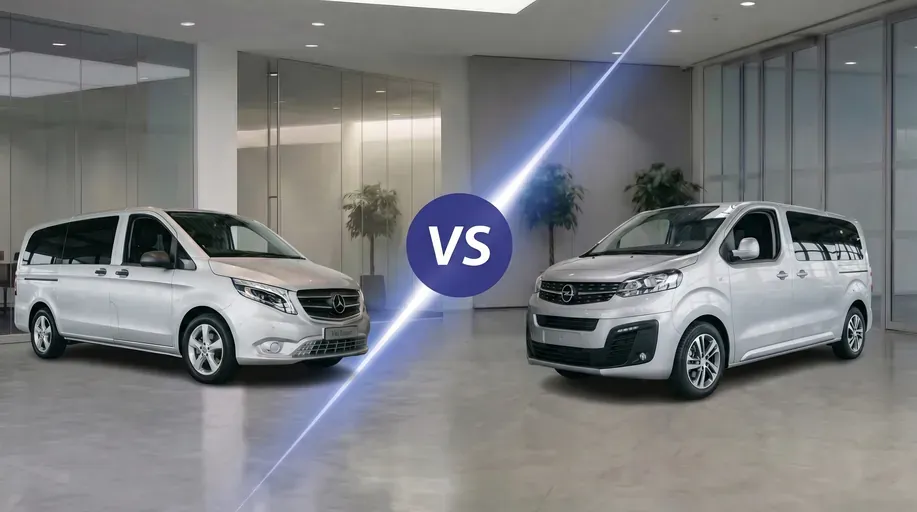
Mercedes-Benz Vito Tourer vs Opel Zafira Life: Which passenger van to choose? We compared space, equipment, and engines. Read our detailed verdict!
May 5, 2026
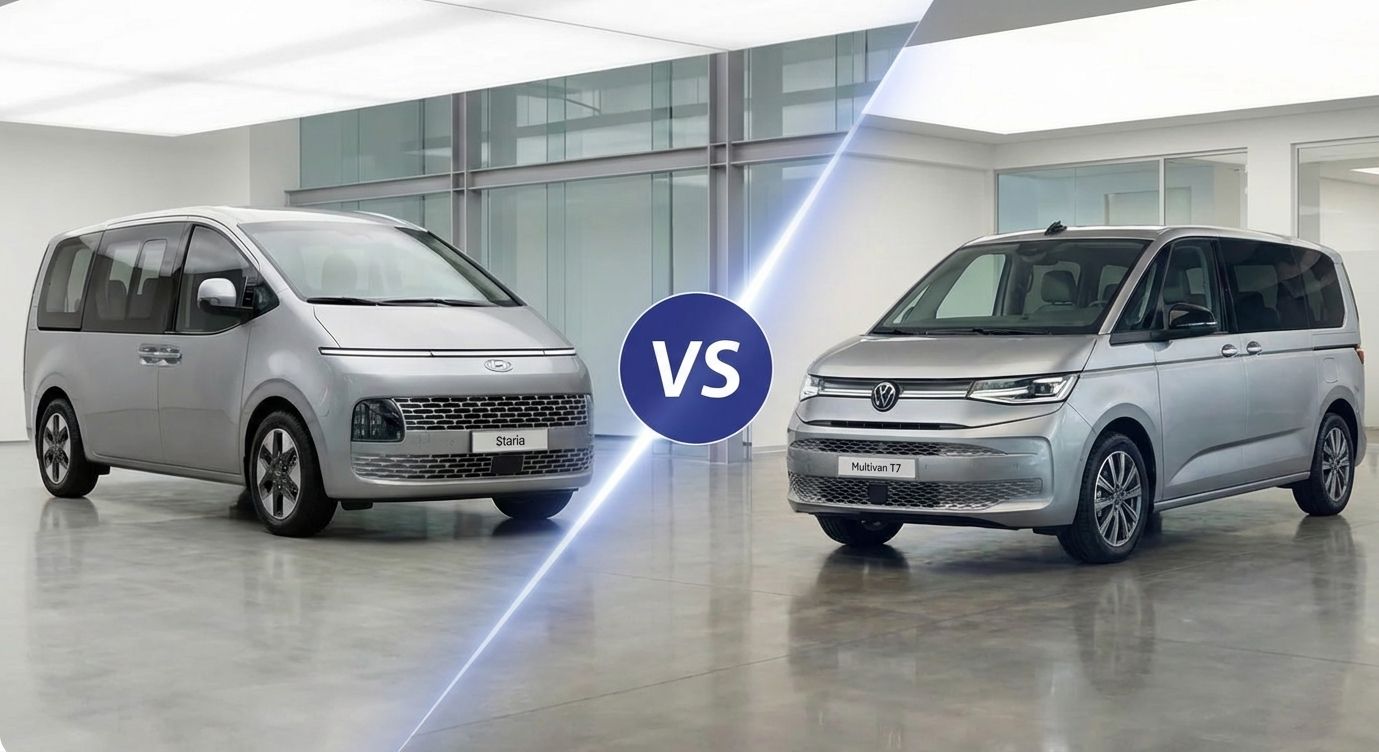
Hyundai Staria vs. Volkswagen Multivan. Detailed comparison of design, practicality and price. Find out which large MPV is the better choice for you.
Oct 23, 2026