Review
Review Porsche Taycan: What do owners and experts really say?
Porsche Taycan review: real owner experiences, charging performance, common faults, and used values. Everything you need before buying.
Oct 24, 2026
Tesla Model S review: real owner experiences, Plaid performance, everyday range, common issues, and used prices for the 2021+ refresh.
November 6, 2026
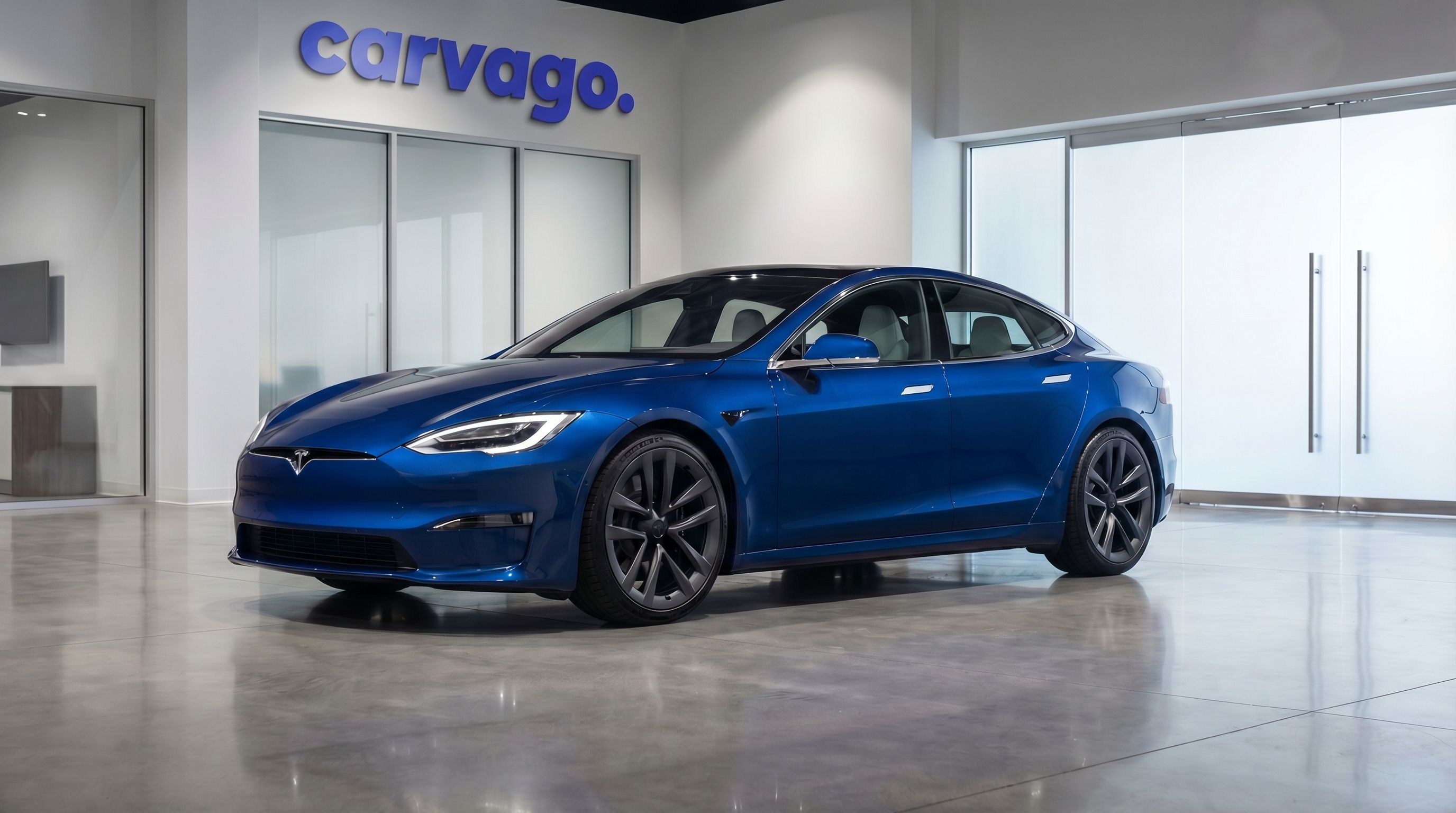
The Tesla Model S is an executive five-door liftback positioned in the full-size premium electric vehicle segment. While the model family dates back further, this review focuses exclusively on the second major refresh—designated internally as "Palladium" and officially catalogued as the 2021+ model—which represents the final specification delivered to European customers before global series production ended in May 2026.
First premiered on 27 January 2021, this extensive refresh brought updated exterior aerodynamics, an overhauled thermal architecture, and a restructured cabin featuring a landscape centre display. European customer deliveries of the electric Tesla Model S commenced in December 2022 for the tri-motor Plaid, followed in January 2023 by the Dual Motor all-wheel-drive variant. Tesla closed European custom orders in August 2025, with late registrations drawing from remaining inventory.
Sold across Europe in a single five-door liftback body style, the Tesla Model S appeals primarily to long-distance executive commuters and private buyers who require fast charging capability, high straight-line performance, and the cargo utility of a wide-opening rear tailgate.
Owner reports and official data show that the refreshed Tesla Model S delivers a sturdier build than earlier model years, although several model-specific mechanical and cosmetic issues require attention on the second-hand market. Because European customer deliveries commenced in December 2022 and concluded with the end of series production in May 2026, long-term multi-decade durability is still establishing itself. Nonetheless, repeated patterns have emerged across owner communities and workshop records.
Official safety authorities have logged several European campaigns for this generation, falling into over-the-air software corrections and physical workshop interventions.
In July 2025, a recall affecting 14,003 vehicles worldwide built between 13 September 2022 and 22 November 2024 addressed an emergency call system defect where the audio function could become unavailable under certain circumstances. This was resolved via a wireless software update. Similar over-the-air updates corrected an issue in June 2024 affecting 6,765 vehicles worldwide from model years 2022 to 2023, where protocol instability caused the rear-view camera display to fail when engaging reverse, and a July 2024 campaign covering vehicles built from 2012 to 2024 where seat occupancy logic prevented the driver seatbelt warning from activating.
Physical safety recalls required workshop visits. In October 2025, a worldwide recall covering 2021 to 2024 models addressed an inoperative horn caused by a mismatched non-mechanical horn pad installed in a mechanical steering wheel assembly or vice versa, requiring workshop inspection and hardware replacement. Previously, in December 2023, a recall covered 192 vehicles worldwide from model years 2021 to 2023 that received an incorrect driver airbag module during an aftermarket or service steering-wheel swap. In November 2023, an inspection campaign covered 17,997 vehicles worldwide built between 18 February 2021 and 24 June 2023, where front seatbelt pretensioner anchors may not have been correctly reattached during previous maintenance work.
On 2021 to 2023 builds equipped with the steering yoke, owners frequently report premature delamination of the synthetic surface material. The outer coating tends to bubble, crack, and peel along the grip edges within 15,000 to 30,000 km. Service bulletins authorised replacements with an updated polyurethane coating or retrofitting a conventional round steering wheel.
A prominent mechanical concern on the all-wheel-drive Tesla Model S is premature rear tyre wear. Professional alignment tests and owner reports confirm that the factory rear suspension geometry features aggressive negative camber. Because the adaptive air suspension lowers automatically at highway speeds, the innermost edge of the rear tyres carries heavy loads. In some cases, the inner shoulder can wear down to the structural cords while several millimetres of legal tread remain across the rest of the tyre. The factory rear camber is non-adjustable, meaning standard alignments can only alter rear toe.
Owners also report driveline shudder and vibration through the front chassis under hard acceleration. When launching at higher suspension settings, steep constant-velocity joint angles accelerate wear in the front half-shaft assemblies. While keeping the ride height setting low mitigates articulation stress, recurring high-torque launches can wear down the half-shaft raceways over time.
Finally, because the electric Tesla Model S relies primarily on regenerative braking for deceleration, friction brake discs rarely generate sufficient heat in daily driving. In wet or salted winter environments, the brake rotors suffer from surface corrosion, pitting, and caliper slider binding if not periodically lubricated and exercised.
The refreshed Tesla Model S arrived on European roads with a streamlined powertrain line-up comprising two distinct all-wheel-drive configurations. Buyers in the pre-owned market choose between the dual-motor setup and the tri-motor performance flagship.
| Engine | Fuel | Power | Gearbox | Model years |
|---|---|---|---|---|
| Model S Dual Motor AWD | Electric | 493 kW (670 hp) | 1-speed automatic | 2023–2026 |
| Model S Plaid | Electric | 750 kW (1,020 hp) | 1-speed automatic | 2022–2026 |
For regular motoring, the electric all-wheel-drive Tesla Model S Dual Motor AWD represents the most balanced choice as a used car. It offers immediate throttle response for urban driving, relaxed cruising at highway speeds, and sufficient reserves for pulling trailers, all while consuming less energy than the three-motor alternative.
The tri-motor Plaid is tailored specifically for drivers seeking extreme straight-line acceleration and occasional circuit use. In daily driving, urban stop-and-go conditions, or standard motorway travel, its additional rear drive unit increases tyre wear and energy demand without offering practical advantages over the dual-motor layout.
Owners report that sustained high-speed motorway driving depletes battery capacity considerably faster than official laboratory figures suggest. In sub-zero winter weather, the combined demands of battery conditioning and interior heating cause an additional drop in highway driving radius compared to warm-weather operation.
At direct-current fast-charging stations, both variants benefit from automatic battery preconditioning when navigating to a charger, allowing high initial energy transfer. Charging speeds naturally taper once the battery state of charge climbs past eighty percent, making frequent, shorter top-ups between ten and eighty percent the most time-efficient method for long-distance travel.
| Parameter | Model S Dual Motor | Model S Plaid |
|---|---|---|
| Length | 5,021 mm | 5,046 mm |
| Width (excluding mirrors) | 1,987 mm | 1,987 mm |
| Height (medium suspension) | 1,430 mm | 1,430 mm |
| Wheelbase | 2,960 mm | 2,960 mm |
| Rear boot volume (upright / folded) | 709 / 1,739 l | 709 / 1,739 l |
| Front trunk volume | 89 l | 89 l |
Note: Luggage figures reflect liquid-fill volume; VDA block ratings are unverified. Overall width extends to 2,189 mm with mirrors unfolded.
The Tesla Model S saloon functions as a practical five-door liftback despite its sleek silhouette. Its wide-opening tailgate reveals a deep luggage bay with a flat loading lip, supplemented by a hidden underfloor compartment and remote electronic releases on the boot wall to lower the backrests. A separate front trunk isolates charging cables and tyre repair kits from everyday cargo.
In the passenger compartment, the extended wheelbase ensures adult occupants have ample knee room in the outer rear seats. A completely flat cabin floor improves foot room for the centre passenger, although the middle seat is firmer and narrower than the outer positions. The main spatial compromise comes from the swept roofline, which restricts rear headroom for taller passengers compared to upright executive rivals.
On open roads, the adaptive air suspension fitted as standard on the Tesla Model S delivers a settled, compliant ride in its softer settings. Testers diverge on broken surfaces, however: some note clean absorption over highway bumps, while others observe low-speed fidgeting and less composed high-speed damping than traditional luxury rivals. The chassis provides relentless all-weather traction and flat cornering thanks to its low centre of gravity, but the steering remains synthetic and communicates little tactile feedback. Its substantial exterior width and mass also make the all-wheel-drive Tesla Model S feel cumbersome on narrow roads, and standard brakes can fade under repeated hard use. Cabin refinement divides opinion: several evaluations praise the active noise cancellation, whereas another records intrusive tyre roar on coarse tarmac.
Inside, the redesigned cabin brings a clear step forward in finish, seating comfort, and a responsive horizontal touchscreen that tilts towards the driver. Even so, general assembly precision and upholstery prestige still trail established German competitors. The ergonomics draw sharp criticism across professional tests: replacing traditional stalks with capacitive steering-wheel buttons makes signalling on roundabouts awkward, while the steering yoke—initially standard, then made optional—is widely dismissed as unsuited to daily driving and tight parking manoeuvres.
All market charts in this section reflect Carvago listings across the entire Tesla Model S model family, including earlier generations represented in the data, rather than isolating the reviewed generation alone. Consequently, this overview does not establish a separate price level specifically for the reviewed generation. Today's median asking price stands at €37,700 for 2021 model years, €79,900 for 2022, and €127,600 for 2026 vehicles. These differing price bands reflect distinct specifications and powertrain packages available across the broader vehicle line.
Active advertisements for the Tesla Model S ranged between 198 and 266 cars from May 2026 to October 2026, starting at 220 listings in May. The chart below tracks how the number of vehicles on offer changed over this six-month span.
Active listings over time
| Month | Tesla Model S |
|---|---|
| 2026-05 | 220 |
| 2026-06 | 229 |
| 2026-07 | 246 |
| 2026-08 | 198 |
| 2026-09 | 231 |
| 2026-10 | 266 |
Source Carvago
Buyers can generally expect between 200 and 266 cars to choose from, though choice has moved from month to month, recovering from a low of 198 listings in August 2026 to reach 266 by October 2026.
The median asking price of used listings advertised today built in 2019 is €40,000, while the median asking price for those built in 2026 is €127,600. The figures do not climb continuously with each model year, showing lower median prices for 2021 than 2020, as well as for 2023 than 2022.
Median advertised price by year of manufacture
| Model year | Tesla Model S |
|---|---|
| 2019 | 40 000 |
| 2020 | 41 600 |
| 2021 | 37 700 |
| 2022 | 79 900 |
| 2023 | 75 600 |
| 2024 | 85 500 |
| 2025 | 100 500 |
| 2026 | 127 600 |
Source Carvago
Buyers browsing the 2019 through 2021 model years encounter median asking prices between €37,700 and €41,600. A 2022 build year sits substantially higher at €79,900, dipping to €75,600 for 2023 before stepping up to €127,600 for 2026 listings.
Between May 2026 and October 2026, the volume of advertised cars tracked across fuel categories shows electric vehicles moving from 220 listings up to 266, as detailed in the monthly breakdown below.
Supply composition by fuel type
| Month | Electric |
|---|---|
| 2026-05 | 220 |
| 2026-06 | 229 |
| 2026-07 | 246 |
| 2026-08 | 198 |
| 2026-09 | 231 |
| 2026-10 | 266 |
Source Carvago
Electric power accounts for every single vehicle on offer, while petrol, diesel, and hybrid counts remain at 0 throughout, meaning prospective buyers will choose exclusively from fully electric cars.
The average asking price for the Tesla Model S stood at €60,400 in May 2026 before dipping to €57,900 the following month, as shown across the six-month period below.
Average price development over time
| Month | Tesla Model S |
|---|---|
| 2026-05 | 60 400 |
| 2026-06 | 57 900 |
| 2026-07 | 59 600 |
| 2026-08 | 64 500 |
| 2026-09 | 70 100 |
| 2026-10 | 72 400 |
Source Carvago
Following that June low of €57,900, the monthly average rose consecutively through to October 2026, where it reached €72,400.
Generous cargo utility with a wide-opening liftback tailgate and front trunk
High straight-line performance combined with secure all-wheel-drive traction
Rapid fast-charging capability supported by automatic battery preconditioning
Capacitive steering-wheel buttons replacing traditional stalks make signalling awkward
Factory suspension alignment causes severe premature wear on inner rear tyre shoulders
Swept roofline restricts rear headroom for taller occupants
Build quality improved over earlier production runs, but buyers must inspect rear inner tyre shoulders, listen for front half-shaft shudder, and verify recall status by VIN.
The Dual Motor all-wheel drive is the most balanced choice, delivering lower energy consumption and ample performance without the accelerated tyre wear of the tri-motor Plaid.
Inspect the inner edges of the rear tyres for structural cord wear, check for front driveline shudder under load, and verify completion of open safety recalls by VIN.
The long wheelbase yields adult legroom and a flat footwell, though the sloping roofline limits rear headroom for taller passengers compared to conventional executive saloons.
Sources: tesla.com, adac.de, autobild.de, autocar.co.uk, topgear.com
This article was prepared using artificial intelligence tools. The section guarantor is Petr Dušek.
Porsche Taycan review: real owner experiences, charging performance, common faults, and used values. Everything you need before buying.
Oct 24, 2026
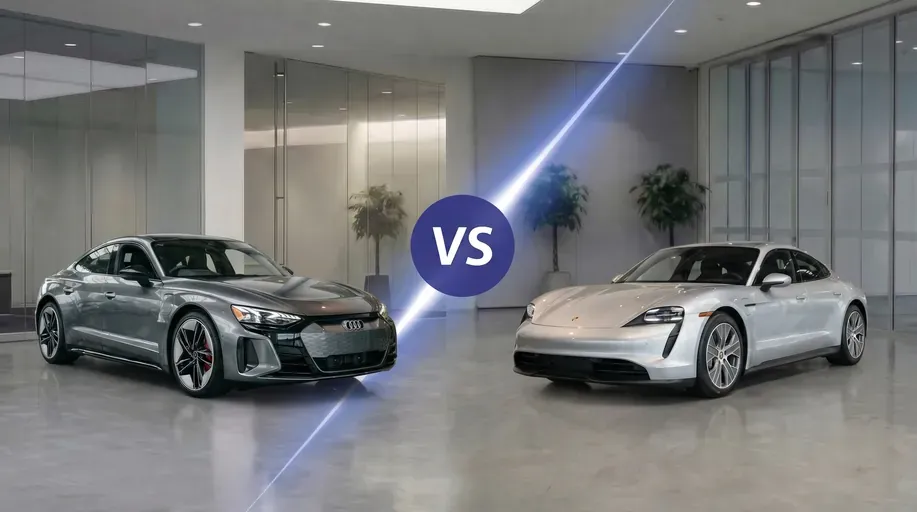
Audi e-tron GT vs. Porsche Taycan Comparison: Which luxury electric car should you choose? Find out everything about performance, real-world range, and read our final verdict.
Oct 16, 2026
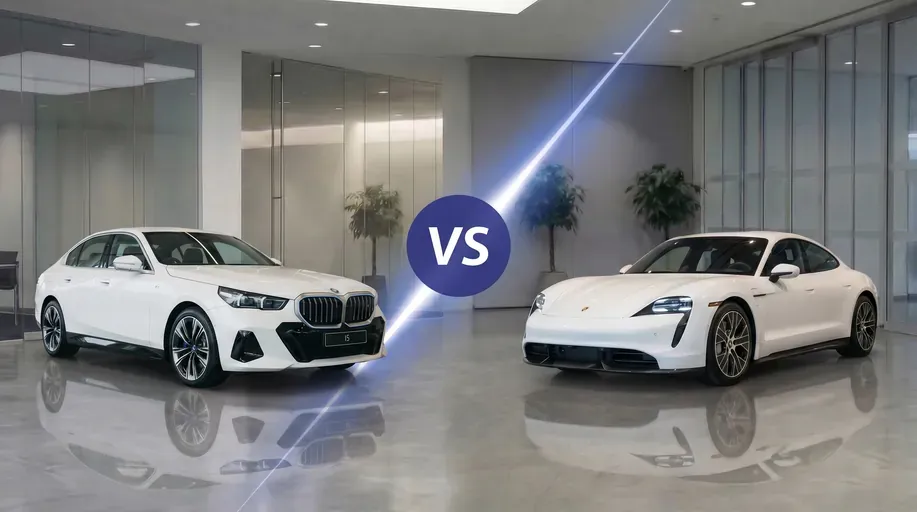
Detailed comparison of BMW i5 vs Porsche Taycan. A detailed look at real-world range, performance, equipment, and our verdict. Choose the right luxury electric car.
May 8, 2026