
Review
Review Ford Edge: What do owners and experts really say?
Ford Edge (2016-2021) review: real owner experiences, common faults, engine picks and used prices. Everything you need to know before buying.
Oct 26, 2026
Articles
Review
Škoda Kodiaq II review: real owner experience, engine picks, practicality, and running costs. Full verdict on the second-generation family SUV.
October 30, 2026
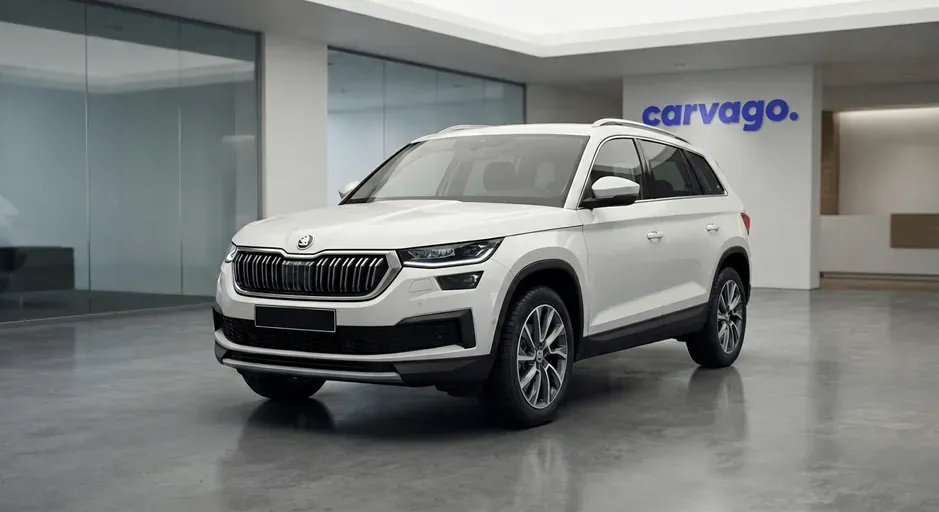
The second-generation Škoda Kodiaq sits as the flagship mid-size SUV in the manufacturer's European passenger car line-up. Following its world premiere on 4 October 2023, series production commenced on 16 January 2024, with first customer deliveries across Europe arriving in May 2024. Because production remains active and recent, this generation has not yet reached a mid-cycle facelift.
Sold exclusively as a five-door SUV, the model provides five-seat and optional seven-seat layouts across its petrol and diesel options. The range broadened later that year when the high-performance RS model had its premiere on 30 October 2024, followed by customer order books opening on 3 December 2024.
Targeted at family buyers and long-distance drivers requiring versatile cabin arrangements, practical load-lugging capacity, and towing ability, the Škoda Kodiaq SUV competes directly against established European mid-size crossovers. This review covers the second-generation model delivered from 2024 onwards.
Because customer deliveries of the second-generation Škoda Kodiaq began across Europe in May 2024, long-term multi-year durability data is not yet established. Early field data shows that major mechanical hardware has proven dependable, but early production months brought software-related grievances alongside two Europe-wide safety recalls that used-car buyers must verify by vehicle identification number (VIN).
The most frequent complaint among owners of 2024 and early 2025 models involves the central touchscreen and driver-assistance network. Owners report central display lag on start-up, occasional screen freezing, and navigation maps hanging during initial loading. Spurious instrument cluster warnings also appear intermittently, temporarily deactivating systems such as Front Assist and Travel Assist. In some cars, owners report that the steering-column stalk buttons for adaptive cruise control failed to register inputs due to internal contact faults.
Official manufacturer service campaigns and subsequent over-the-air software updates resolved these system freezes and communication errors in the vast majority of cases. Where cruise control buttons remained unresponsive, workshops resolved the fault by replacing the steering column stalk assembly.
Two safety recalls have been issued across European markets that affect the second-generation Škoda Kodiaq:
Drivers and test reports note low-speed clutch hesitation or slight shuddering from the dual-clutch automatic transmission during tight parking manoeuvres or stop-and-start crawl. While not indicative of widespread component failure, abrupt engagement warrants verifying whether the transmission software has been updated through CarAudit or an authorised dealer. Additionally, release latches on the sliding middle bench and the optional third-row seats can become stiff or bind after heavy family use.
The second-generation Škoda Kodiaq simplifies its mechanical lineup by eliminating manual gearboxes entirely. Every variant comes standard with an automatic transmission operated from a steering-column stalk, with front-wheel-drive and all-wheel-drive configurations tailored to specific usage profiles.
| Engine | Fuel | Power | Gearbox | Drivetrain | Model years |
|---|---|---|---|---|---|
| 1.5 TSI mHEV | Petrol (mild hybrid) | 110 kW (150 hp) | 7-speed automatic | Front-wheel drive | 2024–present |
| 2.0 TSI | Petrol | 150 kW (204 hp) | 7-speed automatic | All-wheel drive | 2024–present |
| 2.0 TSI RS | Petrol | 195 kW (265 hp) | 7-speed automatic | All-wheel drive | 2025–present |
| 2.0 TDI | Diesel | 110 kW (150 hp) | 7-speed automatic | Front-wheel drive | 2024–present |
| 2.0 TDI 4x4 | Diesel | 142 kW (193 hp) | 7-speed automatic | All-wheel drive | 2024–present |
| 1.5 TSI iV | Plug-in hybrid | 150 kW (204 hp) | 6-speed automatic | Front-wheel drive | 2024–present |
For suburban commuting, school runs, and frequent short urban trips, the mild-hybrid 1.5 TSI petrol serves as an easy-going entry point. Its integrated starter-generator smooths out stop-start cycles in traffic, though it demands higher engine revs when fully loaded with passengers. Drivers with regular access to home charging can step up to the hybrid Škoda Kodiaq iV, which covers daily city commutes entirely on electric power and supports rapid direct-current charging.
Frequent highway drivers should focus on the diesel Škoda Kodiaq. The front-wheel-drive 2.0 TDI offers relaxed cruising and low fuel consumption over long motorway stints, thanks to robust mid-range pulling power and an automatic sailing function that decouples the engine when coasting.
For pulling heavy horseboxes or caravans, adverse winter weather, or driving in hilly terrain, the Škoda Kodiaq 4x4 with the more powerful diesel engine is the most capable configuration. Its all-wheel-drive system provides dependable traction off the line and manages heavy trailers without strain.
Buyers who want all-weather capability without diesel characteristics can opt for the all-wheel-drive 2.0 TSI in the petrol Škoda Kodiaq lineup, which delivers quiet, linear acceleration in mixed use. At the top of the range, the RS variant provides sharper throttle response and brisk overtaking pace for drivers wanting sportier dynamics.
For documented service actions, software updates, and mechanical inspection points, refer to the owner experiences section.
| Variant | Length (mm) | Width (mm) | Height (mm) | Wheelbase (mm) | Boot volume (seats up / folded, l) |
|---|---|---|---|---|---|
| Standard 5-seater | 4,758 | 1,864 | 1,657–1,659 | 2,791 | 910 / 2,105 |
| Standard 7-seater | 4,758 | 1,864 | 1,656–1,658 | 2,791 | 340 / 845 / 2,035* |
| Plug-in hybrid (5-seat only) | 4,758 | 1,864 | 1,656 | 2,791 | 745 / 1,945 |
*For the seven-seater, figures indicate capacity behind the third row, behind the folded third row, and with both rear rows folded flat. Sport variants feature subtly extended bumpers and a fractionally higher ride height not reflected in the table above.
The second-generation Škoda Kodiaq accommodates tall adults in the second row with ample headroom and knee clearance, supported by a comfortable bench height off the floor. The middle row slides fore and aft on rails, splits in a 60:40 arrangement, and features reclining backrests to tailor passenger legroom against boot space. In three-row configurations, the rearmost seats fold flat into the cargo floor, though their tighter footwells and lower seat cushions make them suitable primarily for children. The luggage compartment provides an unobstructed flat loading area, though choosing the plug-in hybrid Škoda Kodiaq deletes the third row entirely and loses the underfloor storage compartment to the traction battery.
Road tests describe the Škoda Kodiaq as a stable, composed cruiser. The standard passive suspension leans towards compliance, absorbing road undulations calmly, though testers note a firm edge over broken urban surfaces. While optional adaptive dampers improve composure, fitting the largest available wheels causes sharp transverse expansion joints to thump through the cabin. Cornering stability is secure with modest body roll, though the steering prioritises light effort over road feel, feeling especially muted when paired with the variable-ratio rack on adaptive-chassis models.
Acoustic isolation earns widespread approval, keeping wind and road noise subdued at motorway speeds. The diesel engines settle into a background hum once cruising, while the plug-in hybrid delivers seamless handovers between electric and petrol power.
Inside the Škoda Kodiaq SUV, cabin build quality shows high rigidity with solid dash assemblies that resist creaks. The physical rotary Smart Dials receive praise over pure touchscreen setups, although the central multi-dial can trigger driving modes instead of fan adjustments if pressed imprecisely. Rearward visibility is compromised by thick pillars and a shallow rear screen. Testers agree on the cabin's highway refinement and motorway stability, but diverge on low-speed ride compliance, where sharp tarmac imperfections divide opinions.
All market charts in this section are drawn from listings across the entire Škoda Kodiaq model family, including other generations represented in the data, rather than the reviewed second generation alone. Because listings cannot be separated by generation using manufacture year alone, this data does not establish a distinct price level for the newest generation. Across the advertised model years, the median asking price stands at €27,200 for 2019 builds, shifts to €45,500 for 2024, and reaches €49,500 for 2026 vehicles.
The volume of advertised Škoda Kodiaq models rose across the six-month period, starting at 13,688 in April 2026 and reaching 15,375 in September 2026. The chart below illustrates the month-to-month counts.
Active listings over time
| Month | Škoda Kodiaq |
|---|---|
| 2026-04 | 13 688 |
| 2026-05 | 14 223 |
| 2026-06 | 14 862 |
| 2026-07 | 15 016 |
| 2026-08 | 14 959 |
| 2026-09 | 15 375 |
Source Carvago
Buyers can expect an extensive selection on the market, as available listings remained high throughout the period and finished at a high of 15,375 after a minor dip to 14,959 in August 2026.
Among used cars advertised today, the median asking price for vehicles built in 2019 is €27,200, while the median asking price for those built in 2026 is €49,500. The chart outlines the price differences across eight model years, where each newer build year commands a higher figure.
Median advertised price by year of manufacture
| Model year | Škoda Kodiaq |
|---|---|
| 2019 | 27 200 |
| 2020 | 29 500 |
| 2021 | 30 000 |
| 2022 | 32 500 |
| 2023 | 37 800 |
| 2024 | 45 500 |
| 2025 | 47 900 |
| 2026 | 49 500 |
Source Carvago
For older options, the median asking price of cars advertised today built in 2020 is €29,500, compared to a median asking price of €37,800 for those built in 2023. At the upper end of the range, the median asking price of cars advertised today built in 2025 is €47,900.
This depreciation curve tracks how the Škoda Kodiaq's residual value falls with vehicle age, shedding approximately 14% in its first year and nearly 32% by age three. The chart below illustrates the model's loss of value over its first seven years.
Residual value by vehicle age
| Vehicle age | Škoda Kodiaq |
|---|---|
| New | 49 600 |
| 1 yr | 42 600 |
| 2 yrs | 38 400 |
| 3 yrs | 33 800 |
| 4 yrs | 31 300 |
| 5 yrs | 27 900 |
| 6 yrs | 24 900 |
| 7 yrs | 22 000 |
Source Carvago
Across the seven years shown, the model sheds roughly 56% of its initial residual value, with the sharpest decline taking place over the first three years before annual depreciation moderates into a steadier pace.
Active listings for the Škoda Kodiaq were led by diesel and petrol models from April to September 2026, with diesel listings standing at 7,770 in April and 8,523 in September. The chart below shows the number of cars advertised across each fuel type month by month.
Supply composition by fuel type
Petrol
Diesel
Hybrid
LPG
| Month | Petrol | Diesel | Hybrid | LPG |
|---|---|---|---|---|
| 2026-04 | 4 523 | 7 770 | 1 390 | 2 |
| 2026-05 | 4 651 | 8 038 | 1 525 | 1 |
| 2026-06 | 4 875 | 8 351 | 1 629 | 0 |
| 2026-07 | 4 906 | 8 431 | 1 672 | 0 |
| 2026-08 | 4 869 | 8 350 | 1 737 | 0 |
| 2026-09 | 4 959 | 8 523 | 1 889 | 0 |
Source Carvago
In September 2026, diesel dominated the advertised selection with 8,523 listings, followed by petrol with 4,959 and hybrid with 1,889. Buyers will have by far the widest choice among diesel and petrol models, while hybrid variants represent a much smaller share of the cars on offer.
The chart tracks the average asking price for the Škoda Kodiaq from April 2026 to September 2026, opening at €38,500 and dipping to €38,200 in May.
Average price development over time
| Month | Škoda Kodiaq |
|---|---|
| 2026-04 | 38 500 |
| 2026-05 | 38 200 |
| 2026-06 | 38 600 |
| 2026-07 | 38 600 |
| 2026-08 | 38 600 |
| 2026-09 | 38 300 |
Source Carvago
Across the entire period, movement was minimal, with the average shifting by less than one percent from €38,500 in April to €38,300 in September while staying within a narrow band between €38,200 and €38,600.
Spacious passenger room with a sliding and reclining second-row bench
High motorway refinement with well-suppressed wind and road noise
Physical rotary dials provide straightforward climate and cabin controls
Early build years experienced touchscreen lag and driver-assistance software glitches
Dual-clutch automatic can hesitate or shudder during low-speed crawling
Third-row seating is cramped for adults and unavailable on the plug-in hybrid
Because customer deliveries only began in May 2024, long-term durability data is not yet established. Mechanical components have proven dependable in early service, though early production cars required software updates and safety recall checks.
The diesel Škoda Kodiaq is best for high-mileage drivers due to its low motorway fuel consumption and relaxed cruising. For towing heavy trailers or driving in winter conditions, choose the all-wheel-drive diesel variant for additional traction.
No. The hybrid Škoda Kodiaq comes strictly as a five-seater because its traction battery is housed under the luggage floor. Buyers needing a third row must choose a conventional petrol or diesel variant.
Verify the car's vehicle identification number with an authorised dealer to confirm that recalls for the front-seat frame and steering gear bolt have been completed. On the test drive, ensure the touchscreen operates without freezing and the dual-clutch transmission shifts smoothly during low-speed parking.
Sources: skoda-storyboard.com, adac.de, ec.europa.eu, autocar.co.uk, auto.cz
This article was prepared using artificial intelligence tools. The section guarantor is Petr Dušek.
Ford Edge (2016-2021) review: real owner experiences, common faults, engine picks and used prices. Everything you need to know before buying.
Oct 26, 2026

Ford Edge vs. Škoda Kodiaq comparison. A detailed look at the equipment, space, and driving characteristics of used SUVs. Read our verdict and choose the right one.
Oct 16, 2026

Detailed comparison of Audi Q5 vs. Jaguar F-Pace. Find out which used luxury SUV offers better driving characteristics, equipment, and reliability. Read our verdict!
May 8, 2026