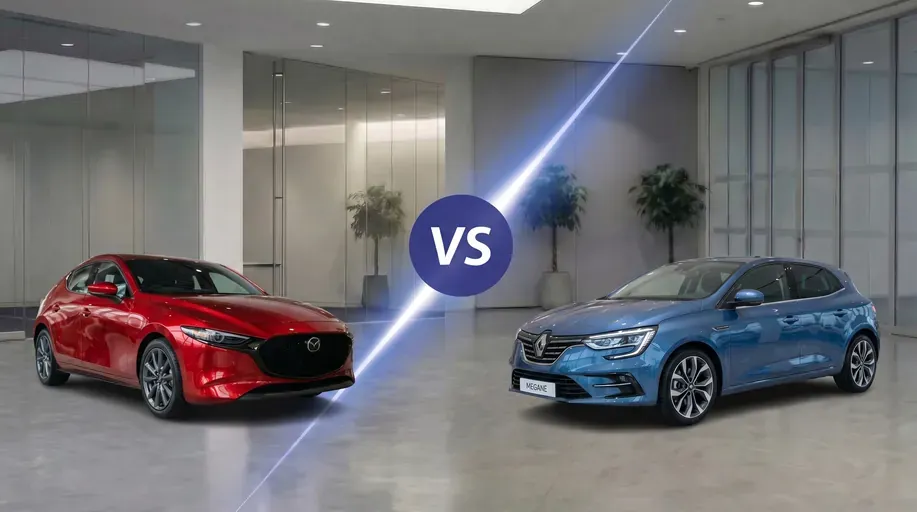
Car battle
Mazda 3 vs. Renault Mégane: Complete comparison 2026
Detailed comparison: Mazda 3 vs. Renault Mégane. We reveal real-world experiences, differences in equipment, and reliability. Find out which hatchback is the better choice!
May 3, 2026
Renault Mégane E-Tech review: real owner experiences, actual EV range, common issues, costs and prices — everything you need before you buy.
November 3, 2026
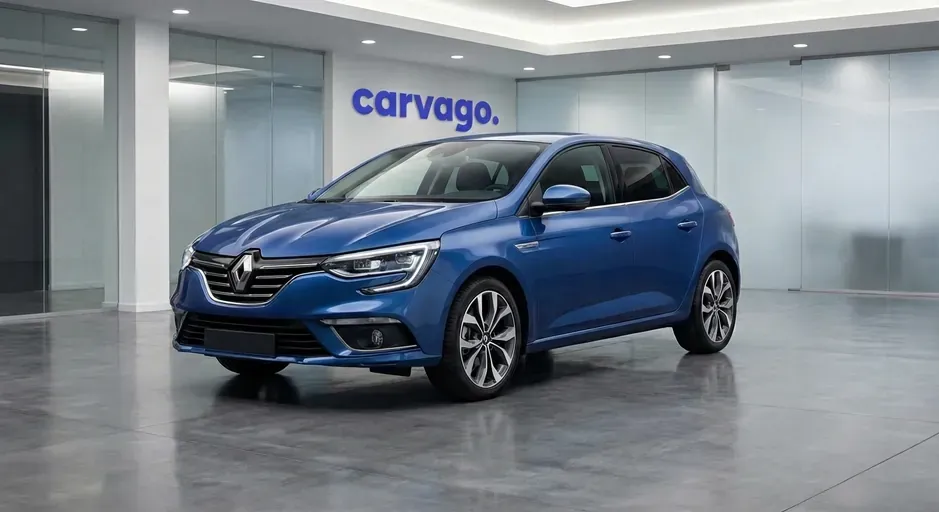
The fifth-generation Renault Mégane re-established the long-running nameplate as a dedicated battery-electric vehicle. Configured exclusively as a five-door crossover-hatchback, the electric Renault Mégane competes in the compact European EV segment, sitting between conventional family hatchbacks and raised crossovers. Following the end of previous-generation combustion-engine production in July 2024, it became the sole vehicle carrying the Mégane badge in Europe.
European customer deliveries of the original version began in April 2022. Renault presented a mid-cycle revision on 22 June 2026, with European order books opening in July 2026 and deliveries commenced in October 2026. This facelift streamlined the line-up, updating the battery chemistry and consolidating the powertrain offering.
The model appeals to urban commuters, smaller families, and fleet drivers seeking a compact footprint for city navigation alongside sufficient highway capability. This review focuses specifically on the fifth generation, examining both the pre-facelift vehicles and the revised model.
Built from early 2022 on a dedicated battery-electric platform, the fifth-generation Renault Mégane has established an encouraging record for mechanical durability, though early production years experienced teething issues with software logic, auxiliary electronics, and initial factory assembly. For the facelifted model delivered to European buyers from October 2026, long-term reliability data and independent endurance records are not yet established due to its recent introduction.
Official European safety monitoring identified a mechanical issue concerning the vehicle immobilisation system. Across two connected notifications in September and October 2025, a safety recall was issued across European markets for vehicles produced between 10 April 2024 and 7 May 2025. In the words of the safety notices, the position sensor of the parking brake actuator is at the wrong angle, causing the stopping pin to be incorrectly placed in the parking lock position. This can result in the mechanical lock not engaging properly when the selector button is pressed, when the vehicle is switched off, when the driver's seatbelt is unbuckled, or when the driver's door is opened.
The defect increases the risk of unintended movement if the vehicle is left unattended on an incline, although the primary assisted parking brake remains operational to immobilise the car. Authorised workshops inspect the assembly and replace the defective transmission parking brake actuator mechanism.
On the earliest production runs built prior to October 2022, owners reported damp front footwell carpets and water pooling around passenger-side floor wiring after heavy downpours or automated car washes. This was traced to miscalibrated robotic sealant application behind the front inner wheel arches at the factory. Dealerships resolved affected cars by resealing the joints under warranty, and factory calibration was corrected in October 2022.
Rear suspension noise is another frequent complaint among drivers. Owners report thumping, clicking, or creaking sounds from the rear axle when driving over speed bumps or rough tarmac at low speeds, particularly in sub-zero winter temperatures. The sound stems from dry friction at the rear shock absorber bump stops and mounts, which authorised service centres address by cleaning and applying specialist lubricant or fitting updated bump stops.
On the electrical side, owners describe communication handshake interruptions when charging on intelligent home AC wallboxes. The car can halt scheduled overnight charging sessions unexpectedly and display a delayed charging status. In some cases, authorised dealer software updates to the onboard charger communication unit resolve this issue. In addition, some 2022–2024 models left parked for multiple weeks or subjected to aborted charging sessions have experienced parasitic drain on the 12-volt auxiliary battery. If the auxiliary battery depletes completely, the car cannot energise its high-voltage contactors, displaying false electrical failure warnings on the dashboard until updated module software is applied or the 12-volt battery is replaced.
In professional endurance testing over 100,000 km, tests describe the core electric drivetrain and high-voltage battery maintaining high operating health with zero roadside breakdowns. Minor wear was confined to secondary body hardware, including snapped luggage shelf clips, driver door hinge stiffness, and loose rear window rubber weatherstripping.
Before completing a purchase, having a used electric Renault Mégane independently checked through CarAudit ensures that its past service record, electrical modules, and structural integrity are thoroughly verified.
The fifth-generation electric Renault Mégane launched exclusively with front-wheel-drive battery-electric powertrains, initially providing two power levels and battery capacities before simplifying to a single specification. Each version employs an electrically excited synchronous motor mated to an automatic reduction gear.
| Engine | Fuel | Power | Gearbox | Model years |
|---|---|---|---|---|
| EV40 130hp | Electric | 96 kW (130 hp) | automatic | 2022–2026 |
| EV60 130hp | Electric | 96 kW (130 hp) | automatic | 2022–2024 |
| EV60 220hp | Electric | 160 kW (220 hp) | automatic | 2022–2026 |
| 67 kWh 220hp | Electric | 160 kW (220 hp) | automatic | 2026–present |
For urban commuting and short daily trips, the entry-level motor paired with the smaller battery is adequate, benefiting from lower overall weight that aids low-speed responsiveness. When browsing as a used car, buyers must verify charging specifications on these earlier models, as initial baseline builds lacked DC fast-charging capability entirely and were limited to single-phase AC charging. The fleet-focused version that combined the lower-powered motor with the larger battery is similarly restricted to the second-hand market.
For mixed use and regular motorway journeys, the higher-output motor with the larger battery pack is the practical choice. Professional evaluations show that the base motor tapers in performance above secondary-road speeds, whereas the stronger motor maintains steady overtaking capability up to motorway speed limits. In the new-car market, the mid-cycle revision made this higher-output motor the sole powertrain available for the Renault Mégane.
Drivers planning to tow should also select the higher-output motor, whether in pre-facelift or facelift form, because its braked towing allowance is considerably higher than that of the lower-powered variant.
For documented drive unit dependability, software service campaigns, and transmission recalls, refer to the owner experiences section.
| Dimension | Pre-facelift (2022–2026) | Facelift (2026–present) |
|---|---|---|
| Length (mm) | 4,199 | 4,199 |
| Width excl. / incl. mirrors (mm) | 1,768 / 2,055 | 1,768 / 2,055 |
| Height (mm) | 1,505 | 1,522 |
| Wheelbase (mm) | 2,685 | 2,685 |
| Boot volume seats upright / folded (l) | 440 / 1,332 | 440 / 1,332 |
The dedicated electric crossover architecture gives the electric Renault Mégane a compact footprint with decent interior utility, though passenger packaging prioritises front occupants. While front riders enjoy broad adjustment and a sliding centre armrest, the rear bench presents compromises for taller adults. The underfloor traction battery forces a raised rear floor level, which restricts foot space beneath the lowered front seats and creates a knees-up seating posture with minimal under-thigh support. A high shoulder line and narrow side glazing can also make the rear quarters feel rather enclosed. Cargo usability is characterised by a deep boot aperture and a separate underfloor cavity intended for charging cables. However, practicality suffers from a notably high load sill and the absence of an adjustable boot floor, which leaves an awkward step when lowering the fixed, 60:40 split rear seatbacks.
Professional testers consistently describe the electric Renault Mégane as one of the quietest compact electric hatchbacks at highway speeds, praising its isolation from wind rush, road rumble, and motor whine. Ride composure is generally solid over undulating asphalt, maintaining tight vertical control without wallow. However, damping remains distinctly firm-edged at urban speeds, where sharp transverse ridges, manhole covers, and potholes transmit noticeable thumps into the cabin—a characteristic magnified on the larger optional twenty-inch wheels. Testers unanimously recommend the smaller standard eighteen-inch wheels for noticeably better daily compliance.
Handling evokes mixed reactions. The steering is direct and quick off-centre, giving the chassis an alert, agile feel during city manoeuvres. On winding roads, however, multiple road tests note that this hyper-direct ratio feels nervous and lacks progressive mechanical feedback, requiring occasional mid-corner corrections. Furthermore, professional tests uniformly criticize front-axle traction: applying full acceleration from standstill or powering out of tight corners on damp asphalt frequently provokes wheelspin and front-end scrub.
Inside, the cabin receives widespread approval for material quality and switchgear ergonomics. Dashboard fabrics, tactile textures, and solid assembly earn high marks, as does the Google-based infotainment system, commended for brisk response times, clean menu logic, and physical climate rocker keys below the screen. The main point of criticism across expert tests focuses on outward visibility: thick rear pillars and a narrow rear window restrict over-the-shoulder sightlines.
All the market charts in this section reflect Carvago listings across the entire Renault Mégane model family, including previous generations present in the dataset, rather than isolating the reviewed electric generation. Because the underlying data groups advertised vehicles strictly by build date, it does not establish a distinct price level for individual generations. Today's advertised offerings show a median asking price of €13,900 for 2019 models and €20,000 for 2022 models, reaching €35,800 for cars manufactured in 2026.
Between May 2026 and October 2026, the count of advertised Renault Mégane cars decreased each month, falling from 5,953 to 4,294 listings, as shown in the chart below.
Active listings over time
| Month | Renault Mégane |
|---|---|
| 2026-05 | 5 953 |
| 2026-06 | 5 560 |
| 2026-07 | 5 173 |
| 2026-08 | 4 764 |
| 2026-09 | 4 725 |
| 2026-10 | 4 294 |
Source Carvago
Although the number of listings moved downward in each recorded month, buyers still have substantial choice, with 4,294 vehicles advertised in October 2026.
The median asking price of cars advertised today, built in 2019, is €13,900, while the median asking price of cars advertised today, built in 2026, is €35,800. The chart below details how median asking prices vary across these build years.
Median advertised price by year of manufacture
| Model year | Renault Mégane |
|---|---|
| 2019 | 13 900 |
| 2020 | 14 500 |
| 2021 | 16 300 |
| 2022 | 20 000 |
| 2023 | 24 000 |
| 2024 | 33 000 |
| 2025 | 35 500 |
| 2026 | 35 800 |
Source Carvago
Buyers looking at 2019 to 2021 model years will encounter median asking prices between €13,900 and €16,300. For a 2024 model, the median asking price is €33,000, representing the largest step between consecutive model years from the 2023 median of €24,000.
This depreciation curve shows how the Renault Mégane's residual value steadily declines over time, losing approximately 29 % of its initial value by age three. The chart below illustrates this ongoing drop across the first seven years of ownership.
Residual value by vehicle age
| Vehicle age | Renault Mégane |
|---|---|
| New | 34 900 |
| 1 yr | 31 300 |
| 2 yrs | 28 800 |
| 3 yrs | 24 900 |
| 4 yrs | 22 600 |
| 5 yrs | 19 600 |
| 6 yrs | 17 400 |
| 7 yrs | 16 100 |
Source Carvago
Across the seven years recorded, the model sheds roughly 54 % of its initial residual value, with depreciation slowing to its gentlest pace between age six and age seven.
Active listings for the Renault Mégane span multiple powertrains, starting in May 2026 with 2236 petrol models and 1684 diesels. The chart below tracks how the number of advertised cars for each fuel type evolved through October 2026.
Supply composition by fuel type
Petrol
Diesel
Hybrid
Electric
LPG
| Month | Petrol | Diesel | Hybrid | Electric | LPG |
|---|---|---|---|---|---|
| 2026-05 | 2 236 | 1 684 | 374 | 1 656 | 2 |
| 2026-06 | 2 060 | 1 606 | 383 | 1 509 | 1 |
| 2026-07 | 1 922 | 1 473 | 376 | 1 401 | 0 |
| 2026-08 | 1 638 | 1 294 | 356 | 1 476 | 0 |
| 2026-09 | 1 587 | 1 316 | 340 | 1 482 | 0 |
| 2026-10 | 1 478 | 1 253 | 300 | 1 263 | 0 |
Source Carvago
By October 2026, petrol led the market with 1478 cars on offer, followed closely by 1263 electric models and 1253 diesels. Buyers will find ample selection across petrol, electric, and diesel options, whereas hybrids represent a narrower choice with 300 active listings.
The chart tracks the average asking price for the Renault Mégane between May 2026 and October 2026, holding at €18,400 across the first three months.
Average price development over time
| Month | Renault Mégane |
|---|---|
| 2026-05 | 18 400 |
| 2026-06 | 18 400 |
| 2026-07 | 18 400 |
| 2026-08 | 18 800 |
| 2026-09 | 18 700 |
| 2026-10 | 18 500 |
Source Carvago
Overall movement was minimal across the period, with the average peaking at €18,800 in August before closing at €18,500 in October.
Quiet cabin with effective suppression of wind, road, and motor noise at highway speeds
Responsive Google-based infotainment system complemented by physical climate keys
Durable core electric drivetrain with high mechanical reliability in endurance testing
Compromised rear seating posture with restricted under-thigh support and foot space
Front-wheel traction loss under sudden acceleration, particularly on damp tarmac
Restricted over-the-shoulder visibility caused by thick rear pillars and narrow glass
Core mechanical components have proved robust in high-mileage testing, though early pre-facelift production suffered from initial assembly defects and auxiliary electronic glitches.
The higher-output motor paired with the larger battery is the most versatile choice for mixed driving and motorway trips. Baseline early models suit urban commuting, though some pre-facelift versions lacked DC fast charging entirely.
Verify by VIN that the transmission parking brake actuator recall has been completed and that all dealer software updates are installed. Early builds should also be inspected for footwell moisture and suspension noises.
It suits smaller families well, offering a 440-litre boot and comfortable front seating. However, the raised cabin floor compromises rear adult seating comfort, and the boot has a high loading lip.
Sources: media.renault.com, adac.de, ec.europa.eu, autocar.co.uk, whatcar.com
This article was prepared using artificial intelligence tools. The section guarantor is Petr Dušek.
Detailed comparison: Mazda 3 vs. Renault Mégane. We reveal real-world experiences, differences in equipment, and reliability. Find out which hatchback is the better choice!
May 3, 2026
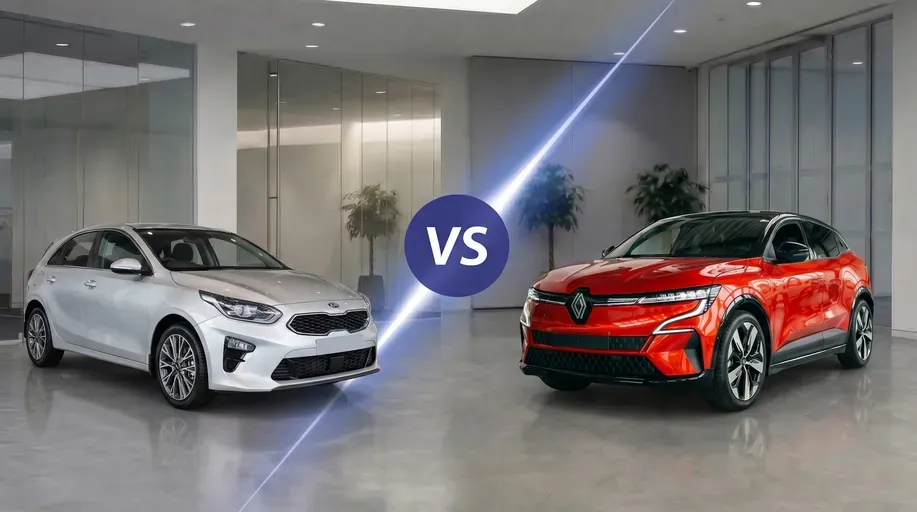
Used car comparison: Kia Ceed vs Renault Mégane. Which hatchback or estate to choose? We compared engines, equipment, and reliability. Read our verdict!
Oct 16, 2026
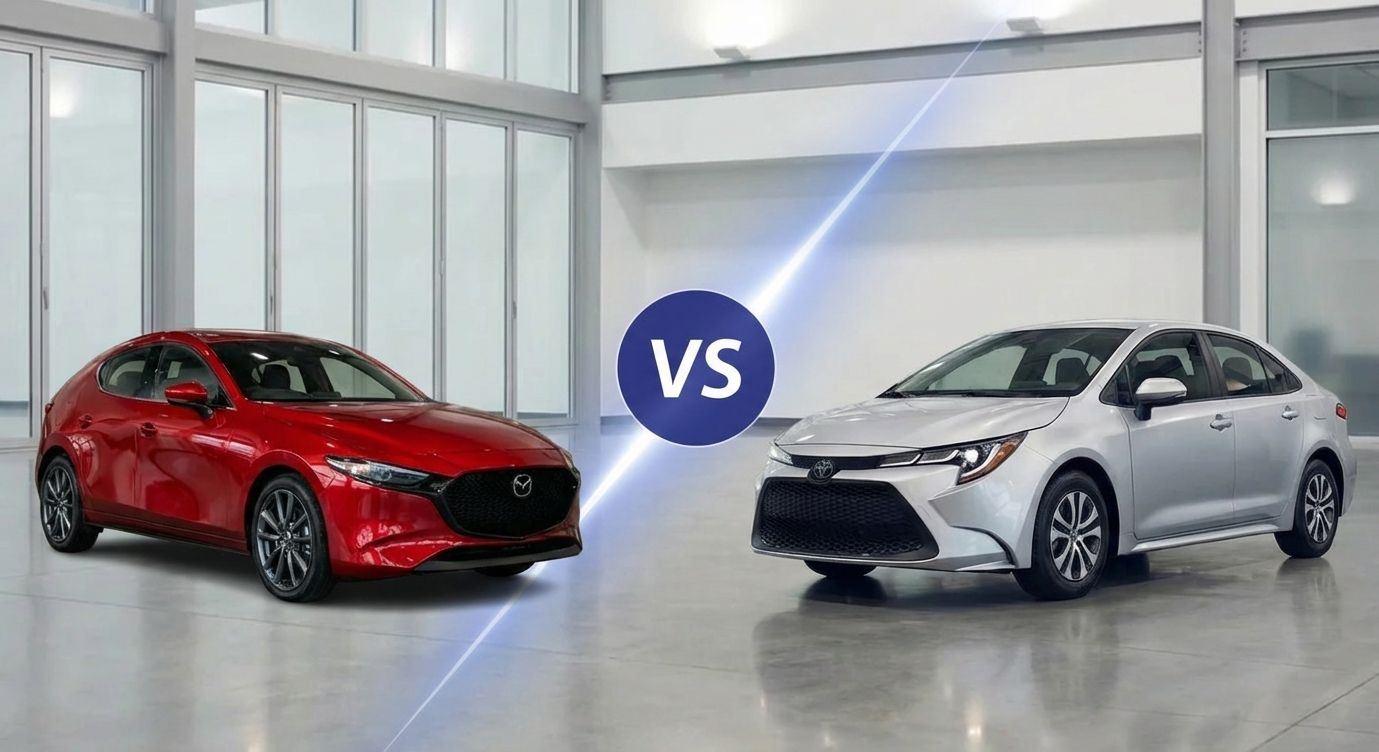
Mazda 3 vs. Toyota Corolla: Which bestseller is better? Our detailed comparison of engines, features, and handling will help you make your final choice.
Oct 23, 2026