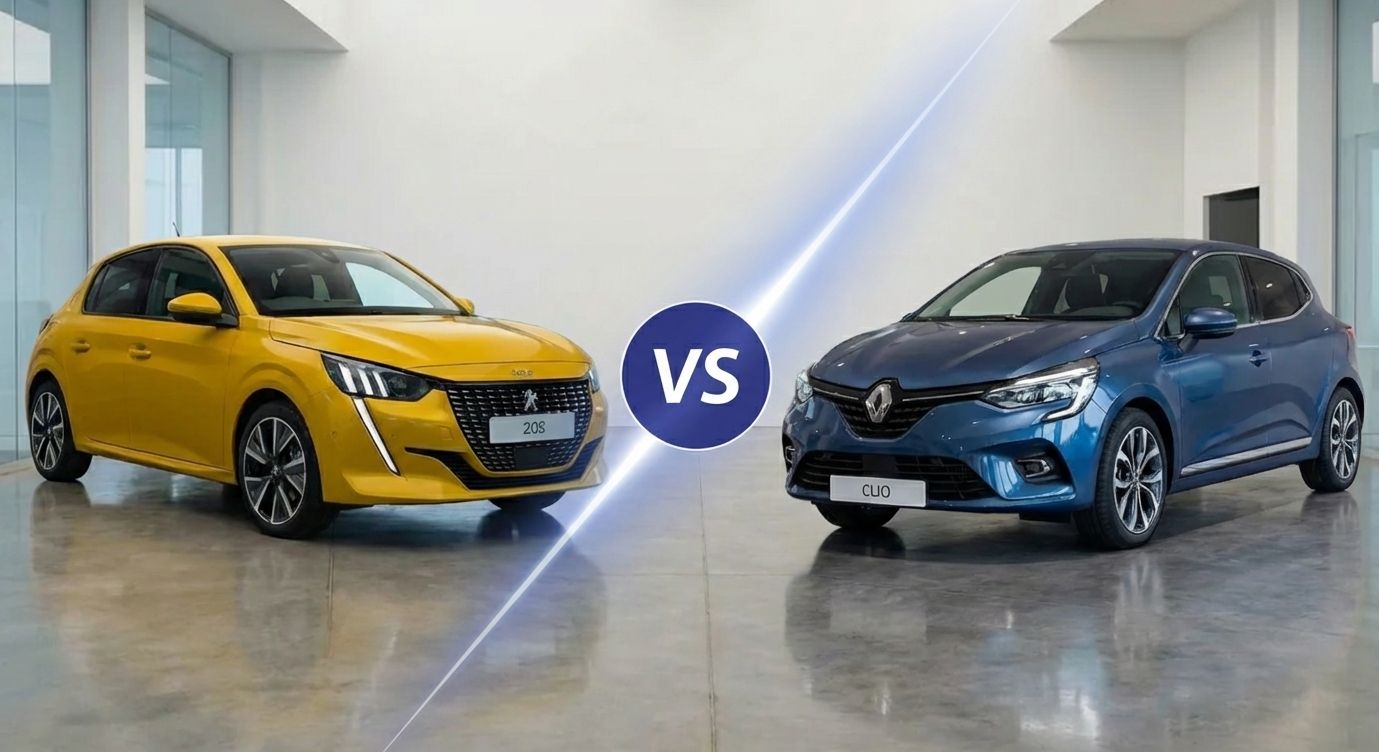
Car battle
Peugeot 208 vs. Renault Clio: Complete comparison 2026
Detailed comparison of Peugeot 208 vs Renault Clio. Find out which French hatchback has better equipment, fuel consumption, and reliability. Read our verdict!
Apr 8, 2026
Articles
Review
Renault Clio VI review: real owner feedback, hybrid running costs, boot space, pricing and our definitive verdict on the new supermini.
October 22, 2026
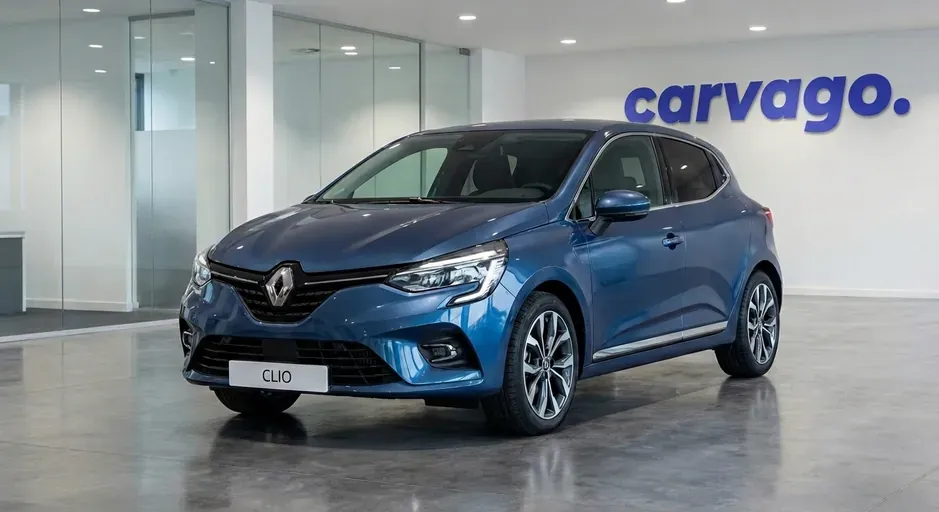
The Renault Clio is one of Europe’s longest-running superminis, competing in the B-segment against established small cars. This review examines the sixth-generation model, which celebrated its world premiere in September 2025. Order books initially opened in France on 15 October 2025, with European customer deliveries commencing in early 2026.
Produced exclusively as a five-door Renault Clio hatchback, the model launched with conventional petrol and full-hybrid options, followed on 05 May 2026 by an orderable dual-fuel petrol and LPG variant. Given the recency of its market launch, the sixth generation has received no mid-cycle facelift to date.
The Renault Clio attracts private buyers, commuters, and small households seeking a manageable footprint for urban driving combined with enough flexibility for motorway travel. This guide details the ownership proposition of the latest generation, outlining its practical packaging, running costs, and road characteristics for used and nearly new buyers.
Because customer deliveries of the sixth-generation Renault Clio commenced in early 2026, long-term endurance patterns, high-mileage component wear, and multi-year reliability statistics are not yet established. Early owner reports and professional road tests indicate that initial issues have centred primarily on minor electronic quirks and powertrain software calibrations rather than fundamental mechanical breakdowns.
The most notable drivability anomaly reported on the hybrid Renault Clio involves its thermal management software. Tests describe and owners report that in cool ambient temperatures, disabling the automatic climate setting causes the petrol engine to run continuously to supply cabin heat. Even when the traction battery has sufficient charge, the combustion engine refuses to switch off in urban traffic unless the climate control remains strictly in automatic mode. Renault addressed this thermal management logic with an over-the-air software calibration update released in spring 2026.
Early production cars have also shown occasional teething troubles with the central infotainment system. Some owners describe brief bursts of static or audio crackling through the door speakers when establishing an initial wireless smartphone connection, as well as temporary touchscreen latency immediately following a cold vehicle start. An over-the-air firmware update rolled out in spring 2026 corrected these handshake buffering delays and improved system boot response.
Official safety registers record one manufacturing recall relevant to this generation. Announced in March 2026 for vehicles built between 18 October 2025 and 20 October 2025 across European markets, the campaign addresses the front suspension. Official notices state that tightening of the front suspension lower control arm ball joint nuts may be insufficient due to a processing defect during assembly. Early warning signs include knocking or clicking sounds from the front wheels at low mileage. If neglected, the fastening could fail, causing the affected wheel to become misaligned. Authorised workshops inspect the lower arm ball joint fixings and fit replacement locking nuts where necessary.
Buyers considering an early-production model on the secondary market can have the vehicle's documented history and physical condition independently verified through CarAudit.
The sixth-generation Renault Clio features a streamlined powertrain line-up focused entirely on efficiency and electrification, dropping all diesel and naturally aspirated units. Buyers choose between a turbocharged petrol unit, a dual-fuel LPG variant, and a petrol full hybrid.
| Engine | Fuel | Power | Gearbox | Model Years |
|---|---|---|---|---|
| 1.2 TCe 115 | Petrol | 84 kW (115 hp) | 6-speed manual | 2026–present |
| 1.2 TCe 115 EDC | Petrol | 84 kW (115 hp) | 6-speed automatic | 2026–present |
| 1.2 Eco-G 120 EDC | Petrol / LPG | 90 kW (120 hp) | 6-speed automatic | 2026–present |
| 1.8 E-Tech full hybrid 160 | Full Hybrid (Petrol) | 115 kW (160 hp) | Multi-mode automatic | 2026–present |
Town and short tripsFor stop-start city driving, the hybrid Renault Clio is the most suitable choice. Its electric-assisted propulsion delivers smooth low-speed progress in heavy congestion without requiring manual shifting.
Mixed use and low running costsDrivers balancing suburban commuting and regional routes are well served by the LPG Renault Clio. The dual-fuel system delivers substantial pump savings and a long combined cruising range across two tanks, while the standard automatic transmission simplifies daily driving.
Motorway journeysFor regular highway cruising, the petrol Renault Clio with the manual gearbox is the most balanced option. It settles into a quiet rhythm at motorway speeds, and the manual transmission avoids the occasional downshift delays found in the dual-clutch automatic.
TowingFor hauling light utility trailers, the full hybrid provides the strongest low-end pull to move away smoothly with added weight. The manual turbocharged petrol also manages light towing duties adequately.
For documented initial service updates and component durability records, see the owner experiences section.
| Dimension / Metric | Hatchback (Petrol) | Hatchback (Full Hybrid) |
|---|---|---|
| Length (mm) | 4,116 | 4,116 |
| Width without mirrors (mm) | 1,768 | 1,768 |
| Height (mm) | 1,451 | 1,451 |
| Wheelbase (mm) | 2,591 | 2,591 |
| Boot capacity, seats upright (l) | 391 | 309 |
| Boot capacity, seats folded (l) | >1,000 | >1,000 |
Dual-fuel LPG variants retain standard luggage capacity above the boot floor, as the gas tank occupies the spare-wheel recess.
The Renault Clio hatchback prioritises front-cabin accommodation and primary cargo volume over second-row passenger space. Front occupants benefit from adequate room and straightforward seat adjustment, but adults seated in the back will find knee and legroom noticeably restricted on longer journeys. Modularity is conventional: the rear bench is fixed rather than sliding, featuring a standard 60/40 split-folding backrest to accommodate longer cargo. Everyday loading benefits from a low boot sill, though choosing the hybrid Renault Clio requires accepting a shallower luggage area due to the traction battery packaged beneath the cargo floor.
On the road, the Renault Clio features a taut suspension setup. Testers observe that while it manages smooth asphalt neatly, broken surfaces and transverse expansion joints reveal noticeable dryness across the chassis. Steering is light and quick, yielding an agile front end and controlled body roll. Cabin acoustics remain quiet at cruising speeds, particularly when the hybrid Renault Clio drives electrically. However, the three-cylinder petrol Renault Clio idles smoothly, though both available automatic gearboxes hesitate during sudden throttle inputs.
The cabin earns praise for sound dashboard materials and an intuitive digital cockpit. The central infotainment responds swiftly, and primary driving controls are straightforward to reach. Ergonomics and daily usability reveal some compromises: thick rear pillars and high shoulder lines hinder rearward visibility, while the concealed exterior rear door releases feel awkward to operate.
Professional tests align on the sharp cornering responses and relaxed cruising manners, but disagree on chassis composure at the limit. While road tests praise predictable handling in daily conditions, emergency evasive swerve trials revealed sudden rear axle breakaway before late stability control intervention.
All market charts in this section are drawn from Carvago's listings of the whole Renault Clio model family, including other generations represented in the data, rather than solely the reviewed generation. Because the figures aggregate broader market listings, this dataset does not establish a separate price level for the newest generation. Across the advertised model years, the median asking price in the current offer ranges from €11,000 for 2019 vehicles to €25,000 for 2026 examples.
Active Renault Clio listings began at 14,988 in April 2026 and peaked at 15,439 the following month. The chart below displays how advertised vehicle counts evolved over the full six-month window.
Active listings over time
| Month | Renault Clio |
|---|---|
| 2026-04 | 14 988 |
| 2026-05 | 15 439 |
| 2026-06 | 15 382 |
| 2026-07 | 15 177 |
| 2026-08 | 14 158 |
| 2026-09 | 13 951 |
Source Carvago
Buyers can expect an extensive selection on the market, though overall choice narrowed gradually over the summer before finishing at 13,951 listings in September.
The median asking price of cars advertised today built in 2019 is €11,000, while the median asking price of cars advertised today built in 2026 reaches €25,000, with asking figures increasing across each subsequent build year.
Median advertised price by year of manufacture
| Model year | Renault Clio |
|---|---|
| 2019 | 11 000 |
| 2020 | 12 900 |
| 2021 | 14 000 |
| 2022 | 14 700 |
| 2023 | 16 500 |
| 2024 | 18 400 |
| 2025 | 19 000 |
| 2026 | 25 000 |
Source Carvago
A buyer focusing on 2021 model years faces a median asking price of €14,000, whereas stepping up to a 2024 build requires a median asking price of €18,400.
This depreciation curve illustrates how the model's value falls with vehicle age, shedding roughly 17% of its initial residual value in the first year and 31% by age three. The figures trace a continuous decline across seven years.
Residual value by vehicle age
| Vehicle age | Renault Clio |
|---|---|
| New | 24 100 |
| 1 yr | 20 100 |
| 2 yrs | 18 500 |
| 3 yrs | 16 600 |
| 4 yrs | 15 100 |
| 5 yrs | 14 300 |
| 6 yrs | 12 900 |
| 7 yrs | 11 600 |
Source Carvago
Across the full seven-year span, the car sheds approximately 52% of its initial value, retaining nearly half of its baseline residual value. The steepest drop occurs in the first year, after which the rate of value loss moderates significantly.
Between April and September 2026, petrol models accounted for the largest volume of advertised Renault Clio listings, rising to 9,542 in May 2026 before easing to 8,439 in September 2026. The chart below tracks how advertised volumes shifted across each fuel type over this period.
Supply composition by fuel type
Petrol
Diesel
Hybrid
CNG
LPG
| Month | Petrol | Diesel | Hybrid | CNG | LPG |
|---|---|---|---|---|---|
| 2026-04 | 9 288 | 1 874 | 2 840 | 0 | 962 |
| 2026-05 | 9 542 | 2 026 | 2 894 | 0 | 957 |
| 2026-06 | 9 492 | 1 922 | 2 991 | 0 | 957 |
| 2026-07 | 9 427 | 1 748 | 2 972 | 1 | 1 008 |
| 2026-08 | 8 768 | 1 484 | 2 945 | 1 | 942 |
| 2026-09 | 8 439 | 1 533 | 2 971 | 2 | 981 |
Source Carvago
By September 2026, petrol remained the dominant choice on the market with 8,439 listings, followed by 2,971 hybrids and 1,533 diesels. Buyers will find the greatest availability among petrol and hybrid options, while diesel and LPG models provide a considerably smaller pool to choose from.
Between April 2026 and September 2026, the average asking price for the Renault Clio began at €15,600 and dipped slightly to €15,500 in May, as tracked in the chart below.
Average price development over time
| Month | Renault Clio |
|---|---|
| 2026-04 | 15 600 |
| 2026-05 | 15 500 |
| 2026-06 | 15 600 |
| 2026-07 | 15 700 |
| 2026-08 | 16 000 |
| 2026-09 | 16 000 |
Source Carvago
Over the six-month period, the average asking price moved from €15,600 to €16,000, representing a modest overall change of under 3% before leveling off in August and September. This movement is small relative to the total price of the vehicle rather than an indicator of a sustained market shift.
Dual-fuel LPG option offers low running costs and long cruising range across two tanks
Agile cornering manners with light steering and controlled body roll
Quiet cabin acoustics at cruising speeds and intuitive digital controls
Suspension feels dry and firm over broken surfaces and transverse joints
Restricted rear knee room for adults and reduced luggage depth on the hybrid
Automatic gearboxes hesitate under sudden throttle inputs
Long-term reliability is not yet established because deliveries only commenced in early 2026. Early teething issues have been limited to software calibrations that were addressed through over-the-air updates.
The hybrid Renault Clio is the most suitable option for urban driving, delivering smooth electric propulsion in heavy traffic. For regular motorway journeys, the manual petrol Renault Clio offers the most balanced drive and avoids the downshift hesitation occasionally noted on automatic transmissions.
Verify by VIN with an authorised dealer that the front suspension ball joint recall was completed. During the test drive, ensure the touchscreen operates smoothly from a cold start and that all software updates have been installed.
The Renault Clio offers sufficient front-seat space and a competitive boot, but restricted rear legroom makes it less suited to carrying adults regularly. It serves commuters and small households best.
Sources: renaultgroup.com, renault.fr, ec.europa.eu, adac.de, autocar.co.uk
This article was prepared using artificial intelligence tools. The section guarantor is Petr Dušek.
Detailed comparison of Peugeot 208 vs Renault Clio. Find out which French hatchback has better equipment, fuel consumption, and reliability. Read our verdict!
Apr 8, 2026

Dacia Sandero (including Stepway) vs Seat Ibiza: Which used hatchback to choose? Read our detailed comparison of equipment, running costs, and our final verdict.
Oct 16, 2026
Volkswagen Polo Mk6 review: real owner feedback, common faults, engine picks, and used prices — everything you need to know before you buy.
Oct 18, 2026