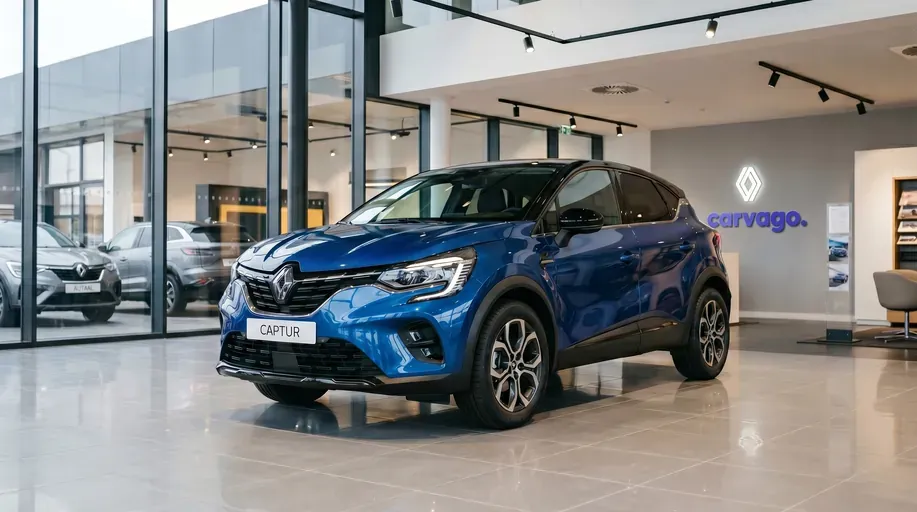
Review Renault Captur: What do owners and experts really say?
Renault Captur II review: real owner experience, hybrid running costs, boot space, common faults — everything you need before you buy.
October 22, 2026
Verdict at a Glance
Who it suits: Urban commuters and small families who want compact exterior dimensions alongside flexible rear seating.
Recommended engine: The four-cylinder turbo petrol for versatile everyday driving, or the E-Tech full hybrid for city use.
What to avoid: Early models with unresolved infotainment or battery glitches, and any car without documented recall repairs checked by VIN.
Introduction
The Renault Captur is a subcompact crossover competing in Europe’s crowded B-SUV segment. Built on the Alliance CMF-B platform, this second generation was revealed on 3 July 2019, followed by order books opening in its home market on 5 November 2019 and initial European customer deliveries starting in January 2020. This review focuses exclusively on the second generation, spanning production from 2019 through 2026.
Sold exclusively as a five-door crossover, the Captur attracts urban commuters and small families seeking compact exterior dimensions alongside flexible seating arrangements. The lineup evolved throughout its production run, adding an initial plug-in hybrid variant in November 2020 and later welcoming updated full-hybrid and bi-fuel options.
A substantial Phase 2 update was unveiled on 4 April 2024, with French orders opening on 10 April 2024 and European customer deliveries commencing in July 2024. The refresh brought redesigned front styling, updated infotainment hardware, and revised chassis tuning while maintaining the original platform architecture and body configuration.
Owner Experiences: Common Faults and Recalls
Owner reports and roadside assistance data indicate that the second-generation Renault Captur has a broadly dependable mechanical baseline, though early production runs were troubled by electronic bugs and software glitches. Long-term reliability for the revised facelift model introduced in 2024 is not yet established, but early examples from 2020 to 2023 show a clear pattern of initial teething troubles that required workshop intervention.
Electronic and Transmission Quirks
On pre-facelift models built between 2020 and 2023, owners frequently report glitches with the portrait touchscreen infotainment system and digital instrument cluster. Symptoms include frozen screens, delayed system start-up, black displays when engaging reverse, and spontaneous resets of the trip computer and fuel consumption meters. Successive dealer software updates rectified the majority of these bugs, though persistent display failures required replacement of the screen or telematics control unit under warranty.
Roadside breakdown statistics highlight premature 12-volt auxiliary battery drain as a frequent issue on 2020 and 2021 models. Control modules failing to enter sleep mode caused overnight discharge, leaving the car unable to start while triggering multiple false error messages on the instrument panel. Reprogramming the body control module and fitting an upgraded battery with greater reserve capacity addressed the issue in most cases, with breakdown numbers dropping to normal levels from the 2022 model year onward.
On the hybrid Renault Captur, owners and technical evaluations report driveline hesitation and low-speed gear shift jolts from the clutchless multi-mode dog-clutch automatic transmission. In slow city traffic or during sudden acceleration, the gearbox can hesitate while synchronising ratios, occasionally prompting temporary warning messages on the instrument panel. Dealer transmission control software updates notably smoothed shifting behavior, though occasional driveline shunt at walking pace remains an inherent characteristic of the mechanical layout. On petrol Renault Captur versions with the dual-clutch automatic gearbox, the transmission has largely avoided major mechanical defects, though early production software occasionally required dealer recalibration to smooth low-speed pull-away.
Verified Safety Recalls
Several European safety recalls apply to the second-generation Captur across different powertrains and production windows:
Affected Area
Production Window
Scope
Affected Models
Remedy
High-voltage battery connection
1 December 2025 to 6 February 2026
European Union
Hybrid variants
Dealership inspection of the high-voltage battery assembly and rectification or replacement of the busbar-to-relay connection to eliminate fire risk.
Parking brake actuator sensor
12 April 2024 to 7 May 2025
Worldwide / EU
Facelift variants with electronic shifter
Inspection and calibration or replacement of the parking brake actuator position sensor to ensure proper park lock engagement.
LPG fuel tank welds
6 February 2023 to 13 June 2023
European Union
1.0 TCe bi-fuel variants
Workshop inspection of the liquefied petroleum gas tank welds and replacement of non-conforming tanks to prevent gas release.
Panoramic glass sunroof bonding
21 August 2019 to 2 September 2019
European Union and UK
Models with fixed glass sunroof
Inspection of the glass roof adhesion, followed by re-bonding or replacement where bonding integrity is compromised.
Power steering column motor
2019 production
European Union
Early production models
Diagnostic check and software reprogramming or replacement of the power steering control module to prevent loss of assistance.
Before buying a used example, you can have its maintenance documentation, physical condition, and electronic systems independently verified by CarAudit.
🔍 What to check before buying
Check the vehicle identification number (VIN) with an authorised dealer to confirm all official safety recalls—including battery connections, parking brake sensors, and fuel tank inspections—have been fully carried out.
Test the central touchscreen and digital instrument display through several restart cycles, confirming that reversing camera views engage reliably and that dealer software updates have been installed.
On hybrid variants, test-drive at low city speeds and request sudden acceleration to ensure the multi-mode transmission transitions between electric and petrol drive without severe shudders or error messages.
On petrol models equipped with an automatic transmission, assess pull-away smoothness from a standstill to check for clutch slip or shuddering when moving off.
Check the operation of the sliding rear bench mechanism to confirm the adjustment lever glides freely and latches firmly into place on both sides.
Engines: Which One to Choose
The second-generation Renault Captur offers an extensive selection of powertrains, ranging from small three-cylinder petrols and factory bi-fuel options to refined four-cylinder turbocharged units, early diesels, and electrified full-hybrid setups. Every version drives the front wheels through a manual gearbox, a dual-clutch automatic, or a multi-mode clutchless transmission.
Engine
Fuel
Power
Gearbox
Available years
1.0 TCe 100
Petrol
74 kW (100 hp)
5-speed manual
2019–2020
1.0 TCe 90
Petrol
67 kW (91 hp)
6-speed manual
2020–present
1.0 TCe 100 LPG / Eco-G 100
Petrol / LPG
74 kW (100 hp)
5-speed manual
2020
1.0 TCe 100 LPG / Eco-G 100
Petrol / LPG
74 kW (100 hp)
6-speed manual
2020–2026
1.2 TCe 115
Petrol
84 kW (115 hp)
6-speed manual
2025–present
1.2 Eco-G 120
Petrol / LPG
90 kW (120 hp)
6-speed automatic
2026–present
1.3 TCe 130
Petrol
96 kW (130 hp)
6-speed manual / 7-speed automatic
2019–2020
1.3 TCe 140 / Mild Hybrid 140
Petrol mild hybrid
103 kW (140 hp)
6-speed manual
2020–present
1.3 TCe 140 / Mild Hybrid 140
Petrol mild hybrid
103 kW (140 hp)
7-speed automatic
2020–2024
1.3 TCe 155
Petrol
113 kW (155 hp)
7-speed automatic
2019–2020
1.3 TCe 160 / Mild Hybrid 160
Petrol mild hybrid
116 kW (158 hp)
7-speed automatic
2020–present
1.5 Blue dCi 95
Diesel
70 kW (95 hp)
6-speed manual
2019–2020
1.5 Blue dCi 115
Diesel
85 kW (115 hp)
6-speed manual / 7-speed automatic
2019–2020
1.6 E-Tech Plug-in Hybrid 160
Petrol PHEV
116 kW (158 hp)
Multi-mode automatic
2020–2023
1.6 E-Tech Full Hybrid 145
Petrol HEV
105 kW (143 hp)
Multi-mode automatic
2021–present
1.8 E-Tech Full Hybrid 160
Petrol HEV
116 kW (158 hp)
Multi-mode automatic
2025–present
Which engine to choose?
For city driving and short daily commutes, the entry three-cylinder petrol TCe 90 and factory bi-fuel Eco-G models provide straightforward transport with light pedal controls. Drivers facing dense urban traffic will also appreciate the hybrid Renault Captur in E-Tech full hybrid guise, which completes a large portion of suburban journeys on electric power without requiring external charging.
For mixed everyday driving and family duties, the four-cylinder 1.3-litre turbo petrol engines represent a well-balanced choice across the lineup. Offered as the earlier TCe 130 or the subsequent Mild Hybrid 140 and Mild Hybrid 160, this unit delivers low vibration, steady mid-range pull, and relaxed cruising. Pairing it with the dual-clutch automatic creates a versatile setup, though the six-speed manual gearbox also offers precise engagement.
Motorway drivers shopping on the secondary market should look at the diesel Renault Captur with the Blue dCi engine. Available only as a used car due to its early retirement, the diesel provides strong tractability over long distances, though it exhibits audible clatter under initial acceleration. For later model years, the four-cylinder petrol Renault Captur serves long-distance travel with superior acoustic refinement.
For towing small trailers or recreational gear, the four-cylinder turbo petrols are the most suitable choice because they offer the highest braked towing limits, whereas hybrid variants carry lower ratings and greater unladen weight. Buyers seeking lower running costs over high annual mileages without choosing diesel will find an economical alternative in an LPG Renault Captur with factory Eco-G preparation.
For a detailed review of mechanical durability, transmission software updates, and battery behaviour across these powertrains, refer to the owner experiences section.
Space & Practicality
Dimension / Capacity
Standard Petrol / Diesel
Full Hybrid E-Tech
Plug-in Hybrid E-Tech
Length (mm)
4,227–4,239
4,227–4,239
4,227
Width (mm)
1,797
1,797
1,797
Height (mm)
1,566–1,584
1,575–1,576
1,576
Wheelbase (mm)
2,639
2,639
2,639
Boot volume, seats upright (l)
422–616
326–480
265–379
Boot volume, seats folded (l)
1,275–1,596
1,149–1,458
1,118
The second-generation Renault Captur provides a flexible interior layout defined by its standard sliding rear bench. Moving the rear bench forward prioritises luggage space when carrying bulky cargo, while pushing it fully rearward creates adequate kneeroom and foot space for adult passengers on the outer seats.
Headroom remains accommodating despite the tapering roofline, although seating three adults across the rear is constrained by cabin width. Everyday loading benefits from a split-level boot floor that creates a flat loading area when the rear backrests are folded down.
What the Tests Say
Professional road tests consistently highlight the Renault Captur as a composed and user-friendly crossover, though with a distinctly firm bias in chassis tuning. While the suspension controls body lean neatly through corners, testers widely agree that it struggles with sharp tarmac ridges and degraded surfaces. Especially when fitted with larger optional wheels, the ride can feel busy and stiff rather than supple. The steering is direct and suitably light for urban manoeuvres, yet it transmits minimal road feel to the driver, and stability control can react abruptly during sudden avoidance tests.
Cabin refinement earns praise at steady cruising speeds, where wind buffeting remains well suppressed. Full hybrid variants operate near-silently in low-speed urban traffic, but testers criticize their powertrain manners under heavy throttle, where the gearbox holds the petrol engine at elevated revolutions, producing a noticeable drone.
Inside, testers view the cabin as a major step forward in assembly standards and tactile surfaces compared to older Renault small cars. The front seats provide good long-distance support, and physical switches for secondary controls maintain straightforward ergonomics. Outward visibility toward the rear corners is compromised by chunky roof pillars and tall rear headrests. With the mid-cycle facelift, road tests welcomed the introduction of the Google-based OpenR Link infotainment system, praising its fluid touch responses and intuitive menus, even if updated chassis components made the suspension feel firmer rather than more forgiving.
Prices and Market Offer
All charts in this section reflect Carvago listings across the entire Renault Captur model family, including earlier generations represented in the dataset, rather than the reviewed generation alone. Because the data aggregates multiple generations, it does not establish a distinct price level solely for the second-generation car. In the current market offer, the median asking price stands at €13,900 for 2019 models and €16,900 for 2020 vehicles. For recent production, the median asking price reaches €22,900 for 2024 models, stepping up to €24,000 for 2025 and €26,200 for 2026 examples.
This chart shows the monthly count of advertised Renault Captur models between April 2026 and September 2026, climbing from 13,327 listings in April to a peak of 14,369 in July.
Renault Captur - availability over time
Active listings over time
Month
Renault Captur
2026-04
13 327
2026-05
13 554
2026-06
13 963
2026-07
14 369
2026-08
13 419
2026-09
13 288
Source Carvago
Supply receded to 13,288 listings by September 2026, giving buyers a broad selection of vehicles even as active inventory shifted down from its mid-summer peak.
Among cars advertised today, the median asking price is €13,900 for models built in 2019, compared with €26,200 for those built in 2026. The data below shows how these asking figures vary across each model year.
Renault Captur - median price by model year
Median advertised price by year of manufacture
Model year
Renault Captur
2019
13 900
2020
16 900
2021
17 500
2022
18 500
2023
20 000
2024
22 900
2025
24 000
2026
26 200
Source Carvago
Buyers looking at 2021 models see a median asking price of €17,500, while 2023 examples sit at €20,000 and 2025 cars require €24,000.
This depreciation curve shows how the Renault Captur loses residual value as it ages, dropping by 13% in its first year and shedding 31% by age three. The progression across the model's first seven years is detailed below.
Renault Captur - value loss by age
Residual value by vehicle age
Vehicle age
Renault Captur
New
26 900
1 yr
23 500
2 yrs
21 100
3 yrs
18 600
4 yrs
17 800
5 yrs
16 500
6 yrs
15 100
7 yrs
12 800
Source Carvago
Over the seven-year span shown, the model loses roughly 52% of its initial residual value, though the annual rate of decline accelerates from year four onward and peaks in year seven.
Across the six months from April to September 2026, petrol models comprised the largest volume of advertised vehicles, registering 7,736 listings in April and 7,196 in September. The chart below tracks how monthly listing counts evolved across each available fuel type.
Renault Captur - supply by fuel over time
Supply composition by fuel type
Petrol
Diesel
Hybrid
Electric
LPG
Month
Petrol
Diesel
Hybrid
Electric
LPG
2026-04
7 736
662
3 695
1
1 190
2026-05
7 812
676
3 734
1
1 294
2026-06
8 035
677
3 822
1
1 395
2026-07
8 058
682
3 961
1
1 623
2026-08
7 374
551
3 843
0
1 610
2026-09
7 196
541
3 752
0
1 761
Source Carvago
Buyers will find the greatest choice among petrol and hybrid models, which stood at 7,196 and 3,752 listings respectively in September 2026. In that same month, LPG offered an additional path with 1,761 listings, whereas diesel was limited to 541 listings and electric power showed 0 listings.
From April 2026 to September 2026, the average asking price for the Renault Captur began at €18,900 before settling at €18,700. The chart below shows how this average developed over the six-month period.
Renault Captur - price trend over time
Average price development over time
Month
Renault Captur
2026-04
18 900
2026-05
18 800
2026-06
18 700
2026-07
18 700
2026-08
18 700
2026-09
18 700
Source Carvago
Across the recorded months, the average asking price shifted by roughly 1%, moving from €18,900 to €18,700 and remaining unchanged from July through September 2026. That represents very little movement overall relative to the prices themselves.
Sliding rear bench allows easy adjustment between passenger kneeroom and luggage capacity
Refined four-cylinder turbo petrol engines offering steady pull and quiet cruising
Straightforward cabin ergonomics with physical secondary controls and intuitive infotainment
Cons
Stiff suspension tuning that struggles to absorb sharp ridges and rough surfaces
Frequent electronic glitches, frozen displays, and auxiliary battery drain on early models
Compromised over-the-shoulder visibility due to thick rear pillars and tall headrests
Frequently asked questions
Is the second-generation Renault Captur reliable?
The Renault Captur has a dependable mechanical foundation, though models built between 2020 and 2023 were prone to electronic glitches that required dealer software updates. Once verified service remedies have been applied, pre-facelift examples prove broadly dependable.
Which engine is the best choice?
The four-cylinder 1.3-litre turbo petrol is the most versatile choice for mixed driving, offering quiet cruising and steady pull. Urban drivers will benefit more from the full hybrid, while early diesels best suit regular long-distance motorway travel.
What should you check before buying a used Captur?
Verify via the vehicle identification number (VIN) that all safety recalls have been carried out by an authorised dealer. During a test drive, ensure the touchscreen operates without freezing and verify that the sliding rear bench latches firmly into place.
Is the Captur practical enough for family use?
Yes for small families, as the sliding rear bench allows you to adjust the balance between rear kneeroom and luggage space. It seats four comfortably, though carrying three passengers across the rear bench is constrained by cabin width.