Nissan Navara vs. Toyota Hilux: Complete comparison 2026
Detailed comparison of Nissan Navara (NP300) vs Toyota Hilux. Discover the key differences in performance, towing capacity, and reliability. Read the verdict before you buy!
May 16, 2026
Articles
Review
Nissan Navara review: real owner experience, common faults, payload and towing specs, running costs and used prices for the D23 pickup.
October 30, 2026

The D23-generation Nissan Navara represents the third European generation of the brand's mid-size pickup, initially introduced to the market as the NP300 Navara. European assembly began in Barcelona in November 2015, with customer deliveries starting in January 2016. Competing in Europe's light commercial vehicle sector against established rivals, it targeted tradespeople, fleet operators, and lifestyle buyers seeking all-wheel-drive utility and substantial towing capacity.
Nissan introduced a mid-cycle update unveiled on 4 June 2019, with showroom sales opening on 1 July 2019.
Production for the European market ended on 16 December 2021 with the closure of the Barcelona manufacturing plant, and leftover dealer inventory concluded sales during 2022. This review examines the European D23 Nissan Navara pickup across its entire production run.
The European-market Nissan Navara established a reputation as a durable dual-purpose utility vehicle, but real-world running reveals a few mechanical vulnerabilities that prospective buyers should evaluate carefully. Professional tests and owner reports show that while the core mechanical package is generally sturdy, components subjected to heavy commercial work, maximum towing loads, or off-road use require thorough inspection.
A critical mechanical concern highlighted by tests and owners centers on the automatic Nissan Navara. The built-in transmission fluid cooler located in the lower tank of the engine radiator can suffer internal tube fractures. When this occurs, engine coolant enters the transmission fluid circuit to form a contaminated emulsion. If not caught early, this cross-contamination dissolves internal friction linings, leading to gear slippage, harsh shifting, loss of reverse gear, and eventual transmission failure. On manual variants, tests note accelerated clutch plate and flywheel wear when trucks are regularly used for heavy towing near maximum capacity. Furthermore, tests describe that timing chain tensioners can suffer from oil starvation or loose retaining bolts, leading to start-up rattling, while owners report occasional delamination of the rubber dampening ring inside the auxiliary crankshaft pulley, creating rotational wobble and metallic chirping noises at idle.
Rear suspension behaviour is another documented issue on early examples. Tests describe that pre-facelift double-cab models built between 2015 and the mid-cycle update in July 2019 experienced pronounced rear-end sag, wallow, and pitch instability when carrying high payloads or heavy trailer nose weights. Nissan revised the suspension for the July 2019 update by introducing dual-stage rear coil springs, retuned dampers, and a raised unladen rear stance. For earlier trucks, owners report that aftermarket progressive coil springs or auxiliary helper kits effectively restore loaded body control.
Official safety recalls for the diesel Nissan Navara have remained modest in scope. A worldwide recall covering vehicles built between May 2016 and May 2019 was issued because the applied maximum efficiency level of the exhaust aftertreatment system in its dosing mode did not meet compliance requirements; the manufacturer remedy involves reprogramming the engine management software. Another campaign affecting double-cab models built between September 2015 and March 2018 in right-hand-drive markets addressed potential reduced retention force in the rear door child locks, resolved by fitting an internal countermeasure retaining clip. In addition, an early European campaign covering vehicles built between October 2015 and June 2016 addressed hardtop canopies where the auxiliary upper brake light could fail to illuminate on startup, requiring a rewired electrical harness connection.
Given the demanding duties typical of a Nissan Navara 4x4, verifying maintenance documentation and physical underbody condition is essential. Prospective buyers can substantiate a vehicle's service history and inspect for hidden off-road strain or structural corrosion with an independent pre-purchase assessment like CarAudit.
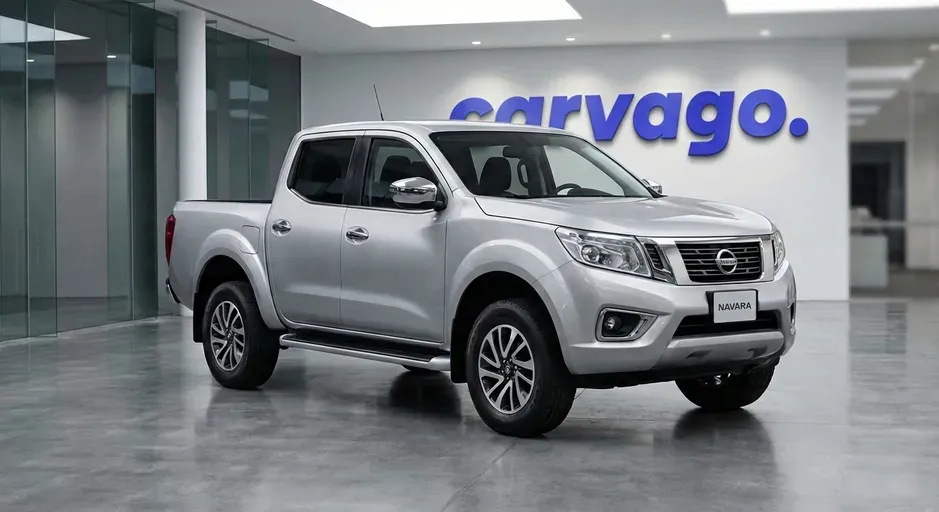
Across Europe, the diesel Nissan Navara was powered exclusively by the 2.3 dCi four-cylinder turbodiesel engine, offered in single-turbo and twin-turbo configurations. Output ratings evolved across the production run, with the base engine receiving twin turbochargers alongside an all-round mechanical revision in July 2019.
| Engine | Fuel | Power | Gearbox | Drivetrain | Model years |
|---|---|---|---|---|---|
| 2.3 dCi (single-turbo) | Diesel | 118–120 kW (160 hp)* | 6-speed manual | Rear-wheel drive / All-wheel drive | 2016–2019 |
| 2.3 dCi (twin-turbo) | Diesel | 140 kW (190 hp) | 6-speed manual / 7-speed automatic | All-wheel drive | 2016–2019 |
| 2.3 dCi (twin-turbo) | Diesel | 120 kW (163 hp) | 6-speed manual | All-wheel drive | 2019–2022 |
| 2.3 dCi (twin-turbo) | Diesel | 140 kW (190 hp) | 6-speed manual / 7-speed automatic | All-wheel drive | 2019–2022 |
*Ratings for the pre-facelift base engine vary between 118 kW and 120 kW across European manufacturer documentation.
For routine urban commuting or short errand runs, a used Nissan Navara is ill-suited. Low operating temperatures prevent automatic particulate filter regeneration, which causes soot accumulation and frequent forced burn cycles. Buyers confined to city traffic should consider an alternative vehicle segment entirely.
For mixed everyday driving, the twin-turbo 2.3 dCi is far more versatile than the early single-turbo unit. The launch single-turbo diesel exhibits noticeable hesitation before the turbocharger spools, requiring frequent downshifting in traffic. In contrast, the twin-turbo configuration delivers steady pulling power from low engine speeds. The updated base twin-turbo introduced in 2019 resolved that early low-end lethargy, making post-facelift entry models equally capable for daily duties.
Long-distance motorway travel strongly favours the stronger twin-turbo engine paired with the seven-speed automatic Nissan Navara. The automatic transmission shifts smoothly and keeps engine speeds relaxed at highway pace. If choosing a manual Nissan Navara, target models built from July 2019 onwards; their revised six-speed gearbox replaced the early unit’s vague, long-throw shift action with shorter throws and taller cruising gears.
For heavy towing or hauling cargo up to the chassis limits, the higher-output twin-turbo Nissan Navara 4x4 is essential. The base engine feels laboured under substantial weight, whereas the stronger twin-turbo pulls with solid mid-range authority, though it lacks the high-end punch of six-cylinder rivals.
For documented reliability issues and recalls, consult the owner experiences section.
| Body style | Length (mm) | Width (mm) | Height (mm) | Wheelbase (mm) | Boot volume (seats up / folded) |
|---|---|---|---|---|---|
| King Cab | 5,225–5,255 | 1,790–1,850 | 1,780–1,810 | 3,150 | —* |
| Double Cab | 5,300–5,330 | 1,850 | 1,805–1,855 | 3,150 | —* |
*Official enclosed cargo volumes in litres are not published for open load beds. Listed dimensions do not apply to the widened and raised off-road conversion (AT32).
The Nissan Navara pickup provides two distinct cabin layouts tailored to different working and family duties. In the five-seat Double Cab, front occupants enjoy supportive seating, but rear passengers contend with an upright backrest angle and limited legroom, making extended travel less accommodating for taller adults. Everyday in-cab utility is enhanced by rear seat cushions that fold upward against the bulkhead, creating a flat floor space suited for securing dry luggage, tools, or items that cannot be exposed to the elements. The King Cab replaces the rear bench with small fold-down jump seats suited only for brief emergency trips, sacrificing passenger accommodation to maximize load-bed floor space. Both variants of the Nissan Navara provide enough width between the rear wheel arches to load a standard Euro pallet flat, though buyers requiring weatherproof everyday boot capacity must budget for an aftermarket bed cover or hardtop canopy.
Road tests consistently note that the coil-sprung multi-link rear suspension—fitted to Double Cabs and post-facelift King Cabs—eliminates the harsh rear-end bounce typical of leaf-sprung pickups when driven unladen. However, testers emphasise that it never matches the compliance of a passenger crossover: tremors from the ladder-frame chassis and vertical fidgeting still filter through over sharp potholes. Directional stability at speed in the Nissan Navara 4x4 is secure and body roll is well contained, but the steering is slow, heavily geared, and detached from the road, making tight urban turns cumbersome.
Acoustic refinement draws mixed observations across evaluations. The diesel engine is vocal and intrusive under hard acceleration, though it settles into a subdued hum during steady cruising. At highway speeds, wind buffeting around the oversized door mirrors becomes noticeable.
Inside, the dashboard layout borrows heavily from the manufacturer’s crossover range, offering clear ergonomics, a commanding driving position, and supportive front seats. Testers note, however, that scratch-prone, utilitarian hard plastics dominate the cabin. Higher equipment tiers provide a multi-camera parking view that significantly eases positioning in tight spots.
From the July 2019 update, standard four-wheel disc brakes addressed earlier criticisms of weak stopping distances on drum-braked models. Revised rear springs preserved unladen composure under increased payloads, while an upgraded touchscreen with smartphone integration improved interface responsiveness, even though interior plastics remained strictly utilitarian.
All the charts in this section are drawn from Carvago's listings of the whole Nissan Navara model family, including other generations represented in the data, not only the reviewed generation, so they do not establish a separate price level for a single generation. In current listings, the median asking price stands at €18,100 for 2015 vehicles, €25,900 for 2018 vehicles, €31,900 for 2021 models, and €30,000 for 2022 cars. On the secondary market, higher asking sums generally reflect strong buyer preference for well-equipped double cabs with automatic gearboxes, while basic manual workhorses sit in the lower brackets.
Over the six months from April to September 2026, the volume of advertised Nissan Navara models grew from 329 to a peak of 409 listings in June before tapering off. The chart below traces these monthly listing counts across the period.
Active listings over time
| Month | Nissan Navara |
|---|---|
| 2026-04 | 329 |
| 2026-05 | 382 |
| 2026-06 | 409 |
| 2026-07 | 398 |
| 2026-08 | 340 |
| 2026-09 | 330 |
Source Carvago
With 330 active listings recorded in September 2026, overall choice for buyers has returned close to its springtime level, offering a consistent pool of vehicles across the market.
The median asking price of cars advertised today built in 2015 is €18,100, whereas the median asking price of cars advertised today built in 2021 is €31,900. The chart below displays how these median asking prices compare across build years, with newer model years generally priced higher, aside from 2022 listings being cheaper than 2021 listings.
Median advertised price by year of manufacture
| Model year | Nissan Navara |
|---|---|
| 2015 | 18 100 |
| 2016 | 22 500 |
| 2017 | 24 000 |
| 2018 | 25 900 |
| 2019 | 27 800 |
| 2020 | 29 000 |
| 2021 | 31 900 |
| 2022 | 30 000 |
Source Carvago
Buyers looking at earlier model years will find that the median asking price of cars advertised today built in 2016 is €22,500, while the median asking price of cars advertised today built in 2018 is €25,900. For later model years, the median asking price of cars advertised today built in 2020 is €29,000, and the median asking price of cars advertised today built in 2022 is €30,000.
Across the six months from April 2026 to September 2026, advertised Nissan Navara stock was heavily dominated by diesel, which accounted for between 328 and 408 listings per month. The chart below traces the monthly volume of listings for each fuel type.
Supply composition by fuel type
Petrol
Diesel
| Month | Petrol | Diesel |
|---|---|---|
| 2026-04 | 1 | 328 |
| 2026-05 | 2 | 380 |
| 2026-06 | 1 | 408 |
| 2026-07 | 1 | 397 |
| 2026-08 | 2 | 338 |
| 2026-09 | 1 | 329 |
Source Carvago
Diesel represents almost the entire available selection, ending the period with 329 listings in September 2026 alongside just 1 petrol model. For prospective buyers, realistic choices on the market are practically confined to diesel powertrains.
The chart tracks the average asking price for the Nissan Navara between April 2026 and September 2026, opening at €26,200.
Average price development over time
| Month | Nissan Navara |
|---|---|
| 2026-04 | 26 200 |
| 2026-05 | 25 900 |
| 2026-06 | 26 000 |
| 2026-07 | 25 500 |
| 2026-08 | 25 500 |
| 2026-09 | 25 400 |
Source Carvago
Across these six months, the average asking price shifted modestly from €26,200 to €25,400—a net decrease of around 3%, with a minor rise to €26,000 in June interrupting the downward drift.
Multi-link rear suspension on Double Cabs and post-facelift King Cabs eliminates harsh unladen bounce
Twin-turbo diesel delivers responsive low-end pulling power and relaxed motorway cruising
Upward-folding rear seat cushions create practical, secure covered cargo space inside the cabin
Radiator cooler breaches on automatic models can cause severe transmission fluid contamination
Upright rear backrests and restricted legroom compromise passenger comfort on long journeys
Slow, heavily geared steering and ladder-frame tremors make urban driving cumbersome
The Nissan Navara features a sturdy mechanical package, but hard commercial work accelerates wear. Automatic models require inspection for transmission fluid contamination from a fractured radiator cooler.
Target models produced from the July 2019 update onwards. They gained an improved manual gearbox, standard four-wheel disc brakes, and revised rear suspension, though they command higher asking prices.
The higher-output twin-turbo 2.3 dCi diesel provides steady low-end pulling power and relaxed cruising. However, no diesel Navara is suited to frequent short urban trips, which prevent particulate filter regeneration.
Inspect automatic models for transmission fluid contamination from the radiator cooler and listen for cold-start timing chain rattle. You can verify underbody condition and service history before purchase using CarAudit.
Sources: nissannews.com, adac.de, rac.co.uk, autocar.co.uk, autoexpress.co.uk
This article was prepared using artificial intelligence tools. The section guarantor is Petr Dušek.

Detailed comparison of Nissan Navara (NP300) vs Toyota Hilux. Discover the key differences in performance, towing capacity, and reliability. Read the verdict before you buy!
May 16, 2026

Detailed comparison of used Toyota Hilux vs Volkswagen Amarok pickups. Discover the differences in reliability and equipment, and read the verdict before you buy.
Oct 16, 2026

Detailed comparison of the Ford Ranger vs. Mitsubishi L200 (Triton). Discover the differences in reliability, equipment, and real-world fuel consumption of used vehicles. Which pickup is the better choice?
May 1, 2026