Review Mercedes-Benz EQS: What do owners and experts really say?
Mercedes-Benz EQS review: real owner experience, common faults, real-world range, used prices and running costs — our definitive verdict.
November 1, 2026
Introduction
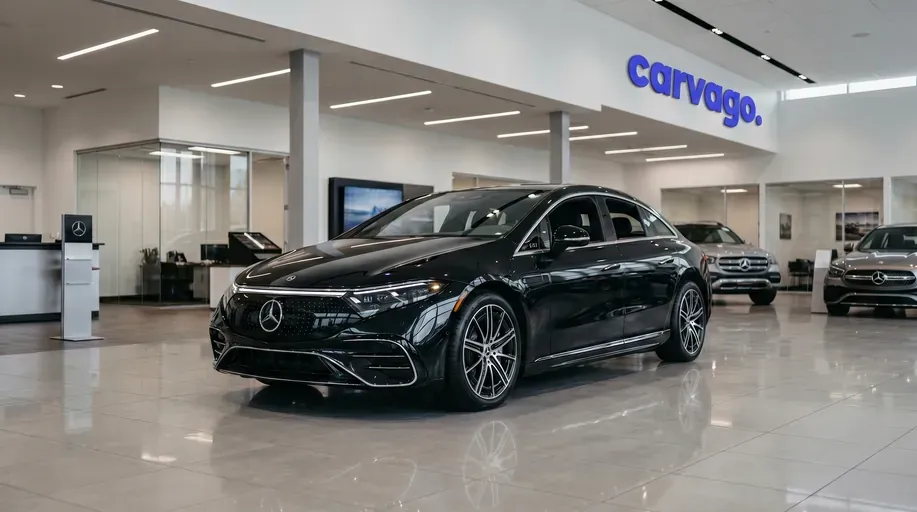
The Mercedes-Benz EQS sits at the top of the brand's dedicated electric portfolio, positioned as a full-size luxury flagship. Built on a bespoke electric architecture, it is produced exclusively as a five-door liftback saloon, pairing a flowing, aerodynamic profile with the cargo flexibility of a large rear hatch.
This review covers the first generation, which entered series production in May 2021 and reached European customers for initial deliveries in late September 2021. The model received a notable update premiered in April 2024, which added a classic upright bonnet star, a redesigned flush grille, an expanded battery capacity, and increased towing limits. A subsequent technical overhaul followed in April 2026, introducing an 800-volt electrical system and updated drive units.
On the used market, the electric Mercedes-Benz EQS primarily appeals to long-distance business commuters, executive fleet operators, and chauffeur services seeking relaxed high-speed cruising capability combined with practical everyday luggage access.
Owner Experiences: Common Faults and Recalls
Early software teething issues feature prominently in owner discussions of the Mercedes-Benz EQS. Owners report instances where the optional three-screen dashboard display blanked out or froze during boot-up, occasionally accompanied by erroneous driver-assistance alerts. Official service bulletins confirm that updating the telematics and central infotainment software at an authorised workshop or via over-the-air updates resolves the problem in most cases, with hardware exchanges restricted to isolated non-responsive units. A related problem reported by owners involves the 12-volt auxiliary battery. After extended periods of standing idle, some cars displayed critical battery warnings on the instrument cluster and refused to engage drive-ready status. Rectification involves a workshop software update to recalibrate the high-voltage to low-voltage converter wake-up parameters, alongside battery replacement if deep discharge occurred.
Professional road tests and owner reports frequently critique the braking mechanism on pre-facelift models built between 2021 and early 2024. In these cars, tests describe an unsettling physical movement of the brake pedal as the electro-hydraulic system blends regenerative and mechanical braking, accompanied by a spongy initial dead zone. Factory revisions introduced from April 2024 altered the brake cylinder hardware and pedal actuation software, though earlier vehicles cannot fully replicate this updated pedal feel through software alone. Because strong energy recuperation handles most routine deceleration, owners also report that the mechanical brake discs can suffer from surface corrosion and glazing if not subjected to occasional firm braking. Furthermore, high electric torque and heavy unladen mass lead to accelerated tyre wear, particularly on the inner shoulders of the rear wheels.
Several official European safety recalls have addressed electrical hardware, software calibration, and mechanical fastenings across the electric Mercedes-Benz EQS production run.
Verified European Safety Recalls
Affected Component
Build Window
Defect Description
Workshop Remedy
Brake caliper screws
February 2021 – September 2021
Front brake caliper mounting screws may not meet specifications, risking detachment
Check and replacement of front caliper attachment bolts
Powertrain management
2021 – 2023
Software monitoring logic could trigger unexpected deactivation of electric propulsion
Flashing updated control software to drivetrain management unit
Rear seatbelt mountings
January 2021 (including pre-production) – April 2023
Seatbelt anchor bolts may not be tightened to specification and could detach under vibration
Inspection and retightening of all rear seatbelt anchor bolts to factory torque
80-amp pyrofuse box
February 2023 – November 2023
Interrupted contact or increased resistance on the fuse could cause drive loss or a fire hazard
Replacement of affected fuse box with validated unit
Reworked fuse boxes
January 2023 – October 2023
Incorrectly reworked fuse boxes can cause contact interruptions or fuse failure, with a risk of fire
Inspection and replacement of suspect fuse boxes
eCall communication unit
April 2021 – June 2025
Non-compliant module configuration can damage internal memory and disable emergency eCall
Replacement of the communication module control unit
Wheel bolt torque
November 2022 – December 2025
Wheel bolts were not tightened to torque specifications, creating a risk of detachment
Inspection and retightening of all wheel bolts to factory torque
Battery management system
2022 – 2024
Continuous accumulation of diagnostic requests causes memory overflow, triggering unexpected shutdown of high-voltage contactors
Workshop BMS software update
🔍 What to check before buying
Check official recall completion on manufacturer registries by VIN, ensuring that powertrain software updates, fuse box replacements, and wheel bolt torque checks were carried out.
Request an authorised workshop diagnostic readout of the high-voltage battery State of Health (SoH) and verify documented maintenance within the network through CarAudit.
Inspect tyre tread depth and wear patterns across the inner shoulders, and verify that replacements carry the correct Extra Load (XL) rating and acoustic foam lining.
Inspect all four brake discs for surface rust or glazing caused by high recuperation driving, and test the initial brake pedal travel on 2021 to early 2024 cars.
Verify on the digital equipment build sheet whether 10-degree rear-axle steering is permanently hardware-coded or locked behind an expiring digital subscription.
Engines: Which One to Choose
The Mercedes-Benz EQS relies entirely on dedicated battery-electric powertrains, available in single-motor rear-wheel-drive or twin-motor all-wheel-drive configurations across three distinct production phases.
Engine
Fuel
Power
Torque
Drivetrain
Gearbox
Model years
EQS 350
Electric
215 kW (292 hp)
565 Nm
RWD
1-speed automatic
2022
EQS 450+
Electric
245 kW (333 hp)
565–568 Nm
RWD
1-speed automatic
2021–2023
EQS 450+
Electric
265 kW (360 hp)
568 Nm
RWD
1-speed automatic
2023–2026
EQS 450+
Electric
300 kW (408 hp)
505 Nm
RWD
2-speed automatic
2026–present
EQS 400
Electric
270 kW (367 hp)
505 Nm
RWD
2-speed automatic
2026–present
EQS 450 4MATIC
Electric
265 kW (360 hp)
800 Nm
AWD
1-speed automatic
2022–2026
EQS 500 4MATIC
Electric
330 kW (449 hp)
828–855 Nm
AWD
1-speed automatic
2022–2026
EQS 500 4MATIC
Electric
350 kW (476 hp)
750 Nm
AWD
2-speed automatic
2026–present
EQS 580 4MATIC
Electric
385 kW (523 hp)
855–858 Nm
AWD
1-speed automatic
2021–2023
EQS 580 4MATIC
Electric
400 kW (544 hp)
858 Nm
AWD
1-speed automatic
2023–2026
EQS 580 4MATIC
Electric
430 kW (585 hp)
800 Nm
AWD
2-speed automatic
2026–present
Mercedes-AMG EQS 53 4MATIC+
Electric
484 kW (658 hp)
950 Nm
AWD
1-speed automatic
2021–2025
Mercedes-AMG EQS 53 4MATIC+ (Dynamic Plus)
Electric
560 kW (761 hp)
1,020 Nm
AWD
1-speed automatic
2021–2025
For urban driving and short suburban commutes, the short-lived entry-level EQS 350 provides quiet progress as a used car, though its limited market presence makes finding one difficult.
For mixed driving and long motorway distances, the rear-wheel-drive EQS 450+ represents the sweet spot of the range. Independent tests praise its progressive power delivery and composed high-speed wafting, achieving the greatest real-world touring range of any variant.
Drivers who routinely travel in adverse winter conditions or tow trailers will be better served by the all-wheel-drive Mercedes-Benz EQS. Both the EQS 450 4MATIC and EQS 500 4MATIC deliver secure traction and swift mid-range overtaking without the efficiency penalty of the larger performance versions. Those intending to tow should prioritise post-facelift models, which gained substantially higher factory trailer limits.
At the top of the range, the twin-motor EQS 580 4MATIC delivers rapid, unflustered cross-country pace focused on passenger comfort. The Mercedes-AMG EQS 53 4MATIC+ provides ferocious launch acceleration, but its immense mass compromises agility on winding roads.
Real-world range and charging
Owners and professional testers identify the electric Mercedes-Benz EQS as an effective touring car, with single-motor versions leading the pack on open roads. While cold winter temperatures cause a noticeable reduction in highway range, thermal management and pre-conditioning via the integrated navigation system help stabilise performance. Rapid charging on long journeys works best when destination chargers are programmed into the route, allowing the battery to reach optimal temperature before arrival. Early model years occasionally suffered communication drops on older charging hubs, whereas later updates provide consistently fast and predictable fast-charging curves.
Space & Practicality
Dimension
Value
Length
5,216–5,225 mm
Width (excluding mirrors)
1,926 mm
Height
1,510–1,520 mm
Wheelbase
3,210 mm
Boot capacity (seats up / folded)
610 / 1,770 l
Dimensions apply to standard saloon models; AMG exterior styling packages and performance variants show minor variations in length and baseline ride height.
The electric Mercedes-Benz EQS adopts a large five-door liftback tailgate rather than a conventional saloon boot lid, providing a wide and accessible luggage opening. Everyday utility is aided by a three-way split rear bench with a central through-loading hatch for longer items. Beneath the front bonnet, there is no luggage compartment; customer access is restricted, with washer fluid refilled through a flap on the left front wing.
In the rear cabin of the Mercedes-Benz EQS saloon, passenger legroom is expansive, yet the low roof arch limits headroom compared with conventional upright saloons. Because the floor sits high over the underfloor battery housing, the rear seating bench provides less under-thigh support than traditional executive saloons. The rear seats do not slide, though optional rear comfort equipment allows electrical adjustment of the backrest rake.
What the Tests Say
Professional tests describe the Mercedes-Benz EQS as quiet at speed, using its aerodynamic profile to filter out wind and tyre roar effectively. High-speed motorway travel is composed and serene, yet low-speed urban driving draws criticism for wheel jitter over sharp surface breaks and sunken drain covers. On undulating secondary roads, the car’s soft springing and substantial mass allow noticeable pitch and float, though firmer chassis modes help restore vertical control. Steering remains light and direct off-centre, but noticeably isolated, offering minimal road feedback regardless of drive mode.
Inside, cabin ambiance is opulent, yet ergonomics divide testers. Capacitive touch sliders on the steering wheel and complex touchscreen menus cause unnecessary driver distraction. Occasional details, such as plasticky steering column stalks, also feel incongruous in a flagship saloon. Reviewers agree that rivals deliver sharper handling and greater driver engagement, but the EQS remains focused on long-distance cruising comfort.
Prices and Market Offer
All the charts in this section are drawn from Carvago’s listings of the whole Mercedes-Benz EQS model family, including other generations represented in the data, not only the reviewed generation, so these figures do not establish a separate price level for the reviewed generation. On the current market, the median asking price stands at €67,600 for model year 2021 and €68,000 for 2022. More recent production years show higher figures, with a median asking price of €78,900 for 2023 vehicles and €110,000 for 2026 models.
Between April and September 2026, active Mercedes-Benz EQS listings ranged from a low of 776 in June to 874 at the start of the period. The chart below traces how monthly advertised counts developed over these six months.
Mercedes-Benz EQS - availability over time
Active listings over time
Month
Mercedes-Benz EQS
2026-04
874
2026-05
813
2026-06
776
2026-07
857
2026-08
859
2026-09
888
Source Carvago
Advertised supply climbed back to 888 listings by September 2026, providing buyers with a consistently broad selection of vehicles on the market.
The median asking price of cars advertised today, built in 2021, is €67,600, whereas the median asking price of cars advertised today, built in 2026, reaches €110,000. The chart below illustrates how these median asking prices compare across each build year.
Mercedes-Benz EQS - median price by model year
Median advertised price by year of manufacture
Model year
Mercedes-Benz EQS
2021
67 600
2022
68 000
2023
78 900
2024
85 700
2025
89 900
2026
110 000
Source Carvago
Buyers considering earlier model years see median asking prices of €67,600 for 2021 and €68,000 for 2022 listings. Stepping up to the newest model years aligns with median asking prices of €89,900 for 2025 and €110,000 for 2026.
Across the six recorded months, electric models accounted for every listing on offer, moving from 874 advertised cars in April 2026 to 888 in September 2026. The chart below traces the monthly counts across all fuel types.
Mercedes-Benz EQS - supply by fuel over time
Supply composition by fuel type
Month
Electric
2026-04
874
2026-05
813
2026-06
776
2026-07
857
2026-08
859
2026-09
888
Source Carvago
With zero listings recorded for petrol, diesel, or hybrid alternatives throughout this period, buyers browsing the market will find an exclusively all-electric selection.
Between April 2026 and September 2026, the average asking price for the Mercedes-Benz EQS began at €70,400 and reached €70,800 in May before edging down over the summer, as detailed below.
Mercedes-Benz EQS - price trend over time
Average price development over time
Month
Mercedes-Benz EQS
2026-04
70 400
2026-05
70 800
2026-06
70 700
2026-07
70 500
2026-08
69 800
2026-09
69 000
Source Carvago
By September 2026, the average asking price finished at €69,000, representing an overall decline of about 2% from April. This modest shift is small relative to the total value of the vehicle, showing little significant movement over the six months.
Quiet high-speed cruising with low wind and tyre noise
Long real-world touring range on single-motor rear-wheel-drive models
Practical liftback tailgate providing a wide luggage opening
Cons
Spongy and artificial brake pedal feel on pre-facelift models
Restricted rear passenger headroom and compromised under-thigh support
Distracting touch-sensitive steering sliders and complex touchscreen menus
Frequently asked questions
Which powertrain is the best choice?
For long-distance touring, the rear-wheel-drive EQS 450+ provides the most balanced option thanks to its composed cruising manner and superior real-world electric range. Drivers who frequently face adverse winter conditions or tow trailers should look to an all-wheel-drive Mercedes-Benz EQS, ideally from the April 2024 update onward for its significantly higher factory towing limits.
What are the main issues to watch out for on early cars?
Cars produced between 2021 and early 2024 draw frequent criticism for an artificial, spongy brake pedal feel that software updates cannot fully resolve. Early builds were also prone to dashboard display freezes and 12-volt auxiliary battery drain after standing idle.
What should you check before purchasing a used model?
Always verify official safety recall completions by VIN and request a workshop diagnostic readout of the high-voltage battery health. It is equally important to inspect the inner shoulders of the rear tyres for accelerated wear.
How much does a used EQS cost?
Across the market, the median asking price for a Mercedes-Benz EQS starts around €67,600 for early model years, rising with later production.