Review Mercedes-Benz EQE: What do owners and experts really say?
Mercedes-Benz EQE review: real owner experience, actual range, common faults and used prices — everything you need to know before buying.
November 2, 2026
Introduction
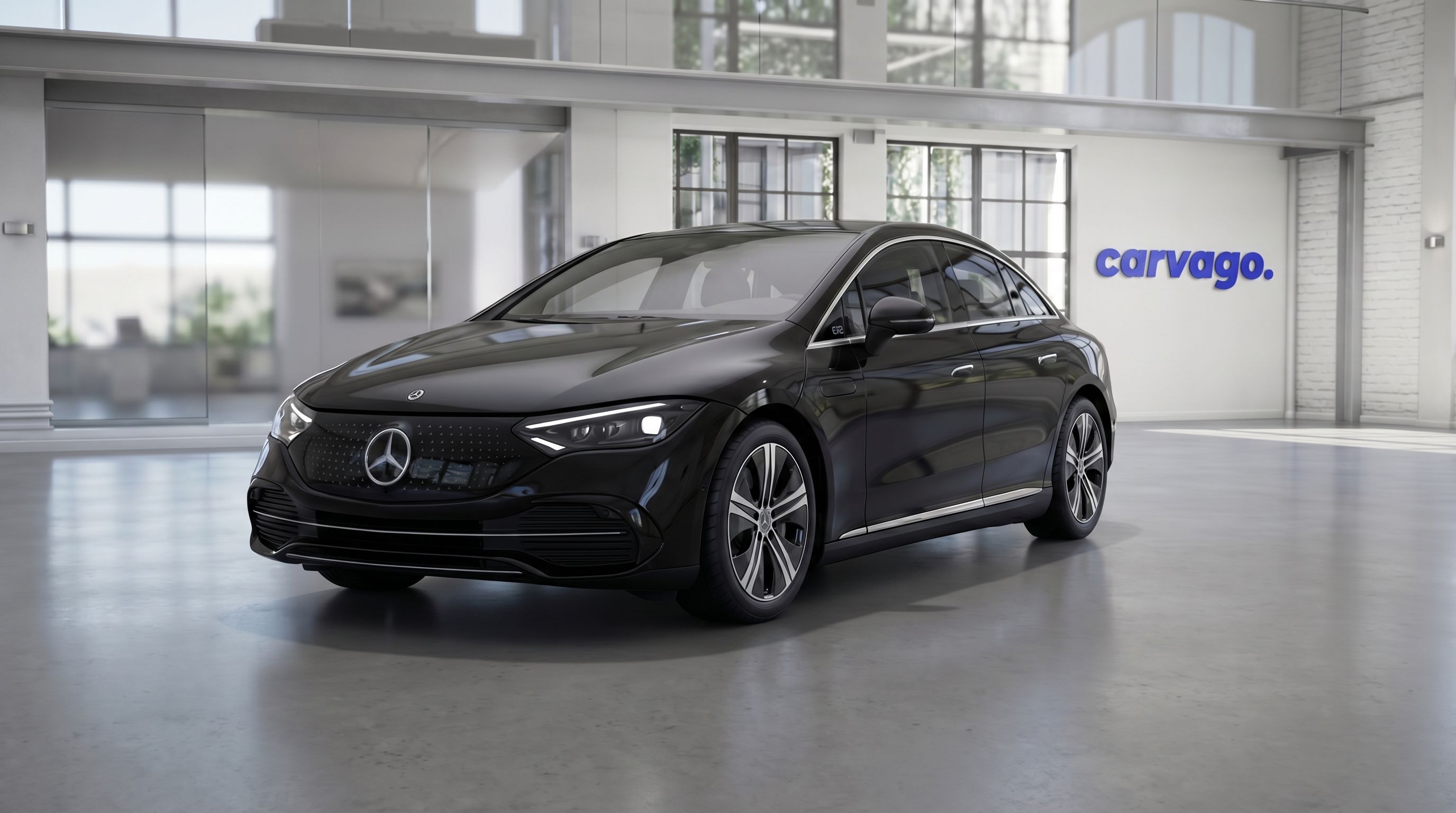
The Mercedes-Benz EQE arrived as the dedicated electric counterpart to the traditional executive class, positioned directly below the larger EQS. Built on the brand's bespoke EVA2 electric architecture, the first-generation Mercedes-Benz EQE Saloon (chassis code V295) made its world premiere on 05 September 2021. European order books opened on 15 March 2022, and the first customer deliveries commenced in late April 2022.
Offered exclusively as a four-door saloon within this model series, the range initially launched with the rear-wheel-drive EQE 350+ and the Mercedes-AMG EQE 43 4MATIC. Mercedes-Benz widened the European portfolio in July 2022 with the addition of the EQE 300, EQE 350 4MATIC, EQE 500 4MATIC, and the AMG EQE 53 4MATIC+.
Aimed primarily at executive company car drivers, long-distance commuters, and fleet operators transitioning away from combustion saloons, the EQE prioritises aerodynamic efficiency and touring refinement for business travel.
Owner Experiences: Common Faults and Recalls
Owner feedback on the Mercedes-Benz EQE shows that long-term mechanical reliability is still taking shape on the European used market, but day-to-day experiences highlight specific electronic and software teething troubles. Owners frequently report that the flush motorized exterior door handles can intermittently refuse to extend upon approach or fail to respond to touch inputs. Another repeated grievance involves unexpected 12V auxiliary battery depletion after short idle periods. When this low-voltage battery drops charge, it triggers a cascade of false error warnings across the instrument cluster and temporarily immobilises the vehicle by preventing the high-voltage contactors from engaging. Authorised dealer power management updates have been reported to resolve the underlying parasitic drain in many cases.
In addition, owners report rapid tyre wear on the inner shoulders of the rear wheels, where substantial vehicle mass and rear suspension geometry can exhaust tyre tread within 24,000 to 32,000 km.
The electric Mercedes-Benz EQE saloon has also been subject to several official European safety recalls addressing mechanical fasteners, electrical fuses, and software logic.
Verified Safety Recalls
Affected Production Window
Defect Description
Reach & Workshop Action
17 November 2022 – 4 December 2025
Wheel bolts were not tightened to official torque specifications, creating a risk that bolts and the wheel assembly could detach while driving.
Worldwide. Authorised workshops inspect wheel bolt attachments on all four wheels and retighten them to specification.
2 March 2022 – 23 July 2025
A manufacturing defect in the steering coupling screw connection can lead to a loose mechanical link to the steering gear, risking total loss of steering.
Worldwide. Workshops inspect the fastener between the steering wheel and steering gear, retightening or replacing it as required.
31 January 2023 – 17 October 2023
Improperly reworked main fuse boxes could suffer broken electrical contacts or incorrect fuse ratings, leading to unannounced drive loss or fire.
Diagnostic requests overload battery management memory, triggering an unexpected module reset that opens high-voltage contactors and cuts propulsion while driving.
Worldwide. Workshops flash updated software onto the battery management system control module.
25 January 2023 – 17 November 2023
A faulty 80-amp main fuse can cause elevated contact resistance, motor failure, or restraint system faults, increasing fire and collision risks.
Worldwide. Dealers inspect and replace the main fuse box assembly with a revised component.
22 November 2021 – 23 February 2022
Incorrect airbag control module coding on early EQE 350, EQE 350+, and AMG EQE 43 models may fail to trigger the pyrofuse to isolate the high-voltage battery in a rear crash.
Europe. Workshops reprogram and recode the airbag control module software parameters.
September 2020 – February 2023
Fault management software errors within the electric drivetrain control unit (campaign includes EQS models) could shut down the drive system and cut motive power without warning.
Worldwide. Dealers install updated control software on the electric drivetrain module.
Before buying, checking that all required workshop campaigns have been completed is essential, which buyers can independently verify using CarAudit.
🔍 What to check before buying
Request official dealer service documentation to confirm that all steering coupling, wheel bolt, and battery management recalls were carried out by VIN.
Check all four tyres across their full tread width, specifically examining the inner shoulders for premature balding or exposed cords.
Test the exterior door handles several times from varying angles to ensure they deploy smoothly upon approach and retract completely flush.
Evaluate the brake pedal feel across different recuperation settings during a test drive, checking for erratic bite or sudden lurching when coming to a halt.
Verify that the vehicle wakes cleanly after standing parked, without low-voltage battery warnings or cascading error messages on the display.
Engines: Which One to Choose
The electric Mercedes-Benz EQE relies entirely on permanent magnet synchronous motors paired with a single-speed automatic reduction gear on each driven axle. Buyers can select between single-motor rear-wheel-drive configurations focused on cruising efficiency and dual-motor all-wheel-drive versions engineered for all-weather traction and rapid pace.
Engine
Fuel
Power
Drivetrain
Gearbox
Model years
EQE 300
Electric
180 kW (245 hp)
Rear-wheel drive
Automatic (1-speed)
2022–2024
EQE 300
Electric
195 kW (265 hp)
Rear-wheel drive
Automatic (1-speed)
2024–2026
EQE 350
Electric
215 kW (292 hp)
Rear-wheel drive
Automatic (1-speed)
2022–2023
EQE 350+
Electric
215 kW (292 hp)
Rear-wheel drive
Automatic (1-speed)
2022–2024
EQE 350+
Electric
235 kW (320 hp)
Rear-wheel drive
Automatic (1-speed)
2024–2026
EQE 350 4MATIC
Electric
215 kW (292 hp)
All-wheel drive
Automatic (1-speed)
2022–2024
EQE 350 4MATIC
Electric
235 kW (320 hp)
All-wheel drive
Automatic (1-speed)
2024–2026
EQE 500 4MATIC
Electric
300 kW (408 hp)
All-wheel drive
Automatic (1-speed)
2022–2024
EQE 500 4MATIC
Electric
330 kW (449 hp)
All-wheel drive
Automatic (1-speed)
2024–2026
Mercedes-AMG EQE 43 4MATIC
Electric
350 kW (476 hp)
All-wheel drive
Automatic (1-speed)
2022–2026
Mercedes-AMG EQE 53 4MATIC+
Electric
460 kW (626 hp)
All-wheel drive
Automatic (1-speed)
2022–2026
For city driving and everyday commuting, the rear-wheel-drive EQE 300 delivers smooth and quiet operation, although the vehicle’s substantial exterior dimensions are tailored primarily for open-road touring.
For mixed driving and long motorway journeys, the rear-wheel-drive EQE 350+ is the most balanced variant in the lineup. It provides composed overtaking capability while achieving lower energy consumption than the dual-motor options, making it a practical choice for drivers who prioritize distance between charging stops.
Buyers who regularly encounter winter weather or plan to pull trailers should opt for the all-wheel-drive Mercedes-Benz EQE. Both the EQE 350 4MATIC and the punchier EQE 500 4MATIC provide secure traction, while vehicles manufactured from April 2024 onward feature a front-axle disconnect unit that decouples the front motor during gentle cruising alongside a significantly uprated towing rating.
Performance enthusiasts have two distinct options. The Mercedes-AMG EQE 43 4MATIC balances swift acceleration with everyday suspension compliance, whereas the flagship Mercedes-AMG EQE 53 4MATIC+ delivers aggressive acceleration at the expense of higher energy consumption and a stiffer baseline ride.
The electric drive units have demonstrated solid mechanical reliability in service.
Real-world range and charging
The sleek aerodynamic profile of the Mercedes-Benz EQE helps minimize high-speed energy consumption on the motorway compared to upright electric SUVs. Cold winter weather leads to a notable reduction in driving range due to cabin climate demands, though cars manufactured from April 2024 onward mitigate this loss with a standard heat pump. DC rapid charging performance remains consistent across European fast-charging corridors, sustaining high intake rates well into the battery replenishment cycle.
Space & Practicality
Parameter
Saloon
Length (mm)
4,946
Width (mm)
1,961
Height (mm)
1,510
Wheelbase (mm)
3,120
Boot capacity (seats up / folded, l)
430 / —
These exterior dimensions do not apply to performance AMG models, which feature extended aerodynamic aprons and a lower ride height; maximum boot capacity with rear seats folded remains unverified by official manufacturer standards.
The long wheelbase provides ample legroom for rear passengers, though the sweeping roofline noticeably limits headroom for taller occupants. The optional panoramic glass roof further reduces available rear headspace. Rear seating flexibility is supported by standard three-way split-folding backrests with a load-through facility. Everyday cargo practicality, however, is restricted by the conventional saloon lid: the boot aperture is narrow and awkwardly shaped, complicating the loading of bulky items. Furthermore, the Mercedes-Benz EQE saloon lacks a front luggage compartment beneath its sealed bonnet, meaning charging cables must share space with luggage in the rear.
What the Tests Say
Road testers broadly commend the electric Mercedes-Benz EQE saloon for its hushed acoustic isolation, noting that road, wind, and powertrain noise remain thoroughly suppressed at motorway speeds. When equipped with optional air suspension, the chassis glides smoothly over coarse surfaces and bridge expansion joints. Optional rear-axle steering lends the long four-door noticeable agility in tight city spaces alongside stable tracking through fast bends. The performance-focused AMG derivative uses firmer damping that manages vertical body movements tightly over crests, albeit by sacrificing low-speed compliance.
The cabin divides opinion. Front occupants enjoy supportive seat contouring and a fast-acting central touchscreen, but ergonomic flaws draw repeated criticism. Testers find the touch-capacitive steering wheel controls distracting on the move, while the arched roofline restricts rearward visibility. Lower dashboard mouldings and plain plastic console trims were also judged disappointing for an executive vehicle.
Professional evaluations agree most strongly on the braking system: on models produced before the April 2024 update, the pedal action was universally criticised for an inconsistent, spongy transition between regenerative deceleration and mechanical friction discs. In higher recuperation modes, the pedal actuator mechanically pulled downward beneath the driver's foot without direct input, making smooth stops awkward to judge. Reviewers differed mainly on open-road damping control, where some appreciated the supple long-distance gait while others faulted floaty vertical rebound over undulating secondary roads.
Prices and Market Offer
All the charts in this section reflect Carvago listings across the entire Mercedes-Benz EQE model family, including other generations represented in the data, rather than exclusively the reviewed generation, and do not establish a separate price level for the reviewed generation alone. Across these advertised listings, the median asking price sits at €50,000 for 2022 models and €53,600 for 2023 examples. Listings from 2024 record a median asking price of €52,500, while 2025 vehicles stand at €53,500 and 2026 cars reach €62,000.
Between May 2026 and October 2026, the number of advertised Mercedes-Benz EQE listings shifted from 2,182 cars down to 1,684. The chart below tracks how monthly availability has moved across this six-month span.
Mercedes-Benz EQE - availability over time
Active listings over time
Month
Mercedes-Benz EQE
2026-05
2 182
2026-06
2 129
2026-07
2 131
2026-08
1 999
2026-09
1 958
2026-10
1 684
Source Carvago
Even with the overall reduction in listings to 1,684 by October 2026, buyers continue to have a substantial volume of vehicles to choose from on the market.
Among Mercedes-Benz EQE cars advertised today, the median asking price for vehicles built in 2022 is €50,000, whereas for those built in 2026 it stands at €62,000. The chart below shows how asking figures compare across available build years.
Mercedes-Benz EQE - median price by model year
Median advertised price by year of manufacture
Model year
Mercedes-Benz EQE
2022
50 000
2023
53 600
2024
52 500
2025
53 500
2026
62 000
Source Carvago
Buyers focusing on 2022 models see a median asking price of €50,000, while 2023 to 2025 selections sit close together between €52,500 and €53,600, with 2024 listings coming in below 2023. For those targeting 2026 examples, the median asking price reaches €62,000.
This depreciation curve illustrates how the Mercedes-Benz EQE loses value as it ages, shedding 13% of its residual value in its first year and 26% by age three. The following chart maps this progression across vehicle age.
Mercedes-Benz EQE - value loss by age
Residual value by vehicle age
Vehicle age
Mercedes-Benz EQE
New
55 000
1 yr
47 700
2 yrs
45 000
3 yrs
40 700
4 yrs
36 700
5 yrs
36 000
6 yrs
32 900
7 yrs
31 500
Source Carvago
Over seven years, the model sheds 43% of its residual value, keeping more than half of its initial value. The sharpest drop occurs in the first year, after which the pace of depreciation moderates considerably.
Active listings for the model family consist entirely of electric powertrains, starting at 2182 electric vehicles in May 2026 and standing at 1684 in October 2026. The chart below details the advertised volume across the recorded months.
Mercedes-Benz EQE - supply by fuel over time
Supply composition by fuel type
Month
Electric
2026-05
2 182
2026-06
2 129
2026-07
2 131
2026-08
1 999
2026-09
1 958
2026-10
1 684
Source Carvago
With zero listings recorded for petrol, diesel, or hybrid variants throughout the period, shoppers will find exclusively electric choices on the second-hand market.
The chart tracks the average asking price for the Mercedes-Benz EQE from May 2026 to October 2026, opening at €52,700.
Mercedes-Benz EQE - price trend over time
Average price development over time
Month
Mercedes-Benz EQE
2026-05
52 700
2026-06
52 100
2026-07
51 800
2026-08
52 000
2026-09
52 300
2026-10
53 100
Source Carvago
Overall movement remained minor relative to the vehicle values, with the monthly average dipping to €51,800 in July 2026 before closing the recorded period at €53,100 in October 2026.
The rear-wheel-drive EQE 350+ is the most balanced choice, delivering composed cruising and lower energy consumption than dual-motor variants. However, drivers who regularly encounter harsh winter conditions or plan to tow should consider all-wheel-drive 4MATIC models built from April 2024 onward instead.
Are early production models reliable?
Early production models are mechanically robust, though cars built before the April 2024 update can suffer from software glitches and low-voltage battery drain. Buyers should ensure all official dealer software updates and recall campaigns have been completed.
What should you check before buying a used model?
Verify through official dealer service documentation that all outstanding safety recalls have been completed by VIN. Additionally, inspect the inner shoulders of all four tyres for premature wear caused by the car's high kerb weight.
How much does a used Mercedes-Benz EQE cost?
Across advertised listings for the Mercedes-Benz EQE, median asking prices start around €50,000 for 2022 models and reach €62,000 for 2026 examples. Depreciation is steepest during the first year before moderating over subsequent years.