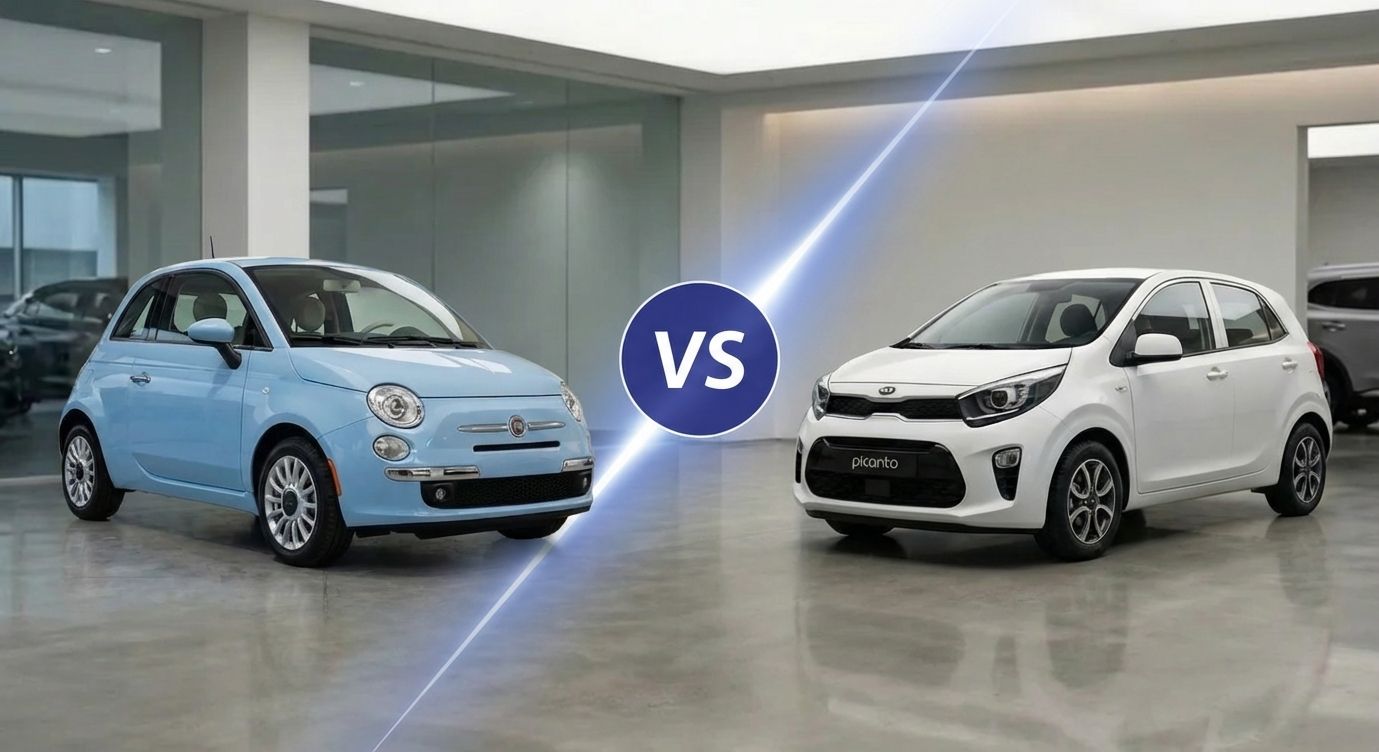
Car battle
Fiat 500 vs. Kia Picanto: Complete comparison 2026
Fiat 500 or Kia Picanto? Our detailed comparison will help you choose the right city car. Detailed tests, features, and verdict.
Apr 14, 2026
Kia Picanto (2017-present) review: real owner experience, common faults, engine picks, running costs and our definitive buying verdict.
November 4, 2026
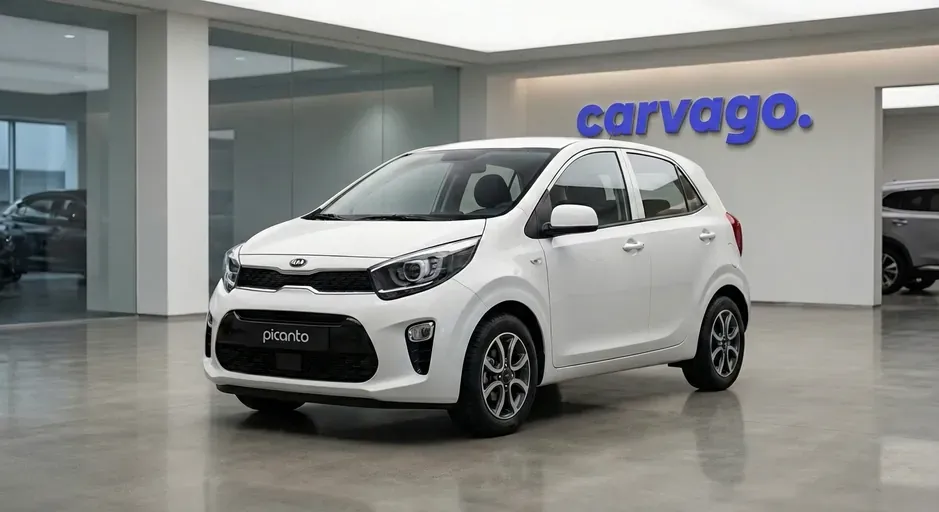
The Kia Picanto represents the brand’s contender in the European city-car segment. This review focuses on the third generation, internally designated JA, which arrived with first European customer deliveries in April and May 2017 and remains in production today. Offered exclusively as a five-door Kia Picanto hatchback, the lineup has included both the standard urban model and a raised, rugged crossover-inspired variant.
During its lifecycle, the platform underwent two major updates. The first facelift was revealed in June 2020, with European customer deliveries starting in the third quarter of 2020, introducing revised front and rear styling alongside updated transmissions. A second, substantial design overhaul was unveiled in July 2023, arriving with first European customer deliveries in July 2024 to bring updated cabin technology and sharper exterior styling aligned with the brand's latest design language.
Aimed primarily at urban commuters, downsizers, and first-time drivers, the Kia Picanto targets buyers looking for a compact footprint suited to tight streets and easy parking, combined with five-door daily usability.
While the Kia Picanto generally proves mechanically robust in everyday service, real-world ownership data highlights several recurring weak points tied to urban use. Roadside breakdown tests frequently identify the 12V starter battery as a failure point, particularly on models built in 2018 and 2019. Short city trips combined with automatic start-stop cycles often prevent the battery from reaching a full state of charge. Furthermore, tests describe premature spark plug fouling on naturally aspirated petrol engines registered in 2017, 2019, and between 2021 and 2023, where frequent cold starts lead to rough idling and cylinder misfires well ahead of standard service schedules.
Drivetrain durability is broadly dependable, though statutory roadworthiness inspections regularly log minor oil sweating around the lower timing cover gasket, engine oil pan, and gearbox casing seams. While this misting rarely develops into an active leak, it requires monitoring. A more prominent ownership complaint concerns the automatic Kia Picanto equipped with the five-speed automated manual transmission introduced in 2020. Owners report and tests describe sluggish gear changes, hesitant clutch engagement, and low-speed shuddering during stop-start traffic. Software adaptations and clutch re-learn procedures often alleviate mild hesitation, but persistent juddering indicates accelerated clutch lining wear or actuator calibration issues.
Official safety recalls have addressed specific mechanical and electrical components across European markets. The most significant pan-European campaigns took place in late 2024 for recently manufactured vehicles. One worldwide action involved an exhaust gas recirculation valve assembly where internal foreign contamination could trigger an electrical short circuit, in some cases causing the engine to stall unexpectedly. Another worldwide campaign addressed launch vehicles from early 2024, where instrument cluster software errors and incomplete coding disabled dashboard speed warnings.
| Defect | Affected Production Window | Reach | Remedy |
|---|---|---|---|
| Exhaust gas recirculation valve internal short circuit | 11 January 2024 – 14 February 2024 | Worldwide (6,869 vehicles) | Replacement of the complete EGR valve assembly |
| Intelligent Speed Limit Assist instrument coding failure | 1 April 2024 – 14 May 2024 | Worldwide (~6,000 vehicles) | Cluster software update and camera variant coding |
| Fuel feed pipe friction against battery tray wiring | 7 September 2020 – 21 July 2023 | United Kingdom (824 vehicles) | Inspection and re-routing; pipe replacement if damaged |
| Inoperative audible chime when rear fog lamp left on | 1 April 2020 – 28 February 2022 | United Kingdom (15,295 vehicles) | Instrument cluster software update |
Before committing to a used purchase, having the vehicle's maintenance records and mechanical condition inspected independently through CarAudit helps ensure past recall work was performed and common city wear is accounted for.
Throughout its production run, the third-generation Kia Picanto has relied strictly on small petrol engines, ranging from atmospheric three- and four-cylinder units to a turbocharged variant. The lineup underwent major technical shifts, first with the 2020 revision that phased out the four-speed torque-converter automatic in favor of an automated manual gearbox, and later with emissions-driven detuning across the naturally aspirated range.
| Engine | Fuel | Power | Gearbox | Model years |
|---|---|---|---|---|
| 1.0 MPi | Petrol | 49 kW (67 PS) | 5-speed manual | 2017 – 2020 |
| 1.25 MPi | Petrol | 62 kW (84 PS) | 5-speed manual / 4-speed automatic | 2017 – 2020 |
| 1.0 T-GDi | Petrol | 74 kW (100 PS) | 5-speed manual | 2018 – 2023 |
| 1.0 DPi | Petrol | 49 kW (67 PS) | 5-speed manual / 5-speed automated manual | 2020 – 2024 |
| 1.2 DPi | Petrol | 62 kW (84 PS) | 5-speed manual / 5-speed automated manual | 2020 – 2024 |
| 1.0 DPi | Petrol | 46 kW (63 PS) | 5-speed manual / 5-speed automated manual | 2024 – present |
| 1.2 DPi | Petrol | 58 kW (79 PS) | 5-speed manual / 5-speed automated manual | 2024 – present |
For purely urban commuting, short hops, and navigating congested streets, the naturally aspirated three-cylinder 1.0-litre units fit the brief neatly. The engine revs willingly and feels light on its feet at city speeds. However, steep hills or heavily loaded journeys quickly expose its modest output, demanding frequent gear changes.
Drivers planning mixed commuting or regular rural routes will find a more capable partner in the four-cylinder 1.2-litre engines (badged as 1.25 MPi or later 1.2 DPi). With an extra cylinder, idle vibration is reduced, mid-range pull is noticeably stronger, and overtakes require far less advance planning.
Longer motorway journeys are best handled by the turbocharged 1.0 T-GDi, which is available only as a used car after leaving the catalogue in late 2023. Its broad torque band pulls comfortably at highway speeds without requiring downshifts on gentle inclines, effectively transforming the small hatchback into a confident all-rounder.
When choosing a gearbox, the manual Kia Picanto remains the easiest transmission to live with thanks to its light clutch pedal and clean shift action. If a two-pedal car is an absolute requirement, early models with the four-speed torque-converter automatic shift much smoother than the automated manual transmission introduced in 2020, though the older gearbox incurs a noticeable fuel penalty.
| Model | Length (mm) | Width (mm) | Height (mm) | Wheelbase (mm) | Boot volume (seats up / folded, l) |
|---|---|---|---|---|---|
| Kia Picanto Hatchback (2017–2023) | 3,595 | 1,595 | 1,485 | 2,400 | 255 / 1,010 |
| Kia Picanto Hatchback (2024–present) | 3,605 | 1,595 | 1,485 | 2,400 | 255 / 1,010 |
| Kia Picanto X-Line (2017–2023) | 3,670 | 1,625 | 1,500 | 2,400 | 255 / 1,010 |
The table dimensions for standard bodywork exclude exterior door mirrors.
Despite its compact footprint, the Kia Picanto makes sensible use of its interior architecture. While five seats are standard across most European markets (with a four-seat layout fitted to entry versions in selected countries), the narrow rear bench realistically accommodates two adults, with shoulder space remaining too tight for three occupants on longer journeys. Rear knee room is sufficient for average-height adults, though taller occupants sitting behind a tall driver will find their knees touching the front backrests.
Practical usability in the back is bolstered by a standard split-folding rear bench, though the lower seat cushion is fixed and cannot slide fore or aft. The luggage compartment features an upright, deep shape that accommodates weekly shopping; models equipped with the dual-height floor available on higher trims eliminate the loading step to provide a flat load deck with the rear seats folded. In addition, no variant of the third-generation car is homologated for towing, meaning trailer use is not permitted.
Road tests consistently highlight the Kia Picanto for its agility and tidy cornering in urban traffic. Its compact footprint and light steering make tight manoeuvres painless, while body lean remains tightly controlled. However, the suspension is tautly damped. Over broken city asphalt, expansion joints, and sunken drains, the ride turns firm and jostles occupants, particularly on models fitted with larger alloy wheels. Out of town, high-speed stability is reassuring, but acoustic refinement is compromised: tyre roar and wind buffeting dominate at motorway pace, and the wheel arches transmit noticeable road spray in wet weather.
Inside, the Kia Picanto hatchback prioritises durability over luxury. The dashboard and door cards consist entirely of hard, unyielding plastics, though panel fit is solid and free of squeaks. Testers rate the ergonomics positively, noting that physical climate controls and the clear central touchscreen fitted to most models keep driver distraction low. The primary complaint centres on the driving position: the steering column adjusts only for height, lacking reach adjustment, and the front seats offer limited lumbar support on extended journeys.
Professional reviews broadly agree that the car proves well-suited to congested streets thanks to its nimble handling and fuss-free controls, while disagreeing slightly on steering feel, which some describe as adequately direct and others as overly remote on centre. The second facelift updated the digital instrumentation and exterior styling, but left the firm low-speed ride and modest cabin sound deadening essentially unchanged.
All charts in this section are drawn from Carvago listings across the entire Kia Picanto model family, including other generations represented in the data, rather than being restricted to the reviewed third generation alone. Current market offerings show a median asking price of €10,400 for 2019 models, moving up to €14,300 for 2023 examples. Newer inventory sits higher across the board, with 2024 models recording a median asking price of €16,700 and 2026 cars reaching €17,700 as updated equipment and lower mileages shape advertised values.
Active Kia Picanto listings tracked across the market peaked at 6,694 in June 2026 before declining to 5,518 by October 2026. The chart below details the month-by-month advertised inventory over this six-month span.
Active listings over time
| Month | Kia Picanto |
|---|---|
| 2026-05 | 6 490 |
| 2026-06 | 6 694 |
| 2026-07 | 6 687 |
| 2026-08 | 6 214 |
| 2026-09 | 6 052 |
| 2026-10 | 5 518 |
Source Carvago
Even with the volume contracting in the late summer and autumn months, buyers still had more than 5,500 advertised cars to compare at the end of the period, ensuring a broad selection across the model range.
Among used listings advertised today, the median asking price for cars built in 2019 is €10,400, while vehicles built in 2026 show a median asking price of €17,700, as detailed in the chart below.
Median advertised price by year of manufacture
| Model year | Kia Picanto |
|---|---|
| 2019 | 10 400 |
| 2020 | 11 000 |
| 2021 | 11 900 |
| 2022 | 13 500 |
| 2023 | 14 300 |
| 2024 | 16 700 |
| 2025 | 17 200 |
| 2026 | 17 700 |
Source Carvago
Buyers focusing on a 2020 model face a median asking price of €11,000, whereas a 2022 model has a median asking price of €13,500 and a 2024 model stands at €16,700.
The depreciation curve illustrates how the Kia Picanto sheds residual value as it ages, losing roughly 27% of its initial value across the first three years.
Residual value by vehicle age
| Vehicle age | Kia Picanto |
|---|---|
| New | 17 900 |
| 1 yr | 16 300 |
| 2 yrs | 14 600 |
| 3 yrs | 13 000 |
| 4 yrs | 12 000 |
| 5 yrs | 10 800 |
| 6 yrs | 10 000 |
| 7 yrs | 8 900 |
Source Carvago
Across the seven years shown, the model loses approximately 50% of its initial residual value, with the steepest year-on-year losses concentrated in the first three years before depreciation moderates.
Across the recorded period, petrol models made up the vast majority of listings, moving from 6348 advertised cars in May 2026 to 5396 in October 2026. The breakdown below tracks the monthly volume of available cars across each fuel type.
Supply composition by fuel type
Petrol
Diesel
LPG
| Month | Petrol | Diesel | LPG |
|---|---|---|---|
| 2026-05 | 6 348 | 6 | 133 |
| 2026-06 | 6 559 | 8 | 124 |
| 2026-07 | 6 542 | 6 | 137 |
| 2026-08 | 6 078 | 9 | 124 |
| 2026-09 | 5 902 | 9 | 138 |
| 2026-10 | 5 396 | 7 | 111 |
Source Carvago
Petrol heavily dominates the current market, accounting for 5396 listings in October 2026 alongside 111 LPG vehicles and 7 diesel models. Buyers will have a wide selection of petrol cars to choose from, whereas alternative fuel options remain extremely limited.
From May 2026 to October 2026, the average asking price for the Kia Picanto stayed nearly constant, beginning at €14,700 and finishing at €14,800. The month-by-month figures are illustrated below.
Average price development over time
| Month | Kia Picanto |
|---|---|
| 2026-05 | 14 700 |
| 2026-06 | 14 700 |
| 2026-07 | 14 700 |
| 2026-08 | 14 700 |
| 2026-09 | 14 700 |
| 2026-10 | 14 800 |
Source Carvago
The average held at €14,700 through September before edging to €14,800 in October 2026, a change of less than one percent that represents minimal overall movement across the six months.
Nimble handling and compact dimensions suited to tight urban driving
Straightforward cabin ergonomics with physical climate controls and intuitive infotainment
Dependable mechanical durability across naturally aspirated petrol engines
Firm low-speed ride over uneven road surfaces and expansion joints
Sluggish shifts and low-speed clutch shudder on the automated manual transmission
Elevated tyre roar and wind buffeting at motorway speeds
The Kia Picanto is mechanically dependable overall, though frequent short city trips can lead to premature starter battery discharge and spark plug fouling.
The four-cylinder 1.2 petrol is the best everyday all-rounder for mixed driving, offering smoother progress than the base three-cylinder engine. For regular motorway trips, seek out the discontinued turbocharged 1.0 T-GDi on the used market.
Pre-2020 models with the four-speed torque-converter automatic shift smoothly despite higher fuel consumption. In contrast, the automatic Kia Picanto with the automated manual introduced in 2020 is best avoided due to hesitant, jerky shifts in city driving.
Check the car's recall history by VIN through an authorised dealer, and test-drive manual and automated gearboxes carefully for clutch shudder or slippage.
Sources: kia.com, adac.de, check-vehicle-recalls.service.gov.uk, autocar.co.uk, autoexpress.co.uk
This article was prepared using artificial intelligence tools. The section guarantor is Petr Dušek.
Fiat 500 or Kia Picanto? Our detailed comparison will help you choose the right city car. Detailed tests, features, and verdict.
Apr 14, 2026
Detailed comparison of Mazda 2 vs Suzuki Swift. Are you looking for the ideal city hatchback? Find out the differences in driving characteristics, fuel consumption, and read our verdict.
Apr 8, 2026
Detailed comparison of used Peugeot 208 and Škoda Fabia cars. We compared engines, equipment, practicality, and reliability. Which city hatchback should you choose?
May 11, 2026