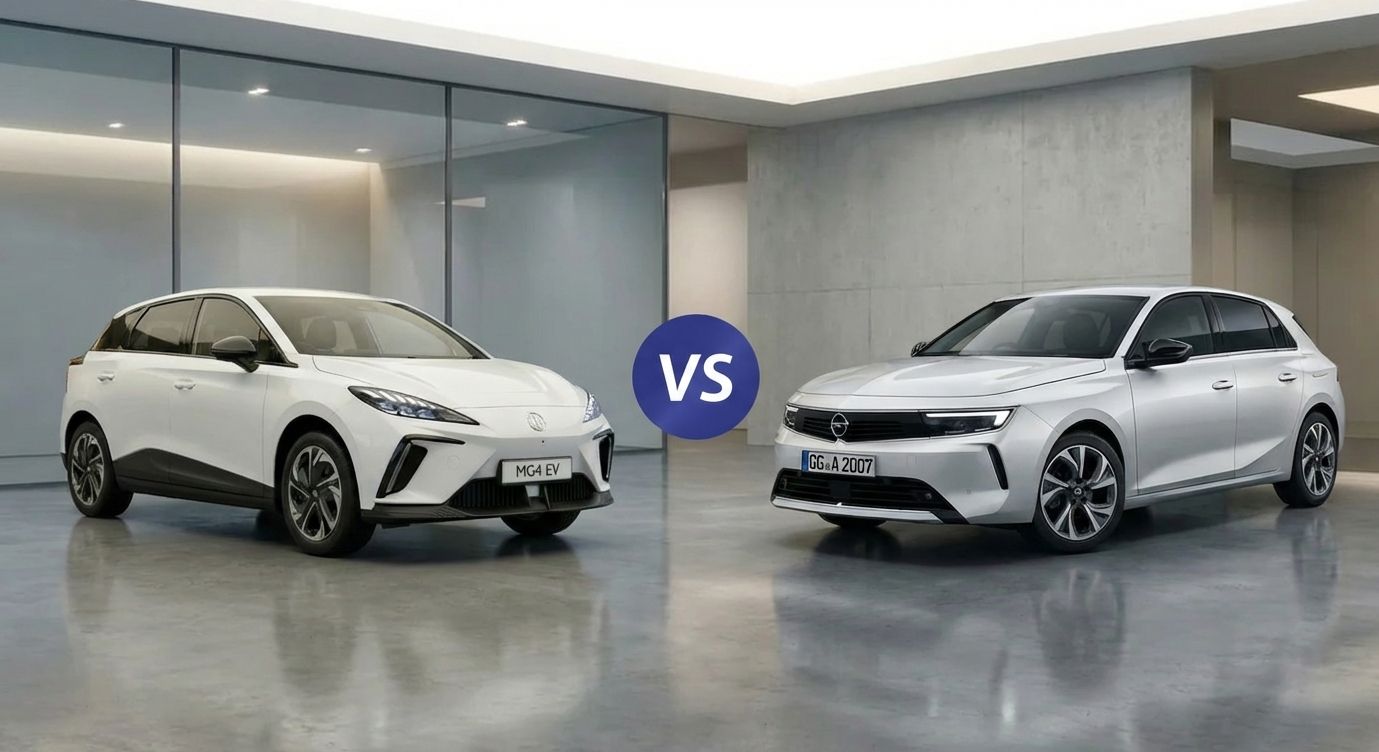
Car battle
MG4 vs. Opel Astra Electric: Complete comparison 2026
Deciding between the MG4 and the Opel Astra Electric? Our detailed comparison of range, price, and equipment will help you choose the right electric hatchback for you.
Apr 14, 2026
Hyundai Ioniq 6 review: real owner experience, real-world range, charging speeds, known issues and prices — everything to know before you buy.
October 25, 2026
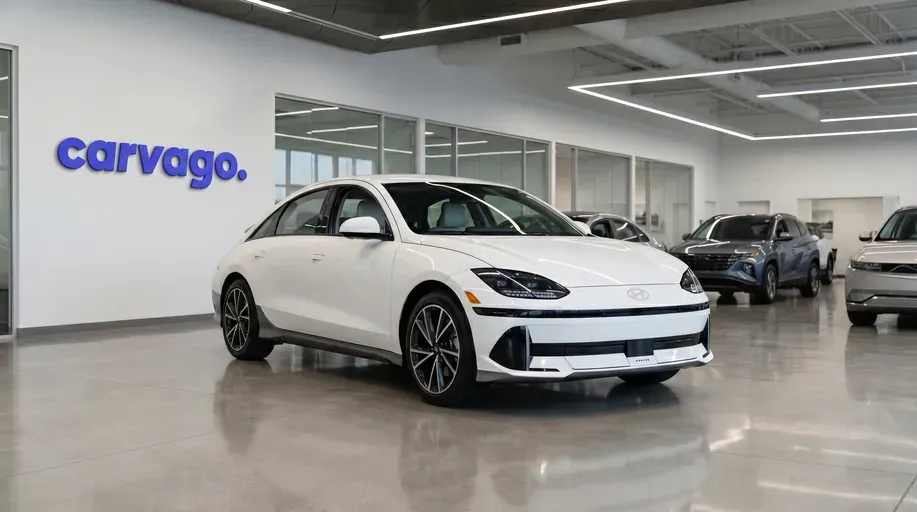
The Hyundai Ioniq 6 is a fully electric mid-size saloon designed with a distinctive streamliner profile to prioritise aerodynamic efficiency over traditional proportions. This review covers the first generation, which entered series production in July 2022. Following the opening of European pre-sales order books in November 2022, the first customer deliveries reached European roads in March 2023. Series production remains ongoing as of late 2026.
Sold across Europe exclusively as a four-door saloon, the vehicle received a mid-cycle facelift revealed on 3 April 2025 alongside a newly introduced styling package. A dedicated high-performance derivative followed with its world debut on 10 July 2025, preceding the updated line-up's European presentation in November 2025 and its European motor-show premiere in January 2026.
Positioned as an aerodynamic alternative to prevalent electric crossovers and SUVs, the Hyundai Ioniq 6 targets company car fleets, motorway commuters, and private drivers who prioritise high-speed energy efficiency and long-distance touring.
With European deliveries underway since March 2023, long-term durability data for the first-generation Hyundai Ioniq 6 is still accumulating. The underlying electric platform has demonstrated robust mechanical integrity, but early production years have been subject to several official safety recalls addressing power management hardware, exterior fittings, and passive safety components.
Official European safety registers record four primary recall campaigns for this generation. The most prominent involves the Integrated Charging Control Unit on early builds, where internal power surges can damage low-voltage charging components. A subsequent campaign addressed the front seatbelt anchor brackets, while smaller actions targeted software stability and exterior body trim.
| Defect Subject | Affected Build Window | Geographic Reach | Defect Summary & Workshop Remedy |
|---|---|---|---|
| Integrated Charging Control Unit (ICCU) | 28 September 2022 – 4 March 2024 | Worldwide (155,760 units across model lines) | The charger of the vehicle's 12-volt battery may malfunction and switch to backup mode, which can cause a full loss of driving power. Workshops update control firmware and replace the module and high-voltage fuse free of charge if fault codes or damage are found. |
| Front Seatbelt Snap-On Anchor | 5 October 2022 – 24 June 2025 | Worldwide (103,163 units) | The front seatbelt snap-on anchor may become misaligned or come loose, impairing restraint function in a collision. Workshops inspect the lower anchorages, install a reinforcement stopper bracket, or replace the seatbelt assembly if damaged. |
| Charging Port Door Outer Panel | 29 August 2022 – 3 January 2025 | Worldwide (31,670 units) | The charging port door outer panel may not be securely attached and could detach while driving. Technicians inspect the motorized flap assembly and apply an upgraded bonding kit or replace loose panels. |
| Digital Instrument Cluster Display | 30 June 2025 – 14 November 2025 | Worldwide (36,316 units across model lines) | Software fault causes the digital instrument cluster to reboot while driving, resulting in a blank display and suppressed warning indicators. Dealerships install an updated cluster software calibration. |
Beyond safety campaigns, owners report that AC home and destination charging can throttle down unexpectedly. During extended sessions or in warm ambient temperatures, high resistance at the charge inlet causes thermal sensors to register elevated temperatures. Rather than halting charging entirely, revised software logic automatically scales down the charging current to safeguard the connection. In stubborn cases, workshops have replaced the inlet socket and wiring harness to lower contact resistance.
Active air flaps positioned in the lower front bumper intake can also sporadically jam. These motorized louvres regulate cooling air to the radiator and aerodynamics, but road grit, salt, and winter slush can cause the mechanism to bind, illuminating an aerodynamic warning light on the instrument cluster. Thorough cleaning of the shutter guide rails usually restores operation, though stripped actuator drive gears require unit replacement.
Owners also highlight auxiliary 12-volt battery discharge as a recurring inconvenience. If the low-voltage battery drops below operating thresholds due to lingering background modules or delayed top-ups, the car will fail to engage the high-voltage battery contactors, leaving the flush exterior door handles unresponsive. In addition, cars driven predominantly in high regenerative braking modes rarely engage the hydraulic friction brakes, allowing surface rust and pitting to form quickly on the rear brake discs.
Before committing to a specific used car, verifying the documented digital history or having the vehicle inspected through CarAudit ensures that all necessary hardware modifications and software updates have been logged.
The electric Hyundai Ioniq 6 offers a focused powertrain lineup built on an 800-volt dedicated platform, spanning single-motor rear-wheel-drive configurations and twin-motor all-wheel-drive systems across both pre-facelift and facelift revisions.
| Engine | Fuel | Power | Drivetrain | Gearbox | Model years |
|---|---|---|---|---|---|
| Standard Range (53 kWh) | Electric | 111 kW (151 hp) | Rear-wheel drive | Automatic (1-speed) | 2022–2026 |
| Long Range (77.4 kWh) | Electric | 168 kW (228 hp) | Rear-wheel drive | Automatic (1-speed) | 2022–2026 |
| Long Range AWD (77.4 kWh) | Electric | 239 kW (325 hp) | All-wheel drive | Automatic (1-speed) | 2022–2026 |
| Standard Range (63 kWh) | Electric | 125 kW (170 hp) | Rear-wheel drive | Automatic (1-speed) | 2026–present |
| Long Range (84 kWh) | Electric | 168 kW (228 hp) | Rear-wheel drive | Automatic (1-speed) | 2026–present |
| Long Range AWD (84 kWh) | Electric | 239 kW (325 hp) | All-wheel drive | Automatic (1-speed) | 2026–present |
| Ioniq 6 N (84 kWh) | Electric | 478 kW (650 hp) | All-wheel drive | Automatic (1-speed) | 2026–present |
For urban driving and daily suburban commutes, the Standard Range rear-wheel-drive variant is well matched to everyday needs. Its lighter kerb weight provides progressive responses around town, though its sustained highway pace remains the most modest in the range.
For mixed use and frequent long-distance motorway travel, the Long Range single-motor rear-wheel-drive model represents the most balanced choice. Delivering clean steering untainted by drive torque, it extracts maximum endurance from its pack thanks to the aerodynamic saloon shape.
Drivers requiring dependable winter traction or brisk overtaking pace should look to the all-wheel drive Hyundai Ioniq 6. Its dual-motor setup automatically disengages the front axle when cruising to preserve energy and offers dependable towing capability alongside the Long Range rear-wheel drive, albeit with a slight penalty in real-world range compared to the single-motor layout.
At the top of the range, the high-performance Hyundai Ioniq 6 N delivers track-ready agility with simulated gear shifting and specialized differentials, catering strictly to enthusiastic drivers.
For detailed owner-reported reliability, charging-control issues, and verified safety recalls regarding the powertrain, consult the owner experiences section.
The aerodynamic streamliner profile helps the saloon achieve low motorway consumption in temperate weather, but cold winter temperatures noticeably increase consumption due to cabin climate control and battery preconditioning demands. At high-power public DC charging hubs, the 800-volt electrical architecture delivers rapid replenishment speeds when the battery is properly preconditioned via the navigation system.
The aerodynamic silhouette of the Hyundai Ioniq 6 saloon directly shapes its passenger and cargo packaging. While the long wheelbase yields substantial knee room in the second row, the descending roofline leaves tight headroom for taller passengers. Because the elevated cabin floor accommodates the battery pack, rear occupants sit with an acute knee angle and minimal under-thigh support. A split-folding rear seatback allows longer items to extend into the cabin, though the rear bench does not slide fore and aft.
Everyday usability reflects the saloon architecture: the rear boot opening is comparatively narrow and shallow for boxy items, but the front luggage compartment under the bonnet provides a dedicated space to store charging cables away from primary cargo.
| Dimension | Pre-facelift Saloon (2022–2025) | Facelift Saloon (from late 2025) |
|---|---|---|
| Length (mm) | 4,855 | 4,925 |
| Width (mm) | 1,880 | 1,880 |
| Height (mm) | 1,495 | 1,495 |
| Wheelbase (mm) | 2,950 | 2,950 |
| Boot volume, seats upright (l) | 401 | 401 |
| Boot volume, seats folded (l) | Not published | Not published |
Figures do not apply to the high-performance N version, which features distinct exterior dimensions and a smaller boot.
On open roads and motorways, the Hyundai Ioniq 6 delivers a planted and settled gait. Its streamlined body suppresses wind buffeting effectively, keeping cabin noise hushed at sustained cruising speeds. Body control remains tidy through bends thanks to a low centre of gravity, and directional stability proves reassuringly secure during sudden evasive manoeuvres. However, driver involvement is muted; the steering rack is accurate and quick to respond, yet it conveys little road texture. Suspension compliance divides opinion: while undulations on fast roads are ironed out smoothly, models equipped with optional larger wheels on higher trims feel fidgety at low speeds, passing sharp potholes, cobbles, and transverse joints directly into the cabin.
Inside, supportive front seating and dedicated physical buttons for climate functions earn praise, and the overall assembly is rattle-free. Testers nevertheless penalise hard, scratch-prone plastics along the lower door panels and centre console. Specific ergonomic choices also draw mixed reactions, notably window switches relocated to the centre console and the optional camera-based digital side mirrors, which compromise depth perception compared to conventional glass. The mandatory speed-warning chimes also require tedious menu navigation to silence on each journey.
Facelift revisions brought minor gains in high-speed acoustic isolation, but the underlying chassis tuning preserves the same duality: calm and composed on long-distance asphalt, yet noticeably firm across broken urban surfaces.
All the market charts in this section are drawn from Carvago listings representing the whole model family rather than filtering exclusively for the reviewed generation, meaning this dataset does not establish a separate price level for the Hyundai Ioniq 6 alone. Earlier listings across the broader data register a median asking price of €8,900 for 2019 and €18,700 for 2022. More recent model years show a median asking price of €39,800 for 2023, €38,000 for 2024, €40,000 for 2025, and €52,700 for 2026.
Active Hyundai Ioniq 6 listings showed little overall variation between April and September 2026, opening at 1,485 cars advertised and closing at 1,454. The monthly totals below show how availability developed across this six-month span.
Active listings over time
| Month | Hyundai Ioniq 6 |
|---|---|
| 2026-04 | 1 485 |
| 2026-05 | 1 407 |
| 2026-06 | 1 385 |
| 2026-07 | 1 427 |
| 2026-08 | 1 404 |
| 2026-09 | 1 454 |
Source Carvago
With inventory remaining between a low of 1,385 and a high of 1,485 listings throughout the period, buyers can expect a dependable selection of around 1,400 cars on offer. This steady volume means shoppers have consistent choice on the market without dealing with sharp swings in availability.
Among used listings of this model advertised today, the median asking price is €8,900 for cars built in 2019 and reaches €52,700 for those built in 2026. The progression between model years is not strictly upward, as listings built in 2024 show a lower median asking price than those built in 2023.
Median advertised price by year of manufacture
| Model year | Hyundai Ioniq 6 |
|---|---|
| 2019 | 8 900 |
| 2020 | 9 700 |
| 2022 | 18 700 |
| 2023 | 39 800 |
| 2024 | 38 000 |
| 2025 | 40 000 |
| 2026 | 52 700 |
Source Carvago
For earlier production years, buyers face a median asking price of €9,700 for 2020 models and €18,700 for 2022 models. Recent model years require significantly more capital, where median asking prices stand at €38,000 for 2024 and €40,000 for 2025.
This depreciation curve illustrates how the model's residual value declines with vehicle age, showing a 30% loss in the first year and a cumulative 36% drop by age three.
Residual value by vehicle age
| Vehicle age | Hyundai Ioniq 6 |
|---|---|
| New | 54 100 |
| 1 yr | 37 800 |
| 2 yrs | 36 000 |
| 3 yrs | 34 700 |
| 4 yrs | 26 700 |
| 5 yrs | 24 400 |
| 6 yrs | 22 300 |
| 7 yrs | 19 900 |
Source Carvago
Across the seven years shown, the model sheds 63% of its initial residual value. The steepest single decline occurs in the first year, after which annual value loss slows considerably between ages one and three.
Across the months from April 2026 to September 2026, the advertised selection consisted exclusively of electric models, starting with 1,485 listings in April and recording 1,454 in September.
Supply composition by fuel type
| Month | Electric |
|---|---|
| 2026-04 | 1 485 |
| 2026-05 | 1 407 |
| 2026-06 | 1 385 |
| 2026-07 | 1 427 |
| 2026-08 | 1 404 |
| 2026-09 | 1 454 |
Source Carvago
With zero listings recorded for petrol, diesel, or hybrid options across the entire period, buyers searching for this model will find an entirely electric market.
The chart tracks the average asking price from April 2026 to September 2026, opening at €32,900 and peaking at €33,500 in June 2026.
Average price development over time
| Month | Hyundai Ioniq 6 |
|---|---|
| 2026-04 | 32 900 |
| 2026-05 | 33 400 |
| 2026-06 | 33 500 |
| 2026-07 | 32 900 |
| 2026-08 | 32 900 |
| 2026-09 | 33 300 |
Source Carvago
Across the six months, prices remained within a narrow range before ending at €33,300, showing very little net movement relative to overall price levels.
Aerodynamic profile suppresses wind buffeting effectively for quiet motorway cruising
Rapid DC charging speeds at high-power chargers when the battery is preconditioned
Substantial second-row knee room enabled by the long wheelbase
Tight rear headroom and minimal under-thigh support due to the sloping roofline and elevated floor
Narrow boot opening and shallow cargo compartment restrict loading bulky items
Fidgety low-speed ride over sharp urban bumps and road joints, especially on larger wheels
The mechanical platform has demonstrated good reliability, but buyers should ensure all factory recalls have been completed by VIN. In particular, the integrated charging control unit requires verification to avoid 12-volt battery failure and loss of drive.
The Long Range rear-wheel-drive Hyundai Ioniq 6 is the most balanced choice for most drivers, pairing long cruising range with clean steering responses. Choose the twin-motor all-wheel-drive version only if you regularly need enhanced winter traction or maximum towing capability.
Confirm via the vehicle identification number that safety recalls—especially for the charging control unit and seatbelt anchors—have been completed in official records. Additionally, test the health of the 12-volt auxiliary battery and inspect the rear brake discs for corrosion from infrequent friction braking.
The long wheelbase provides ample legroom, but the sloping roofline and raised battery floor restrict rear headroom and thigh support for taller passengers. The saloon boot opening is also relatively narrow and shallow for bulky items.
Sources: hyundai.news, hyundai.com, adac.de, europa.eu, autocar.co.uk
This article was prepared using artificial intelligence tools. The section guarantor is Petr Dušek.
Deciding between the MG4 and the Opel Astra Electric? Our detailed comparison of range, price, and equipment will help you choose the right electric hatchback for you.
Apr 14, 2026
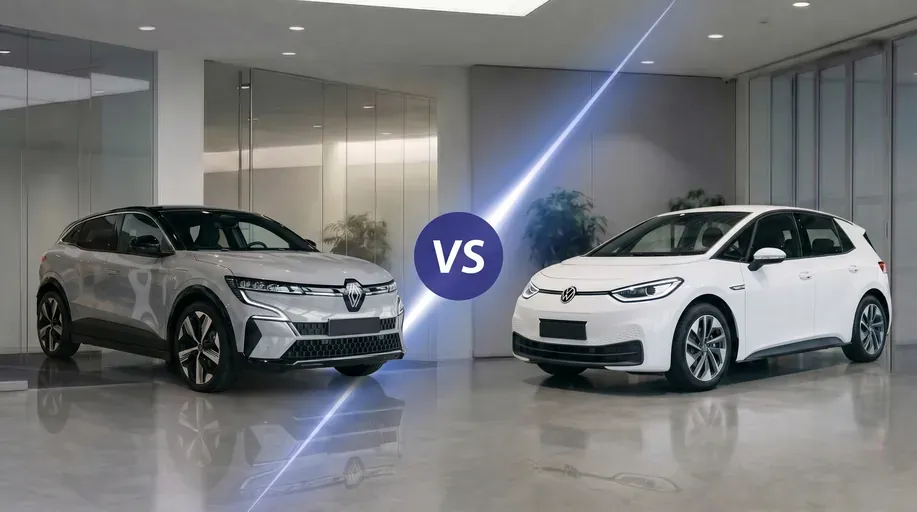
Detailed comparison of Renault Mégane E-Tech vs Volkswagen ID.3. Discover real-world range, differences in equipment, and driving characteristics. Read our final verdict.
May 7, 2026
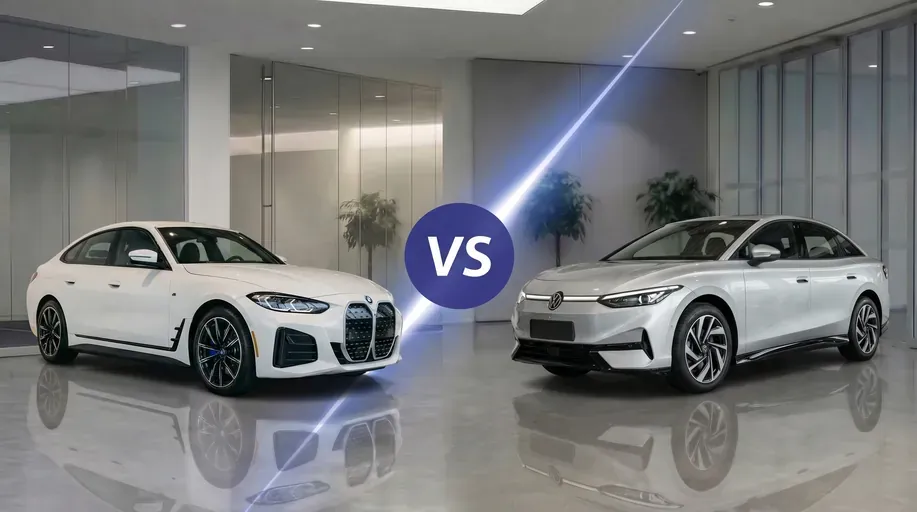
Comparison of the BMW i4 and Volkswagen ID.7. Find out which electric car has better real-world range, equipment, and driving comfort. Read our final verdict.
Apr 14, 2026