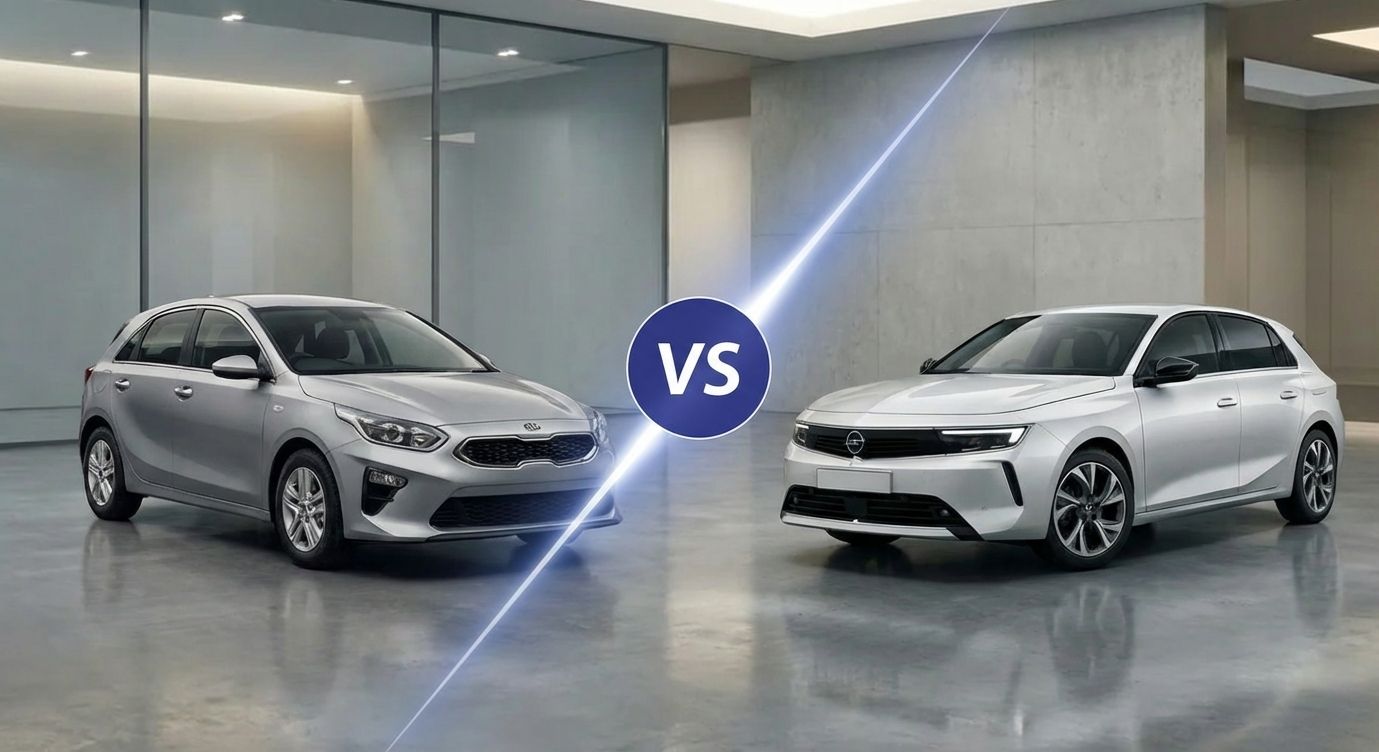
Car battle
Kia Ceed vs. Opel Astra: Complete comparison 2026
Detailed comparison of the Kia Ceed and Opel Astra. We compared real-world fuel consumption, reliability, and equipment. Find out which popular hatchback is worth buying.
Oct 16, 2026
Hyundai i30 review: real owner experience, common faults, engine picks and running costs — everything you need to know before you buy.
November 6, 2026
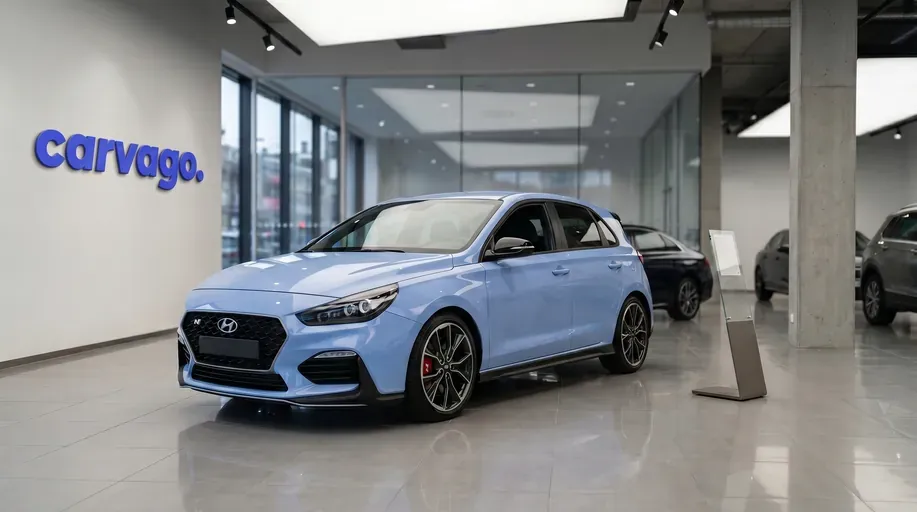
The Hyundai i30 represents the South Korean brand in the European compact class, engineered specifically for European roads and built at the manufacturer’s plant in Nošovice, Czech Republic. This review examines the third generation (internal codes PD and PDE), which arrived with initial European customer deliveries in January 2017 and remains on sale through 2026.
Across its production lifecycle, the model was offered in three distinct body variants: the five-door Hyundai i30 Hatchback, the load-carrying Hyundai i30 Wagon delivered from June 2017, and the five-door Fastback, which arrived with first customer deliveries in January 2018 alongside the performance-focused i30 N. The generation received two factory updates. Following an unveiling on 26 February 2020, the first facelift entered production on 25 May 2020, introducing revised front-end styling and 48-volt mild-hybrid systems. A second facelift debuted on 25 March 2024, with production starting in April 2024 to refresh exterior details and standard safety equipment.
In the used market, the third-generation i30 appeals primarily to commuters, small families, and fleet operators seeking straightforward, cost-effective compact transport without unnecessary complexity.
Roadside assistance statistics and technical inspection reports show that the third-generation Hyundai i30 generally presents an uncomplicated ownership record, though several recurring mechanical and electrical weaknesses affect specific model years. Breakdown records for vehicles built between 2017 and 2020 identify discharged 12-volt starter batteries as the most frequent roadside failure. This issue predominantly affects vehicles driven on frequent short urban trips, where the smart alternator charging strategy struggles to keep the factory battery replenished; in many cases, replacing the original unit with a higher-capacity AGM battery resolves the problem. Additionally, periodic roadworthiness inspections record higher-than-average rates of rear brake disc corrosion, surface scoring, and binding parking brake mechanisms on cars operated lightly in urban traffic.
On the transmission front, owners of the automatic Hyundai i30 fitted with the seven-speed dry dual-clutch gearbox report low-speed clutch judder, delayed take-up, and hesitations during stop-and-go crawling once mileage passes 50,000 to 80,000 km. In mild cases, workshop recalibration of the clutch touch-points and control software restores smooth shifts, while persistent shuddering requires replacing the dry clutch pack. For the high-performance i30 N built from 2017 to 2021, owners describe internal failure of the mechanical high-pressure fuel pump control valve, leading to hesitations under acceleration, extended cranking times, or emergency limp-home mode. Dealerships rectify this issue by fitting a revised fuel pump alongside an engine control unit software update.
Official safety recalls across the European Union have addressed several critical safety components. The largest campaign involves the diesel Hyundai i30 equipped with the 1.6-litre engine built between 25 October 2018 and 15 July 2020. The official safety notice states that fibres from the vacuum tandem pump belt can seal the mesh pre-filter, causing tightening of the brake pedal, loss of brake assistance, and potential engine damage. Authorised workshops inspect the lubrication circuit, remove the mesh filter, and replace the pump if wear is detected.
Other European safety recall campaigns apply to narrower production windows:
Before committing to a used purchase, having the mechanical condition and service logs independently verified through CarAudit provides certainty that safety campaigns have been documented.
Throughout its production run, the third-generation Hyundai i30 has featured an extensive powertrain range covering naturally aspirated petrol units, turbocharged three- and four-cylinder engines, mild hybrids, diesels, and dedicated performance variants.
| Engine | Fuel | Power | Gearbox | Model Years |
|---|---|---|---|---|
| 1.4 MPi | Petrol | 73 kW (100 hp) | 6-speed manual | 2017–2020 |
| 1.5 DPi | Petrol | 81 kW (110 hp) | 6-speed manual | 2020–2024 |
| 1.5 DPi | Petrol | 71 kW (96 hp) | 6-speed manual | 2024–present |
| 1.0 T-GDi | Petrol | 88 kW (120 hp) | 6-speed manual | 2017–2024 |
| 1.0 T-GDi 48V | Mild Hybrid (Petrol) | 88 kW (120 hp) | 6-speed manual, 7-speed automatic | 2020–2024 |
| 1.0 T-GDi | Petrol | 74 kW (100 hp) | 6-speed manual, 7-speed automatic | 2024–present |
| 1.0 T-GDi | Petrol | 85 kW (115 hp) | 6-speed manual | 2026–present |
| 1.4 T-GDi | Petrol | 103 kW (140 hp) | 6-speed manual, 7-speed automatic | 2017–2020 |
| 1.5 T-GDi 48V | Mild Hybrid (Petrol) | 118 kW (160 hp) | 6-speed manual, 7-speed automatic | 2020–2024 |
| 1.5 T-GDi 48V | Mild Hybrid (Petrol) | 103 kW (140 hp) | 6-speed manual, 7-speed automatic | 2024–present |
| 1.6 T-GDi | Petrol | 110 kW (150 hp) | 7-speed automatic | 2026–present |
| 1.6 CRDi | Diesel | 70 kW (95 hp) | 6-speed manual | 2017–2019 |
| 1.6 CRDi | Diesel | 81 kW (110 hp) | 6-speed manual, 7-speed automatic | 2017–2018 |
| 1.6 CRDi | Diesel | 85 kW (115 hp) | 6-speed manual, 7-speed automatic | 2018–2022 |
| 1.6 CRDi | Diesel | 100 kW (136 hp) | 6-speed manual, 7-speed automatic | 2017–2020 |
| 1.6 CRDi 48V | Mild Hybrid (Diesel) | 100 kW (136 hp) | 6-speed manual, 7-speed automatic | 2020–2022 |
| i30 N | Petrol | 184 kW (250 hp) | 6-speed manual | 2017–2024 |
| i30 N Performance | Petrol | 202 kW (275 hp) | 6-speed manual | 2017–2020 |
| i30 N Performance | Petrol | 206 kW (280 hp) | 6-speed manual, 8-speed automatic | 2021–2024 |
For frequent urban trips, the naturally aspirated four-cylinder petrol engines — the earlier 1.4 MPi and the subsequent 1.5 DPi — are the most durable options on the used market. Their dual-port indirect injection setup eliminates intake valve carbon buildup on short, cold journeys, and their mechanical simplicity avoids turbocharger wear. The three-cylinder 1.0 T-GDi delivers more low-end throttle response in traffic, though its direct-injection system benefits from periodic longer trips. A manual gearbox remains the preferable transmission for purely stop-and-go city work.
The turbocharged four-cylinder units represent the most versatile choice for combined commuting. The pre-facelift 1.4 T-GDi and the later 1.5 T-GDi mild hybrid deliver linear mid-range pulling power and superior acoustic refinement over the three-cylinder engine. An automatic Hyundai i30 equipped with the seven-speed dual-clutch transmission adds commuting ease, while a petrol Hyundai i30 with the six-speed manual gearbox offers lower long-term upkeep.
As a used buy, the diesel Hyundai i30 with the 1.6 CRDi engine is the most economical long-haul cruiser, providing relaxed low-end torque across continuous high-speed driving. Following the discontinuation of diesel options, the 1.5 T-GDi mild hybrid took over as the primary long-distance powertrain, offering stable motorway pace and composed high-speed cruising.
For regular trailer towing or carrying heavy passenger loads, the 1.6 CRDi diesel holds the highest braked towing limits across the range. Among petrol variants, the four-cylinder 1.4 T-GDi and 1.5 T-GDi paired with a manual gearbox provide the most stable pulling capability, whereas the smaller three-cylinder petrol and dual-clutch variants carry lower manufacturer towing ratings.
For detailed ownership reports, recurring mechanical faults, and component wear patterns across these engines, refer to the owner experiences section.
| Body style | Length (mm) | Width (mm) | Height (mm) | Wheelbase (mm) | Boot capacity (upright / folded, l) |
|---|---|---|---|---|---|
| Hatchback | 4,340 | 1,795 | 1,455 | 2,650 | 395 / 1,301 |
| Fastback | 4,455 | 1,795 | 1,425 | 2,650 | 450 / 1,351 |
| Estate | 4,585 | 1,795 | 1,465–1,475 | 2,650 | 602 / 1,650 |
Exterior height varies on estate models depending on roof rails. Dedicated performance versions sit lower, and models fitted with a rear stiffness brace offer slightly lower luggage volumes.
Across all body variants, the Hyundai i30 seats five occupants, though it accommodates four adults best over long distances. In both the Hyundai i30 Hatchback and the Hyundai i30 Estate, rear legroom is adequate for average-height adults, but taller passengers will find the low rear seat cushion leaves under-thigh support lacking. The swept roofline of the fastback body style also narrows rear headroom compared to the hatchback and estate. Practicality prioritises straightforward utility over flexible seating; the rear bench is fixed and cannot slide fore and aft to adjust legroom against cargo space. A 60:40 split-folding rear seatback is standard throughout the range, and on higher trims, a centre pass-through flap is included in the armrest for longer cargo. Loading bulky cargo is simplest in the estate thanks to its broad tailgate aperture, low load sill, and useful underfloor compartments.
Professional tests describe the chassis as safe, composed, and predictable rather than dynamic. At urban speeds, the suspension feels firm and can transmit abrupt vertical thumps across manhole covers and broken asphalt, but it settles noticeably into a steady, composed cruise on open roads and motorways. Through corners, grip remains reassuringly stable during sudden avoidance manoeuvres, albeit accompanied by body roll and artificially weighted, feedback-light steering. Acoustic insulation keeps engine and wind noise well muted at highway speeds, though coarse surfaces provoke noticeable tyre roar.
Inside, the Hyundai i30 earns praise for sensible ergonomics. Dedicated physical switchgear and rotary dials for climate settings sit within easy reach, sparing drivers from menu diving on the central touchscreen. The infotainment system operates intuitively, and panel fit is uniformly tight. Testers nevertheless point out the cabin's utilitarian ambience, citing sombre tones and scratch-prone hard plastics across the lower console and door cards. Front seats provide decent endurance on extended drives, though taller occupants note modest under-thigh support.
Reviewers agree that the car prioritises fuss-free competence over driver involvement, though they differ on ride compliance: some find town driving adequately compliant, while others label it brittle. Mid-cycle updates modernised the infotainment displays and exterior styling without altering the underlying driving dynamics, while later evaluations noted visible cost-saving measures, such as exposed painted metal on the inner window frames.
All charts in this section are drawn from Carvago's listings of the whole Hyundai i30 model family, including other generations represented in the data, not only the reviewed generation. Because the dataset does not separate individual production eras, these figures do not establish a distinct price level for the third generation alone. In today's advertised selection, the median asking price sits at €15,600 for model year 2019 and €17,000 for 2022, shifting to €21,400 for 2023 cars and reaching €26,900 for 2026 examples.
The chart tracks active Hyundai i30 listings between May 2026 and October 2026, opening at 9,965 vehicles, peaking at 10,207 in June, and closing at 9,291.
Active listings over time
| Month | Hyundai i30 |
|---|---|
| 2026-05 | 9 965 |
| 2026-06 | 10 207 |
| 2026-07 | 10 090 |
| 2026-08 | 9 639 |
| 2026-09 | 9 658 |
| 2026-10 | 9 291 |
Source Carvago
With active listings remaining above 9,000 every month, buyers can expect broad choice on the market, despite total numbers gradually dipping toward the end of the period.
For used listings advertised today, the median asking price of cars built in 2019 is €15,600, while the median asking price of cars advertised today built in 2026 stands at €26,900. The chart below details how median asking prices compare across build years.
Median advertised price by year of manufacture
| Model year | Hyundai i30 |
|---|---|
| 2019 | 15 600 |
| 2020 | 16 500 |
| 2021 | 16 700 |
| 2022 | 17 000 |
| 2023 | 21 400 |
| 2024 | 24 200 |
| 2025 | 24 800 |
| 2026 | 26 900 |
Source Carvago
Buyers considering earlier model years encounter a median asking price of €17,000 for cars advertised today built in 2022. Moving to the 2023 model year, the median asking price of cars advertised today is €21,400.
This depreciation curve shows how the model's residual value falls as it ages, shedding roughly 12% in the first year and 30% by age three. The chart below outlines this decline across seven years.
Residual value by vehicle age
| Vehicle age | Hyundai i30 |
|---|---|
| New | 26 800 |
| 1 yr | 23 600 |
| 2 yrs | 20 900 |
| 3 yrs | 18 700 |
| 4 yrs | 17 300 |
| 5 yrs | 16 900 |
| 6 yrs | 15 400 |
| 7 yrs | 14 100 |
Source Carvago
Across the seven years shown, the model loses about 47% of its initial residual value, with the steepest drop concentrated in the first three years before the rate of decline slows.
Active listings for the Hyundai i30 are overwhelmingly petrol-powered, standing at 8804 petrol cars alongside 425 diesel options in October 2026. The breakdown below tracks the monthly volume of advertised vehicles across each fuel type from May 2026 to October 2026.
Supply composition by fuel type
Petrol
Diesel
Hybrid
CNG
LPG
| Month | Petrol | Diesel | Hybrid | CNG | LPG |
|---|---|---|---|---|---|
| 2026-05 | 9 353 | 509 | 93 | 0 | 2 |
| 2026-06 | 9 609 | 498 | 89 | 1 | 2 |
| 2026-07 | 9 534 | 463 | 80 | 3 | 1 |
| 2026-08 | 9 083 | 465 | 80 | 2 | 2 |
| 2026-09 | 9 153 | 439 | 57 | 2 | 2 |
| 2026-10 | 8 804 | 425 | 51 | 2 | 3 |
Source Carvago
Petrol models make up the vast majority of the current market supply, giving used buyers an extensive selection. Those looking for alternatives face a far narrower field, with only 425 diesel examples and 51 hybrid cars advertised in October 2026.
The chart below tracks the average asking price from May 2026 to October 2026, which began at €20,600.
Average price development over time
| Month | Hyundai i30 |
|---|---|
| 2026-05 | 20 600 |
| 2026-06 | 20 700 |
| 2026-07 | 20 600 |
| 2026-08 | 20 800 |
| 2026-09 | 20 800 |
| 2026-10 | 20 900 |
Source Carvago
Across this period, the average moved very little relative to the overall price level, shifting by roughly one percent from €20,600 to €20,900 alongside slight month-to-month fluctuations.
Clear, intuitive cabin ergonomics with dedicated physical controls for daily functions
Low-maintenance naturally aspirated petrol engines well suited to urban driving
Composed high-speed cruising stability with effective wind and engine noise insulation
Dry dual-clutch automatic transmission prone to low-speed shuddering and clutch wear
Firm low-speed ride that transmits sharp jolts over broken road surfaces
Scratch-prone hard cabin plastics and sombre interior trim
The Hyundai i30 generally presents an uncomplicated ownership record with low maintenance demands. However, dry dual-clutch automatic versions require careful inspection for low-speed clutch shuddering.
The naturally aspirated 1.4 MPi and 1.5 DPi petrol engines are best suited for short urban commutes because their indirect injection avoids intake carbon buildup. While the turbocharged 1.0 T-GDi offers livelier low-end response in traffic, its direct-injection system benefits from periodic longer runs.
Confirm with an authorised dealership by VIN that all official safety recalls have been completed, particularly on 1.6-litre diesels. On an automatic Hyundai i30, verify that the transmission pulls away smoothly without slipping or judder.
The Hyundai i30 Estate provides the best versatility thanks to its 602-litre boot, low loading sill, and wide tailgate opening. By contrast, the fastback reduces rear passenger headroom due to its sloping roofline.
Sources: hyundai.news, adac.de, autocar.co.uk, autoexpress.co.uk, whatcar.com
This article was prepared using artificial intelligence tools. The section guarantor is Petr Dušek.
Detailed comparison of the Kia Ceed and Opel Astra. We compared real-world fuel consumption, reliability, and equipment. Find out which popular hatchback is worth buying.
Oct 16, 2026
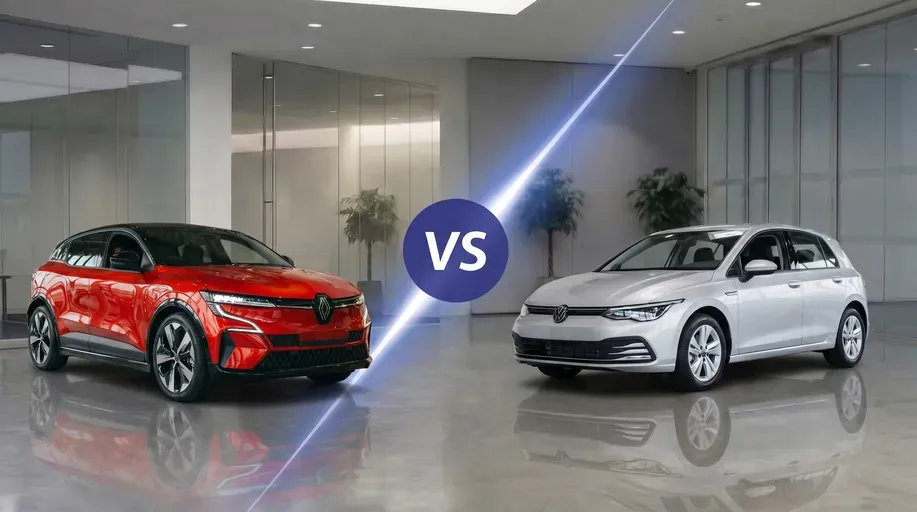
Detailed comparison of Renault Mégane vs Volkswagen (VW) Golf. Evaluation of equipment, engines, and reliability. Find out which used hatchback is the better choice.
May 14, 2026
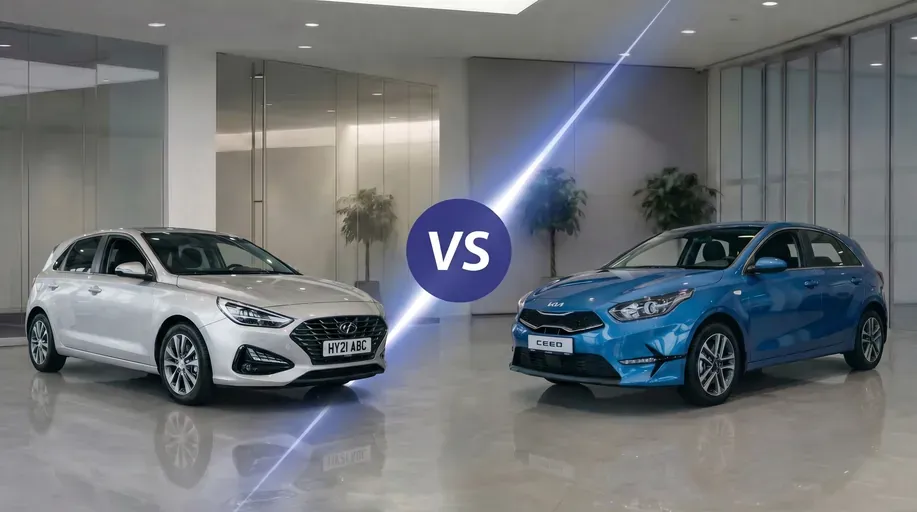
Detailed comparison of Hyundai i30 vs Kia Ceed. Explore real-world experiences, engine reliability, and a detailed verdict to help you choose the better car.
Apr 25, 2026