Review Citroën C3: What do owners and experts really say?
Citroën C3 and ë-C3 review: real owner impressions, running costs, EV range and prices. Our definitive verdict on the new hatchback.
October 31, 2026
Verdict at a Glance
Who it suits: Budget-conscious commuters and urban drivers seeking uncomplicated daily transport.
Recommended engine: The hybrid for stop-and-go city traffic, or the manual petrol for lowest purchase cost.
What to avoid: Cars without documented recall repairs—check the vehicle by VIN.
Introduction
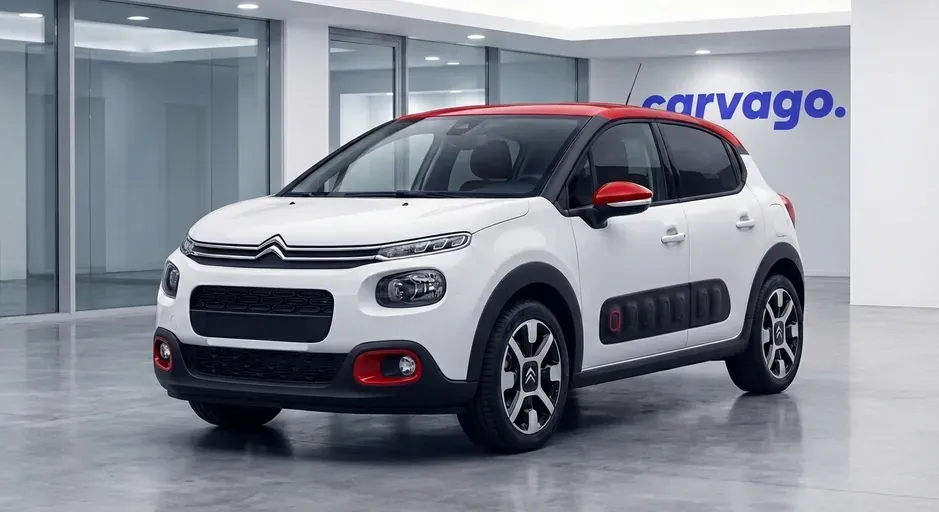
The fourth-generation Citroën C3 redefines the French brand’s small-car formula, adopting an elevated crossover stance within the European supermini class. Following its world premiere on 17 October 2023 and the start of series production in early 2024, European customer deliveries commenced in September 2024. This review focuses exclusively on this fourth generation, which remains in active production through 2026 with no facelift to date.
Sold primarily as a five-door Citroën C3 hatchback—alongside a light commercial van variant introduced in early 2025—the range encompasses multiple drivetrains. The fully electric model led European customer deliveries in September 2024, alongside order books opening for the turbocharged petrol variant. A mild-hybrid powertrain joined the lineup in 2024, followed by a smaller urban-range battery option added in mid-2025.
Aimed at budget-conscious commuters, urban households, and buyers seeking uncomplicated daily mobility, the Citroën C3 targets pragmatic drivers looking for accessible transportation in a compact footprint.
Owner Experiences: Common Faults and Recalls
Because European customer deliveries of this fourth-generation Citroën C3 only began in September 2024, long-term durability and high-mileage wear patterns are not yet established. The 1.2 Turbo petrol and hybrid engines use a timing chain. However, early production batches have been subject to several manufacturer safety campaigns and initial software glitches that prospective buyers should verify.
Multiple safety recalls have been registered across European safety registers for this generation. The most serious concern involves the pedal assembly: between 15 May 2025 and 1 November 2025 on the Citroën C3, a missing or improperly fitted retaining pin could allow the brake pedal support to disengage, making mechanical braking impossible and risking collisions. On right-hand-drive vehicles, this prompted a manufacturer stop-drive instruction. In the event of pedal disengagement, the electronic parking brake on the centre console remains operative to slow the vehicle to a controlled stop, alongside automatic emergency braking intervention.
Earlier production batches built between 4 March 2024 and 23 April 2025 were recalled across Europe and worldwide due to loose union nuts on the high-pressure fuel pipe between the pump and fuel rail, which could cause fuel leaks and fire. A third recall covers vehicles produced from 21 February 2025 to 21 May 2025, where the electric power steering wiring harness was routed between two mounting screws; vibration during steering can abrade the harness, causing a short circuit, loss of power steering assistance, or fire. Additionally, the hybrid Citroën C3 produced between 22 November 2024 and 22 December 2025 was recalled because clearance between the petrol particulate filter tube and the 48-volt starter-alternator is under 10 mm, risking water ingress, electrical arcing, and fire in wet conditions.
Recall Subject
Model Build Window Across Shared Platforms
Powertrains Affected
Official Remedy
Brake pedal support pin
15 May 2025 – 01 November 2025
All powertrains
Inspect and reseat or replace pedal retention pin and mounting bracket
High-pressure fuel pipe nuts
4 March 2024 – 23 April 2025
Petrol and Hybrid
Inspect line connections, tighten nuts to specification, or replace damaged fuel lines
Electric power steering harness
21 February 2025 – 21 May 2025
All powertrains
Inspect wiring loom, reroute away from mounting screws, fit revised clips, or replace damaged harness
Particulate filter pipe clearance
22 November 2024 – 22 December 2025
1.2 Hybrid
Inspect clearance, fit updated terminal protection cap, and adjust or replace filter pipe assembly
Beyond official safety campaigns, owners report repeated software and electronic faults. On models fitted with the central 10.25-inch infotainment display, the screen can freeze, enter reboot cycles, or drop wireless smartphone connections upon vehicle start-up, which workshops mitigate by flashing revised multimedia firmware. On the electric Citroën C3, tests describe and owners report parasitic drain of the auxiliary 12-volt battery when left parked for extended periods, accelerated by mobile application polling; when the 12-volt battery drops below operational threshold, high-voltage contactors cannot close, immobilising the vehicle. For the hybrid Citroën C3, owners report low-speed hesitation, shuddering, and jerky handoffs below 30 km/h as the dual-clutch automatic switches between electric drive and petrol propulsion. Dealership software recalibrations resolve most of these transmission hesitations. When buying a used example, having documentation and open campaigns independently checked via CarAudit provides assurance that necessary updates are complete.
🔍 What to check before buying
Check the car's vehicle identification number (VIN) with an authorised dealer to confirm that safety campaigns for the brake pedal retaining pin, power steering harness, fuel line unions, and starter-alternator clearance have been fully completed.
On the hybrid, drive in low-speed stop-and-go traffic under 30 km/h to check for smooth power transitions and confirm that transmission software updates have eliminated clutch shudder.
On the electric model, test the 12-volt auxiliary battery condition and verify that body computer and telematics software updates have been installed to prevent parasitic battery drain during parking.
Test the central infotainment display from a cold start to ensure immediate boot-up, reliable smartphone projection, and stable menu operation.
On manual petrol models, evaluate clutch pedal resistance, travel smoothness, and ease of engagement into first and reverse gears.
Engines: Which One to Choose
The fourth-generation Citroën C3 marks a major departure from its predecessors by dropping diesel powertrains entirely. Buyers can choose between a purely petrol engine, an electrified mild hybrid with an automatic gearbox, and the all-electric ë-C3.
Engine
Fuel
Power
Gearbox
Model years
Turbo 100
Petrol
74 kW (100 hp)
6-speed manual
2024–present
Hybrid 100
Petrol 48V MHEV
74 kW (100 hp)
6-speed automatic
2024–2025
Hybrid 110
Petrol 48V MHEV
81 kW (110 hp)
6-speed automatic
2025–present
ë-C3 113 Standard Range
Electric
83 kW (113 hp)
Automatic
2024–present
ë-C3 113 Urban Range
Electric
83 kW (113 hp)
Automatic
2025–present
For buyers on a strict budget who want the lowest upfront purchase price and the simplest mechanical layout, the manual petrol Citroën C3 is the most straightforward choice. It delivers enough low-down pulling power for general family duties and handles occasional motorway trips without fuss, though drivers who regularly navigate stop-and-go urban traffic will prefer a self-shifting option.
If daily driving consists mostly of congested city streets, the hybrid Citroën C3 is the natural fit. Its electrified dual-clutch transmission manages slow speeds smoothly, pulling away silently on battery power and completing large portions of city journeys with the petrol engine shut off. It is also the only petrol-fuelled option for those who require a two-pedal car.
The electric Citroën C3 suits commuters who can charge at home and primarily drive locally or across suburban corridors. The Standard Range model provides adequate versatility for regional weekend trips, whereas the Urban Range variant is strictly intended as a secondary household runabout for short hops. Neither electric version is recommended for frequent, high-mileage motorway cruising due to highway efficiency limitations. For light towing duty, only the petrol and hybrid models provide meaningful capability, as the base electric model cannot tow a trailer at all.
For a detailed breakdown of common mechanical teething troubles, software quirks, and official manufacturer recalls, see our dedicated owner experiences section.
Space & Practicality
Thanks to its upright crossover-style silhouette, the fourth-generation Citroën C3 makes effective use of its compact footprint. The elevated roofline ensures ample front and rear headroom for adult occupants, while the tall seating position eases everyday entry and exit. Rear kneeroom is competitive for the small-car class, comfortably accommodating two adults on urban commutes, although carrying three across the rear bench is constrained by overall cabin width. For cargo hauling, standard rear seats fold in a practical 60/40 split to extend luggage capacity, though folding them leaves a pronounced step in the load bay rather than a flat floor, and the exterior loading lip is relatively deep when lifting heavy items. Boot volume remains uniform across petrol, hybrid, and fully electric versions due to underfloor battery packaging.
Metric
Measurement
Length
4,015 mm
Width (excluding mirrors / unfolded)
1,755 mm / 2,017 mm
Height (without / with roof bars)
1,567 mm / 1,577 mm
Wheelbase
2,540 mm
Boot capacity (seats upright)
310 l
Boot capacity (seats folded)
1,188 l
These cargo figures do not apply to commercial two-seat van variants, which feature a dedicated load bay.
What the Tests Say
Professional road tests praise the fourth-generation Citroën C3 for delivering a comfortable, bump-absorbing ride around town, where its standard progressive hydraulic cushions isolate passengers from potholes better than most small hatchbacks. However, testers note a clear trade-off at higher speeds: the soft suspension allows noticeable vertical float over undulating country roads and can trip up abruptly on sharp transverse ridges. Handling is tuned strictly for safety rather than excitement, characterised by predictable front-end push at the limit and solid stability in evasive manoeuvres. Steering is universally described as light and easy for city parking, but reviewers split on its feedback; some find it reassuringly weighted on the motorway, while others report a detached feel devoid of road engagement. Cabin refinement in the electric Citroën C3 is quiet at low speeds, though motorway cruising exposes wind rush around the upright windscreen alongside audible motor whine under harder acceleration.
Inside, the cabin layout earns credit for keeping essential functions user-friendly. Reviewers consistently commend the retention of physical heating and ventilation switches, a dedicated button to silence driver-assistance alerts, and a raised instrument strip that sits cleanly above the compact steering wheel. Hard cabin plastics are widespread, but testers agree that textile dashboard inserts effectively break up the utilitarian feel on higher trims. Standard versions omit a central touchscreen and radio in favour of a smartphone cradle, which is replaced by a 10.25-inch infotainment display on higher trims. Seating also draws a unanimous verdict: the thickly cushioned front chairs offer relaxing support on daily commutes, yet their soft side bolsters provide minimal lateral hold through corners.
Prices and Market Offer
All the charts in this section are drawn from Carvago's listings of the whole model family, including other generations represented in the data, not only the reviewed generation. Consequently, this overview does not establish a separate price level for the reviewed generation alone. Across the available Citroën C3 stock, the median asking price stands at €11,000 for 2019 model years and €19,800 for 2026 cars, where differences between model years reflect variations in generation, powertrain type, and specification.
Across the market, advertised Citroën C3 listings began at 10,469 in April 2026 and stood at 9,710 by September 2026. The monthly figures below illustrate how availability developed over this six-month span.
Citroën C3 - availability over time
Active listings over time
Month
Citroën C3
2026-04
10 469
2026-05
10 494
2026-06
10 453
2026-07
10 285
2026-08
9 412
2026-09
9 710
Source Carvago
Buyers have a wide selection to choose from, with inventory holding above 10,000 vehicles through July before dipping to a low of 9,412 in August and rebounding slightly in September. Overall supply has remained ample throughout the period, giving used-car shoppers plenty of options.
Among Citroën C3 listings advertised today, the median asking price is €11,000 for cars built in 2019, compared to a median asking price of €19,800 for 2026 models.
Citroën C3 - median price by model year
Median advertised price by year of manufacture
Model year
Citroën C3
2019
11 000
2020
11 900
2021
12 500
2022
13 100
2023
14 100
2024
14 900
2025
18 400
2026
19 800
Source Carvago
Buyers focusing on build years from 2020 to 2024 encounter median asking prices between €11,900 and €14,900. The largest difference between consecutive model years appears between 2024 and 2025, where the median asking price is €18,400.
This depreciation curve illustrates how the Citroën C3 loses value as it ages, shedding about 28% of its initial residual value by age two and over 35% by age three. The chart below traces this trajectory across seven years of vehicle age.
Citroën C3 - value loss by age
Residual value by vehicle age
Vehicle age
Citroën C3
New
20 400
1 yr
17 400
2 yrs
14 700
3 yrs
13 200
4 yrs
12 000
5 yrs
11 300
6 yrs
10 400
7 yrs
9 800
Source Carvago
Across the seven years shown, the model sheds roughly 52% of its residual value in total. The rate of loss is steepest during the first two years, after which the curve flattens noticeably.
The chart tracks the monthly count of advertised cars by fuel type between April and September 2026, opening with 8,374 petrol listings in April and closing at 7,455 in September.
Citroën C3 - supply by fuel over time
Supply composition by fuel type
Petrol
Diesel
Hybrid
Electric
CNG
LPG
Month
Petrol
Diesel
Hybrid
Electric
CNG
LPG
2026-04
8 374
1 378
12
598
0
100
2026-05
8 341
1 457
15
581
0
95
2026-06
8 234
1 473
13
615
0
109
2026-07
8 039
1 399
22
721
1
96
2026-08
7 326
1 240
32
717
1
87
2026-09
7 455
1 319
62
772
0
95
Source Carvago
In September 2026, petrol dominated the offer with 7,455 listings, followed by 1,319 diesel and 772 electric options. Buyers will find the greatest availability by far among petrol models, with diesel serving as the main alternative and electric or hybrid choices remaining comparatively limited.
Between April 2026 and September 2026, the average asking price for the Citroën C3 started at €14,100 before finishing the recorded period at €14,400.
Citroën C3 - price trend over time
Average price development over time
Month
Citroën C3
2026-04
14 100
2026-05
14 100
2026-06
14 000
2026-07
14 100
2026-08
14 300
2026-09
14 400
Source Carvago
Across these months, the overall shift was modest at roughly 2%, dipping slightly to €14,000 in June 2026 before rising to €14,400 by September 2026.
Comfortable, bump-absorbing urban ride thanks to standard progressive hydraulic cushions
Upright crossover stance provides ample headroom and easy entry and exit
User-friendly dashboard layout retaining physical controls for heating and ventilation
Cons
Soft suspension allows noticeable vertical float at speed, paired with minimal cornering seat support
Standard specification omits a central infotainment display in favour of a smartphone cradle
Early production batches affected by multiple safety recalls and glitchy infotainment software
Frequently asked questions
Which engine is best for the Citroën C3?
For the lowest purchase price and straightforward maintenance, the manual petrol engine is the most practical choice, while the hybrid automatic suits congested urban driving. The electric Citroën C3 serves as a practical short-range commuter if you can charge at home, though high-speed motorway efficiency is limited.
Is the fourth-generation Citroën C3 reliable?
Because European deliveries only began in late 2024, long-term reliability remains unproven. The engines use a timing chain, though early production cars have required dealer software updates and recall remedies.
What should you check before buying a used Citroën C3?
Verify the vehicle identification number (VIN) with an authorised dealer to confirm that all manufacturer safety recalls have been carried out. During a test drive, ensure the transmission transitions smoothly on hybrid models and verify that infotainment software operates without freezing.
How spacious is the Citroën C3 for family use?
The tall crossover roofline provides ample headroom and adequate kneeroom for two adults, though three passengers across the rear bench will find shoulder space restricted. Cargo capacity is consistent across all powertrains, but folding the rear seats leaves a stepped loading floor.