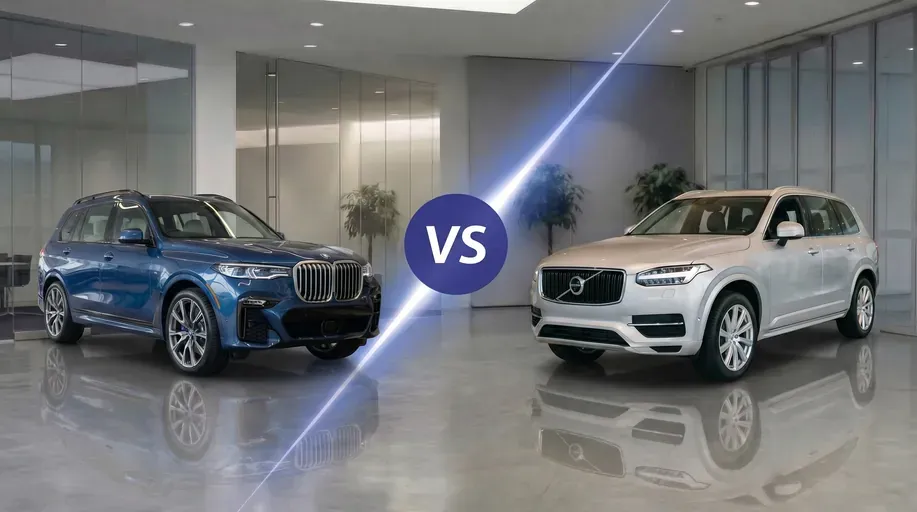
Car battle
BMW X7 vs. Volvo XC90: Complete comparison 2026
Detailed comparison of the luxury SUVs BMW X7 and Volvo XC90. We reveal real-world experiences, differences in equipment and space. Read our verdict before you buy!
Oct 16, 2026
Articles
Review
BMW X5 review: real owner insights, engine picks, running costs and used prices. Here is our verdict on the fourth-generation luxury SUV.
October 29, 2026
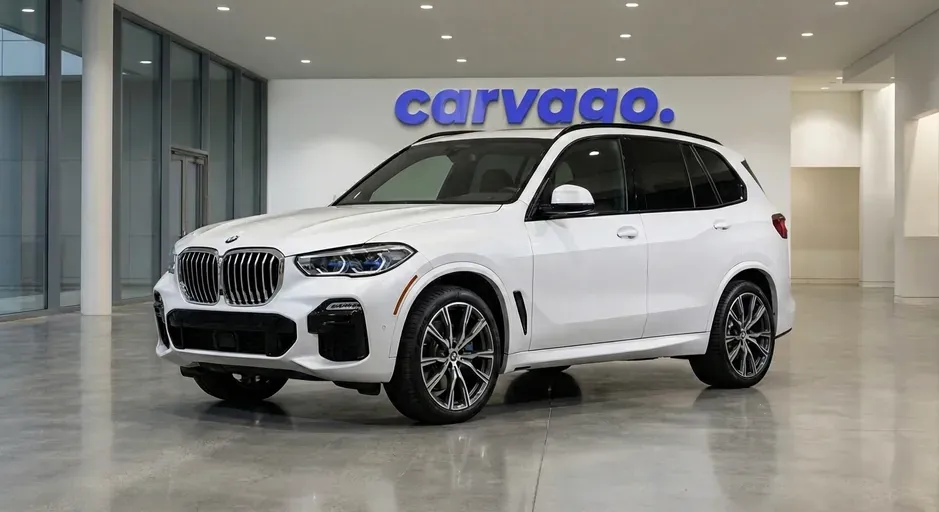
The BMW X5 competes in the executive luxury SUV segment, functioning as a large five-door vehicle designed for long-distance travel, family transport, and heavy towing duties. This review covers the fourth-generation model, which entered series production in August 2018. Following the opening of European order books in June 2018, initial customer deliveries commenced in November 2018, with production running through July 2026.
Premiered on 8 February 2023, the facelifted line-up entered series production in April 2023, with first European customer deliveries following that spring. The update introduced revised front and rear styling, a single curved digital display panel across the dashboard, and standard mild-hybrid electrification across the conventional engine range.
The vehicle primarily serves private and corporate buyers seeking all-weather traction, passenger space, and high towing capabilities for long-distance journeys or regular trailer use.
Safety recalls on the fourth-generation BMW X5 have addressed several critical mechanical and electronic components across European and global markets. In April 2024, expanding to an affected worldwide fleet of around 1.5 million BMW Group vehicles in September 2024, an official recall was launched for vehicles produced between 9 June 2022 and 2 September 2024. Signal interference in the electric motor position sensor of the Integrated Brake System (IBS) can cause a failure of hydraulic brake power assistance, disabling ABS and Dynamic Stability Control and potentially extending stopping distances. Baseline mechanical braking remains functional through a hydraulic backup circuit, though it requires significantly higher pedal pressure. Authorised workshops install diagnostic software to monitor sensor plausibility and trigger early dashboard alerts, replacing the hydraulic actuator block entirely if defect codes or affected hardware batches are found.
Starter relay components have prompted three distinct campaigns across Europe. In October 2025, two recalls were registered: one covering multiple generations of vehicles built between 28 September 2015 and 7 September 2021 (1,145,385 vehicles worldwide) due to insufficient water sealing that can cause corrosion, short circuits, and fire; and a second for cars built between 20 March 2018 and 11 February 2025 (162,852 vehicles worldwide) regarding inadequate relay fastening that could loosen and create a short-circuit fire hazard. In July 2026, an expanded worldwide campaign affecting 744,234 vehicles produced between 31 July 2020 and 26 February 2026 addressed wear abrasion inside the starter relay that increases contact resistance, creating a fire risk during engine starting. Official advice instructs owners not to leave the vehicle running unattended immediately after starting until the starter unit is replaced. Additionally, a January 2026 campaign affecting 105,124 vehicles built between May 2023 and October 2025 addresses undetected steering rack sensor faults that could lead to unintended steering movement at standstill or low speeds, resolved via a control unit software update.
Beyond safety campaigns, owners report a recurring low-speed shudder, humming, or binding sensation on all-wheel-drive BMW X5 models when making tight, full-lock manoeuvres in parking areas. This judder stems from thermal breakdown of the transfer case fluid, which leads to micro-slippage across the internal wet clutch pack. Flushing the fluid and running an electronic calibration routine often resolves early symptoms, but neglected friction plate wear eventually requires replacing the entire transfer case. Independent tests describe micro-leaks developing in the rubber bellows of the two-axle air suspension—standard equipment on plug-in hybrid BMW X5 models and optional on conventional variants—typically after 80,000 to 120,000 km. Leaking air springs cause the vehicle to sag on one corner overnight, which forces the onboard compressor to cycle continuously and risks premature compressor burnout.
On six-cylinder petrol variants and related plug-in hybrids, owners and tests describe external coolant loss occurring between 60,000 and 110,000 km. While the base mechanical block and timing chains demonstrate high durability, external leaks frequently originate from heat-embrittled plastic oil filter housings cracking against the engine block, weepage at the mechanical water pump shaft seal, and failing O-rings on the turbocharger coolant lines. Replacing these aging composite and rubber parts with updated components restores cooling circuit integrity.
The fourth-generation BMW X5 arrived on the European market exclusively with all-wheel drive and an eight-speed automatic gearbox. The engine portfolio spans turbocharged four-cylinder and six-cylinder units, electrified plug-in hybrids, and high-output twin-turbo V8s.
| Engine | Fuel | Power | Gearbox | Model years |
|---|---|---|---|---|
| xDrive25d | Diesel | 170 kW (231 hp) | 8-speed automatic | 2019–2023 |
| xDrive30d | Diesel | 195 kW (265 hp) | 8-speed automatic | 2018–2020 |
| xDrive30d | Diesel (mild hybrid) | 210 kW (286 hp) | 8-speed automatic | 2020–2023 |
| xDrive30d | Diesel (mild hybrid) | 219 kW (298 hp) | 8-speed automatic | 2023–2026 |
| xDrive40d | Diesel (mild hybrid) | 250 kW (340 hp) | 8-speed automatic | 2020–2023 |
| xDrive40d | Diesel (mild hybrid) | 259 kW (352 hp) | 8-speed automatic | 2023–2026 |
| M50d | Diesel | 294 kW (400 hp) | 8-speed automatic | 2018–2020 |
| xDrive40i | Petrol | 250 kW (340 hp) | 8-speed automatic | 2018–2020 |
| xDrive40i | Petrol (mild hybrid) | 245 kW (333 hp) | 8-speed automatic | 2020–2023 |
| xDrive40i | Petrol (mild hybrid) | 280 kW (381 hp) | 8-speed automatic | 2023–2026 |
| M50i | Petrol | 390 kW (530 hp) | 8-speed automatic | 2019–2023 |
| M60i | Petrol (mild hybrid) | 390 kW (530 hp) | 8-speed automatic | 2023–2026 |
| X5 M Competition | Petrol | 460 kW (625 hp) | 8-speed automatic | 2020–2023 |
| X5 M Competition | Petrol (mild hybrid) | 460 kW (625 hp) | 8-speed automatic | 2023–2026 |
| xDrive45e | Petrol plug-in hybrid | 290 kW (394 hp) | 8-speed automatic | 2019–2023 |
| xDrive50e | Petrol plug-in hybrid | 360 kW (490 hp) | 8-speed automatic | 2023–2026 |
For urban driving and short daily commutes, the plug-in hybrid BMW X5 models—the pre-facelift xDrive45e and the updated xDrive50e—are the most sensible choices, provided you have regular access to home or workplace charging. Both pair a six-cylinder petrol unit with an electric motor, allowing daily local trips to run entirely without the combustion engine. However, once the traction battery is depleted on long journeys, their extra unladen weight increases fuel consumption noticeably compared to the diesels.
For frequent motorway travel, the diesel BMW X5 range represents the most capable long-distance option. The four-cylinder xDrive25d is adequate around town, but its smaller engine works hard at motorway speeds. The six-cylinder xDrive30d is the sweet spot of the entire range, offering ample low-end torque and quiet high-speed cruising. Drivers who regularly carry heavy loads will appreciate the twin-turbo xDrive40d for its extra mid-range muscle, while the quad-turbo M50d was dropped early and remains an enthusiast rarity with high maintenance demands.
For heavy towing, the six-cylinder diesels—specifically the xDrive30d and xDrive40d—are superior to the plug-in hybrids thanks to their sustained pulling power and higher permitted towing ratings.
For mixed everyday driving with moderate annual mileage, the six-cylinder petrol BMW X5 xDrive40i delivers smooth acceleration and responsive throttle pickup without the exhaust-aftertreatment complexities of a modern diesel. The V8-powered M50i, M60i, and X5 M Competition models deliver intense straight-line speed, but demand substantially higher budgets for fuel, brakes, and tyres.
For details on common component failures, cooling leaks, and high-voltage electronics, refer to the owner experiences section.
| Dimension / Capacity | Combustion & Mild-Hybrid | Plug-in Hybrid |
|---|---|---|
| Length (mm) | 4,922–4,935 | 4,922–4,935 |
| Width without mirrors (mm) | 2,004 | 2,004 |
| Height (mm) | 1,745–1,765 | 1,745–1,755 |
| Wheelbase (mm) | 2,975 | 2,975 |
| Boot capacity, seats upright (l) | 650 | 500 |
| Boot capacity, seats folded (l) | 1,870 | 1,720 |
Figures do not apply to the high-performance Competition model, which features specific exterior bodywork and chassis lowering, nor to models configured with the optional third-row seating where luggage capacity is reduced.
The BMW X5 SUV provides ample headroom and legroom in the second row, accommodating tall adults comfortably on long journeys. The outer rear seats offer well-sculpted contours and an upright, commanding seating position, though the middle position is firmer and slightly constrained by the centre console and transmission tunnel. Everyday usability is enhanced by a standard three-way split-folding rear bench with through-loading, while an optional electric adjustment allows the second row to slide fore and aft to balance legroom against cargo space. A defining practical element of the BMW X5 is its standard two-piece electrically operated split tailgate: the upper window hatch swings upward while the lower tailgate drops horizontally, providing a level loading shelf that prevents unsecured items from rolling out. In the hybrid BMW X5, the traction battery sits beneath the boot floor, which removes the underfloor storage compartment and creates a slightly raised loading deck. Non-hybrid models were optionally available with an occasional third row, suitable primarily for children.
Professional road tests broadly agree that the BMW X5 strikes a composed balance between body discipline and long-distance compliance. Models fitted with two-axle air suspension absorb motorway undulations smoothly, though sharp urban edges remain noticeable on larger wheels. Handling is secure and agile, guided by precise and naturally weighted steering, even if communicative road feel through the rim is lacking. However, agility varies by variant: heavy hybrid BMW X5 models feel blunt during rapid directional changes, whereas the high-performance X5 M Competition corners virtually flat at the expense of an uncompromisingly stiff ride on typical European tarmac. Cabin refinement is generally high, with well-isolated wind noise and smooth engines, though coarse asphalt induces noticeable tyre resonance on larger wheel options.
Interior assembly quality and forward visibility draw praise, though unlined door pockets that allow loose items to rattle draw recurring criticism. Testers also point out that standard front seats lack adjustable lumbar support without optional upgrades.
The mid-cycle update altered cabin usability noticeably. The arrival of the curved display removed physical climate control switches and tactile shortcut buttons, migrating ventilation adjustments entirely into touchscreen menus. Reviewers found this layout more distracting to operate while driving. Steering-wheel distance controls for driver-assistance systems were similarly integrated into display sub-menus, creating an ergonomic step backwards despite the dashboard's modern visual appearance.
All market charts in this section are drawn from listings across the entire BMW X5 model family rather than only the fourth generation, so the data reflects the full model range available on the platform. Across these listings, the median asking price starts at €50,000 for 2019 models and climbs steadily to €59,000 for 2022 examples. Advertised values take a noticeable step upward with 2023 vehicles at €76,000, coinciding with the introduction of facelifted versions, before climbing to €91,000 for 2024 and peaking at €98,000 for 2026 models.
The chart tracks the volume of advertised BMW X5 models each month from April 2026 to September 2026, starting at 13,114 listings and peaking at 13,639 in July.
Active listings over time
| Month | BMW X5 |
|---|---|
| 2026-04 | 13 114 |
| 2026-05 | 13 391 |
| 2026-06 | 13 549 |
| 2026-07 | 13 639 |
| 2026-08 | 12 962 |
| 2026-09 | 13 242 |
Source Carvago
Across the entire six-month span, available inventory remained between 12,962 and 13,639 listings, ensuring buyers consistently have an extensive selection to choose from.
The median asking price of cars advertised today built in 2019 is €50,000, while the median asking price of cars advertised today built in 2026 reaches €98,000. Asking prices are generally higher for newer model years across the chart, though vehicles from 2025 have a lower median than those from 2024.
Median advertised price by year of manufacture
| Model year | BMW X5 |
|---|---|
| 2019 | 50 000 |
| 2020 | 53 500 |
| 2021 | 56 000 |
| 2022 | 59 000 |
| 2023 | 76 000 |
| 2024 | 91 000 |
| 2025 | 90 000 |
| 2026 | 98 000 |
Source Carvago
Buyers looking at 2019 to 2022 models face median asking prices between €50,000 and €59,000. For 2023 through 2026 vehicles, medians span from €76,000 to €98,000, with 2025 listings priced lower than 2024 examples.
This depreciation curve illustrates how the model's residual value falls with age, showing that the steepest drop occurs in the first year with a 22% loss, widening to a 37% loss by age three.
Residual value by vehicle age
| Vehicle age | BMW X5 |
|---|---|
| New | 103 600 |
| 1 yr | 80 900 |
| 2 yrs | 75 100 |
| 3 yrs | 65 000 |
| 4 yrs | 55 700 |
| 5 yrs | 49 600 |
| 6 yrs | 45 800 |
| 7 yrs | 41 600 |
Source Carvago
Across the seven years shown, the model sheds 60% of its initial value, retaining about 40% of its baseline. The pace of depreciation slows noticeably after age four, with subsequent annual drops remaining below 11%.
Advertised diesel cars numbered 7,271 in April 2026 and 7,333 in September 2026. The chart below details the monthly counts of advertised vehicles across each fuel type.
Supply composition by fuel type
Petrol
Diesel
Hybrid
| Month | Petrol | Diesel | Hybrid |
|---|---|---|---|
| 2026-04 | 1 658 | 7 271 | 4 184 |
| 2026-05 | 1 665 | 7 473 | 4 252 |
| 2026-06 | 1 722 | 7 601 | 4 225 |
| 2026-07 | 1 792 | 7 655 | 4 192 |
| 2026-08 | 1 752 | 7 126 | 4 084 |
| 2026-09 | 1 812 | 7 333 | 4 097 |
Source Carvago
Diesel and hybrid powertrains make up the vast majority of listings, with 7,333 diesel and 4,097 hybrid cars on offer in September 2026. Buyers looking for petrol power have a noticeably smaller pool to pick from, with 1,812 vehicles advertised in the same month.
The average asking price for the BMW X5 stood at €65,800 in April 2026 and reached €67,200 by September 2026, as illustrated in the monthly figures below.
Average price development over time
| Month | BMW X5 |
|---|---|
| 2026-04 | 65 800 |
| 2026-05 | 66 500 |
| 2026-06 | 66 900 |
| 2026-07 | 66 800 |
| 2026-08 | 67 200 |
| 2026-09 | 67 200 |
Source Carvago
Across the six months shown, the average moved by just over 2%, shifting from €65,800 to €67,200 with a slight dip to €66,800 in July 2026, indicating modest overall variation across the period.
Composed balance between agile road manners and long-distance ride comfort
Spacious passenger cabin with a practical two-piece split electric tailgate
Refined, muscular six-cylinder powertrains well suited for towing and motorway cruising
Significant safety recalls concerning the braking system and starter relays requiring VIN verification
Facelift replaces physical climate and driver-assistance controls with touchscreen menus
Known risks of all-wheel-drive transfer case judder and air suspension leaks over time
The six-cylinder diesel BMW X5 xDrive30d is the most balanced choice for motorway travel and towing, offering strong low-end torque and refined cruising. A plug-in hybrid BMW X5 suits urban commutes with regular charging access, though its extra weight increases fuel consumption once the battery is depleted.
The most frequent issues involve driveline shudder from the all-wheel-drive transfer case and leaking air suspension bellows. Documented recall completion for the braking system and starter relays should also be verified.
Facelifted 2023–2026 models feature updated styling and standard mild-hybrid technology, but road tests note that integrating ventilation controls into the curved display touchscreen makes adjustments more distracting on the move. Pre-facelift models retain physical climate controls.
Check the car's VIN with an authorised dealer to confirm all recall work on the braking system and starter relay is complete, and perform tight turns in a car park to check for transfer case judder. To verify the driveline, air suspension, and service history thoroughly before purchasing, you can book an inspection through CarAudit.
Sources: press.bmwgroup.com, adac.de, autocar.co.uk, autobild.de, whatcar.com
This article was prepared using artificial intelligence tools. The section guarantor is Petr Dušek.
Detailed comparison of the luxury SUVs BMW X7 and Volvo XC90. We reveal real-world experiences, differences in equipment and space. Read our verdict before you buy!
Oct 16, 2026
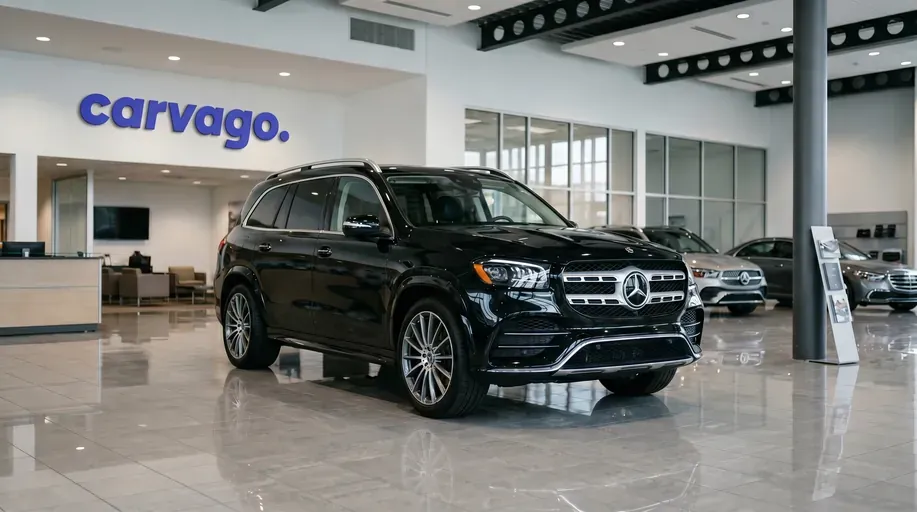
Mercedes-Benz GLS review: real owner experience, common faults, running costs and used prices — everything you need before you buy.
Oct 27, 2026
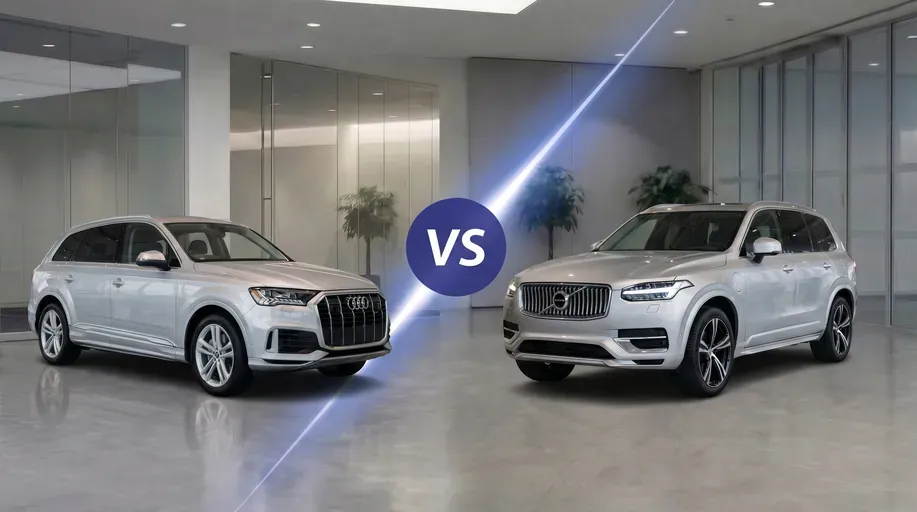
Detailed comparison of the Audi Q7 and Volvo XC90. Discover the differences in equipment, fuel consumption, and reliability of used cars. Which luxury SUV is the better choice? Read our verdict.
Apr 17, 2026