BMW M4 vs. Jaguar F-Type: Complete comparison 2026
Detailed comparison of the BMW M4 vs. Jaguar F-Type. Discover real-world experiences, performance and equipment comparisons, and our verdict to help you choose your sports car.
Apr 24, 2026
Articles
Review
BMW M4 review: real owner experience, common faults, running costs, and used prices for G82 & G83 models — everything you need to know.
November 7, 2026

The second generation of the BMW M4 sits at the sharp end of the premium mid-size performance segment, competing directly with high-output sports coupés and cabriolets. Following its premiere in late 2020, production at Dingolfing commenced in November 2020, and first European customer deliveries arrived in March 2021. This review focuses exclusively on this second generation, covering all models built from late 2020 through to the present.
Buyers can choose between two distinct body formats: the fixed-roof BMW M4 Coupé and the fabric-roof BMW M4 Convertible. Both variants cater to driving enthusiasts seeking track-capable chassis dynamics alongside cross-country touring capability, with the line-up expanding to include an all-wheel-drive configuration from July 2021.
A mid-cycle facelift arrived in 2024. Revealed on 31 January 2024, series production began in March 2024, with European customer deliveries underway by April 2024. The update introduced revised exterior lighting signatures, updated cockpit display technology, and an increase in power output for all-wheel-drive versions, modernising the range while preserving the model's core mechanical layout.
Real-world owner experiences with the second-generation BMW M4 show a robust mechanical package, though several design characteristics and official workshop actions demand close scrutiny on the used market. Because series production began in late 2020, long-term multi-decade durability is still establishing itself, but patterns around vulnerable components, hardware wear, and factory campaigns are well documented.
Owners report that the horizontally mounted auxiliary engine oil cooler is particularly vulnerable. Positioned at the lowest point of the front engine bay, it sits behind an open-slotted plastic deflector. Road debris, stones, or bottoming out over steep kerbs can puncture the exposed core. If punctured, rapid oil loss can occur, risking swift engine failure if the powertrain is not shut down immediately. Many owners fit reinforced aftermarket metal guards to protect the core.
Inside, the optional carbon-fibre bucket seats are a known wear point. Tests describe and owners report severe friction on the high outer leather bolsters during entry and exit. Visible creasing and finish abrasion frequently appear between 15,000 and 30,000 km.
In official technical service communications, BMW addressed an engine manufacturing defect affecting a specific production window. On BMW M4 Coupé models built between 16 July and 7 September 2021, and BMW M4 Convertible models built between 23 July and 29 July 2021, the sliding layer of the upper crankshaft main bearing shells could peel. This flaw risked metallic debris contamination and engine seizure, requiring authorised workshops to inspect and replace the bearing shells or the engine assembly under warranty.
The second-generation M4 has been included in several European safety recall campaigns:
Before committing to a purchase, you can have any used vehicle independently inspected by a professional service such as CarAudit to verify its mechanical condition and ensure that all mandatory service actions have been properly carried out.
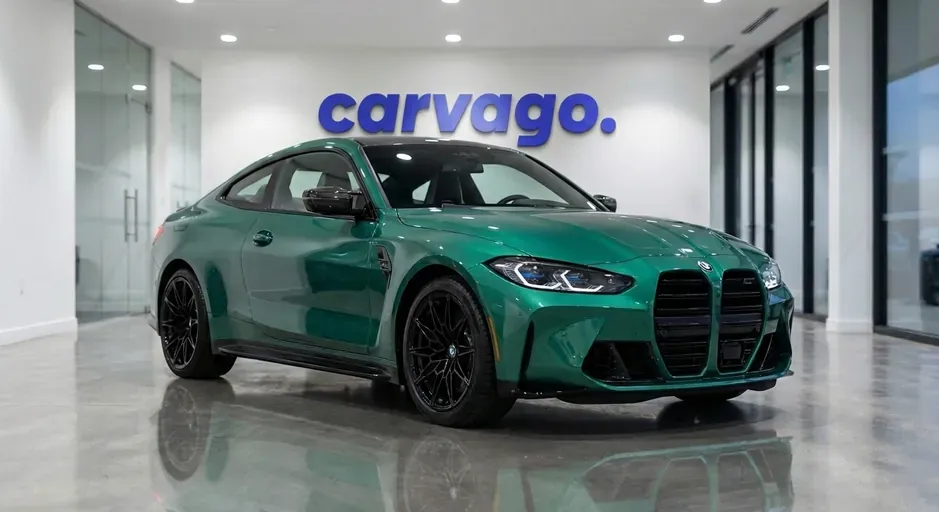
The second generation of the BMW M4 is powered exclusively by a twin-turbocharged inline six-cylinder petrol engine. Depending on the model variant, it is paired with either a manual gearbox or an automatic transmission, driving either the rear wheels or all four wheels.
| Engine | Fuel | Power | Drivetrain | Gearbox | Model Years |
|---|---|---|---|---|---|
| 3.0 M4 | Petrol | 353 kW (480 hp) | Rear-wheel drive | 6-speed manual | 2021–present |
| 3.0 M4 Competition | Petrol | 375 kW (510 hp) | Rear-wheel drive | 8-speed automatic | 2021–present |
| 3.0 M4 Competition M xDrive | Petrol | 375 kW (510 hp) | All-wheel drive | 8-speed automatic | 2021–2024 |
| 3.0 M4 Competition M xDrive | Petrol | 390 kW (530 hp) | All-wheel drive | 8-speed automatic | 2024–present |
| 3.0 M4 CS | Petrol | 405 kW (550 hp) | All-wheel drive | 8-speed automatic | 2024–present |
| 3.0 M4 CSL | Petrol | 405 kW (550 hp) | Rear-wheel drive | 8-speed automatic | 2022–2023 |
A high-performance petrol engine is inherently unsuited to short urban hops, where the powertrain rarely achieves stable operating temperature. For driving that frequently includes stop-and-go city traffic, the automatic transmission fitted to the Competition variants offers manageable low-speed crawling and parking manners, whereas the clutch in the manual version requires active effort in heavy congestion.
For mixed everyday use across changing conditions, the Competition with all-wheel drive represents the most versatile package. The all-wheel-drive BMW M4 provides dependable traction in wet or cold weather without sacrificing rear-biased agility, and it can decouple the front axle entirely when rear-wheel drive is preferred. Enthusiasts prioritizing traditional driver engagement over outright pace should look at the manual BMW M4, which is offered strictly as a BMW M4 Coupé with rear-wheel drive.
On sustained motorway journeys, the automatic Competition models cruise comfortably with low engine speeds in top gear, providing substantial overtaking reserves and reduced driver fatigue. Buyers who want open-air touring will find the BMW M4 Convertible available exclusively as a Competition model with all-wheel drive and the automatic transmission. For circuit use, the track-focused M4 CS delivers sharpened throttle responses and higher output, though its stiffer engine mounts introduce more vibration into the passenger cabin.
Towing is not an option on this generation, as the vehicle is not homologated for trailer operation.
For details on mechanical durability, service advisories, and known component concerns, consult the owner experiences section.
| Body Style | Length (mm) | Width (mm) | Height (mm) | Wheelbase (mm) | Boot Volume (l) |
|---|---|---|---|---|---|
| Coupé | 4,794–4,801 | 1,887 | 1,393–1,398 | 2,857 | 440 |
| Convertible | 4,794–4,801 | 1,887 | 1,395–1,399 | 2,857 | 385 (roof closed) / 300 (roof open) |
Dimensions vary slightly between pre-facelift and facelift models. Figures do not apply to limited-edition lightweight variants, which feature altered body widths, revised ride heights, or deleted rear seats. BMW does not publish an official standard volume figure for the Coupé with rear backrests folded.
In everyday use, the BMW M4 Coupé balances track-honed capabilities with genuine grand-touring usability. The two sculpted rear individual seats accommodate adults with adequate legroom, though the descending roofline naturally restricts headroom for taller occupants. Cabin versatility benefits from split-folding rear backrests with through-loading functionality, allowing longer items to extend forward. Front seat specification directly impacts everyday practicality: standard sports seats tilt forward smoothly for rear access, whereas optional carbon bucket seats feature wide bolsters that make climbing into the back noticeably awkward.
By contrast, the BMW M4 Convertible features a more compromised passenger setup. Its rear backrests are set distinctly upright, wind buffeting becomes intrusive at highway speeds with the roof stowed, and the rear bench is fixed in place. Practicality in the open-top variant relies on a central load-through hatch, while retracting the fabric top requires lowering an internal partition that cuts into available luggage depth.
Professional road tests describe the BMW M4 Coupé as an inherently firm machine engineered around track-level stability and strong mechanical grip. The chassis remains taut, yet adaptive dampers manage undulating surfaces with composure. Sharp expansion gaps and broken asphalt still transmit noticeable vertical thumps into the cabin, and the BMW M4 Convertible exhibits slight cowl shake over coarse roads. Through corners, front-end bite is direct, with progressive rear breakaway. Choosing an all-wheel-drive BMW M4 provides secure traction in all conditions, though testers note it trades away some playful adjustability. The steering is quick and accurate, but testers agree it lacks nuanced road-surface texture, and heavier steering settings feel artificially weighted.
Road roar from the wide performance tyres penetrates the cabin on coarse surfaces. While the twin-turbocharged straight-six provides linear thrust, testers find its acoustic tone somewhat detached, relying on synthetic sound enhancement rather than natural mechanical charisma.
Inside, material quality and assembly are sound. The optional carbon bucket seats divide opinion: they hold occupants securely, but a rigid centre thigh-bolster makes daily entry and exit awkward, making the standard sport seats far better for long journeys. Dedicated steering-wheel toggles for custom drive modes are widely praised by testers. The mid-cycle update introduced a sweeping curved digital display; while the central rotary controller remains intuitive, moving physical climate controls into touchscreen sub-menus was widely judged an ergonomic downgrade.
All charts in this section are drawn from Carvago listings of the whole BMW M4 model family, including other generations represented in the data, rather than solely the reviewed generation, so these figures do not establish a separate price level for the newest generation alone. Across current platform listings, the median asking price spans from €56,800 for 2019 examples to €99,600 for 2026 models. In between, buyers encounter a median asking price of €72,900 for 2021 cars, reaching €86,900 for 2023 and €94,500 for 2024.
The chart below tracks the number of advertised BMW M4 listings over a six-month span, moving from 1,865 listings in May 2026 to 1,724 in October 2026.
Active listings over time
| Month | BMW M4 |
|---|---|
| 2026-05 | 1 865 |
| 2026-06 | 1 730 |
| 2026-07 | 1 773 |
| 2026-08 | 1 625 |
| 2026-09 | 1 744 |
| 2026-10 | 1 724 |
Source Carvago
Overall selection remained broad throughout the period, with monthly counts fluctuating between a low of 1,625 in August 2026 and the opening peak of 1,865 rather than following a continuous upward or downward trend.
Across used listings of this model family advertised today, the median asking price of cars built in 2019 is €56,800, compared with €99,600 for those built in 2026.
Median advertised price by year of manufacture
| Model year | BMW M4 |
|---|---|
| 2019 | 56 800 |
| 2020 | 59 900 |
| 2021 | 72 900 |
| 2022 | 77 900 |
| 2023 | 86 900 |
| 2024 | 94 500 |
| 2025 | 98 500 |
| 2026 | 99 600 |
Source Carvago
Buyers looking at 2021 models see a median asking price of €72,900, while targeting 2024 or 2025 builds moves the figure to €94,500 and €98,500 respectively.
This depreciation curve illustrates how the BMW M4's residual value falls with vehicle age, shedding roughly 25% of its initial value in the first year and 37% by age three. The chart below tracks this progression across the model family over seven years.
Residual value by vehicle age
| Vehicle age | BMW M4 |
|---|---|
| New | 79 300 |
| 1 yr | 59 800 |
| 2 yrs | 55 600 |
| 3 yrs | 49 900 |
| 4 yrs | 46 000 |
| 5 yrs | 41 100 |
| 6 yrs | 33 600 |
| 7 yrs | 31 900 |
Source Carvago
Across the seven years shown, the model sheds 60% of its initial residual value, with the steepest decline occurring in the first year before the annual loss moderates between ages one and four.
Between May 2026 and October 2026, active listings were heavily concentrated in petrol models, recording 1863 cars in May and 1720 by October. The chart below tracks the monthly count of advertised cars across each fuel type.
Supply composition by fuel type
Petrol
Diesel
Hybrid
| Month | Petrol | Diesel | Hybrid |
|---|---|---|---|
| 2026-05 | 1 863 | 1 | 1 |
| 2026-06 | 1 727 | 2 | 1 |
| 2026-07 | 1 771 | 2 | 0 |
| 2026-08 | 1 622 | 3 | 0 |
| 2026-09 | 1 740 | 4 | 0 |
| 2026-10 | 1 720 | 4 | 0 |
Source Carvago
In October 2026, petrol dominated the offer with 1720 listings, compared to 4 for diesel and 0 for hybrid. Anyone searching for this model will realistically be selecting almost entirely from petrol options.
The chart tracks the average asking price for the BMW M4 from May 2026 to October 2026, opening at €86,400.
Average price development over time
| Month | BMW M4 |
|---|---|
| 2026-05 | 86 400 |
| 2026-06 | 85 100 |
| 2026-07 | 83 700 |
| 2026-08 | 84 000 |
| 2026-09 | 83 700 |
| 2026-10 | 83 200 |
Source Carvago
Across the six-month span, the average asking price decreased by roughly 4 percent overall, moving from €86,400 to €83,200 with a slight mid-period uptick to €84,000 in August.
Dependable all-weather traction and strong front-end grip, especially with all-wheel drive
Practical grand-touring usability in the Coupé thanks to split-folding rear seats
Dedicated steering-wheel toggles for quick custom drive-mode adjustments
Vulnerable low-mounted engine oil cooler exposed to stone and debris damage
Optional carbon bucket seats hinder daily access and suffer premature bolster wear
Firm low-speed ride over sharp road imperfections alongside noticeable tyre roar
The mechanical package is robust, though the exposed low-mounted engine oil cooler is susceptible to road debris damage. Buyers should verify through the VIN that all official recalls—including the starter motor replacement—have been completed.
The all-wheel-drive BMW M4 with the automatic transmission is the most practical choice, offering secure all-weather traction and easier low-speed commuting. The manual BMW M4 provides maximum driver involvement, though its heavier clutch demands more effort in heavy traffic.
Inspect the low-mounted auxiliary oil cooler for damage and check the outer bolsters on optional carbon bucket seats for heavy wear. Having the car professionally inspected through CarAudit ensures that vital running-in checks and open factory recalls are verified.
Across used listings for the model family, median asking prices sit around €72,900 for 2021 models, rising to €94,500 for 2024 examples. Value loss is steepest during the first year of ownership before the annual depreciation moderates.
Sources: newsroom.bmwgroup.com, kba-online.de, adac.de, autobild.de, autocar.co.uk
This article was prepared using artificial intelligence tools. The section guarantor is Petr Dušek.

Detailed comparison of the BMW M4 vs. Jaguar F-Type. Discover real-world experiences, performance and equipment comparisons, and our verdict to help you choose your sports car.
Apr 24, 2026

Detailed comparison: Honda Civic Type R vs Hyundai i30 N. We reveal the differences in performance, handling, and price. Read our final verdict before buying!
May 13, 2026

The Great Coupe Comparison: Lexus RC F vs Toyota GR Supra. A detailed look at performance, equipment, and real-world driving characteristics. Read our final verdict!
Oct 16, 2026