Review
Review Audi A4: What do owners and experts really say?
Audi A4 (B9) review: real owner experience, common faults, engine picks and used prices — everything you need to know before you buy.
Oct 21, 2026
Alfa Romeo Giulia review: real owner experience, reliability, engine picks, running costs and used prices — our verdict on the saloon.
November 7, 2026
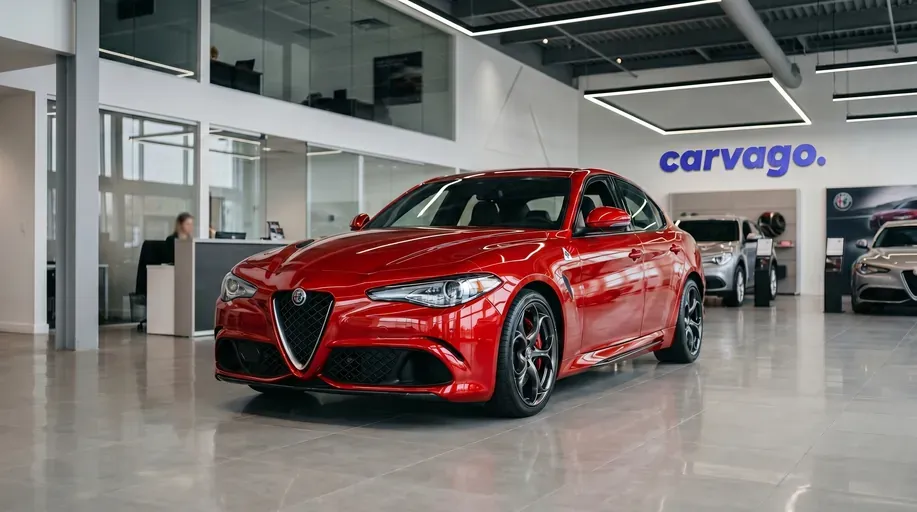
The Alfa Romeo Giulia represents the Italian manufacturer's entry in the premium mid-size executive segment. This review examines the first generation (Type 952), built on the rear-wheel-drive Giorgio platform. Series production officially commenced at the Cassino plant in April 2016, with initial European customer deliveries beginning in May 2016. Assembly remains active, with manufacturing officially scheduled to continue through 2027.
Sold exclusively as a four-door Alfa Romeo Giulia saloon, the vehicle received two notable revisions during its production cycle. An interior and driver-assistance update was revealed in November 2019 for the 2020 model year. A visual mid-cycle facelift followed in October 2022, introducing full-LED adaptive matrix headlamps and a digital instrument cluster, with first customer deliveries reaching European showrooms in February 2023.
The Giulia primarily attracts buyers seeking an alternative to mainstream German executive competitors. It appeals to drivers who prioritise dynamic chassis balance and classic four-door saloon proportions over the load-lugging practicality of an estate or the raised driving position of an SUV.
Owner feedback and specialist reports paint a reassuring picture of the Alfa Romeo Giulia: mechanically, the saloon is robust, but early production years suffered from electrical sensitivities and sub-optimally placed auxiliary components. Rather than fundamental engine or gearbox failures, most disruptions stem from battery state-of-charge management or moisture ingress into auxiliary wiring.
The most widespread electrical quirk across all model years involves the 12-volt battery and its intelligent battery sensor. Tests and owner reports indicate that when battery charge drops below roughly 70 percent—common in cars parked for long periods or driven solely on brief urban trips—the system sheds electrical loads. This triggers false warning cascades across the instrument cluster, showing deactivated stability control, unavailable start-stop, and locked drive-mode selectors despite the underlying hardware functioning properly. On pre-facelift cars built between 2016 and 2019, owners also report starting difficulties and intermittent cut-outs caused by six micro-relays mounted behind the front right wheel-arch liner. Exposed to road salt and water spray, their terminals can corrode; replacing them with updated sealed relays resolves the issue in reported cases.
Engine-specific issues are limited to a few documented hardware components. On the petrol Alfa Romeo Giulia, including both the 2.0-litre four-cylinder and the 2.9 V6, the factory plastic coolant bleed screws on upper coolant hoses become brittle under continuous heat cycles, causing slow weeping and sweet-smelling vapour under the bonnet. On the diesel Alfa Romeo Giulia, the rubber O-ring between the oil pick-up tube and the variable-displacement oil pump stiffens and shrinks over time, typically surfacing between 80,000 and 120,000 km. During cold starts, the pump draws aerated oil past the hardened seal, triggering a momentary low oil pressure dashboard message that requires prompt seal replacement to prevent bearing wear.
Official European recall registers document several safety campaigns that prospective buyers should verify:
Prospective buyers often report a skipping or thudding noise from the front tyres on full steering lock during low-speed parking manoeuvres. This is not a suspension defect or worn bushing; it is the natural consequence of the car's aggressive steering geometry engineered for high-speed precision. When verifying a used example, independent verification through CarAudit ensures all factory recall actions and control unit updates are fully documented.
The first-generation Alfa Romeo Giulia launched exclusively with turbocharged four-cylinder and twin-turbocharged V6 internal combustion engines, omitting electrified powertrains throughout its production run. Power is delivered to either the rear axle or all four wheels through six-speed manual or eight-speed automatic transmissions.
| Engine | Fuel | Power | Gearbox | Drivetrain | Model years |
|---|---|---|---|---|---|
| 2.2 Diesel | Diesel | 100 kW (136 hp) | 6-speed manual | Rear-wheel drive | 2016–2017 |
| 2.2 Diesel | Diesel | 110 kW (150 hp) | 6-speed manual | Rear-wheel drive | 2016–2017 |
| 2.2 Diesel | Diesel | 110 kW (150 hp) | 8-speed automatic | Rear-wheel drive | 2016–2018 |
| 2.2 Diesel | Diesel | 118 kW (160 hp) | 8-speed automatic | Rear-wheel drive | 2018–2024 |
| 2.2 Diesel | Diesel | 132 kW (180 hp) | 6-speed manual | Rear-wheel drive | 2016–2018 |
| 2.2 Diesel | Diesel | 132 kW (180 hp) | 8-speed automatic | Rear-wheel drive | 2016–2018 |
| 2.2 Diesel | Diesel | 132 kW (180 hp) | 8-speed automatic | All-wheel drive | 2017–2018 |
| 2.2 Diesel | Diesel | 140 kW (190 hp) | 8-speed automatic | Rear-wheel drive | 2018–2022 |
| 2.2 Diesel | Diesel | 140 kW (190 hp) | 8-speed automatic | All-wheel drive | 2018–2020 |
| 2.2 Diesel | Diesel | 154 kW (210 hp) | 8-speed automatic | All-wheel drive | 2016–present |
| 2.0 Turbo | Petrol | 147 kW (200 hp) | 8-speed automatic | Rear-wheel drive | 2016–2023 |
| 2.0 Turbo | Petrol | 206 kW (280 hp) | 8-speed automatic | Rear-wheel drive | 2020–present |
| 2.0 Turbo | Petrol | 206 kW (280 hp) | 8-speed automatic | All-wheel drive | 2016–present |
| 2.9 V6 Quadrifoglio | Petrol | 375 kW (510 hp) | 6-speed manual | Rear-wheel drive | 2016–2018 |
| 2.9 V6 Quadrifoglio | Petrol | 375 kW (510 hp) | 8-speed automatic | Rear-wheel drive | 2016–2023 |
| 2.9 V6 Quadrifoglio | Petrol | 382 kW (520 hp) | 8-speed automatic | Rear-wheel drive | 2023–present |
| 2.9 V6 GTA and GTAm | Petrol | 397 kW (540 hp) | 8-speed automatic | Rear-wheel drive | 2020–2021 |
For urban commuting and frequent short trips, a petrol Alfa Romeo Giulia fitted with the four-cylinder petrol engine is the most sensible option. The engine warms up quickly, avoids the particulate filter clogging that affects diesels on brief hops, and matches well with the automatic gearbox in stop-and-go city traffic.
For mixed daily driving, the rear-wheel-drive base petrol offers a balanced compromise between everyday usability and chassis agility. On the used market, it delivers sufficient mid-range response for overtaking, while buyers requiring extra traction during winter months can opt for an all-wheel-drive Alfa Romeo Giulia with the more potent petrol engine. Early production years also offered a manual Alfa Romeo Giulia, though the automatic is smoother and far more common.
Frequent long-distance and motorway drivers will find the best match in a diesel Alfa Romeo Giulia. The 2.2 Diesel delivers solid low-end pulling power and low engine revolutions at highway cruising speeds. Most diesel variants are now available strictly as used cars, with only the top-output diesel surviving on select new-car price lists.
For towing duties, the all-wheel-drive diesel is the most capable configuration thanks to its low-speed pulling strength and traction. The stronger petrol variant with all-wheel drive also handles trailers reliably, whereas the high-performance Quadrifoglio is not homologated for towing.
For detailed information regarding mechanical failure points, service schedules, and factory recalls for these engines, see the owner experiences section.
| Dimension / Volume | Sedan |
|---|---|
| Length (mm) | 4,643 – 4,650 |
| Width without mirrors (mm) | 1,860 |
| Height (mm) | 1,436 – 1,450 |
| Wheelbase (mm) | 2,820 |
| Boot capacity (seats up / folded, l) | 480 / — |
The dimensions above do not apply to high-performance versions, which feature wider track widths, specific bumper profiles, and a lower ride height.
As a dedicated rear-wheel-drive platform, the Alfa Romeo Giulia saloon prioritises chassis balance and seating position over pure packaging volume. Rear-seat ingress requires some care due to relatively narrow door openings and a low roofline. Once seated, two adults enjoy sufficient knee room and under-thigh support, though taller passengers will find headroom limited. A substantial floor tunnel intrudes heavily into the center footwell, effectively rendering the middle rear position suitable only for short journeys. Practicality benefits from a three-way split-folding rear backrest with an integrated central ski hatch for longer items, although the fixed lower bench cannot slide. The boot offers a flat floor and a regular rectangular shape, but loading bulkier cargo remains constrained by the traditional saloon aperture and exposed lid hinges.
Professional road tests consistently commend the Alfa Romeo Giulia for its dynamic agility and poised chassis balance. Its direct steering rack delivers immediate front-end response in corners, though some testers note the rapid ratio feels nervous during high-speed motorway cruising and filters out granular road texture. Ride comfort remains supple over rolling undulations, but versions riding on larger wheels transmit sharp thuds over urban potholes. Cabin noise is adequately suppressed in regular driving, though coarse motorway surfaces induce noticeable tyre roar. Testers also point out that the brake-by-wire system lacks fine pedal modulation at walking pace, resulting in snatchy stops.
The driving position is praised for its extensive steering-wheel adjustment and tactile aluminium gearshift paddles (standard on higher trims, optional on others). Keeping physical controls for the climate settings ensures straightforward operation on the move. However, tactile finish on the lower centre console and secondary switchgear sits below contemporary benchmarks. The infotainment system also remains smaller and less intuitive than segment standards, though the mid-cycle updates introduced a clearer digital instrument cluster and a more practical touchscreen interface.
Testers widely agree that the Alfa Romeo Giulia offers rewarding dynamics, backed by seamless automatic gear shifts. They disagree, however, on whether the ultra-quick steering is an engaging asset or a hindrance to relaxed touring, while early evaluations noted that the electronic stability control responded hesitantly during abrupt avoidance manoeuvres.
All charts in this section draw from Carvago listings across the entire Alfa Romeo Giulia model family, including other generations represented in the data, rather than only the reviewed generation. Because this data does not establish a separate price level for the reviewed generation, figures reflect the broader market offer by year of manufacture. The median asking price is €24,000 for 2019 models, €30,000 for 2021 cars, and €39,000 for 2023 examples. Recent showroom stock records €48,000 for 2024 builds, while 2026 listings show a median asking price of €61,000.
Between May 2026 and October 2026, the number of advertised Alfa Romeo Giulia models moved from 1,631 listings down to 1,403. The chart below traces these monthly listing counts across the six-month period.
Active listings over time
| Month | Alfa Romeo Giulia |
|---|---|
| 2026-05 | 1 631 |
| 2026-06 | 1 542 |
| 2026-07 | 1 569 |
| 2026-08 | 1 507 |
| 2026-09 | 1 475 |
| 2026-10 | 1 403 |
Source Carvago
With 1,403 listings recorded in October 2026, buyers still have considerable choice, even though the total number of vehicles on offer has drifted down from the 1,631 available in May.
Across used listings advertised today, the median asking price of cars built in 2019 is €24,000, while the median asking price of cars advertised today built in 2026 is €61,000. The chart below details these values across each successive model year.
Median advertised price by year of manufacture
| Model year | Alfa Romeo Giulia |
|---|---|
| 2019 | 24 000 |
| 2020 | 26 900 |
| 2021 | 30 000 |
| 2022 | 35 800 |
| 2023 | 39 000 |
| 2024 | 48 000 |
| 2025 | 56 600 |
| 2026 | 61 000 |
Source Carvago
For buyers considering an earlier build like the 2020 model year, the median asking price of cars advertised today is €26,900, whereas listings built in 2025 carry a median asking price of €56,600.
This depreciation curve illustrates how the Alfa Romeo Giulia loses residual value as it ages, shedding roughly 20 % of its initial value in the first year and 42 % by age three. The data below shows how that decline progresses across seven years of vehicle age.
Residual value by vehicle age
| Vehicle age | Alfa Romeo Giulia |
|---|---|
| New | 59 600 |
| 1 yr | 47 900 |
| 2 yrs | 40 100 |
| 3 yrs | 34 300 |
| 4 yrs | 32 400 |
| 5 yrs | 31 400 |
| 6 yrs | 28 100 |
| 7 yrs | 24 400 |
Source Carvago
The steepest losses occur across the first three years, after which depreciation flattens noticeably between ages three and five before the model sheds a total of 59 % of its value by age seven.
Between May and October 2026, the advertised selection was split entirely between petrol and diesel models, starting at 1050 petrol and 580 diesel listings in May. The chart below tracks how the number of active listings developed across each fuel type over this six-month period.
Supply composition by fuel type
Petrol
Diesel
| Month | Petrol | Diesel |
|---|---|---|
| 2026-05 | 1 050 | 580 |
| 2026-06 | 979 | 562 |
| 2026-07 | 1 007 | 561 |
| 2026-08 | 981 | 525 |
| 2026-09 | 956 | 518 |
| 2026-10 | 893 | 509 |
Source Carvago
Petrol represents the majority of the offer, ending with 893 cars compared to 509 diesel options in October 2026, while hybrid and electric counts remain at 0. Anyone shopping for this model will have a realistic choice solely between petrol and diesel, with petrol providing the broader selection.
Between May 2026 and October 2026, the average asking price for the Alfa Romeo Giulia moved from €41,500 to €42,800, as tracked in the monthly data below.
Average price development over time
| Month | Alfa Romeo Giulia |
|---|---|
| 2026-05 | 41 500 |
| 2026-06 | 41 800 |
| 2026-07 | 42 000 |
| 2026-08 | 43 400 |
| 2026-09 | 42 900 |
| 2026-10 | 42 800 |
Source Carvago
Across the six months, the average asking price rose by approximately three percent, reaching a high of €43,400 in August 2026 before settling at €42,800 in October. This overall movement is minor relative to the vehicle values, representing small month-to-month fluctuations rather than a clear trend.
Agile handling with poised chassis balance and direct steering response
Seamless automatic transmission paired with mechanically robust engines
Sound driving ergonomics featuring physical climate controls and aluminium shift paddles
Sensitive 12-volt battery system that triggers false electronic dashboard warnings
Restricted rear headroom and an intrusive floor tunnel that compromises the middle seat
Secondary cabin switchgear and infotainment usability that trail class benchmarks
The Alfa Romeo Giulia is mechanically robust, with durable engines and gearboxes. Most issues stem from low battery voltage triggering false warnings rather than hardware failures.
The 2.0 Turbo petrol Alfa Romeo Giulia is the best choice for urban and mixed driving because it warms quickly and avoids emissions filter clogging. High-mileage motorway drivers are better served by the diesel Alfa Romeo Giulia, provided cold-start oil pressure is verified.
Cars built from the 2020 model year onward are recommended for their upgraded interior controls and fewer early electrical gremlins. Facelift models from 2023 add further exterior and display refinements.
Have an authorised dealer verify the vehicle identification number to confirm all safety recall campaigns have been completed. On diesel versions, check that no oil pressure warning illuminates during a cold start.
Sources: media.stellantis.com, adac.de, ec.europa.eu, autocar.co.uk, quattroruote.it
This article was prepared using artificial intelligence tools. The section guarantor is Petr Dušek.
Audi A4 (B9) review: real owner experience, common faults, engine picks and used prices — everything you need to know before you buy.
Oct 21, 2026
Detailed comparison of Audi A4 vs. Volvo V60. Find out which premium car has better driving characteristics, equipment, and reliability. Read our clear verdict.
Oct 16, 2026
Detailed comparison of Alfa Romeo Giulia vs Jaguar XE. Discover real-world experiences, differences in driving characteristics, and the verdict on which sedan to choose.
Nov 12, 2026