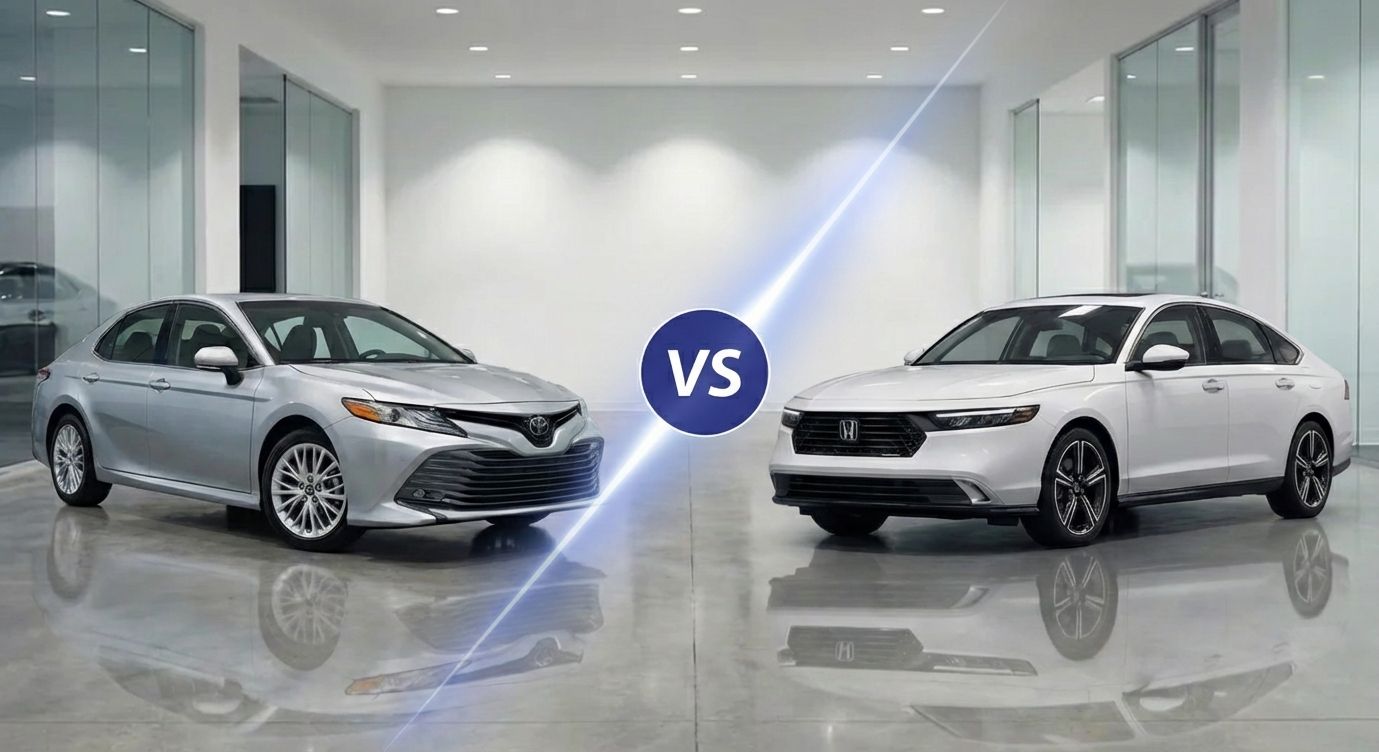
Car battle
Toyota Camry vs. Honda Accord: A Complete 2025 Comparison
Toyota Camry vs. Honda Accord: Which sedan to choose? Our detailed comparison helps you find the right car based on key differences and our verdict.
Apr 13, 2026
Articles
Car battle
Detailed comparison of Renault Talisman vs. Toyota Camry. Discover the real differences in reliability, equipment, and fuel consumption. Find out which car to choose based on our verdict.
October 16, 2026
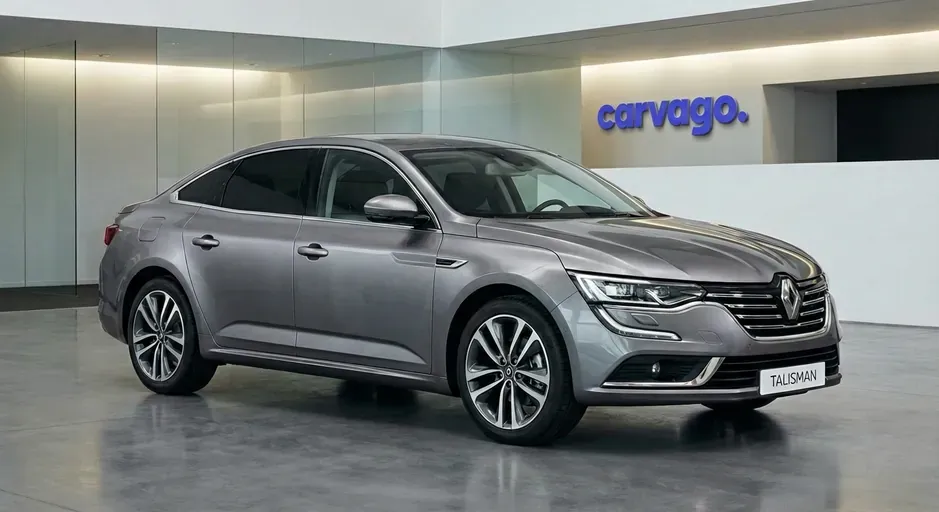
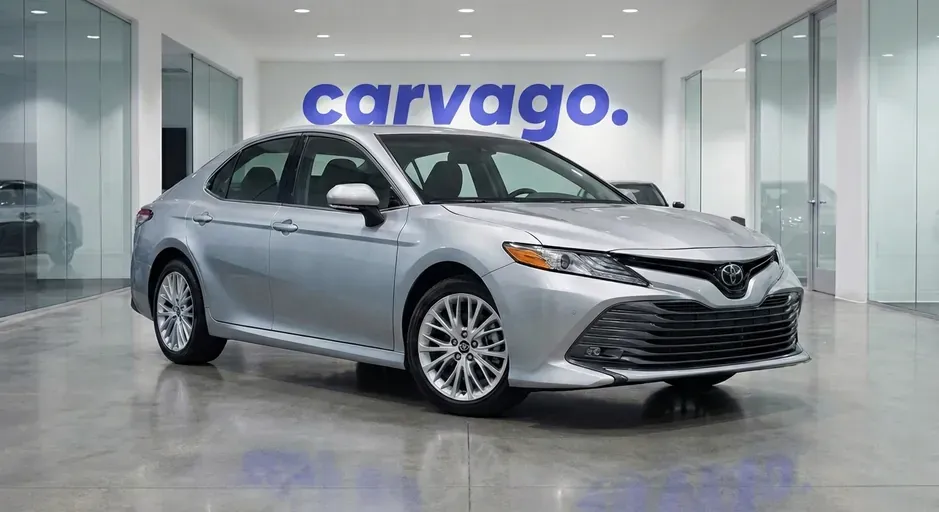
The Renault Talisman, also known in some markets as the Renault Samsung SM6, represents an elegant French vision of an executive car, targeting drivers looking for sophisticated design and comfortable driving characteristics. Opposing it is the globally successful Toyota Camry, also sold under the name Daihatsu Altis in its domestic Japanese market, which, on the other hand, has built an unshakable reputation as an exceptionally reliable and economical sedan with an advanced hybrid drive. The following comparison will detail these two completely different approaches to the mid-size class and help you find out which of them represents a smarter choice on the used car market.
Looking at the exterior dimensions, it is clear that both the Renault Talisman and the Toyota Camry belong to the mature and larger representatives of the mid-size class, which impress with their representative proportions. Focusing on the models from the latest generations available on the used car market (roughly from the 2019 model years until the end of their production), the Japanese representative measures 4885 mm in length, making it 36 mm longer than the base sedan from Renault. However, the French competitor clearly counters in the width parameter, where it reaches exactly 1868 mm compared to 1840 mm for the Toyota. For future owners, this means in practice that while the wider Talisman will offer a slightly airier interior in the shoulder area for the crew, the narrower Toyota will be noticeably easier to maneuver and open doors in tight parking spaces or underground garages.
A significant indicator of interior spaciousness is the wheelbase, which always directly affects the longitudinal legroom in the cabin. Here, the Toyota Camry with its 2825 mm has a clear advantage over the Talisman, whose wheelbase is a maximum of 2809 mm. This difference of roughly 16 mm gives the Toyota a great advantage in knee room for rear-seat passengers, which is ideal for frequent and long journeys by adult passengers. Renault, on the other hand, slightly wins in height – offering up to 1463 mm (or 1465 mm for the estate version) compared to 1445 mm for the low-cut Camry. The slightly higher roof structure thus plays into the hands of the French car when it comes to more comfortable boarding and a small reserve in headroom for taller passengers.
A fundamental difference in the final choice between these two models in terms of bodywork is the overall diversity of the offer on the used car market. While Toyota offers its modern Camry (XV70 generation) in Europe exclusively as an elegant three-box sedan, the Renault Talisman also gives customers the choice of a popular and very practical estate body, sold under the Grandtour designation. With a length of 4865 mm, this version is almost as long as the sedan, but thanks to the extended roof and differently shaped rear, it fundamentally facilitates the transport of bulkier items. So if you are primarily looking for a practical car for the family or the regular transport of dogs and strollers, the presence of the estate variant for the Talisman is often the main argument for buying, while the Camry will appeal more to drivers requiring a classic corporate or executive sedan.
| Parameter | Renault Talisman Sedan | Toyota Camry Sedan | Renault Talisman Estate |
|---|---|---|---|
| Length (mm) | 4849 | 4885 | 4865 |
| Width (mm) | 1868 | 1840 | 1868 |
| Height (mm) | 1456 - 1463 | 1445 | 1456 - 1465 |
| Wheelbase (mm) | 2808 - 2809 | 2825 | 2808 - 2809 |
When choosing an executive or family car, the luggage compartment volume often plays a key role, not only for everyday practicality but also for comfortable traveling. Both the Renault Talisman and the Toyota Camry target customers who require a spacious and representative car, but their approach to the luggage compartment differs noticeably. While the French representative offers a choice between an elegant sedan and a highly practical estate (Grandtour) on the market of approximately four-year-old used cars, the Japanese automaker relies exclusively on the classic sedan body type for its eighth generation (XV70) on the European market.
Looking closer at the numbers, we encounter a very interesting paradox. The Renault Talisman in the sedan version offers a huge basic volume of 608 liters, which on paper is even slightly more than the 572 liters available in the estate version. This difference is due to the different methodology of measuring under the luggage compartment cover and the different shape of the rear; however, the Grandtour model more than makes up for it with incomparably better access and the possibility of easily folding down the rear seats, creating a giant space with a volume of 1,681 liters. The competing Toyota Camry counters with a solid 524 liters in its sedan. Although its luggage compartment is slightly smaller in the basic layout, the engineers managed to cleverly hide the hybrid system batteries under the rear seats, so they do not fundamentally limit the utility value of the trunk.
In practice, these differences mean a different degree of everyday usability. While the Toyota Camry easily accommodates enough luggage for a normal family vacation and is fully sufficient for weekend shopping, the Renault Talisman offers space for several extra suitcases in both body versions. The Grandtour variant, thanks to its generous loading opening, represents an ideal choice for the carefree transport of a baby stroller or bulkier sports equipment. In conclusion, if maximum transport capacity and variability are your absolute priorities, the Renault Talisman will be a better companion. The Toyota Camry, on the other hand, will appeal to those interested who are more than satisfied with the above-average space of a spacious sedan and prefer the operational efficiency of a hybrid powertrain.
| Parameter | Renault Talisman Sedan | Toyota Camry Sedan | Renault Talisman Estate |
|---|---|---|---|
| Basic volume (liters) | 608 | 524 | 572 |
| Max. volume with folded seats (liters) | 1,022 | Not available | 1,681 |
When choosing a used mid-size car, towing capacity is a key parameter for many drivers that fundamentally affects the overall practicality of the vehicle – whether it's for the occasional transport of oversized items or regularly towing a family caravan. If we compare roughly four-year-old models of the Renault Talisman (1st generation) and the Toyota Camry (XV70 generation), we encounter a massive difference.
The Renault Talisman is considered an excellent and versatile all-rounder. Its standard braked towing capacity starts at 1500 kg (primarily for the TCe petrol versions), while the popular dCi diesel engines and the more spacious Grandtour version reach a very solid maximum permitted weight of 1800 to 1850 kg. An unbraked trailer for the Talisman can weigh the legislative limit of 750 kg. This capacity is fully sufficient for weekend shopping or a longer holiday, or you can gain extra space for a few more suitcases in the form of a small trailer.
Conversely, for the Toyota Camry with the modern 2.5 Hybrid engine, official towing capacity data is missing. In practice, this reveals the downside of the economical hybrid drive with reduced capacity – for the European market, this generation was not homologated for towing trailers, and the permitted load value for both braked and unbraked trailers is therefore 0 kg. Any tow bar on this Toyota will serve exclusively as a mounting point for a bicycle carrier.
In conclusion, thanks to its very good towing parameters, the Renault Talisman is a fully-fledged solution for active drivers and cottage owners who need to transport cargo regularly. The Toyota Camry, on the other hand, will primarily appeal to buyers who do not need a tow bar and whose priority is smooth operation and economical driving without the need to hook up a trailer.
| Model and engine | Braked towing capacity (kg) | Unbraked towing capacity (kg) |
|---|---|---|
| Renault Talisman TCe (110–165 kW) | 1500–1850 | 750 |
| Renault Talisman dCi / Blue dCi (81–147 kW) | 1600–1850 | 750 |
The approach of both car manufacturers to powertrains differs diametrically, which means a very different choice for buyers in the used car market. While the Renault Talisman relies on the traditional European school with a wide range of turbocharged diesel and petrol engines, the Toyota Camry appeals to the market exclusively with a single, meticulously refined hybrid powertrain. For drivers who spend hundreds of hours on highways, the long range and high torque of Renault's powerful diesels will play a major role. Conversely, buyers looking for bulletproof reliability, low operating costs, and perfect refinement in mixed traffic will find their ideal in Toyota's exceptionally efficient hybrid.
In its single generation (2015–2022), the Renault Talisman offers a diverse range of engines, which, however, changed significantly over the years due to emission standards. In four-year-old used cars, you will exclusively encounter newer and cleaner units designated as Blue dCi and TCe GPF. The role of a reliable petrol base is fulfilled by the successful 1.3 TCe 160 (118 kW) engine, while frugal highway travelers will be pleased by the 1.7 Blue dCi diesel units or the more powerful 2.0 Blue dCi two-liter engines reaching up to 147 kW (200 hp) with a torque of 400 Nm. For drivers seeking dynamics, the peak of the range was the 1.8 TCe petrol engine with an output of 165 kW (225 hp), whose technology originates from the sporty Alpine model. Most newer engines on the market are paired as standard with the EDC automatic dual-clutch transmission.
| Engine type | Fuel | Power (kW) | Torque (Nm) | Transmission |
|---|---|---|---|---|
| 1.3 TCe 160 | Petrol | 118 | 260 | 7EDC |
| 1.6 TCe 150 / 200 | Petrol | 110 / 147 | 220 / 260 | 7EDC |
| 1.8 TCe 225 | Petrol | 165 | 300 | 7EDC |
| 1.6 dCi 130 / 160 | Diesel | 96 / 118 | 320 / 380 | 6MT / 6EDC |
| 1.7 Blue dCi 120 / 150 | Diesel | 88 / 110 | 300 / 340 | 6MT |
| 2.0 Blue dCi 160 / 190 / 200 | Diesel | 118 / 140 / 147 | 360 / 400 / 400 | 6EDC |
Note: The older 1.6 TCe and 1.6 dCi units were available in the first years of production. In models relevant to today's nearly-new used car market (from 2019/2020), they were replaced by the modernized TCe and Blue dCi versions.
The Toyota Camry (XV70 generation) represents the embodiment of Japanese efficiency and entered the European market with an absolutely clear, uncompromising vision. You would look in vain for a diesel or a classic turbocharged petrol engine in the price list – only the sophisticated 2.5 Hybrid full-hybrid system is available. This system combines a naturally aspirated 2.5-liter four-cylinder petrol engine operating on the Atkinson cycle with a powerful electric motor, with the total system output reaching 160 kW (218 hp). Power is seamlessly transmitted to the front wheels via an electronically controlled e-CVT planetary transmission. The biggest advantage of this choice is the real-world fuel consumption, which even for such a large and heavy sedan normally hovers around 5 to 5.5 liters per 100 km. The absence of complex components such as turbochargers, traditional starters, or delicate dual-clutch transmissions makes the hybrid Camry a benchmark for long-term reliability.
| Engine type | Fuel | Power (kW) | Torque (Nm) | Transmission |
|---|---|---|---|---|
| 2.5 Hybrid | Hybrid (Petrol/Electric) | 160 | 221 (combustion) / 202 (electric) | e-CVT |
Final recommendation: The choice between these cars closely depends on your daily usage. For drivers eating up highway kilometers at high speeds, the Renault Talisman with the 2.0 Blue dCi engine will be the clear favorite, as the massive pull from low revs guarantees relaxed cruising dynamics. However, if you spend a large part of your time in suburban traffic, crawling through cities, or simply place the highest possible emphasis on economy, trouble-free operation, and peace on board, the Toyota Camry represents an almost unbeatable choice in the used car market.
Choosing the right engine is a key step for long-term satisfaction, which is why our recommendations are based on real-world experience, mechanical reliability, actual fuel consumption, and owner feedback. Although both cars target managers and families looking for a comfortable mid-size car, their under-the-hood philosophies couldn't be more different. While the French representative historically relies on a wide range of diesel and turbocharged petrol units, the Japanese competitor arrived in the European market in its XV70 generation with a radically different approach, relying exclusively on a naturally aspirated petrol engine combined with an advanced and time-tested hybrid drive.
When looking for a roughly four-year-old used car (from the engine lineup available between 2018 and 2022), the ideal choice for the Talisman is the two-liter diesel Blue dCi 160. This engine replaced the older and more complex 1.6 dCi units and offers an excellent compromise between dynamics, long-term reliability, and operating costs. Its main advantage is a flat torque curve (360 Nm from just 1500 rpm) and real-world fuel consumption on long journeys, which safely stays under 6 liters per 100 km. Mechanically, it is a very robust powertrain that is tailor-made for drivers devouring highway kilometers. The biggest risk with it is the typical clogging of the diesel particulate filter (DPF) and the dilution of engine oil with diesel during frequent short city trips, where regeneration is not completed. How to spot it: When choosing a used car, check the service history with an emphasis on whether the oil was ideally changed every 15,000 km (not after nonsensical extended intervals), run your finger inside the exhaust tailpipe, which should be clean without a thick layer of greasy soot, and watch out for messages on the trip computer about the need to service the emission system. If you plan to drive mainly on short city routes, consider the petrol alternative TCe 160 instead, but for traditional long-distance use, this two-liter diesel is an absolutely great and rational choice.
Here, the recommendation for a roughly four-year-old used car from the XV70 generation (available in Europe since 2019) is absolutely clear, as this model was sold in our market with a single, but phenomenal engine: the 2.5 Hybrid Dynamic Force. This system combines a large-displacement naturally aspirated four-cylinder engine with an electric motor and an e-CVT planetary gearbox, forming the imaginary holy grail of mechanical reliability. The usual worries about turbochargers, delicate injectors, DPF filters, conventional clutches, or dual-mass flywheels are completely eliminated here. The total output of 160 kW (218 hp) provides the car with smooth and seamless acceleration, while real-world fuel consumption surprisingly stays around 5 to 5.5 l/100 km even in heavy city traffic. This powertrain will be exceptionally appreciated by calmer drivers and people with a high proportion of city or suburban driving. The hybrid system is renowned for its extreme durability; its only weakness can be neglected maintenance of the traction battery cooling. How to spot it: During the inspection, check the cooling air intake grille for the battery, which is usually located in the interior under the rear seats – it must not be clogged with dust or pet hair, otherwise there is a risk that the battery will start to degrade due to overheating. During the test drive, also focus on the smoothness of the ride itself; the transition between purely electric and combustion drive must be smooth and almost imperceptible. If the car jerks noticeably when the petrol engine starts, it could mean neglected spark plug replacement or wear of the torsional damper in the transmission.
When choosing a used car, fuel consumption is one of the key factors, but the paper values from manufacturers rarely fully correspond to everyday reality. While laboratory standards try to approximate real conditions, practice behind the wheel tends to be different and heavily dependent on the route profile and driving style. For a more objective comparison, it is therefore ideal to look at real-world data, for example on the popular community portal Spritmonitor.de, where thousands of drivers record every refueling over the long term. We focused on the engines that are most relevant on the used car market for roughly four-year-old cars (manufactured between 2020 and 2022) for both models.
| Model and engine | Average consumption (l/100 km) |
|---|---|
| Toyota Camry 2.5 Hybrid (160 kW) | 5.5 |
| Renault Talisman 2.0 Blue dCi 160 (118 kW) | 5.8 |
| Renault Talisman 2.0 Blue dCi 200 (147 kW) | 6.6 |
| Renault Talisman 1.3 TCe 160 (117 kW) | 6.5 |
| Renault Talisman 1.8 TCe 225 (165 kW) | 8.5 |
Looking closer at the real-world data, it is clear that Toyota's hybrid technology shows its immense strength. The Camry with the 2.5 Hybrid engine achieves an excellent 5.5 l/100 km, which is a respectable performance for such a large and representative sedan. However, it is ably seconded by the diesel Renault Talisman with the popular 2.0 Blue dCi 160 powertrain, which stays close behind with a real-world average of around 5.8 l/100 km. Surprisingly, the smaller 1.3 TCe turbocharged petrol engine in the Talisman cannot fully compete with the advanced Japanese hybrid in terms of consumption, and in practice, it asks for an average of 6.5 liters. This fully demonstrates the classic ailment of small-displacement turbocharged engines in large cars – as soon as they have to work under a heavier load, their efficiency drops rapidly and they do not save fuel as one might expect from the charts. If you reach for the top-of-the-line petrol Talisman with the powerful 1.8 TCe 225 engine, you must also expect an average that certainly exceeds eight and a half liters.
What do these numbers mean for a typical user? If you spend most of your time crawling through city traffic jams or on shorter suburban routes, the Toyota Camry will be a clear favorite and an unrivaled money-saver for you. Its ability to constantly recuperate energy and crawl along purely on electricity makes huge sense in the city, and budget-conscious buyers will be thrilled. On the other hand, highway cruisers and long-distance mile-eaters who drive at stable higher speeds will still appreciate the French two-liter diesel Blue dCi much more. It doesn't run out of breath on the highway, and its fuel consumption rises only very gradually with increasing pace, unlike its petrol and hybrid competitors. The petrol versions of the Talisman then make more sense for drivers who have a lower annual mileage and prefer the quietness and refinement of a petrol engine, without running costs playing a primary role for them.
It can therefore be said that fuel consumption should be one of the absolutely crucial arguments when deciding between these two cars. The Toyota Camry represents the technological pinnacle for mixed and urban driving with the excellent efficiency of a naturally aspirated engine supported by an electric motor. The Renault Talisman, on the other hand, remains a perfect choice thanks to its proven and efficient diesel engines for those who spend the vast majority of their time on highway journeys across the country or Europe. Choosing the right powertrain thus largely depends purely on your personal driving profile.
When choosing roughly four-year-old used cars (model years 2021–2022), we get to very interesting offers for both cars, with different depreciation curves showing on the market. While the French representative attracts with a faster price drop, and thus a great price-to-equipment ratio, the Japanese sedan, on the contrary, holds its value with admirable certainty.
The Renault Talisman said goodbye to the European market in 2022. Roughly four-year-old models thus represent the very newest and most fine-tuned versions after the modernization that took place in the spring of 2020. Given the faster depreciation, which is quite typical for French cars of this class, it is a very attractive second-hand choice.
The eighth generation of the Toyota Camry established itself on the European market exclusively with a hybrid powertrain. Models from 2021 and 2022 (i.e., cars after a minor facelift) are among the most reliable you can buy in the mid-size class. The reputation of trouble-free hybrids from Toyota is fully reflected here in the behavior of the used car market – the Camry holds its value extremely well.
| Feature | Renault Talisman (2021–2022) | Toyota Camry (2021–2022) |
|---|---|---|
| Approximate used car price | €16,000 – €23,000 | €23,000 – €31,000 |
| Value retention (residual value) | Below average (advantageous for the buyer) | Above average |
| Dominant powertrain in listings | Diesel (Blue dCi) / Petrol (TCe) | Petrol hybrid (2.5 Hybrid) |
| Main attraction of buying used | Maximum equipment for a very low price | Reliability and minimal future price drop |
Final verdict on prices:
If you are looking for the youngest possible, exceptionally comfortable, and spacious car with full equipment for the lowest possible purchase price, the Renault Talisman is a fantastic choice where you fully benefit from the steeper depreciation curve of a new car. However, if your priority is absolute reliability, very low fuel consumption in the city, and you expect to want to sell the car well again in a few years, it makes sense to pay extra for the Toyota Camry, which will reward you with an exceptionally stable residual value.
When comparing the safety of family cars, it is common to highlight maximum five-star ratings. Although both models achieved five stars in their respective tests (Talisman in Euro NCAP tests and Camry in equivalent ANCAP tests), it is absolutely crucial to consider the context and the year the cars were tested. The methodology and test protocols are constantly evolving over time and becoming drastically stricter. Today's standards place an incomparably higher emphasis on advanced active safety, such as new frontal crash simulations, cyclist detection, or crisis scenarios at intersections. For this reason, percentage scores from different years cannot be directly compared, as the requirements for achieving full points are diametrically different.
The Renault Talisman underwent Euro NCAP crash tests in 2015, easily achieving the maximum five stars. With a score of 86% for adult occupant protection and 84% for child occupant protection, it demonstrated excellent passive safety and platform structural rigidity. The lower scores for vulnerable road user protection (68%) and safety assist systems (76%) clearly reflect the era before the widespread introduction of autonomous emergency braking systems and advanced sensors. Furthermore, from the perspective of current rules, the Talisman's certification has expired, meaning its safety equipment belongs more to older generation technologies.
In the case of the Toyota Camry (eighth generation available since 2018), the situation is completely different, as this model was not directly tested by the European organization Euro NCAP. For this reason, there is no official percentage data that could be entered into a table for direct comparison. However, the car underwent a very similar and recognized methodology by the Australian organization ANCAP in 2017, from which it took away a full five stars. Despite the absence of a European certificate, the Camry is equipped with the modern TNGA platform and already brings the Toyota Safety Sense active assist package as standard, which includes a pre-collision system with pedestrian detection, lane departure alert, and adaptive cruise control.
In conclusion, both cars offer a solid and safe construction that represented the top of the class at the time of their market launch. The Renault Talisman has clearly documented results from European tests, but its tests were conducted under much more lenient rules many years ago. The Toyota Camry, on the other hand, lacks a direct Euro NCAP rating, but thanks to its generation-newer global construction and uncompromising emphasis on standard active safety, it offers overall more modern and comprehensive occupant protection according to current standards.
| Parameter | Renault Talisman | Toyota Camry |
|---|---|---|
| Year of testing | 2015 | Not tested |
| Adult occupant protection | 86% | - |
| Child occupant protection | 84% | - |
| Vulnerable road user protection | 68% | - |
| Safety assist systems | 76% | - |
In addition to standard equipment, each model offers unique features that go far beyond basic functionality. Both cars approach added value from a different perspective – while the French representative attracts with technological chassis innovations and digitalization, the Japanese sedan relies on a sophisticated hybrid drive and executive comfort in the rear seats.
Advantages:
Disadvantages:
Advantages:
Disadvantages:
Based on long-term user feedback, service reports, and failure statistics, we have compiled a detailed overview of the most common problems that used car buyers should watch out for. Especially with cars around four years old, it is important to know the weak points of the given generation. Whether you decide on French elegance or Japanese hybrid technology, before the actual purchase, an independent technical inspection of the car always pays off, which will help uncover any expensive surprises.
The Renault Talisman (especially models before the 2020 facelift) is known for its attractive design and rich equipment, but in terms of reliability, it requires greater caution when buying on the secondary market. After the facelift (from 2020), the build quality and software stability improved significantly.
Summary for Renault Talisman:
The Talisman is an extremely comfortable and spacious car. If you reach for newer models (ideally after the 2020 facelift with the 2.0 Blue dCi engine), you will avoid most teething problems. In older models, any problems are more in the nature of annoying electronic quirks rather than fatal engine failures, yet caution is in order.
The eighth-generation Toyota Camry (available on the European market since 2018/2019) is a global benchmark for reliability. Cars around four years old show an absolute minimum of serious faults in MOT and service statistics. Problems here relate more to consumable properties and minor imperfections.
Summary for the Toyota Camry:
Buying a four-year-old Toyota Camry is a safe bet. The car does not suffer from any expensive design flaws, and the hybrid system shows extreme durability. If you can put up with the weaker infotainment and thinner paint, the Camry will reward you with completely trouble-free operation with minimal service costs. Nevertheless, even with such a reliable car, a used car inspection should take place before signing the contract to rule out any poorly repaired accident damage.
When buying a used car, a thorough inspection is crucial, and for both models, there are specific points to watch out for. It definitely always pays to invest in a comprehensive vehicle inspection, which will reveal any hidden defects before signing the contract.
The Talisman offers a luggage compartment volume of 608 liters in the sedan body style, while the Japanese competitor has a value of 524 liters. In addition, the French car can also be purchased as a practical Grandtour estate, which is completely missing from Toyota's offer on the European market. For family use and frequent transport of bulkier items, the Renault is clearly the more practical choice.
Toyota has long been perceived as a benchmark of quality, and its model maintains a worldwide reputation as a trouble-free car with minimal demands for extra servicing. Renault has significantly improved reliability in newer model years, but more complex systems like the 4Control all-wheel steering can pose a slightly higher service risk in used cars over time. In terms of overall lifespan and maintenance-free operation, the Asian representative therefore has the upper hand in long-term ownership.
While Toyota relies exclusively on a proven petrol hybrid system in the European market, which excels with very low consumption in city and suburban traffic, Renault takes a more classic approach. The backbone of its used car offering consists of economical dCi diesel engines and powerful turbocharged TCe petrol units. Diesel engines are still unbeatable for drivers with high annual mileage purely on highways, while the hybrid dominates in mixed traffic.
Both sedans excel in providing driving comfort, but they achieve it through different technical approaches. Renault benefits from optional adaptive dampers, thanks to which it can absorb bumps while maintaining surprising agility in corners. The competing model, on the other hand, relies on an extremely quiet cabin, mechanically smooth operation of the drivetrain, and an overall softer, more swaying suspension tuning for a relaxed ride.
The French model loses value noticeably faster, so as a few-year-old used car, it represents a very attractive purchase with the maximum possible equipment at an affordable price. Toyota holds its value on the secondary market exceptionally firmly, which means a higher initial investment for the new owner. However, this disadvantage will partially return to the owner of the Japanese car upon resale in the form of minimal depreciation.
Sources: ADAC, mdcr.cz, forbes.cz, motorvize.cz, autorevue.cz, carstyle.cz
This article was prepared using artificial intelligence tools. The section guarantor is Petr Dušek.
Toyota Camry vs. Honda Accord: Which sedan to choose? Our detailed comparison helps you find the right car based on key differences and our verdict.
Apr 13, 2026
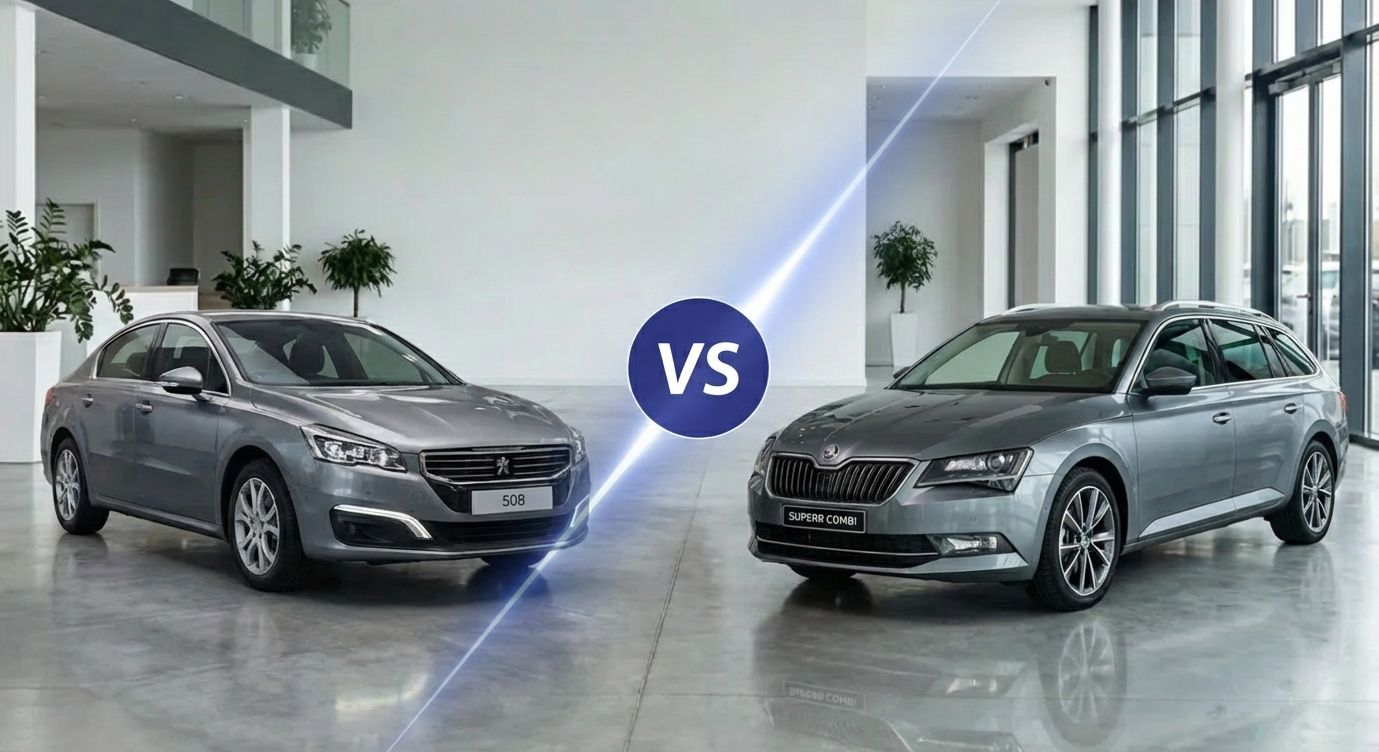
Peugeot 508 vs. Škoda Superb: Detailed comparison, real-world experiences, and the verdict to help you choose the best executive car.
Apr 13, 2026
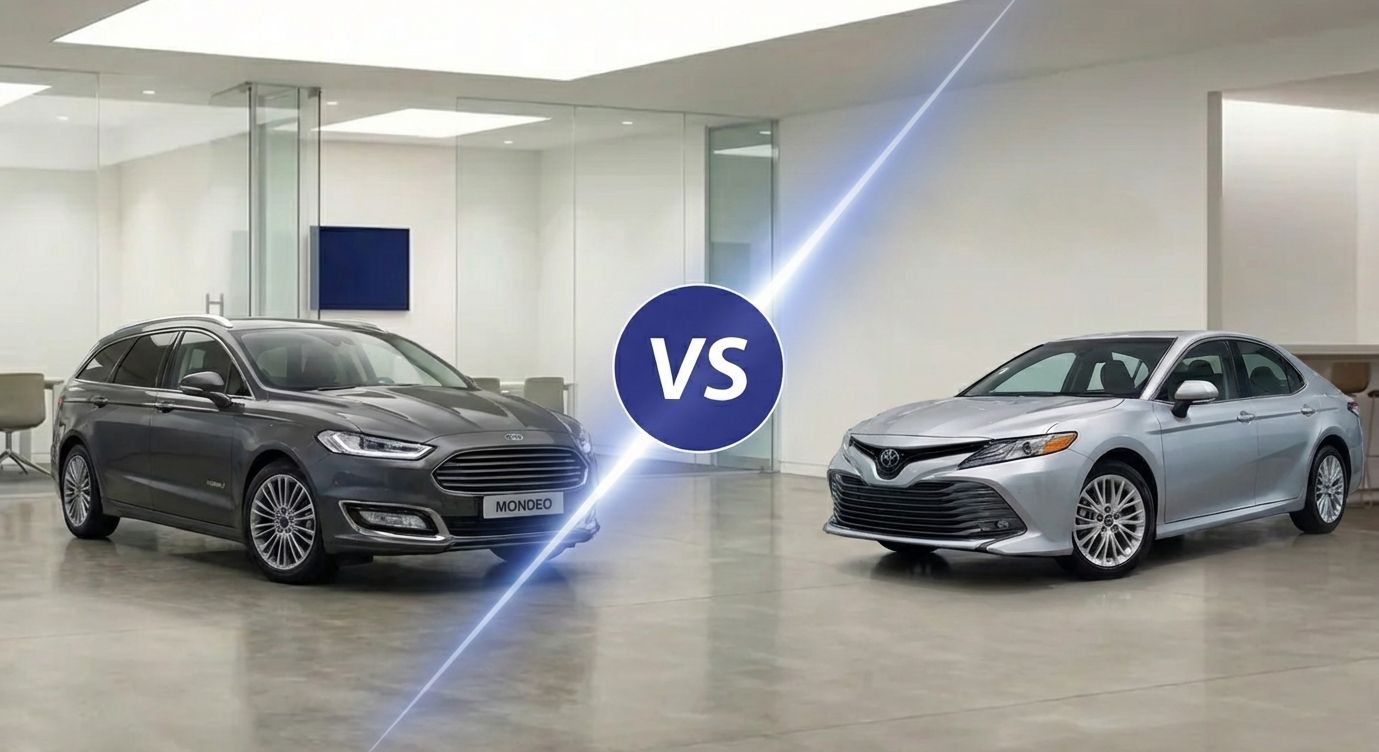
Ford Mondeo vs. Toyota Camry: Detailed comparison, tests, data, and verdict. Find out which sedan is the best choice for you on the used car market.
Apr 13, 2026