Nissan Qashqai vs. Peugeot 3008: Complete comparison 2026
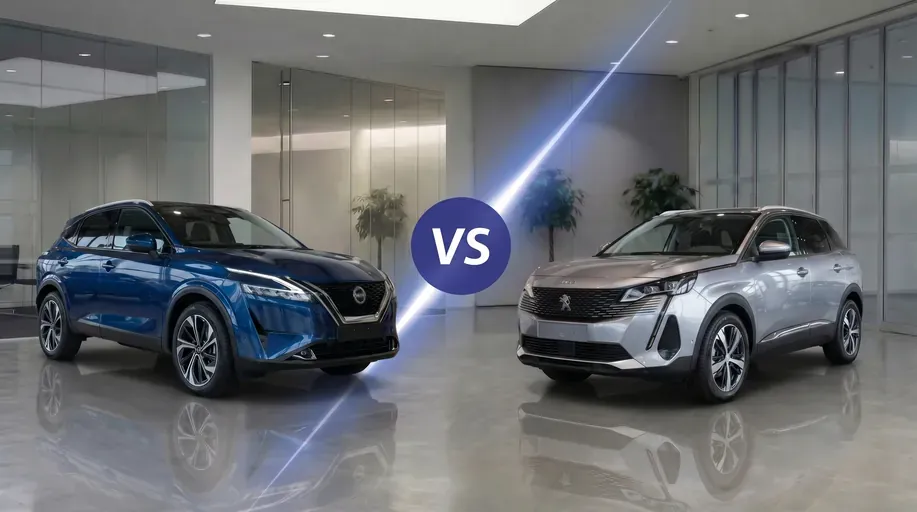
Nissan Qashqai vs Peugeot 3008: A major comparison of used SUVs. Find out real-world fuel consumption, reliability, and differences in equipment to help you choose the right car.
Apr 23, 2026
Detailed comparison of the Renault Austral and Volkswagen Tiguan. Discover the differences in equipment, fuel consumption, and spaciousness. Our clear verdict will help you choose the right SUV.
October 16, 2026


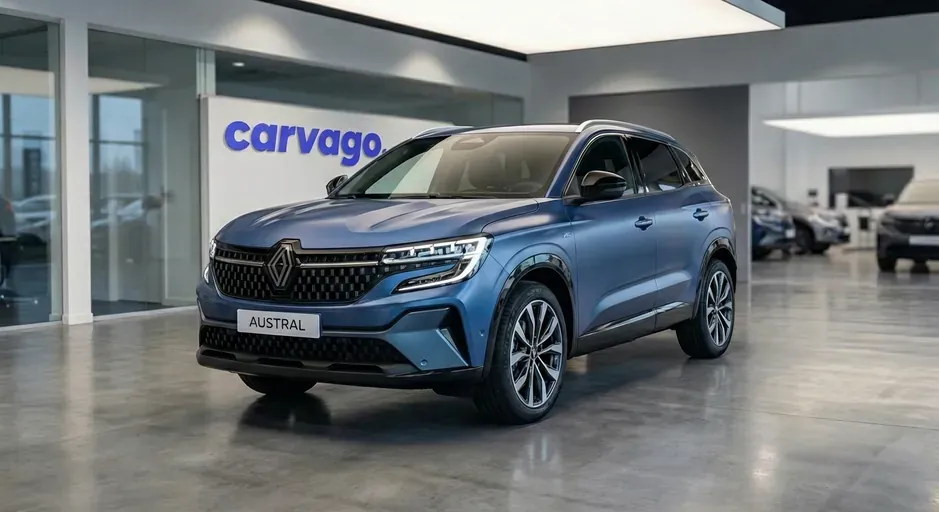
The Renault Austral is an elegant compact SUV that, as the modern successor to the Kadjar model, focuses primarily on innovative technologies, a premium interior, and fuel-efficient hybrid powertrains. Its rival today is the popular Volkswagen Tiguan (also known as Tiguan Allspace, Tiguan L, or Tayron in extended and local variants), which has long been considered an exceptionally practical and versatile benchmark for the entire family car segment. The following comparison will provide a detailed look at the strengths and weaknesses of both these confident competitors and help you determine which one is the ideal choice for your garage.
The first-generation Renault Austral and the second-generation Volkswagen Tiguan (representing an ideal choice for those interested in a roughly four-year-old used car) fall right into the heart of the highly competitive compact SUV segment. Looking at the overall length of both vehicles, you will find that they take up almost identical space on the road. The length of the Renault Austral is 4510 mm, while the Volkswagen Tiguan ranges between 4509 and 4514 mm depending on the chosen equipment and bumper shape (for example, in the R version). This negligible difference means that both cars behave very similarly in terms of longitudinal maneuverability. In practice, they are equally easy to park in narrow city garage spaces, so when choosing between this pair, the overall length plays no significant role in the final decision.
Larger and more noticeable differences for the user can be found when comparing width and height. The Volkswagen Tiguan, at 1839 to 1859 mm, is wider than the Renault Austral, which offers a fixed value of 1825 mm. The German representative is also significantly taller, reaching up to 1675 mm compared to 1618 mm for the Renault. The increase in these values gives the Tiguan a more robust and boxier stance. In practice, this means a slightly better sense of airiness in the interior and more shoulder room. On the other hand, the Austral's lower silhouette contributes to a more dynamic appearance and slightly facilitates handling roof cargo, whether it's securing bicycles or installing a roof box.
A key factor for cabin spaciousness and driving stability is the wheelbase. In this discipline, the Volkswagen Tiguan, with a value of 2678 to 2680 mm, has only a very slight lead over the Renault, which has a wheelbase of 2667 mm. The difference of just 11 to 13 millimeters is almost imperceptible in real-world use, so both family SUVs can offer adequate comfort even for rear-seat passengers. In the final decision, it won't be about dramatic differences in millimeters, but rather about personal preferences for proportions – you will choose between the more aerodynamically tuned French design and the traditionally functional, slightly bulkier approach of the German classic.
| Parameter | Renault Austral SUV | Volkswagen Tiguan SUV |
|---|---|---|
| Width (mm) | 1825 | 1839 - 1859 |
| Length (mm) | 4510 | 4509 - 4514 |
| Height (mm) | 1618 | 1668 - 1675 |
| Wheelbase (mm) | 2667 | 2678 - 2680 |
When choosing a family SUV, the trunk volume often plays a decisive role. Whether you are carrying a stroller, sports equipment, or heading on a summer vacation, every extra liter means significantly less stress when packing. The Renault Austral and Volkswagen Tiguan are strong players in the popular compact SUV segment, but their approach to interior space utilization differs quite significantly. For comparison, we are focusing on models that currently dominate the used car market, i.e., approximately four-year-old models (the first-generation Renault Austral and the popular second-generation Volkswagen Tiguan).
The second-generation Volkswagen Tiguan (produced until 2023) is a long-standing benchmark and a family favorite in terms of transport capacity. In its basic configuration, it offers a generous 615 liters, a value that is perfectly sufficient for weekend shopping or longer vacations without the need for unpleasant compromises. After fully folding the rear seats, the cargo space increases to an impressive 1,655 liters. Thus, the Tiguan serves without problems not only for travel but also for moving larger pieces of furniture or transporting very bulky cargo.
The first-generation Renault Austral (from 2022) offers slightly more modest, yet still very practical values for most users compared to its German rival. A key specific of the Austral model is that the trunk volume varies depending on the chosen engine. Standard mild-hybrid versions (Mild Hybrid 140 and 160) have a standard volume of 500 liters, which increases to 1,525 liters after folding the seats. However, if you opt for the more economical E-Tech Full Hybrid variant, you must expect a noticeable reduction in the basic trunk to 430 liters (and 1,455 liters after folding) due to the physical placement of the traction battery under the floor. In a direct comparison, the Volkswagen Tiguan thus provides space for several extra suitcases, which can be a deciding factor for larger families.
| Parameter | Renault Austral SUV (Mild Hybrid) | Renault Austral SUV (Full Hybrid) | Volkswagen Tiguan SUV |
|---|---|---|---|
| Basic volume (liters) | 500 | 430 | 615 |
| Maximum volume with seats folded (liters) | 1525 | 1455 | 1655 |
If trunk size and maximum transport capacity are your absolute priority, the second-generation Volkswagen Tiguan offers significantly more space in both basic and expanded configurations. The Renault Austral handles common family needs without trouble, but in its full-hybrid versions, valuable volume might be missing when packing for longer trips.
Towing capacity is often a key parameter for drivers who regularly transport heavy loads, whether it's family caravans, trailers with building materials, or horse transport. When comparing approximately four-year-old used cars – namely the first-generation Renault Austral (produced since 2022) and the popular second-generation Volkswagen Tiguan (ideally in post-facelift versions around 2020–2022) – we encounter vast differences that reflect the different approaches of both manufacturers to this segment.
Renault Austral is designed primarily as a modern, comfortable SUV for daily use, and its braked trailer weight limits range from 1,350 kg to 1,800 kg. The highest capacity of 1,800 kg is achieved with the more powerful Mild Hybrid 160 engine. However, it is crucial to mention the specifics of the electrified versions. If you opt for the top-of-the-line E-Tech Full Hybrid 200 variant, the maximum towing capacity drops to 1,500 kg due to the additional weight of the batteries and the more complex powertrain. In practice, this limit is perfectly sufficient for a weekend trip to the DIY store, transporting a smaller caravan, or a lighter boat, but it won't be enough for the heaviest loads.
Conversely, the second-generation Volkswagen Tiguan clearly shows its more robust origins. Even with the basic 1.5 TSI petrol engines, it can handle a braked trailer weighing 1,600 to 1,800 kg. Similar to the Renault, a compromise applies to the eHybrid plug-in hybrid, but with a more acceptable limit of 1,800 kg. However, a completely different league opens up if you choose more powerful units with all-wheel drive. With 2.0 TDI and 2.0 TSI engines, the Tiguan easily tows heavy braked trailers weighing up to 2,500 kg. This provides plenty of room for a few extra suitcases even in the largest twin-axle caravan, and thanks to this, the Tiguan easily handles the transport of horses or large boats.
Both cars offer a standard 750 kg for unbraked trailers, which is the maximum value set by European legislation for this category of passenger cars. The conclusion is therefore clear: while the Renault Austral perfectly satisfies the average weekender and common recreational needs, the Volkswagen Tiguan is an uncompromising workhorse that is the clear winner of this comparison for towing truly large loads.
| Model and engine | Braked trailer weight (kg) | Unbraked trailer weight (kg) |
|---|---|---|
| Renault Austral 1.3 Mild Hybrid 140 (1st gen) | 1350 - 1800 | 750 |
| Renault Austral 1.3 Mild Hybrid 160 (1st gen) | 1800 | 750 |
| Renault Austral 1.2 E-Tech Full Hybrid 200 (1st gen) | 1500 | 750 |
| VW Tiguan 1.5 TSI (2nd gen) | 1600 - 1800 | 750 |
| VW Tiguan 1.4 eHybrid (2nd gen) | 1800 | 750 |
| VW Tiguan 2.0 TDI SCR (2nd gen) | 1800 - 2500 | 750 |
| VW Tiguan 2.0 TSI (2nd gen) | 2000 - 2500 | 750 |
The engine lineup clearly demonstrates the generational and philosophical differences between the two cars. While the Renault Austral (1st generation from 2022) made a radical departure, betting exclusively on electrified petrol engines and completely removing diesel engines and all-wheel drive from its range, the Volkswagen Tiguan relies on its proven wide palette. On the used car market, among vehicles around four years old, you will find economical diesels, powerful 2.0-litre petrol engines, and popular plug-in hybrid versions in the facelifted 2nd generation Tiguan (2020–2023). For drivers covering long motorway distances and towing trailers, the Tiguan will be the clear choice thanks to the option of robust 4MOTION all-wheel drive, while the Austral makes sense primarily for suburban drivers who appreciate the above-average smoothness and efficiency of modern French mild and full hybrids.
Under the bonnet of the Renault Austral from 2022 and newer, you won't find traditional conventional or diesel engines; everything is already electrified. The foundation consists of reliable 1.3-litre four-cylinder turbocharged petrol engines, supplemented by 12V mild-hybrid technology. The Mild Hybrid 140 version has an output of 103 kW and was the only one commonly available on the secondary market with both a manual and a continuously variable transmission (CVT), while the more powerful Mild Hybrid 160 (116 kW) relied purely on an automatic. The pinnacle and, from a technological standpoint, the most interesting engine is the E-Tech Full Hybrid 200. This features a completely new 1.2-litre turbocharged three-cylinder engine which, together with two electric motors and a unique clutchless multi-mode transmission, achieves a system output of 147 kW. Furthermore, the car can move and pull away purely on electricity at low speeds. The entire model range offers front-wheel drive only. It is also worth noting in the data that Renault began replacing the original power variants with the Mild Hybrid 150 version from the turn of 2024/2025, but these model years are still rare on the four-year-old used car market.
| Engine type | Fuel | Power (kW) | Torque (Nm) | Transmission |
|---|---|---|---|---|
| 1.3 Mild Hybrid 140 | Petrol (Mild-hybrid) | 103 | 260 | 6-speed manual / CVT automatic |
| 1.3 Mild Hybrid 160 | Petrol (Mild-hybrid) | 116 | 270 | CVT automatic |
| 1.2 E-Tech Full Hybrid 200 | Petrol (Full-hybrid) | 147 | 205 (combust.) / 205 (elec.) | E-Tech multi-mode |
The Volkswagen Tiguan in its facelifted 2nd generation (model years 2020–2023), which is currently among the most sought-after four-year-old used cars, offers an engine for almost every lifestyle. The basic 1.5 TSI OPF petrol engine (typically 110 kW) will please calmer drivers and significantly saves fuel on country roads with its cylinder deactivation technology (ACT). More demanding clients often chose the potent 2.0 TSI OPF engine, offered in a power range from 140 kW to 180 kW, always with very confident 4MOTION all-wheel drive and a lightning-fast DSG dual-clutch transmission. An absolute extreme in the price list was the sporty Tiguan R model with a fierce output of 235 kW (320 hp). For corporate fleets or high motorway mileages, the diesel benchmark 2.0 TDI SCR is a necessity – most often chosen in the 110 kW version, but also available in a more powerful 147 kW variant (up to 400 Nm of torque). For environmentally oriented drivers with a garage equipped with a socket, the 1.4 eHybrid OPF plug-in hybrid version was intended, with a combined system output of 180 kW.
| Engine type | Fuel | Power (kW) | Torque (Nm) | Transmission |
|---|---|---|---|---|
| 1.5 TSI OPF | Petrol | 96 - 110 | 250 | 6-speed manual / 7-speed DSG |
| 2.0 TSI OPF | Petrol | 140 - 180 | 320 - 370 | 7-speed DSG (4MOTION) |
| 2.0 TSI (Tiguan R) | Petrol | 235 | 420 | 7-speed DSG (4MOTION) |
| 1.4 eHybrid OPF | Petrol (PHEV) | 180 | 400 (system) | 6-speed DSG |
| 2.0 TDI SCR | Diesel | 90 - 147 | 320 - 400 | 6-speed manual / 7-speed DSG (incl. 4MOTION) |
The decision between the two cars in terms of the technology under the bonnet is quite straightforward and depends entirely on how and where you drive most often. For families heading to the mountains every other weekend, owners of heavier trailers, or motorway cruisers covering tens of thousands of kilometres a year, the Renault Austral without a diesel and 4x4 makes no sense; in this sphere, the VW Tiguan 2.0 TDI 4MOTION reigns supreme. However, if you fall into the category of suburban drivers looking for a car for the daily school run, shopping, and weekend trips in the surrounding area, the modern Renault Austral E-Tech 200 offers the smooth response of an electric motor, driving in traffic jams without the internal combustion engine running, and overall very pleasing fuel consumption even without the hassle of plugging in cables.
For high mileages and driving off paved roads, the Volkswagen Tiguan remains the clear choice thanks to the indestructible 2.0 TDI diesel and all-wheel drive, while the Renault Austral makes huge sense as an economical, dynamic solution for the city with its brilliantly tuned full-hybrid.
Choosing the right engine is a key factor for long-term satisfaction, mechanical reliability, and sustainable operating costs. Looking at the market for roughly four-year-old used cars, we are witnessing a clash of two automotive eras. The Renault Austral, produced since 2022, has completely abandoned diesel engines and relies exclusively on advanced mild-hybrid and complex full-hybrid petrol units. Interestingly, its base four-cylinder engines were developed in a very successful collaboration with Mercedes-Benz. Conversely, the second-generation Volkswagen Tiguan (especially in the popular facelifted version from 2020–2023) still offers a proven range of classic petrol and diesel powertrains. Furthermore, its TDI turbodiesels have evolved with "Twin Dosing" technology (double urea injection), making them some of the cleanest internal combustion engines on the market. The recommendations below are based on real-world user experience, dynamics, and maintenance requirements within the used car market.
The best and most rational choice in the range of slightly used Australs is the four-cylinder petrol engine Mild Hybrid 160 paired with an automatic transmission. This 1.3-liter unit stands out for its excellent mechanical durability, very refined operation, and convincing pull.
For four-year-old second-generation Volkswagen Tiguan models, the absolute favorite in terms of residual value and reliability is the 2.0 TDI SCR diesel (EA288 evo series), typically paired with a seven-speed DSG dual-clutch transmission. This engine embodies why the Tiguan is the king of its class.
Official fuel consumption figures provided by manufacturers often differ from real-world usage. To determine actual costs, it is always best to rely on data from drivers themselves rather than laboratory charts. In this comparison, we used data from the popular European community portal Spritmonitor.de, where thousands of users meticulously record their refueling over the long term. We focused on the engine options most typical for roughly four-year-old used cars currently on the market – the second generation for the popular Volkswagen Tiguan and the first generation for the Renault Austral.
| Model and Engine | Average Consumption (l/100 km) |
|---|---|
| Volkswagen Tiguan 2.0 TDI SCR (110 kW) | 6.7 |
| Volkswagen Tiguan 2.0 TDI SCR (147 kW) | 7.4 |
| Renault Austral Mild Hybrid 160 (116 kW) | 6.8 |
| Renault Austral Mild Hybrid 140 (103 kW) | 6.9 |
| Volkswagen Tiguan 1.5 TSI OPF (110 kW) | 7.9 |
| Volkswagen Tiguan 2.0 TSI OPF (140 kW) | 8.6 |
| Renault Austral E-Tech Full Hybrid 200 (146 kW) | 5.5 |
Looking at the collected data organized by engine type, a very clear trend emerges. Although carmakers try to reduce consumption with small-displacement turbocharged engines, such as the 1.5 TSI petrol in the Volkswagen, these units cannot work miracles in massive SUVs. In practice, their real-world consumption often hovers around eight liters because they must exert significantly more effort to move a heavy vehicle. Conversely, the traditional 2.0 TDI diesel engine in the Tiguan confirms its long-standing reputation as an efficient workhorse, keeping the average safely below the seven-liter mark. A major surprise is the efficiency of the mild-hybrid systems in the Renault Austral, which, despite their petrol base, stay below seven liters per 100 km. The most economical choice of all is the full-hybrid Austral E-Tech 200, which, thanks to sophisticated electrification, manages an average of a fantastic 5.5 liters.
What does this difference mean for the typical user? If you are looking for a family SUV primarily for city driving, commuting from suburban areas, or daily stop-and-go traffic, the full-hybrid Austral E-Tech will bring you significant fuel savings. Its ability to move at low speeds largely on pure electricity will quickly show on your wallet. On the other hand, if you spend weekends traveling across the country, clocking up thousands of highway kilometers a year, or need to tow a trailer frequently, the Tiguan 2.0 TDI diesel remains the most practical choice with an unrivaled highway range, despite all modern environmental trends. The base petrol and mild-hybrid engines then represent a happy medium for drivers with average annual mileage.
In conclusion, fuel consumption and the preferred type of powertrain will play a pivotal role when deciding between these two used cars. Both vehicles embody different worlds and approaches. While the Volkswagen Tiguan with its proven TDI engines targets traditional motorists and families spending a lot of time on the highway, the Renault Austral scores with tech-oriented buyers who want to maximize the efficiency of daily urban and suburban driving. Your final choice should therefore be based solely on where and how you drive the vehicle most often.
When looking at the market for roughly four-year-old used cars (model years 2021–2023), you will encounter an interesting contrast. While the second-generation Volkswagen Tiguan after its facelift is an established staple and the market is literally saturated with them, the Renault Austral represents a newcomer that only began appearing on the roads at the turn of 2022 and 2023. This differing position is significantly reflected in average prices and overall availability of used units.
Thanks to its immense popularity among corporate fleets and families alike, the selection of used Tiguans is vast. Prospective buyers can choose from a plethora of engines, trim levels, and mileages, making it easier to find a car that fits a specific budget.
The Renault Austral replaced the older Kadjar model in the brand's lineup and entered the market with the ambition to attract more demanding customers. Given that it arrived on the market only recently, used cars from the first years of production tend to have significantly lower mileage and often still come with a valid factory warranty.
| Model | Starting price (used) | Typical price | Price of premium versions | Market availability |
|---|---|---|---|---|
| VW Tiguan (2nd gen facelift) | from €23,000 | ~ €27,000 | over €33,000 | Very high |
| Renault Austral (1st gen) | from €27,000 | ~ €31,000 | over €35,000 | Limited |
The German representative currently scores points with its huge range of available vehicles, which allows the purchase price to be pushed lower. Conversely, the French model represents a more exclusive commodity that requires a higher initial investment but compensates for it with more modern technology, lower average mileage, and the status of an almost new car.
While you can find a Volkswagen Tiguan more easily and at a lower entry price thanks to the huge supply of used cars, the Renault Austral, as a newer model, holds its price higher but rewards you with a fresh design and attractive low mileage.
Both models boast a maximum five-star rating in Euro NCAP crash tests. However, when comparing the safety of used cars on today's market, it is crucial to put these results into the correct context and consider the year the tests themselves took place. Euro NCAP's methodology and testing protocols evolve constantly over time and become much stricter. While older tests focused primarily on passive safety and handling the impact itself, newer protocols place huge emphasis on active safety, precise detection of cyclists, intersection collision simulations, and accident prevention in general. For this reason, percentage results from different years cannot be directly and fully compared as equals.
Renault Austral underwent Euro NCAP tests in 2022, and thus had to face very strict modern criteria. The car excelled particularly in the area of safety assistance systems, where it achieved an excellent 87%. This result reflects the presence of state-of-the-art autonomous emergency braking (AEB) systems, which can reliably detect vulnerable road users even in challenging scenarios. A modern feature in the form of a center airbag also contributes significantly to the high level of protection for adult occupants (88%) and children (83%). In a side impact, it deploys between the front seats, preventing a dangerous collision between the bodies of the driver and the passenger.
The Volkswagen Tiguan generation most represented on the four-year-old used car market (second generation after the facelift) formally draws from Euro NCAP tests conducted in 2016. Although this is an older methodology, its 96% score in adult occupant protection clearly demonstrates an exceptionally strong and robust body structure. The 68% result in the safety assistance systems category is a direct reflection of the standards at the time, which simply did not require such complex assistant responses (for example, advanced driver alertness monitoring or reactions to cyclists when turning) as today's. Although the Tiguan received modernized assistance systems during its refresh, Euro NCAP generally does not repeat the original test until a completely new generation is introduced.
| Parameter | Renault Austral | Volkswagen Tiguan |
|---|---|---|
| Year of testing | 2022 | 2016 |
| Adult occupant protection | 88 % | 96 % |
| Child protection | 83 % | 80 % |
| Vulnerable road user protection | 69 % | 68 % |
| Safety assistance systems | 87 % | 68 % |
In the final comparison, both cars offer an exceptionally high standard of passive protection. Among used cars, the Volkswagen Tiguan is a symbol of uncompromising structural strength, which even after years remains a guarantee of maximum safety for the family. However, the Renault Austral benefits from the fact that it was designed several years later, which automatically brings the latest active and passive safety features. Especially when it comes to accident prevention and the integration of new safety standards, the Austral offers significantly more modern and comprehensive occupant protection.
While the Volkswagen Tiguan builds on a robust body structure awarded an impressive 96% for adult protection in 2016, the Renault Austral brings a much more modern suite of active assistants and innovations that fully comply with today's strict Euro NCAP standards.
Both of these popular SUVs offer much more than just basic spec-sheet equipment, and each manufacturer approaches added value in its own way. In addition to standard equipment, each model offers several unique features and technological solutions that can be decisive for the customer during the final selection.
Excellent and fast OpenR Link infotainment with a built-in Google system
Economical E-Tech full hybrid powertrains with very good efficiency
Great maneuverability and agility thanks to the 4Control all-wheel steering system
Attractive and modern interior design with premium-feeling materials
Rich standard equipment of modern safety and assistance systems
Complete absence of all-wheel drive (offered only as front-wheel drive)
Lack of diesel engines in the range, which highway travelers would appreciate
Stiffer suspension tuning, which reduces comfort on bumps when equipped with larger wheels
Poorer rear visibility caused by massive rear pillars and a smaller window
The Renault Austral is an ideal choice for drivers looking for a technologically advanced, modern, and stylish SUV primarily for roads and urban environments. Thanks to the best-in-class infotainment and economical hybrids, it will delight tech fans who don't mind the absence of a diesel engine or all-wheel drive.
Huge selection of reliable engines, including popular TDI diesels and plug-in hybrids
Availability of 4Motion intelligent all-wheel drive on more powerful versions
Excellent cabin spaciousness and a very large, practically shaped luggage compartment
Traditionally high residual value and great interest in the used car market
Balanced driving characteristics and great comfort when choosing the DCC adaptive chassis
Higher purchase price on the used car market compared to French competitors
More outdated infotainment system compared to the modern solution in the Renault
Poorer ergonomics caused by touch-sensitive surfaces on the steering wheel and climate control panel in facelifted versions
Conservative exterior design, which can appear somewhat sterile
The Volkswagen Tiguan represents a safe bet for families and demanding travelers who require maximum practicality, versatility, and excellent ergonomics. Its strongest weapon is the wide range of classic powertrains, including reliable diesels and all-wheel drives, but you will pay extra for this immense versatility on the used car market.
Based on long-term user experience, service reports, recalls, and insights provided by our comprehensive car inspections, we have compiled an overview of the most common problems you should watch out for when choosing these models on the used car market.
The Renault Austral replaced the Kadjar on the market, and given its shorter time on the market, most reported faults in roughly four-year-old and younger examples relate more to "teething problems" and software imperfections.
Early Austral models are mainly plagued by software glitches and minor inconsistencies in the hybrid powertrain's operation, but major mechanical failures have not yet appeared on a large scale.
The second-generation Volkswagen Tiguan after the facelift is an established model with well-mapped reliability, where specific problems associated mainly with more complex technology and the onboard system appear around the age of four.
The Tiguan is a mechanically very robust car, but it requires diligent service care for the DSG dual-clutch transmission and occasionally tests the driver's patience with its onboard infotainment and touch controls.
When buying a used car, a thorough inspection is key. Here are several specific points you should focus on for these two models, which is why an independent technical inspection of the car is always worthwhile before purchase.
Volkswagen Tiguan is more practical and overall more spacious in terms of luggage space. It offers a basic volume of up to 615 litres thanks to sliding rear seats, which allow the space to be flexibly increased. Renault Austral has a maximum of 500 litres, while in the E-Tech full hybrid version, the boot volume is reduced to 430 litres.
If you are looking for an economical diesel engine for long motorway journeys, the only choice from this pair is the Volkswagen Tiguan with its proven 2.0 TDI units. Renault has completely abandoned diesel engines for the Austral model. Instead, the French brand relies exclusively on mild-hybrid and advanced full-hybrid petrol engines.
Renault Austral has a significant advantage in this regard thanks to its top-of-the-line OpenR Link system, which runs directly on the Google Automotive platform. The system offers extremely smooth operation and integrated services like Google Maps. The infotainment in the Tiguan is reliable and functional, but its user interface and touch-sensitive climate controls can feel a bit slower and more dated.
The Renault Austral is noticeably more agile in the city if equipped with the optional 4Control four-wheel steering system. This system turns the rear wheels in the opposite direction to the front ones, significantly reducing the turning circle to the level of small city hatchbacks. While the Volkswagen Tiguan offers great visibility and good maneuverability, it does not achieve the same level of nimbleness as its French competitor.
The Volkswagen Tiguan is considered an ideal family car thanks to its excellent variability, robust build quality, and more legroom in the rear seats. It also pleases with details like folding tables for rear passengers or the ability to slide the rear bench. While the Renault Austral attracts with a more appealing interior design and premium materials, it lags slightly behind in terms of pure family practicality and spaciousness.
Sources: ADAC, aktualne.cz, auto.cz, fdrive.cz, autotechnik.cz, autickaruvblog.cz
This article was prepared using artificial intelligence tools. The section guarantor is Petr Dušek.

Nissan Qashqai vs Peugeot 3008: A major comparison of used SUVs. Find out real-world fuel consumption, reliability, and differences in equipment to help you choose the right car.
Apr 23, 2026

Nissan Qashqai vs. Renault Austral: A detailed comparison to help you choose. We compare design, engines, prices, and deliver a clear verdict.
Oct 16, 2026

Detailed comparison: Citroën C5 Aircross vs. Seat Ateca. Find out which used SUV offers better comfort and equipment. Read the facts and our final verdict.
Oct 16, 2026